
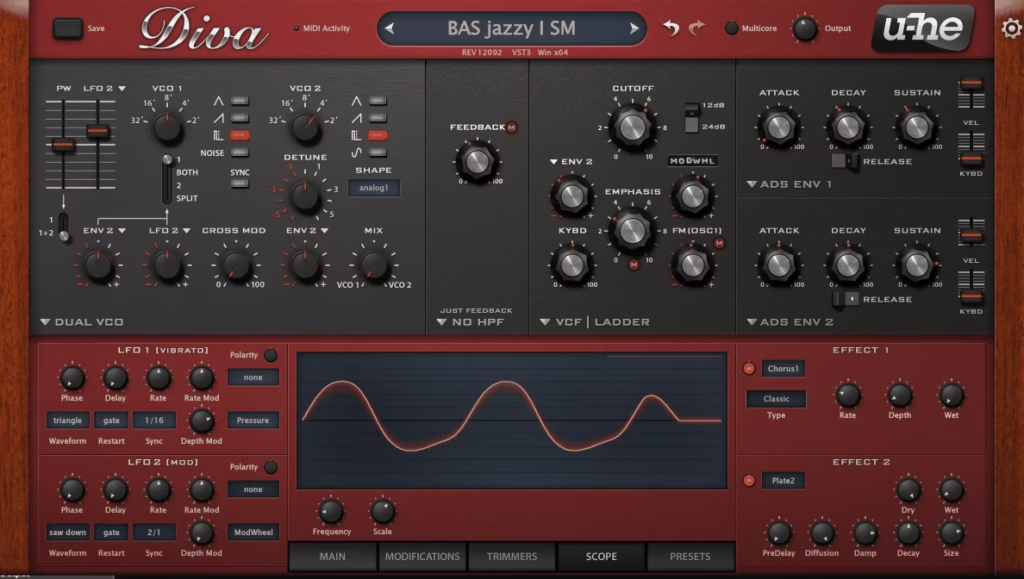
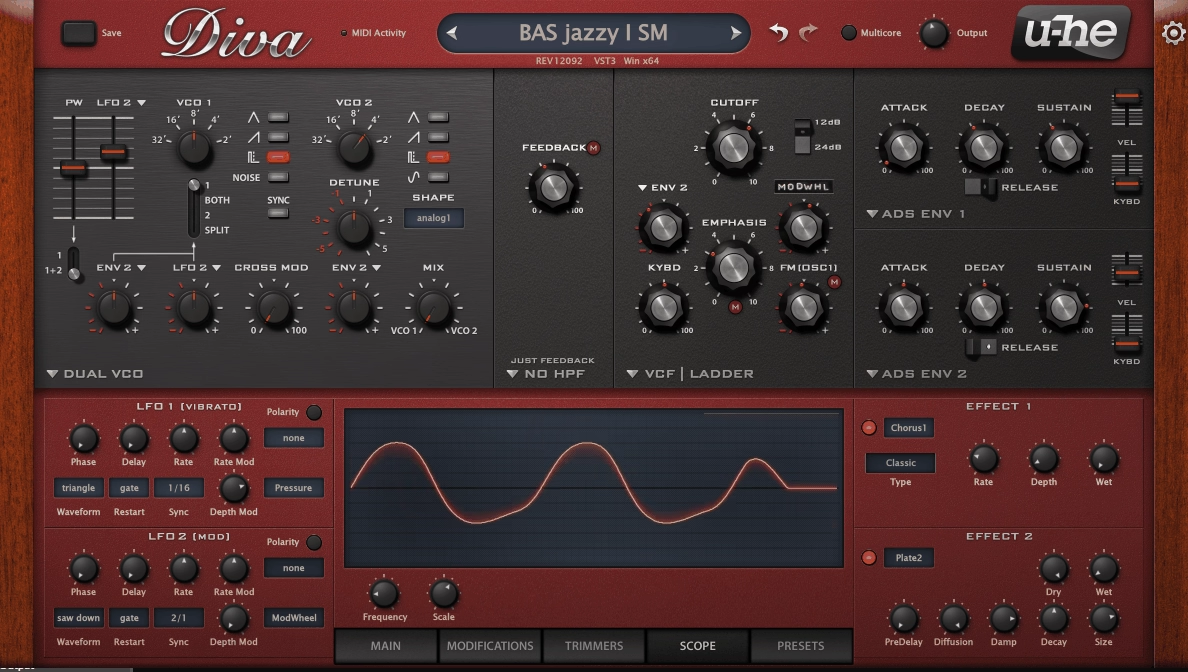
u-he Diva is one of those plugins that’s been sitting at the top of the analog-modeling soft synth conversation for over a decade, and honestly, it’s earned that position.
I’ve been using Diva on and off since it came out, and I keep coming back to it whenever I need something that genuinely sounds like an analog synth rather than just an approximation of one.
There are newer synths with flashier interfaces, deeper modulation systems, and more CPU-friendly performance out there. But very few of them sound as convincingly analog as Diva does when you push it hard.
The name itself is a bit of a joke that tells you everything about the philosophy. Diva stands for Dinosaur Impersonating Virtual Analogue, which is u-he’s way of acknowledging that this plugin is built around recreating the sound of vintage hardware synthesizers with a level of circuit-level accuracy that most developers don’t bother with.
What I mean is that u-he Diva models the zero-delay feedback behavior of analog circuits, the interactions between components, the way real oscillators drift and interact, and the specific nonlinearities of different filter types.
The result is a synth that genuinely feels different to play compared to most soft synths, because it responds to parameter changes the way hardware does rather than the way code usually does.
From the Pluginerds Store
One more thing before you finish reading: we also stock studio hardware and accessories directly through Pluginerds Shop. Microphones, interfaces, controllers, cables, and the small stuff that never comes included with anything.
Visit Pluginerds ShopIs Diva Worth the Money in 2026?
I’d say at sale price, it’s one of the best investments you can make if you want a synth that genuinely captures the feel of vintage analog hardware in your sessions. The longer answer depends on what you’re actually looking for.
If you want an analog-modeling synth that sounds authentically like a Minimoog, Juno, Jupiter, or Oberheim (and lets you mix and match components in ways no real analog synth could), Diva delivers that at a level most competing plugins can’t match.
I believe the value proposition is strongest for producers working in genres where analog character actually matters: house, techno, ambient, synthwave, film scoring, and anywhere you’d reach for classic analog hardware sounds.
If you’re producing modern pop, hip-hop, or electronic music that leans on cleaner digital sounds, you might get more practical use out of something like Serum 2 or Phase Plant for the price.
For me, Diva earns its money in two specific scenarios.
First, when you need basslines, leads, or pads with that unmistakable analog weight that digital oscillators just don’t replicate. Second, when you’re doing sound design and you want to explore the territory between different vintage synth architectures, like putting a Minimoog-style oscillator into a Roland-style filter with an Oberheim-style envelope, which is something no real hardware synth lets you do.
Get the Free Plugin Starter Kit
The genuinely useful free DAWs and plugins worth installing. No filler. Straight to your inbox.
What Makes Diva Different
Diva sits in a specific space that most soft synths don’t really occupy, and that’s where its value comes from. Most analog-modeling plugins take one of two approaches. They either emulate a specific piece of hardware in detail (like Arturia’s V Collection or Cherry Audio’s synths), or they build a generic analog-style synth that captures the general flavor without being tied to a particular model.
Diva does neither of those things exactly. Instead, it builds a modular analog synth where each component (oscillator, filter, envelope, etc.) is modeled after the specific behavior of a different classic hardware synth, and you can mix and match them freely.
Here’s what genuinely makes that different from other approaches:
- Circuit-Level Modeling:
Diva doesn’t just capture the sound of analog hardware, it models the actual circuit behavior including zero-delay feedback, component interactions, and the way signals respond to extreme settings. This is why Diva is CPU-hungry, because the math underneath is legitimately more complex than what most soft synths do.
- Multiple Oscillator Models:
Five different oscillator modules, each modeled after a different hardware reference (Minimoog-style triple VCO, Roland-style dual VCO, Juno-style DCO, Oberheim-style dual oscillator, and a digital option). You pick which one you want for each patch.
- Multiple Filter Models:
Five different filter models covering Moog-style ladder, Oberheim SEM-style, Roland-style cascade, and a bite filter. Each one has its own distinct character, and you can combine them with any oscillator module.
- Analog-Style Drift and Variation:
The oscillators genuinely drift and respond to parameter changes the way analog hardware does, which gives patches a sense of life and movement that’s hard to get from other soft synths.
- Great Sound Design Flexibility:
Because you can mix and match hardware references freely, Diva lets you build hybrid analog synths that couldn’t exist in real hardware, which opens up sound design possibilities that straight hardware emulations don’t.
I found that once you start building patches with this mindset, Diva feels less like a plugin and more like a modular analog setup you’re piecing together from vintage modules.
“Diva doesn’t just capture the sound of analog hardware, it models the actual circuit behavior.”
Oscillators and Filters
The core of Diva’s sound comes from the flexibility of its oscillator and filter modules, and this is where the plugin really differentiates itself from competitors. The oscillator section gives you five distinct modules to choose from, and each one genuinely sounds like what it’s emulating.
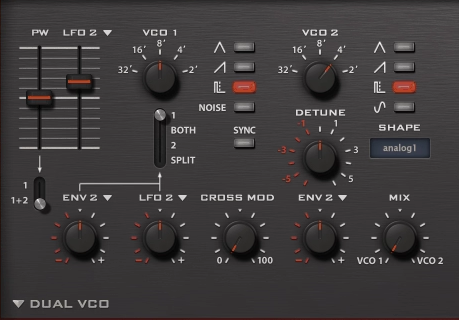
Triple VCO is the Minimoog-style oscillator, three VCOs with the specific drift and character of the original. Dual VCO models Roland-style oscillators with sync and cross-modulation options.
DCO captures the Juno-style digitally controlled oscillator with its characteristic stable pitch and noise-based chorus. Dual VCO Eco is a lighter CPU version of the dual oscillator model, useful when you need multiple instances running at once.
Digital is a more modern oscillator with wavetable-style options for when you want something outside the analog emulation territory. Each oscillator module has its own specific character that you can hear immediately when you switch between them with the same filter and envelope settings.
The Triple VCO has that fat, slightly unstable Minimoog quality. The DCO has the cleaner, more stable Juno sound with the characteristic chorus effect. The filter section is where Diva really flexes its modeling depth. Five filter models each capture the specific behavior of different vintage filter circuits:
- Ladder Filter:
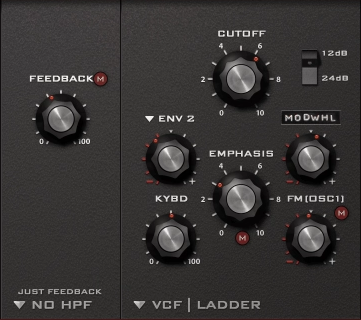
Modeled after the Minimoog’s ladder filter, with the characteristic warmth, resonance behavior, and subtle distortion when you push it hard.
- Cascade Filter:
Roland-style filter with a cleaner, more precise character than the ladder, useful for TB-303-style bass sounds and classic Roland leads.
- Multimode Filter:
Oberheim SEM-style state-variable filter with low-pass, high-pass, band-pass, and notch modes, with the specific resonance character of the SEM.
- Bite Filter:
A more aggressive filter option with sharper resonance and more character under drive, useful for edgy, in-your-face sounds.
- Uhbie Filter:
u-he’s own filter design that doesn’t emulate a specific piece of hardware but rounds out the filter options with its own character.
What makes this genuinely useful is that you can put any oscillator into any filter.
A Minimoog-style triple VCO through an Oberheim SEM filter isn’t something you can do with real hardware, but Diva lets you do exactly that, and the results are often musically interesting in ways you don’t expect.
Modulation and Envelopes
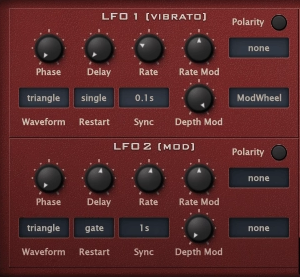
Diva’s modulation system is more traditional than some modern synths, but it’s deep enough to handle most sound design needs, and the quality of the modulation sources is part of why patches feel so alive.
You get two envelopes, two LFOs, and a modulation matrix that connects them to nearly every parameter in the synth. The envelopes come in three modeled flavors (ADS, Analog, and Digital), each with its own response curve and behavior.
The analog envelope in particular has the specific slightly-curved attack and decay shapes that analog hardware produces, which contributes to the organic feel of patches. I’ve found this to be one of those subtle things that you don’t notice on its own but that adds up to make Diva sound more convincingly analog across a whole mix.
The LFOs offer multiple waveforms including sine, triangle, saw, square, and sample-and-hold, with tempo sync and phase options. Each LFO can be used as a modulation source for any parameter through the modulation matrix, and you can also route audio-rate modulation for FM-style effects.
The modulation matrix is where you assign modulation sources to destinations, and while it’s not as visually flashy as some modern matrices, it handles what you need it to do without getting in the way. You can modulate oscillator pitch, filter cutoff, amplifier level, and pretty much any other parameter with any combination of envelope, LFO, velocity, aftertouch, modwheel, or keyboard tracking.
For me, the depth of the modulation is less about sheer feature count and more about how it feels in use. The modulation sources have the analog-style smoothness and response that matches the rest of the synth, which means modulation moves feel musical rather than digital.
Effects
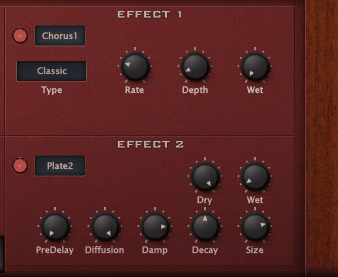
Diva includes a built-in effects section that’s more substantial than you’d expect from a synth that’s primarily about analog emulation, and I’ve found the quality of the effects genuinely holds up against dedicated effect plugins in a lot of situations.
You get five effect slots that can be freely assigned and routed, covering the core effect categories most producers need.
The effects are modeled with the same attention to analog character as the rest of the synth, so they don’t feel like digital afterthoughts bolted onto an analog synth.
Here’s what’s included in the effects section:
- Chorus:
You get a classic analog-style chorus with multiple modes ranging from subtle thickening to full-on vintage ensemble character. Particularly good on pads and strings where you want that specific Juno-style chorus quality without having to reach for a separate plugin.
- Phaser:
Analog-modeled phaser with adjustable stages and modulation depth, giving you that classic swirling analog phaser sound that works beautifully on pads, leads, and rhythmic patches.
- Plate Reverb:
Built-in plate reverb with a warm, musical character that sits nicely behind Diva patches without clouding the sound. Good for adding space without reaching for an external reverb plugin.
- Delay:
Stereo delay with tempo sync, feedback control, and filter options on the feedback loop. Covers everything from subtle slapback to longer dub-style delays with movement.
- Rotary:
It’s a Rotary speaker emulation that works surprisingly well for more than just organ sounds. Adding rotary movement to pads and leads gives them a sense of physical motion that static patches don’t have.
What I like about Diva’s effects is that they’re part of the signal path rather than just tacked on at the end.
You can route them in different orders, use them to color the sound before it hits other modulation stages, and build patches where the effects are integral to the character of the sound rather than just a polish step.
For producers who build patches from scratch and want to finish them within the synth rather than chaining external effects, the built-in section saves real time and CPU.
Sound Character
Here’s where Diva really earns its reputation, because the sound character is the main reason most producers buy it and keep coming back to it.
I’d describe Diva’s sound as warm, thick, and physically present in a way that most soft synths don’t quite achieve.
When you play a Diva bass through a decent monitoring setup, it has the weight and the sub-frequency content that makes you feel the note rather than just hear it. Leads have that cutting, harmonically rich quality that real analog synths produce when you drive them hard. Pads have the subtle movement and instability that comes from analog component drift, which keeps them from sounding static.
The filter behavior is particularly worth talking about. When you push Diva’s ladder filter resonance into self-oscillation, it behaves like real hardware with a specific saturation character rather than digital distortion.
When you sweep the filter, the response curve has that slightly nonlinear quality that analog filters produce, which adds musicality to filter sweeps that you don’t get from mathematically perfect digital filters. These are the kinds of details that cumulative add up to make a synth sound convincingly analog rather than just analog-ish.
I appreciate that Diva doesn’t try to be everything. It doesn’t do wavetable synthesis, granular processing, or complex FM the way some modern synths do.
What it does is analog emulation at a level most competitors can’t match, and it does that one thing exceptionally well. For a plugin that came out over a decade ago, the sound quality still holds up against newer competitors, which says a lot about how well u-he built it.
“Diva genuinely captures the feel of vintage analog hardware in a way most soft synths don’t quite match.”
Presets and Sound Library
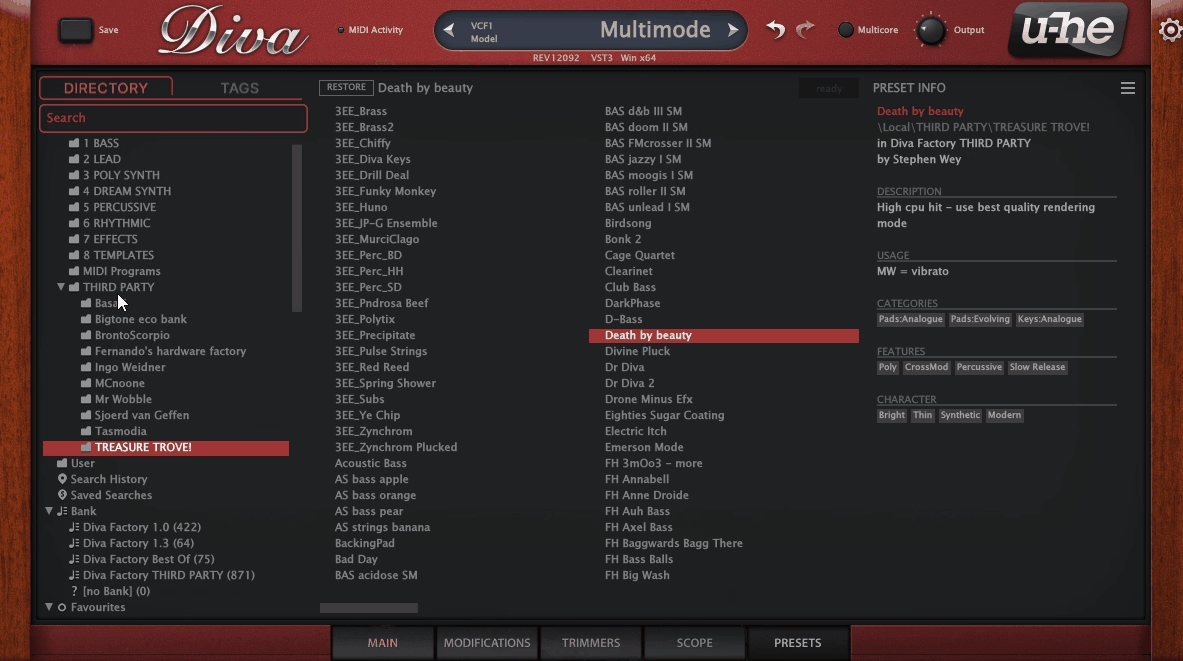
Diva ships with a solid factory preset library, and the u-he community has built up a huge third-party preset ecosystem over the years that’s genuinely worth exploring.
The factory presets cover the expected territory well: analog basses, leads, pads, plucks, brass, and effects.
Most of them are designed to showcase specific aspects of Diva’s character rather than being polished production-ready sounds, so they work well as starting points for your own sound design rather than as finished patches you drop into a track.
I’ve found the pads and evolving textures to be particularly strong in the factory library. Diva’s combination of analog drift, modulation depth, and filter character produces pads that have a sense of life and movement that makes them sit beautifully in a mix.
Here’s how the preset situation breaks down:
- Factory Library:
Several hundred factory presets covering analog bass, leads, pads, plucks, brass, strings, and effects. Good reference points for what Diva can do across different hardware emulation territories.
- Third-Party Soundsets:
A huge ecosystem of third-party preset packs from respected sound designers, covering everything from classic analog emulations to modern production-focused sounds. Many of these are available for $20-50 per pack and genuinely expand what Diva can do.
- User Community Presets:
Active user community sharing free and paid presets through u-he’s forums and third-party sites, which means you can always find fresh sounds if you want to extend the factory library.
- Preset Browser:
The built-in preset browser has tagging, search, and favorites functionality that makes it easier to navigate a large library once you’ve accumulated presets over time. If you’re the kind of producer who builds sounds from scratch rather than relying on presets, Diva rewards that approach because the architecture is deep enough to support real sound design.
If you prefer to start from presets and tweak, the combination of factory content and available third-party packs gives you plenty to work with.
More Info & Price: u-he Diva (Trial Available)
Get the Free Plugin Starter Kit
The genuinely useful free DAWs and plugins worth installing. No filler. Straight to your inbox.

Hello, I’m Viliam, I started this audio plugin focused blog to keep you updated on the latest trends, news and everything plugin related. I’ll put the most emphasis on the topics covering best VST, AU and AAX plugins. If you find some great plugin suggestions for us to include on our site, feel free to let me know, so I can take a look!