
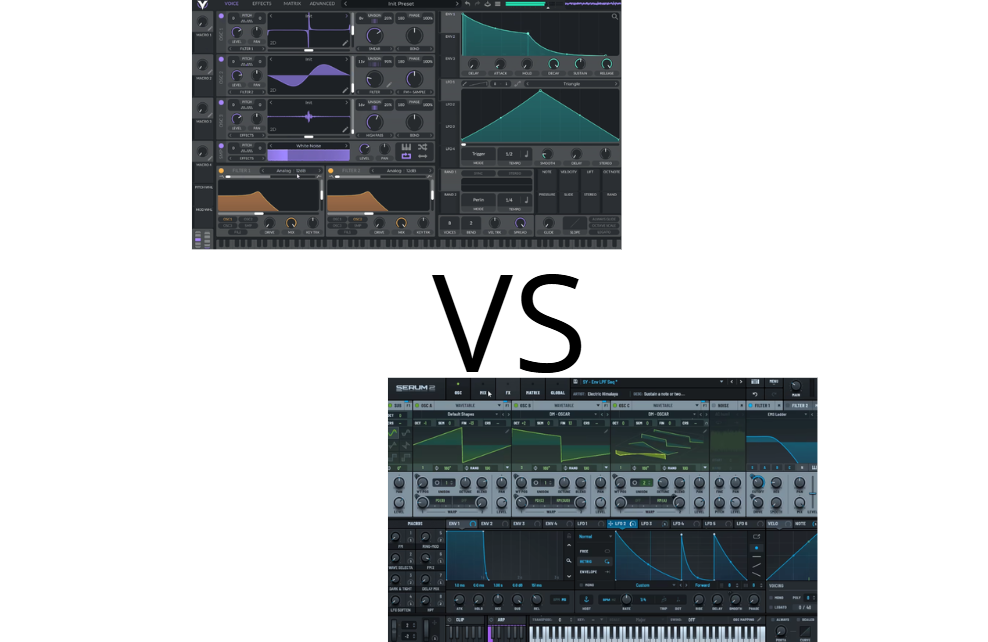
Every few years, a synthesizer arrives that shifts the conversation about what a software instrument should cost and what it should offer, and when Vital appeared in 2020 it did exactly that.
Matt Tytel released a free wavetable synthesizer with a visual modulation system, a genuinely excellent sound engine, and an interface that rivaled synths costing hundreds of dollars, and the reaction from the producer community was somewhere between enthusiasm and disbelief.
Here was something that could go note-for-note with Serum on a large proportion of electronic music sound design tasks, and the baseline version cost absolutely nothing.
Serum 2 lands in this context as both a response to the years of serious wavetable competition and as Steve Duda‘s own answer to what a modern version of his most influential instrument should be.
The upgrade from the original Serum is significant: new per-voice filters, new oscillator processing modes, Chaos modulation generators, improved stack controls, and a more capable effects chain. It builds on the foundation that defined electronic music production for a decade.
Vital is extraordinarily good for a free synthesizer, good enough to be a primary production instrument, and significantly closer to Serum in quality than its price difference suggests. Serum 2 is better in specific areas that matter to specific workflows, but the gap is smaller than the price gap implies, and for producers whose sound design doesn’t push the boundaries of what Vital offers, the upgrade isn’t necessarily justified.
Quick Comparison
| Feature | Xfer Serum 2 | Matt Tytel Vital |
|---|---|---|
| Developer | Xfer Records / Steve Duda | Matt Tytel (solo developer) |
| Price | ~$189 full; Splice rent-to-own ~$9.99/mo; upgrade from Serum 1 available | Free (Basic); Plus ~$25/yr; Pro ~$80/yr; perpetual Basic is free with no time limit |
| Synthesis Type | Wavetable (OSC A + B), Sub, Noise; new oscillator processing modes in S2 | Wavetable (OSC 1 + 2 + 3), Sub/Sample; spectral warp modes |
| Oscillator Count | 2 wavetable OSCs + Sub + Noise | 3 wavetable OSCs + Sampler/Sub |
| Filter Count | 2 per voice (new in S2); 30+ types | 2 per voice; extensive filter types including formant, comb, phaser |
| Modulation | Drag-and-drop; LFOs, envelopes, macros, MIDI, Chaos generators (new) | Drag-and-drop; LFOs, envelopes, macros, random, MIDI; visual modulation system widely praised |
| Effects Chain | 10-slot expanded chain: reverb, chorus, delay, distortion, EQ, compression, filter, phaser, flanger, multi-FX | 14 built-in effects: reverb, chorus, delay, distortion, EQ, compressor, phaser, flanger, filter, chorus, delay, bit crusher, stereo, formant filter |
| Wavetable Editor | Industry-leading visual editor; extensive import modes; new warp types in S2 | Capable visual editor; spectral analysis display; good import workflow |
| MPE Support | Yes, improved in S2 | Yes |
| Preset Ecosystem | Largest third-party preset library in software synthesis; inherits full Serum 1 library | Growing but significantly smaller; active community sharing; Vital-specific preset market expanding |
| CPU Efficiency | Good; more demanding than Serum 1 due to new per-voice filter and processing; still efficient by high-quality synth standards | Excellent; widely cited as one of the most CPU-efficient wavetable synthesizers available |
| Latest Update | Serum 2 (2024): per-voice filters, Chaos modulation, new oscillator processing, improved effects | Vital 1.5 with various improvements; development has been slower since initial release |
Get the Free Plugin Starter Kit
The genuinely useful free DAWs and plugins worth installing. No filler. Straight to your inbox.
Is Vital Still Relevant in 2026?
Yes, and significantly so. The concern that free software becomes irrelevant as paid alternatives advance is understandable but doesn’t fully apply here for a few reasons that are worth spelling out.
First, Vital’s synthesis engine was genuinely excellent from its initial release and hasn’t regressed. The wavetable engine quality, the three-oscillator architecture (one more than Serum’s two), the visual modulation system, and the effects chain were all competitive with paid synthesizers when Vital launched and remain so today.
Time doesn’t make a good synthesizer worse, and Vital’s capabilities haven’t deteriorated just because Serum 2 was released.
Second, the producer community around Vital has grown substantially since 2020. There are thousands of free and commercially available Vital presets, wavetable collections, and tutorial resources that didn’t exist at launch, and the cumulative effect of that community growth is that Vital now comes with significantly better accompanying resources than it did when it was new.
Many professional-quality Vital preset banks are available for free or at very low cost, narrowing the practical advantage of Serum’s larger ecosystem.
And third, Vital’s free tier is genuinely functional, not a crippled demo. The Basic free version gives you the full synthesis engine, the full modulation system, the full effects chain, and 75 preset slots, with the limitation being a smaller factory preset library and no Vital Online access for community preset browsing.
The paid tiers ($25/year for Plus, $80/year for Pro) add more factory presets and the online preset library access, but the synthesis capabilities themselves are unchanged from the free version. You’re paying for content and convenience, not for engine capability.
The area where Vital’s relevance is most legitimately questioned is in its update cadence: Matt Tytel is a solo developer, and Vital’s update frequency has been notably slower than what Xfer has delivered with Serum 2. There are features that competing synthesizers have added since Vital’s launch that haven’t made it into Vital’s update cycle. Whether those specific features matter to your production workflow determines how much this concerns you.
Sound Design
- Serum 2
Serum 2’s sound design capabilities build on the original Serum’s foundation and add meaningful new depth in specific areas. The most significant additions for sound design are the new oscillator processing modes, which give you wavefolding, new FM configurations, and ring modulation directly at the oscillator stage before the signal reaches the filter.
This means you can now process the wavetable content at the source rather than relying entirely on filter and effects processing to add harmonic complexity, which changes the character of sounds built in Serum 2 in subtle but real ways.
The Chaos modulation generators are a genuinely new addition to Serum’s toolset: nonlinear modulation sources that produce complex, unpredictable output with a character that ranges from smooth and wandering to erratic and glitchy depending on how you configure them.
For sound designers who want organic variation in patches without manually building complex multi-source modulation chains, the Chaos generators provide a class of behavioral complexity that wasn’t available in the original Serum.
The new per-voice filter (Serum 2 now has two filters per voice rather than one global filter) opens up sound design options where different oscillators can be filtered independently before they mix, creating sounds where the harmonic content of each oscillator is shaped differently before combining.
This is architecturally meaningful for complex layered sounds where you want textural differentiation between oscillator sources.

- Vital
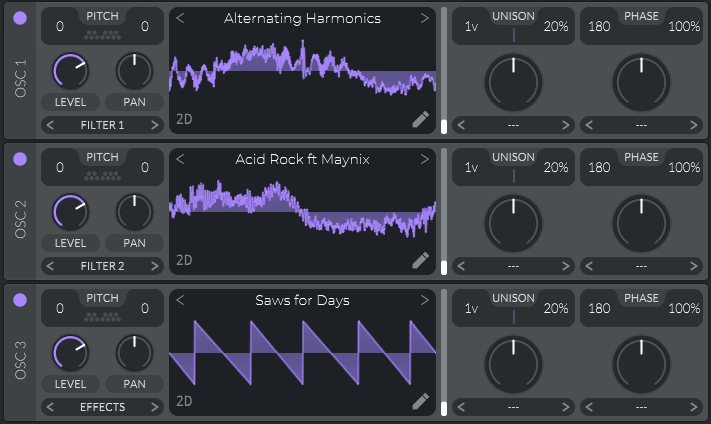
Vital’s sound design capability is centered on its three full wavetable oscillators (compared to Serum’s two) and the spectral warp modes that process the oscillator output in the frequency domain before it reaches the filter.
Vital’s spectral morphing capability lets you blend between different spectral shaping algorithms in real time using modulation, which creates animated, shifting timbral changes that feel different from what standard wavetable position modulation or filter modulation achieves.
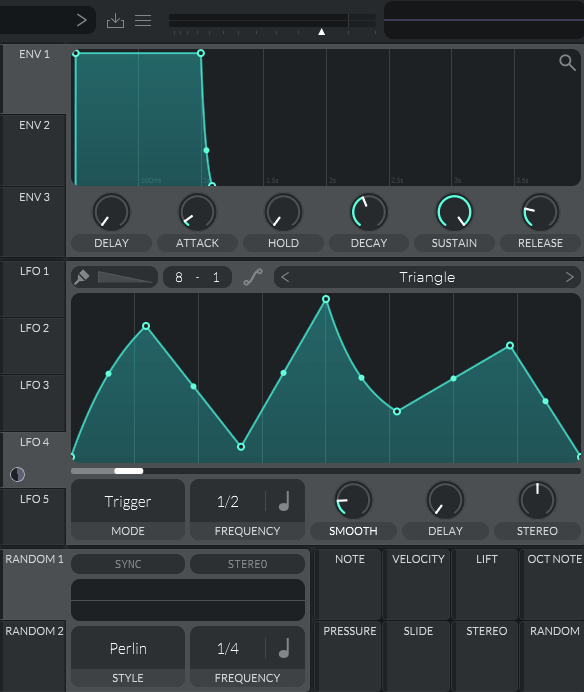
The visual modulation system in Vital is one of its most celebrated features and influences how producers approach modulation patching in the instrument: every modulation connection is displayed as a colored curve in the modulation target’s display, with the amount and phase of modulation visible at a glance across the interface.
This visual feedback makes it much easier to understand what a complex patch is doing without opening separate modulation matrix windows, and it encourages more experimental patching because the results are immediately legible.
Vital’s third oscillator gives you a meaningful advantage in layered sound design: running three independent wavetable sources simultaneously through separate modulation paths before mixing gives you more internal complexity within a single patch than Serum 2’s two-oscillator architecture allows without stacking multiple instances.

Sound Character
- Serum 2
Serum’s sonic character is clean, detailed, and precise, with a brightness and clarity that has become associated with a specific era and style of electronic music production. The anti-aliasing and oversampling in Serum have always been among the best in any wavetable synthesizer, producing a high-frequency extension that stays smooth and artifact-free even at the extremes of wavetable position modulation.
This precision is part of what makes Serum sounds sit so naturally in dense electronic music mixes: they have a clarity that doesn’t require extensive post-processing to cut through.
Serum 2’s new oscillator processing modes add some additional tonal character options at the source level, giving you more harmonic richness without the full transparency of the base wavetable sound.
The new warp modes can produce more aggressive, distorted timbres directly from the oscillator before any filtering, which gives Serum 2 more of a character range at the oscillator level than the original had.
- Vital
Vital’s character is warm, somewhat denser in the low-mids, and slightly less analytically bright than Serum at equivalent settings, which many producers describe as a pleasant difference that makes Vital patches feel slightly fuller and less clinical.
The specific character of Vital’s oscillator output, which some engineers attribute to differences in oversampling and anti-aliasing approach between the two instruments, means that similar wavetables processed similarly in both synths can produce subtly different results in a mix context.
The spectral warp modes give Vital a particular ability to generate smooth, harmonically complex timbres through frequency-domain processing that feels distinctly different from both standard filter processing and straightforward wavetable position morphing. This mid-range frequency richness is part of what makes Vital pads and ambient textures feel thick and immediate even at moderate settings.
Genre Fit
- Serum 2
Serum’s genre associations are the deepest of any software synthesizer in electronic music, and Serum 2 inherits all of them. Future bass, dubstep, trap, EDM, and commercial pop production has used Serum as a primary instrument for most of the past decade, and the specific sounds, techniques, and design approaches of those genres are baked into the instrument’s enormous preset ecosystem.
If you’re working in any of those styles and you want to use sounds that professional producers in those genres are actively building from, Serum 2 is the instrument with the community and library to support that immediately.
Cinematic and trailer music production has adopted Serum extensively for hybrid electronic textures, particularly the kinds of evolving atmospheric pads and tension sounds that the instrument’s modulation system and effects chain can generate.
Drum and bass, garage, and UK bass music production has strong Serum associations through specific preset aesthetics that have become genre-defining sounds. Lo-fi and chill-hop production uses Serum for warm, slightly filtered melodic elements that sit in the specific frequency space those genres occupy.
- Vital
Vital’s genre associations have developed more organically from its community base than from any specific marketing or artist alignment. Lo-fi, bedroom pop, ambient, and experimental electronic music has adopted Vital significantly, partly because the instrument’s warm character suits those aesthetics and partly because the free price made it accessible to producers in those communities who were building small studios on minimal budgets.
The specific warmth and density of Vital’s pads make it particularly well-suited to atmospheric electronic production.
Future bass and EDM producers have adopted Vital as an alternative to Serum for many of the same sound design tasks, and the overlap in sonic territory between the two instruments at these genres is substantial enough that experienced listeners often can’t distinguish Vital patches from Serum patches in blind comparisons at equivalent quality levels.
Synthwave, vapor, and retrowave production has found Vital particularly useful because its oscillator character and filter options suit the specific analog-warm aesthetic of those genres well, and the community around those styles has developed a strong Vital preset ecosystem that supports new producers coming in.
Wavetable Engine Compared
- Serum 2
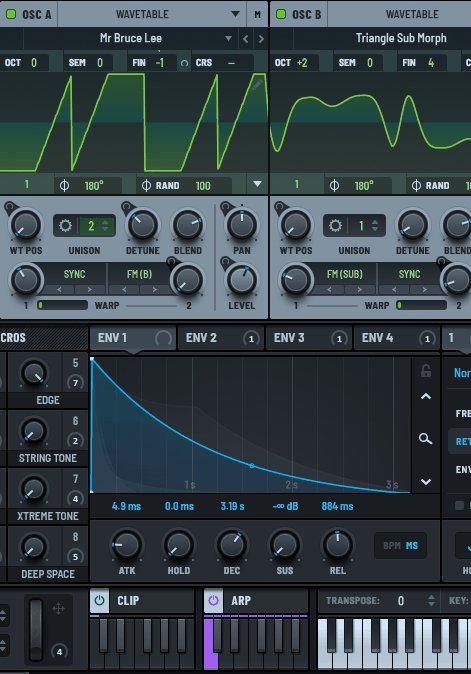
Serum’s wavetable editor remains the most detailed and precise visual interface for wavetable design in any commercial synthesizer. The frame-by-frame display of the waveform with harmonic spectrum analysis, the multiple import algorithms for different source material types, and the extensive warp mode options for processing the table in real time make it the reference implementation for visual wavetable design.
Sound designers who build custom wavetables from scratch treat Serum’s editor as the standard because the visual feedback is so detailed and the tools are so specific.
The new warp modes in Serum 2 expand the oscillator processing options significantly: new distortion types, wavefolding, and ring modulation at the oscillator stage give you more ways to modify the table before filtering, and these process the waveform in ways that are predictable and visualizable in the editor.
The improved Stack controls for unison give you more specific control over how multiple voices are distributed in pitch and stereo space, which matters enormously for the big supersaw leads and wide pad textures that define much of Serum’s commercial use.
- Vital
Vital’s wavetable engine is strong and competitive but not quite at Serum’s level of visual detail in the editor.
The waveform display is clear and the spectral analysis is useful, but the import workflow and the range of analytical tools available in the editor don’t fully match Serum’s depth for producers who want to build and edit wavetables from scratch with precise control. For producing and performing with existing wavetables, the difference is minimal; for deep custom wavetable creation, Serum’s editor remains more capable.
What Vital’s wavetable engine offers that partially compensates is the spectral warp processing at the oscillator output stage, which operates in the frequency domain on the wavetable output rather than on the waveform itself.
This creates a different class of timbral shaping than the standard warp modes, producing spectral morphing effects where the energy distribution across harmonics changes in ways that standard filter processing can’t replicate.
Modulation and Routing
- Serum 2
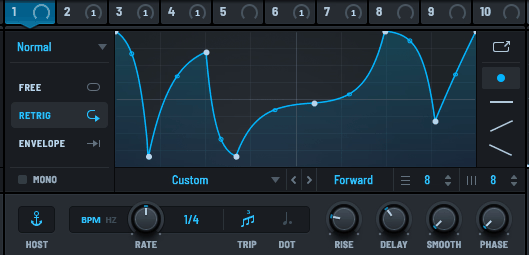
Serum’s modulation system is clean and well-established, and Serum 2 adds the Chaos modulation generators as new sources that didn’t exist in the original. The drag-to-assign workflow, where right-clicking any knob or parameter exposes an assignment menu with every available modulation source listed, is fast and reliable.
The modulation indicators on assigned parameters show you at a glance where active modulation is connected, and the modulation matrix view gives you a list of all active connections for reference.
The Chaos generators produce nonlinear, complex modulation behavior that’s difficult to achieve through conventional LFO and envelope routing: smooth flowing variation, rhythmic pulsing, and genuinely unpredictable parameter movement are all available at different settings.
For producers who want patches that feel organic and variable rather than exactly repeatable, Chaos adds a meaningful layer of behavior complexity.
The four macro knobs function as the primary performance control system: you assign any parameters you want to control in real time to the macros with independent amount settings, and they work well for building playable patches where a single knob adjusts multiple aspects of the sound simultaneously.
- Vital
Vital’s modulation system is the feature that most distinguishes it from its competitors, and the visual feedback approach is genuinely more informative than Serum’s at a glance. When you connect a modulation source to a destination in Vital, a colored animation appears in the destination’s knob display showing the actual modulation movement in real time: the knob’s visual indicator sweeps through the modulation range as the LFO cycles, giving you immediate visual confirmation that the modulation is working as intended and letting you see its speed and depth without any additional clicks.
This visual approach was influential enough that it shaped how subsequent synths thought about modulation display, and it remains one of the most effective solutions to the “what is this patch doing?” problem that complex modulation routing creates. Learning to read a Vital patch’s modulation state from its interface is faster than learning to read the same information from Serum’s parameter indicators.
Vital also supports modulation of modulation: you can use one LFO to modulate the rate of another LFO, or use an envelope to modulate the depth of an LFO, which creates evolving, changing modulation behavior over time. The number of simultaneously available LFOs and envelopes in Vital gives you more modulation sources per patch without hitting limits than some competing synthesizers.
Built-in Effect Plugins
- Serum 2
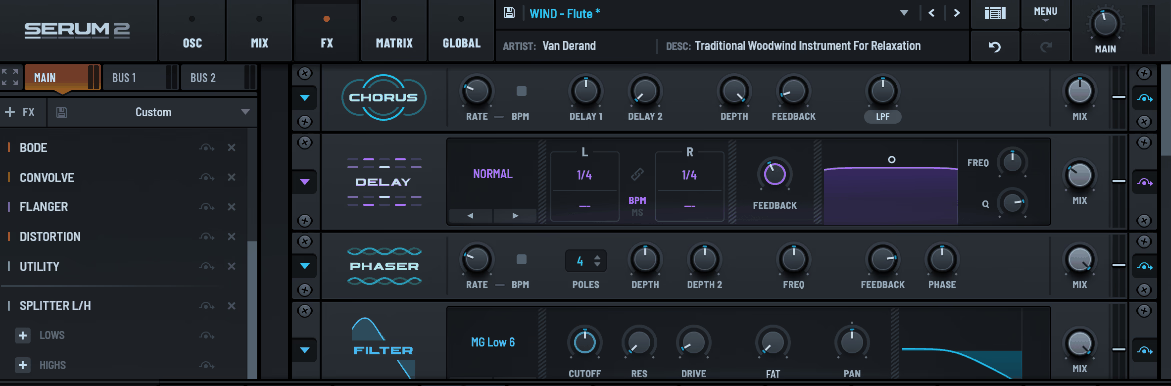
Serum 2 improved its effects section significantly from the original Serum, which had a capable but relatively basic effects chain. The new version covers: reverb, chorus, delay, distortion, EQ, compressor, filter, phaser, flanger, and a multi-effect module that covers additional processing options.
The quality of individual effects has improved across versions, with better reverb algorithms and more flexible distortion and compression options that make the effects chain more useful for finishing sounds within the synthesizer.
The effects work well for producing sounds that are ready to place in a mix without requiring extensive external processing, and the reverb in particular has a specific quality that works well for the atmospheric pads and ambient textures that Serum is commonly used for.
The serial routing of the effects chain applies processing in the slot order, which is straightforward to manage and predictable in behavior.
- Vital
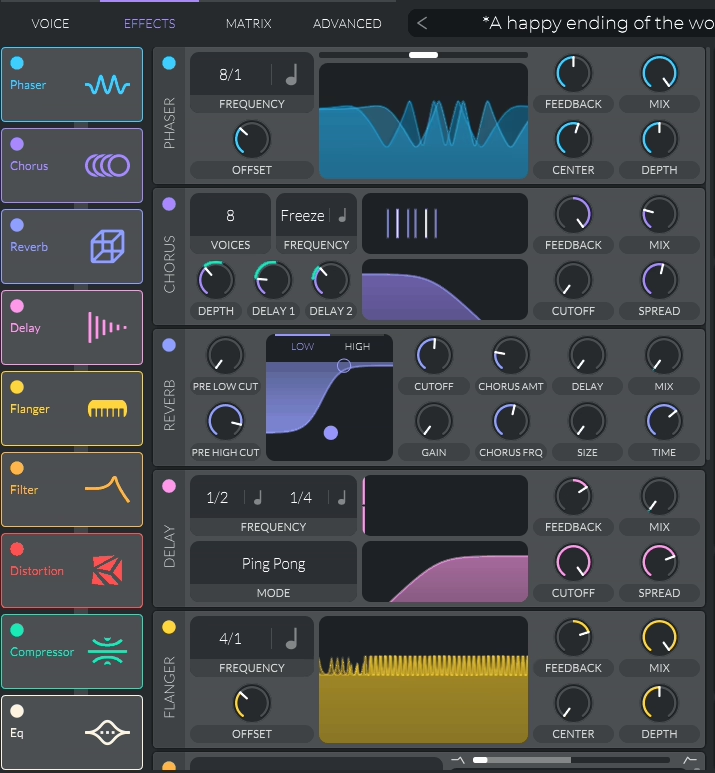
Vital’s 14 built-in effects technically exceed Serum’s count, and the variety of options within the chain is genuinely broad: in addition to the standard reverb, chorus, delay, and distortion, Vital includes bitcrusher, stereo spread, and a formant filter as dedicated effects slots that Serum doesn’t match in the same form.
The formant filter effect in particular gives you vowel-like resonant shaping as a post-synthesis effect that has interesting applications for vocal-like pad textures and animated harmonic shaping.
The reverb quality in Vital is highly regarded for a free synthesizer: the algorithm produces a smooth, dense decay that works well for ambient and pad textures without obvious digital artifacts. Some producers describe Vital’s reverb as having a warmth that complements the synthesizer’s overall character particularly well.
Vital also allows modulation of effects parameters using the main modulation system, so you can route an LFO to reverb size, an envelope to distortion drive, or a Macro to chorus depth, giving the effects chain the same dynamic modulation capability as the synthesis parameters.
This integration between the modulation system and the effects chain makes Vital a more cohesive instrument: the effects feel like part of the synthesis environment rather than a separate processing stage.
Free vs Paid Value: Vital Advantage
This is the section that matters most for producers who are deciding between investing in Serum 2 or building their workflow around Vital.
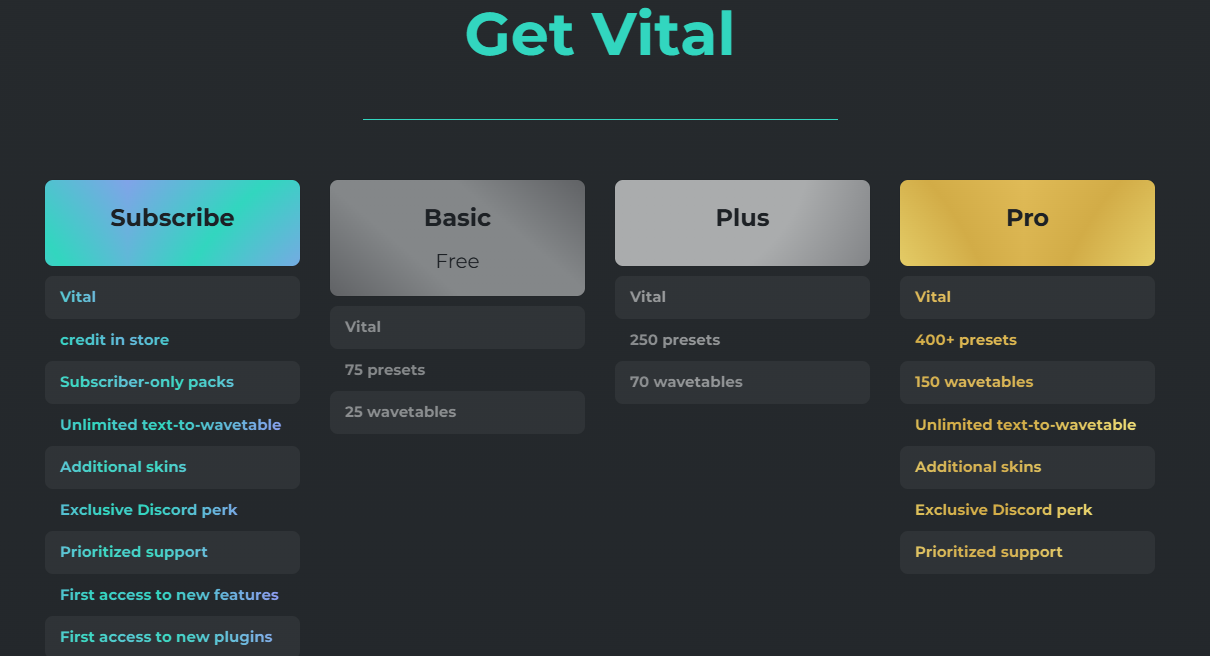
Vital’s free tier is one of the most compelling value propositions in all of music software. You get the full synthesis engine, the full three-oscillator architecture, the full modulation system, the full effects chain, and unlimited project use without any time limit, watermark, or audio interruption.
The only limitation is a smaller preset library (75 presets versus thousands in the paid tiers) and no Vital Online access for community preset browsing.
For a producer starting from scratch with no existing plugin investment, this means you can build a genuinely professional wavetable synthesizer workflow without spending any money on a synthesizer at all. The skills you develop in Vital’s modulation system, wavetable editor, and effects chain are directly applicable and transferable to any other wavetable synthesizer if you later upgrade, because the fundamental concepts are the same.
The Vital Plus tier at approximately $25/year is an extraordinary value if you want more preset content: it adds significantly more factory presets, the online preset library access, and additional wavetable content for a price that’s a small fraction of Serum 2’s cost.
Serum 2’s value proposition is strongest for producers who have existing investment in the Serum ecosystem: the original Serum’s enormous preset library, the custom wavetables collected over years, the workflow familiarity built up across many production sessions, and the specific character of Serum’s sound that has become part of their production identity.
For those producers, the upgrade from Serum to Serum 2 makes clear sense because the new features meaningfully expand an existing toolkit rather than requiring investment in something entirely new.
For a new producer choosing between “free Vital” and “paid Serum 2,” the honest answer is to start with Vital, develop your synthesis skills and production workflow, identify specific limitations that Vital creates for what you’re trying to make, and then evaluate whether Serum 2 addresses those specific limitations before spending $189.
Many producers who go through that process find that Vital covers their needs completely. Some find that the preset ecosystem, specific oscillator processing options, or workflow differences in Serum 2 are worth the investment. Both outcomes are legitimate.

Preset Ecosystem and Community
- Serum 2
Serum 2 inherits the largest third-party preset ecosystem of any software synthesizer in electronic music. Over the decade since Serum’s original release, thousands of commercial preset banks have been created for the instrument covering every sub-genre of electronic music, every sound category from basses and leads to pads and plucks, and every style from cinematic to club-ready.
The breadth of this ecosystem means that whatever specific sound or genre territory you’re working in, there’s almost certainly professionally designed Serum preset content that covers it.
The wavetable sharing community around Serum is similarly extensive: custom wavetables built by sound designers worldwide are available through multiple platforms, and the standard Serum wavetable format has been adopted broadly enough that new wavetables continue to appear regularly.
When you buy Serum 2, you’re not just buying the synthesizer: you’re buying access to the most extensive third-party content library available for any individual software synthesizer.

- Vital
Vital’s preset community has grown substantially since launch but remains significantly smaller than Serum’s. The free price point and the quality of the instrument have attracted active community development, and both commercial and free Vital preset banks are increasingly available through the major plugin stores and directly through the Vital Online service.
The Vital Online browser, accessible with paid tiers, lets you search and download community-shared presets directly from within the synthesizer, which is a convenient discovery mechanism.
The practical gap between Vital’s and Serum’s preset ecosystems depends on how you use preset content: if you primarily build your own sounds from scratch, the preset library size matters much less than the synthesis capabilities. If you rely on commercially produced preset banks as the foundation of your sound design, Serum’s larger ecosystem is a meaningful practical advantage.

Latest Offerings and Updates
- Serum 2
The transition from Serum to Serum 2 represents the most significant update the instrument has received since its 2014 launch, and the specific additions are all meaningfully functional rather than cosmetic: the per-voice filter, Chaos modulation generators, new oscillator processing modes, improved Stack controls, and the enhanced effects chain all expand what the instrument can do in ways that affect actual sound design rather than just interface aesthetics.
Steve Duda has indicated that Serum 2’s new technical foundation is designed to support future feature additions more easily than the original codebase allowed, suggesting that ongoing development is planned. The commercial success of Serum gives Xfer strong incentive to continue developing the instrument actively.
- Vital
Vital’s update history has been slower than Serum’s, which is a predictable consequence of having a single developer compared to a company with dedicated development resources. The updates that have arrived have added meaningful features and improvements to stability and compatibility, but the pace of feature additions has been notably more incremental than Serum’s trajectory.
The Vital Online service continues to be developed with new community content, and the preset ecosystem grows independently of the software’s own update cadence as the community continues creating. But for new synthesis features and capabilities, the update timeline is less predictable than a commercial product with a full development team.
CPU Performance
- Serum 2
Serum 2 is somewhat more CPU-demanding than the original Serum, primarily because of the new per-voice filter processing and the more complex oscillator processing modes. The original Serum was notable for its CPU efficiency relative to its quality, and Serum 2 maintains solid efficiency while adding meaningful new capabilities, remaining within the range of practical for running multiple simultaneous instances in a typical production session on any modern computer.
The new oscillator processing modes and Chaos modulation have some computational overhead, but the overall performance remains good: most producers describe running four to eight simultaneous Serum 2 instances in a session as achievable without significant performance issues on current hardware.
- Vital
Vital is consistently described as one of the most CPU-efficient wavetable synthesizers available, which is a remarkable achievement given the quality of its synthesis engine. The fact that a free instrument can run many more simultaneous instances than Serum 2 on the same hardware is a practical advantage that matters particularly for producers who run dense arrangements with many synthesizer parts playing simultaneously.
The three-oscillator architecture might be expected to be more CPU-demanding than Serum’s two-oscillator approach, but Vital’s optimized code means it typically performs comparably to or better than Serum 2 at equivalent polyphony settings. For producers on older or less powerful computers, Vital’s efficiency advantage is even more significant.
Learning Curve
- Serum 2
Serum has always had one of the best learning curves of any professional synthesizer, and Serum 2 maintains that accessibility while adding new depth for experienced users. The signal flow is logical and linear: oscillators go through filters, filters go through effects, and the modulation matrix connects sources to destinations in a predictable way.
The new features in Serum 2 follow the same interface conventions as the original, so producers familiar with Serum find the upgrade intuitive.
The enormous resource library around Serum, including years of YouTube tutorials, written guides, and preset annotations, makes learning Serum’s specific approach faster and more supported than almost any other synthesizer. If you have a specific question about a Serum technique or sound design approach, the answer has almost certainly already been documented somewhere accessible.
- Vital
Vital’s visual modulation system makes it one of the more accessible synthesizers for producers who are new to modulation-centric sound design.
The fact that you can see modulation happening in real time on every assigned parameter removes a significant cognitive barrier: you can watch the LFO moving a filter cutoff rather than inferring it from the sound, which makes the relationship between modulation routing and sound change much more immediate and teachable.
The preset annotations in Vital explain what specific modulation connections and synthesis choices achieve, which makes opening existing patches an educational experience as well as a starting point for editing. For producers who learn by exploring and modifying existing sounds, Vital’s interface makes that process particularly transparent.
The smaller tutorial resource library compared to Serum means that very specific Vital sound design questions may not have ready-made answers, but the fundamental synthesis concepts are universal enough that Serum tutorials often apply directly to the equivalent Vital workflow.
Which Synth Is More Relevant in 2026?
Both, in different contexts, and being specific about those contexts is more useful than declaring a winner.
Serum 2 is more relevant if you’re working in commercial EDM, future bass, trap, or any genre where the Serum preset ecosystem’s depth gives you immediate access to sounds that professional producers in those genres are actively using.
The specific character of Serum’s wavetable engine, the depth of the custom wavetable editor, and the Chaos modulation generators all contribute to a synthesis environment that’s ahead of Vital in specific technical dimensions.
For producers who have invested in the Serum ecosystem through preset banks, custom wavetables, and workflow familiarity over many years, Serum 2’s upgrade is the natural continuation of that investment.
Vital is more relevant if you’re building a production setup from a budget constraint, if CPU efficiency matters for your hardware situation, if the three-oscillator architecture or Vital’s specific spectral warp modes suit your sound design approach better, or if you’re a new producer who wants to develop synthesis skills on a high-quality instrument without an upfront financial commitment.
The fact that Vital is genuinely competitive with Serum at the level of synthesis quality makes it relevant not just as a budget option but as a primary instrument for producers who simply prefer how it sounds and works.
For the majority of producers who don’t have the time or inclination to deeply compare synthesis engines and are looking for a practical recommendation: if you have no existing Serum investment and you’re not immediately working in a genre where the Serum preset ecosystem is critical, start with Vital.
Learn the synthesis fundamentals, develop your sound design workflow, build a production history. Then evaluate Serum 2 based on specific limitations you’ve identified rather than on theoretical feature comparisons.
The Bottom Line
Serum 2 is the more capable instrument in specific technical dimensions: the wavetable editor depth, the Chaos modulation generators, the per-voice filter architecture, the new oscillator processing modes, and the largest preset ecosystem in software synthesis all represent genuine advantages for producers who need what those specific features provide.
It’s the better professional choice for commercial EDM and bass music production where the Serum ecosystem’s depth matters, and for experienced sound designers who want the most precise wavetable design tools available.
Vital is genuinely remarkable for what it offers at no cost, and it remains relevant in 2026 not as a Serum substitute but as a primary instrument in its own right. Three wavetable oscillators, an excellent visual modulation system, competitive effects, spectral warp processing, and outstanding CPU efficiency form a synthesis toolkit that’s worthy of professional use regardless of its price.
For new producers, for budget-constrained studios, for producers on older hardware, and for anyone who simply prefers Vital’s warmer character and visual modulation approach, it’s not a compromise choice: it’s a legitimate primary synthesizer.
The most practical answer for most producers is that you can have both: Vital for free as your primary wavetable instrument, and Serum 2 as a targeted investment for the specific preset ecosystem and synthesis depth it adds, purchased when your production direction specifically calls for what Serum 2 uniquely provides. That combination gives you more synthesis capability than either instrument alone at a total cost that’s reasonable for a serious studio investment.
Check here: Xfer Recordings Serum 2
Check here: Matt Tytel Vital
Get the Free Plugin Starter Kit
The genuinely useful free DAWs and plugins worth installing. No filler. Straight to your inbox.

Hello, I’m Viliam, I started this audio plugin focused blog to keep you updated on the latest trends, news and everything plugin related. I’ll put the most emphasis on the topics covering best VST, AU and AAX plugins. If you find some great plugin suggestions for us to include on our site, feel free to let me know, so I can take a look!