
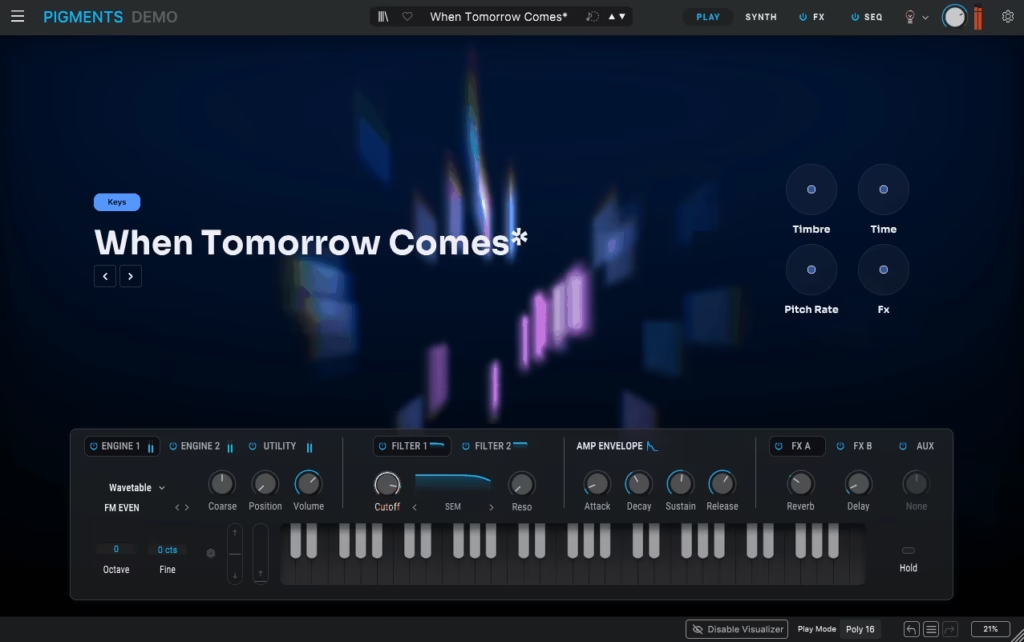
If you spend any amount of time in synthesizer communities, you’ll notice that Arturia Pigments and Xfer Serum have occupied adjacent positions in the modern software synth conversation for several years now, both celebrated, both capable of producing the same broad categories of sound, and both frequently recommended to producers who want a single synth that can do essentially everything.
With the arrival of Serum 2, that conversation has a new chapter, and the comparison between these two instruments deserves a thorough look because they’re making fundamentally different arguments about what a modern software synthesizer should be.
Arturia Pigments argues for breadth and integration: it’s a multi-engine synth that combines wavetable, virtual analog, sample, granular, and harmonic engines into a single instrument with a visual modulation system and a deep effects rack, built by a company with a strong background in hardware modeling and instrument design.
Serum 2 argues for refinement, community, and a specific kind of workflow efficiency: it builds on the original Serum’s extraordinary wavetable engine and massive preset ecosystem with significant improvements to its oscillator processing, modulation depth, and effects chain, refined specifically for the kind of sound design work that made the original Serum the most widely used wavetable synthesizer in electronic music production.
Quick Comparison
| Feature | Arturia Pigments 5 | Xfer Serum 2 |
|---|---|---|
| Developer | Arturia (Grenoble, France) | Xfer Records / Steve Duda (Los Angeles, CA) |
| Synthesis Engines | Wavetable, virtual analog (VA), sample, granular, harmonic; two independent engines running simultaneously | Wavetable (OSC A and B); sub-oscillator; noise oscillator |
| Oscillator Count | 2 main engines (each with multiple oscillators), plus 2 utility engines (func and sample) | OSC A, OSC B, Sub, Noise |
| Modulation System | Visual drag-and-drop: unlimited LFOs, envelopes, function generators, MIDI sources, macro knobs, randomize | Drag-and-drop modulation matrix: LFOs, envelopes, macros, MIDI, Chaos generators (new in S2) |
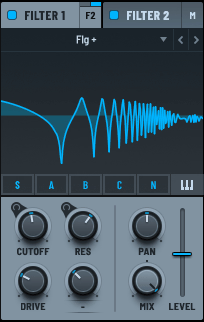
| Filters | 3 simultaneous filters with extensive routing options; 50+ filter types including ladder, SEM, Comb, Formant | 2 filters per voice (new in S2); 30+ filter types |
| Effects Rack | Extensive built-in effects: reverb, chorus, delay, EQ, compressor, distortion, multiband, vocoder, flanger, phaser, and more; 3 FX chains | 10-effect chain (expanded in S2): reverb, chorus, delay, distortion, EQ, compression, filter, phaser, flanger, multi-FX |
| Arpeggiator / Sequencer | Arpeggiator + step sequencer with pitch, velocity, chord, and modulation lanes | Arpeggiator with updated controls in S2 |
| Wavetable Import | Yes, plus wavetable creation from audio files | Yes, with extensive wavetable editor; industry-standard for custom WT import and creation |
| Preset Library | 1,000+ factory presets; extensive third-party library growing | Industry-leading factory presets; largest third-party preset ecosystem in any software synth |
| MPE Support | Yes | Yes (improved in S2) |
| Pricing | ~$99-$199 full; included in Arturia V Collection; available via Arturia subscription | ~$189 full; upgrade from Serum 1 available; subscription option through Splice |
| Free Trial | Demo available (output noise limitations); Arturia subscription trial | Demo available through Xfer; Splice rent-to-own with monthly payments |
Get the Free Plugin Starter Kit
The genuinely useful free DAWs and plugins worth installing. No filler. Straight to your inbox.
About Arturia Pigments
Arturia Pigments is the French company’s flagship software synthesizer, built from the ground up as a modern multi-engine instrument rather than an emulation of specific vintage hardware.
While the rest of Arturia’s catalog is dominated by painstaking recreations of classic synths like the Minimoog, Prophet-5, CS-80, and Buchla, Pigments exists in a different category: it’s Arturia’s original instrument, designed to bring together multiple synthesis approaches in a single, visually cohesive environment that lets you combine them freely.
The philosophy behind Pigments is that any given sound design problem should be solvable within the instrument without reaching for additional plugins. The two main synthesis engines can each run one of five types (wavetable, virtual analog, sample, granular, or harmonic), and routing their outputs through three simultaneous filters with extensive signal flow options gives you a sound design flexibility that most single-engine synths can’t match.
Arturia’s visual modulation system, where you drag a source onto a destination and see colored indicators showing what’s modulated and by how much, makes the modulation routing process more intuitive than the matrix systems that some other synths use.
Pigments has gone through several major version updates since its initial release, each adding new engine types, filter options, effects modules, and workflow improvements.
The current version includes the Harmonic engine (an additive synthesis approach where you draw the spectral content of a sound directly), the Sample engine (a sophisticated sampler with granular and looping capability built into the synth itself), and expanded effects routing with separate send chains for pre- and post-filter processing.

About Xfer Serum 2
Serum needs very little introduction in the modern production world because it became the reference wavetable synthesizer for electronic music production in the years following its 2014 release.
Steve Duda’s instrument was built with a specific set of priorities that turned out to match what a generation of producers actually needed: an extremely high-quality wavetable engine with visual waveform editing, a capable modulation system, a solid effects chain, and a workflow that made sound design fast and legible.
The original Serum’s wavetable display showing you exactly what the oscillator is doing in real time was a design insight that influenced every wavetable synth that followed.
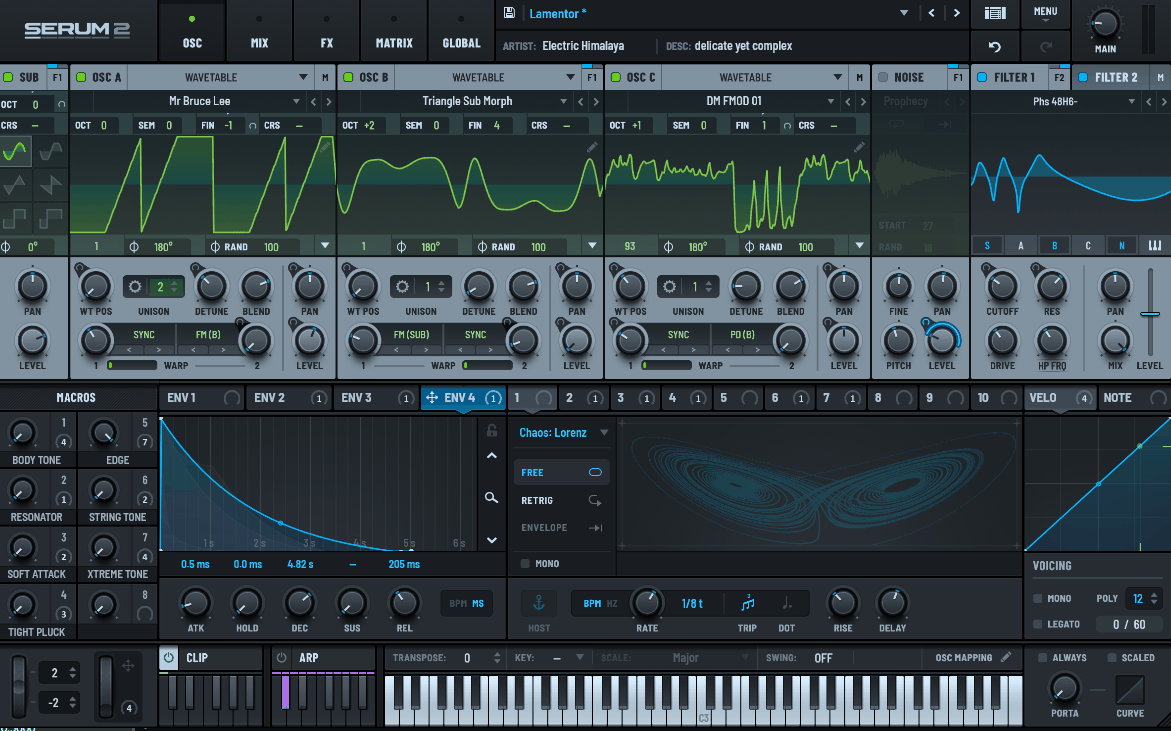
Serum 2 builds on that foundation with significant technical improvements rather than a radical reimagining of the instrument’s identity. The new version adds a second filter to each voice (previously Serum had one global filter), new oscillator processing modes that expand the wavetable morphing and distortion capabilities, a Chaos modulation source that adds complex nonlinear modulation behavior, improvements to the Stacks feature for polyphonic detuning and unison, improvements to the effects chain, an updated arpeggiator, and enhanced MPE support.
The core workflow and sound character of Serum remain recognizable and intact: Serum 2 is a refinement of a beloved instrument rather than a departure from it.
The Serum preset ecosystem is one of the most significant practical advantages Serum has over any competing wavetable synthesizer.
The enormous community of sound designers, preset banks, and sample packs built around the original Serum means that Serum 2 inherits the largest third-party sound library of any software synthesizer in electronic music, with tens of thousands of commercially available preset banks, free community presets, and wavetable collections that cover every genre and sound design territory imaginable.

Sound Design
- Arturia Pigments
Pigments shines most distinctly when you’re combining synthesis approaches within a single patch, and this multi-engine capability is the clearest reason to choose it over a single-engine alternative.
Running the wavetable engine for the harmonic content of a lead sound while simultaneously running the granular engine for textured movement underneath, with both routed through shared filters and a single unified modulation system, gives you combinations of synthesis types that aren’t easily achievable in instruments that lock you into one approach.
A pad that starts as a sampled orchestral texture, gets granularly processed into something evolving and ambient, and runs through a virtual analog filter ladder to add warmth and resonance is a reasonably achievable Pigments patch rather than a complex signal routing exercise.
The harmonic engine is Pigments’ most distinctive synthesis tool and the one with the least equivalent elsewhere at this price point. By drawing the amplitude of each harmonic partial directly, you can construct timbres from scratch in the frequency domain and then animate those partial amplitudes with modulation, creating sounds that morph between different harmonic structures in ways that wavetable synthesis approximates but doesn’t directly replicate.
Combining the harmonic engine output with any of Pigments’ other engines through its filter routing opens up sound design territory that’s genuinely novel.
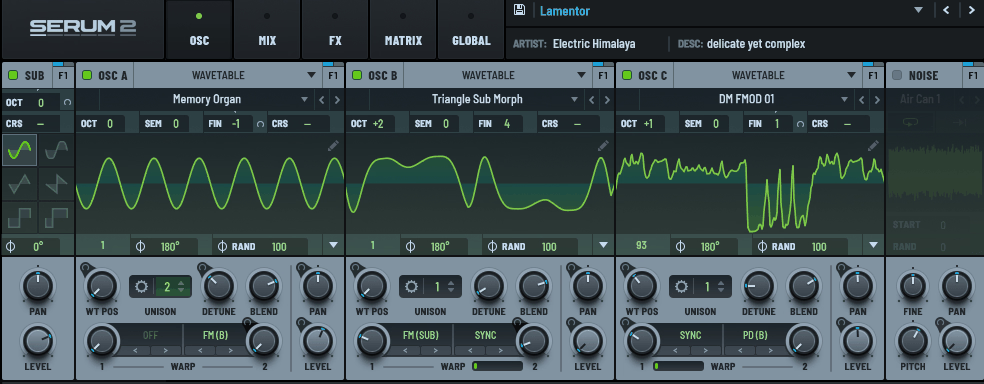
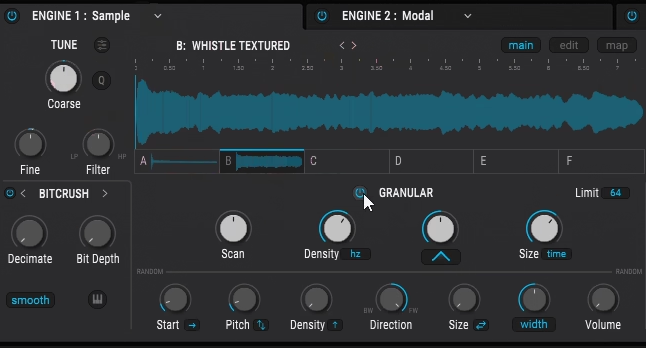
The granular engine goes beyond what typical granular synthesis implementations offer by letting you load any audio file and control grain size, density, spray, and position simultaneously, with modulation available on all of those parameters.
Evolving pads built from short audio samples, rhythmic granular textures, and ambient clouds of processed source material are all achievable within Pigments without external processing.
- Serum 2
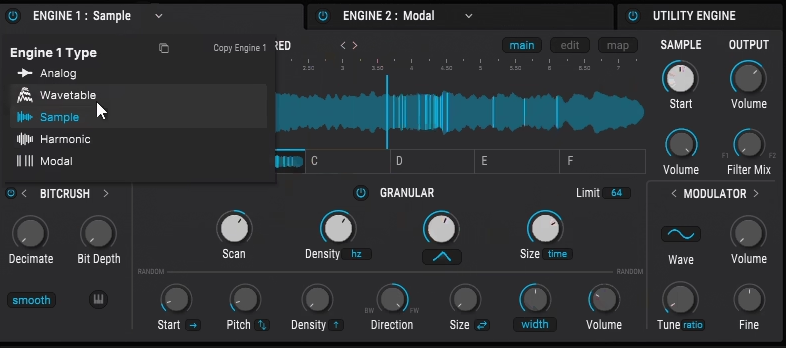
Serum’s sound design strength is wavetable and oscillator processing depth, and the specific quality of what Serum does within the wavetable domain is what has kept it at the center of professional electronic music production for a decade.
The wavetable display showing you the actual waveform at each position in the table, the visual warp mode that lets you see and adjust how the wavetable morphs through positions, and the extensive oscillator processing (including new modes added in Serum 2) give you a level of visual control over the waveform itself that makes complex wavetable design more deliberate.
The new oscillator processing modes in Serum 2 add significant new capability to what was already a capable wavetable engine: new distortion, wavefolder, and FM processing modes at the oscillator level mean you can process the waveform before it even reaches the filter, creating harmonic complexity and character at the source rather than relying entirely on the wavetable table selection.
This changes the character of the instrument in subtle but meaningful ways, giving sounds built in Serum 2 more internal complexity than the same patch would have had in the original.
The noise oscillator in Serum, which can be loaded with any audio sample to act as a noise source, contributes significantly to sound design involving textural elements, transient character, and rhythmic noise layers. Combined with Serum 2’s expanded filter routing and effects chain, it lets you build sounds where the noise component has its own fully processed character separate from the main oscillators.
Sound Character
- Arturia Pigments
Pigments doesn’t have the same universal sonic identity that Serum does precisely because its character changes dramatically depending on which engines you’re using and how you’re combining them.
The virtual analog engine has the specific warmth and subtle imperfection of Arturia’s TAE modeling technology, which draws from the company’s deep experience in hardware synth emulation and produces a soft saturation and slight drift that gives VA patches a more organic feel than digitally clean oscillators.
The wavetable engine has a clean, detailed character that lets you hear the specific spectral content of the table clearly. The granular engine has the particular shimmer and density of grain-based processing.
The unified character that emerges from Pigments across all these engine types is a sense of visual and emotional clarity: Pigments sounds tend to have a specific presence and definition that comes from the instrument’s attention to voice architecture and filter design.
The filters in particular, which include Arturia’s models of the SEM, ladder, and Steiner-Parker filter topologies from its hardware emulation work, add a warmth and character to Pigments sounds that distinguishes them from the cleaner filter sound of Serum.
- Serum 2
Serum has a specific sonic character that producers describe with remarkable consistency: precise, detailed, slightly bright, and extremely clean. The wavetable engine’s high-quality oversampling and anti-aliasing mean that Serum sounds don’t have the aliasing artifacts that some earlier wavetable synthesizers produced at high frequencies, and the result is a clarity that sits beautifully in dense mixes.
Serum’s character is associated with a specific generation of electronic music production because the instrument’s sound signature is identifiable across thousands of commercial productions.
The filters in Serum are well-regarded for their clean, consistent character across types: the ladder filter has a warmth that doesn’t muddy the oscillator character, and the Serum-style modeled filters produce the expected resonance and frequency behavior without unexpected coloration.
The cleanliness of Serum’s character is part of what makes it so versatile: it doesn’t impose a house sound on your patches the way some more character-heavy synthesizers do.
Synthesis Engines Compared
- Pigments: Five Engine Types
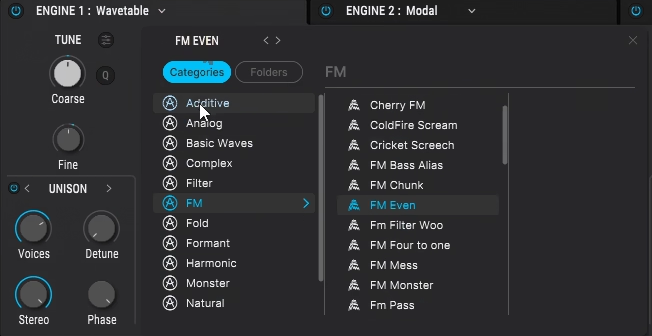
The breadth of Pigments’ synthesis engine options gives it a practical advantage for producers who want one instrument that can cover genuinely diverse sound design territory without requiring external plugins or instruments. The five available engine types and what each brings:
- Wavetable: Standard wavetable playback with position modulation, multiple unison voices, and stereo spread. Comparable in quality to Serum’s wavetable engine though with a slightly different visual approach.
- Virtual Analog (VA): Arturia’s TAE-based virtual analog oscillator with classic waveforms, sync, FM, and ring modulation. Has a distinctly warmer, slightly less clinical character than Serum’s oscillators in clean settings.
- Sample: A full sampler engine within the synth that supports multi-sample playback with pitch tracking, velocity layers, loop points, and granular processing toggle. This makes Pigments capable of hybrid synthesis where recorded sounds are combined with synthesized elements in a single voice.
- Granular: Real-time granular processing of any loaded audio file, with control over grain size, density, spray, position, and pitch randomization.
- Harmonic: Additive synthesis in the frequency domain. Draw the amplitude of each harmonic partial manually, then animate them with modulation sources for spectral morphing effects.
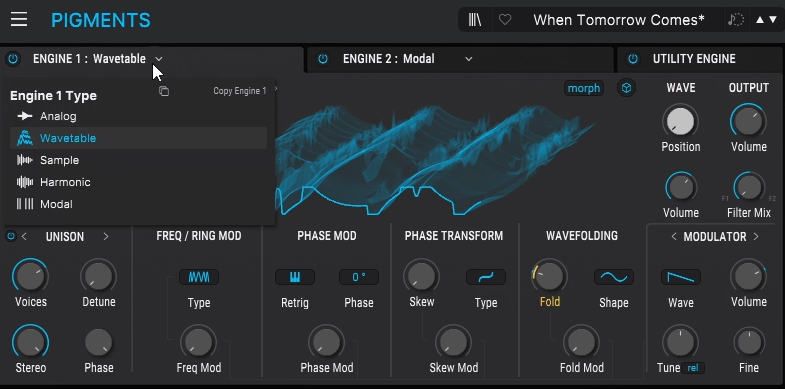
Each of these engines runs at the same level of polish and integration into the Pigments voice architecture: you’re not using a secondary, lower-quality engine when you switch to granular or harmonic. The modulation system, filters, and effects work identically regardless of which engines you’ve chosen.
- Serum 2: Deep Wavetable Specialization
Serum’s engine structure is simpler on the surface but more deeply specialized within its domain. OSC A and OSC B are both full wavetable oscillators with independent wavetables, unison stacks, detune, stereo spread, and all the same oscillator processing options.
The Sub oscillator provides a clean sine wave or other simple waveform at a fixed octave below the fundamental for adding low-end foundation. The Noise oscillator provides a loaded sample-based noise source with independent pitch and filter envelope.
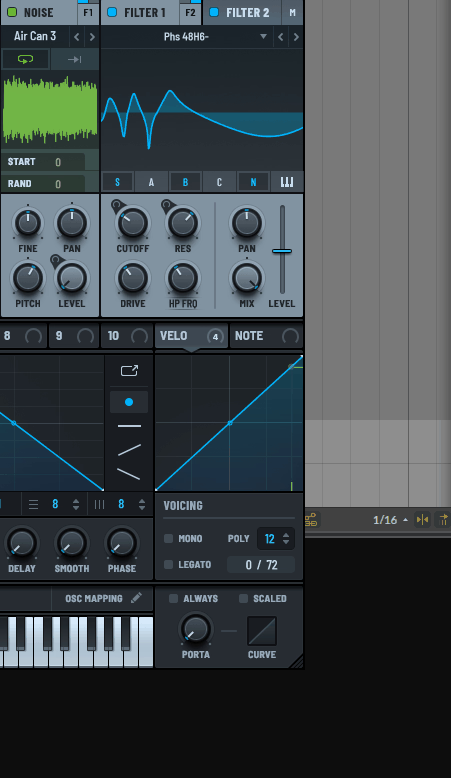
The new oscillator processing in Serum 2 adds a significant layer to what was already a strong wavetable engine: the new warp modes include wavefolding, new FM configurations, and ring modulation directly at the oscillator stage, which means you can process the wavetable sound before it reaches the filter in ways that add complexity and character that were previously only achievable through the filter and effects stages.
This effectively gives Serum 2 more oscillator-level sound design depth than Serum 1 had, making the gap between Serum and Pigments in oscillator diversity smaller than it was, though Pigments’ granular, sample, and harmonic engines still cover territory Serum doesn’t.
Wavetable Engine Deep Dive
Both instruments take wavetable synthesis seriously and implement it with genuine technical depth, but they do it somewhat differently and the differences matter for specific workflows.
- Pigments Wavetable
Pigments’ wavetable engine centers on a clear visual representation of the waveform table with direct position control and modulation. You can import any audio file and have Pigments analyze it into a wavetable, or draw custom waveforms and collect them into a table.
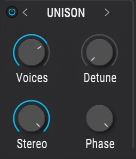
The engine supports up to 8 unison voices per oscillator with configurable detune, spread, and blend, and the wavetable morphing is smooth and continuous with modulation.
One area where Pigments’ wavetable engine differs meaningfully from Serum’s is in the wavetable creation workflow: Pigments makes it relatively accessible to build custom wavetables through its built-in tools, but the community knowledge base and third-party wavetable resources for Pigments don’t approach the depth of what’s available for Serum. If you plan to build a library of custom wavetables over time and draw from community-shared tables, Serum’s ecosystem advantage matters.
- Serum 2 Wavetable
Serum’s wavetable editor is the most visually detailed and precise of any commercial wavetable synthesizer, which is part of why it established itself as the reference instrument for wavetable production. The waveform display shows you exactly what each frame of the table looks like, the spectrum display shows the harmonic content, and the interpolation between frames is smooth and predictable.
The import modes let you analyze audio files using different algorithms depending on whether the source is a tonal sound, a formant-based sound, or a transient, giving you meaningful control over how the wavetable is extracted from an audio file.
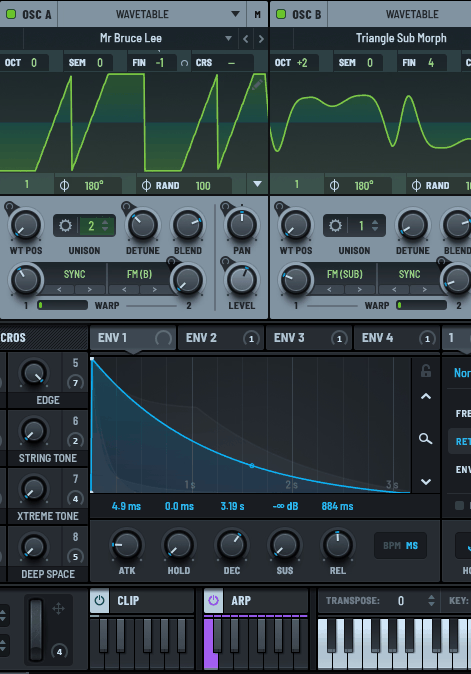
Serum 2 expands on this with improved warp modes that affect how the wavetable is read and processed: the new warp options include additional distortion types and waveshaping options that operate before the filter, giving you more ways to modify the harmonic content of the table in real time.
The new Stack feature improvements give you more control over how unison voices are detuned, panned, and pitch-quantized, which is particularly relevant for the kinds of supersaw leads and wide pads that Serum production is associated with.
Modulation and Routing Depth
- Pigments
Pigments’ modulation system is the one area where many sound designers describe the instrument as genuinely ahead of its competitors.
The visual approach, where you grab a modulation source from a panel at the bottom of the interface and drag it to any knob, filter, effect parameter, or destination in the synth, with a colored ring immediately appearing around the destination to show the modulation amount and depth, makes modulation routing a visual experience rather than a parameter entry exercise.
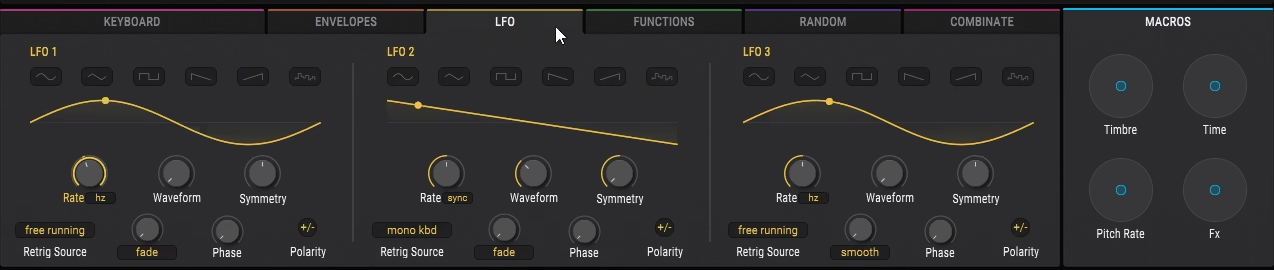
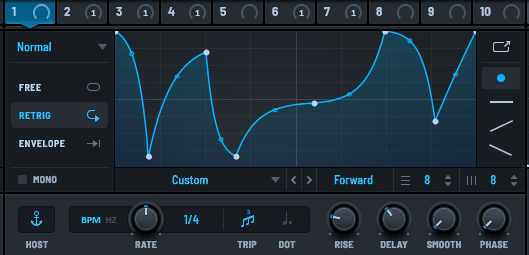
The available modulation sources are extensive: multiple LFOs with custom waveform drawing and synchronization options, multiple envelopes with adjustable curve shapes for every segment, function generators that can act as complex envelope/LFO hybrids, random sources, MIDI input sources (velocity, aftertouch, pitch bend, mod wheel, specific CC numbers), macro knobs for live performance control, and a perform mode that assigns macros to an XY pad interface.
The ability to use any envelope output as a modulation source for any other envelope parameter is a specific example of the modulation depth that Pigments offers and that most competitors don’t match: you can have an LFO whose rate is itself modulated by an envelope, or a filter cutoff modulated by a function generator whose shape is being morphed by a second LFO, creating evolving patches that change their behavior over time in complex ways.
- Serum 2
Serum’s modulation system has always been strong and Serum 2 expands it with the addition of Chaos generators: nonlinear modulation sources that produce complex, pseudo-random output with controllable character ranging from smooth and flowing to erratic and unpredictable.
These give Serum 2 a class of modulation behavior that creates organic variation in patches without requiring the complex multi-source routing that achieving similar results in Serum 1 required.
The drag-to-assign modulation workflow in Serum is clean and well-established: you right-click any parameter, choose an available modulation source, and set the amount. The visual indicators showing active modulations are clear and unambiguous, though the system is less immediately visual at the synth-level overview than Pigments’ colored ring approach.
Macro controls in Serum 2 work similarly to Pigments’ approach: you assign multiple parameters to a single macro knob with independent amounts and directions, creating a single control that simultaneously adjusts several related aspects of the patch for expressive performance use.
Arpeggiator and Sequencer
- Pigments
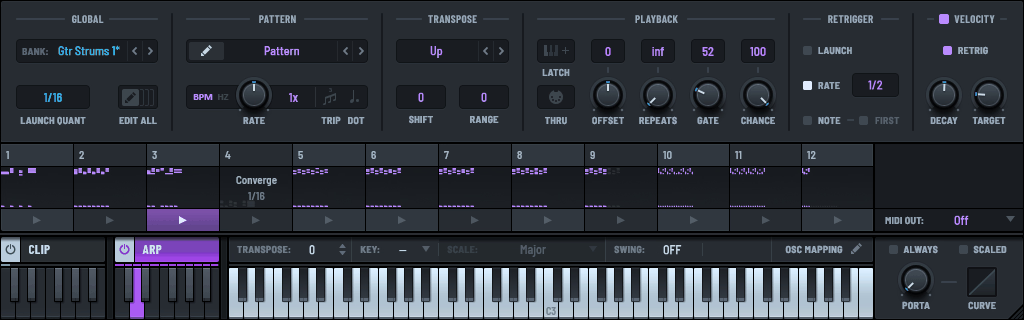
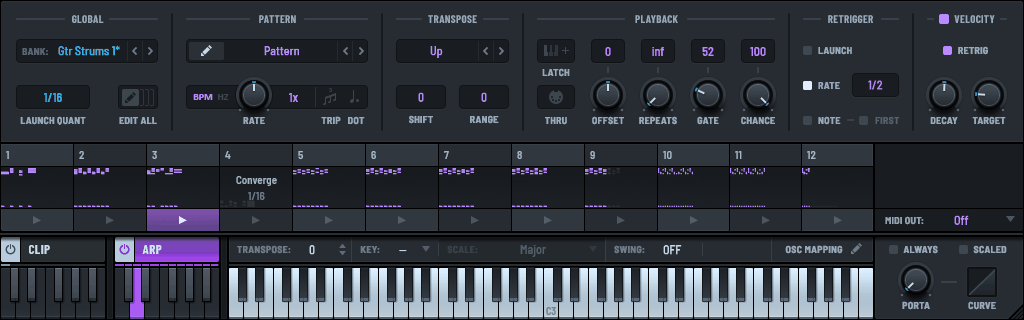
The arpeggiator and step sequencer in Pigments are meaningfully more capable than what most software synthesizers include, and for producers who want to keep everything within the instrument rather than relying on their DAW’s MIDI tools, Pigments’ internal rhythm tools provide real value.
The step sequencer has multiple lanes covering pitch, velocity, chord, and modulation values, and the step length can be set independently from the sequencer rate, allowing for polyrhythmic patterns where the sequence length doesn’t align with the song tempo in simple ways.
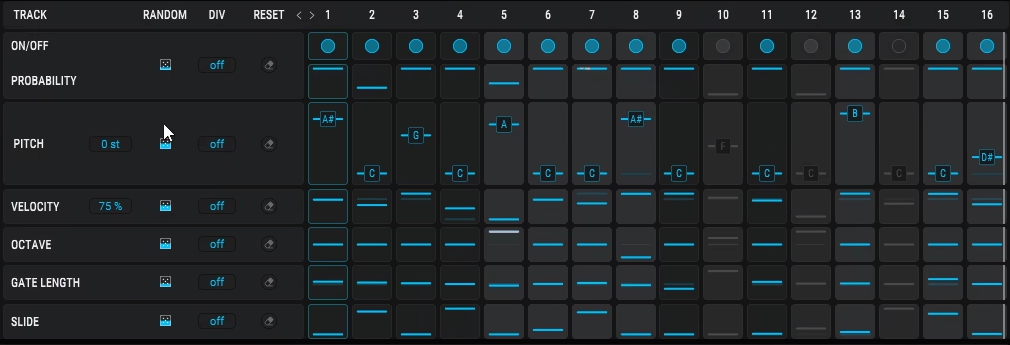
The chord feature in the sequencer lets you define chords for each step rather than just single notes, which makes Pigments’ arpeggiator more versatile for harmonic material than most synth arps.
Combined with the modulation system’s ability to route sequencer values to synthesis parameters, you can build patches where the timbre changes at each step in the sequence alongside the pitch and rhythm, which is a meaningful step toward the kind of generative, evolving sequences that Pigments’ architecture suits.
- Serum 2
Serum 2 has updated its arpeggiator with improvements to the rate options, step count, and control over note length and velocity, making it a more capable rhythmic tool than the original Serum’s arpeggiator.
It remains a competent arpeggiator rather than a deep sequencer: you can set the pattern, direction, rate, and step values, but the multi-lane step sequencer with modulation routing that Pigments offers goes beyond what Serum 2’s arp provides.
For producers who primarily use their DAW’s MIDI tools for sequencing and only need a basic arpeggiator for live playing or quick pattern generation, Serum 2’s arpeggiator covers the job well. For producers who want the synthesizer to generate complex patterns independently, Pigments’ sequencer is the stronger tool.
Built-in Effect Plugins and Processing
- Pigments
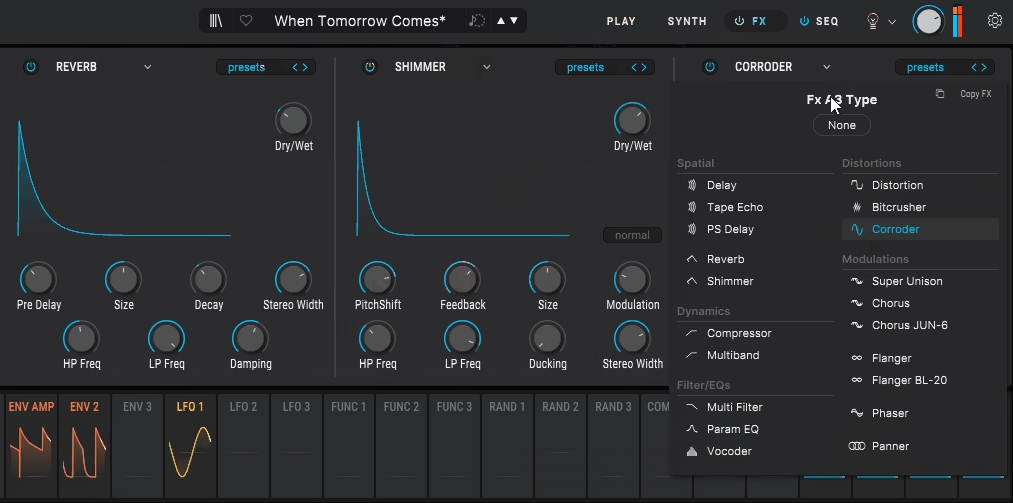
Pigments has one of the most complete built-in effects sections of any synthesizer plugin, and its three separate FX chains (two pre-filter insert chains and one main output chain) give you an architectural flexibility that most synth effects sections don’t match.
You can apply distortion to one oscillator’s signal before it hits the filter while the other oscillator’s signal goes through chorus first, creating per-oscillator processing that blends into a unified filter stage.
The effects available include: stereo delay, multiple reverb types (room, plate, spring, shimmer), chorus and flanger, phaser, distortion with multiple circuit types, compressor, multiband EQ, bitcrusher, vocoder, ring modulator, and more.
Having a vocoder built directly into the effects chain means you can do real-time vocoder processing of the synth’s own oscillators without external routing.
The ability to modulate any effects parameter using the main modulation system is significant: an LFO modulating reverb size, an envelope modulating distortion drive, or a macro controlling chorus depth all work through the same drag-and-drop modulation system that handles the core synthesis parameters, making complex animated effects straightforward to set up.
- Serum 2
Serum 2 improved its effects section significantly from the original Serum, which had a capable but relatively basic 10-slot effects chain. The new version has improved the quality of individual effect types and expanded the processing options available within them, with better reverb algorithms, improved distortion modes, and more flexible chorus and delay configurations.
The effects in Serum 2 are high quality for a built-in synth effects section, covering the primary needs of most patches: reverb for space, chorus or ensemble for width, delay for rhythmic character, distortion for harmonic content, and compression for dynamics control. The signal flow is straightforward, with effects applied in the order of the chain to the full synth output.
Where Serum 2’s effects approach differs from Pigments’ is in the per-oscillator routing capability: Serum 2 applies effects globally to the mixed oscillator output rather than giving you independent pre-filter processing chains per oscillator. This is simpler to manage but less flexible for complex multi-engine patches.
Preset Library Quality
- Arturia Pigments
Pigments’ factory preset library has grown with each major version update and now covers over 1,000 presets across every sound category: leads, basses, pads, keys, sequences, arpeggiated textures, percussive sounds, and sound design tools.
The Arturia sound design team consistently produces presets that demonstrate the instrument’s specific capabilities, and many factory presets are excellent demonstrations of what the multi-engine approach can achieve: pads that use the granular engine for evolving texture alongside the virtual analog engine for warmth, sequences that use the step sequencer for rhythmic modulation alongside the wavetable engine for spectral movement.
The third-party Pigments preset market is growing but remains smaller than what Serum has accumulated over nearly a decade of community development.
If you’re evaluating Pigments partly on the basis of available sound expansion options, it’s worth noting that while commercially available Pigments preset banks are increasingly numerous, the breadth of free community presets and wavetable resources doesn’t approach what Serum offers.
- Serum 2
Serum’s preset ecosystem is the largest in software synthesis for electronic music, and Serum 2 inherits the entirety of it. The original Serum accumulated over ten years of commercially produced preset banks, free community presets, and professionally designed wavetable collections, and virtually all of it remains compatible with Serum 2.
The number of available Serum preset packs across every sub-genre of electronic music, from future bass and riddim through cinematic and dark ambient, is genuinely staggering.
The factory presets in Serum 2 are excellent starting points and include demonstrations of the new features added to the instrument, with patches that specifically highlight the new oscillator processing, filter routing, and Chaos modulation sources.
But for most working Serum users, the third-party preset ecosystem is as important as the factory library, and having immediate access to everything built for Serum 1 makes Serum 2 an extraordinarily well-stocked instrument from day one.
CPU Performance
Both synthesizers are capable of significant CPU load at high polyphony with complex patches, and honest expectations about performance are useful going in.
- Arturia Pigments
Pigments is a more CPU-intensive instrument than Serum, primarily because of the computational cost of combining multiple synthesis engines per voice and the granular processing capability.
A complex Pigments patch using both engines with the granular engine active, multiple LFOs running at high rates, and a full effects chain can reach significant CPU usage at high polyphony, and on older computers, unison patches with many stacked voices can be demanding.
Arturia includes a polyphony limiter in Pigments that you can use to cap the maximum voice count for heavy patches, and freezing Pigments tracks when you’re not actively editing them is a practical workflow step for complex sessions.
The harmonic engine in particular can be expensive at high partial counts, and running it alongside the granular engine simultaneously pushes CPU requirements higher.
Arturia has improved Pigments’ performance with each major update, and on modern Apple Silicon and high-core-count Windows machines it runs comfortably for most production contexts.
The resource demands are worth knowing about before using Pigments as a live performance instrument, where frozen tracks aren’t an option.
- Serum 2
Serum has always been notably CPU-efficient for a high-quality wavetable synthesizer, and Steve Duda’s emphasis on optimized code has kept Serum and now Serum 2 among the less resource-intensive options at its quality level.
Serum 2 is somewhat more demanding than the original Serum due to the new per-voice filter, new oscillator processing, and improved effects algorithms, but it remains efficient enough that running multiple instances of complex Serum 2 patches in a production session is practical on any modern computer without the kind of polyphony management that Pigments requires for heavy patches.
For live performance, Serum 2’s CPU efficiency is a meaningful advantage: you can play chords and runs with high polyphony settings without worrying about note stealing or audio dropouts in a way that’s more dependable than Pigments’ more demanding architecture.
Genre Fit
- Arturia Pigments
Pigments’ multi-engine architecture and granular processing capability make it particularly well-suited to cinematic and film music, ambient and experimental production, and any genre where textural complexity and hybrid synthesis are part of the aesthetic.
The granular engine combined with the sample engine gives Pigments a unique position for soundtrack composers who want to process recorded sounds within a synthesizer environment and combine them with synthesized elements.
Electronic music production benefits from Pigments’ flexibility across all sub-genres: the virtual analog engine covers the warm leads and filtered basses that house and techno production relies on, the wavetable engine covers the spectral leads and wobbles of bass music and EDM, and the harmonic engine opens up spectral sound design that’s less common in mainstream electronic production but increasingly present in experimental and modular-influenced contexts.
The step sequencer makes Pigments particularly useful for techno and minimal production where evolving sequences with rhythmic modulation are central to the sound.
- Serum 2
Serum’s genre associations are strongly tied to future bass, dubstep, trap, and contemporary EDM, where the specific character of Serum’s wavetable oscillators, its supersaw and wide unison capability, and its preset ecosystem have defined a sound that’s recognizable across millions of productions.
If you’re working in any of these genres and you want access to the sounds that professionals in those genres are using as their primary instrument, Serum 2 is the straightforward answer.
Pop music production uses Serum heavily for leads, synth pads, and textural elements because the instrument’s clean character sits well in commercial mixes and because its enormous preset ecosystem includes sounds that are immediately production-ready.
Hip-hop and R&B production uses Serum for melodic synth elements, plucks, and atmospheric pads. Techno and house production uses Serum’s filter and modulation capabilities for classic electronic music textures.
The genre reach of Serum 2 is broad enough that it’s genuinely difficult to name a contemporary electronic or pop genre where Serum is not a primary production tool for a significant portion of working producers.
Learning Curve
- Arturia Pigments
Pigments has a steeper learning curve than Serum for new synthesizer users, and that’s worth acknowledging directly.
The multi-engine architecture means you’re managing more decisions at the start of patch creation: which engines to use, how to route them through the filter section, which of the three filter slots to activate and in which configuration, and how to organize the modulation sources across a more complex voice structure.
The visual modulation system is intuitive once learned, but the initial orientation to Pigments’ signal flow takes more time than Serum’s more linear approach.
Arturia supports Pigments with tutorial content and preset annotations that explain what specific sound design choices achieve, and the instrument rewards deep investment in learning: the more time you spend understanding what each engine and modulation combination does, the more capable Pigments becomes as a sound design environment.
For producers who enjoy the process of learning a complex instrument thoroughly, Pigments’ depth is satisfying rather than frustrating.
- Serum 2
Serum’s learning curve is among the gentlest of any professional synthesizer, and this has always been one of the most important practical arguments for choosing it. The signal flow is clean and predictable: oscillators go through a filter, the filter output goes through the effects chain, and the modulation matrix lets you connect any source to any destination.
The visual waveform display immediately shows you what the oscillator is doing, which makes understanding the relationship between wavetable position and sound much more accessible than learning wavetable synthesis through numbers alone.
The enormous library of YouTube tutorials, written guides, preset annotations, and community resources built around Serum means that almost any specific question you have about how to achieve a particular sound has already been answered and documented somewhere accessible.
This community knowledge base is part of the instrument’s practical value that doesn’t appear on the spec sheet: the combined learning resource around Serum is larger and more organized than what exists for any other software synthesizer.
Trials and Demo
- Arturia Pigments
Arturia provides a demo version of Pigments that introduces periodic audio noise to the output, letting you use the full feature set with the limitation that you can’t export clean audio without purchasing.
This is a fair approach that gives you genuine evaluation time in real production sessions, and the noise injection is infrequent enough that you can evaluate the instrument’s sound and workflow meaningfully.
Pigments is also available through Arturia’s subscription service at approximately $9.99/month, which gives you access to Pigments alongside other Arturia instruments and effects as a monthly subscription option.
If you already own any Arturia products, keep in mind that Pigments is included in the V Collection bundle and may be available to you at an upgrade price rather than full new license cost.

- Serum 2
Xfer provides a demo version of Serum 2 with similar noise-based output limitations that let you evaluate the instrument before purchasing.
For producers who want to spread the cost of the full license over time, the Splice Rent-to-Own option lets you pay approximately $9.99/month and download the full version immediately, with the license transferring to you when the total price is paid. Owners of the original Serum can upgrade to Serum 2 at a discounted upgrade price, making the transition cost lower than a new full license purchase.
Which Is More Future-Proof?
This is a genuinely interesting question because both companies have strong incentives to develop their instruments further, and both have track records of meaningful updates over time.
Arturia Pigments has been updated steadily with new engine types and features since its initial release, and Arturia’s position as a major player in both hardware and software gives the company the resources and stability to continue developing Pigments for the foreseeable future.
The instrument’s multi-engine architecture means future engine additions would expand what Pigments can do rather than requiring a fundamental redesign.
Serum 2 represents a fresh technical foundation that Steve Duda described as enabling improvements that were impossible within the original Serum’s codebase. The new architecture is meant to support future feature additions more easily, and the extraordinary commercial success of Serum gives Xfer strong reasons to continue developing Serum 2 actively.
The preset ecosystem continues to grow daily through the active producer community, which makes Serum’s effective capabilities expand continuously even without software updates.
The most future-proof consideration isn’t which instrument gets more features, but which one fits the production workflows that will matter to you in two or three years. If your production direction involves increasingly complex multi-synthesis hybrid sounds and granular texture design, Pigments’ architecture has room to grow.
If you’re building a production library and community network around a specific instrument’s preset ecosystem, Serum 2’s established position and massive sound library makes it the safer long-term investment.
Last Words
Both deserve to be in the conversation for best modern synthesizer plugin, and both would serve the majority of electronic music producers well as a primary instrument. The choice between them is genuinely about matching the instrument’s specific strengths to your specific needs.
I woudl say, choose Arturia Pigments if multi-engine synthesis that genuinely combines wavetable, virtual analog, granular, sample, and harmonic approaches in a single voice is important to your sound design work; if the step sequencer with modulation lanes fits the kind of evolving sequences you build; if cinematic, ambient, or experimentally textured music is a significant part of what you produce; or if you’re already in the Arturia ecosystem through V Collection and want a synth that represents those strengths in an original instrument rather than a hardware emulation.
Choose Serum 2 if the most detailed and visually precise wavetable engine available in any software synthesizer is your priority; if access to the largest third-party preset ecosystem in electronic music production is important to you; if CPU efficiency and reliable performance at high polyphony matters for your setup or live use; if EDM, future bass, trap, or commercial pop production is where most of your work lives; or if you’re coming from the original Serum and want to build on the investment you’ve already made in sounds, wavetables, and workflow familiarity.
For many producers, both end up in the session: Serum 2 for the sounds it does with extraordinary efficiency and community support, Pigments for the moments when multi-engine hybrid design or granular texture work is the right tool. At their respective bundle and sale pricing points, that combination is one of the strongest double-synthesizer investments available.
Buy Pigments here (Support Pluginerds):
Buy Pigments here (Trial available)
Buy Xfer Serum 2 here (Trial Available)
Get the Free Plugin Starter Kit
The genuinely useful free DAWs and plugins worth installing. No filler. Straight to your inbox.

Hello, I’m Viliam, I started this audio plugin focused blog to keep you updated on the latest trends, news and everything plugin related. I’ll put the most emphasis on the topics covering best VST, AU and AAX plugins. If you find some great plugin suggestions for us to include on our site, feel free to let me know, so I can take a look!