
You can learn a lot about what a producer values by looking at which filter plugins they actually keep. Filters are one of those tools that attract two completely different types of users: engineers who need precise, transparent frequency control for mixing decisions, and producers who want movement, character, and a way to make static sounds feel alive.
The difference shows up in the plugin itself. A good mixing filter is often nearly invisible, while a creative filter is frequently the centerpiece of an entire arrangement moment.
The best plugins on this list cover both ends of that spectrum, and a few of them genuinely do both. Whether you need the warm, buttery sweep of a Minimoog ladder filter on a pad, the aggressive all-mode squelch of an old analog box, a one-knob autopilot tool for transitions, or a completely new approach to what a filter can even be, there is something worth knowing about on this list.
From the Pluginerds Store
A quick mention: alongside the blog, we run Pluginerds Shop, our own store for studio hardware and accessories. Everything on it is there because someone on this team actually uses gear like it, not because it was the cheapest thing to list.
Visit Pluginerds Shop1. KORG Filter Ark
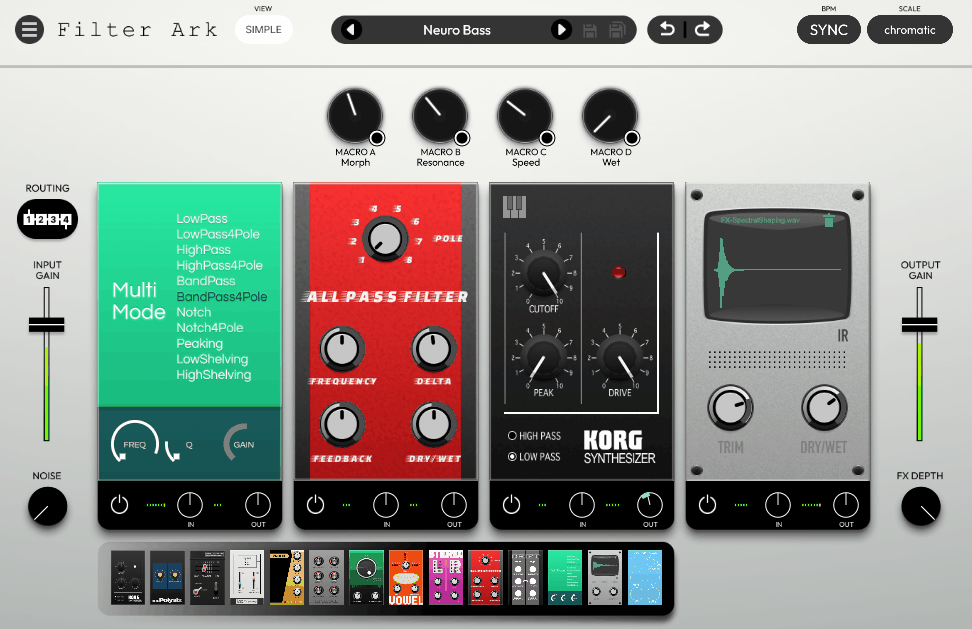
Released at NAMM 2026 and part of the KORG Collection 6, Filter Ark is the most ambitious filter plugin on this list by a significant margin. Rather than modeling a single legendary filter, KORG has built an entire environment where filters from the MS-20, Polysix, miniKORG 700S, and ARP Odyssey sit alongside modern designs including physical modeling resonators, a vowel filter, waveguides, and an impulse response loader.
You can run up to four of these simultaneously. I believe this is the right way to do a filter plugin in 2026, because it positions the filter as a creative instrument rather than a utility, and the scope of what you can do between the routing options and modulation system is genuinely wider than anything else in this category.
- 14 Filter Models Including Classic and Modern:
The library covers MS-20 with both high-pass and low-pass circuits, the smooth Polysix 24dB/oct lowpass, miniKORG 700S Traveler, all three ARP Odyssey variants, a Morphing Filter, Vowel filter, Modal Resonators, Waveguide from the Volca Drum, Spectral Tracer, Drift, and a Multimode filter.
The classic designs use KORG’s CMT component modeling technology from the rest of the Collection, which means the MS-20 sounds like an MS-20 and the Polysix sounds like a Polysix rather than a generic approximation.
- Up to Four Filters Simultaneously with Flexible Routing:
You can combine up to four filter modules at once in series, parallel, feedback, and other configurations, meaning the interactions between filters become their own design element. I found running the MS-20 highpass into the Polysix lowpass creates a bandpass response that sounds nothing like a standard bandpass filter, because both circuits are bringing their own character to the result.
- Modulation System with Step Sequencer and Sidechain:
The modulation section includes a morphable LFO, envelope follower with sidechain input, a customizable step sequencer with adjustable steps and playback modes, and a Random Generator, all of which can target cutoff, resonance, and other filter parameters simultaneously. The step sequencer in particular gives you rhythmically locked filter movement without needing to draw automation.
- Noise Oscillator and Scale Quantizer:
Filter Ark can operate without an external input signal thanks to a built-in noise oscillator and a cutoff frequency scale quantizer that locks cutoff movement to musical scales. When combined with the modulation system and step sequencer, this turns the plugin into a percussive or melodic sound generator on its own, without any audio coming in at all.
Get the Free Plugin Starter Kit
The genuinely useful free DAWs and plugins worth installing. No filler. Straight to your inbox.
2. Arturia Filter MINI
When Arturia built their Mini V software instrument back in 2003 in collaboration with Bob Moog himself, the foundation of that project was a painstaking component-level recreation of the 24dB/oct ladder filter at the heart of the Minimoog.
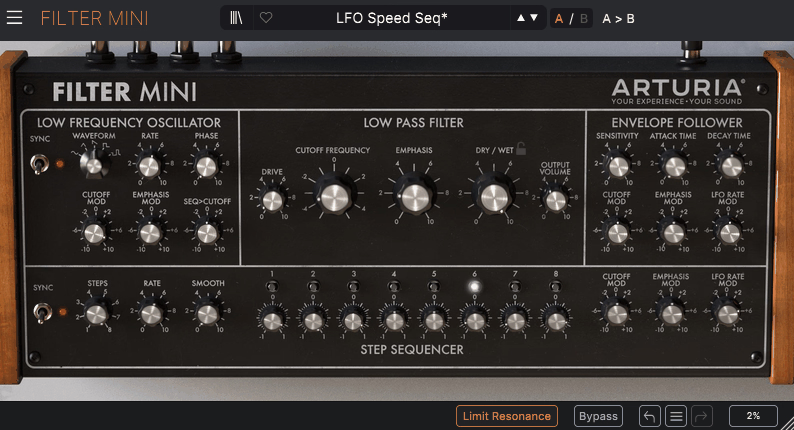
Filter MINI is that specific filter, extracted into a standalone plugin using Arturia’s TAE True Analog Emulation technology, and it remains one of the most naturally musical-sounding filter tools available for any source material. I used it on electric piano and the result sounded like I had routed the track through an actual vintage synthesizer rather than a plugin, which is the highest compliment I can give anything in this category.
- 24dB/Oct Minimoog Ladder Filter:
The core is a 24dB/octave ladder lowpass filter modeled at component level, capturing the characteristic behavior where emphasis decreases as you lower the cutoff frequency, allowing bass frequencies to pass through in a way that sounds distinctly musical rather than clinical. The soft clipping character of the original amplification stages is also reproduced, adding harmonic richness even at moderate settings.
- LFO with Sample and Hold:
Beyond standard sine, triangle, square, and sawtooth waveforms, the LFO includes a Sample and Hold mode that takes a random value and freezes it for a defined duration, creating step-like random filter movement that locks to the Rate setting. This is particularly effective for creating rhythmic, quantized filter jumps in techno and electronic music contexts without a sequencer.
- Envelope Follower with Sidechain Input:
The envelope follower tracks the dynamics of the input signal to drive the cutoff, emphasis, and LFO rate, with adjustable sensitivity, attack, and decay controls to smooth or sharpen the response. I found it works very naturally on guitars for auto-wah effects, reacting to pick attack in a way that feels like a well-tuned hardware wah pedal.
- 8-Step Sequencer:
A configurable 8-step sequencer can drive the cutoff frequency, emphasis, and LFO rate in sync with the DAW clock, giving you sequenced filter patterns that loop independently of your arrangement. The combination of sequencer and Sample and Hold LFO opens up filter animation options that no static cutoff sweep can achieve.
- Drive Parameter:
A Drive control adds pre-filter saturation that thickens the tone before it hits the ladder circuit, pushing the filter into the kind of gentle overdrive character the original hardware produces when driven by a hot signal. This alone is worth loading the plugin on bass or synth leads that need body without obvious distortion.
- Six Filter Modes:
Filter MINI includes lowpass, highpass, bandpass, and notch configurations alongside the main ladder lowpass, giving you access to different filtering characters beyond the plugin’s primary signature. The multimode extension adds considerably to the plugin’s usefulness in mixing applications beyond purely creative sweeping.
3. Moogerfooger MF-101S Lowpass Filter
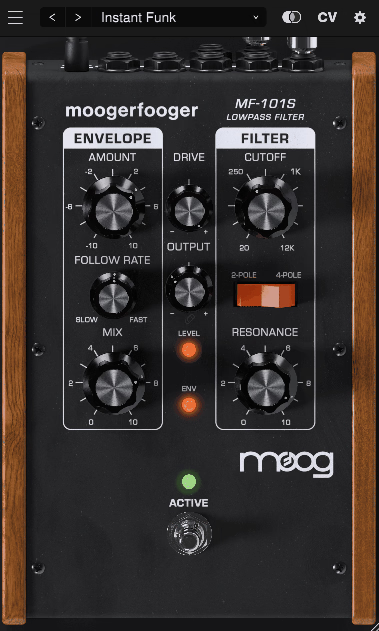
The original Moogerfooger MF-101S was released in 1998 as a 4-pole lowpass filter and envelope follower in hardware pedal form, a direct descendant of Moog’s modular synthesizer designs adapted for guitar, voice, and general audio processing.
The MF-101S plugin recreates it with exceptional accuracy while adding stereo functionality and digital-only features the hardware never had. I realized within minutes of first using it that the filter responds to your signal differently from most emulations, with an organic, breathing quality around the resonance point that makes automation and real-time control feel genuinely expressive rather than mechanical.
- 4-Pole Ladder Lowpass with Envelope Follower:
The circuit pairing is the same as the original: a classic 4-pole Moog ladder lowpass filter with an integrated envelope follower that applies dynamic motion to the filtered sound based on the amplitude of the input signal. The interaction between these two modules is what made the hardware valuable, and the plugin faithfully captures how envelope amount and filter cutoff interact at different resonance settings.
- CV Interconnectivity Between Plugin Instances:
Following the hardware’s modular CV system, the MF-101S supports virtual CV connections between multiple Moogerfooger plugin instances across your DAW session, meaning one plugin can modulate the parameters of another just as you could patch hardware Moogerfoogers together with cables. This turns the plugin collection into a modular performance system within the DAW environment.
- Stereo Mono/Stereo Envelope Following:
In STEREO envelope mode, the left and right channels each get their own independent envelope follower that tracks the dynamics of that specific channel separately, so stereo material produces different filter movement on each side based on the actual stereo content rather than a summed mono response. This opens up spatial filtering effects that the hardware couldn’t achieve.
4. Polyverse Filterverse
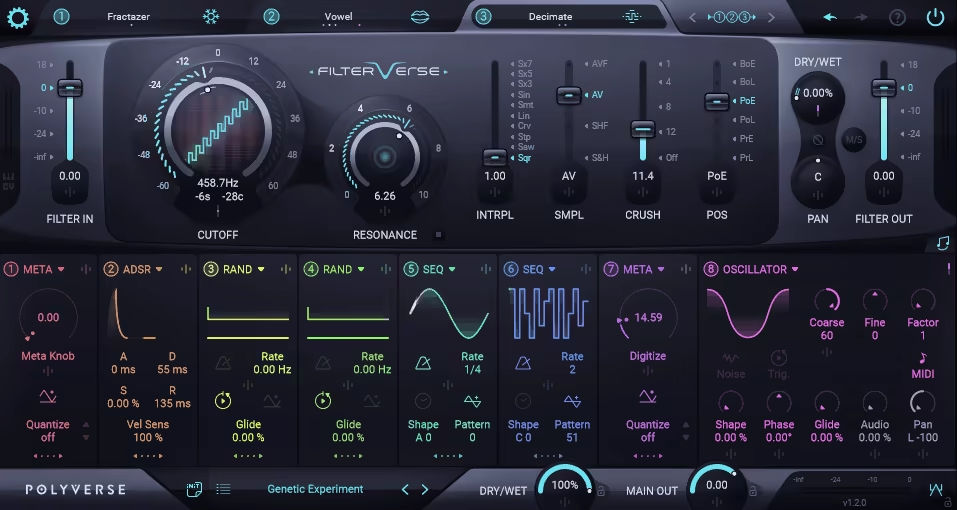
With 30 filter types, 250+ algorithms, three slots with serial/parallel routing, and eight modulation sources including an audio-rate oscillator, the options available in Filterverse are not just more than other filter plugins, they are categorically different in kind.
Filterverse 1.2 added five new filter modules, a significantly enhanced sequencer, and CPU optimizations that make it considerably more practical in larger sessions than earlier versions.
- 30+ Filter Types Across Three Slots:
The filter library spans classic analog types like Swiss Army Knife and Bread and Butter through complex multi-peak, comb, and fractal options, tempo-synced delays, and lush reverb-infused filters like Coils, Tempong, and Space.
The three processing slots can hold any combination in any order, with draggable tabs to rearrange position and panning, phase, and mid-side controls per slot for additional stereo shaping.
- Eight Modulation Sources with Cross-Modulation:
The modulation system includes a Meta Knob, step sequencer/LFO, ADSR, envelope follower, randomizer, pitch detector, MIDI/CV input, and audio-rate oscillator, and crucially, sources can modulate each other and multiple sources can target the same destination simultaneously. The audio-rate oscillator in particular opens up FM-style interactions with the filter that produce results unavailable from any LFO-based system.
- 1,000+ Presets by Professional Sound Designers:
The factory library includes over 1,000 presets contributed by producers and sound designers including Infected Mushroom, Mr. Bill, John Lehmkuhl, ill.Gates, and Assaf Dar Sagol, organized with a tagging system covering type, mood, and effect category. Many presets have parameters mapped to the Meta Knob or MIDI inputs for immediate live performance use.
- Enhanced Sequencer with Polyrhythmic Control:
Version 1.2 upgraded the step sequencer with new glide, phase, and polyrhythmic controls that let the sequencer function as a mini modular sequencer inside the plugin, running at rates and cycle lengths independent of the main tempo for evolving patterns that never quite repeat in a predictable way.
5. Minimal Audio Hybrid Filter
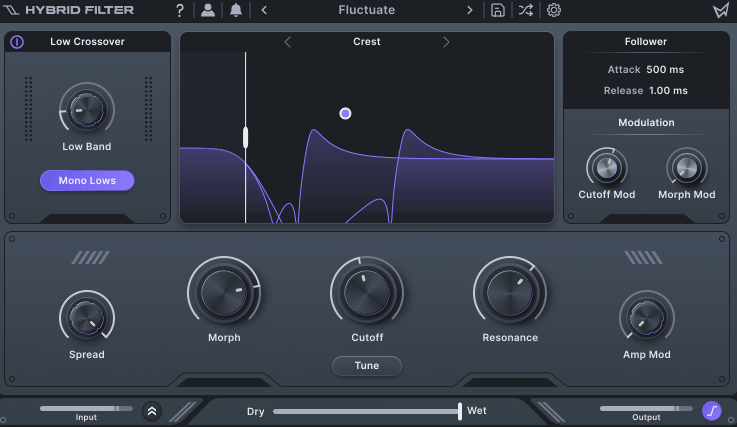
Hybrid Filter is the standalone version of the filter section found in Minimal Audio’s Current synthesizer, and it’s specifically designed with bass music and electronic production in mind. The 50+ filter types span morphing, formant, comb, and phaser modes, and the built-in low-frequency crossover is the feature that makes it particularly practical for production contexts where you want aggressive filter effects without destroying your sub content.
I found the filter selection genuinely broader than what any single hardware emulation offers, and the morphing modes produce EQ curve transitions that would take complex envelope-driven EQ automation to approximate any other way.
- 50+ Filter Types Including Morphing Modes:
The library covers standard LP/HP/BP modes with carefully modeled resonance behavior, custom morphing modes that smoothly interpolate between different EQ shapes, formant filters, comb filters, and phaser modes, with a Morph knob that drives smooth transitions through the internal filter configurations in ways that differ depending on the selected type. The morphing behavior alone makes this a uniquely expressive tool compared to any fixed-type filter.
- Low-Frequency Crossover (Safe Bass):
The integrated multi-band crossover lets you designate a frequency threshold below which the filter has no effect, protecting sub frequencies from the processing while allowing the filter to work freely on the mid and upper content above that point. An optional Mono Lows mode sums the protected low-frequency band to mono simultaneously, which is standard practice in electronic production for phase coherence in the sub range.
- Envelope Follower with Amp Mod:
Beyond the standard envelope follower for auto-filter effects, Hybrid Filter includes an Amp Mod mode that adds audio-rate amplitude modulation tracking the filter’s cutoff frequency, creating additional harmonics and tonal filter effects that respond to what the filter is doing rather than to the input dynamics. This produces vowel-like, vocoder-adjacent results especially on sustained tones.
- Stereo Spread and Real-Time Display:
A stereo spread control adjusts the relative cutoff frequency between left and right channels for wide filtering effects, while the real-time filter response display shows you exactly what each filter setting is doing to the frequency spectrum as you adjust it. I found the visual feedback genuinely useful when exploring the more unusual filter types whose behavior isn’t immediately predictable by ear.
- Soft-Clip Limiter:
A built-in soft-clip limiter at the output keeps resonance spikes and extreme settings from clipping the output without killing the character of the filter response, which is a practical safeguard that most filter plugins force you to handle externally. For live performance or experimental use, this makes Hybrid Filter considerably more usable at extreme settings.
6. Waves MetaFilter
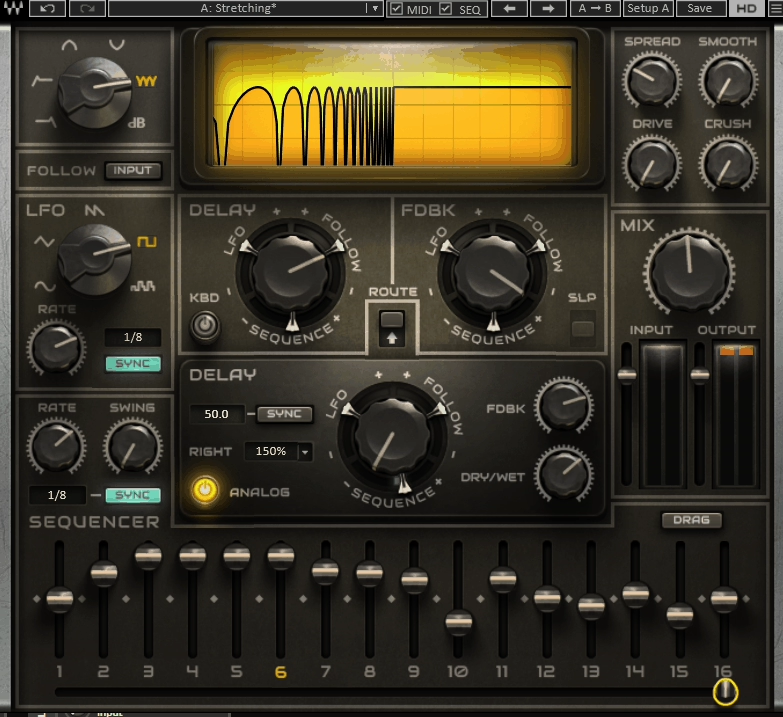
MetaFilter is powered by Waves’ Virtual Voltage technology, the same analog modeling engine used in their Element synthesizer, and the filter sound it produces has a warmth and character.
What it does well is provide a comprehensive creative filter tool in one place: multi-mode filtering with three simultaneous modulation sources, a delay section with analog emulation mode, sidechain capability, MIDI learn for live use, and six filter operation modes. It’s been around long enough to have proven itself across a wide range of production styles, and I found it genuinely enjoyable to use on anything that needed to move.
- Six Filter Modes:
The plugin operates in lowpass, highpass, bandpass, notch, comb, and amplifier modes, with the amplifier mode converting the cutoff into a volume control so you can use MetaFilter’s three modulation sources as a sophisticated tremolo and gating tool rather than a frequency filter. The comb mode routes cutoff into delay time for resonant, metallic effects.
- Three Simultaneous Modulation Sources:
A 16-step sequencer, an LFO with five waveforms including random, and an envelope follower with external sidechain can all run simultaneously, each with independent depth controls for cutoff, resonance, and delay time. The ability to route all three at once to different targets creates modulation complexity that would normally require multiple plugins.
- Analog Delay Section:
The built-in delay module includes rate control, feedback, dry/wet mix, sync to host tempo, and an Analog mode that emulates vintage delay hardware with smoother transient response. The delay can be offset between left and right channels by 150% or 200% for stereo width effects, and all delay parameters respond to the modulation sources.
- MIDI Learn and Live Performance:
MetaFilter includes comprehensive MIDI Learn for all parameters and the ability to play the filter cutoff directly from a MIDI keyboard, making it a practical live performance tool without requiring automation programming. I found the combination of keyboard-triggered cutoff and LFO modulation to be immediately musical in ways that DAW automation alone doesn’t replicate.
7. Soundtoys FilterFreak
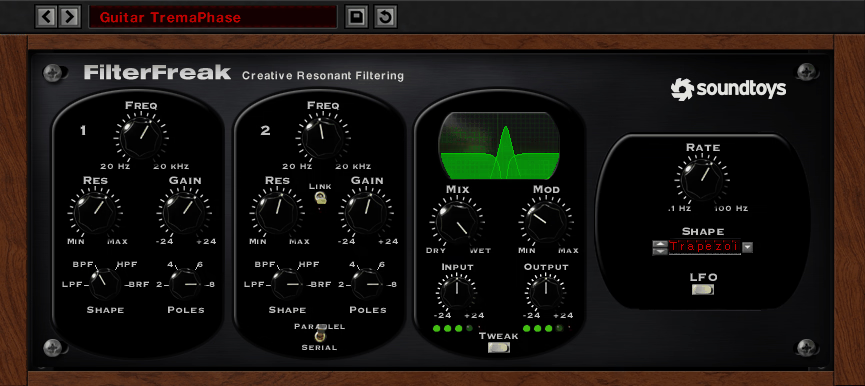
FilterFreak is one of those plugins that has been quietly influencing electronic music production for over two decades without making a lot of noise about it.
Released in 2004, it was built to capture the warmth and character of hardware filters like the Mutron III, Morley Wah, and Sherman Filterbank while adding modulation capabilities that no hardware device could match.
It ships as two plugins: FilterFreak 1 with a single filter and FilterFreak 2 with two filters in series or parallel, and both share the same fundamental character.
- Switchable Filter Types Including HP, LP, BP, and Notch:
You can select highpass, lowpass, bandpass, and band-reject filter modes with 2 to 8 poles, giving you control over how steep the filter slope is rather than just which type it is. The 8-pole modes produce an extremely surgical cutoff that sounds nothing like the 2-pole settings, effectively giving you multiple distinct filter characters within a single mode.
- Seven Analog Saturation Styles:
The saturation section offers seven distortion types including warm tube-like, crunchy, compressive, and more extreme options that can be placed before or after the filter stage. The ability to position saturation pre or post filter changes the character of both elements significantly, and I found routing aggressive saturation into the filter produced the kind of gritty, resonant squelch that hardware filter effects are known for.
- Rhythm Editor with MIDI Sync:
FilterFreak’s standout feature that still feels genuinely novel is the Rhythm Editor, which lets you program custom filter envelope patterns that lock to MIDI clock, creating rhythmic filter sequences that can make static sounds move like live performance.
Patterns are interchangeable with other Soundtoys plugins, so you can share rhythmic patterns between FilterFreak and other effects in a session.
- Two-Filter Architecture in FilterFreak 2:
The second plugin gives you two complete filters that can be patched in series or parallel, with a Link option to drive both simultaneously or operate them independently for different modulation targets. Running two filters with different types and poles in series produces compound filter characters that single-stage filters can’t approximate.
- 6 Modulation Modes Including Step and Sample and Hold:
Beyond standard LFO and envelope following, FilterFreak includes a Step mode, ADSR envelope, and a unique signal threshold trigger that activates modulation when the incoming signal crosses a set level. The Step mode in particular turns FilterFreak into a rhythmic sequencing tool without needing the Rhythm Editor, triggering preset filter positions at each step.
- Self-Oscillation:
Pushing resonance high enough sends the filter into self-oscillation, generating a pitched sine tone from the filter itself that tracks along with your audio. I use this for specific moments where I want a resonant tone to appear from within the processing rather than adding a separate oscillator, and FilterFreak handles the transition from filtered audio to self-oscillation smoothly.
8. Rave Generation Filterbank
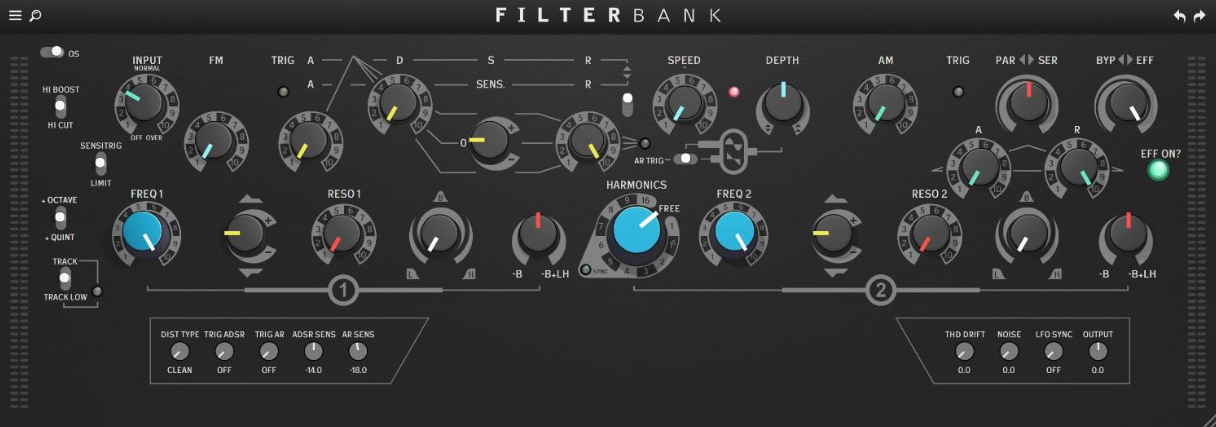
Image Credit: PluginBoutique
Filterbank from Rave Generation is a dual state-variable filter plugin built for producers, sound designers, live performers, and electronic musicians, using a meticulous approach to analog circuit modeling that covers capacitor simulation, diode pair feedback, and component interaction rather than just input-output response matching.
It is a newer entry in this category, released in 2025, but the modeling quality and the specific feature combination makes it worth serious attention for bass music and electronic production contexts.
- Dual SVF Architecture with Diode Pair Simulation:
The core is two independent state-variable filters enhanced with detailed diode and capacitor feedback modeling that recreates the non-linear response of classic analog circuits. The diode pair simulation generates asymmetric distortion that adds harmonic complexity in a way that VCA-based soft clipping doesn’t, and the capacitor simulation introduces time-domain behavior that makes sweeps feel more elastic and reactive.
- Moog-Style Resonance Feedback:
The recursive resonance system mirrors Moog ladder filter resonance behavior, capable of smooth enhancement at moderate settings and self-oscillation when pushed to extremes. The feedback path combines with the diode modeling to produce resonance peaks that feel distinctly alive under fast modulation compared to what most filter plugins produce.
- Comprehensive Modulation Matrix:
The modulation system includes LFOs, AR and ADSR envelopes, and an envelope follower with precise routing and depth control, plus an adaptive pitch tracking feature that locks filter movement to the harmonic content of the input signal for musically relevant sweeps. I found pitch tracking particularly valuable on melodic basslines where the filter naturally follows the pitch of the played notes.
- Dual-Stage Distortion with Thermal Drift:
A two-stage distortion engine with thermal drift emulation adds warmth, saturation, and edge, with the drift behavior introducing subtle organic variation over time that gives the processed signal a living quality. The distortion can be placed in the signal chain relative to each filter stage independently, which changes the character of both the distortion and the filter response significantly.
- Serial and Parallel Filter Routing:
The two filters can be arranged in series for cumulative filtering or parallel for blended operation, with independent control over each filter’s type, cutoff, and resonance. Blending parallel filters with different modes at different cutoffs produces complex, multi-peak frequency responses that no single filter can achieve.
9. Sugar Bytes WOW 2
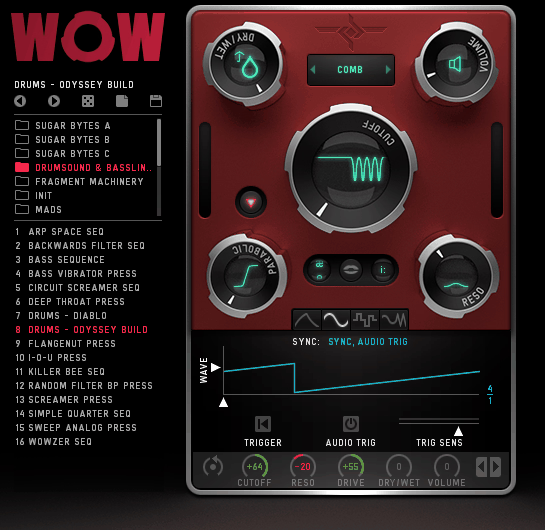
WOW 2 occupies a specific position in the filter plugin market that not many plugins have managed to claim: it is simultaneously one of the most creative and one of the most musical-sounding filter tools available.
The 21 filter types are all free of aliasing with huge resolution according to Sugar Bytes, and in practice the sound quality stands up to that claim. Skrillex, Boyz Noise, SiriusMo, and Modeselektor have all used it, and the kinds of bass sounds and timbral transformations the plugin makes possible have left a clear mark on the electronic music that came out of the era it defined.
- 21 Alias-Free Filter Types:
The filter library covers everything from an 8-pole Lowpass and screaming Comb filter to the dirty Diode MS, the gnarly 030, and various flavors of highpass, bandpass, and resonant multi-mode filters, and all of them operate in Vowel Mode, which applies the filter’s character to formant shaping. I found the Comb filter on sustained bass tones to be particularly spectacular, producing a singing resonance that responds beautifully to slow cutoff sweeps.
- Vowel Mode with Nine Formants:
Every filter in WOW 2 works in Vowel Mode, where you select two of nine vocal formant positions and the filter morphs between them for talkbox-style shaping and surreal modulation. The formant positions cover the phonemes of the vowels in seat, hen, fat, tu, the, father, awe, copy, and boot, and blending between them while filtering produces some of the most distinctly voice-like sounds a filter plugin has ever created.
- Seven Pre/Post Distortion Types:
The distortion section gives you seven algorithms including Parabolic (tube-inspired), Hyperbolic, Diabolic, Sine, 1-bit, Crush, and Digitize, and critically, the distortion can be placed before or after the filter stage. Pre-filter distortion thickens the harmonic content before it gets filtered, while post-filter distortion adds grit to the shaped result. The placement choice produces dramatically different results with the same settings.
- Wobble Generator:
Lifted from Sugar Bytes’ Cyclop synthesizer, the Wobble Generator is an advanced LFO mode that morphs both LFO shape and speed simultaneously, specifically designed for creating the characteristic bass wobble sounds of dubstep and bass music but applicable to any source that benefits from complex, evolving LFO motion.
- Modulatable Modulators:
WOW 2’s modulation system is notable for allowing the modulation sources themselves to be modulated, so the LFO rate can be modulated by the envelope follower, the step sequencer depth can be modulated by the LFO, and so on.
- 250+ Presets with Instant Randomize:
The preset library includes contributions from Drumsound & Bassline Smith and Mouse On Mars among others, covering the full range from clean studio filter sweeps to extreme bass design starting points. A one-click Randomize function generates new random configurations within the current filter type for instant variation when the current preset isn’t moving in the right direction.
10. Waves OneKnob Filter
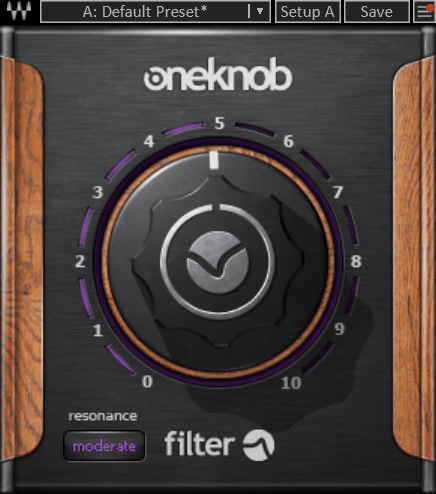
Sometimes the best plugin is the one that’s already loaded on the channel and doesn’t require any decisions. OneKnob Filter is exactly that: a single low-pass filter with one knob that sweeps from fully muted to fully open, with a resonance button that steps through four settings from none to extreme.
El-P from Run the Jewels uses it for automated filter sweeps on “Down” from Run the Jewels 3 and called it “amazing for automated filter sweeps and perfect for milking frequencies out of kick drums and basses.” That’s a precise description of what it does well and why it has earned a permanent place in so many producers’ chains.
- 12dB/Oct Lowpass with Silky Sweep Character:
The 12dB/oct lowpass transition sounds like vintage synthesizer analog circuits according to Waves, with a smooth frequency sweep from below audible range all the way to fully open. I found the smoothness of the transitions particularly notable for DJ-style filter sweeps and mix drops, where any harshness in the transition is immediately audible to a live audience.
- Four Resonance Settings:
The resonance button steps through four settings from none to extreme, which is exactly the right level of control for a one-knob tool. Fully off gives you a clean, neutral filter character. At extreme, the resonance emphasizes the cutoff frequency enough to add a synth-like singing quality to the sweep, particularly on full mixes and drum loops.
- MIDI and Automation Ready:
The single knob is fully automatable and responds to MIDI control, making OneKnob Filter a practical live performance tool that can be mapped to a hardware controller and swept manually in real time. The combination of simplicity and real-time control is why it shows up consistently in both studio and performance contexts.
- Transition and DJ Production:
The smooth, zero-decision workflow makes it the default first choice when you need a filter drop, a frequency buildup, or a quick tonality change in a mix without breaking creative flow. Waves describes it as equally at home from the mixing room to the DJ booth, and the design philosophy genuinely supports both contexts without compromise.
Extra: Kilohearts Filter Table
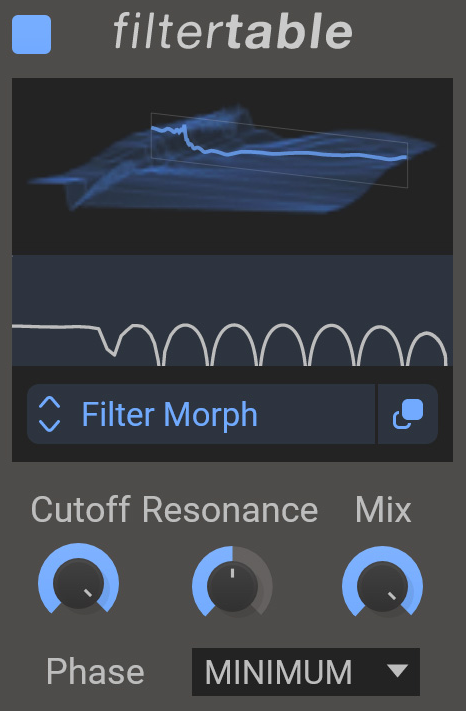
Filter Table is Kilohearts’ most genuinely novel filter concept, and it represents a different kind of creativity from everything else on this list. Rather than emulating or reimagining analog filter circuits, it converts the harmonic content of a wavetable frame into a filter shape that gets applied to any incoming audio.
Scanning through the wavetable smoothly changes the filter response. The results range from standard-ish frequency shaping to completely unpredictable, morphing spectral transformations that no traditional filter architecture could produce.
- Wavetable-Derived Filter Shapes:
The filter shape is generated from the frequency spectrum of a wavetable frame, meaning the filter response at any given moment is literally a visual translation of a waveform into a frequency curve. Factory wavetables cover spectral manipulation, textures, formants, and more, and you can drag in any external wavetable or audio sample for immediate conversion into a filter shape.
- Four Phase Response Modes:
You can choose between Minimum for a snappy, zero-latency response; Linear for phase-aligned parallel processing; Original for preserving the natural phase relationships of the wavetable; and Raw, which uses the unprocessed waveform as a filter kernel for the most unpredictable, artifact-prone results. The Raw mode in particular produces distinctive character that sounds unlike any conventional filter.
- Snapin Ecosystem Integration:
Beyond standalone DAW use, Filter Table works as a Kilohearts Snapin within Phase Plant, Snap Heap, or Multipass, where it can be combined and modulated with other effects at audio rate. In Phase Plant, you can use the Note Modulator at 100% for keytracking the filter cutoff directly to the playing pitch, which makes it genuinely playable as a melodic instrument rather than just an effect.
Get the Free Plugin Starter Kit
The genuinely useful free DAWs and plugins worth installing. No filler. Straight to your inbox.

Hello, I’m Viliam, I started this audio plugin focused blog to keep you updated on the latest trends, news and everything plugin related. I’ll put the most emphasis on the topics covering best VST, AU and AAX plugins. If you find some great plugin suggestions for us to include on our site, feel free to let me know, so I can take a look!