
Semi-modular synthesizers occupy a unique middle ground that I think makes them some of the most interesting instruments available right now.
They give you a working synthesizer out of the box with a default signal path that produces sound the moment you plug in, but they also provide a patch bay that lets you override, reroute, and extend that default path in ways that sealed-panel synths simply can’t.
You get the convenience of a standard synth with the creative flexibility of a modular system, and you don’t need to understand patching to start making music because the internal connections handle that for you until you’re ready to experiment.
What makes semi-modulars particularly compelling for sound designers, ambient producers, and experimentally minded musicians is the patch bay as a gateway. You start by playing the synth normally, learning what each section does through the default routing.
Then you plug in one cable, hear how it changes the sound, and gradually build an understanding of signal flow and modulation routing that would take much longer to develop from scratch in a fully modular system.
I’ve selected eleven semi-modular synths that cover a wide range of approaches, from Moog’s warm, musical instruments through aggressive Behringer recreations to genuinely experimental machines that abandon conventional synthesis architecture entirely.
1. Moog Matriarch
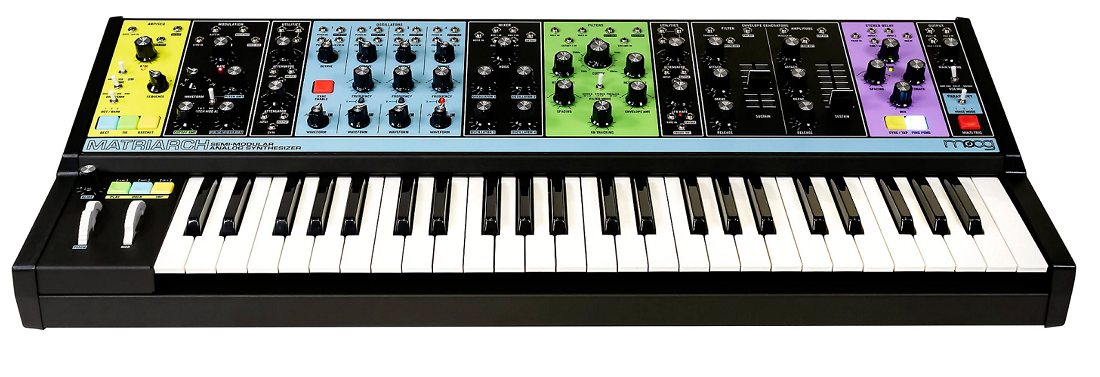
The most powerful semi-modular in Moog’s current lineup, combining four analog oscillators, dual Moog ladder filters, an analog BBD delay, a spring reverb alternative, and a 90-point patch bay in a single instrument with a performance-ready keyboard.
Moog Matriarch works beautifully as a conventional keyboard synth, but the patch bay transforms it into something far more experimental when you start connecting things that the default routing doesn’t.
For producers who want the Moog sound with the creative freedom of modular patching, the Matriarch provides both without requiring any additional modules or external equipment.
- 90 Patch Points
The 90-point patch bay exposes virtually every signal and control voltage in the instrument for external access, including oscillator outputs, filter inputs, envelope outputs, LFO signals, delay send/return, and keyboard CV.
You can break any connection in the default signal flow and reroute it through external processors, create feedback loops by patching the output back into the input, or use the Matriarch’s modules as independent processing blocks for external audio. The depth of the patch bay is what separates the Matriarch from Moog’s simpler semi-modulars.
- Dual Filters
Two independent Moog ladder filters can be configured in series or parallel, each with its own cutoff, resonance, and modulation routing. The dual filter architecture opens up frequency-shaping possibilities that single-filter semi-modulars can’t provide.
You can sculpt two different frequency ranges independently, create dual resonant peaks that interact, or process separate oscillator groups through different filters via the patch bay.
- Analog Delay
A real analog BBD delay built into the signal path adds spatial depth with the specific warm, degrading, pitch-wobbling character that analog delays are prized for. The delay has its own patch bay connections, meaning you can route the delay’s feedback into the filter, use the delay as a sound source by pushing feedback into self-oscillation, or process external audio through the delay independently of the synth voice.
- Paraphonic Play
Four-voice paraphonic capability distributes the four oscillators across up to four notes through the shared filter section. The paraphonic mode adds harmonic complexity beyond single-note playing, and the patch bay lets you route individual oscillator outputs to different destinations for even more varied results.
Get the Free Plugin Starter Kit
The genuinely useful free DAWs and plugins worth installing. No filler. Straight to your inbox.
2. Pittsburgh Modular Taiga Keyboard
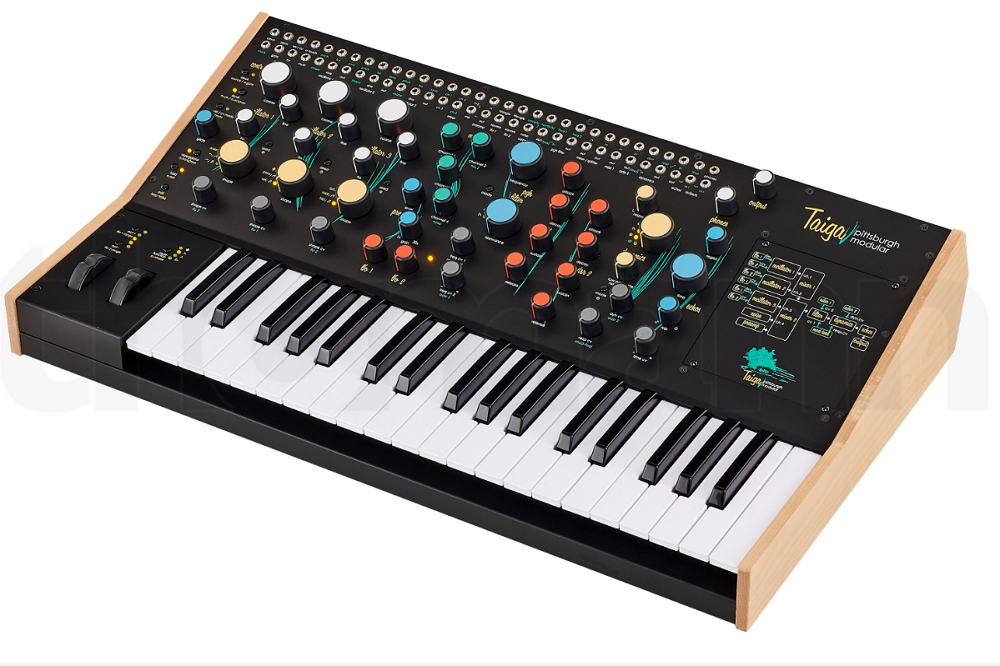
A genuinely original semi-modular design rather than a recreation of any vintage instrument, and the only synth on this list with a built-in Eurorack expansion bay that lets you physically install additional modules into the keyboard itself.
Modular Taiga Keyboard gives you three analog oscillators with proprietary wavefolders, the signature Pittsburgh filter, a dynamics controller that goes beyond standard VCAs, and a 64-point patch bay in a 37-key keyboard format.
The Taiga doesn’t sound like a Moog, a Korg, or a Roland. It has its own distinctive tonal character built around Pittsburgh Modular’s unique circuit designs, which makes it one of the most sonically individual instruments on this list.
- Wavefolders
Each of the three oscillators passes through a proprietary six-stage wavefolder that folds waveforms back on themselves to generate complex harmonic content beyond standard analog waveforms.
The wavefolders add a West Coast synthesis quality to what is otherwise an East Coast subtractive architecture, creating harmonically dense, metallic, and complex tones that simple filtering of standard waveforms doesn’t produce. For sound design, the wavefolders are the Taiga’s most distinctive feature.
- Eurorack Bay
A 24hp powered Eurorack expansion bay built into the keyboard lets you install your own Eurorack modules directly inside the instrument. You can add a fourth oscillator, an additional filter, a digital effects module, a sequencer, or anything else that fits the space.
The expansion bay is unique among semi-modular synths and means the Taiga literally grows with your needs rather than remaining fixed in its factory configuration.
- Dynamics Section
Pittsburgh’s proprietary dynamics controller replaces the traditional VCA with a circuit based on lowpass gate concepts, manipulating both amplitude and harmonic content simultaneously.
As sounds decrease in volume, they also lose brightness, mimicking how acoustic instruments behave in the real world. The dynamics section gives the Taiga a more organic, natural quality than standard VCA-based instruments.
- Pittsburgh Filter
The signature Pittsburgh multimode filter has a specific character described as warm, smooth, and gummy with no dead spots through its frequency range.
The filter supports simultaneous lowpass, bandpass, and highpass modes that can be combined, and the resonance doesn’t thin out the low end the way many filter designs do. The filter is one of the main reasons the Taiga has its own sonic identity distinct from recreations of classic designs.
- BBD Delay
An analog bucket-brigade delay built into the instrument adds spatial and textural processing that’s available at the patch bay for creative routing. The delay can process the main output, act as an independent effect for external signals patched in, or be incorporated into feedback loops for experimental sound generation.
- 64 Patch Points
The 64-point patch bay provides access to virtually every signal and CV in the instrument, including individual oscillator, filter, envelope, LFO, mixer, and delay connections. The extensive patching means you can use the Taiga as a collection of independent analog modules rather than a fixed-signal-path instrument, creating routings that the default internal wiring never intended.
3. Behringer 2600
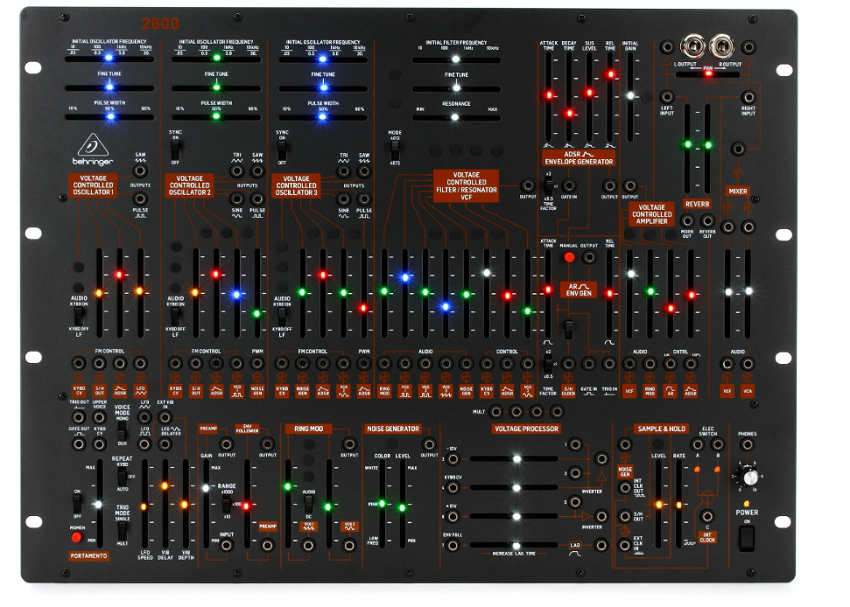
A recreation of the legendary ARP 2600, one of the most influential semi-modular synthesizers in history. The Behringer 2600 reproduces the ARP 2600’s slider-based interface, three oscillators, spring reverb, and the normalized patch bay architecture where the default signal path runs through visual connections on the panel but can be overridden by plugging in cables.
The ARP 2600 is the instrument that taught an entire generation about synthesis through its visual signal flow, and the Behringer version preserves that educational, experimental quality at an accessible price.
- Visual Signal Flow
The panel layout shows the default signal path visually through printed lines connecting the modules, and you override those connections by patching cables into the points along the path.
The visual routing is what made the ARP 2600 legendary as a teaching instrument, because you can see how audio flows from oscillator through filter to amplifier and understand the signal chain by looking at the panel.
- Spring Reverb
A real spring reverb built into the instrument provides the specific metallic, resonant spatial quality that spring tanks are known for. The spring reverb is available at the patch bay, meaning you can process any signal through it and incorporate it into creative feedback routing.
- Three Oscillators
Three analog oscillators with FM capability, ring modulation between them, and independent patch points give you dense harmonic content and the cross-modulation interactions that made the 2600 a sound design standard for film and electronic music.
4. Arturia MiniBrute 2
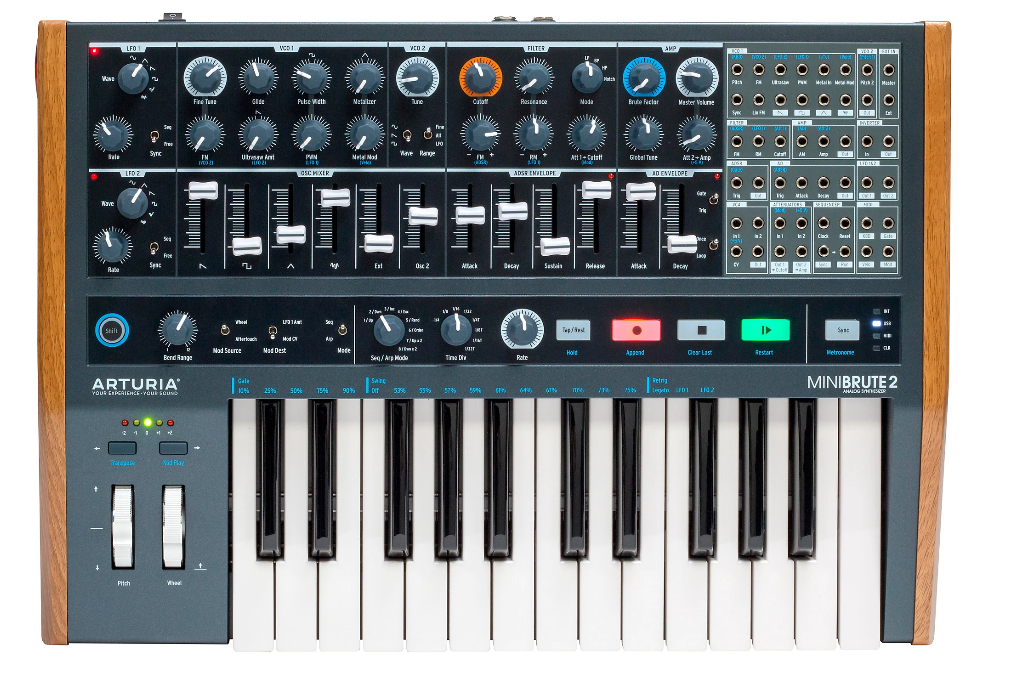
The MiniBrute 2 takes Arturia’s raw analog voice and wraps it in a comprehensive semi-modular package with a 48-point patch bay and a step sequencer that serves double duty as a modulation source.
Arturia MiniBrute 2 gives you the Brute oscillator with its distinctive harmonic content, the Steiner-Parker filter, dual envelopes, dual LFOs, and a workflow that balances accessible synthesis with genuine modular flexibility.
What I appreciate about the MiniBrute 2’s approach to semi-modular is how the sequencer integrates with the patch bay, turning rhythmic sequences into modulation sources that drive the entire instrument in ways that standard synths don’t facilitate.
- Brute Factor
The Brute Factor circuit feeds the signal back into itself, adding feedback-driven distortion and harmonic complexity that ranges from subtle warmth to screaming, aggressive chaos.
The Brute Factor is what gives the MiniBrute its distinctive raw, aggressive character. At low settings it adds edge and overtones. At higher settings it pushes the synth into self-oscillating feedback territory that produces textures no standard distortion circuit creates.
- Sequencer/Mod
The step sequencer functions as both a note programmer and a CV modulation source available at the patch bay. You can program a sequence of control voltage values and route the sequencer’s output to any patchable destination, turning the sequencer into a rhythmic modulation generator for filter cutoff, oscillator pitch, LFO rate, or any other parameter.
- Patch Bay
A 48-point patch bay provides extensive signal routing including audio and CV connections for oscillators, filter, envelopes, LFOs, sequencer, and external inputs. The patch bay is large enough for genuinely complex routing while staying organized on the compact panel.
- Steiner Filter
The Steiner-Parker multimode filter produces a character that’s different from Moog, Roland, or Korg filter designs. The Steiner-Parker has a distinctive resonance behavior that’s more aggressive and less smooth than ladder filters, which suits the MiniBrute’s raw, edgy personality.
5. Moog DFAM
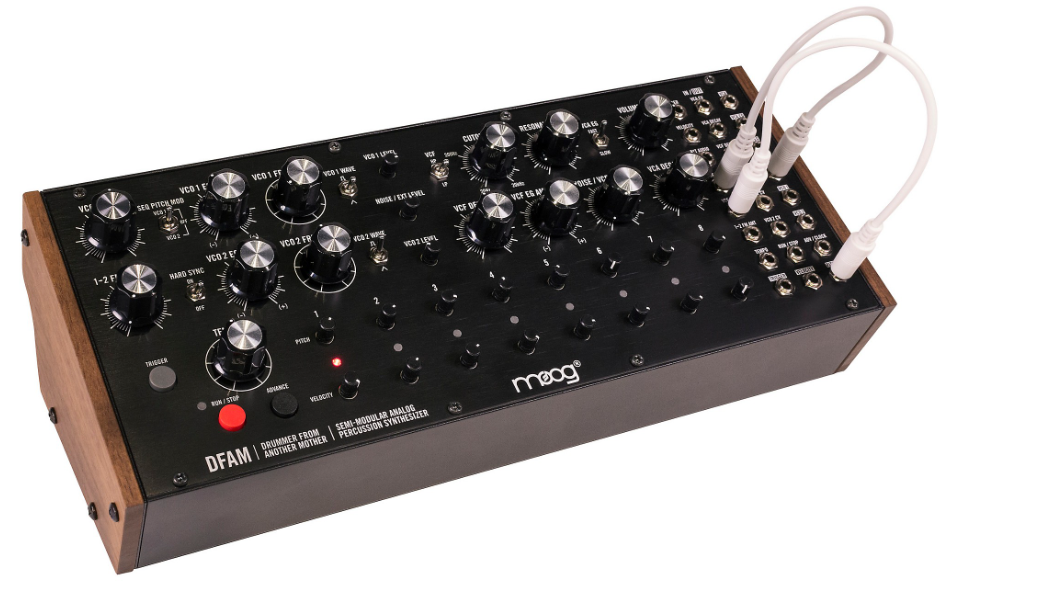
The Drummer From Another Mother is Moog’s semi-modular analog percussion synthesizer, designed to generate drum and percussion sounds entirely from analog synthesis rather than samples.
Moog DFAM uses two analog oscillators through a Moog ladder filter with a built-in 8-step sequencer and an exposed 24-point patch bay that lets you create rhythmic patterns that no sample-based drum machine produces.
The DFAM is the percussive counterpart to the Mother-32, and together they form a complete Moog semi-modular production system.
- Analog Drums
Two analog oscillators through the Moog ladder filter generate drum sounds from raw synthesis rather than playback. Kicks, snares, hi-hats, toms, and completely alien percussion textures all emerge from adjusting oscillator pitch, noise level, filter decay, and VCA envelope.
The synthesized percussion sounds have an organic, weighty quality that sample-based drums don’t carry because every hit is generated fresh by the analog circuit.
- 8-Step Sequencer
The 8-step sequencer with velocity and pitch controls per step drives the percussion patterns. Each step independently adjusts pitch and velocity, meaning your rhythmic patterns have tonal movement built into them. The sequencer is deliberately simple, which keeps the instrument immediate and performance-oriented.
- Patch Bay
A 24-point patch bay provides modulation and signal routing that transforms the DFAM from a simple drum voice into an experimental percussion instrument. You can route oscillator pitches to unexpected destinations, create feedback between the filter and oscillators, or sync the DFAM’s clock to external sources for integrated performance with other gear.
6. Intellijel Designs Cascadia
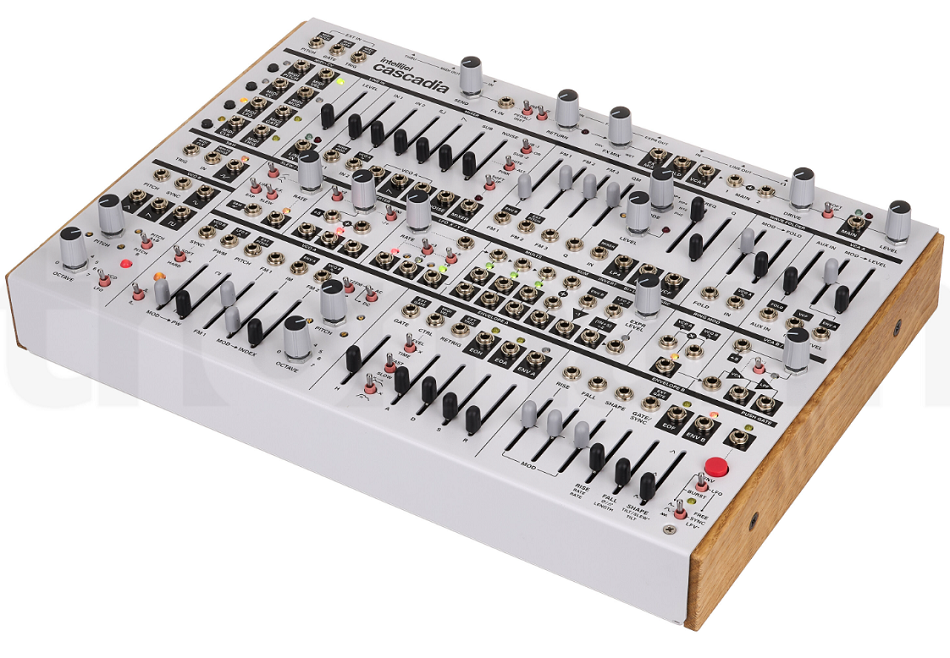
A full-featured semi-modular desktop synthesizer from one of the most respected names in Eurorack modular, designed with the depth and quality that modular enthusiasts expect.
Intellijel Cascadia packs two analog oscillators, a dual-mode filter, function generators, VCAs, a spring reverb model, and a generous patch bay into a desktop format that provides genuine modular-quality synthesis without requiring a Eurorack case.
The Cascadia comes from a company that makes some of the most popular individual Eurorack modules on the market, and the semi-modular instrument reflects that expertise.
- Modular Heritage
The oscillators, filter, and utility modules inside the Cascadia are derived from Intellijel’s acclaimed Eurorack designs, meaning you get modular-grade circuit quality in a self-contained format. The oscillator section draws from the Dixie and Rubicon module lineage, the filter from the Polaris, and the function generators from Quadrax. You’re getting a curated selection of some of the best individual Eurorack modules assembled into a single instrument.
- Function Generators
Multiple function generators replace traditional dedicated LFOs and envelopes with flexible, multipurpose modules that can function as envelopes, LFOs, one-shot bursts, or complex modulation shapes depending on how you configure and patch them. The function generators provide more modulation flexibility than fixed LFO/envelope designs because each one adapts to whatever role your patch needs.
- Dual Filter
A dual-mode filter with different characteristics per mode provides tonal variety from a single filter stage. The filter quality reflects Intellijel’s Eurorack heritage, with clean tracking, musical resonance, and self-oscillation capability that meets the expectations of modular synthesists who are accustomed to high-quality individual filter modules.
- Reverb Model
A spring reverb emulation adds spatial processing within the instrument, available at the patch bay for creative routing. The reverb provides ambient texture and depth without requiring external processing, and its position in the patch bay means you can use it on any signal, not just the main synth output.
- Desktop Quality
The build quality and circuit design reflect Intellijel’s position as a premium Eurorack manufacturer. The panel layout, knob feel, and signal quality meet the standards that modular enthusiasts expect, which sets the Cascadia apart from budget semi-modulars where cost savings are more apparent in the build.
7. Behringer Proton
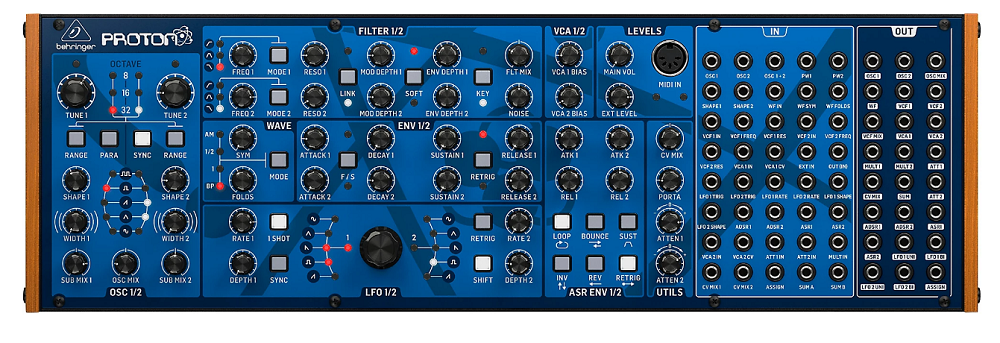
A compact desktop semi-modular inspired by the EDP Wasp, one of the strangest and most characterful synths of the late 1970s.
Behringer Proton recreates the Wasp’s unusual digital oscillator architecture fed through an analog filter with a patch bay that opens up routing possibilities the original never offered.
The Wasp had a specific sound, raw, buzzy, and slightly aggressive, that came from its unconventional digital oscillator design. The Proton captures that character in a desktop format with semi-modular flexibility.
- Wasp Character
The oscillator architecture follows the Wasp’s distinctive design, producing a raw, slightly buzzy, digitally influenced tone that’s different from pure analog oscillator designs. The Wasp sound has a particular edge and presence that cuts through mixes in a way that smoother analog oscillators don’t, which is why the original developed a cult following despite its budget origins.
- Analog Filter
The analog multimode filter shapes the oscillators with resonance and frequency control that adds analog warmth and character to the digitally influenced oscillator output. The filter interaction with the Wasp-style oscillators is what creates the Proton’s specific sonic identity.
- Compact Patching
A patch bay in the compact desktop format provides semi-modular routing without requiring significant desk space. The patching adds creative flexibility beyond the default signal path, letting you create feedback, external processing, and modulation routing in a footprint that fits alongside other desktop synths.
8. SOMA Pulsar-23
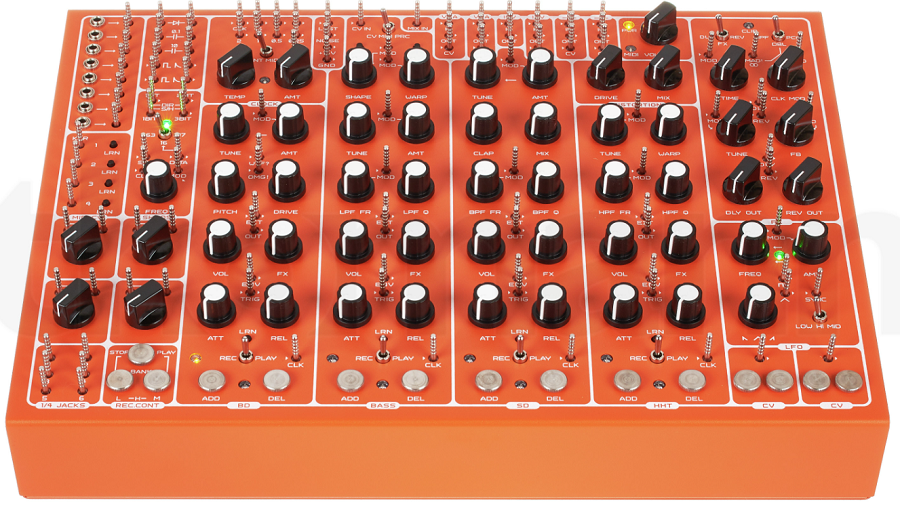
This is the most experimental instrument on the entire list, and it approaches semi-modular synthesis from a direction that no other manufacturer has attempted. SOMA Pulsar-23 is an analog drum machine and bass synthesizer with four independent voices that you patch together using bare metal contact points and alligator clips rather than conventional patch cables and jacks.
The Pulsar-23 abandons virtually every convention of standard synthesis and replaces them with a system where electricity flows through physical connections you create by touching, clipping, and bridging contact points across the instrument’s surface.
- Contact Patching
Bare metal contact points across the instrument’s surface replace conventional patch jacks. You connect them using alligator clips, your fingers, metal objects, or anything conductive. The contact-based patching means you can create connections that conventional patch bays don’t allow, including using your body as a patch cable where touching two points simultaneously creates a modulation routing whose intensity depends on your skin’s resistance.
- Four Voices
Four independent analog voice channels (bass drum, snare, hi-hat, and clap/percussion) each have their own oscillator, envelope, and modulation capabilities. The voices can be cross-patched so one voice modulates another, creating polyrhythmic interactions where the drum sounds influence each other’s pitch, timing, and timbre.
- Chaos Circuits
Built-in chaos and feedback circuits generate unpredictable modulation and audio signals that you can patch into any voice. The chaos circuits produce evolving, never-repeating patterns that add organic variation to rhythmic content, creating drum patterns that shift and mutate over time in ways that programmed patterns don’t.
- Bass Synth
One of the four voices doubles as a bass synthesizer with a dedicated oscillator and filter path, meaning the Pulsar-23 handles both percussion and bass duties from a single instrument. The bass voice carries the same analog weight and character as the drum voices, and you patch it to interact with the percussion for unified rhythmic and tonal content.
9. Moog Mother-32
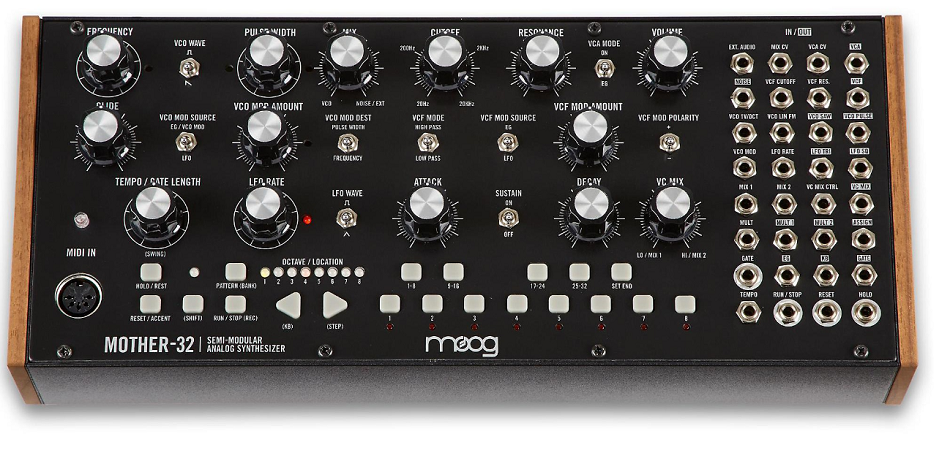
The instrument that started Moog’s modern semi-modular lineup and remains one of the most focused, well-designed entry points into semi-modular synthesis. Moog Mother-32 gives you a single Moog analog oscillator through the Moog ladder filter with a 32-point patch bay and a step sequencer in a compact Eurorack-compatible format.
The Mother-32’s strength is its deliberate simplicity. One oscillator, one filter, one path. You learn what every knob does quickly, and the patch bay extends the instrument exactly when you’re ready to go deeper.
- Focused Design
One oscillator through one filter with a clear, linear signal path provides the simplest possible introduction to semi-modular synthesis while maintaining the full Moog analog sound quality. The simplicity means every patch cable you plug in produces an obvious, understandable change because you’re modifying a signal path you already fully understand.
- Step Sequencer
The 32-step sequencer with ratcheting, gate length control, and assignable outputs drives the Mother-32’s voice and provides CV/gate output for controlling external gear. The sequencer is musical enough for standalone composition and flexible enough to serve as a modulation source through the patch bay.
- 32 Patch Points
The 32-point patch bay provides enough routing to explore creative patching without the overwhelming density of larger semi-modulars.
The patch bay is sized for learning and experimentation rather than encyclopedic completeness, which suits the Mother-32’s role as an entry point into modular concepts.
- Eurorack Format
The Eurorack-compatible 60hp module can be removed from its standalone case and installed in a Eurorack system, transforming the Mother-32 from a standalone synth into part of a larger modular setup.
The dual-use design means your investment grows with you if you eventually build a modular system.
- Stackable
Multiple Mother-32 units stack mechanically and sync musically, and they integrate with Moog’s other semi-modulars (DFAM, Subharmonicon) for a complete Moog semi-modular ecosystem. Building a stack of Moog semi-modulars creates a compact but powerful analog production system where each instrument handles a different role.
10. Behringer NEUTRON
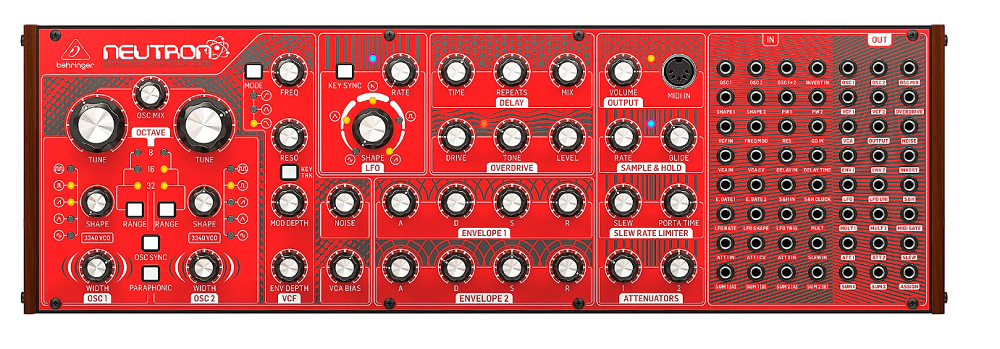
One of the most feature-dense semi-modular synths available at a budget price, packing two analog oscillators, a multimode filter, two LFOs, two envelopes, a BBD delay, overdrive, and a 56-point patch bay into a compact desktop format. Behringer NEUTRON covers more synthesis ground per dollar than most instruments on this list.
The Neutron isn’t based on any specific vintage synth. It’s Behringer’s own design, and the feature density combined with the extensive patch bay makes it one of the most flexible budget semi-modulars available.
- Feature Density
The sheer amount of synthesis capability, two VCOs, a multimode filter, two envelopes, two LFOs, sample-and-hold, noise, overdrive, and a BBD delay, packed into a single compact desktop module at this price point is genuinely notable. You get a complete synthesis toolkit that covers bass, leads, effects, drones, and percussion without needing any additional modules.
- 56 Patch Points
The 56-point patch bay provides extensive routing for a budget instrument, with access to oscillator, filter, envelope, LFO, delay, and utility connections. The patch bay density means the Neutron supports complex creative routing that many semi-modulars at higher prices don’t offer simply because they have fewer patch points.
- Overdrive Circuit
A built-in analog overdrive adds harmonic distortion that ranges from subtle warmth to aggressive clipping. The overdrive processed through the patch bay means you can place it anywhere in the signal chain, not just at the output, which opens up tonal possibilities that fixed-position distortion doesn’t provide.
- BBD Delay
An analog bucket-brigade delay with its own patch bay connections adds spatial processing with the warm, degrading character of analog delay. The delay is particularly useful for semi-modular patching because feeding the delay output back into the filter or oscillators creates evolving, self-modulating textures.
11. Moog Subharmonicon
Closing the list with the most conceptually unusual Moog semi-modular and one of the most fascinating instruments in this entire roundup.
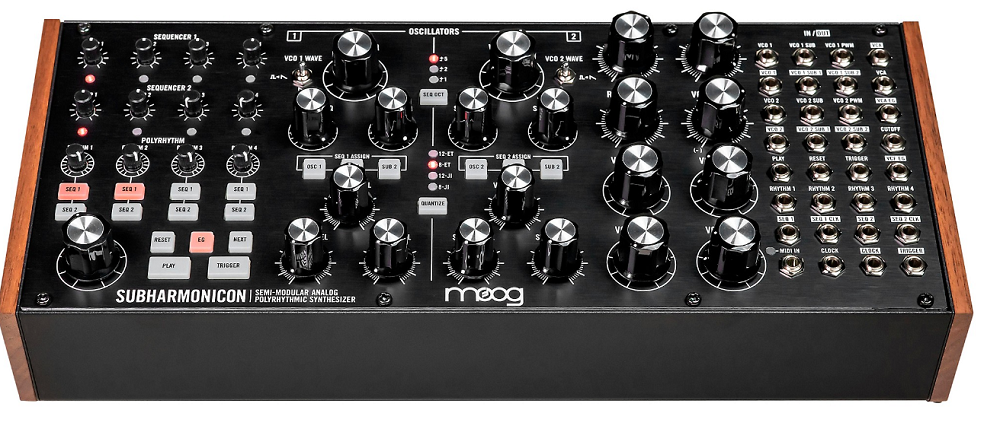
Subharmonicon generates sound through subharmonic oscillators that produce pitches derived from mathematical subdivisions of a fundamental frequency, which is an approach to pitch generation that standard oscillators don’t use. The result is harmonically related tones that create chords and intervals from a single fundamental.
The Subharmonicon also includes a polyrhythmic step sequencer where multiple sequence tracks run at different subdivisions of a master clock, creating rhythmic patterns that phase against each other over time.
- Subharmonics
Two main oscillators each feed two subharmonic generators that produce pitches at mathematically related subdivisions of the main oscillator frequency. Selecting different subdivision ratios generates intervals (octaves, fifths, fourths, thirds) that are inherently in harmonic relationship to the fundamental. The subharmonic approach creates chord-like textures from oscillator relationships rather than from playing multiple keys, which produces a specific consonant, harmonically locked quality that independently tuned oscillators don’t replicate.
- Polyrhythmic Seq
A four-track step sequencer where each track runs at a different rhythmic subdivision of the master clock creates patterns that phase and realign over extended cycles. Track one might run at quarter notes while track two runs at sixths and track three at fifths, creating polyrhythmic content that shifts and evolves across dozens of bars before the pattern cycle repeats.
- Moog Circuit
The Moog analog oscillators and ladder filter provide the warm, harmonically rich tone quality that defines the Moog sound, applied to the subharmonic and polyrhythmic concepts. The Moog circuit quality means the experimental pitch and rhythm generation sounds musical and warm rather than clinical and cold.
- Patch Bay
A 48-point patch bay provides extensive routing for the subharmonic oscillators, sequencer tracks, envelopes, and filter. The patching lets you cross-modulate between the subharmonic generators, route sequencer tracks to unexpected destinations, and create feedback paths that exploit the mathematical relationships between the subharmonic frequencies.
- Sequencer Sync
The sequencer synchronizes with the Mother-32, DFAM, and other clock-capable instruments, which means the Subharmonicon’s polyrhythmic content integrates with conventional rhythmic patterns from other gear. The sync capability is essential because the Subharmonicon’s polyrhythmic output becomes most musically interesting when it’s phasing against a steady rhythmic foundation from another source.
- Chord Generation
The subharmonic generators effectively create chords from a single note input by generating harmonically related pitches automatically.
You play a single note and the subharmonics produce a chord structure beneath it based on the subdivision ratios you’ve selected. For ambient, drone, and experimental music, the automatic chord generation from a monophonic input produces textures that conventional synthesis approaches require multiple voices and careful tuning to achieve.
Get the Free Plugin Starter Kit
The genuinely useful free DAWs and plugins worth installing. No filler. Straight to your inbox.

Hello, I’m Viliam, I started this audio plugin focused blog to keep you updated on the latest trends, news and everything plugin related. I’ll put the most emphasis on the topics covering best VST, AU and AAX plugins. If you find some great plugin suggestions for us to include on our site, feel free to let me know, so I can take a look!