
 The 37-key format hits a sweet spot that I think more producers should consider. It gives you three full octaves of playing range, which is enough for two-handed playing, comfortable chord voicing, and melodic work without constant octave switching, while taking up roughly half the desk space of a 61-key controller.
If your primary instrument is a DAW and you’re using a MIDI controller to input notes, trigger sounds, and control parameters rather than performing extended piano passages, 37 keys provides most of what you practically need.
What separates the options in the 37-key space is everything that surrounds the keys: the pads, knobs, faders, arpeggiators, sequencers, and DAW integration features that transform a keyboard from a simple note input device into a production control surface.
Some controllers on this list are pure keyboards with minimal extras. Others pack enough controls to function as the central hub of your entire production workflow.
I’ve picked ten controllers (plus one bonus) that represent the best current options for producers who want the 37-key balance of playability and space efficiency, from full-featured production centers through DAW-specific designs to ultra-portable, stripped-down keyboards for when you need nothing more than keys and velocity.
1. 37-Key MIDI Controller Keyboard — $129.99

Starting with an option from the Pluginerds store before the specialist 37-key controllers below.
The 37-Key MIDI Controller Keyboard gives you 37 full-size keys across three octaves, pitch and modulation wheels, and USB-C connectivity at $129.99. Every 37-key article exists because the format is the practical starting point for serious MIDI performance in a compact footprint — three octaves covers most playing requirements, and the pitch and mod wheels let you perform expressively in real time. This covers those fundamentals. The controllers below add weighted action, aftertouch, assignable encoders, deep DAW integration, and build quality that the more capable options in this list provide at higher cost.
- Three-Octave Range
37 keys gives you complete coverage from C2 to C5 in a single position without octave shifting — wide enough for the majority of melodic and harmonic programming, narrow enough to sit comfortably on a desk without dominating the workspace.
For producers whose main constraint is desk space, the 37-key format is the considered choice rather than a compromise. You keep the range you actually need while freeing up the space that a 49 or 61-key controller takes.
- Pitch and Mod Wheels
Dedicated pitch bend and modulation wheels provide real-time expressive control that pad-only and strip-based controllers handle less naturally.
Smooth pitch bends, vibrato, and modulation automation are all more intuitive on wheels than on any other interface. For the cost of entry into 37-key keyboards, dedicated wheels are a meaningful indicator of a controller designed for actual performance rather than transport control.
- USB-C
USB-C connectivity works without adapters on current computers and handles both power and MIDI data over a single cable. No separate power supply required.
Shop at Pluginerds — 37-Key MIDI Controller Keyboard $129.99
Get the Free Plugin Starter Kit
The genuinely useful free DAWs and plugins worth installing. No filler. Straight to your inbox.
2. Arturia KeyStep Pro
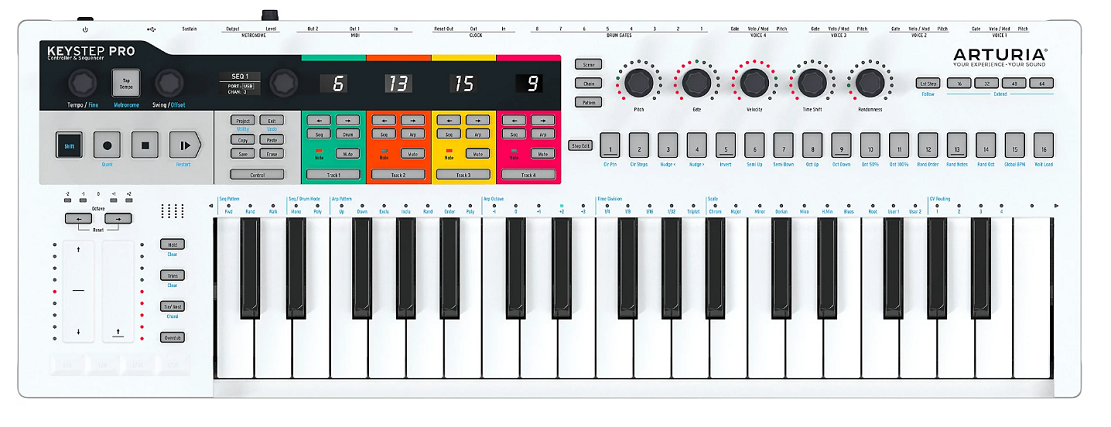
Far more than a MIDI controller, the KeyStep Pro is a four-track polyphonic sequencer, arpeggiator, and performance keyboard that serves as the central hub for both software and hardware setups.
KeyStep Pro gives you 37 slim keys with velocity and aftertouch alongside four independent sequencer tracks with their own CV/Gate outputs, drum sequencing capability, and extensive MIDI connectivity that bridges the gap between your DAW and any hardware synths you own.
The KeyStep Pro isn’t competing with basic MIDI keyboards. It’s competing with standalone sequencers and performance controllers, and the fact that it also has a quality keyboard attached makes it uniquely versatile.
- Four Sequencers
Four independent polyphonic step sequencers with up to 64 steps each run simultaneously, each with their own MIDI channel or CV/Gate output.
You program a bass line on track one, chords on track two, a melody on track three, and drums on track four, and all four sequences play back independently while you control tempo, swing, and randomization globally. The sequencer depth is what elevates the KeyStep Pro from controller to composition tool.
- CV/Gate Outputs
Dedicated CV/Gate/Mod outputs for each sequencer track plus additional CV/pitch/velocity outputs connect the KeyStep Pro directly to analog synthesizers and Eurorack modules without requiring a separate MIDI-to-CV converter.
For producers with hardware synths, the CV connectivity means the KeyStep Pro controls both your software instruments and your analog gear from a single device with tight timing.
- Chord Memory
A chord mode lets you play full chords from single key presses, and you can program custom chord shapes that transpose across the keyboard. The chord mode is useful for quick composition when you want to hear harmonic progressions without voicing every chord manually, and it integrates with the sequencer so you can sequence chord progressions.
- Arpeggiator
A deep arpeggiator with multiple modes, gate control, swing, and pattern options generates melodic content from held notes. The arp interacts with the sequencer, meaning you can arpeggiate a sequence or sequence an arpeggio, creating layered rhythmic and melodic content from the KeyStep Pro alone.
3. AKAI Professional MPK Mini Plus
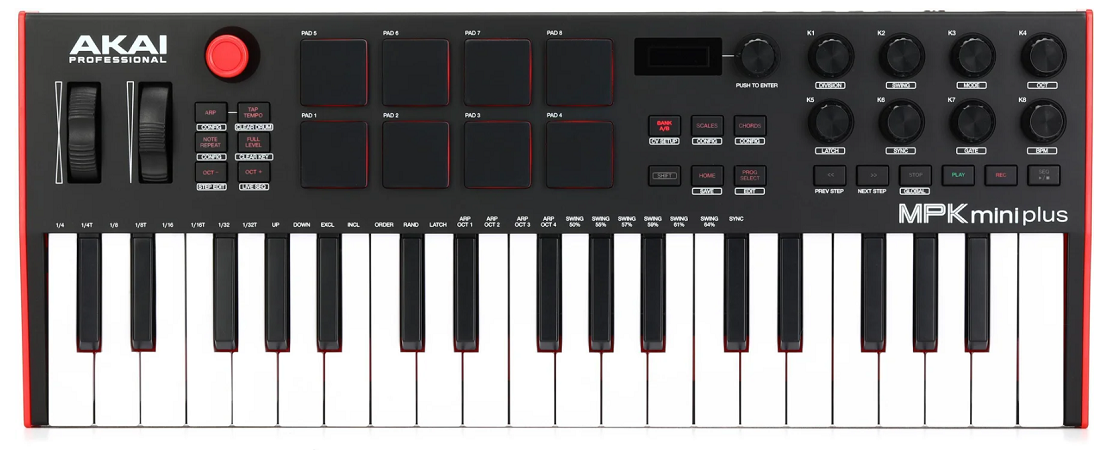
The updated Mini Plus takes the concept that made the original MPK Mini one of the best-selling MIDI controllers ever and expands it with a 37-key keybed, more pads, and an onboard sound engine that lets you make music without a computer connected.
AKAI MPK Mini Plus gives you 37 mini keys, 16 velocity-sensitive pads, 8 assignable knobs, and a built-in speaker with an integrated sound engine containing synth, organ, and electric piano sounds.
The standalone sound capability is what sets the MPK Mini Plus apart from standard MIDI controllers. You can use it as a regular controller when connected to your DAW, but you can also pick it up and play it anywhere without a computer.
- Built-in Engine
A standalone sound engine with synth, organ, electric piano, and other instrument sounds plays through the built-in speaker or headphones without a computer connected.
For practice, idea sketching, and portable music making, the onboard sounds mean you’re never limited to silent key pressing when you’re away from your studio. The sound quality won’t replace your software instruments, but it’s genuinely usable for capturing ideas on the go.
- 16 Pads
16 velocity-sensitive MPC-style pads with four pad banks provide 64 total pad assignments for drums, samples, clips, and MIDI triggering. The pads carry the MPC heritage that AKAI built its reputation on, and they’re responsive enough for finger drumming. Having pads alongside 37 keys means you can play melodic parts and trigger drums from the same controller.
- Arpeggiator
A built-in arpeggiator with multiple modes and tempo control generates patterns from held notes. The arp works both in standalone mode with the onboard sounds and in controller mode with your DAW, adding melodic generation capability that basic MIDI keyboards don’t include.
- 8 Knobs
Eight assignable rotary encoders provide hands-on control over software parameters, virtual instrument settings, or mixer levels. The knobs are positioned above the keyboard for easy access during playing, and they’re freely assignable to any MIDI CC for custom mapping to your specific software workflow.
- Software Bundle
A comprehensive software package including MPC Beats production software, virtual instruments, and effects provides a complete production environment for producers who are starting from scratch. The software bundle means you can go from unboxing to producing music without spending anything additional on software.
- USB-C Power
USB-C connectivity with bus power means a single cable connects the MPK Mini Plus to your computer for both power and MIDI data. The USB-C connection is more robust than the micro-USB found on older models, and the bus power eliminates the need for external adapters.
4. Nektar Impact GX Mini
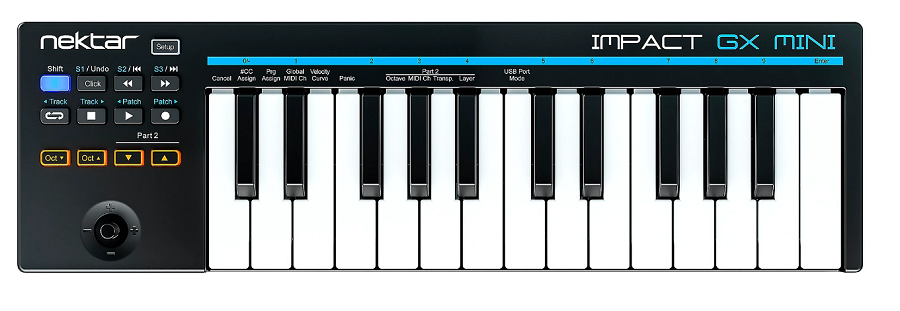
Stripped back to the essentials and focused purely on being a reliable, responsive 37-key MIDI input device without the extras that inflate the cost of more feature-rich controllers. Nektar Impact GX Mini gives you 37 velocity-sensitive mini keys with DAW integration for major platforms in a straightforward, no-frills package.
Sometimes you just need keys and nothing else, and the GX Mini handles that role with a clean design and solid key feel at a price that’s hard to argue with.
- DAW Integration
Pre-configured integration profiles for major DAWs including Ableton Live, Logic, Cubase, and others provide automatic mapping of transport controls and basic parameters without manual MIDI learn setup. The integration means your play, stop, record, and navigation controls work immediately after selecting your DAW profile.
- Clean Design
The minimal, uncluttered layout focuses on the keyboard itself without pads, knobs, or faders competing for desk space. For producers who already have a separate pad controller or use mouse-based control for parameters, the clean design means you get 37 keys in the smallest possible footprint.
- Key Feel
The velocity-sensitive mini keybed provides consistent response across the range with a feel that’s reliable for note input and basic performance. The keys won’t compete with full-size keybeds for expressive playing, but they’re responsive enough for accurate MIDI input at a budget price.
5. Korg microKEY 37 MkII
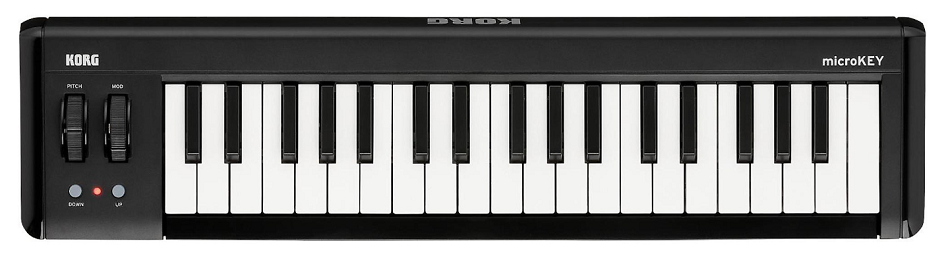
Korg’s ultra-compact 37-key controller built around their Natural Touch mini keybed that I find more playable than most competing mini-key designs. MicroKEY 37 MkII keeps things simple with the keyboard, octave buttons, a sustain button, and a joystick controller for pitch bend and modulation, all in a lightweight package that barely takes up more space than a laptop.
The microKEY’s strength is the key feel. Korg’s Natural Touch mechanism has a slightly different action than standard mini keys, with a responsiveness and consistency that makes quick melodic input feel natural.
- Natural Touch
Korg’s Natural Touch mini keybed provides a playing feel that’s noticeably different from generic mini-key mechanisms. The keys have a slightly more cushioned response with better velocity sensitivity consistency across the range. For producers who find most mini keys too stiff or too mushy, the Natural Touch feel is worth trying because it sits in a middle ground that many players prefer.
- Joystick
A multi-axis joystick combines pitch bend and modulation control into a single physical interface. The joystick provides the same functional control as separate pitch and mod wheels but in a fraction of the space, which is practical for a controller designed around compactness.
- Sustain Button
A dedicated sustain button on the panel provides sustain pedal functionality without requiring an external pedal. For quick sketching sessions where you want to sustain notes but don’t have a pedal connected, the onboard button is a practical inclusion.
- Lightweight
At well under a kilogram, the microKEY 37 is one of the lightest 37-key controllers available, making it genuinely practical for travel and mobile production. You can toss it in a bag alongside your laptop without adding significant weight.
6. Novation Launchkey 37 MK4
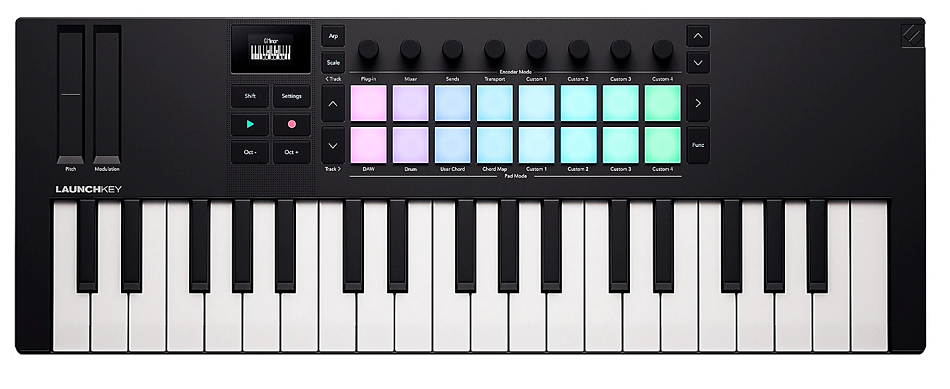
Novation’s flagship compact controller designed specifically for deep integration with Ableton Live while working well with any DAW. Launchkey 37 MK4 gives you 37 full-size keys with aftertouch, 16 velocity-sensitive pads, 8 rotary encoders, and 9 faders in a format that provides comprehensive production control alongside a quality keybed.
The full-size keys are what distinguish the Launchkey 37 from mini-key controllers. If you need expressive playing alongside production controls, the MK4 provides both without stepping up to a larger format.
- Full-Size Keys
37 full-size velocity-sensitive keys with channel aftertouch provide a playing experience that mini-key controllers can’t match. The full-size keybed makes the Launchkey 37 suitable for expressive performance where touch sensitivity, aftertouch modulation, and comfortable finger spacing matter. The aftertouch adds a modulation dimension that you control through pressure rather than reaching for a separate control.
- Fader Bank
Nine faders alongside the rotary encoders provide dedicated level control for mixer channels, which is unusually comprehensive for a 37-key controller. The faders make the Launchkey 37 function as a partial mixing surface alongside its keyboard and pad duties, reducing the need for a separate fader controller.
- Ableton Mode
A dedicated Ableton Live integration mode provides automatic mapping of session view clips, device parameters, mixer controls, and transport functions. The integration goes deeper than basic MIDI CC assignment because Novation has worked with Ableton to create a custom protocol that provides visual feedback on the controller’s LEDs reflecting Ableton’s session state.
7. IK Multimedia iRig Keys 2 Pro
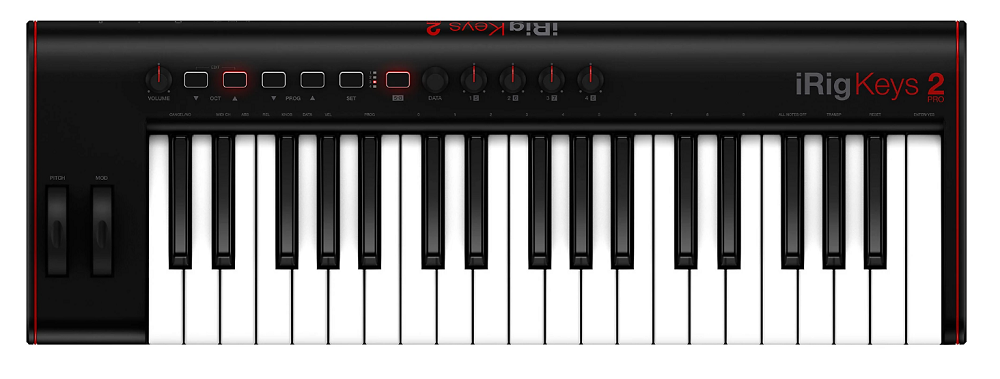
A full-size 37-key controller designed to work equally well with computers, iOS devices, and Android devices through a range of connectivity options. iRig Keys 2 Pro gives you 37 full-size velocity-sensitive keys with four assignable knobs, a volume/data slider, and connections for USB, Lightning, and standard USB-C, making it one of the most universally compatible controllers available.
The cross-platform compatibility is the iRig Keys 2 Pro’s defining feature. Most MIDI controllers work with computers and maybe iOS. The iRig Keys 2 Pro works with effectively everything.
- Universal Connect
Simultaneous connectivity options for USB (computer), Lightning (older iOS), and USB-C (newer iOS and Android) mean the iRig Keys 2 Pro connects to practically any device you own without adapters. You plug the appropriate cable into your computer, iPad, iPhone, or Android device and the controller works immediately. The universal compatibility eliminates the platform-specific limitations that most controllers impose.
- Full-Size Keys
37 full-size velocity-sensitive keys provide a comfortable playing surface in a controller that’s still portable enough for mobile production. The full-size keybed is what separates the iRig Keys 2 Pro from the mini-key iRig options and makes it suitable for producers who want a playable mobile keyboard rather than just a note input device.
- Audio Output
A 1/4-inch audio output lets you connect directly to amplifiers, speakers, or audio interfaces, which is useful when using the iRig Keys 2 Pro with iOS devices that lack dedicated audio output for synth apps. The audio connection simplifies mobile setups where you’re using the controller with an iPad running synth applications.
- Software Bundle
An extensive software package including IK Multimedia’s SampleTank, Syntronik, and other virtual instruments provides a complete production toolkit alongside the hardware. The bundle is particularly valuable for iOS users because it includes mobile versions of IK’s instruments.
- Compact Footprint
Despite the full-size keys, the iRig Keys 2 Pro maintains a compact overall footprint by minimizing the panel space around the keybed. The controller is narrower front-to-back than many competing full-size 37-key designs, which matters when desk depth is limited.
8. Midiplus X3 Mini
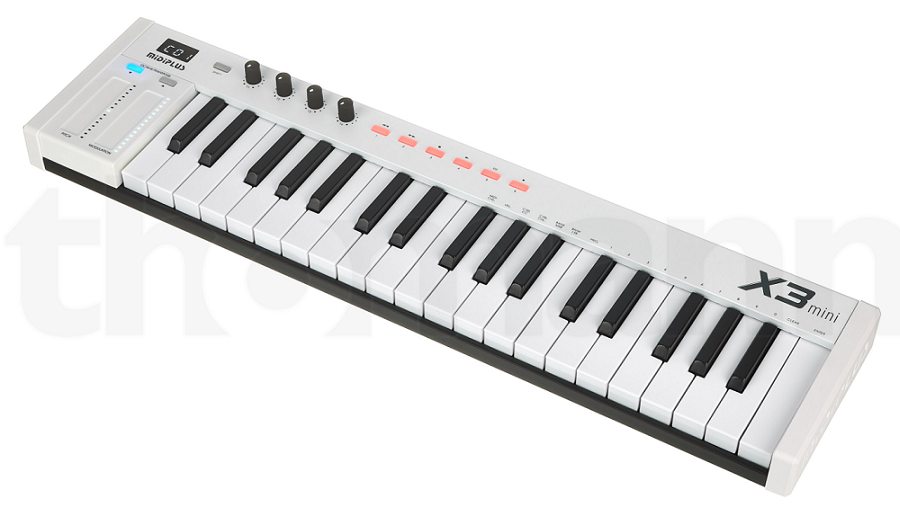
The budget pick on this list, offering 37 velocity-sensitive mini keys with four assignable knobs, capacitive touch strips for pitch and modulation, and a 3-digit LED display at a price that undercuts most competing 37-key controllers significantly. Midiplus X3 Mini doesn’t have the build quality or feature depth of the more expensive options here, but it delivers functional 37-key MIDI control at the lowest cost of entry on this list.
For producers who need 37 keys on a tight budget and don’t require pads, faders, or deep DAW integration, the X3 Mini covers the basics without the extras you’re not paying for.
- Touch Strips
Capacitive touch strips for pitch bend and modulation replace physical wheels, keeping the controller’s profile slim while providing the essential performance controls. The touch strips respond to finger position and pressure, giving you pitch bend and mod control in a space-efficient format that traditional wheels would require more panel depth to accommodate.
- Four Knobs
Four assignable rotary encoders with customizable MIDI CC mapping provide hands-on parameter control for your DAW or virtual instruments. The knobs are pre-assigned to common functions (volume, pan, expression, reverb) but can be reconfigured for any purpose.
- LED Display
A 3-digit LED display shows the current octave, transpose setting, and parameter values, which is more visual feedback than many ultra-budget controllers offer. The display eliminates guesswork about your current octave position or control values.
9. Novation Launchkey Mini 37 MK4
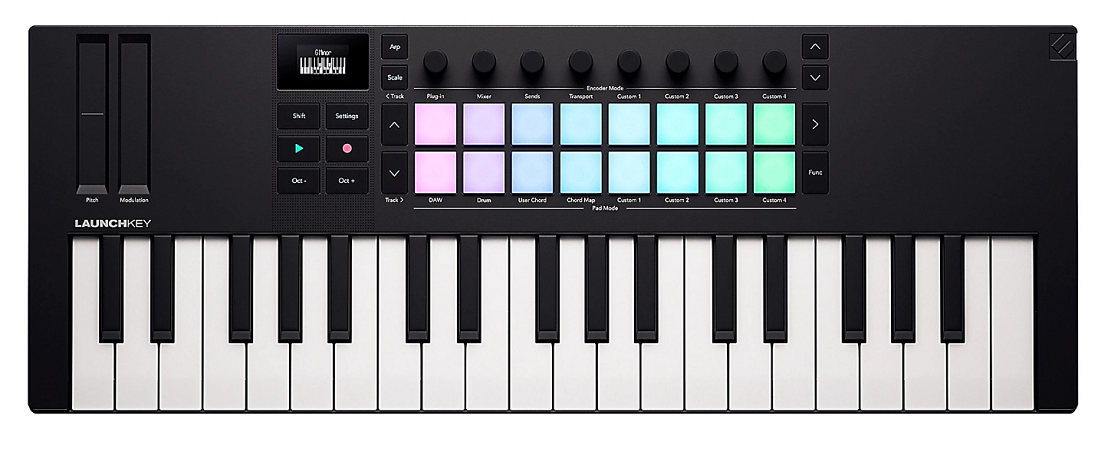
Taking the popular Launchkey Mini concept and stretching it to 37 mini keys while maintaining the compact form factor that made the Mini series successful. Novation Launchkey Mini 37 MK4 gives you the same pad and control layout as the standard Launchkey Mini but with significantly more keyboard range, keeping the 16 RGB pads, 8 knobs, and deep DAW integration in a controller that’s barely wider than a standard 25-key mini.
For producers who love the Launchkey Mini’s workflow but find 25 keys too limiting, the 37-key version solves that problem without dramatically increasing the desk footprint.
- Mini Format
The 37-key version maintains the compact proportions of the Launchkey Mini series rather than expanding to the larger chassis of the standard Launchkey. The mini format means you get the extra octave of range in a controller that still fits in tight spaces where a full-size 37-key wouldn’t work.
- RGB Pads
16 velocity-sensitive RGB pads provide clip launching, drum programming, and chord mode functionality with visual feedback through LED colors. The pads display clip status, note mapping, and mode information through color coding, which provides immediate visual context during production.
- Scale Mode
A scale mode locks the keyboard to notes within a selected musical scale, preventing wrong notes during performance and composition. The scale constraint is useful for melodic input when you want to stay within a key without thinking about which notes are safe, and it applies to both the keys and the pads.
- Fixed Velocity
A fixed velocity option sends consistent velocity values regardless of how hard you press the keys, which is useful for step-entering notes where you want uniform dynamics or for triggering samples where velocity variation isn’t desired. The toggle between velocity-sensitive and fixed modes gives you flexibility for different input scenarios.
10. Novation FLkey 37
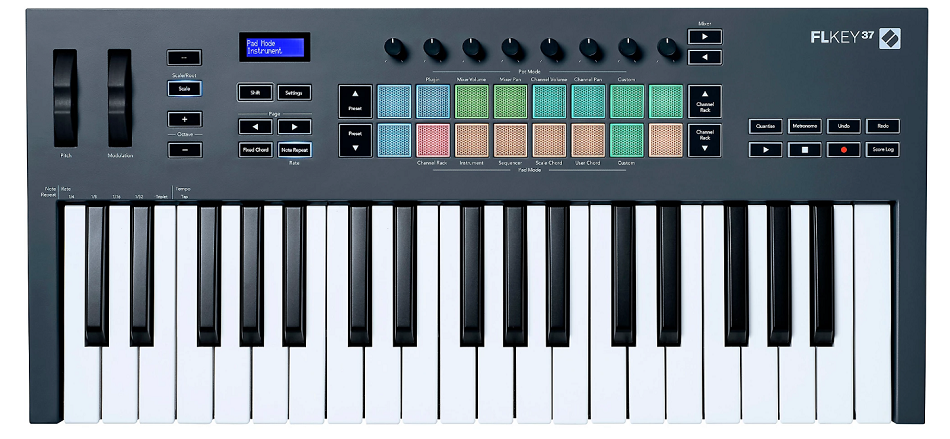
Built specifically for FL Studio with custom integration that maps the FLkey’s controls to FL Studio’s channel rack, mixer, piano roll, and playlist in ways that generic controllers don’t handle natively. Novation FLkey 37 gives you 37 full-size keys, 16 pads, 8 knobs, and a dedicated control surface designed from the ground up for the FL Studio workflow.
If FL Studio is your primary DAW, the FLkey 37 eliminates virtually all manual MIDI mapping because Novation and Image-Line collaborated on the integration.
- FL Studio Map
Pre-configured mappings for FL Studio’s channel rack, mixer, piano roll, step sequencer, and playlist provide immediate, deep control without manual MIDI learn setup. The integration means knobs automatically control the active channel’s parameters, pads trigger the step sequencer, and transport controls manage playback, all configured out of the box.
- Channel Control
Automatic parameter mapping to the active channel in FL Studio’s channel rack means the eight knobs always control the most relevant parameters for whatever instrument or plugin you currently have selected. Switch channels and the knobs follow, providing context-sensitive control that generic controllers require manual setup to achieve.
- Score Logger
A score logging function captures notes you play even when FL Studio’s recording isn’t armed, letting you recover ideas you played spontaneously. The score logger catches the moments where you were just noodling and accidentally played something worth keeping, which happens more often than deliberate recording for many producers.
- Quantize Input
Real-time input quantization corrects your played notes to the grid as you record, which is useful for producers who prefer playing parts live but want rhythmically precise results. The quantization snaps notes to your selected grid value without requiring post-recording editing in the piano roll.
- Full-Size Keys
37 full-size velocity-sensitive keys provide a playing surface suited to performing parts rather than just step-entering notes. The full-size keybed gives the FLkey 37 an advantage over mini-key FL Studio controllers for producers who play their parts live and want a comfortable, responsive keyboard.
Extra: Miditech Garagekey Mini
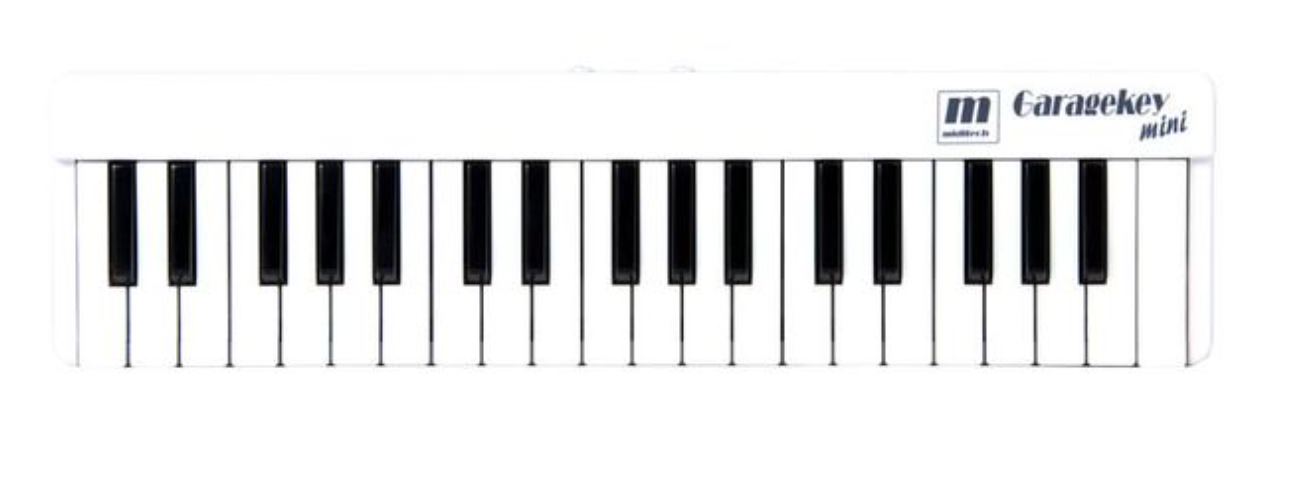
I’m including this as a bonus because it represents the absolute minimum viable 37-key MIDI controller, the smallest and simplest option for producers who need nothing more than 37 velocity-sensitive mini keys and octave buttons in the most compact possible format. Miditech Garagekey Mini measures just 45cm wide and weighs almost nothing, which means it fits in a laptop bag alongside your computer with room to spare.
The Garagekey Mini has no knobs, no pads, no faders, and no pitch or mod wheels. It’s just keys and octave buttons. But sometimes that’s exactly what you need.
- Ultra-Compact
At 45cm x 12cm, the Garagekey Mini is one of the smallest 37-key controllers ever made, fitting in spaces where even other mini-key 37-key controllers won’t go. The dimensions are barely larger than many 25-key controllers, which means you get an extra octave of range in essentially the same footprint.
- Bus Powered
USB bus power with no external adapter required means a single USB cable handles both power and MIDI data. The cable-only operation keeps your mobile setup to the absolute minimum: laptop, USB cable, Garagekey, done.
- Class Compliant
Driverless operation across Windows, Mac, and iOS means the Garagekey Mini works immediately when plugged in without downloading or installing anything. The class-compliant operation is particularly useful for iOS users who want a simple, immediate keyboard input for iPad synth apps.
- Velocity Keys
Velocity-sensitive mini keys provide dynamic response despite the ultra-compact and ultra-affordable format. The velocity sensitivity means your playing dynamics translate to the software, which is a feature that some ultra-budget controllers omit.
Get the Free Plugin Starter Kit
The genuinely useful free DAWs and plugins worth installing. No filler. Straight to your inbox.
Hello, I’m Viliam, I started this audio plugin focused blog to keep you updated on the latest trends, news and everything plugin related. I’ll put the most emphasis on the topics covering best VST, AU and AAX plugins. If you find some great plugin suggestions for us to include on our site, feel free to let me know, so I can take a look!