
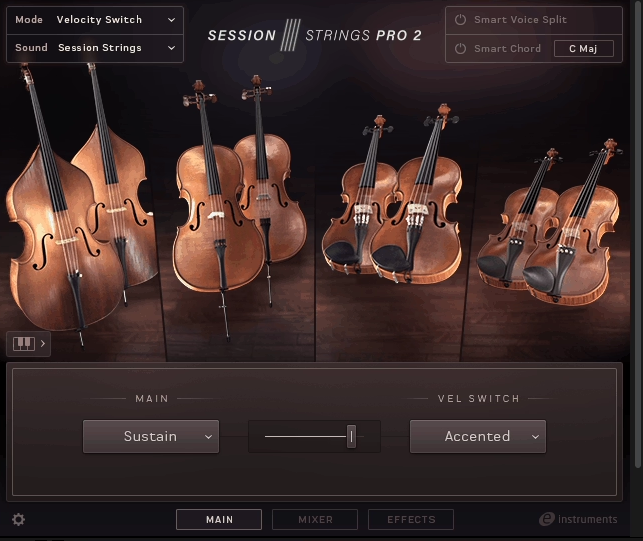
String libraries occupy one of the most competitive categories in the entire Kontakt ecosystem, and the libraries that earn long-term places in working composers’ templates are the ones that combine recording quality with genuinely practical playability rather than prioritizing one at the expense of the other.
Session Strings 2 Pro sits firmly in that category, offering a professionally recorded chamber string ensemble that was built specifically around the workflow demands of modern music production and scoring rather than as a purely documentary recording of an acoustic ensemble.
The library covers the full range of a chamber string section across violins, violas, cellos, and basses, recorded with the depth of articulation coverage and the dynamic resolution that distinguishes a serious production tool from a basic string patch.
I think what makes Session Strings 2 Pro specifically compelling rather than just broadly competent is the attention paid to how strings are actually used in pop, cinematic, and hybrid production contexts: the articulations, the section sizing options, and the interface design all reflect a practical understanding of how working producers and composers need to interact with string samples under session conditions.
For composers and producers who need a high-quality chamber string library that balances recording authenticity with the playability and workflow speed that real production sessions demand, Session Strings 2 Pro is worth the investment.
The combination of articulation depth, section control flexibility, and the quality of the underlying recordings gives it staying power well beyond an initial purchase.
Inside the Engine
Running inside Kontakt, Session Strings 2 Pro benefits from the stability and DAW compatibility that platform provides, but what matters most for a string library is what happens within the engine: how the samples are organized, how velocity and round-robin variation is handled, and how the instrument responds to the kind of continuous, nuanced playing that string writing requires. The library is built around a multi-microphone recording session captured in a real acoustic space, with the natural room character of the recording venue preserved in the samples rather than processed out and replaced with artificial reverb.
- Sample Architecture
The underlying sample architecture covers multiple velocity layers per articulation, with round-robin variation systems for repeated notes and legato transitions that are detailed enough to prevent the mechanical repetition that undermines less carefully recorded libraries under sustained or fast playing.
The velocity crossfade behavior between layers is tuned specifically for the expressive range that string performance requires, where the transition between a soft pianissimo and a moderate mezzo-forte involves not just a volume change but a genuine shift in bow pressure, contact point, and tonal character that the layering captures accurately.
I noticed that the legato transition samples in particular reflect a level of recording investment that’s not universal even in libraries at similar price points: the transitions between notes during legato playing use dedicated samples of the actual string movement between intervals rather than pitch-bending existing sustain samples, which produces the specific bow retake and finger placement character that makes a string part sound performed rather than synthesized.
- Microphone Perspectives
The multiple microphone perspectives available within the library give you control over the spatial character of the ensemble from within the Kontakt interface, covering close positions that emphasize the detail and physicality of the individual instruments through to more distant positions that capture more of the room’s acoustic character.
Being able to blend between these during mixing rather than committing to a single perspective during the initial writing stage is a practical advantage that becomes more valuable the more varied the projects you’re scoring for, since the same ensemble might need to feel intimate in one context and more distant and orchestral in another.

Get the Free Plugin Starter Kit
The genuinely useful free DAWs and plugins worth installing. No filler. Straight to your inbox.
Articulations and Playing Techniques
The articulation library is where the recording investment in Session Strings 2 Pro becomes most apparent, and it’s the dimension of the library that most directly determines how versatile and convincing it is across different musical contexts.
A string library with limited articulation coverage forces you to compensate with MIDI editing and processing to make up for what the samples don’t provide, which costs time and rarely produces fully convincing results. The articulation coverage here is broad enough that the most common string writing requirements are met without workarounds.
- Sustained Articulations
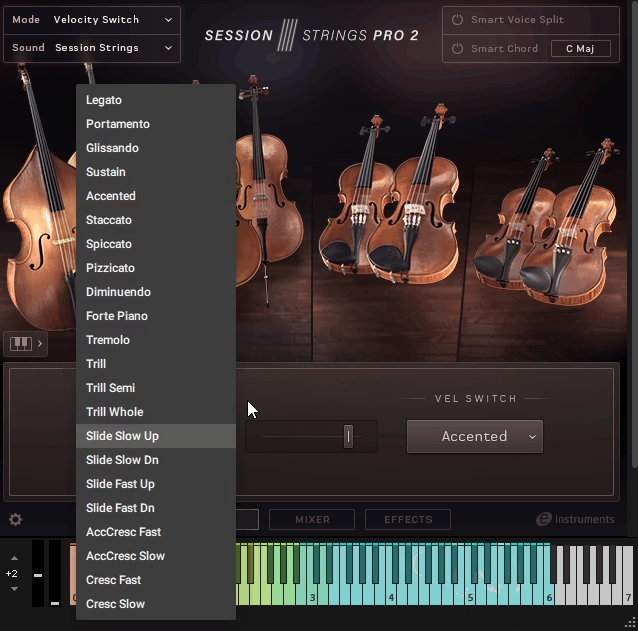
The sustained articulation set covers the range of bow techniques that string players use for held notes: standard legato sustains with natural bow changes, the more consistent tone of sul tasto playing near the fingerboard, the brighter and more penetrating character of sul ponticello near the bridge, and the specific tonal coloring of con sordino muted playing.
Each of these has a genuinely distinct character that serves specific musical purposes, and having them available as separate articulations rather than as a single generic sustain with EQ applied on top produces results that are meaningfully more convincing in context.
I must say that the sul ponticello articulation is one I find myself reaching for more than I expected before working with the library in depth: the slightly glassy, intense quality it adds to string lines that need edge and presence without switching to a completely different sound source is genuinely useful in hybrid production contexts where you’re layering strings with electronic elements and need the acoustic content to cut through.
- Short and Percussive Articulations
The short articulation set covers spiccato, staccato, pizzicato, and col legno, each with the velocity sensitivity and round-robin variation needed to write convincing rhythmic and percussive string parts. I believe the quality of short articulations is where many string libraries reveal the limitations of their recording investment, because short notes expose sample repetition and velocity inconsistency far more quickly than sustained notes do.
The spiccato in Session Strings 2 Pro has enough round-robin variation and velocity resolution that fast repeated passages retain a natural irregularity that keeps them from sounding mechanical under close listening.
- Legato and Transitions
The legato engine handles interval transitions between notes with dedicated transition samples rather than pitch manipulation, which is the approach that produces the most convincing results for melodic string writing. The transition character covers both upward and downward intervals with the appropriate bow direction and finger placement behavior for each, and the speed of the transition is responsive to how quickly you play from note to note, producing faster, more clipped transitions for quick melodic lines and slower, more expressive glides for emotional passages that require the full movement between notes to be audible.
Ensemble and Section Control
One of the more practically useful aspects of Session Strings 2 Pro is the control it gives you over the size and configuration of the ensemble rather than locking you into a single fixed orchestration.
I love how this reflects a real understanding of how strings are actually used across different production contexts: a quartet session for an intimate pop track has completely different character requirements from a larger chamber group for a cinematic cue, and being able to access different section sizes from within a single library is a significant workflow advantage.
- Section Size Options
The section size controls allow you to configure the ensemble from smaller, more intimate groupings through to fuller chamber string configurations, with the tonal character and spatial impression changing appropriately as the section size changes.
Smaller sections produce the more exposed, individual instrument character that suits intimate acoustic productions, while larger configurations produce the blended, unified sound associated with ensemble writing where individual voices merge into a collective texture.
I realized that having this range within a single library means you’re not switching between separate instruments to access different ensemble sizes: you’re adjusting a parameter on the same recordings.
- Ensemble Blending
The blend controls between sections allow you to mix the relative level and character of the different string families within the ensemble, which gives you direct compositional control over the tonal weight of the low strings relative to the violins, the prominence of the violas in the mid-range, and the overall balance of the ensemble as a whole.
For me, this is most useful when writing for hybrid contexts where you want the string texture to emphasize a specific frequency range that complements rather than competes with the electronic elements sharing the same space.
Effect Section
The effects section in Session Strings 2 Pro is more comprehensive than what most string libraries offer at this level, and it’s worth spending time with rather than leaving at defaults.
The Compressor gives you three modes to choose from: Gentle for subtle dynamic smoothing that keeps the natural feel of the performance intact, Punchy for more aggressive transient shaping that tightens the ensemble’s attack, and Transparent for gain reduction with minimal coloration when you need the dynamics managed without any additional character added.
The Insert Effects section includes an EQ with three specifically named modes that reflect how string engineers actually think about tonal shaping: Warmth adds body and low-mid richness that suits intimate acoustic productions, Wood emphasizes the natural resonant character of the instruments themselves, and Bow brings out the attack and contact point character of the bow on string, which adds presence and definition to melodic lines that need to cut through a dense mix.
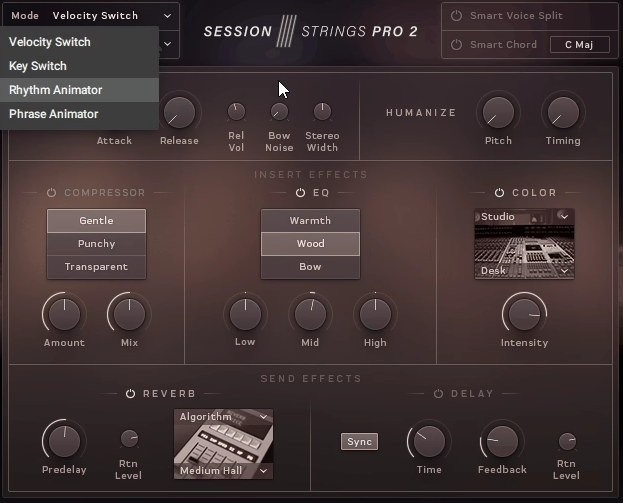
Beyond the insert chain, the Color FX section provides a range of more creative processing options for pushing the ensemble’s character in less naturalistic directions, which is where the sound design flexibility of the library extends meaningfully beyond standard string library processing. These work well in hybrid contexts where you want the strings to carry a specific processed character rather than a purely acoustic one.
The Send Effects cover Reverb and Delay with the standard send architecture, allowing you to dial in the amount of spatial processing independently from the dry signal. I found the reverb particularly useful for establishing the ensemble’s acoustic environment quickly without reaching for an external reverb plugin, since it’s calibrated specifically for the tonal character of the recordings.
Finally, the Humanize section gives you two controls: Pitch and Timing. These introduce subtle randomization to the pitch stability and note timing of the ensemble performance, which reduces the quantized, perfectly aligned quality that sample libraries can produce under repeated note passages. I’d say even a small amount of Humanize on both controls makes a noticeable difference to how natural the ensemble feels over longer phrases, especially in slower, more exposed writing where perfect mechanical precision would feel artificial.
Playability and Expression
A string library’s recording quality matters enormously, but how it responds to real-time playing is what determines how useful it is in actual sessions. Session Strings 2 Pro is built with playability as a genuine priority, with the articulation switching, velocity response, and legato behavior all calibrated for the way composers and producers actually interact with string samples during writing and recording rather than for idealized conditions that rarely apply in practice.
- Velocity and Dynamics
The velocity response across the library covers the full expressive range of chamber string playing with enough resolution between layers that you can use keyboard dynamics to shape the emotional temperature of a passage in real time.
Soft playing produces the specific tonal character of light bow pressure: slightly more nasal, with less attack and a gentler onset than full bow strokes. Harder velocities produce the fuller, more penetrating sound of deeper bow pressure with a more defined attack transient that gives melodic lines clarity and forward motion.
I’d say the dynamic range available through velocity alone is one of the qualities that most directly affects how expressive Session Strings 2 Pro feels under the hands: when you can communicate the difference between a tender pianissimo and a passionate fortissimo through how hard you press the keys, the writing process feels more like performing and less like programming, which consistently produces better musical results.
- Articulation Switching
The keyswitching system for moving between articulations is laid out with enough logic and consistency that it becomes second nature fairly quickly, and the response time between activating a keyswitch and hearing the new articulation is fast enough to use during live recording passes rather than only during programmed MIDI sequences.
I have to say that articulation switching latency is one of those qualities that’s easy to overlook in library reviews but enormously important in actual use: a library where switching articulations requires careful pre-planning because the response is slow enough to miss a phrase boundary is significantly harder to work with than one where you can switch expressively in real time.
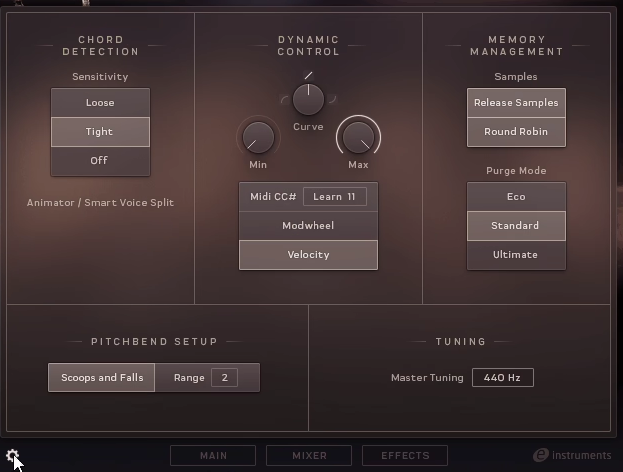
Settings in Session Strings 2 Pro
Scoring and Production Applications
The practical applications of Session Strings 2 Pro span a wide enough range of production contexts that it’s one of those libraries that earns its place in a template rather than being reserved for specific project types. The recording quality and articulation depth make it convincing in scoring contexts where the strings need to sound like a real ensemble, while the section control and processing flexibility make it adaptable enough to work in pop, hybrid, and electronic production contexts where authentic string character is one ingredient among many rather than the primary focus.
- Cinematic and Scoring
In cinematic scoring applications, the full articulation set and legato engine provide the expressive range needed to write convincing melodic string lines, emotional sustained passages, and rhythmic pizzicato and spiccato parts without reaching outside the library for additional resources.
The microphone perspective options give you control over how the ensemble sits spatially in a cinematic mix, and the section size controls allow you to match the ensemble scale to the scope of the cue.
I believe Session Strings 2 Pro handles the full range of chamber string scoring requirements that come up in everyday film and television work without the gaps and compromises that force you to patch in material from other sources.
- Pop and Hybrid Production
For pop and hybrid production, the tighter section sizes and closer microphone perspectives produce the intimate, present string character that suits modern pop arrangements where strings are used for emotional depth and melodic color rather than orchestral scale.
I suggest starting with the smaller section configurations and closer microphone blend for pop contexts, then adjusting the ensemble size upward if the track’s emotional demands call for a fuller, more cinematic string presence. The library’s adaptability across this range without requiring multiple different instruments is one of its strongest practical qualities.
Check here: Native Instruments Session Strings 2 Pro
Get the Free Plugin Starter Kit
The genuinely useful free DAWs and plugins worth installing. No filler. Straight to your inbox.

Hello, I’m Viliam, I started this audio plugin focused blog to keep you updated on the latest trends, news and everything plugin related. I’ll put the most emphasis on the topics covering best VST, AU and AAX plugins. If you find some great plugin suggestions for us to include on our site, feel free to let me know, so I can take a look!