
Electric guitar is one of the most difficult instruments to convincingly reproduce in a sample library because so much of what makes guitar playing feel authentic lives in the details: the way a player mutes a string between chord changes, the subtle timing variation of a strummed passage, the specific attack character of a pick hitting the strings at different angles.
Most guitar libraries struggle with at least one of these, and the ones that get all of them right tend to be the ones that earn a permanent place in a production template. Session Guitarist: Electric Mint is Native Instruments’ attempt to build a clean, articulate electric guitar instrument specifically suited to modern pop, indie, and atmospheric production, and it succeeds in ways that are worth understanding before you decide whether it belongs in your setup.
The instrument is built around a single guitar recorded through a clean, bright signal chain with a specific tonal character that sits somewhere between a Fender Stratocaster clarity and the warmth of a semi-hollow body, giving it enough presence to cut through a mix without the edginess that can make brighter guitars difficult to work with alongside other melodic elements.
I think the “Mint” name is a good descriptor: this is a fresh, clean, slightly cool electric guitar sound that suits styles where clarity and space matter more than grit and weight.
For producers who work in indie pop, bedroom pop, singer-songwriter production, lo-fi, and any style where a clean or lightly driven electric guitar is part of the sonic palette, Session Guitarist: Electric Mint is worth adding to your toolkit. The combination of recording quality, strumming engine, and the tonal character of the source gives you a guitar instrument that integrates into those production styles naturally rather than requiring significant processing to make it fit.
From the Pluginerds Store
Before you go — if you're putting together or upgrading a home studio setup, we run our own store alongside the blog at Pluginerds Shop. Everything on it is picked by people who actually make music, not sorted by whoever paid for placement on a marketplace. Worth a look if you're filling in the gaps in your setup.
Visit Pluginerds ShopAbout library
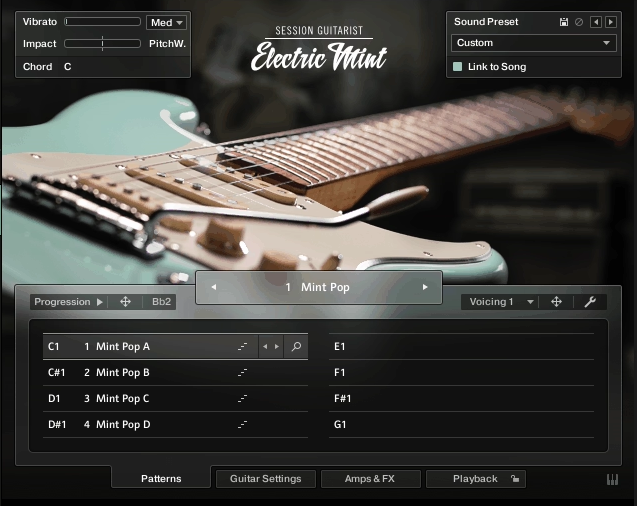
At its core, Electric Mint is a Kontakt instrument that provides both a pattern-based strumming and picking engine and direct access to individual notes and chords for manual playing.
The design philosophy follows the Session Guitarist series approach: give producers who don’t play guitar access to a guitar instrument that behaves like a real player, covering the rhythmic strumming patterns, articulation variations, and performance details that would take a real session guitarist to deliver.
I believe the most important distinction to make upfront is that Electric Mint is not a general-purpose electric guitar library covering every style from clean jazz to heavy distortion.
It is a specific instrument with a specific tonal character, and that specificity is both its strength and its natural limitation. If you need aggressive pickup character, open-back cabinet tone, or high-gain distortion, this isn’t the right tool. But if you need the specific clean, articulate, slightly bright electric guitar sound that dominates modern indie and atmospheric production, it’s exactly right.
Get the Free Plugin Starter Kit
The genuinely useful free DAWs and plugins worth installing. No filler. Straight to your inbox.
The Guitar and Its Character
The recorded source instrument has a tonal character that’s worth describing precisely before anything else, because it’s the quality that most determines whether Electric Mint fits your productions.
The guitar sits in clean to lightly driven territory with a specific brightness and articulation that emphasizes pick attack, string detail, and the natural resonance of the body without the aggressive midrange honk of a full-on Telecaster twang or the compressed warmth of a heavier humbucker-equipped instrument.
- Tone and Pickup Character
The pickup character preserved in the recordings gives individual notes and strummed chords a clean definition that works particularly well in production contexts where the guitar needs to sit alongside synthesizers, drum machines, and programmed elements without competing with them for the same frequency space.
I noticed that the high-end detail in the recordings is present but not harsh: the pick attack reads clearly, the string texture is audible, and the natural decay of each note has a pleasing character that makes the instrument pleasant to listen to at length without fatigue.
The body resonance captured in the recordings adds a warmth and physicality that prevents the guitar from sounding thin or clinical despite its brightness, which is the balance that makes a clean electric guitar actually useful in a production context rather than something you immediately want to EQ into a different character.
- Amp and Signal Chain
The amp and signal chain used during the recording session produced a sound that sits between fully clean and lightly driven, giving individual notes and chords a subtle harmonic warmth that pure DI recording doesn’t produce. I must say that this is the sweet spot for the kind of guitar parts Electric Mint is designed for: clean enough to be versatile, warm enough to feel recorded rather than artificially clinical.
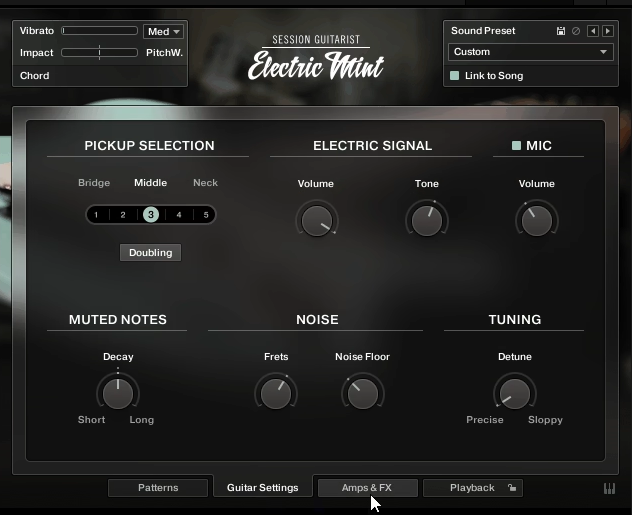
The on-board amp and effects controls within the instrument let you push the character toward more driven territory or pull it back toward cleaner, more pristine tones, giving you a range of character adjustments without requiring external processing during the writing stage.
The Strumming Engine
This is the component that most producers buying Electric Mint will spend the most time with, and it’s where the practical value of the library becomes most clear in actual use.
The strumming engine contains a library of recorded guitar patterns covering a wide range of rhythmic feels and strumming characters, from simple downstroke patterns through to more complex fingerpicked and mixed strumming approaches that would be difficult to program convincingly from individual notes.
- How It Works
The pattern playback system analyzes the chord you play in the left-hand keyboard range and generates a guitar strumming pattern that follows your harmonic input while maintaining the timing variation, dynamic nuance, and articulation character of the recorded pattern.
This means you can play chord changes in real time and have Electric Mint generate a guitar part that responds to those changes with the natural rhythm and feel of a recorded player, rather than triggering the same mechanical loop regardless of your input.
I love how the patterns handle chord transitions: the specific way a guitar player mutes strings and repositions between chords is captured in the transition samples, which produces the short moments of muted string noise and position change character that make guitar tracks feel played rather than assembled.
These micro-transitions are one of the most commonly missing qualities in guitar libraries that rely on clean, isolated note samples, and Electric Mint handles them well.
- Pattern Variety
The pattern library covers indie, pop, folk, and atmospheric guitar feels with enough variety that finding the right rhythmic character for a specific production context is relatively fast.
Patterns range from slow, sparse picking approaches suited to ambient and emotional ballad contexts through to more energetic strumming feels for driving pop and indie productions, and the dynamic variation within each pattern keeps them from sounding repetitive under extended playback.
I’d say the coverage of fingerpicked patterns is one of the more musically useful aspects of the collection for modern production: fingerpicking has a specific intimacy and textural character that strummed patterns don’t provide, and having it available within the same instrument means you’re not switching between different tools to access different guitar performance styles.

Playing It Directly
Beyond the strumming engine, Session Guitarist: Electric Mint gives you direct keyboard access to individual notes, chord voicings, and articulations for producers who want to write specific guitar parts note by note rather than working from patterns.
The keyboard mapping covers the guitar’s natural range with the most commonly needed articulations available through keyswitches: sustained notes, muted notes, harmonics, slides, and the specific palm-muted character that gives electric guitar its characteristic percussive staccato quality in rhythmic contexts.
The legato engine handles melodic note transitions with the sliding and hammer-on character of real guitar playing, which is what makes melodic guitar lines feel performed rather than sampled.
I have to say that the legato behavior specifically on melodic single-note lines is one of the more convincing aspects of the library: the transitions between notes during smooth melodic playing have the specific finger-on-string character that makes guitar melody sound organic rather than keyboard-triggered.
Chord voicings mapped across the keyboard give you access to realistic guitar chord shapes rather than simply stacking the same intervals from whatever root note you play, which produces the specific open-string resonance and voicing character of actual guitar chord positions.
For me, this is one of the most important qualities for a guitar library to get right because unrealistic voicings are immediately audible to anyone who knows the instrument, and Electric Mint consistently produces voicings that feel natural and guitaristically correct.
Where It Sits in a Mix
The frequency character of Session Guitarist: Electric Mint is designed to integrate naturally into modern indie and pop production contexts without requiring heavy EQ adjustment to find its place in a mix.
The brightness of the source recording sits in a range that complements rather than competes with synthesizer pads and melodic keyboards, and the natural low-end rolloff of the clean electric guitar signal prevents it from cluttering the low-mid frequency range where bass and drums need to operate without competition.
I appreciate that the on-board processing controls cover the basic adjustments that matter most for mix integration: amp character, reverb send level, and output level control are all available within the instrument without requiring you to exit to external processing during the writing stage.
For final production work, routing Electric Mint to a dedicated channel with external amp simulation and reverb gives you full control, but the on-board options produce a good working sound quickly.
The reverb character available within the instrument has a specific atmospheric quality that suits the production aesthetics Electric Mint is designed for: it’s the kind of room and plate sound that gives indie and atmospheric electric guitar parts their characteristic space without the obvious artificial quality of cheaper reverb algorithms.
Scoring and Production Applications
The primary production contexts where Electric Mint delivers most convincingly are indie pop, bedroom pop, singer-songwriter production, lo-fi, and atmospheric electronic production where a clean or lightly driven electric guitar is part of the sonic palette rather than a genre-defining element in isolation. In these contexts, the tonal character and the behavior of the strumming engine produce results that integrate immediately into a production without extensive processing or adjustment.
I found Electric Mint particularly effective in hybrid production contexts where guitar is layered with synthesizers and electronic drums: the specific frequency character of the instrument leaves room for the electronic elements to operate clearly while the guitar adds acoustic warmth and human character that prevents the production from feeling entirely synthetic.
This layering application is one of the more underappreciated uses of a clean electric guitar library, and Electric Mint handles it better than most because its tonal balance was clearly designed with this kind of integration in mind.
I suggest approaching the library as a texture and atmosphere tool as much as a melody and chord instrument: the strummed patterns at lower velocities with the reverb level increased produce ambient, textural guitar content that works as a bed underneath other melodic elements, and this atmospheric application is as musically useful as the more conventional chord and melody functions the library is primarily designed for.
Is It Worth It?
For producers who regularly work in the production styles Electric Mint is designed for, the library is worth the investment primarily because the tonal character and strumming engine together produce results that would take significant time to program or record yourself, and the quality of the output is consistent enough to use in professional productions without extensive additional processing.
I believe the value is strongest for producers who don’t play guitar themselves and need convincing guitar parts in indie and atmospheric production contexts, because the strumming engine specifically closes the gap between what a non-guitarist can program and what a session player delivers in a meaningful way.
For guitar players who track their own parts, the use case is narrower but the direct playability and the specific tonal character still make it a useful sketch and production tool for contexts where tracking isn’t practical.
Check here: Electric Mint
Get the Free Plugin Starter Kit
The genuinely useful free DAWs and plugins worth installing. No filler. Straight to your inbox.

Hello, I’m Viliam, I started this audio plugin focused blog to keep you updated on the latest trends, news and everything plugin related. I’ll put the most emphasis on the topics covering best VST, AU and AAX plugins. If you find some great plugin suggestions for us to include on our site, feel free to let me know, so I can take a look!