
Techno has always been a hardware genre. The sounds that defined Detroit, Berlin, and every warehouse in between came from physical machines, from the kick drums of the 909, the acid lines of the 303, the metallic percussion of analog drum synths, and the relentless sequences of hardware step sequencers. While you can absolutely produce techno entirely in software today, there’s a reason producers keep gravitating back to dedicated hardware for the genre.
The immediacy of turning a knob and hearing the filter scream, the hypnotic workflow of step sequencing patterns on a grid, and the happy accidents that come from physical interaction with circuits produce results that mouse clicking on a screen rarely replicates.
The current hardware landscape for techno is particularly strong because you’re not limited to choosing between vintage recreations and expensive flagships anymore.
The range now covers analog drum synths that create percussion from raw oscillators, groove boxes that contain entire production environments in a single unit, classic drum machine recreations at affordable prices, and synthesizers that handle the bass, leads, and atmospheric textures that sit alongside the rhythm section.
I’ve picked eight instruments that cover the core sounds and workflows of techno production, from dedicated percussive machines through all-in-one production stations to synths that handle the melodic and textural elements.
1. Behringer Edge
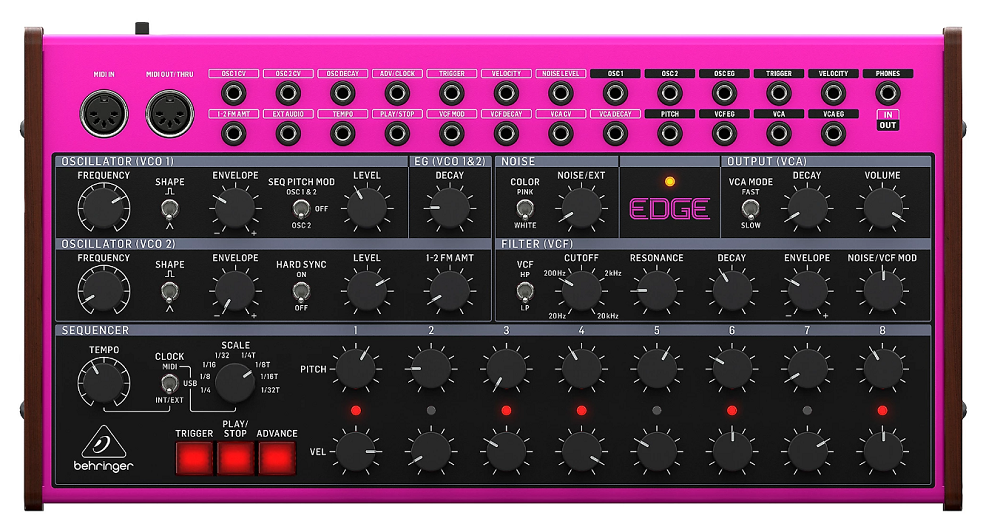
Starting with a piece of gear that sits in the fascinating space between synthesizer and drum machine. The Behringer Edge is a semi-modular analog percussion synthesizer that creates drum and percussive sounds from scratch using two analog VCOs, a 24dB resonant ladder filter, noise generator, and three separate decay envelopes rather than playing back samples.
For techno, where the specific character of your kick, snare, and hi-hat defines your identity as a producer, having a synthesizer that builds percussion from raw analog components gives you sounds that are entirely your own.
The Edge’s approach to percussion is fundamentally different from sample-based drum machines because every sound is generated from the analog circuit in real time, meaning you can twist the oscillator tuning, filter cutoff, and envelope decay while a pattern plays and the drums transform under your hands.
- Dual Sequencer
Two 8-step sequencers with independent pitch and velocity controls let you program percussion patterns where the drum sound itself changes on every step.
The dual architecture means you can run two different rhythmic patterns simultaneously, creating polyrhythmic techno grooves from a single instrument.
Pushing the sequencer speed beyond normal BPM ranges into the thousands transforms the step patterns into audio-rate waveforms, which is where the Edge enters experimental territory that conventional drum machines don’t touch.
- Ladder Filter
The multimode 24dB resonant ladder filter with switchable low-pass and high-pass modes shapes the analog oscillators into percussive tones with a warmth and aggression that sample playback doesn’t replicate.
Sweeping the filter cutoff while a pattern plays transforms kicks into toms, snares into metallic hits, and hi-hats into screaming noise bursts. The filter is as much a performance tool as a sound shaping one.
- Patch Matrix
A 15×10 I/O patch matrix provides semi-modular routing that lets you break the default signal flow and create custom connections.
Feeding the noise generator directly into the filter modulation input, routing one sequencer’s velocity output to the other sequencer’s pitch input, or creating feedback loops through the patch matrix produces results that the standard routing can’t achieve. For techno sound design, the patch matrix is where you find sounds nobody else has.
- Analog Character
The fully analog signal path produces percussion with the specific grit, warmth, and harmonic richness that analog circuits inherently provide. The analog character means your drum sounds carry a weight and presence that sits naturally alongside other analog gear, and the slight imperfections in the circuit behavior add the organic quality that makes analog percussion feel alive rather than static.
Get the Free Plugin Starter Kit
The genuinely useful free DAWs and plugins worth installing. No filler. Straight to your inbox.
2. Roland TR-1000
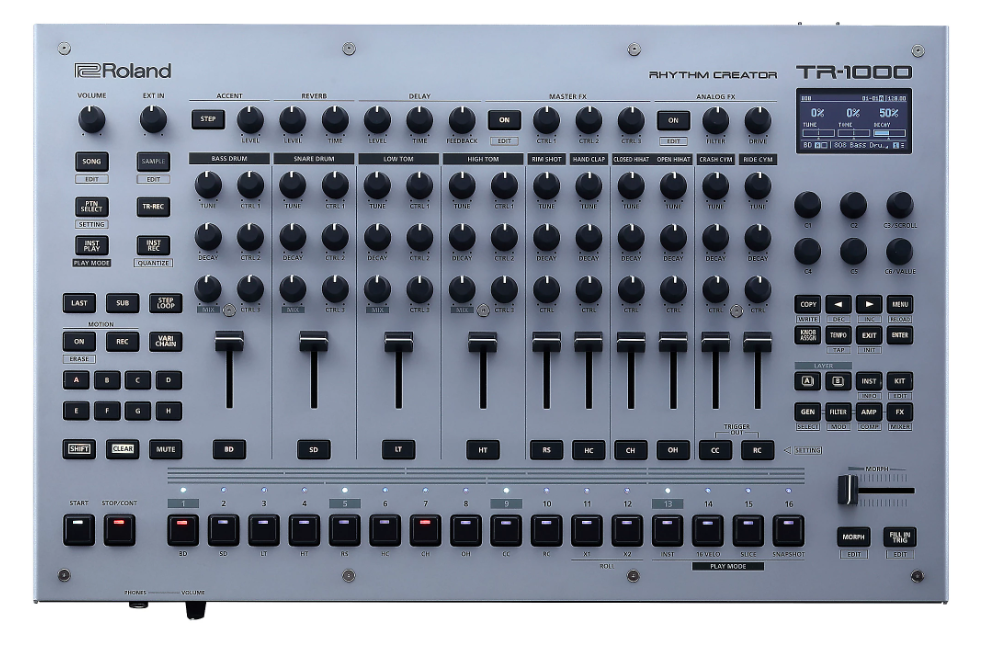
Roland’s newest entry into the drum machine world takes a fresh approach to sample-based drum production while maintaining the workflow legacy of the TR series.
The Roland TR-1000 combines Roland’s ACB modeling technology with sample playback and import capability, giving you access to classic TR sounds alongside the ability to load your own samples and process them through the TR workflow.
For techno producers, the TR-1000 represents the intersection of classic Roland drum machine heritage with modern production flexibility, delivered through the iconic step sequencer grid that shaped the genre’s rhythmic foundation.
- ACB + Samples
The engine combines Analog Circuit Behavior modeling of classic TR drums with user-importable samples, meaning you can blend Roland’s modeled 909 kick and 808 hi-hats with your own field recordings, processed drum hits, or found sounds.
The hybrid approach gives you the specific Roland drum character that techno expects alongside the personal sonic identity that custom samples provide. The blend between modeled and sampled content happens per-instrument, so your kick might be pure ACB while your percussion layer uses imported content.
- TR Sequencer
The classic TR-style step sequencer with per-step velocity, probability, sub-steps, and pattern chaining provides the rhythmic programming workflow that defined techno’s drum patterns.
The sequencer’s grid-based approach encourages the kind of repetitive, hypnotic pattern building that techno is built on, and the modern additions (probability per step, sub-step divisions) add variation and complexity that the original TR machines couldn’t achieve.
- Performance Pads
Velocity-sensitive pads provide real-time triggering and performance capabilities alongside the step sequencer. The pads let you layer fills, accent specific hits, and trigger variations during playback, which adds a live performance dimension to the otherwise grid-based programming workflow.
- Sound Shaping
Extensive per-instrument sound shaping including tuning, decay, tone, and compression gives you hands-on control over each drum voice. The sound shaping goes deeper than basic sample playback parameters, letting you tune and shape each voice in the way that the classic TR machines allowed, where the kick drum’s character came from turning the tuning and decay knobs until it sat right.
- Effects Section
Built-in per-instrument and master effects including reverb, delay, distortion, and compression process the drum sounds within the machine. For techno, having effects integrated into the drum machine means your rhythm programming includes the spatial and tonal processing as part of the pattern, and the distortion in particular adds the kind of analog-style grit that techno drums often need.
- Pattern Chain
Pattern chaining and variation tools let you build complete drum arrangements from individual patterns without a DAW. The chaining system creates longer structures from short patterns, which suits the way techno tracks develop through subtle variation over extended sections rather than dramatic arrangement changes.
3. Roland MC-101
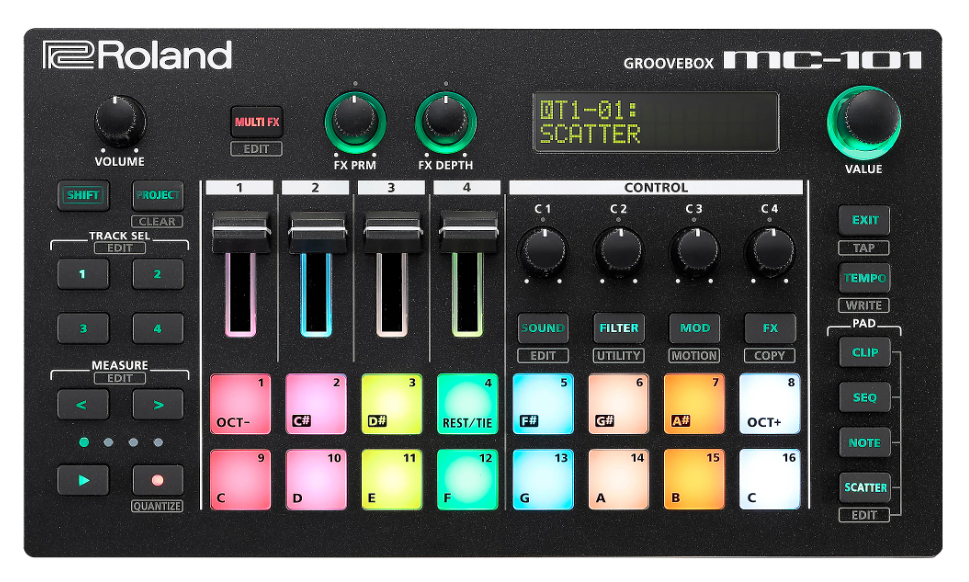
A complete groovebox that fits in your hand and contains four tracks of synthesis, sampling, and sequencing powered by Roland’s ZEN-Core engine. The Roland MC-101 is the most portable all-in-one techno production environment available, giving you drums, bass, leads, and effects in a battery-powered format roughly the size of a large paperback book.
For techno producers who want to sketch ideas, perform live, or produce away from a studio, the MC-101 puts an entire production toolkit in your jacket pocket.
- Four Tracks
Four simultaneous tracks of synthesis and sampling let you build complete techno arrangements with kick/percussion on one track, bass on another, and leads or atmospheric elements on the remaining two. The four-track architecture means you go from a blank slate to a complete groove without needing additional gear. Each track accesses the ZEN-Core engine independently, so the sound quality matches Roland’s full-size instruments.
- ZEN-Core Engine
The ZEN-Core synthesis platform provides virtual analog oscillators, PCM waveforms, multimode filters, and comprehensive effects at a quality level that matches Roland’s flagship synths. The engine handles everything from classic TR drum sounds to lush pad textures to aggressive bass lines, all from the same compact hardware.
- Clip Workflow
A clip-based arrangement system lets you build song structures from individual pattern clips, triggering different combinations in real time. For live techno performance, the clip workflow gives you the flexibility to arrange on the fly rather than following a fixed sequence, which suits the genre’s emphasis on extended, DJ-style set building.
4. Arturia MiniFreak
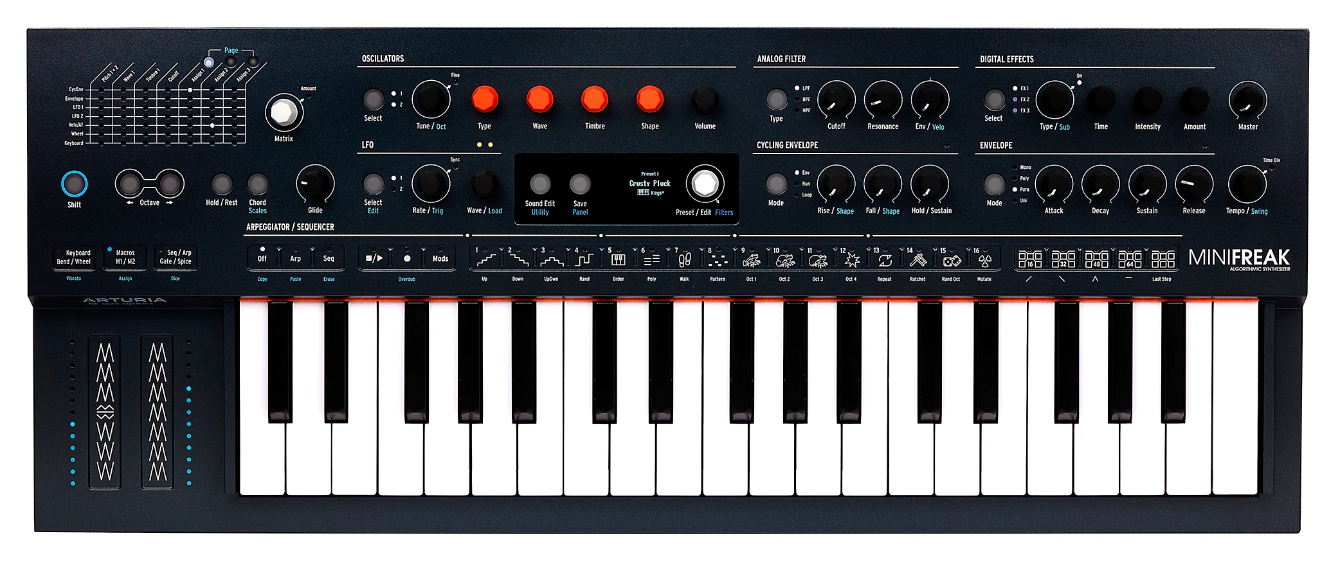
For the synth side of techno, the acid lines, the atmospheric pads, the aggressive leads, and the evolving textures, MiniFreak covers more ground from a single compact instrument than any other hardware synth at its price point.
The hybrid digital/analog architecture with multiple oscillator engines through a real Steiner-Parker analog filter produces everything from squelching acid bass to granular atmospheric washes.
The MiniFreak appears on techno lists because the analog filter’s resonant character handles the aggressive, screaming filter sweeps that the genre demands, while the digital engine variety provides the textural range that a purely analog monosynth can’t match.
- Acid Character
The analog Steiner-Parker filter produces the squelching, screaming resonance that defines acid techno when you push it hard. The filter behavior at high resonance settings is aggressive and musical in the specific way that techno bass lines need, with a character that’s different from Moog ladder or Roland-style filters but equally suited to the genre.
- Engine Range
Over a dozen synthesis engines give you starting timbres that cover the full range of techno’s sonic vocabulary. Virtual analog for classic leads and bass, wavetable for evolving textures, granular for atmospheric content, FM for metallic stabs, Karplus-Strong for percussive plucks. The engine variety means one MiniFreak handles multiple roles in a techno arrangement.
- Sequence Tools
The step sequencer with Spice & Dice randomization creates evolving patterns that develop over time rather than repeating identically. For techno, where repetition needs subtle variation to maintain hypnotic interest across extended tracks, the randomization introduces controlled chaos that keeps sequences alive.
- Effects Chain
Three simultaneous effects including distortion, delay, and reverb process the synth output within the instrument. For techno, the built-in distortion is particularly useful because it adds the harmonic density and aggression that the genre’s bass and lead sounds often need to cut through a dense rhythm section.
5. Roland TR-8S
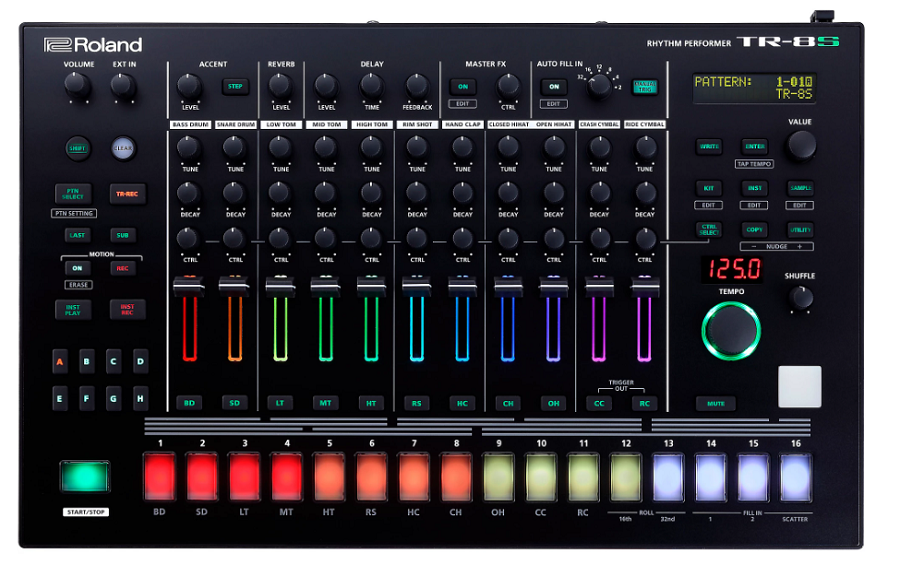
The definitive modern Roland drum machine for electronic music production, with ACB modeling of the entire TR family (808, 909, 707, 606, and more) plus sample import capability and per-voice effects in a performance-focused desktop format. Roland TR-8S has become a staple of techno production and live performance setups for good reason.
The TR-8S earns its place because it’s the most comprehensive way to access the specific Roland drum sounds that techno is built on, combined with enough modern features to make it more than just a nostalgia machine.
- Full TR Library
ACB models of the TR-808, TR-909, TR-707, TR-606, and other classic Roland machines give you access to the specific drum sounds that defined techno’s rhythmic foundation.
The 909 kick, the 808 hi-hats, the 606’s metallic character, all available from a single instrument with the ability to mix elements from different machines in a single kit. The ACB modeling captures the specific behavior of each machine rather than just approximating the sound.
- Sample Import
You can import your own samples alongside the modeled drums, creating hybrid kits that blend Roland’s classic sounds with personal content. The sample import means the TR-8S grows beyond its factory sounds, and for techno producers who want the TR workflow with their own signature drum sounds, the import capability is essential.
- Per-Voice FX
Individual effects assignable per drum voice let you process each element of your kit independently. Distortion on the kick, reverb on the clap, delay on the hi-hat, all happening simultaneously within the machine. The per-voice processing is what transforms the TR-8S from a drum machine into a complete rhythm production tool.
6. SOMA Pulsar-23
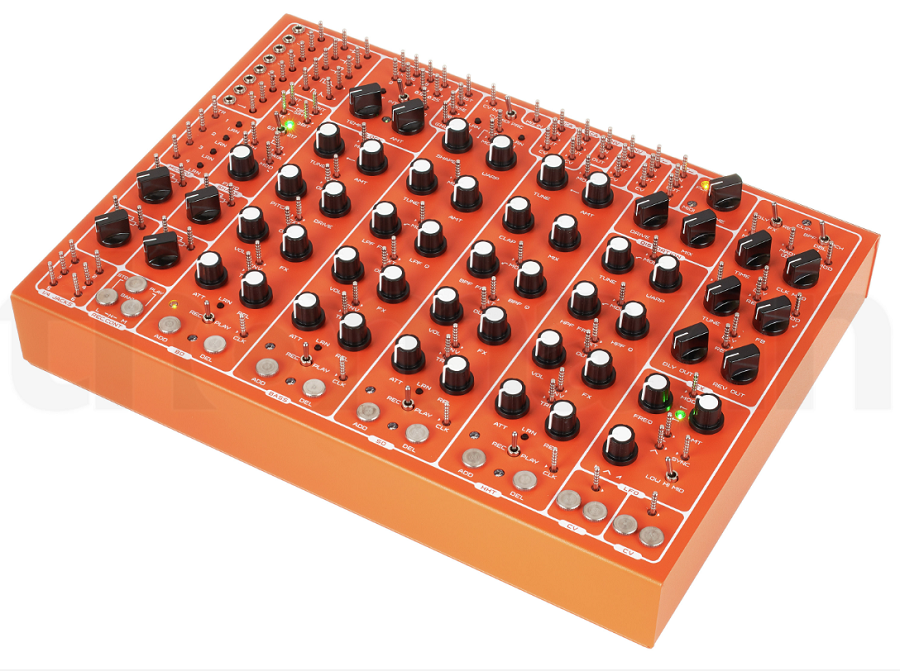
This is the wild card on the list, and I include it because no other instrument produces the kind of sounds the Pulsar-23 creates. SOMA Pulsar-23 is an analog semi-modular drum machine with four independent sound channels, extensive patch bay routing, and a design philosophy that embraces chaos, experimentation, and controlled accidents as fundamental to the creative process.
For techno producers who want their percussion to sound genuinely unique rather than recognizable as a specific machine, the Pulsar-23 creates drum sounds and rhythmic patterns that are impossible to identify as coming from any particular source.
- Four Channels
Four independent analog synthesis channels (Bass Drum, Snare, Hi-Hat/Clap, and a flexible fourth voice) each generate percussion from scratch through dedicated analog circuits.
Each channel has its own oscillators, noise source, filter, and envelope with enough parameter depth for complex sound design. The channels interact through the patch bay, creating rhythmic relationships and timbral cross-modulation between drum voices.
- Patch Bay
An extensive patch bay with dozens of connection points lets you route control voltages, audio signals, and triggers between channels in configurations that create self-generating, evolving rhythmic patterns.
The Pulsar-23’s patch bay goes far beyond simple modular routing. Patching the hi-hat’s trigger output into the bass drum’s pitch input, for example, creates rhythmic pitch patterns on the kick that follow the hi-hat rhythm. The cross-channel patching is where the Pulsar-23 creates its characteristic unpredictable, evolving grooves.
- Touch Plates
Conductive touch plates on the surface respond to your skin’s conductivity, allowing you to influence the circuits with your body as part of the instrument.
Touching different plates simultaneously creates circuit connections through your body’s resistance, producing sounds and rhythmic behaviors that no knob or switch can replicate. For live techno performance, the touch plate interaction is genuinely theatrical and musically unpredictable.
- Chaos Design
The entire instrument is designed to embrace controlled unpredictability rather than precise, repeatable programming.
The circuits behave somewhat differently each time depending on temperature, patch configuration, and interaction, which means the Pulsar-23 produces patterns and sounds that evolve organically rather than repeating identically. For techno producers tired of perfectly quantized, predictable drum patterns, the Pulsar-23’s inherent chaos is a feature.
- Feedback Paths
The patch bay enables audio feedback loops where the output of one channel feeds back into another or into itself, creating self-sustaining, evolving tonal content that the straight signal path doesn’t produce. The feedback paths turn the drum machine into a drone and texture generator alongside its percussive capabilities, which is useful for the atmospheric elements that darker techno styles incorporate.
7. Arturia DrumBrute Impact
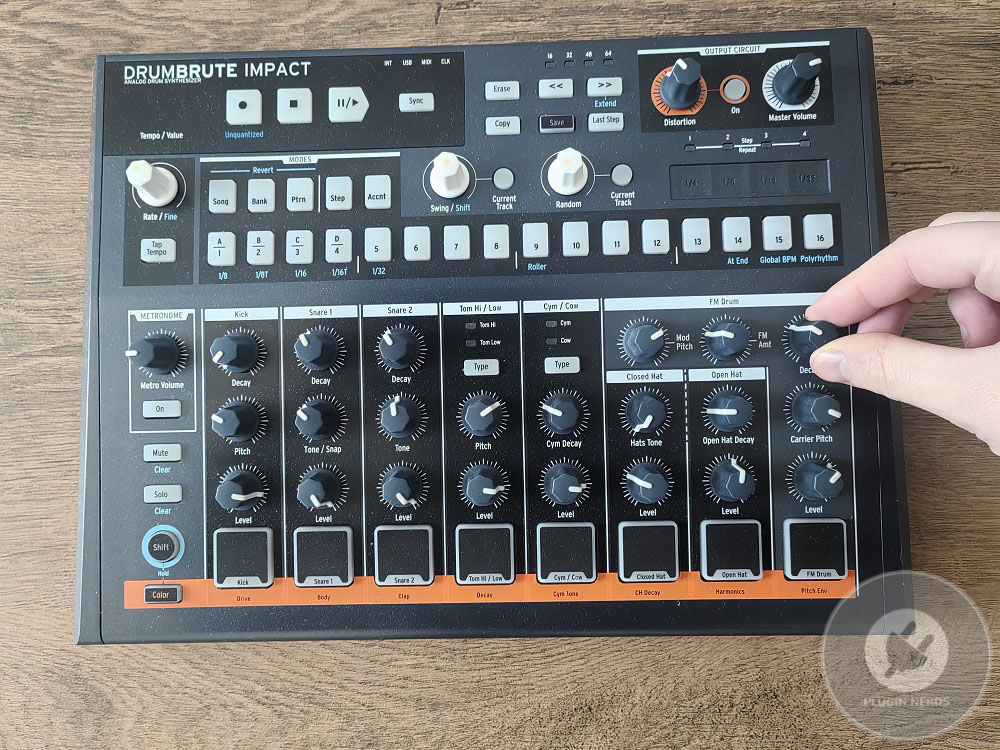
The most immediate and affordable dedicated analog drum machine for techno, with individual analog synthesis per voice, dedicated knobs for every parameter, and a distortion circuit that adds the grit and character the genre needs. Arturia DrumBrute Impact puts hands-on analog percussion in your setup at a price that makes it practical as a dedicated techno rhythm tool.
The DrumBrute Impact makes this list because the combination of analog drum synthesis, dedicated controls, and the distortion circuit produces the kind of raw, characterful techno percussion that sample-based machines at the same price don’t match.
- Analog Voices
Each drum voice (kick, snare, hi-hat, cymbal, and several others) is generated by its own dedicated analog synthesis circuit rather than sample playback. The analog generation means every drum sound carries the warmth, weight, and organic quality that analog circuits naturally produce. For techno, the analog kick in particular has a weight and punch that sits in a mix differently from sampled kicks.
- Distortion Circuit
A global distortion circuit adds grit, saturation, and aggressive character to the entire drum mix or individual voices. The distortion is what transforms the DrumBrute Impact from a clean drum machine into a techno percussion tool, adding the harmonically dense, overdriven quality that the genre’s harder styles demand. You can dial in subtle warmth or push it into full-on crunch.
- Step Sequencer
A 64-step sequencer with polyrhythmic capability, probability, and randomization creates patterns that develop and evolve over time. The polyrhythmic support means different voices can run at different pattern lengths simultaneously, creating the kind of shifting, phase-pattern grooves that add complexity to techno rhythms. The probability and randomization keep patterns from sounding mechanically identical on every loop.
8. Behringer RD-9
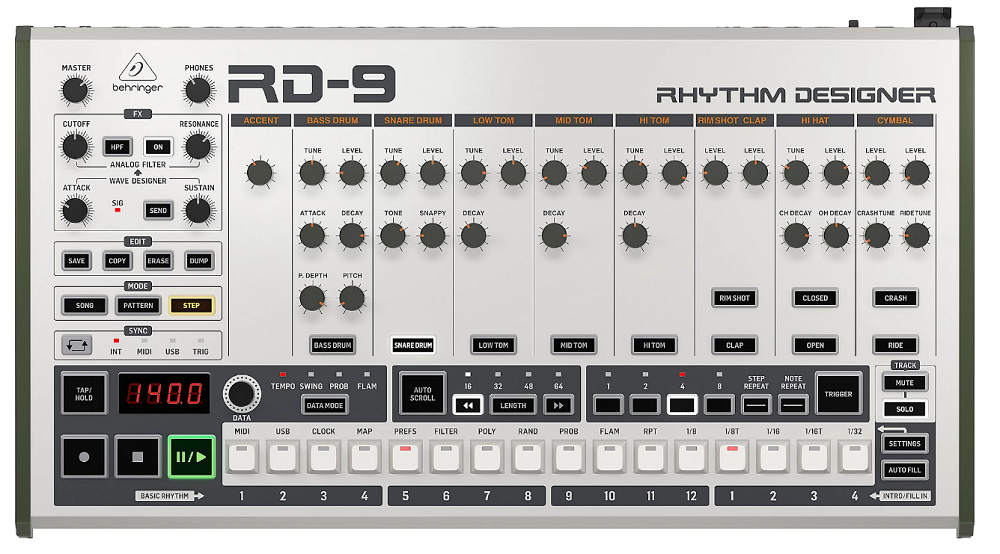
A faithful recreation of the Roland TR-909 drum machine at a fraction of the original’s vintage market price. The Behringer RD-9 gives you the specific 909 drum sounds that techno was literally built on, with analog sound generation for the bass drum, snare, clap, toms, and rim shot, plus sample-based hi-hats and cymbals that follow the original’s hybrid architecture.
The 909 is techno’s defining drum machine, and the RD-9 makes that specific sound accessible without the several-thousand-dollar investment that vintage units demand.
- 909 Sound
The analog drum circuits faithfully reproduce the specific tonal character of the TR-909’s bass drum, snare, clap, and toms. The 909 bass drum in particular, with its specific punchy, resonant, slightly overdriven character, is one of the most important sounds in techno history. The RD-9 captures that specific kick character alongside the snare’s crisp snap and the clap’s noisy burst with convincing accuracy.
- Analog/Digital
The hybrid analog/digital architecture follows the original 909’s design where the bass drum, snare, clap, toms, and rim shot are analog while the hi-hats, crash, and ride are sample-based. The hybrid approach is historically accurate and produces the specific timbral relationship between the warm analog drum voices and the brighter, crisper digital cymbal sounds that defines the 909’s character.
- Step Sequencer
The TR-style step sequencer with the familiar grid programming interface reproduces the workflow that created techno’s foundational drum patterns. The sequencer includes accent, shuffle, and pattern chaining that let you build complete drum arrangements from short pattern building blocks, following the same workflow that producers have used with 909s since the genre’s inception.
- Individual Outputs
Individual audio outputs per drum voice let you process each element separately through external effects, EQ, and compression.
For techno production, the individual outputs are essential because you can apply different compression to the kick, reverb to the clap, and distortion to the snare to shape each element precisely for your mix. The individual routing is what transforms the RD-9 from a pattern player into a serious production tool.
Get the Free Plugin Starter Kit
The genuinely useful free DAWs and plugins worth installing. No filler. Straight to your inbox.

Hello, I’m Viliam, I started this audio plugin focused blog to keep you updated on the latest trends, news and everything plugin related. I’ll put the most emphasis on the topics covering best VST, AU and AAX plugins. If you find some great plugin suggestions for us to include on our site, feel free to let me know, so I can take a look!