
A great arpeggiator transforms how you interact with a synthesizer. Instead of playing individual notes and programming sequences manually, you hold a chord and the arpeggiator turns it into rhythmic, melodic, evolving patterns that respond to what you play in real time. The best hardware arpeggiators go far beyond basic up/down note cycling.
They offer pattern modes, rhythmic divisions, probability, ratcheting, gate control, and the ability to generate musical content that’s genuinely more interesting than what you’d program deliberately.
What makes hardware arpeggiators particularly valuable compared to DAW-based alternatives is the immediacy and physicality of the interaction. You hold a chord, twist the rate knob, change the pattern mode, and the arpeggiator responds instantly under your hands.
The results feel performed rather than programmed, which is why arpeggiated hardware synth parts have a quality that MIDI arpeggiator plugins struggle to replicate.
I’ve assembled eleven hardware synths where the arpeggiator is a genuine standout feature rather than an afterthought, covering everything from a brand new algorithmic monster with entropy-driven pattern variation to affordable compact instruments with surprisingly deep arp sections.
1. ASM Leviasynth Keyboard
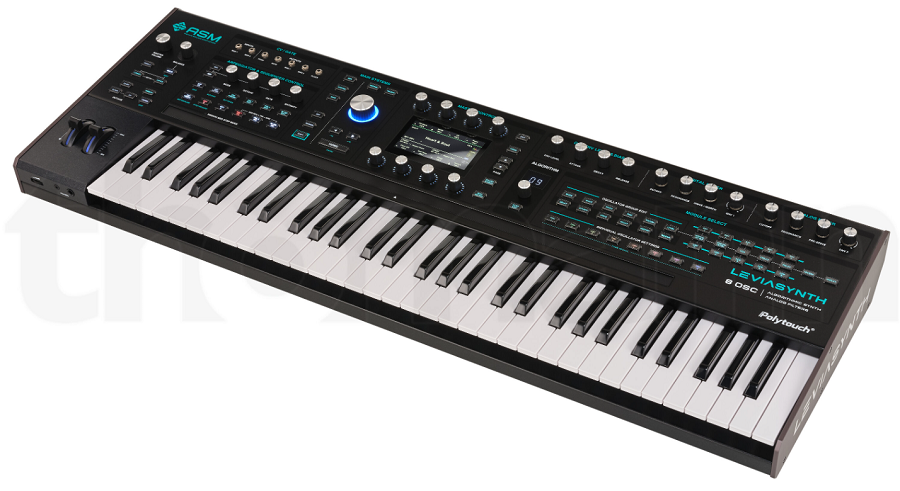
The newest and most powerful entry on this list, and its arpeggiator alone would justify inclusion even before you consider the extraordinary synthesis engine underneath.
ASM Leviasynth Keyboard is a 16-voice algorithmic hybrid synthesizer with eight oscillators per voice, but what matters for this article is the expanded arpeggiator inherited from the beloved Hydrasynth and taken significantly further with a new Entropy function designed specifically for real-time pattern variation.
The Leviasynth’s arp builds on what made the Hydrasynth’s arpeggiator one of the most inspiring in hardware synthesis, adding intelligent variation tools that keep patterns evolving without losing musical coherence.
- Entropy Function
The Entropy control introduces controlled randomness into arpeggiator patterns, varying note order, velocity, and timing in real time while maintaining the harmonic content of what you’re playing.
The Entropy function is what separates the Leviasynth’s arp from standard randomization because it’s designed to produce musically coherent variation rather than pure chaos. You dial in how much unpredictability you want and the arp mutates within boundaries that still sound intentional.
- Eight Modes
Eight distinct arpeggiator modes including up, down, up/down, random, order played, and more exotic patterns provide the rhythmic foundation.
Each mode interacts with the Entropy function differently, meaning the same chord through the same Entropy setting produces different results depending on which mode you’ve selected. The mode variety combined with Entropy creates an enormous range of pattern behaviors from a single held chord.
- Sequencer Integration
A three-track sequencer works alongside the arpeggiator, with the ability to generate arp patterns directly from sequencer data. The integration means you can program a specific note sequence and then apply the arpeggiator’s pattern modes and Entropy to transform it, or record an arpeggiated performance into the sequencer for further editing. The two systems feeding into each other creates layered rhythmic complexity.
- Expression Depth
The Polytouch polyphonic aftertouch keybed and four-octave ribbon controller provide per-note expression that modulates the arpeggiated output in real time. Pressing harder on specific notes within a held chord changes those notes’ filter, amplitude, or modulation while the arpeggiator cycles through them. The expressive control over individual arp notes adds a performance dimension that velocity alone can’t provide.
Get the Free Plugin Starter Kit
The genuinely useful free DAWs and plugins worth installing. No filler. Straight to your inbox.
2. Roland Jupiter-X
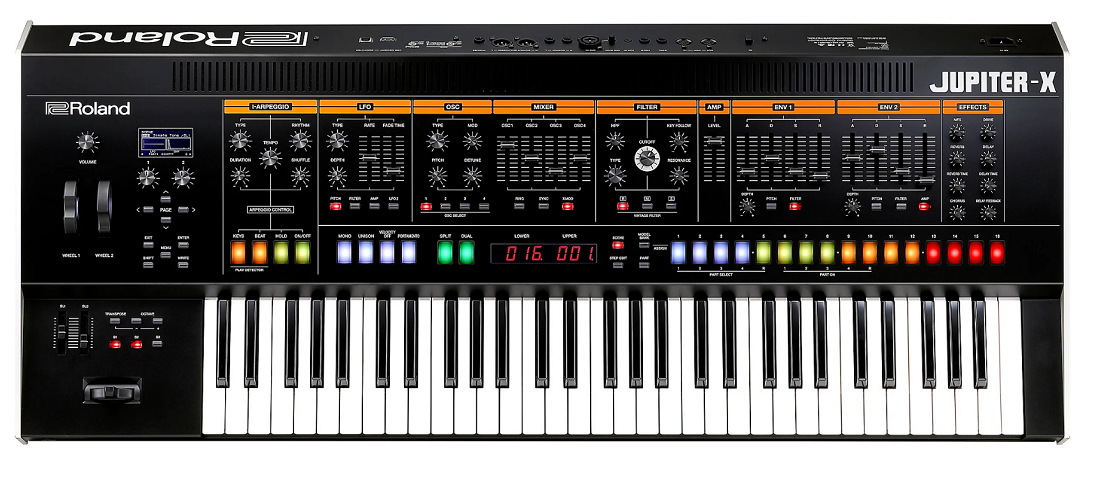
The Jupiter-X earns its place near the top of this list because of the I-Arpeggio system, which is one of the most musically intelligent arpeggiators available in any hardware synth. Roland Jupiter-X doesn’t just cycle through notes.
The I-Arpeggio analyzes what you play and generates context-aware patterns that respond to your chord voicings, inversions, and playing dynamics in ways that standard arpeggiators don’t attempt.
The intelligence behind the I-Arpeggio is what makes it genuinely useful for composition rather than just pattern generation, because the output sounds like it was written rather than algorithmically generated.
- I-Arpeggio Engine
The I-Arpeggio (Intelligent Arpeggio) system generates patterns that respond to your playing context rather than following fixed rules.
Play a minor chord and the arp generates patterns suited to minor tonality. Change to a major chord and the pattern character shifts. The intelligence means the arpeggiator produces musically aware results where the rhythmic and melodic output reflects what you’re actually playing rather than applying the same mechanical pattern regardless of harmonic content.
- Pattern Variety
Hundreds of I-Arpeggio patterns covering rhythmic, melodic, bass line, and accompaniment styles give you an enormous library of starting behaviors. The patterns range from simple rhythmic cycling through complex multi-octave melodic phrases that sound composed rather than generated. For different production contexts, you can find patterns suited to everything from ambient evolving textures to driving rhythmic sequences.
- Realtime Control
Dedicated controls for arpeggio rate, gate, and pattern selection let you manipulate the arp in real time during performance.
Sweeping the rate from slow to fast, shortening the gate for staccato pulses, or switching patterns mid-performance creates dynamic, evolving arpeggiated content that responds to your gestures rather than running on autopilot.
- Scene Layers
The dual-layer scene system lets you run two different arpeggiator configurations simultaneously, one per scene layer. Combining a slow, ambient arp on one layer with a fast, rhythmic pattern on the other creates polyrhythmic, multi-textured arpeggiated content from a single chord hold. The scene morphing then crossfades between arp configurations for evolving pattern transitions.
- Model Integration
The arpeggiator works across all of the Jupiter-X’s Model Expansion engines, meaning you can apply I-Arpeggio patterns to Jupiter-8, Juno-106, SH-101, and other classic Roland sounds. Running the I-Arpeggio through a vintage Juno pad or a Jupiter brass patch gives you arpeggiated classic Roland content that combines modern pattern intelligence with legacy sound character.
- MIDI Output
The I-Arpeggio output can be captured as MIDI for recording into your DAW, meaning the intelligent patterns become editable note data. For producers who want to use the I-Arpeggio as a composition tool rather than just a real-time performance feature, the MIDI output lets you generate patterns on the Jupiter-X and then refine them in your arrangement.
3. Novation Bass Station II
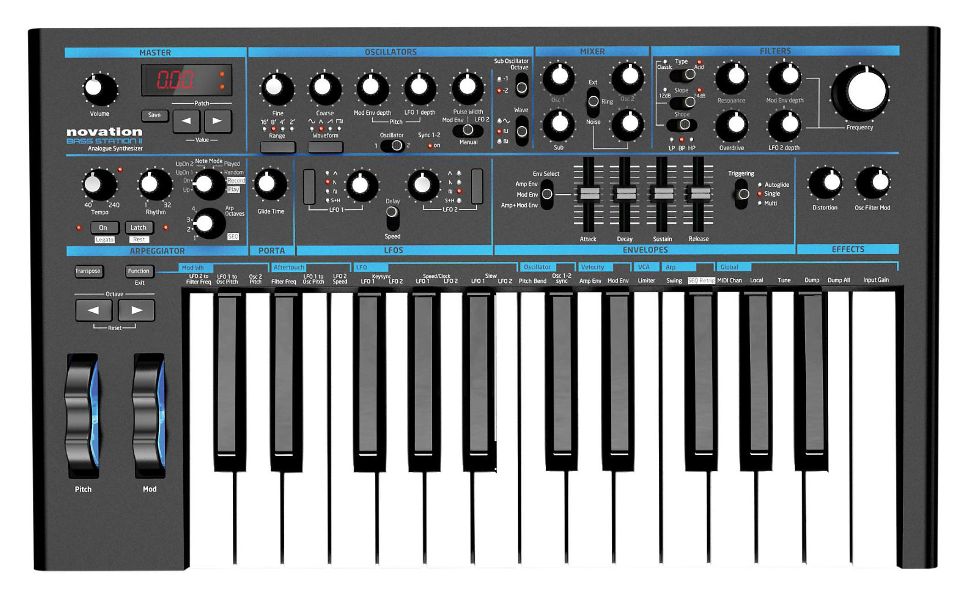
The arpeggiator on the Bass Station II is deeper than you’d expect from a compact analog monosynth, and the combination of arp patterns with the dual filter architecture produces some of the most characterful arpeggiated bass and lead lines available at this price.
Novation Bass Station II gives you an arp with multiple modes, divisions, and gate control that interacts beautifully with the analog signal path.
What makes the Bass Station II’s arp particularly useful is how it interacts with the acid filter mode, producing squelching, accented arpeggiated patterns that sound like a more musical version of a 303 sequence.
- Arp Modes
Multiple arpeggiator modes including up, down, up/down, random, and played order with selectable octave range and rhythmic division give you the pattern foundations.
The modes cover the standard cycling patterns you’d expect plus the random mode that introduces unpredictability. The octave range control lets you spread the arp across multiple octaves for wider, more dramatic patterns.
- Filter Interaction
The arpeggiator’s gate and accent behavior interact with the dual selectable filters (classic and acid) in ways that produce characterful, dynamic patterns.
Running the arp through the acid filter with resonance cranked creates the specific squelching, accented arpeggiated bass lines that defined acid house and techno. The filter’s response to the arp’s dynamics adds tonal movement that static filter settings don’t provide.
- Latch Function
A latch mode holds the arpeggiated pattern running without keeping keys pressed, freeing your hands to adjust filter, envelope, and modulation parameters in real time while the pattern plays. The latch is essential for live performance and sound design because it lets you shape the timbre of the arpeggiated content with both hands rather than dedicating one hand to holding the chord.
4. Arturia PolyBrute 12
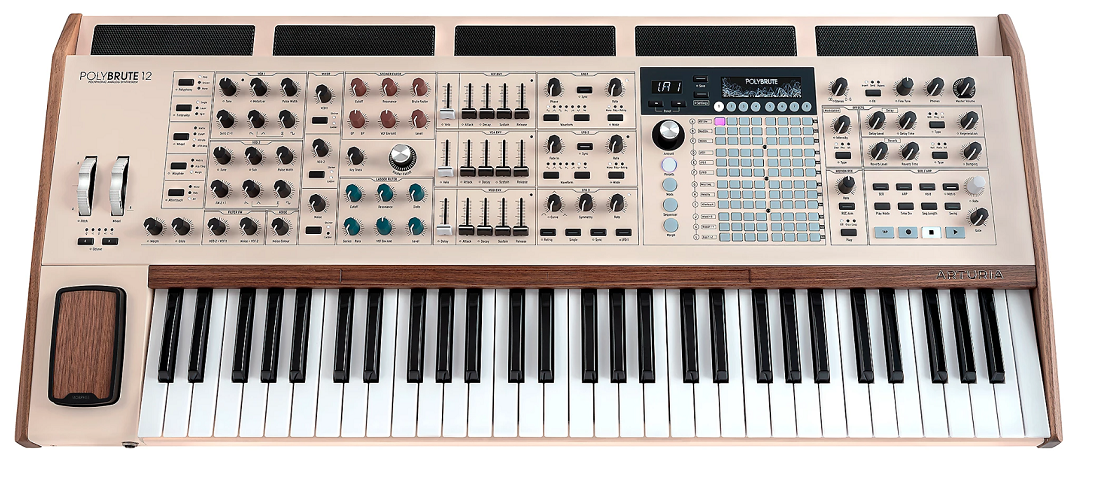
The arpeggiator on the PolyBrute 12 gains a unique dimension from the synth’s morph system, which means you can morph between two completely different arpeggiated sounds using a single control.
Arturia PolyBrute 12 lets you set up an arpeggio on Sound A, a completely different arpeggio on Sound B, and sweep the morph to transition between them, which produces evolving arpeggiated passages that no other analog polysynth can replicate.
The twelve voices of analog polyphony mean the arpeggiated output carries the warmth, depth, and organic variation that only real analog voices provide, and the morph adds a performance dimension to arp use that’s genuinely innovative.
- Morph Arpeggios
Setting up different arpeggiated patches on Sound A and Sound B and sweeping the morph control creates transitions where the arpeggiation pattern, timbre, filter settings, and effects all shift simultaneously.
The morphing arpeggio is what sets the PolyBrute 12 apart from every other arp on this list, because you’re not just changing the pattern, you’re transforming the entire sound character of the arpeggiated content continuously.
- Matrix Control
The modulation matrix can route arpeggiator-related parameters to physical controls, meaning you can use the matrix to create custom arp behaviors where velocity controls filter depth, aftertouch adjusts arp rate, and the morph wheel shifts between pattern styles.
The matrix routing extends the arp’s expressiveness beyond what the dedicated arp controls alone provide.
- Ribbon Performance
The ribbon controller provides smooth, continuous parameter sweeps during arpeggiated playback. Sliding your finger along the ribbon to control filter cutoff while an arp pattern cycles creates the kind of fluid, performative filter sweeps over arpeggiated content that knobs handle less smoothly.
- Twelve Voices
Twelve analog voices mean arpeggiated chords can sustain and overlap without voice stealing. When you play a six-note chord through the arp with long release times, the twelve voices ensure every note has room to ring and decay naturally. The voice count prevents the thinning and truncation that arpeggiators on lower-voice-count synths suffer from.
5. Sequential Prophet 6
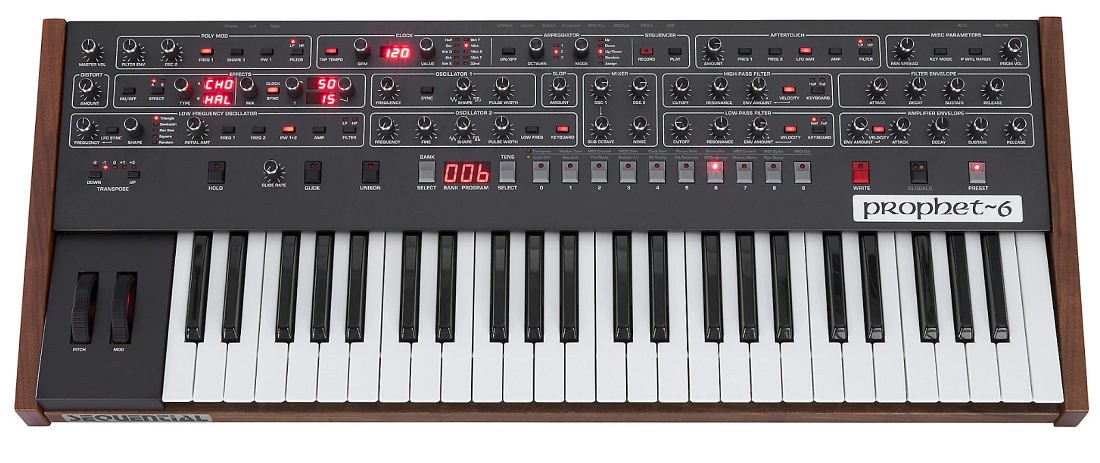
The Prophet 6‘s arpeggiator is deliberately simple, and that simplicity combined with the pure analog sound quality is what makes it effective. Sequential Prophet 6 gives you a clean, musical arpeggiator that lets the Curtis oscillators and filters do the talking rather than overwhelming you with pattern options.
For producers who want arpeggiated content that sounds immediately beautiful because of the analog quality rather than the pattern complexity, the Prophet 6 delivers that with elegant restraint.
- Analog Quality
The arpeggiated output inherits the full Curtis oscillator and filter tone quality, meaning every note in the arp pattern carries the warmth, harmonic richness, and organic variation of the Prophet 6’s analog signal path. The sound quality of the arpeggiated notes is what sets the Prophet 6 apart from digital synths with more complex arp features but less compelling raw tone.
- Poly-Mod Arps
Routing the Poly-Mod section to modulate oscillator pitch or filter cutoff during arp playback creates timbral movement within each arpeggiated note that evolves the sound continuously. The Poly-Mod adds metallic overtones, subtle pitch shifts, and harmonic complexity to arpeggiated patterns that the arp controls alone don’t generate.
- Effects Processing
The built-in chorus and delay process the arpeggiated output within the synth, adding spatial depth and rhythmic complexity. Running an arp through the tempo-synced delay creates cascading repetitions that interleave with the arp pattern, producing rhythmic density that sounds like a more complex pattern than what you’re actually playing.
6. Moog Matriarch
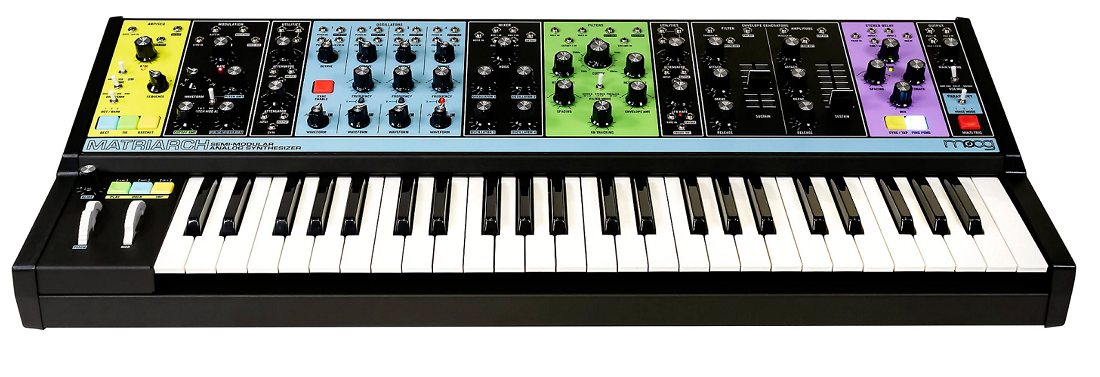
The Matriarch’s arpeggiator takes on a unique character because of the semi-modular patch bay, which lets you route the arp’s output to modulate parameters that standard arpeggiators can’t reach.
Moog Matriarch combines a functional arpeggiator with the ability to patch the arp’s gate and trigger signals to any destination in the semi-modular architecture, turning rhythmic note patterns into rhythmic modulation patterns.
The patch bay integration transforms the Matriarch’s arp from a simple note cycler into a rhythmic modulation source that drives the entire synth.
- Patch Bay Routing
The arp’s gate, trigger, and CV outputs are available at the patch bay, meaning you can route the arpeggiator’s rhythmic behavior to control filter cutoff, oscillator pitch, delay feedback, LFO rate, or any other patchable parameter.
The arp becomes a clock source and rhythmic modulation generator alongside its note-playing function. Patching the arp gate to control the analog delay feedback, for example, creates rhythmic delay swells that sync with the arpeggiated pattern.
- Analog Delay Sync
Running the arpeggiated output through the BBD analog delay with the delay time synced to the arp rate creates cascading, warm repetitions that fill the space between arp notes. The analog delay’s natural degradation adds warmth and character to each repetition, and the interaction between arp timing and delay timing produces rhythmic textures that feel organic and alive.
- Paraphonic Arps
The four-voice paraphonic architecture lets you arpeggiate chords where each note passes through the shared filter, creating a filtered, harmonically rich arpeggiated texture that’s different from fully polyphonic arps because the filter responds to the combined content of all four voices simultaneously.
- Spring Reverb
The built-in spring reverb adds a specific spatial quality to arpeggiated content that digital reverbs don’t replicate. Arpeggiated patterns through spring reverb acquire a vintage, physical resonance that gives the cascading notes a tangible sense of space.
- Moog Character
Four Moog oscillators through the Moog ladder filter give every arpeggiated note the unmistakable warmth and weight of the Moog signal path. The character of the individual notes within the arp pattern carries the fat, harmonically dense quality that defines the Moog sound, which means even simple up/down arp patterns sound rich and compelling.
7. Behringer DeepMind 12
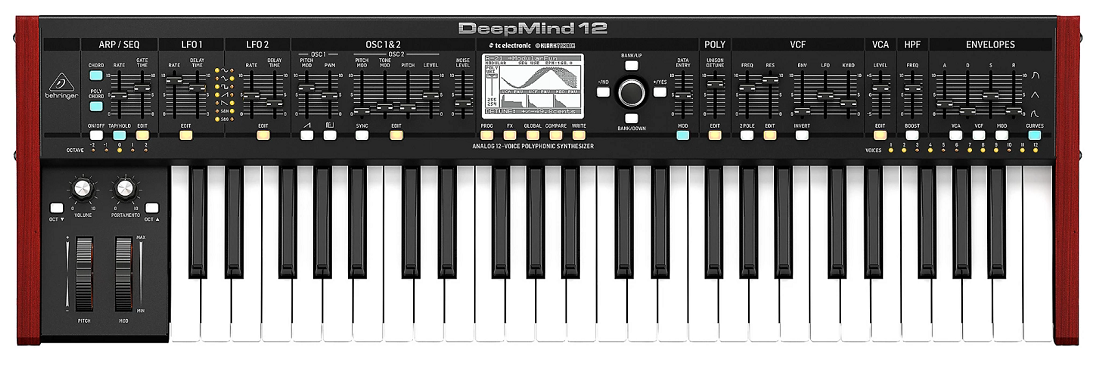
The DeepMind 12’s arpeggiator benefits from the synth’s twelve analog voices and comprehensive effects section, meaning arpeggiated patterns carry the polyphonic depth and spatial processing that the genre demands. DeepMind 12 gives you an arp with multiple modes and divisions at a price where twelve-voice analog arpeggiation would otherwise be out of reach.
The value proposition for arpeggiated content specifically is that you get twelve real analog voices running through chorus, phaser, delay, and reverb at a cost that’s genuinely remarkable.
- Twelve Voice Arps
Twelve analog voices provide enough polyphony for complex arpeggiated chords with long release times where notes overlap and sustain naturally. The voice count means you can arpeggiate rich, extended chords without notes cutting off prematurely, which is essential for the wide, shimmering arpeggiated pads that electronic and ambient music rely on.
- Effects Layering
The 32-slot effects engine processes arpeggiated output with chorus, phaser, delay, reverb, and more simultaneously. Running arpeggiated pads through triple chorus into long reverb with tempo-synced delay creates massive, immersive arpeggiated textures that sound finished without external processing.
- Mod Matrix Arps
The modulation matrix can route arp-related parameters to create custom behaviors where the arpeggiated output controls filter movement, effects depth, or other parameters in sync with the pattern rhythm.
8. Novation Summit
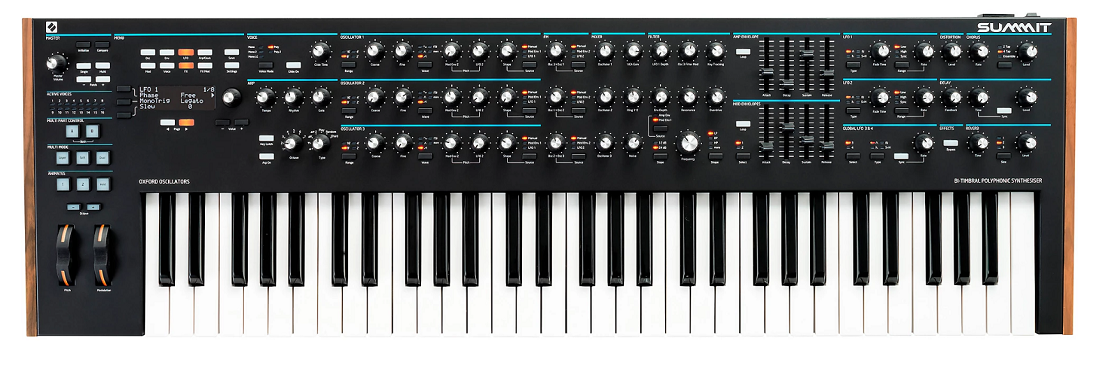
A sixteen-voice bi-timbral polysynth that can run two independent arpeggiators simultaneously, one per timbral layer. Novation Summit lets you arpeggiate one layer with a slow, evolving pattern while the second layer runs a completely different arp at a different rate, creating polyrhythmic, multi-textured arpeggiated content from a single instrument.
The dual-layer arp capability combined with sixteen analog voices means you can build arpeggiated textures of real complexity and depth.
- Dual Layer Arps
Two independent arpeggiators running simultaneously across the bi-timbral layers create polyrhythmic, multi-textured arpeggiated content. You can run a slow ambient arp on Layer A while Layer B cycles a fast rhythmic pattern, and the two interact in ways that a single arpeggiator can’t produce. The independent control means each layer’s arp has its own rate, mode, gate, and pattern settings.
- Sixteen Voices
Sixteen voices split across two layers give you eight voices per arpeggiator, which is enough for sustained, overlapping arpeggiated notes with natural release tails. The polyphony ensures that complex arpeggiated chords across both layers maintain their full harmonic content without voice stealing.
- Oxford Oscillators
The FPGA-based Oxford oscillators provide alias-free digital waveforms alongside wavetable content, giving the arpeggiated output a sonic quality that combines digital precision with analog filter warmth. The oscillator quality means arpeggiated notes are clean and well-defined regardless of speed, avoiding the aliasing artifacts that can make fast digital arps sound harsh.
- Animate Controls
Animate buttons trigger parameter changes during arp playback, adding timbral variation at the press of a button. Holding an Animate button while an arp plays transforms the sound character of the pattern, which is useful for creating builds, transitions, and dramatic timbral shifts during live arpeggiated performance.
9. Modal Cobalt5s
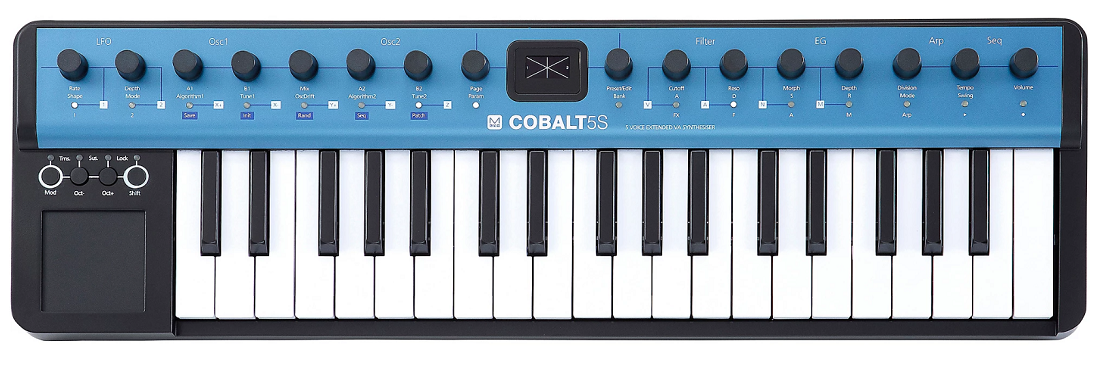
A five-voice virtual analog synth with an arpeggiator that punches above its weight class for the compact format and affordable price. Modal Cobalt5s gives you a fully featured arp with multiple modes, gate control, and swing in an instrument that fits on a crowded desk and doesn’t break the bank.
For producers who want hardware arpeggiation with polyphonic capability without the investment of a flagship polysynth, the Cobalt5s delivers convincing arpeggiated content at an accessible price point.
- Arp Modes
Multiple arpeggiator modes with adjustable gate, swing, and octave range provide the pattern variety you need for different musical contexts. The modes cover standard up/down/random patterns plus variations that create more interesting rhythmic behavior. The swing control in particular adds the timing feel that makes arpeggiated patterns groove rather than march mechanically.
- Joystick Control
The four-axis joystick provides real-time parameter manipulation during arp playback. Sweeping the joystick to control filter cutoff and resonance simultaneously while an arp pattern cycles creates dynamic, expressive timbral movement over the arpeggiated content that dedicated knobs handle less fluidly.
- MPE Expression
MPE compatibility means per-note expression from MPE controllers can influence individual notes within the arp pattern. If you’re using an MPE controller like a ROLI Seaboard, each arpeggiated note can carry its own unique pressure, slide, and pitch bend data, adding expressive depth to patterns that standard MIDI arp implementations don’t support.
- Compact Polyphony
Five-voice polyphony in a compact format means you get enough voices for arpeggiated chords to sustain and overlap at a size that doesn’t dominate your desk. Five voices handles most practical arpeggiation scenarios, and the compact footprint means the Cobalt5s works as a dedicated arp machine in setups where desk space is shared with other instruments.
- Algorithm Variety
Multiple synthesis algorithms beyond basic subtractive provide different tonal starting points for arpeggiated content. The additional algorithms create harmonic complexity that standard virtual analog synthesis doesn’t reach, meaning your arpeggiated patterns carry more timbral interest than simple filtered waveforms.
10. Arturia MiniFreak
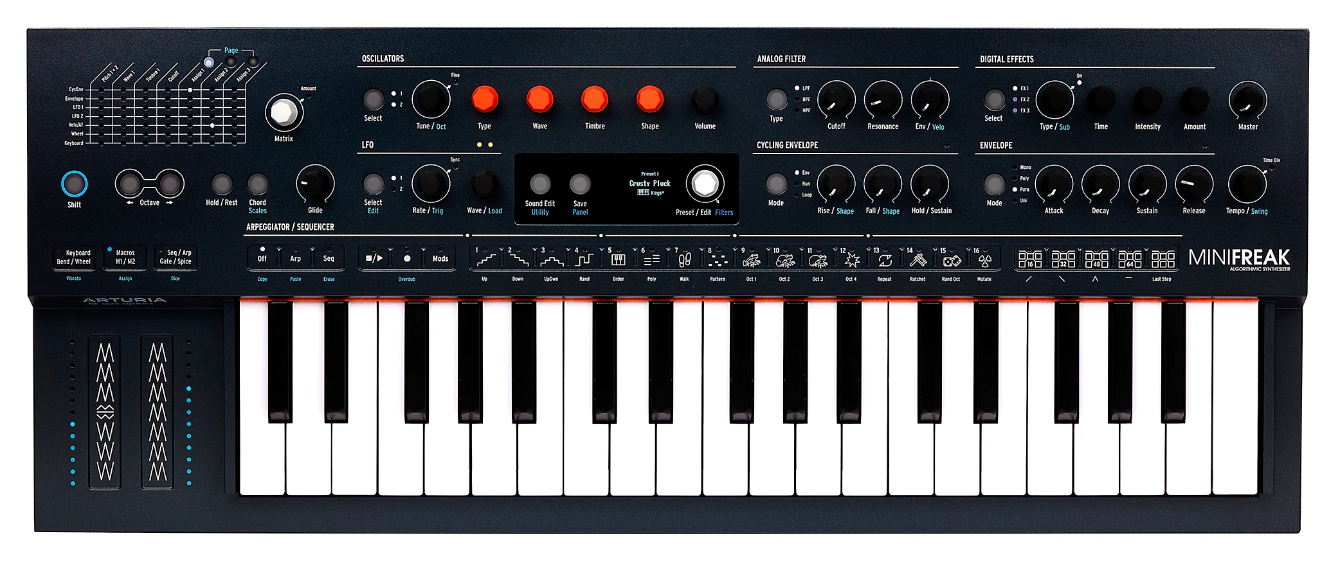
The MiniFreak’s arpeggiator benefits from the synth’s multiple oscillator engines and analog filter, meaning arpeggiated patterns can use granular, wavetable, FM, and Karplus-Strong timbres processed through a real analog circuit.
Arturia MiniFreak gives you arpeggiated content with more timbral variety than any other affordable hardware synth because the arp runs through whichever of the dozen-plus engines you’ve selected.
The combination of arp pattern with unusual oscillator engines produces arpeggiated textures that standard analog or digital synths can’t create.
- Engine Arpeggios
Arpeggiation running through granular, Karplus-Strong, modal, or FM engines produces fundamentally different results than arpeggiation through standard analog waveforms. A granular arp sounds completely different from a physical modeling arp, and having all of these available from one affordable instrument means your arpeggiated palette is uniquely broad.
- Spice & Dice
The Spice and Dice randomization applies variation to arpeggiated sequences, modifying pitch, velocity, and gate per step within controlled boundaries. The randomization keeps arp patterns evolving and interesting over extended playback rather than repeating identically, which matters in production contexts where arpeggiated parts need to sustain interest across entire song sections.
- Analog Warmth
The Steiner-Parker analog filter processes the arpeggiated digital engine output, adding warmth and resonance character to every note in the pattern. The analog filter gives arpeggiated content from the MiniFreak a body and organic quality that purely digital budget synths with similar arp features don’t provide.
- Motion Recording
The macro motion recorder captures knob movements during arp playback and loops them, creating automated timbral variation that syncs with the arp pattern. Recording a slow filter sweep while the arp cycles adds movement to the arpeggiated texture that plays back automatically on every loop.
11. Roland GAIA 2
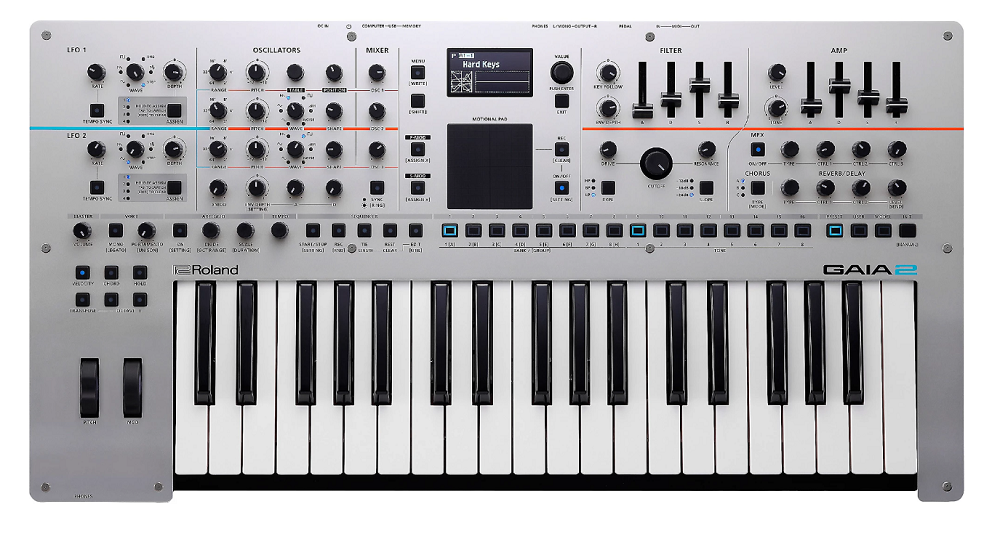
Closing the list with a synth whose arpeggiator benefits from the three-tone layered architecture and scene morphing system. Roland GAIA 2 lets you arpeggiate three independent tone layers simultaneously, each with its own oscillator, filter, and effects settings, creating arpeggiated textures with the density and complexity of three separate synths playing together.
The three-tone arp layering combined with the scene morphing creates arpeggiated content that evolves between two complete sound configurations, which is a capability that most synths on this list don’t offer.
- Three Tone Arps
The arpeggiator runs across all three tone generators simultaneously, meaning each arpeggiated note triggers three independent layers with their own oscillator, filter, and envelope settings. The layered arp output has the density and complexity of multiple synths playing the same pattern, creating rich, stacked arpeggiated textures from a single held chord.
- Scene Morphing
The dual-scene system lets you set up two completely different arpeggiated configurations and crossfade between them in real time. One scene might have a bright, fast arp with short gate, while the other has a warm, slow arp with long sustain. Morphing between them creates gradually evolving arpeggiated transitions that suit builds and breakdowns.
- No Menu Arps
The front panel controls let you adjust arp parameters including rate, mode, and gate without entering any menus. The direct access means you can manipulate the arpeggiator in real time during performance with the same immediacy as turning the filter knob, which makes the GAIA 2’s arp feel more performable than synths that hide arp controls behind screen navigation.
- D-50 Arps
Access to the D-50 synthesis engine alongside the virtual analog tones means you can arpeggiate the classic Roland D-50 textures that defined an era of electronic music. The D-50’s characteristic breathy attacks and evolving sustains take on new life when arpeggiated, producing cascading textures that combine vintage digital character with rhythmic pattern energy.
- Effects Integration
The effects section processes the arpeggiated three-tone output with delay, reverb, chorus, and more. Tempo-syncing the delay to the arp rate creates rhythmic cascades that fill the spaces between arpeggiated notes, adding density and spatial depth. The integrated effects mean your arpeggiated patches are complete, processed sounds that recall with their full spatial character intact.
- I-Arpeggio Access
The GAIA 2 includes access to Roland’s I-Arpeggio intelligence, providing the same context-aware pattern generation that the Jupiter-X offers. The I-Arpeggio responds to what you play by generating patterns that reflect your harmonic content, making the arpeggiated output feel composed rather than mechanically cycled.
Get the Free Plugin Starter Kit
The genuinely useful free DAWs and plugins worth installing. No filler. Straight to your inbox.

Hello, I’m Viliam, I started this audio plugin focused blog to keep you updated on the latest trends, news and everything plugin related. I’ll put the most emphasis on the topics covering best VST, AU and AAX plugins. If you find some great plugin suggestions for us to include on our site, feel free to let me know, so I can take a look!