
Both have been around long enough to build serious track records, let you keep 100% of your streaming royalties, and both get your music onto Spotify, Apple Music, and every major platform you care about. So at first glance, you might wonder if it even matters which one you choose.
The differences between them are specific enough that the wrong choice can cost you real money over time, limit features you’ll eventually need, or leave you without the services that actually matter for where your career is going.
I’ve dug into both platforms in detail, including the fees that don’t show up in the headline pricing, and I want to give you a clear, practical picture of how they actually compare.
Quick Comparison
| Feature | DistroKid | TuneCore |
|---|---|---|
| Entry Price | $24.99/year (1 artist, unlimited releases) | $22.99/year (Rising Artist plan) |
| Pricing Model | Annual subscription, unlimited releases | Annual subscription, unlimited releases |
| Royalty Split | 100% (20% on YouTube CID) | 100% streaming; 20% on social + YouTube CID |
| Music Stays Live If Canceled | No (unless Leave a Legacy paid) | No |
| Distribution Speed | 24-48 hours (fastest) | 1-5 business days |
| Store Coverage | 150+ DSPs | 150+ DSPs |
| YouTube Content ID | Add-on ($4.95/song/yr or $14.95 one-time) | Included in paid plans (20% cut) |
| Publishing Administration | Not available | Yes ($75 setup + 20% of royalties) |
| Sync Licensing | Limited (YouTube Creator Music only) | Yes (50% commission) |
| Scheduled Release Dates | Musician Plus ($44.99/yr) and above | All plans |
| Pre-Save / Smart Links | HyperFollow (built-in, free) | Available |
| Royalty Splits for Collaborators | Free (built-in) | Free for featured artists; $14.99/yr per primary co-artist |
| Analytics | Basic (better on higher tiers) | More detailed daily trend reports |
| Customer Support Quality | Article-based; mixed reviews | Email support, 1 business day response |
| Accelerator / Artist Development | Not available | Yes (TuneCore Accelerator program) |
| Label / Multi-Artist Plans | Ultimate from $89.99/yr (up to 100 artists) | $14.99/yr per additional artist |
What Is DistroKid?
DistroKid was founded in 2013 by Philip Kaplan with a straightforward mission: let independent artists upload unlimited music for one flat annual fee and keep 100% of their royalties. Before DistroKid popularized this model, most distributors charged per release or took a commission on earnings, which made releasing music regularly expensive and complicated.
The platform is built around speed, simplicity, and volume. You upload your tracks, fill in your metadata, and DistroKid handles delivery to Spotify, Apple Music, Amazon Music, TikTok, YouTube Music, Tidal, Deezer, and over 150 other platforms.
The upload flow is deliberately minimal, and most artists can complete their first release in under 15 minutes. That simplicity is a genuine feature for artists who want to move fast and spend their time making music rather than navigating complex release forms.
Spotify holds a minority stake in DistroKid, which has strengthened the platform’s integration with Spotify specifically. DistroKid is a Spotify Preferred Distributor, which means it sits at the top of Spotify’s own recommended list, and it provides instant Spotify artist verification and fast delivery times to that platform in particular.
The honest caveat is that DistroKid is a lean distribution tool. It gets your music onto platforms quickly and keeps your royalties intact, but it doesn’t offer publishing administration, significant sync licensing infrastructure, or deep artist development programs. If those things are part of your career strategy, you either need a different distributor or a separate service alongside DistroKid.
What Is TuneCore?
TuneCore has been around since 2006, making it one of the oldest independent distribution platforms still operating at scale. It helped pioneer the direct-to-platform model that now defines the entire distribution industry, and its acquisition by Believe in 2015 gave it access to significantly more resources, industry connections, and career development infrastructure than most distributors its size would have.
Today TuneCore positions itself as something closer to a full-service partner than a pure distribution tool. Beyond getting your music onto streaming platforms, it offers publishing administration, sync licensing, detailed analytics, artist development through its Accelerator program, and marketing support that goes beyond what DistroKid provides.
For artists who are starting to think about their music as a business with multiple revenue streams beyond streaming, that service depth is genuinely meaningful.
TuneCore moved from a per-release model to an unlimited subscription model in recent years, which addressed one of its biggest historic criticisms: that a large catalog became expensive to maintain over time.
The current structure is more competitive with DistroKid, though the pricing still sits slightly higher on the upper tiers and the TuneCore model charges $14.99 per year for each additional primary artist, which adds up for anyone managing multiple acts or joint releases.
Distribution Reach and Store Coverage
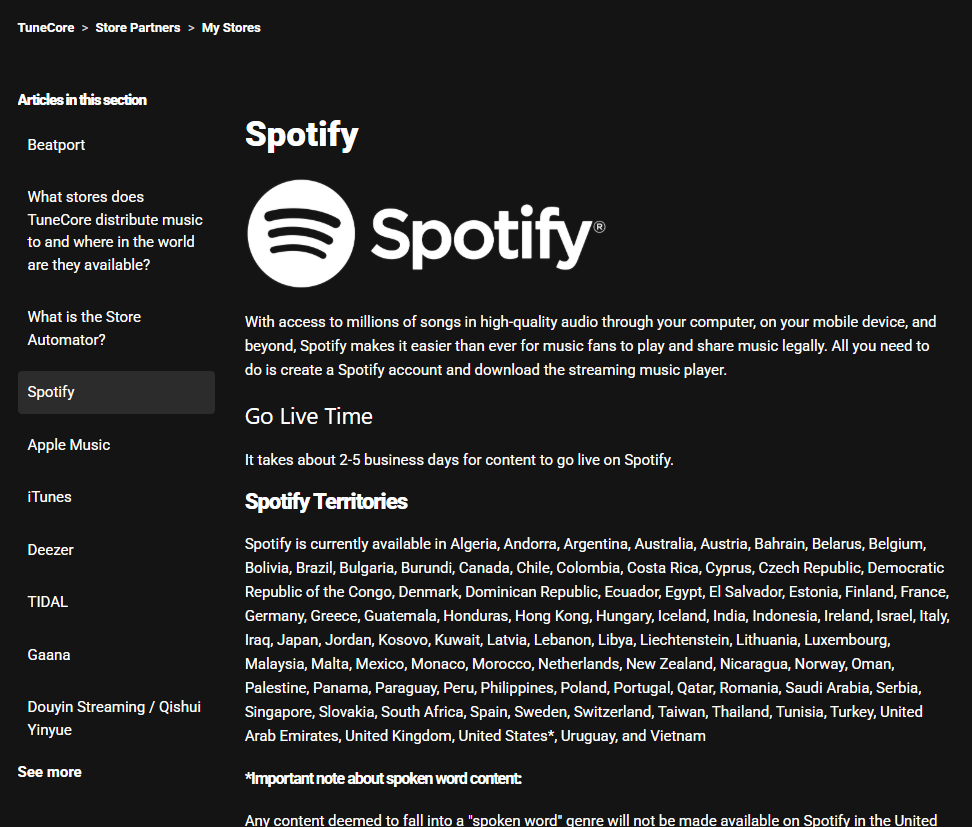
Both platforms distribute to 150+ digital stores and streaming platforms including all the major DSPs: Spotify, Apple Music, Amazon Music, YouTube Music, Tidal, Deezer, TikTok, Instagram, Facebook, iHeartRadio, Pandora, and dozens of regional platforms covering Asia, Latin America, and Europe.
For most independent artists, the platform coverage is effectively identical, and the practical difference in reach between them is minimal. Both will get your music to every platform that materially affects your income.
Where small differences exist tends to be in specialty platforms, Beatport access, or regional DSPs, and TuneCore has a slight edge in total partner count for artists targeting audiophile or regional stores specifically.
I’d say the coverage gap between these two is not a deciding factor for most people. What matters more is how they handle everything else around the delivery itself.
Pricing and Annual Fees
This is where you need to pay close attention, because the headline prices look similar but the real costs diverge meaningfully depending on how you release music and what features you actually need.
- DistroKid Plans
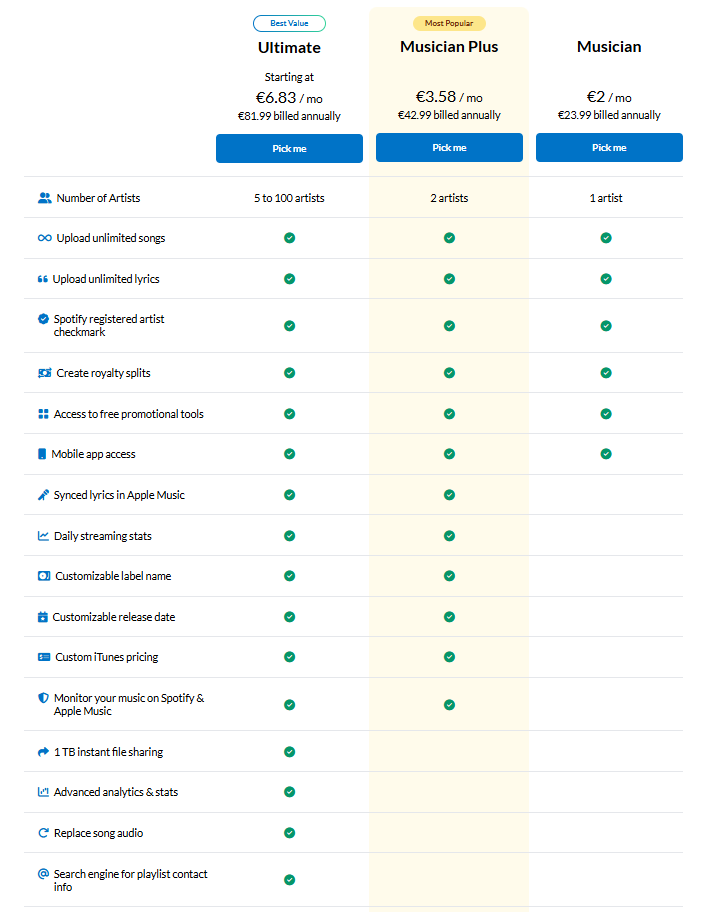
DistroKid’s Musician plan starts at €23.99 per year for one artist with unlimited uploads. The Musician Plus plan at €42.99 per year adds customizable release dates, customizable label names, advanced analytics, song audio replacement after release, and the ability to cover two artist profiles.
The Ultimate plan starts at €81.99 per year and scales up to cover 5 to 100 artists depending on the sub-tier, adding features like playlist contact search tools on top of everything in the lower plans.
The subscription price is the starting point, not the full picture. Content ID costs $4.95 per song per year or $14.95 one-time per song. Shazam and iPhone Siri recognition costs $0.99 per song. Leave a Legacy, which keeps a release live after your subscription lapses, costs $29.99 per release.
Cover song licensing is $14.99 per song per year. Store Maximizer, which automatically adds your releases to new platforms over time, is an additional annual fee. For an artist releasing six songs a year who wants Content ID and catalog protection on everything, the real annual cost is meaningfully higher than €23.99.
- TuneCore Plans
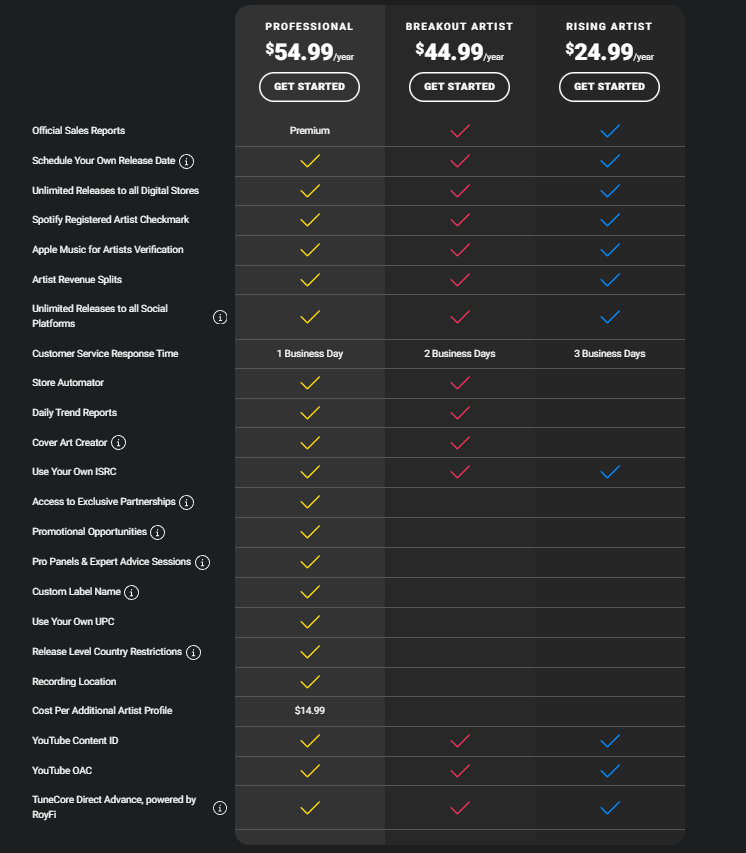
TuneCore’s Rising Artist plan is $24.99 per year with unlimited releases to 150+ digital stores. Stepping up to Breakout Artist at $44.99 per year adds scheduled release dates, custom label names, your own ISRC, and access to exclusive partnerships like Tidal and Twitch. At the top sits the Professional plan at $54.99 per year, which brings custom UPC codes, YouTube Content ID, and faster customer service response times.
For artists who’d rather avoid a subscription, there’s also pay-per-release pricing: $24.99/year for a single or $44.99/year for an album, renewing at $56.49/year after the first.
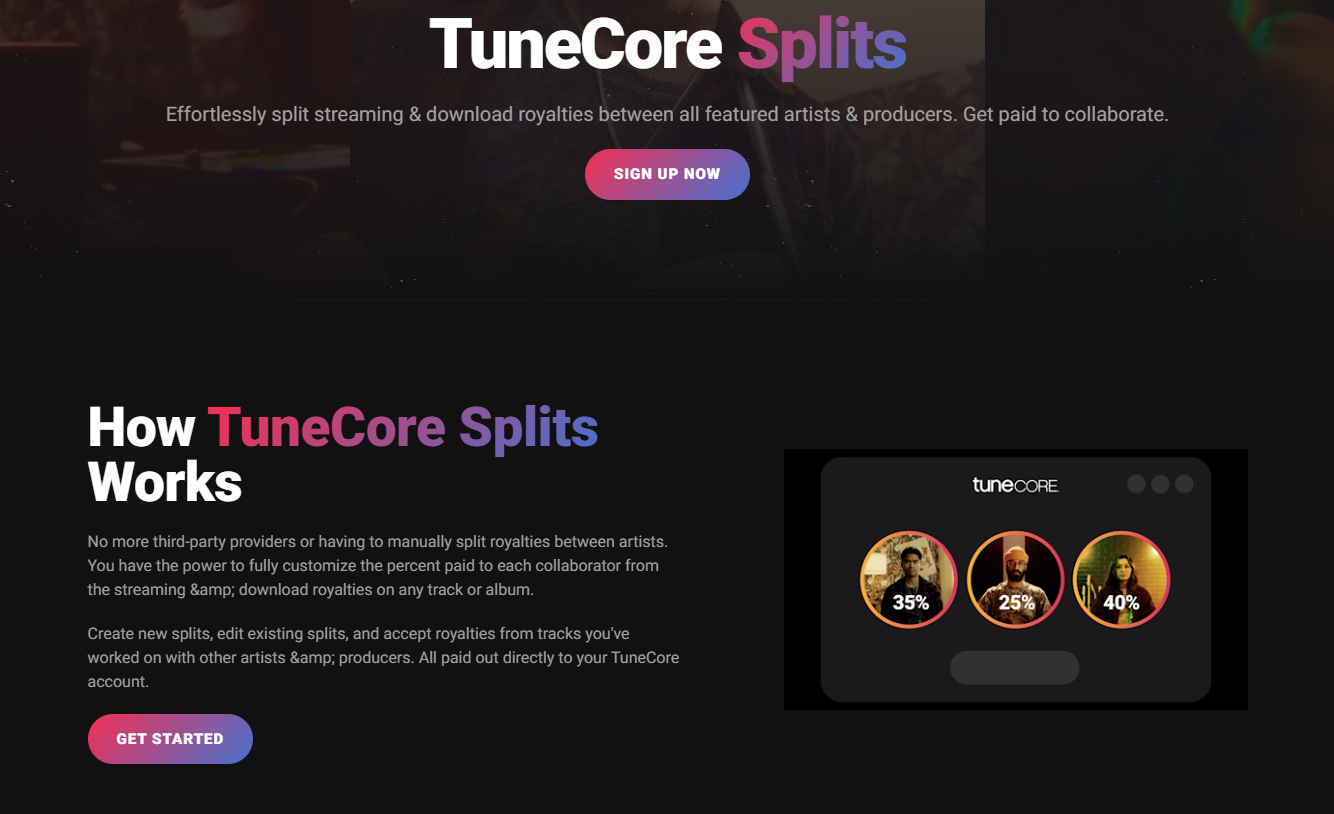
Worth flagging is the $14.99 annual fee per additional primary artist profile on joint releases, which adds up fast for anyone regularly collaborating with other billed artists. TuneCore also takes a 20% fee on social platform monetization from TikTok, Facebook, Instagram, and YouTube, which is a notable difference from DistroKid’s 100% artist royalty policy on social platforms.
Their publishing administration and sync licensing services carry separate commission fees that are worth factoring in if those are part of your plan.
Here’s the complete merged bullet covering both royalty terms and the Splits feature:
- DistroKid’s Royalty Terms and Splits
DistroKid keeps 0% of standard streaming royalties from Spotify, Apple Music, Amazon Music, Tidal, Deezer, and similar platforms, meaning you keep 100% of what those DSPs pay out.
The one exception is YouTube Content ID revenue, where DistroKid takes 20%, which is actually on the lower end compared to other distributors offering Content ID services.
Social platform monetization from TikTok and Instagram is kept in full by the artist, which is a meaningful advantage as social platform income becomes a larger share of independent artist revenue.
DistroKid deposits royalties into your DistroKid Bank as soon as they’re received from streaming platforms, and you can withdraw the earnings on demand through PayPal, Payoneer, or check.
The on-demand withdrawal model is one of its most genuinely useful features for artists who want access to their money without waiting through long monthly reporting periods that other distributors sometimes impose.
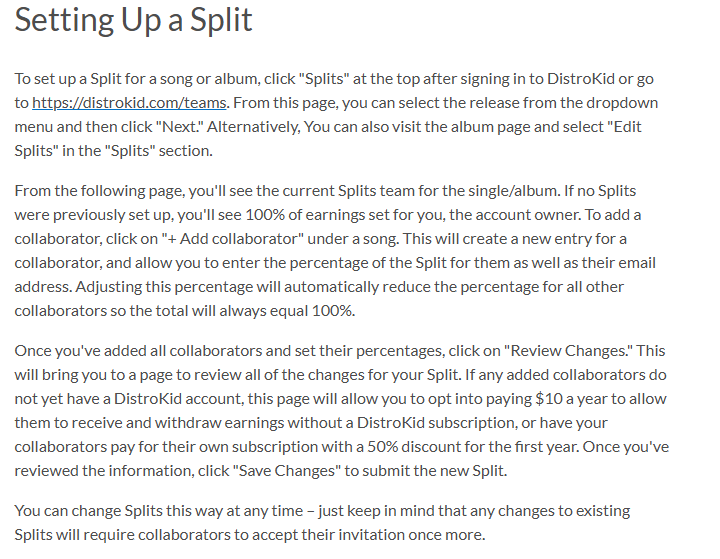
Beyond standard royalty handling, DistroKid includes a built-in Splits tool that automatically divides earnings between collaborators like producers, bandmates, managers, or featured artists, sending each person their share directly to their own DistroKid Bank.
Setting up a Split is straightforward: you navigate to the album page, click Edit Splits, add each collaborator by email, and assign them a percentage that automatically rebalances the remaining shares to equal 100%.
Collaborators only see their own percentage for privacy, and earnings are held until they accept the invitation, which means your release isn’t delayed if a collaborator takes time to sign up.
If an invited collaborator doesn’t have a DistroKid subscription, you can pay $10/year to give them collect-and-withdraw access without requiring them to subscribe, or they can sign up with a 50% discount on their first year.
For a quick how-to on splitting earnings, check out this video:
- TuneCore’s Royalty Terms
TuneCore keeps 100% of standard streaming and download royalties.
The meaningful difference is that TuneCore takes a 20% cut from social platform monetization including TikTok, Instagram, and Facebook, as well as from YouTube Content ID revenue.
For an artist building a significant audience on TikTok, that 20% cut on social earnings is a real ongoing cost that adds up as your catalog generates more income there.
TuneCore pays out monthly with a $10 minimum payout threshold. That monthly cycle is slower than DistroKid’s bi-weekly payments, which matters less for artists with high streaming volume but can feel slow for smaller or emerging artists waiting on their first payouts.
Speed to Stores
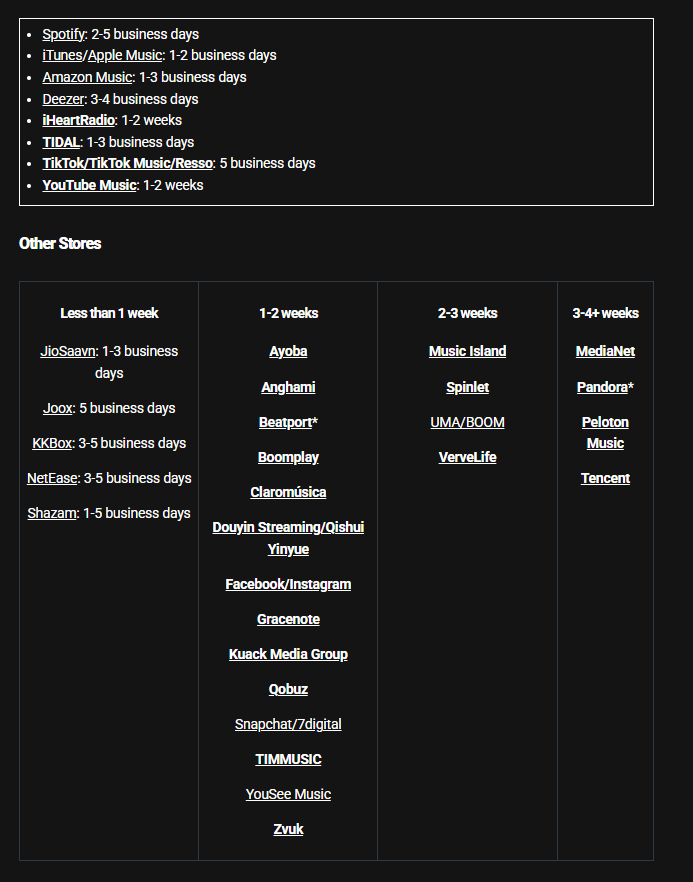
DistroKid is consistently the fastest distributor on the market, with most releases reaching Spotify and Apple Music within 24 to 48 hours.
On smaller regional platforms and some specialty DSPs, delivery can take up to a week, but for the major platforms that drive the majority of streaming income, DistroKid is hard to beat on speed.
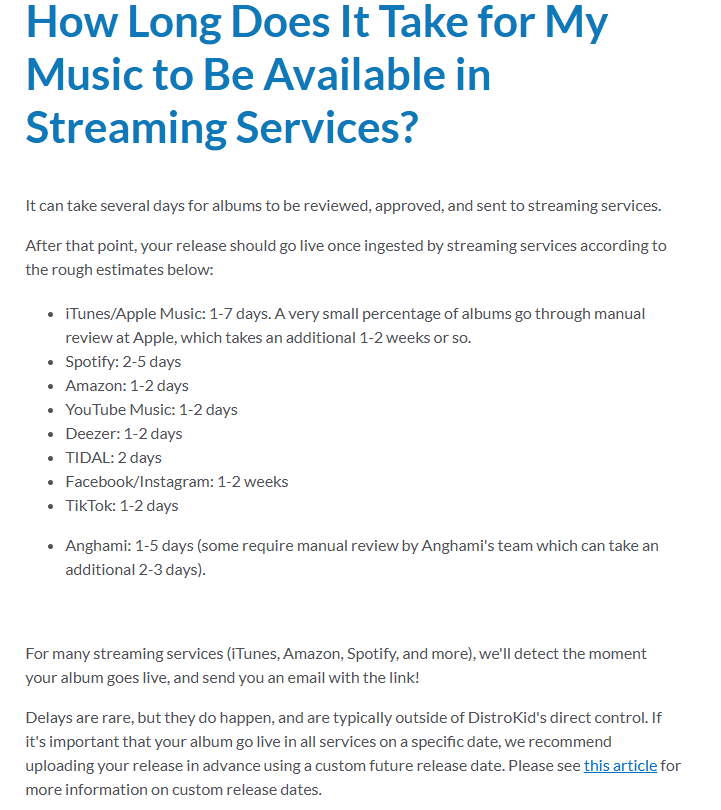
TuneCore typically takes 1 to 5 business days for most platforms, which is competitive but not quite as fast as DistroKid in practice.
Both platforms recommend uploading at least two to three weeks before your planned release date to allow time for Spotify editorial pitching, which requires submission at least seven days before the release date through Spotify for Artists regardless of which distributor you use.
One meaningful difference is scheduled release dates. TuneCore allows custom release date scheduling on all plans, which is important for coordinating a Friday drop with your marketing, press, playlist pitching, and social content calendar. DistroKid only allows scheduled dates on the Musician Plus plan at $44.99 per year and above.
On the base Musician plan, your release goes live whenever DistroKid processes it, which could be any day of the week. For artists who care about launch timing, this is a real limitation at DistroKid’s entry price.
Spotify for Artists and Apple Music for Artists Verification
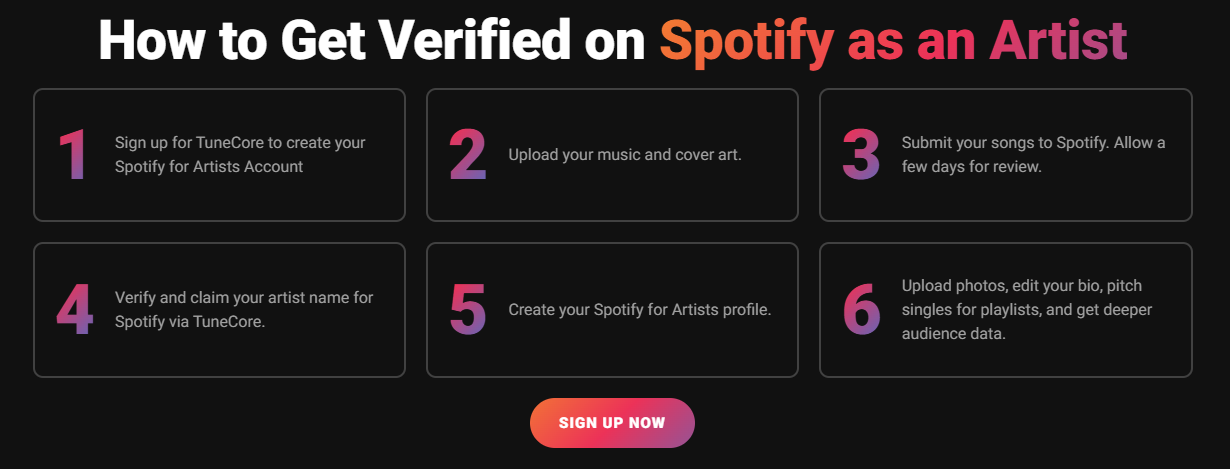
Both platforms provide instant Spotify artist verification, which gives you access to the Spotify for Artists dashboard, the ability to manage your profile and artist image, pitch unreleased music to Spotify editorial playlists, and access listener analytics directly from Spotify.
DistroKid has a particularly smooth verification process given its Preferred Distributor status with Spotify, and most artists get their Spotify for Artists access set up within the first day or two of their first release. TuneCore’s verification process is reliable and functions similarly, though it occasionally takes slightly longer to process depending on the account.
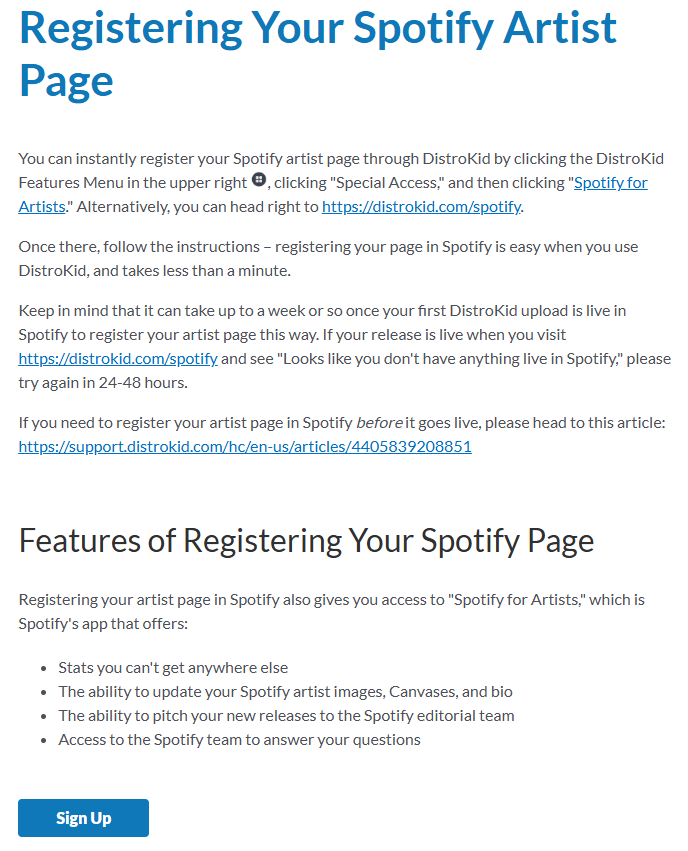
Both platforms also handle Apple Music for Artists verification, which gives you access to your Apple Music analytics dashboard and the ability to manage your artist profile there. The process and timeline are comparable across both platforms.
For most artists, verification through either distributor is a straightforward, essentially painless process, and it’s not a significant differentiating factor between the two.
YouTube Content ID and Monetization
This is one of the areas where the practical differences between the two platforms are most felt by working artists, and it’s worth being specific.
- DistroKid
DistroKid does not include YouTube Content ID in its base plans. It’s an add-on at $4.95 per song per year or $14.95 as a one-time fee per song. For an artist with a growing catalog, this cost adds up to a meaningful sum annually if you want Content ID protection on everything you release.
The upside is that once you opt in, DistroKid takes the industry-standard 20% of YouTube Content ID revenue, which is consistent and transparent.
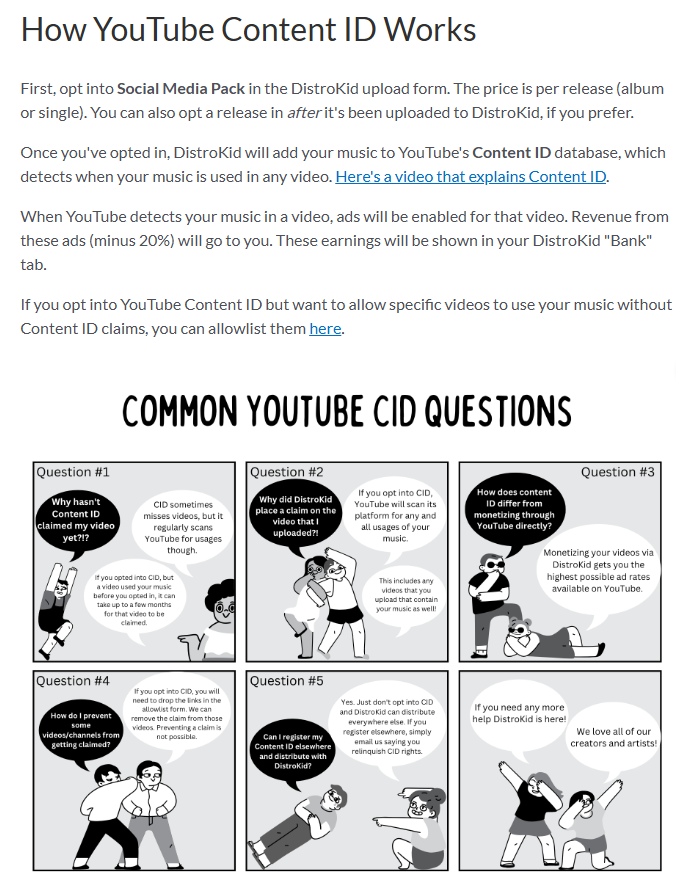
I want to note that Content ID has a nuanced effect on your music’s YouTube ecosystem. When you register a track to Content ID, any channel that uses your music in their videos will have the monetization redirected to you rather than them.
That’s the intended protection, but it can discourage channels from promoting your music organically since using it costs them revenue. This is a consideration that applies regardless of which distributor handles your Content ID, and it’s worth thinking about based on how you want your music to spread on YouTube.
- TuneCore
TuneCore includes YouTube Content ID as part of its paid subscription plans at no additional per-song cost, which is a genuine advantage for artists who want blanket Content ID coverage across their catalog without calculating additional fees per release.
The trade-off is the 20% cut on Content ID revenue and the additional 20% cut on social platform monetization from TikTok, Instagram, and Facebook, which DistroKid does not take.
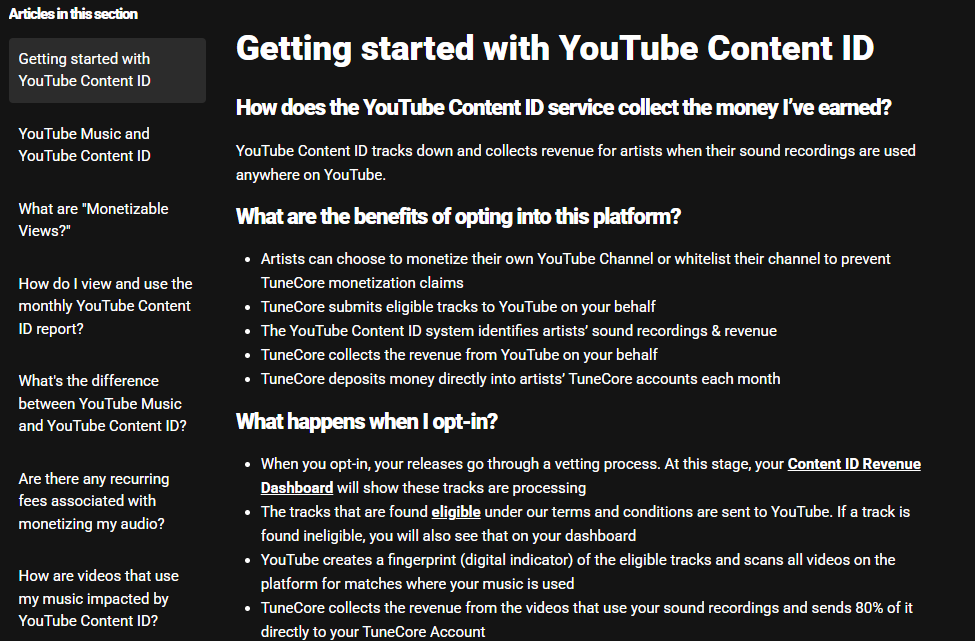
For an artist generating significant income from social platforms, TuneCore’s 20% social platform commission is a real ongoing cost. For an artist whose primary YouTube and social income is minimal, TuneCore’s included Content ID is a convenient feature that removes the per-song add-on math.
Publishing and Sync Licensing
This is one of the most significant functional differences between the two platforms, and it matters a lot for certain categories of artists.
- DistroKid Publishing
DistroKid does not offer publishing administration. It doesn’t collect mechanical royalties, doesn’t register your compositions with global PROs, and doesn’t have an infrastructure for managing the publishing side of your catalog. If you want those royalties collected, you need a separate publishing administrator like Songtrust, DistroKid’s partner, or your performing rights organization.
For the majority of independent artists whose income comes primarily from streaming royalties, this gap doesn’t create an immediate problem.
But for songwriters who are also placing music with other artists, or whose music generates significant performance royalties from radio and sync placements, leaving the publishing layer unmanaged means leaving real money uncollected.
- TuneCore Publishing
TuneCore offers publishing administration as an add-on service for a $75 one-time setup fee plus a 20% commission on publishing royalties collected. This registers your compositions globally and collects mechanical and performance royalties from territories that streaming platforms don’t always pay correctly without a dedicated publisher in place.
The sync licensing service connects your music to opportunities in film, TV, advertising, and media placements, with TuneCore taking a 50% commission on sync deals secured.
That commission is on the higher end for sync services, but having a pipeline into sync opportunities at all is something DistroKid simply doesn’t offer.
For a songwriter with a catalog that generates real publishing royalties, TuneCore’s administration service pays for itself. For an artist primarily earning from streaming with no sync ambitions, the $75 setup fee and ongoing commission may not be worth the overhead.
Fan-Facing Features
- DistroKid HyperFollow
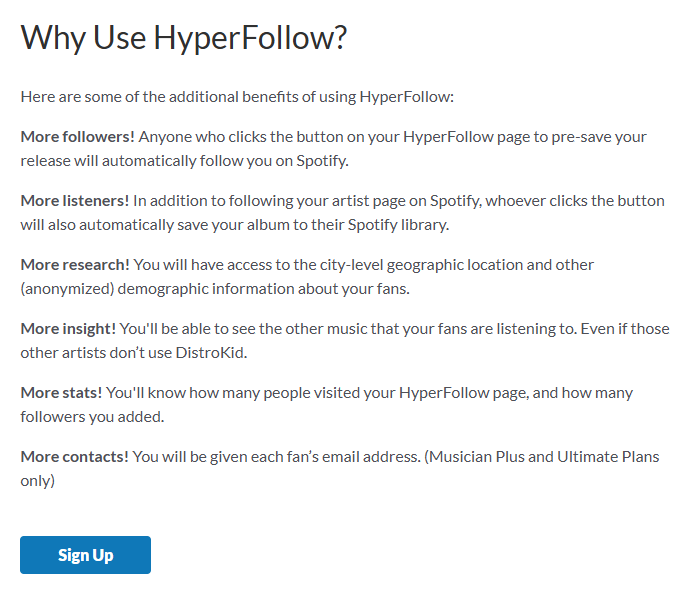
DistroKid’s HyperFollow is one of its most genuinely useful fan-facing tools. A HyperFollow page is automatically created for every upload the moment you finish submitting your release, giving you a pre-save landing page before your music goes live. Fans who click the pre-save button automatically follow you on Spotify and save the album to their library when it drops.
The link never changes, which means you can use it in your bio, your posts, and your press materials from the day you upload without ever having to update your links.
HyperFollow also collects email addresses from fans who pre-save, gives you city-level geographic data on who’s engaging with your release, and shows you what other music those fans are listening to. For an artist actively building their audience, those data points are practically valuable.
I found that the automatic Spotify follow trigger combined with the album save is what makes HyperFollow genuinely more useful than a basic link aggregator for pre-release campaigns specifically.
You’re right to correct me. TuneCore calls it “LinkShare,” not “smart links” generically. Here’s the corrected version with accurate info based on what you found:
- TuneCore’s LinkShare
TuneCore offers a feature called LinkShare, which creates a single page directing fans to your release across multiple digital stores like Spotify, Apple Music, Amazon Music, Tidal, YouTube Music, Deezer, iTunes, Napster, and Pandora. Once your single goes live on at least one of these stores, the LinkShare page automatically becomes active and populates with the available store links.
One limitation worth knowing: only singles are eligible for LinkShare, not albums or social platform-only releases. There’s also no analytics or customization available for LinkShare pages, so you won’t see how many clicks or saves the page has driven, and you can’t change the design beyond the standard cover art, share link, and store buttons.
Compared to DistroKid’s HyperFollow, which supports pre-save campaigns, fan email collection, and customizable landing pages, TuneCore’s LinkShare is genuinely more bare-bones. However, TuneCore’s overall analytics layer around release performance, streaming trends, and audience data is noticeably stronger thanks to daily trend reports on higher-tier plans, which gives data-driven artists more granular insight into how their catalog is performing over time even if the link-sharing tool itself is less feature-rich.
Customer Support
- DistroKid Support
DistroKid’s customer support is article-based by default. When something goes wrong or you have a question, you’re directed to help articles and community forum threads before reaching a human. Getting direct human support can be frustrating to navigate, particularly in time-sensitive situations like a release that needs fixing quickly.
That said, DistroKid holds a 4.6-star rating on Trustpilot (at the time of writing this), which suggests that for the majority of artists who use it without running into major issues, the experience is positive. The problems tend to surface when something goes wrong and you need a fast human response.
- TuneCore Support
TuneCore offers email-based customer support with a stated one business day response time, and the overall reputation for support responsiveness is better than DistroKid’s. For artists who value knowing there’s a real team responding to problems on a predictable timeline, TuneCore’s support model is meaningfully more reassuring.
The trade-off is that TuneCore’s support is still not immediate. One business day is the target, not a guarantee, and for time-critical release issues that can still feel slow. Neither platform offers phone support or live chat, which is a limitation both share.
Which Is Better for Independent Artists?
For most independent artists releasing music regularly with a lean budget, DistroKid wins on pure value. The $24.99 entry price for unlimited releases, the fastest delivery in the industry, free built-in royalty splits, HyperFollow for pre-saves, and 100% of social platform revenue make it the most efficient distribution tool available at that price point.
I think DistroKid is the right default choice for artists who are in volume mode: releasing consistently, growing an audience on streaming and social platforms, and haven’t yet reached a point where publishing administration or sync licensing are part of the income strategy.
The lack of scheduled release dates on the base plan is a real limitation worth acknowledging, and upgrading to Musician Plus at $44.99 per year to unlock that feature is worth it for any artist who cares about coordinating their releases with a marketing plan.
The add-on costs for Content ID and Leave a Legacy are the honest asterisks on DistroKid’s pricing, and you should calculate those into your actual annual cost before assuming the $24.99 number is your full spend.
Which Is Better for Established Acts?
- TuneCore
For artists who have built an audience and are starting to think seriously about all the revenue streams their music generates, TuneCore’s service depth becomes genuinely relevant. Publishing administration, sync licensing access, the Accelerator program, daily analytics reporting, and more reliable customer support give TuneCore advantages that matter more as your music career scales.
The 20% commission on TikTok, Instagram, and YouTube Content ID earnings is the real cost of that additional service infrastructure, and for artists generating meaningful social platform income, that percentage deserves serious attention before signing up.
- Distrokid
For established acts managing multiple artists or operating a small label, the comparison is more nuanced. DistroKid’s Ultimate plan pricing is more cost-efficient per artist at scale, while TuneCore’s publishing and sync services are more comprehensive for artists who need that layer of revenue management.
In my opinion, artists who are earning enough from music to treat it as a primary income source and who have sync ambitions or significant publishing royalties to collect will find TuneCore’s service suite justifies its higher total cost. Artists who are still in the growth phase and primarily generating streaming income will find DistroKid’s lean model more financially sensible.
The Bottom Line
DistroKid and TuneCore are both legitimate, reliable distribution platforms, and either one will get your music onto every platform that matters. The decision isn’t about which one is objectively better; it’s about which one matches how you work and where your career is right now.
DistroKid is the stronger choice for artists releasing music regularly who want the fastest delivery, the lowest total annual cost, full social platform royalties, free royalty splits for collaborators, and a clean pre-save system in HyperFollow.
It’s the most efficient pure distribution tool at its price point, and for artists who don’t need publishing administration or sync licensing, the lean model is a feature rather than a limitation.
TuneCore is the stronger choice for artists who want publishing royalty collection, sync licensing opportunities, deeper analytics, more reliable human customer support, and career development resources through the Accelerator program.
It costs more overall, particularly if you’re generating meaningful social platform income that TuneCore takes a 20% cut from, but the service layer is meaningfully deeper for artists at a stage of their career where that infrastructure matters.
For a new independent artist releasing their first few singles, start with DistroKid. For a songwriter with a catalog, publishing royalties to collect, and sync placements as part of your strategy, TuneCore is worth the additional investment.

Hello, I’m Viliam, I started this audio plugin focused blog to keep you updated on the latest trends, news and everything plugin related. I’ll put the most emphasis on the topics covering best VST, AU and AAX plugins. If you find some great plugin suggestions for us to include on our site, feel free to let me know, so I can take a look!