
There are all sorts of plugin bundles out there, but very few carry the kind of historical weight that the Eventide Clockworks Bundle does. Eventide’s hardware processors defined the sound of some of the most important recordings in modern music history, and the Clockworks Bundle is the official software recreation of those landmark units.
The collection includes eight plugins derived from four pieces of hardware: the H910 Harmonizer, H949 Harmonizer, SP2016 Reverb, and the Omnipressor, along with dual and Mk II versions of several of them. I think understanding where each piece of hardware came from is important context for evaluating what the bundle actually is, because these aren’t attempts to create the best possible pitch shifter or reverb available today: they’re faithful recreations of specific, historically significant circuits with their own distinct character and limitations.
For producers and mixing engineers who care about the specific sonic character of these hardware units and want access to the sounds they defined without chasing down vintage gear, this bundle is genuinely irreplaceable. Nothing else sounds like these tools because nothing else is modeled from the same specific circuits, and that specificity is the entire point.
H910 Harmonizer
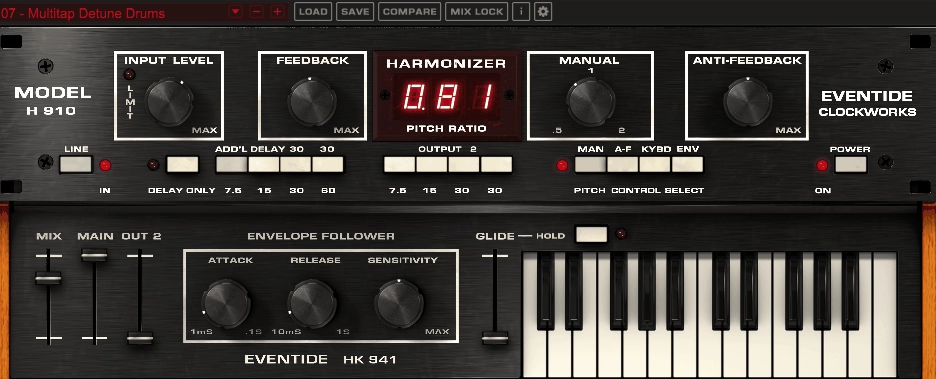
The H910 was the world’s first commercially available digital audio effects processor, released by Eventide in 1975, and the plugin bearing its name faithfully recreates its pitch shifting with feedback and delay, including the specific glitchy, lo-fi digital artifacts that made it so distinctive on records from that era. I must say, there is genuinely no other plugin that sounds like this one, because the artifacts are not bugs to be designed around: they are the character.
- Pitch Shifting and Feedback
The pitch shifting in the H910 is deliberately unstable by modern standards: it operates with a limited pitch ratio range, and the specific way it handles the transitions between pitch intervals creates a slightly smeared, imprecise quality that engineers in the late 1970s and 1980s learned to use as an effect in its own right. The feedback control allows the pitch-shifted signal to be fed back into the input, building cascading layers of transposed pitch that were used on David Bowie and Led Zeppelin recordings to create textures that no other processing of that era could produce.
The delay time control adds a short pre-delay before the pitch-shifted signal, which combined with the feedback creates a kind of temporal smearing that makes the H910’s output feel like it exists in its own acoustic space. At subtle settings this adds a specific width and depth to the sound; at more extreme settings it becomes an effect unto itself.
- Lo-Fi Digital Character
The 12-bit digital architecture of the original hardware is part of what the plugin reproduces, and this shows up as a specific noise floor and a particular quality to how the pitch-shifted audio sits in the frequency spectrum. It’s warmer and more limited in bandwidth than any modern pitch shifter, and that limitation is musically meaningful: the H910’s output occupies a different sonic space from the source material in a way that creates natural separation rather than the tight, precise relationship of a transparent modern pitch processor.
H910 Dual Harmonizer
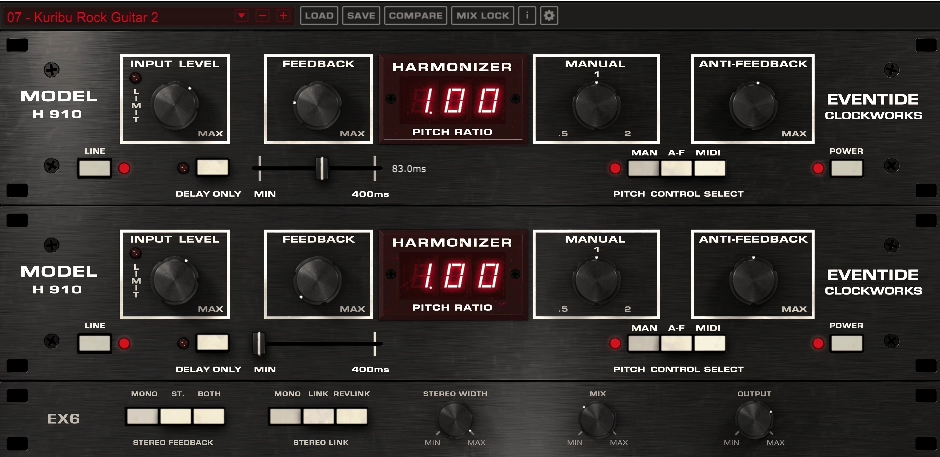
The Dual version of the H910 provides two independent H910 instances that can be run in series or parallel configurations, which was how studio engineers in the hardware era typically deployed these units: stacking two H910s to create more complex pitch relationships and thicker, more layered results than a single unit could produce.
- Dual Configuration
Running two H910 circuits simultaneously opens up interval relationships between the two shifted signals that a single unit can’t achieve: one instance can shift up a fifth while the other shifts down a third, or both can be set to slightly different pitch values to create the specific beating frequency between detuned signals that makes harmonizers sound wide and complex rather than simply doubled.
The routing options between the two instances determine whether the second H910 processes the output of the first or the dry signal, which produces completely different results and covers a wide range of layered pitch applications from lush to overtly processed.
H949 Harmonizer
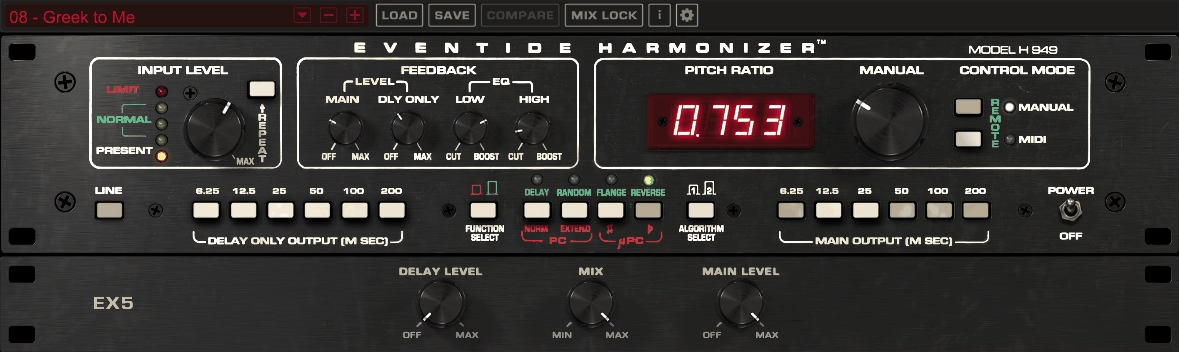
Where the H910 was deliberately and charmingly unstable, the H949 was Eventide’s refinement of the harmonizer concept, released in 1977 with smoother pitch shifting, true flanging capability, and a more controllable micro-pitch shifting mode that extended the practical applications of the hardware significantly.
- Smoother Pitch Shifting
The improved pitch shifting algorithm in the H949 produces a cleaner, more stable transposition than the H910 while retaining the analog warmth and bandwidth limitations of the hardware era. This makes it more useful for applications where you want pitch shifting to be heard as pitch shifting rather than as an effect in its own right: doubling a vocal at a tight interval, adding a harmony line to a guitar, or thickening a bass with a transposed copy that sits just below the fundamental.
- True Flanging
The H949’s flanging mode is one of the most authentic hardware flanger recreations available in plugin form, because it generates flanging through the same physical mechanism as the original tape-based flanging effect: varying the delay time of a copy of the signal and mixing it with the original, which creates the characteristic jet-plane sweep as the comb filter notches move through the frequency spectrum. The sweep range and rate controls cover the full range from very slow, barely perceptible phase movement through to dramatic, wide-sweep flanging that completely transforms the character of the source.
- Micro-Pitch Shifting
The micro-pitch mode was one of the H949’s most significant contributions to studio practice, and it remains one of the most useful modes in the plugin. Setting the pitch shift to a very small interval (typically 5 to 15 cents) and mixing the shifted signal with the original creates a stereo width and dimension that behaves differently from chorus or conventional widening because the comb filtering relationship between the original and shifted signals has a specific tonal character that sounds natural and musical rather than processed.
H949 Dual Harmonizer
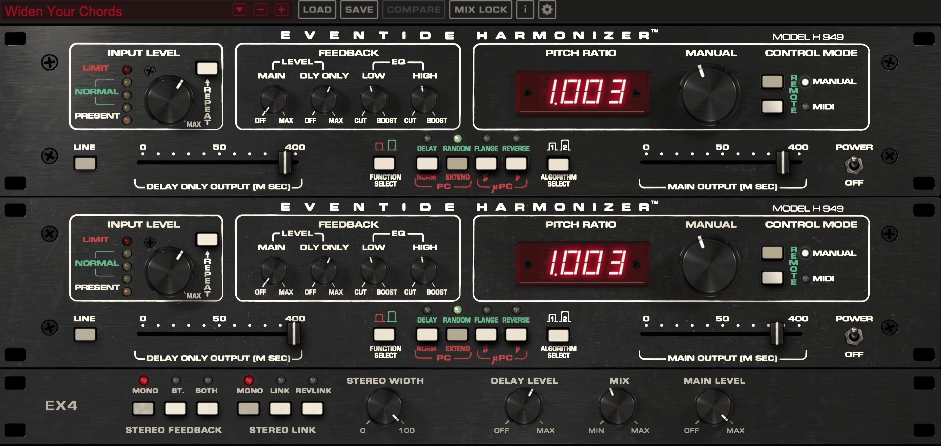
The Dual H949 follows the same logic as the Dual H910: two independent H949 instances available for parallel or series routing, allowing the combination of flanging, micro-pitch shifting, and full pitch shifting from a single plugin with the routing flexibility of two separate hardware units.
- Extended Layering
I believe the Dual H949 is most compelling when you combine its two flanging or micro-pitch modes with different settings, because the interaction between two slightly different flanger sweep rates creates a more complex and less obviously mechanical movement than a single flanger can produce. Two flangers at similar but not identical rates create a beating pattern between their respective phase notches that sounds organic and difficult to replicate by other means.
Omnipressor
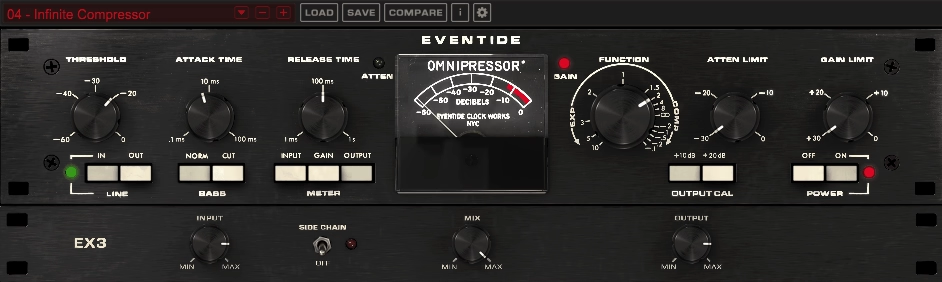
The Omnipressor is unlike any other compressor in this collection or most other plugin collections, because its compression ratio range extends below 1:1 into territory that inverts the relationship between input level and output level rather than simply reducing it. I found this to be the most conceptually unusual and genuinely irreplaceable tool in the entire bundle.
- Dynamic Range Control
Standard compressors apply a ratio above 1:1, meaning that for every dB the input rises above threshold, the output rises by less than 1dB. The Omnipressor can be set to ratios below 1:1, which means the output rises by more than 1dB for every dB of input increase, meaning expansion rather than compression, and can be pushed all the way to gain inversion, where louder input signals produce quieter output and vice versa.
This is a processing behavior that simply does not exist in any other dynamic processor, and the creative applications range from subtle upward expansion that makes quiet details more audible through to deliberate gain inversion effects that create rhythmic pumping and breathing patterns.
- Attack and Release
The attack and release controls on the Omnipressor have a specific character that reflects the analog circuitry of the hardware: the attack responds differently at different input levels, and the release behavior has a program-dependent quality that makes it sound more natural than a fixed-time digital implementation.
At compression settings the Omnipressor has its own specific character for transient shaping and dynamic control that engineers familiar with the hardware developed strong opinions about, and the plugin recreates that character accurately.
Instant Phaser Mk II
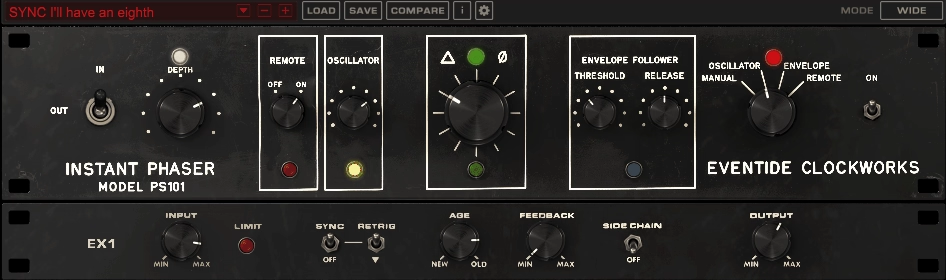
The Instant Phaser was Eventide’s original analog phaser hardware, and the Mk II version of the plugin both recreates the original circuit and adds the expanded control options that modern production workflows benefit from. The phaser character is specifically rooted in the analog phase-shift network design of the hardware, which produces a different quality of sweep than the digital phaser algorithms common in most plugin collections.
- Analog Phase Character
The analog phase-shift network produces notches in the frequency response that have a specific spacing and depth characteristic of the hardware’s design, and the interaction between these notches and musical content has a warmth and musicality that digital phaser algorithms don’t replicate exactly.
I noticed that the Instant Phaser Mk II sounds particularly compelling on keyboards, guitars, and synthesizers where the analog warmth of the phase effect complements the tonal character of the source rather than sitting on top of it.
- LFO and Manual Sweep
The LFO rate and depth controls cover the range from very slow, evolving phase movement through to fast modulation that creates vibrato-like effects at extreme depth settings. The manual sweep mode allows the phase position to be set to a fixed point or swept by hand via MIDI control, which opens up performance-oriented phasing applications that the auto-LFO mode doesn’t address.
Instant Flanger Mk II
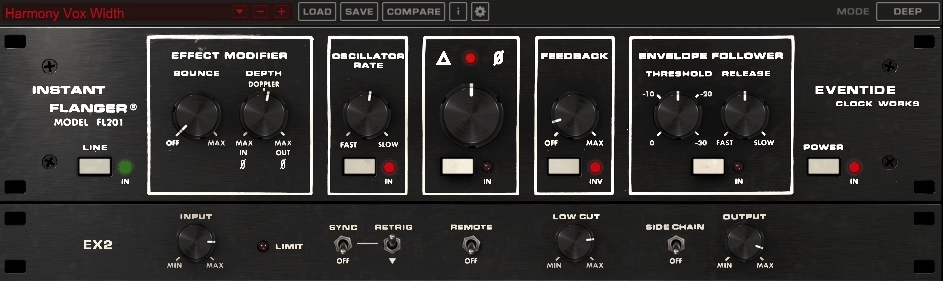
The Instant Flanger Mk II recreates Eventide’s hardware flanger, which approaches flanging through a different circuit topology than the H949’s flanging mode, producing a distinct flavor of the effect that engineers who worked with the original hardware recognize as its own specific character.
- Hardware Flanger Character
The specific jet-plane sweep quality of the Instant Flanger reflects the analog bucket-brigade device (BBD) circuit approach of the original hardware, which has a warmth and slight unpredictability in the sweep behavior that purely digital flanger implementations don’t naturally produce.
The feedback control determines how prominent the comb filter notches become, from gentle and subtle through to the intense, resonant flanging character at high feedback settings that makes the effect impossible to ignore.
- Manual and Auto Modes
Like the Instant Phaser, the Flanger Mk II supports both automated LFO-driven sweep and manual control of the flange position, with the manual mode being particularly useful for setting a fixed flanging point that creates a specific tonal color rather than a continuously sweeping effect.
A fixed flanger position with moderate feedback produces a comb filter coloration that adds harmonic interest to guitars and synthesizers without the obvious movement of conventional flanging.
SP2016 Reverb
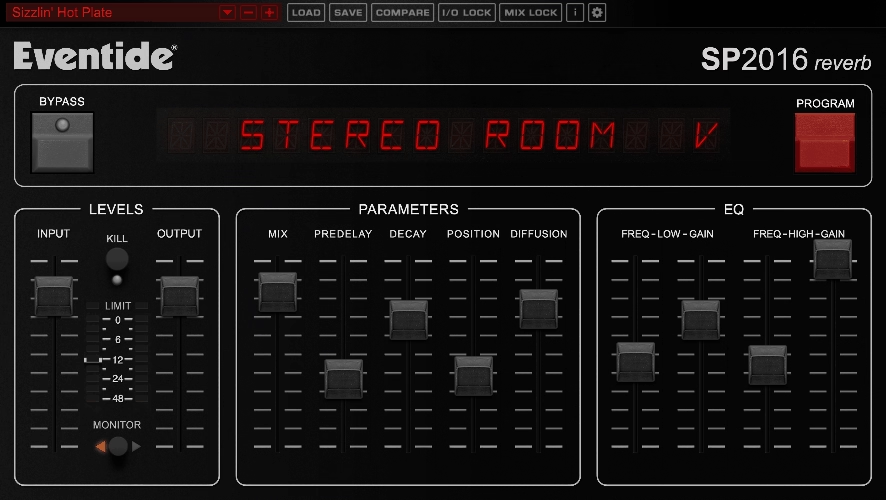
The SP2016 powered the reverb sound on countless hit records of the 1980s and 1990s, and the specific Room, Plate, and Stereo Room algorithms it contained have a particular density, shimmer, and tonal character that modern algorithmic reverbs consistently struggle to replicate.
I realized when spending time with this plugin that some reverb textures genuinely require the specific hardware character of the SP2016 to work correctly, and no amount of parameter adjustment on a modern reverb gets you to the same place.
- Room Algorithm
The Room algorithm produces a dense, rich room simulation that was used extensively on drum recordings and orchestral content of the era. It has a specific buildup time and tail character where early reflections blend into the late reverb in a way that sounds cohesive and musical rather than like two separate processing stages, and the room size and decay controls produce results that feel like real acoustic spaces rather than mathematical approximations of them.
- Plate Algorithm
The Plate algorithm is one of the most historically significant reverb sounds in recorded music: smooth, dense, and with a specific high-frequency shimmer that became the standard for vocal reverb on pop and R&B productions of the 1980s. It has a particular sustain and tail character that sits under vocals without masking them, adding depth and space in a way that feels like the voice is inside the reverb rather than having reverb applied to it from outside.
- Stereo Room
The Stereo Room algorithm expands on the Room algorithm with independent processing for the left and right channels, which creates a wider, more three-dimensional spatial impression than a mono room simulation. On drum overheads, piano, and acoustic instruments where the stereo image of the source is already well-defined, the Stereo Room adds depth without collapsing the width.
Final Thoughts
The Eventide Clockworks Bundle is genuinely a different kind of investment from most plugin collections. You’re not buying the most technically capable or feature-rich tools in their respective categories: you’re buying faithful software recreations of specific hardware that defined the sound of specific records, with all the character, warmth, and idiosyncrasy of those original circuits intact.
For producers who care about the specific sonic reference points these hardware units represent, and who want access to that sound in a software environment without hunting down vintage gear or paying boutique hardware prices, this bundle is the most direct and authentic route available. The combination of the H910 and H949 for pitch and harmonizing, the SP2016 for reverb, and the Omnipressor for dynamics covers a remarkable range of historically significant processing in a single purchase.
Check here: Eventide Clockworks Bundle

Hello, I’m Viliam, I started this audio plugin focused blog to keep you updated on the latest trends, news and everything plugin related. I’ll put the most emphasis on the topics covering best VST, AU and AAX plugins. If you find some great plugin suggestions for us to include on our site, feel free to let me know, so I can take a look!