
Native Instruments and Audio Imperia are not a pairing you would have predicted a few years ago, but the collaboration makes genuine sense when you think about what each brings to the project. NI provides the Kontakt engine and the distribution reach that puts a library in front of a massive global user base, while Audio Imperia brings the deep orchestral recording expertise and the specific cinematic sensibility that has made them one of the more respected names in premium sample library development.
The result sits comfortably among the best Kontakt libraries available for cinematic work, and once you spend time with it, that reputation is easy to understand.
The result of that collaboration is Kithara, a plucked strings library built around a wide range of historical and contemporary instruments from multiple cultural traditions, recorded with the kind of attention to detail and dynamic range that characterizes serious orchestral sample work.
I think what makes this subject matter genuinely interesting is that plucked strings occupy a specific timbral space in scoring that bowed strings, brass, and woodwinds simply don’t cover: they’re percussive and sustained simultaneously, they have an attack character that cuts through dense textures, and the less common historical instruments carry cultural associations that immediately evoke specific settings and time periods.
For composers working in film, television, and game scoring where distinctive instrumental color is part of the creative brief, Kithara is worth the investment.
The combination of recording quality and instrument range gives you access to sounds that would otherwise require commissioning live sessions or piecing together multiple inferior libraries, and having them in a unified Kontakt environment with consistent processing and playability is a significant practical advantage.
Instrument Collection
The breadth of instruments covered is what immediately distinguishes Kithara from a standard plucked strings library, which typically means guitar, harp, and perhaps a handful of ethnic variants without much depth in any of them. Audio Imperia recorded a genuinely wide range of plucked string instruments from different cultural traditions and historical periods, which means you’re working with timbral and harmonic material that most composers don’t have easy access to in a sample library format.
I found that moving between instruments in the library reveals how much variation exists within the plucked string family as a whole. The attack character, decay behavior, and harmonic content differ substantially between a delicate historical instrument and a larger, more resonant one, and the recording captures those differences with enough fidelity that each instrument retains its individual character rather than blending into a generic plucked string sound.
The articulation coverage per instrument varies based on each instrument’s natural expressive range, but across the library you generally have access to standard plucked articulations alongside harmonics, muted variations, and in some cases specific extended techniques. This gives you the expressive vocabulary needed for professional scoring work rather than the limited single-articulation approach of budget sample libraries.

Get the Free Plugin Starter Kit
The genuinely useful free DAWs and plugins worth installing. No filler. Straight to your inbox.
Recording Quality
The recording sessions were conducted to a standard consistent with Audio Imperia’s other premium library releases, using high-quality microphones and preamps in a controlled acoustic environment that captures the natural resonance and room character of each instrument without imposing heavy processing or a fixed artificial reverb.
I must say the decision to record dry with natural room character is the right one for a library at this level: it gives you maximum flexibility to place the instruments in whatever acoustic space your production requires.
- Velocity Layering
The dynamic range captured across velocity layers is one of the most important practical qualities of the library, and it’s an area where plucked strings specifically demand careful attention. These instruments have a very wide natural dynamic range from the softest fingertip contact through to full-force plucking, and the velocity layering covers that range with enough resolution that transitions between dynamic levels feel smooth and natural rather than stepped and mechanical.
This matters more for plucked strings than for many sustained instruments because the attack character changes significantly across the dynamic range and any discontinuity between layers is immediately audible. The resolution of the layering in Kithara addresses this directly, and the result is a library where you can play expressively across the full dynamic range without the mechanical stepping that undermines less carefully recorded alternatives.
- Microphone Perspectives
Multiple microphone perspectives are available to give you control over the spatial character of the sound, from closer positions that emphasize the instrument’s own resonance and attack detail through to more distant positions that capture more room and air. Being able to blend between these within the Kontakt interface rather than committing to a single perspective during mixing is a genuinely useful flexibility.
This is particularly relevant for scoring work where the same instrument might need to feel close and intimate in one cue and more distant and atmospheric in another. Blending the close and room perspectives at different ratios produces spatial results that neither position alone achieves, and the ability to make that decision at the mixing stage rather than during library design gives you creative options that a fixed single-mic library doesn’t.
Kontakt Interface and Playability
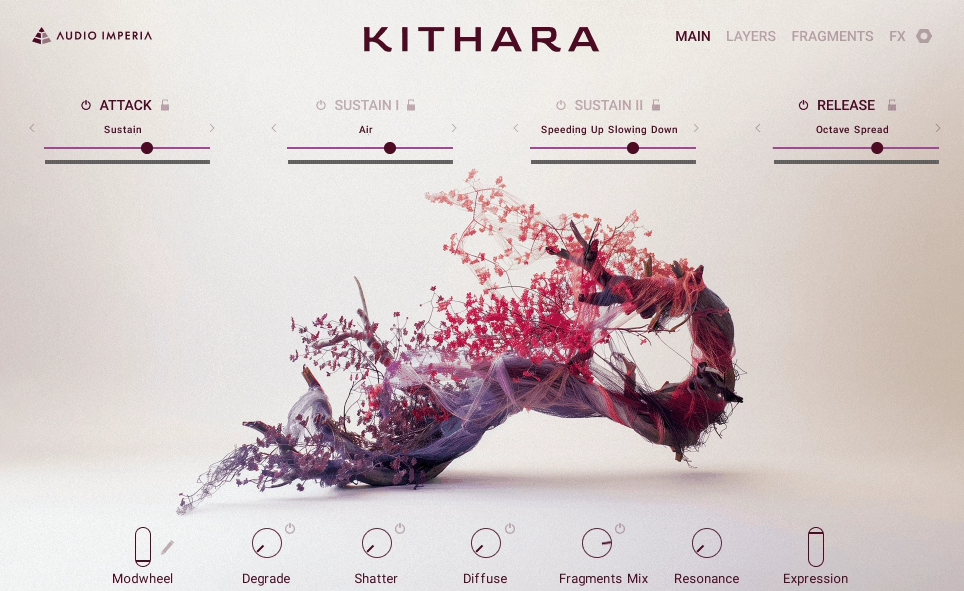
Running inside Kontakt 7 means Kithara benefits from the stability and widespread DAW compatibility of the platform, which is a practical advantage for composers who already have Kontakt in their workflow and don’t want to manage a separate plugin ecosystem for their sample libraries. The interface follows Audio Imperia’s design language from their other libraries: clean, visually consistent, and focused on giving you access to the most important parameters without requiring deep menu navigation.
I appreciate how the mapping and playability of the instruments across the keyboard is handled with musical logic rather than simply distributing samples chromatically. The range of each instrument is respected in how the samples are mapped, and the transition between velocity layers and round-robin variations is tuned to minimize the mechanical repetition that makes lesser sample libraries feel artificial under fast or repeated playing.
The round-robin variation system handles repeated notes with particular care, which matters for plucked strings specifically because the sharp attack of each pluck makes any sample repetition immediately audible in a way that sustained instrument samples can disguise more easily. The variation system in Kithara addresses this with enough alternate samples that repeated notes retain a natural variation in attack character and subtle timing that keeps performances sounding organic.
Sound Design Potential
Beyond straight playback of recorded articulations, Kithara includes sound design capabilities within the Kontakt engine that allow you to process and transform the recorded samples into more abstract textural material.
I love how Audio Imperia consistently includes this kind of creative processing layer in their libraries rather than treating them as strictly documentary recordings of acoustic instruments, because the most interesting sample library work often happens in the space between faithful reproduction and deliberate transformation.
For me, the most compelling creative territory in a plucked strings library is transforming the natural decay of the instruments into sustained pad-like textures: taking the slowly decaying resonance of a plucked historical instrument and stretching it into a long atmospheric texture produces results with a specific acoustic authenticity that synthesized pads simply don’t share.
The sample material in Kithara is well-suited to this approach because the recording quality preserves the natural harmonic complexity of each instrument’s decay in enough detail that processed versions retain their acoustic character.
Cinematic Applications
I’d say the primary use case that Kithara was designed for is clear: cinematic scoring where instrumental color and cultural specificity matter to the storytelling. The less common historical and non-Western instruments in the collection are particularly valuable in this context because they carry specific cultural and temporal associations that composers working in film and television regularly need to reference without resorting to cliché.
A well-placed plucked string instrument from a specific cultural tradition can establish a setting or period in a single bar more effectively than extensive orchestral writing, and having those instruments available at recording-session quality in a Kontakt instrument is a meaningful creative advantage that becomes apparent the moment you start placing them in a real project. I believe Kithara also works effectively in hybrid orchestral contexts where you’re layering acoustic sample content with electronic or synthesized elements.
- Hybrid Layering
The plucked string attacks provide a sharp, acoustic transient against which synthesizer pads and processed textures sit naturally, creating a sense of grounded physicality that purely synthetic textures lack. The historical instruments add an organic quality that prevents the hybrid texture from feeling entirely manufactured, and the dynamic range of the recording gives you enough control over the attack and body of each note to balance the acoustic and electronic elements precisely.
This is one of the more underappreciated applications of a library like Kithara: not as a standalone orchestral resource but as an acoustic anchor in hybrid productions where the goal is to make electronic content feel physically present rather than entirely synthetic. The attack character of plucked strings is particularly effective in this role because it cuts through dense electronic textures in the same frequency range where synthesizers tend to blur and smear.
Pricing
Kithara is priced in line with other premium cinematic sample libraries from Audio Imperia, reflecting the recording investment required to capture this range of instruments at this quality level. I would recommend checking Native Instruments’ website or authorized retailers for current pricing, as NI periodically offers promotional pricing on their collaborative library releases that can make the entry point significantly more accessible.
The value assessment depends on how central plucked string color is to your scoring practice. For composers who regularly need this specific timbral territory, the recording quality and instrument range justify the price clearly and the library will earn its place in your template quickly. For composers who only occasionally need plucked strings, the investment may be harder to justify against a more broadly applicable library at a similar price point.
Final Thoughts
What the collaboration between Native Instruments and Audio Imperia produces in Kithara is exactly what you’d hope from a pairing of those two names: recording quality and instrument curation from Audio Imperia’s deep experience in cinematic sample development, delivered in a playable and widely compatible format through the Kontakt 7 engine. The focus on plucked strings as a specific and genuinely underserved category rather than as a peripheral section of a larger orchestral library gives the collection a depth and specificity that generalist libraries simply can’t match.
I suggest Kithara most specifically for composers who work in scoring contexts where the textural and cultural specificity of plucked string instruments is regularly relevant to their work. If that describes your practice, this is one of the more complete and well-recorded resources available for that specific instrument family, and the recording quality alone sets it apart from most alternatives.
Check more info here: Native Instruments & Audio Imperia Kithara
Get the Free Plugin Starter Kit
The genuinely useful free DAWs and plugins worth installing. No filler. Straight to your inbox.

Hello, I’m Viliam, I started this audio plugin focused blog to keep you updated on the latest trends, news and everything plugin related. I’ll put the most emphasis on the topics covering best VST, AU and AAX plugins. If you find some great plugin suggestions for us to include on our site, feel free to let me know, so I can take a look!