

There’s a version of this comparison that gets written as a straightforward feature list, but that version misses the most important thing: Slate Digital and Waves Audio have fundamentally different philosophies about how producers should own and build their plugin toolkit, and the choice between them is shaped as much by that philosophical difference as by the actual plugins involved.
Waves built its reputation over three decades selling individual perpetual licenses at prices that declined significantly over time through aggressive sales, accumulating a catalog of over 200 plugins across every mixing and mastering category.
Slate Digital built its identity around subscription access, and the Complete Access they offer alongside Solid State Logic and Harrison Audio is one of the most comprehensive subscription deals in the plugin market.
The plugins themselves are excellent on both sides. What you’re really choosing is whether you want to build a collection piece by piece over years with perpetual ownership of each tool, or whether you want immediate access to a large, high-quality library through a monthly payment that requires continued commitment to maintain.
Both approaches work, but understanding which works better for your specific situation is what this comparison is designed to help with.
From the Pluginerds Store
Before you get into the plugins on this list, something most mixing and mastering guides do not mention. A compact IEM pair as a second reference at low volume catches what your main headphones are smoothing over.


Quick Comparison
| Feature | Slate Digital | Waves Audio |
|---|---|---|
| Founded | 2007, Los Angeles, CA | 1992, Tel Aviv, Israel |
| Primary Licensing | Subscription (All Access Pass; Complete Access Bundle); perpetual also available | Perpetual licenses; Waves Update Plan optional |
| Subscription Price | All Access Pass: ~$14.99/mo (annual) or $19.99/mo (monthly); Complete Access Bundle (incl. SSL + Harrison): $19.99/mo (monthly) or $199.99/yr | No plugin subscription; Waves Update Plan ~$10-15/mo (optional updates only) |
| Plugin Count | 80+ (All Access Pass); 150+ (Complete Access Bundle with SSL + Harrison) | 200+ individual plugins across all categories |
| Flagship Channel Strip | Virtual Mix Rack (VMR 3.0): modular channel strip hosting 40+ analog-modeled modules | Scheps Omni Channel 2: fixed-module multi-band channel strip |
| Console Emulation | VCC (Virtual Console Collection): API, SSL, Neve, Trident; also SSL 4K B/E/G via Complete Access | Abbey Road TG Mastering Chain, SSL G-Bus, API-2500; no VCC-style full console saturation tool |
| Flagship EQ (Mixing) | Infinity EQ 2, FG-N (Neve 1073-style), FG-S (SSL-style), AirEQ (in VMR) | F6 Dynamic EQ, H-EQ Hybrid EQ, PuigTec EQs, API 550A/550B/560, Scheps 73 (Neve 1073) |
| Flagship Compressor | FG-116 (1176-style), FG-401 (VCA), VBC (Virtual Buss Compressor), FG-Stress (Distressor emulation) | CLA-76, CLA-2A, API-2500, SSL G-Bus Compressor, PuigChild 670 |
| Mastering Limiter | FGX-2 Mastering Processor; Clarity plugin (AI resonance control) | L2 Ultramaximizer, L3-16 Multimaximizer; Abbey Road TG Mastering Chain |
| Vocal Processing | FG-DS (de-esser), VMS (Virtual Mic System), Fresh Air, pitch correction via Slate Revoice integration | Vocal Rider, Tune Real-Time, CLA Vocals, Dugan Automixer, Clarity VX Pro (noise reduction) |
| Saturation / Tape | VTM (Virtual Tape Machines), Heatwave saturation, VCC console saturation | Abbey Road J37 Tape, Kramer Master Tape, Vitamin Sonic Enhancer |
| Analog Modeling Depth | Very high for core VMR modules and VCC; component-level modeling approach | Very high for licensed hardware emulations (Abbey Road, SSL, API, PuigTec) |
| Free Trial | 14-day trial for Complete Access Bundle | 7-day trial per individual plugin |
| Perpetual Option | Yes (individual VMR modules and standalone plugins; $99-$149 per plugin) | Yes (primary licensing model; individual plugins at $29-$299) |
Get the Free Plugin Starter Kit
The genuinely useful free DAWs and plugins worth installing. No filler. Straight to your inbox.
Mixing Plugins Comparison
Both brands built their mixing plugin reputation around analog hardware emulation, and both are genuinely excellent at it. The real difference sits in how those emulations are organized, how you access them, and how they actually fit into a mixing workflow.
- Slate Digital: VMR as the Core Mixing Engine
The Virtual Mix Rack (VMR) is the beating heart of how most Slate Digital users actually mix, and it’s a fundamentally different approach from anything Waves offers. VMR is a modular channel strip framework: you open one plugin instance and load as many processing modules as you want inside it, in any order you choose, from Slate’s growing library of 40+ hardware-modeled modules.
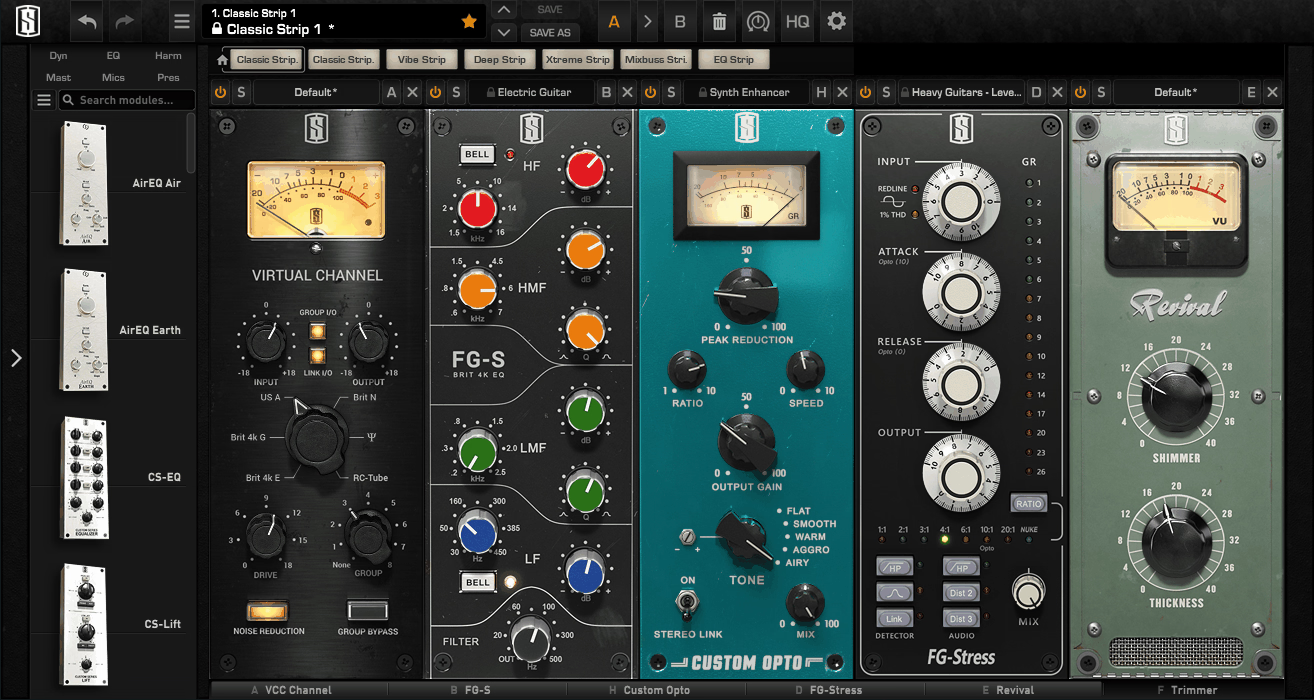
Those modules cover EQs, compressors, preamps, de-essers, exciters, noise suppression, and more. You can rearrange, bypass, and customize the chain entirely within that single plugin window.
Key VMR modules worth knowing:
- FG-N: Class A discrete British EQ modeled on the vintage Neve 1073, with the rich harmonics, fat saturation, and interactive midrange bands that made the original famous. Lush on vocals, drums, and guitars.
- FG-S: British console EQ modeled on the SSL 9000 E-Series desk character, with interactive mid bands and a fat, musical tone that works as a workhorse on virtually any track.
- FG-116: Slate’s most praised compressor, modeled on the classic American FET compressor (Universal Audio 1176). Slate CTO Fabrice Gabriel has called it one of the most difficult compressors he’s ever modeled, specifically because of the nuances and harmonic character of the original.
- FG-401: A VCA compressor with two distinct circuit paths, giving you a hybrid of the most popular VCA bus compressors used in professional studios.
- FG-DS: An intelligent de-esser that controls sibilance without dulling the top end of the vocal.
- FG-BOMBER: Saturation and transient shaping tool that adds aggressive punch to drums and buses.
VMR 3.0 added a Discovery Preset Browser pulling from an online library of presets, searchable by instrument type, genre, and author. Each preset includes pre-mapped Macro Controls that give you hands-on control over the most important parameters in the chain without touching individual module knobs, which significantly speeds up the workflow when you want analog character without spending an hour dialing in every parameter manually.
Beyond VMR, Slate’s mixing catalog includes the VCC (Virtual Console Collection), which applies subtle console saturation and harmonic character across every channel of your DAW through a system of matched send and return plugins, simulating the cumulative effect of running individual tracks through a specific analog console’s circuitry. VCC covers four console characters: SC (Slate Console, custom design), BRIT (Neve-style), RC (API-style), and US-A (SSL-style).
Running VCC on every channel produces cumulative harmonic content and inter-channel interaction that makes a mix sound like it went through real hardware in a way no single channel strip plugin can fully replicate. The VTM (Virtual Tape Machines) complements this by applying analog tape saturation, compression, and frequency shaping to any bus or master, with three tape formulas modeling specific vintage machines.
- Waves: Individual Plugins Across Every Category
Waves’ mixing catalog is the broadest of any developer in the industry, covering over 200 plugins across virtually every processing category, and mixing tools make up the majority of that catalog. The core difference from Slate’s VMR-centric approach: Waves plugins are individual tools you use one at a time, combining them in your DAW as individual inserts rather than inside a unified rack framework.
Flagship Waves mixing tools worth calling out:
- Scheps Omni Channel 2 (a comprehensive channel strip with modular-style flexibility, covered in its own section below)
- Scheps 73 (a Neve 1073 emulation developed with Grammy-winning mixer Andrew Scheps)
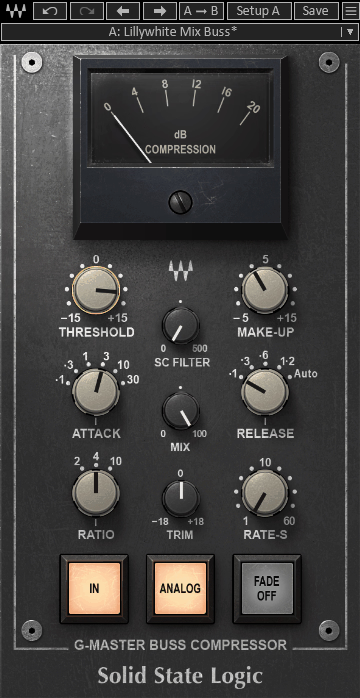
- SSL G-Master Buss Compressor
- CLA-76 (1176 emulation)
- CLA-2A (LA-2A emulation)
- PuigChild 670 (Fairchild 670 emulation)
- F6 Dynamic EQ
- H-EQ Hybrid EQ
- Vitamin Sonic Enhancer
- API 550A, 550B, and 560 EQ emulations

Waves also covers territory Slate doesn’t touch, with tools like Vocal Rider (automatic vocal level riding that tracks the vocal against the mix bus), Dugan Automixer (automatic dialogue level management for multi-speaker interviews and broadcast), Tune Real-Time (real-time pitch correction), and a deep roster of artist-branded plugins (CLA-series, Scheps series, API series) that reflect how specific producers and engineers actually use hardware in their sessions.
Mastering Plugins Comparison
- Slate Digital
Slate’s mastering tools are smaller in catalog scope than Waves but cover the most important categories. The FG-X 2 Mastering Processor is the flagship: a transparent limiter with peak control, perceived loudness enhancement, and the kind of musical response that works well across genres at high LUFS targets.

The Clarity plugin (not to be confused with iZotope’s Clarity VX) is Slate’s adaptive resonance suppression tool for mastering, intelligently targeting harsh frequency buildups in real time. The Infinity EQ 2 is an upgraded parametric EQ with dynamic filter capability and three new filter types that works equally well for mastering EQ decisions.
The VIRTU assisted mastering service is also included with the All Access Pass subscription, giving you web-based AI-assisted mastering for distribution-ready files.
Through the Complete Access Bundle, the SSL mastering tools enter the picture: SSL’s Native Bus Compressor 2 and the SSL channel strip compressor sections add the SSL console bus compression character to the mastering toolkit, and the Harrison Audio plugins add Nashville-style processing tools that many mix engineers reach for on the final stages of a mix.
- Waves
Waves has a deeper standalone mastering catalog than Slate, built around the L-series limiters ( L3-LL and L4) that established the company’s professional mastering credibility in the 1990s and early 2000s. The Abbey Road TG Mastering Chain is Waves’ most complete mastering-specific plugin, modeling the EMI TG12410 console used in Abbey Road’s mastering suites since the 1970s.
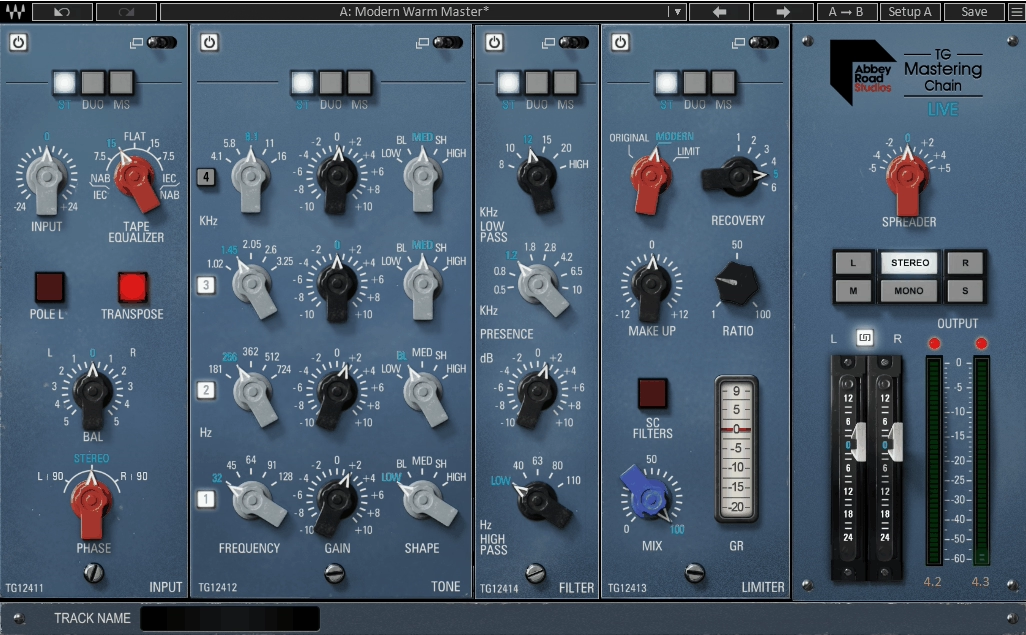
The Linear Phase EQ and F6 Dynamic EQ handle mastering EQ, the SSL G-Master Bus handles bus compression, and the Vitamin Sonic Enhancer handles harmonic enhancement.
Waves doesn’t have an AI-assisted mastering service comparable to VIRTU, and its streaming compliance metering is solid through the WLM Plus Loudness Meter without the integrated streaming preview capabilities of more modern mastering suites. The depth of the L-series limiters and the Abbey Road TG hardware provenance remain significant advantages in the mastering space when engineers want the specific character those tools provide.
Sound Character
- Slate Digital
Slate’s analog modeling gets described by a lot of engineers as among the most convincing software emulations of the specific hardware pieces they’re based on, particularly the VMR compressors and EQs. The FG-116 captures the specific punchy, fast transient response and transformer saturation character of the 1176 in a way many engineers find convincing at a circuit behavior level.
The FG-N has the specific lush, harmonically rich character of the Neve 1073 preamp and EQ. The VCC console characters are considered by engineers who’ve used the real hardware as a credible approximation of the cumulative coloration that analog console routing produces across a full mix.
The overarching sound character of Slate’s VMR tools is warm, dense, and saturated in a controlled way, the emulations tend to add harmonic content and a sense of depth that makes elements sit in a mix with a physicality that clean digital processing just doesn’t produce. This character becomes especially pronounced when you combine VCC channel saturation with VMR processing, since you’re stacking multiple layers of analog-modeled harmonic coloration simultaneously.
- Waves
Waves’ sound character spans a wider range, precisely because the catalog covers so many different hardware references. The Abbey Road TG Mastering Chain has the neutral-but-warm character of EMI’s mastering console.
The CLA-76 has the aggressive, punchy FET character of the 1176 in its specific All-Buttons mode behaviors. The PuigTec EQPs have the passive EQ character of the Pultec, with that famous bass boost/cut interaction intact. The SSL G-Master Bus delivers the specific cohesive glue character of the SSL bus compressor.
What unifies Waves’ character across the catalog is a high degree of accuracy to specific hardware references, particularly in the tools developed under official licensing agreements with Abbey Road Studios, API, and other manufacturers. The modeling tends to prioritize faithfulness to the behavior of the original hardware over adding extra coloration, which means Waves tools often feel more controlled and precise than Slate’s more densely saturated emulations.
Neither approach is objectively better, it’s a question of whether you prefer rich harmonic density (Slate) or faithful hardware documentation (Waves) as the primary value.
Virtual Mix Rack vs Scheps Omni Channel
These are the two flagships in their respective companies’ channel strip category, and they represent two genuinely different approaches to what a channel strip plugin should do.
- Slate Digital Virtual Mix Rack 3
VMR is infinitely customizable because the module architecture means you can load any combination of Slate’s 40+ processing modules in any order within a single plugin instance. You might build a chain with the FG-N EQ first, then the FG-116 compressor, then the FG-DS de-esser, then the FG-BOMBER for additional saturation.
Or you might flip that order and run compression first, EQ second. Or add a preamp saturation module before any of that.
The modularity means VMR can be a gentle EQ-and-compress channel strip or a complex, multi-stage processing chain with eight modules, depending entirely on what you put in it.
The Dream Strips feature lets you store up to eight complete channel strip configurations and switch between them instantly, which is useful when you’re working on a session with drums, vocals, bass, and synths that all need different processing approaches and you want to recall a pre-built chain for each type.
The Discovery Preset Browser in VMR 3.0 pulls from a community-created preset library where award-winning engineers have shared their VMR chains with descriptions of intended use, genre, and instrument. You can search by instrument type, apply a preset as a starting point, and adjust from there, which dramatically reduces setup time compared to building a VMR chain from scratch.
- Waves Scheps Omni Channel 2
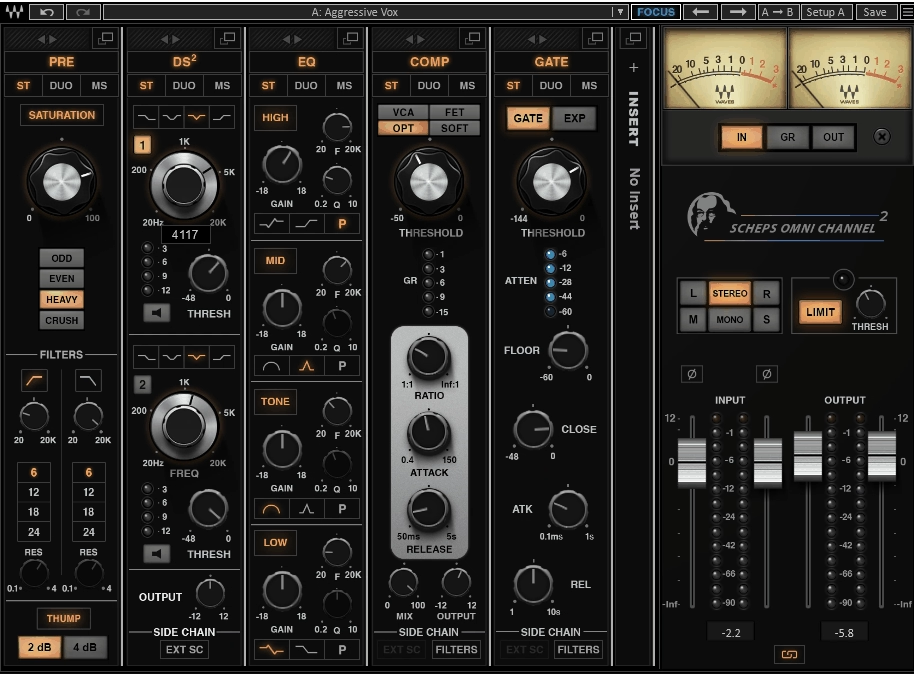
Scheps Omni Channel 2 is a fixed-architecture channel strip with specific modules in a defined signal chain, developed in collaboration with Grammy-winning mixer Andrew Scheps. It includes six modules: EQ (a four-band equalizer that functions as both a broad musical EQ and a more surgical parametric), Pre (three saturation flavors for adding harmonic color), Compression (three different compressor characters with wet/dry parallel compression control), DS (a de-esser), Gate (for gating and expansion), and SPACE (a reverb and ambience tool).
The modules can be enabled and disabled, and you can reorder some of the processing stages, but the core architecture is defined rather than fully open-ended.
What Scheps Omni Channel 2 does exceptionally well is provide a single, well-balanced channel strip that sounds great on virtually any source without requiring you to think about which modules to load. The compressor options are voiced musically, the saturation in the Pre section adds warmth without being heavy-handed, and the EQ has a character that works intuitively across different material.
For engineers who want a channel strip that’s fast, consistent, and doesn’t require deep configuration knowledge, Scheps Omni Channel 2 is the more immediately practical tool.
The key difference: VMR is the deeper and more flexible system that rewards the time you invest in learning its library and building chains, while Scheps Omni Channel 2 is the faster, more immediately deployable tool that gets you to a good result more quickly without requiring knowledge of 40 different modules. Both are genuinely excellent at what they do.
Analog Emulation Quality
- Slate Digital
Slate’s analog modeling is led by CTO Fabrice Gabriel, who’s built a reputation as one of the most technically rigorous analog modeling engineers in the plugin industry. The FG-116 in particular gets consistently cited by engineers with experience on real 1176 hardware as capturing the specific circuit behavior, transformer saturation, and harmonic character of the original in a way that goes beyond visual similarity to actual sonic accuracy.
The FG-N captures the Neve 1073 preamp’s harmonic character and EQ response. The VCC console emulations reproduce the cumulative effect of analog console routing in a way that’s difficult to replicate with simple channel strip saturation.
Slate’s modeling approach tends to be component-level and comprehensive, meaning the goal is for the plugin to respond to signal level changes, extreme settings, and dynamic input material the same way the original hardware would. When you push a Slate compressor hard, it behaves the way the hardware would under those conditions, including the specific gain reduction behavior, release character, and saturation that happens when you drive the circuitry.
- Waves
Waves’ analog modeling depth is most pronounced in the tools developed under official hardware manufacturer licensing, particularly the Abbey Road plugins developed with Abbey Road Studios, the SSL G-Bus developed in collaboration with SSL, and the PuigTec EQs modeled after producer Jack Joseph Puig’s personal vintage Pultec hardware. These licensed relationships typically give Waves access to original schematics, component measurements, and sometimes the original hardware and engineers, which produces emulations faithful to the documented behavior of the original units.
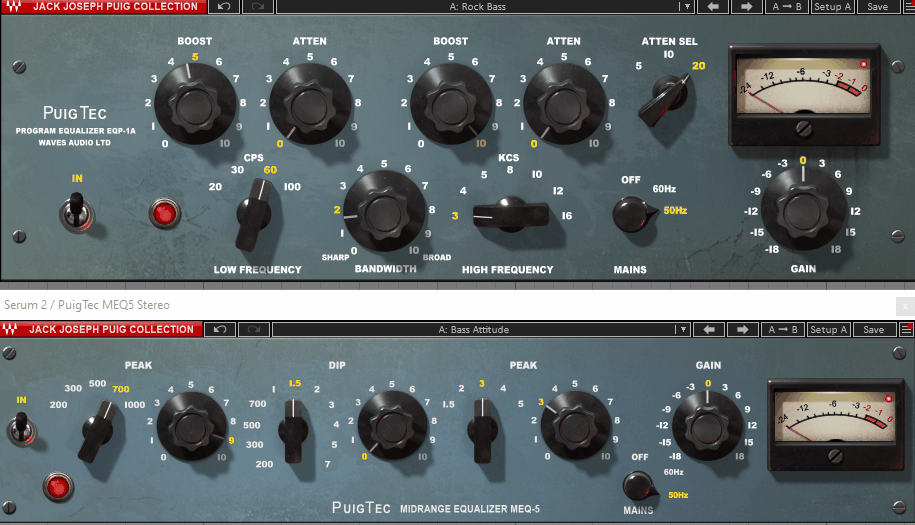
The CLA-76 and CLA-2A were developed with input from Grammy-winning mixer Chris Lord-Alge and are considered among the better software emulations of the 1176 and LA-2A respectively, though comparing them directly to Slate’s FG-116 is a common discussion in mixing communities with valid arguments on both sides. The Abbey Road TG Mastering Chain has genuine provenance from the actual console it emulates, and the modeling was done with access to the hardware in Abbey Road’s studios.
Bundle Options and Pricing
- Slate Digital
Slate’s bundle structure is clear and subscription-driven:
The All Access Pass at approximately $14.99/month billed annually (or $19.99/month billed monthly) gives you all 80+ Slate Digital plugins, access to the Slate Academy online courses, the VIRTU assisted mastering service, over 20GB of royalty-free samples, and access to all new Slate plugins and updates as they release. This is the core Slate subscription for producers who specifically want the Slate catalog.
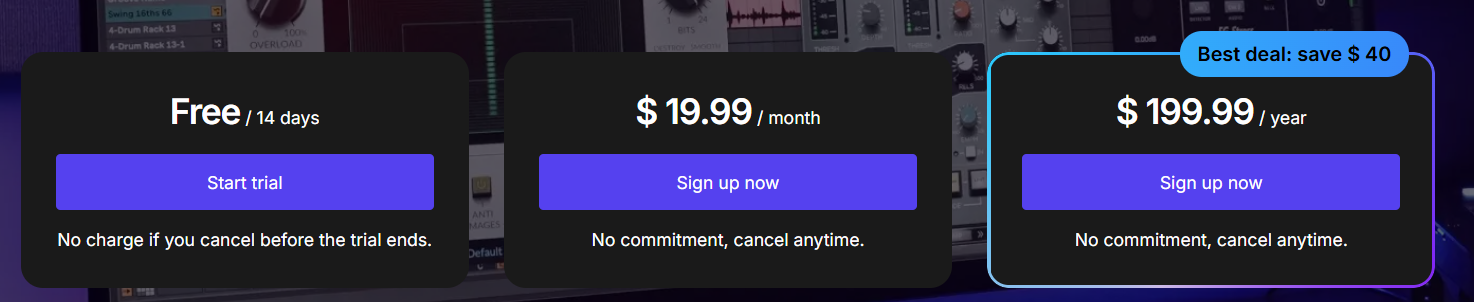
The Complete Access Bundle at $19.99/month (month-to-month) or $199.99/year (annual) bundles the All Access Pass with the SSL Complete subscription, giving you the complete plugin catalogs from Slate Digital, Solid State Logic, and Harrison Audio simultaneously. At this price, you’re getting 150+ professional plugins from three major companies.
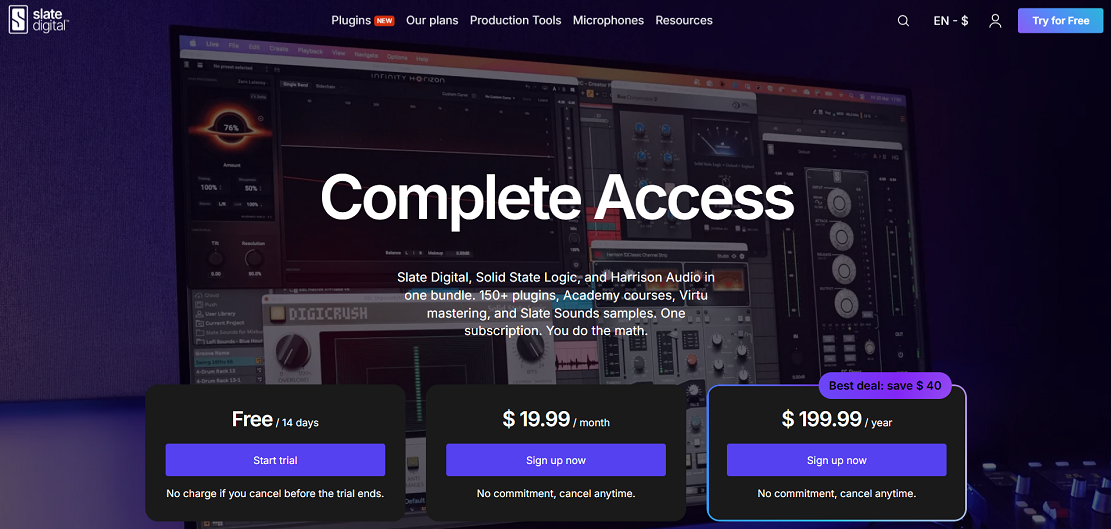
The SSL side includes the full 4K B, 4K E, and 4K G channel strip suites, the Native Bus Compressor 2, the Stereo Bus Compressor, the Drumstrip, the Vocalstrip, and more. The Harrison side adds Nashville-originated mixing tools.
Educational pricing is available at approximately $99.99/year for eligible students and teachers.
For producers who want perpetual ownership of specific Slate tools, individual VMR modules and standalone plugins are available at $99-$149 per plugin, with a VMR Essentials bundle at $49 perpetual that includes six core modules (EQ, de-esser, compressor, gain stage, aggressive compressor, and enhancer) as an entry-level owned collection.
- Waves
Waves doesn’t offer a single “mastering and mixing bundle” at a specific price point the way Slate’s All Access Pass provides a single subscription. Instead, Waves organizes its plugins into a series of bundles at various price points.
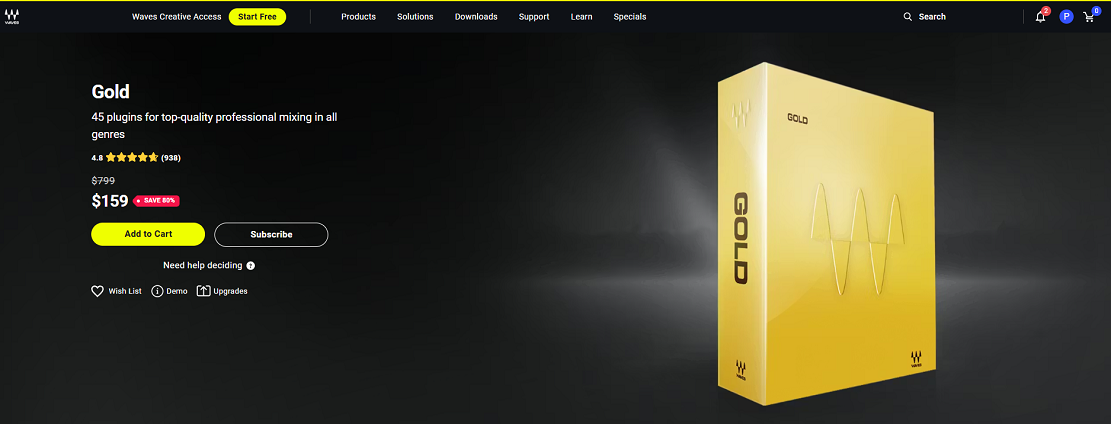
The Platinum Bundle is one of the most popular entry-level comprehensive options, typically available at sale prices of $299-$399 and including 65+ plugins covering the most important mixing and mastering tools. The Horizon Bundle is the next tier up, including 90+ plugins with a broader selection of hardware emulations and creative tools.
The Gold Bundle is a smaller, more focused option at a lower price point for producers who need the core Waves toolkit without the full library breadth.
Individual Waves plugins at full price range from $49 to $299, but the aggressive and frequent sales mean most plugins are available for $29 to $79 during promotional periods. The company runs sales regularly enough that the practical acquisition cost for most Waves plugins is significantly below the list price.
Subscription vs Perpetual Licensing
This is the most practically important dimension of the whole comparison for most producers, because it determines how you own your tools and what happens to your access when your financial circumstances change.
- Slate Digital: Subscription First
Slate Digital operates primarily on a subscription model where you pay a monthly or annual fee for access to the complete library, and your access ends if you stop paying. The All Access Pass gives you all 80+ Slate Digital plugins for approximately $14.99/month billed annually or $19.99/month on a month-to-month basis.
The Complete Access Bundle adds the complete SSL and Harrison Audio plugin libraries on top for the same $19.99/month (month-to-month) or $199.99/year (annual) price point, making it one of the strongest subscription value propositions in the plugin industry: 150+ plugins from three major companies for the price of most individual perpetual plugins.
Slate also added perpetual license options for individual VMR modules and standalone plugins, priced around $99 to $149 per plugin. That lets you own specific tools permanently without subscribing, but the perpetual pricing is relatively high compared to competitors when individual plugins are purchased separately, and the VMR modules only function inside the VMR rack rather than as standalone plugins.
The practical reality of the Slate subscription is this: if you subscribe for a year, you get immediate access to a world-class plugin library for a cost that’s lower than buying even a handful of comparable perpetual plugins. Cancel, and you lose access to everything.
There’s no middle path where you retain some tools from the library based on how long you’ve been a subscriber.
- Waves: Perpetual by Default
Waves operates on perpetual licenses where each plugin you buy is yours permanently, regardless of whether you ever pay Waves again. The optional Waves Update Plan (~$10-15/month or around $100-150/year) gives you access to new versions and updates as they release, but declining the Update Plan doesn’t remove your access to the plugins you already own, you simply stay on the version you have.
This perpetual model is the core of Waves’ value proposition for engineers who want to build a stable toolkit: every plugin purchase is a permanent asset rather than a recurring obligation. The frequent and aggressive sale pricing at Waves means you can build a serious mastering and mixing toolkit for less than the annual cost of a Slate subscription if you’re patient and selective about which tools you buy when they go on sale.
The practical challenge with Waves perpetual licensing is that building a complete toolkit takes time, sales awareness, and investment spread over multiple purchases. You won’t have access to everything from day one, you’ll have what you’ve bought so far, which may or may not be adequate for the session in front of you.
Trials and Demo
- Slate Digital
Slate offers a 14-day free trial for the Complete Access Bundle, giving you full access to all 150+ plugins including the SSL and Harrison Audio catalogs for two weeks without any payment.
This is one of the most generous plugin trials available in terms of the breadth of tools you get to evaluate simultaneously, and for a subscription service where the value proposition is about the whole library rather than individual tools, a two-week trial with everything accessible is the right structure.

- Waves
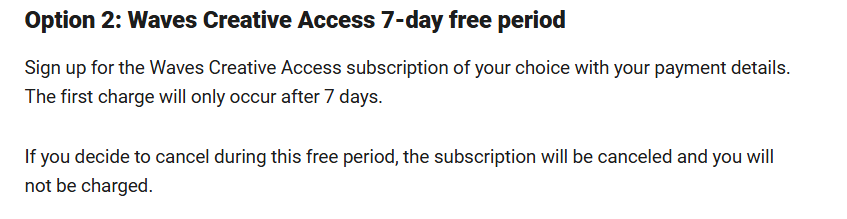
Waves offers a 7-day free trial for individual plugins. Since Waves operates on individual plugin purchases rather than a bundle subscription, you trial specific tools you’re considering buying rather than the entire library.
The 7-day window is tight for evaluating a complex plugin like the Abbey Road TG Mastering Chain, but sufficient for simpler tools like the L2 limiter or the SSL G-Bus.
The practical approach many producers take with Waves is buying at sale price rather than trialing, at $29-$49 per plugin, the financial risk is low enough that owning a plugin outright is often easier than managing the trial window and remembering to evaluate it before it expires. The guarantee of perpetual access means a $29 purchase remains useful indefinitely, even if you don’t use the plugin immediately.
Which Is the Better All-in-One Solution?
When you’re evaluating which brand gives you the most complete and usable toolkit from a single source, the answer is more nuanced than it first appears.
For sheer catalog breadth per dollar spent on access, the Slate Digital Complete Access Bundle at $19.99/month is the stronger all-in-one solution: 150+ plugins from three major companies (Slate, SSL, Harrison) for less than the cost of most individual perpetual licenses. No single Waves bundle at any price point gives you that quantity of high-quality, hardware-modeled mixing and mastering tools simultaneously.
For workflow integration and modular efficiency, Slate’s VMR is a genuinely more cohesive mixing system than anything Waves offers, the ability to stack and rearrange Slate’s 40+ modules within a single plugin instance, with a community preset browser and macro controls, creates a mixing workflow that’s both faster and more organized than managing individual Waves plugins as separate inserts across a long effects chain.
For breadth of specialized tools, Waves covers territory Slate doesn’t: live sound with SoundGrid, broadcast with Dugan Automixer, vocal pitch correction with Tune, noise reduction with Clarity VX Pro, and a much longer list of hardware emulations covering consoles, microphone preamps, and specific vintage units that Slate simply hasn’t modeled. If your work crosses into live production, broadcast, film, or any of the specialized audio domains Waves has developed tools for, Waves has coverage that Slate lacks.
For ownership stability, Waves is the better all-in-one solution if you prioritize tools you’ll always have access to regardless of your subscription status. A Waves toolkit built through perpetual purchases is yours permanently, which matters if you’re building a professional studio identity around specific tools you’ll use for years.
Get the Free Plugin Starter Kit
The genuinely useful free DAWs and plugins worth installing. No filler. Straight to your inbox.

Hello, I’m Viliam, I started this audio plugin focused blog to keep you updated on the latest trends, news and everything plugin related. I’ll put the most emphasis on the topics covering best VST, AU and AAX plugins. If you find some great plugin suggestions for us to include on our site, feel free to let me know, so I can take a look!