
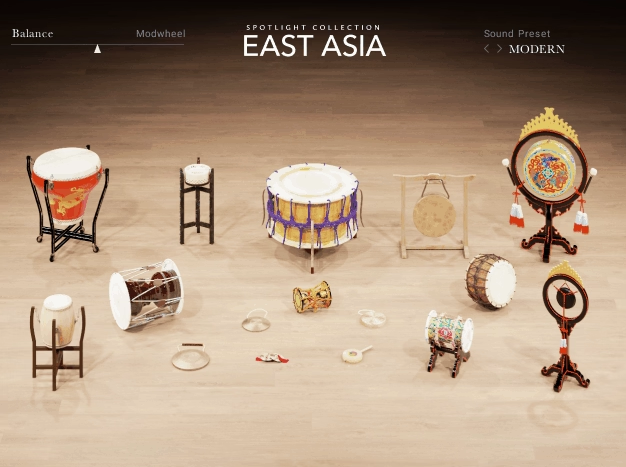
The gap between wanting to use East Asian instruments in a production and actually having access to them at a quality level that serves professional work has historically been wide enough that most Western composers either avoided the territory entirely or settled for poorly sampled approximations that didn’t hold up under close listening.
Spotlight Collection: East Asia is Native Instruments’ attempt to close that gap, bringing together a curated set of traditional East Asian instruments recorded with the same attention to detail and playability that NI applies to their flagship Western instrument libraries.
The collection draws from Chinese, Japanese, and Korean musical traditions, covering melodic, percussive, and textural instruments from each of those traditions in a unified Kontakt environment with a consistent interface and workflow logic across all included instruments.
I think the key question any composer considering this library needs to answer is whether the recording authenticity and playability are sufficient for professional use, because there’s a meaningful difference between a library that gives you a vague approximation of an instrument’s character and one that actually captures how the instrument sounds and behaves in practice.
For composers working in film, television, and game scoring where East Asian cultural settings are part of the storytelling, the Spotlight Collection: East Asia is worth a serious look. The recording quality and instrument curation represent a genuine step above the generic world music library category, and the Kontakt integration makes these instruments accessible within the same workflow environment that most professional composers already use daily.
From the Pluginerds Store
Before you go — if you're putting together or upgrading a home studio setup, we run our own store alongside the blog at Pluginerds Shop. Everything on it is picked by people who actually make music, not sorted by whoever paid for placement on a marketplace. Worth a look if you're filling in the gaps in your setup.
Visit Pluginerds ShopAbout library
At its foundation, Spotlight Collection: East Asia is a multi-instrument Kontakt library covering traditional melodic, percussive, and textural instruments from Chinese, Japanese, and Korean musical traditions, built specifically for Western composers and producers who need authentic East Asian instrumental color in their productions without requiring specialist knowledge of the performance practices associated with each instrument.
The “Spotlight” series from Native Instruments is designed around accessibility: the goal is to make genuinely recorded traditional instruments usable by composers who come from Western production backgrounds rather than requiring an ethnomusicological understanding of each tradition as a prerequisite for useful output.
I believe the most important thing to understand about this library before evaluating it is that it occupies a specific position: it’s not a research-grade ethnomusicological archive of every playing technique and regional variation for each instrument, and it’s not a superficial loop collection with some traditional instrument branding applied.
It sits between those extremes, providing enough authentic recording depth and articulation coverage to be convincing in professional scoring contexts while remaining accessible enough that a Western composer without specialist background can load it and produce useful results within a reasonable time.
Get the Free Plugin Starter Kit
The genuinely useful free DAWs and plugins worth installing. No filler. Straight to your inbox.
Instruments and Cultural Coverage
The instrument selection across the collection spans the three main East Asian musical traditions with enough breadth within each to cover the most commonly needed instrumental colors without spreading so thin that each instrument feels inadequately represented.
Chinese instruments include the erhu, the bowed two-string fiddle whose specific singing, vocal quality is one of the most recognizable timbres in Chinese music, the guzheng, the plucked zither with its characteristic gliding slides and resonant low strings, and dizi and xiao flutes with their specific breathy, airy tone that differs meaningfully from Western flute character.
Japanese instruments include the shakuhachi, the end-blown bamboo flute whose specific breathy tone and pitch flexibility are central to Japanese music and cinema, the koto, the plucked zither that occupies a similar role in Japanese music to the guzheng in Chinese contexts but with its own distinct tuning and playing character, and taiko percussion covering the range of large barrel drums that have become broadly recognizable in Western film scoring contexts.
Korean representation includes the gayageum, the twelve-string zither that carries a specific plucked brightness, and traditional percussion elements from Korean musical traditions.
I must say that the decision to draw from all three traditions rather than focusing exclusively on one is both a strength and a limitation worth being clear about.
The breadth gives you a genuinely wide palette of East Asian instrumental color, which is exactly what a composer working across different project types needs. But depth within any single tradition is necessarily limited compared to what a library focused exclusively on, say, Japanese instruments could provide.
Recording Quality and Authenticity
The recordings underlying the Spotlight Collection: East Asia were made with professional musicians who are native performers on these instruments, which is the single most important quality decision a library developer can make for this kind of material.
The specific bowing pressure and position variations of an erhu player, the characteristic slide ornaments of a guzheng performer, the specific embouchure and breath character of a shakuhachi player: these are qualities that come from years of traditional training and performance practice, and they’re present in the recordings here in ways that make the instruments sound like they were played by someone who grew up with them rather than someone reading a manual.
- Recording Environment
The sessions were captured in controlled acoustic environments with high-quality microphones and signal chains that preserve the natural character of each instrument without imposing heavy processing or artificially brightening the high-frequency content in ways that misrepresent how these instruments actually sound in a room.
I found this particularly important for instruments like the shakuhachi and erhu, whose natural tonal character involves specific timbral qualities that processed recordings tend to smooth out in ways that make them sound generic rather than authentic.
The natural room character preserved in the recordings gives you flexibility during mixing to place the instruments in whatever acoustic environment your production requires, from close and intimate through to more spacious and distant. This is the right approach for a library that’s designed to serve multiple production contexts rather than a single fixed aesthetic.
- Performer Authenticity
The specific ornaments, microtonal inflections, and performance idioms that characterize each tradition are present in the recordings in ways that make the sampled instruments recognizable to listeners who are familiar with the source traditions. For a composer working on material where cultural authenticity matters to the storytelling, this is the quality that determines whether the library is actually usable for serious work or only for contexts where a vague approximation is sufficient.
I realized working through the collection that the erhu recordings in particular capture the specific vibrato and bow pressure character that makes the instrument recognizable rather than sounding like a generic bowed string instrument of indeterminate origin.
Articulations and Playing Techniques
The articulation coverage across the Spotlight Collection: East Asia is calibrated to the practical needs of Western composers rather than to exhaustive coverage of every technique that exists within each tradition, and I think this is the right call for a library positioned around accessibility. You get the articulations that come up most frequently in scoring and production work: sustained notes for melodic lines, short and staccato versions for rhythmic writing, legato transitions for smooth melodic movement, and the specific ornamental techniques that define each instrument’s character in its native tradition.
- Melodic Articulations
The sustained articulations across the melodic instruments capture the specific tonal behavior of each instrument at different dynamic levels, with velocity layering that reflects how the instrument’s character genuinely changes across its dynamic range rather than simply adjusting volume. The erhu’s tone becomes more pressing and intense at louder dynamics in a way that’s qualitatively different from the softer, more intimate quality at quiet levels, and the layering captures this transition with enough resolution that you can use keyboard dynamics to shape the emotional temperature of a melodic line in real time.
The legato transitions use dedicated samples of the actual technique for moving between pitches on each instrument rather than pitch-bending sustained samples, which produces the specific glide and position-change character of each instrument’s approach to melodic movement. For the guzheng and gayageum, this includes the characteristic slide ornaments that are central to how these plucked zithers move between notes in performance.
- Percussive and Ornamental Techniques
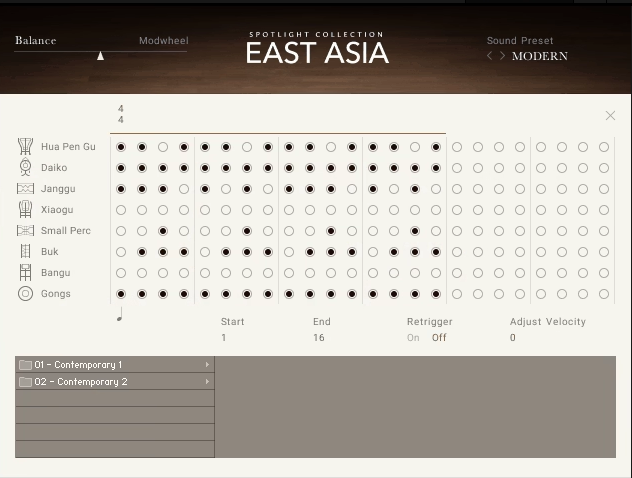
The taiko and Korean percussion articulations cover the range of strike types and positions that produce different tonal characters from the same drum, from the centered, full-bodied strike through to the more rimshot-adjacent edge hits that produce a sharper, less resonant quality. I appreciate that the velocity sensitivity across the percussion is calibrated for the wide dynamic range that taiko performance naturally covers: soft practice-hall strokes through to the full-force ceremonial strikes that produce the deep, resonant impact the instrument is most associated with in Western film music.
For the melodic instruments, grace notes, trills, and the specific ornamental techniques of each tradition are represented as dedicated articulations rather than requiring manual MIDI programming to approximate them, which makes writing idiomatic-sounding melodic lines significantly more achievable for composers who don’t have detailed knowledge of each tradition’s ornamentation practice.
Playability for Western Workflows
This is the heading that matters most for the majority of composers who would consider buying the Spotlight Collection: East Asia, because the specific anxiety around traditional instrument libraries from non-Western traditions is whether they’re actually usable by someone who comes from a Western production background. The honest answer for this collection is yes, with qualifications that are worth understanding before you purchase.
- Keyboard Mapping and Scale Considerations
The instruments are mapped chromatically across the keyboard in the standard Western way, which means you can approach them as you would any other Kontakt melodic instrument without needing to learn a new interface paradigm. I want to note that this chromatic mapping means you’re responsible for using the instruments in musically appropriate ways: the library gives you access to every chromatic pitch, but the specific scales and melodic conventions of each tradition require your own knowledge or research to apply correctly if authenticity is a priority for your project.
For composers who are writing impressionistically rather than attempting strict authenticity, this chromatic mapping is exactly what you want: it gives you the timbral character of these instruments with the same pitch flexibility you have with any Western instrument. For composers who need genuine musical authenticity, the responsibility for using the instruments idiomatically rests with you rather than being enforced by the library.
- Articulation Switching and Workflow Speed
The keyswitching system for moving between articulations is consistent across the collection, which means the muscle memory you develop with one instrument transfers to the others rather than requiring you to relearn the logic for each new instrument you load.
The response time for articulation switching is fast enough to use during live recording passes, and the most commonly needed articulations are accessible from the lowest keyboard positions without requiring large hand movements during performance.
I’d say the workflow speed for a composer coming from a Western orchestral library background is genuinely good: the interface logic is familiar enough that you’re spending your time writing music rather than learning a new paradigm, and the most practically useful articulations are immediately accessible without needing to explore the full instrument in depth before getting useful results.
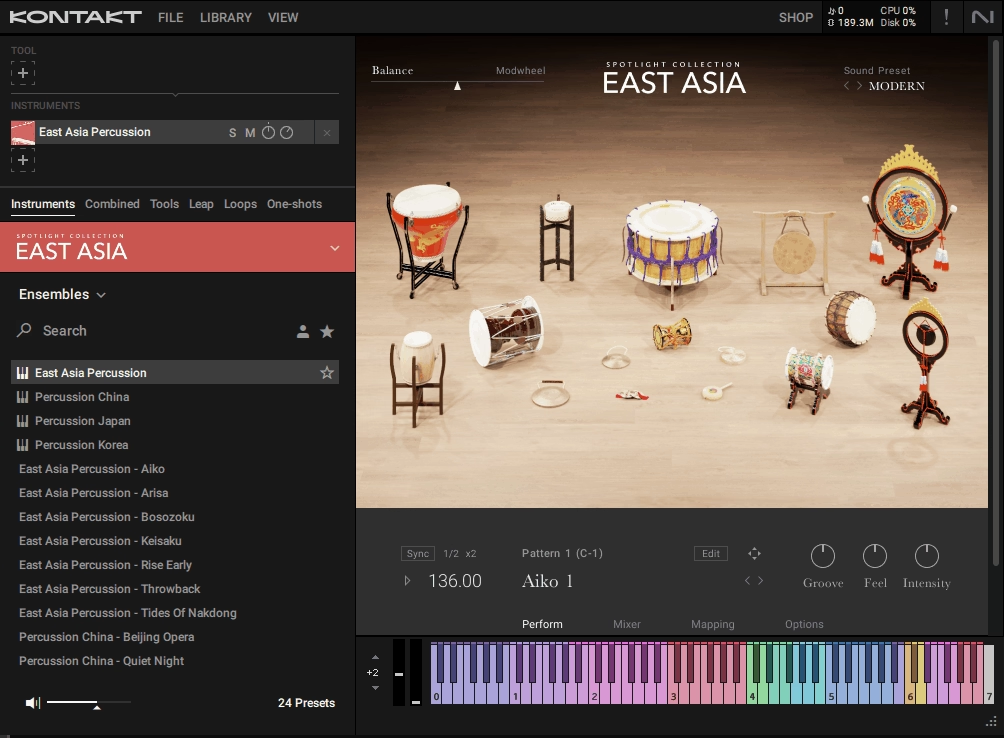
Running as a Kontakt instrument, the Spotlight Collection: East Asia benefits from the stability and DAW compatibility of that platform, which matters practically for composers who are already using Kontakt as part of their workflow and don’t want to introduce a separate plugin ecosystem for a handful of specialized instruments.
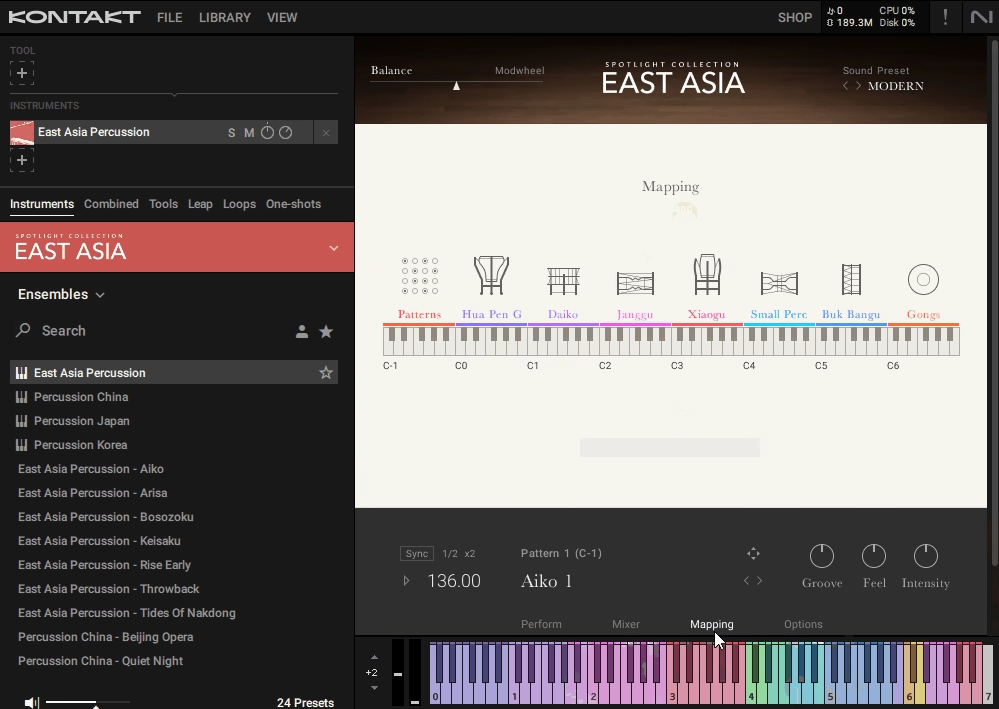
The interface follows NI’s design language for the Spotlight series: clean, uncluttered, and focused on giving you fast access to the parameters that matter most for this kind of material.
- Instrument Navigation
The preset browser within Kontakt organizes the collection’s instruments by type and tradition, which makes finding the right instrument for a specific need straightforward even before you know the collection in depth. The categorization reflects how Western composers tend to think about these instruments in scoring contexts: by sonic character and cultural association rather than by technical classification within each tradition’s own organizational logic.
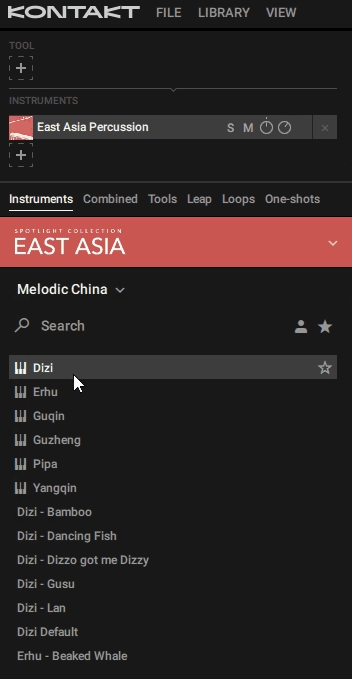
I love how the consistent visual design across all instruments in the collection reduces the cognitive load of switching between them during a session: when you move from the erhu to the koto to the shakuhachi within the same cue, the interface logic remains the same even though the instruments themselves are very different, which keeps your attention on the music rather than on navigating unfamiliar software.
- Microphone and Mix Controls
The microphone blend and output level controls available within each instrument’s interface give you basic spatial and level shaping without requiring you to exit to an external mixer, which keeps the workflow compact during the initial writing stage. For more detailed processing, routing the instruments to separate tracks in your DAW and applying external reverb and EQ gives you full control, but the on-board controls are sufficient for sketching and in many cases for final production work without additional processing.
Scoring and Production Applications
The primary application for the Spotlight Collection: East Asia is cinematic scoring where East Asian cultural settings, time periods, or thematic associations are part of the storytelling, and this is where the collection delivers most convincingly.
Film and television projects set in historical or contemporary East Asian contexts, video game scoring for games set in the region, and documentary music that requires cultural specificity without commissioning live sessions are all contexts where this library covers a genuine need at a professional level.
- Cinematic Scoring
For me, the most valuable instruments in the collection for cinematic scoring are the ones that carry the strongest cultural recognition: the erhu for Chinese emotional expressiveness, the shakuhachi for Japanese contemplative atmosphere, and taiko for dramatic percussive impact. These three instruments appear in a disproportionate share of Western film music associated with East Asian settings, and having them recorded at this quality level gives you a credible foundation for that kind of scoring work.
The guzheng and koto are particularly useful for establishing specific cultural settings quickly: a single plucked phrase from either instrument communicates a specific time and place to Western listeners immediately, which is one of the most practically valuable qualities an instrument can have in a scoring context where you’re working against picture and need the audience to understand where they are within seconds of a scene beginning.
- Hybrid and Electronic Production
Beyond strictly cinematic applications, the timbral character of these instruments integrates well into hybrid electronic production contexts where traditional acoustic material is layered with synthesized or electronic elements.
The attack character of plucked instruments like the guzheng and koto cuts through dense electronic textures in a way that adds physical grounding to otherwise fully synthetic material, and the specific harmonic content of each instrument adds cultural specificity that purely electronic sound design can’t replicate.
I believe the collection is most compelling in hybrid contexts where the goal is a specific cultural resonance rather than strict historical accuracy: using the shakuhachi’s breathy tone as a melodic element against a modern electronic production, or the taiko as a rhythmic anchor in a trailer track that mixes acoustic and synthesized percussion, produces results that work on both cultural and sonic levels simultaneously.
Is It Worth It?
The honest answer depends primarily on how frequently East Asian instrumental color appears in your production work and what level of quality your projects require.
If you regularly score for projects where these instruments are compositionally central, the recording quality and playability of the Spotlight Collection: East Asia justify the investment clearly, and the collection will earn its place in your template through regular use rather than sitting as an occasional specialty resource.
For composers who only occasionally need East Asian instruments and primarily for broadly impressionistic rather than culturally specific applications, the value calculation is harder to make, because there are lower-cost alternatives that provide a more superficial level of coverage that may be sufficient for those specific needs.
But for professional scoring work where the cultural authenticity of the instrumental color matters to the project, there are very few alternatives that combine this recording quality with this level of playability in a Kontakt format, and the collection represents genuinely good value relative to what commissioning live sessions for the same material would cost.
Check here: Native Instruments Spotlight Collection: East Asia
Get the Free Plugin Starter Kit
The genuinely useful free DAWs and plugins worth installing. No filler. Straight to your inbox.

Hello, I’m Viliam, I started this audio plugin focused blog to keep you updated on the latest trends, news and everything plugin related. I’ll put the most emphasis on the topics covering best VST, AU and AAX plugins. If you find some great plugin suggestions for us to include on our site, feel free to let me know, so I can take a look!