

These three companies barely operate in the same world, even though they all technically make plugin effects and instruments. That’s what makes comparing them interesting, and kind of tricky.
Out in Burlington, Vermont, SoundToys runs a small effects-focused operation that does one thing at an absurdly high level: hardware-inspired character effects built around saturation, delay, and modulation. No instruments, no mastering tools, no mixing utilities, just deeply musical effect plugins that have become embedded in how contemporary records sound.
Head over to France and you’ve got Arturia, which plays in both camps. They’ve built one of the largest vintage analog instrument emulation catalogs in the industry, and over the years they’ve expanded into mixing and creative effects too. Out of these three, they’re the closest thing to a one-stop shop.
Then there’s Universal Audio, which doesn’t really fit the “plugin company” label cleanly. They’ve been building actual studio hardware in California for over 60 years, and their plugin catalog grew out of that hardware pedigree.
The result is one of the deepest and most technically ambitious collections of hardware emulations available anywhere, and thanks to their Spark subscription, you no longer need UA hardware to run it natively on your CPU.
The reason you’re reading this comparison is probably to figure out where your plugin budget actually makes an impact, and the honest answer is that these three barely overlap in what they’re best at. Understanding where each brand genuinely shines is way more useful than trying to crown a single winner.
Quick Comparison
| Feature | SoundToys | Arturia | Universal Audio (UAD) |
|---|---|---|---|
| Founded / Origin | Burlington, VT, USA | Meylan, France | Scotts Valley, CA, USA |
| Core Strength | Creative character effects: saturation, delay, modulation | Vintage synth emulations + broad effect collection | Studio hardware emulations: consoles, compressors, tape |
| Plugin Bundle | Soundtoys 5 (23 plugins) | FX Collection 6 (35+ effects); V Collection 10 (40+ synths) | UAD Spark (60+ native plugins via subscription) |
| Instrument Plugins | None | Yes: V Collection 10 with 40+ vintage synth/keyboard emulations | Yes: Moog Minimoog, Opal Synth, Waterfall B3, Ravel Piano, PolyMAX |
| Hardware Emulation Focus | Moderate: hardware-inspired, not always direct emulation | High: TAE technology for analog synth accuracy; named hardware emulations | Very high: officially licensed Neve, API, Studer, Teletronix, Fairchild |
| Flagship Saturation | Decapitator (analog saturation); Radiator (tube color) | Dist COLDFIRE, Dist TUBE-CULTURE, Dist OPAMP-21 | Studer A800 tape; Neve 1073 preamp; various channel strip saturations |
| Flagship Delay | EchoBoy (industry standard); PrimalTap | Delay TAPE-201, Delay BRIGADE, Delay ETERNITY | EP-34 Tape Echo; Roland RE-201 Space Echo; Cooper Time Cube |
| Flagship Compressor | Devil-Loc (creative crusher only) | Comp FET-76, Comp VCA-65, Comp TUBE-STA | 1176 FET, LA-2A, Fairchild 660/670, API 2500 |
| Flagship Reverb | SuperPlate (5 plate emulations); SpaceBlender; Little Plate | Rev PLATE-140, Rev LX-24, Rev SPRING-636, Rev INTENSITY | Lexicon 224, AMS RMX16, EMT 140 Plate, Capitol Chambers |
| Licensing Model | Perpetual (bundle or individual) | Perpetual (bundle or individual) | Subscription ($19.99/mo or $149.99/yr via Spark) + perpetual options |
| Hardware Required | No | No | No (Spark runs natively; Apollo required only for real-time DSP monitoring) |
| Full Bundle / Sub Price | ~$499 (regular sales at $249-$399) | FX Collection 6 ~$499; V Collection 10 ~$599; both often on sale | Spark: $19.99/mo or $149.99/yr (perpetual licenses also available) |
| Free Trial | 30 days fully functional | 30-day trial per plugin | 14 days (30 days for Volt interface owners) |
| Best For | Delay, saturation, vocal effects, mix character | Vintage synth sounds, broad effects, instrument + effect combo | Classic studio compression, EQ, tape, console character |
Get the Free Plugin Starter Kit
The genuinely useful free DAWs and plugins worth installing. No filler. Straight to your inbox.
About SoundToys

Most of the SoundToys founding team came out of Eventide, the New York hardware company behind the H3000 and a long run of studio processors that defined recorded music from the 70s onward.
That background matters. These aren’t software developers who decided to emulate hardware, they’re hardware people who moved into software. They know how analog gear actually behaves under signal because they spent years building it, and their plugins reflect that: the goal is capturing how the hardware responds, not just matching knob positions to equivalent math.
The Soundtoys 5 bundle gives you 23 plugins, all focused on effects. Saturation and distortion come from Decapitator, Radiator, and Devil-Loc. Delays run through EchoBoy, PrimalTap, and EchoBoy Jr.
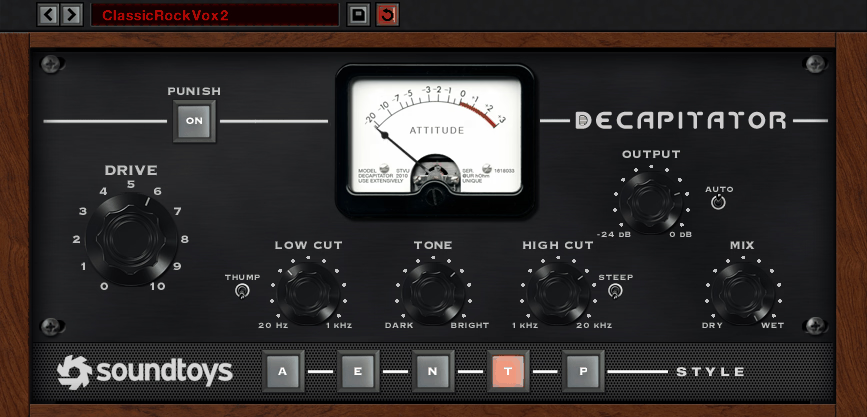
Reverb is covered by SuperPlate with its five classic plate emulations, Little Plate, and the newer SpaceBlender for more experimental spaces.
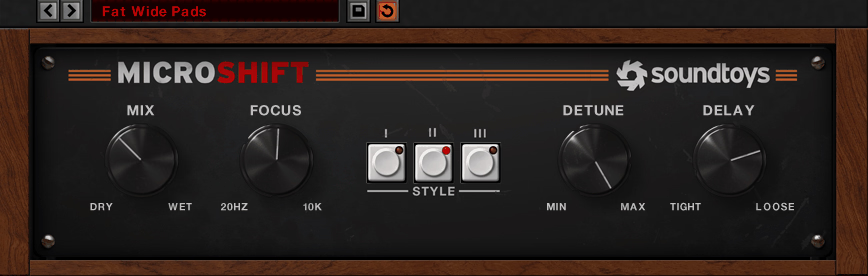
Modulation pulls from PanMan, Tremolator, PhaseMistress, FilterFreak, and Crystallizer, and vocals get Little AlterBoy and MicroShift. The Effect Rack ties it all together, chaining up to 14 SoundToys effects into one plugin so you can build and recall custom multi-effect setups per track.
What you won’t find here are instruments, transparent EQs or dynamics for clean mixing, or anything aimed at mastering. That’s the point. The catalog is deliberately narrow because SoundToys would rather be exceptional at a specific thing than decent across everything, and it shows in how these tools actually sound.
About Arturia
Arturia was founded in 1999 in Meylan, France, and built its reputation initially through V Collection, a steadily growing library of vintage synthesizer and keyboard emulations using the company’s proprietary TAE (True Analog Emulation) technology, which models the component-level behavior of analog circuits to reproduce the specific character of the oscillators and filters in each instrument.
The V Collection now includes over 40 instruments spanning synthesizers like the Mini V, Prophet-5, CS-80, Juno-60, Jupiter-8, ARP 2600, Oberheim OB-Xa, and Buchla Easel, alongside electric pianos, organs, string machines, and the company’s original instruments like Pigments (a modern wavetable/analog hybrid synthesizer) and Augmented series of AI-assisted hybrid instruments.

The FX Collection is the effects-focused companion to V Collection, currently at version 6 with more than 35 effect plugins covering preamps, EQs, compressors, delays, reverbs, distortion/saturation, modulation, filters, and Arturia’s own creative effects.
The FX Collection takes the same vintage hardware emulation approach as V Collection for its mixing tools, offering named reproductions of the Neve 1073 preamp, API 1073 and other consoles, 1176, VCA 65 (DBX 165A), TUBE-STA (Universal Audio 175B), the Roland RE-201 Space Echo (Delay TAPE-201), Roland Dimension D chorus, Juno-6 chorus, and others, alongside original creative effects that don’t replicate specific hardware.
Arturia also makes hardware: the KeyLab keyboard controller series, the DrumBrute Impact and BeatStep rhythm machines, and the MiniBrute 2 and MatrixBrute analog synthesizers. The software ecosystem integrates with the hardware through Analog Lab, a preset browser that gives you immediate access to V Collection sounds without opening individual plugin windows.
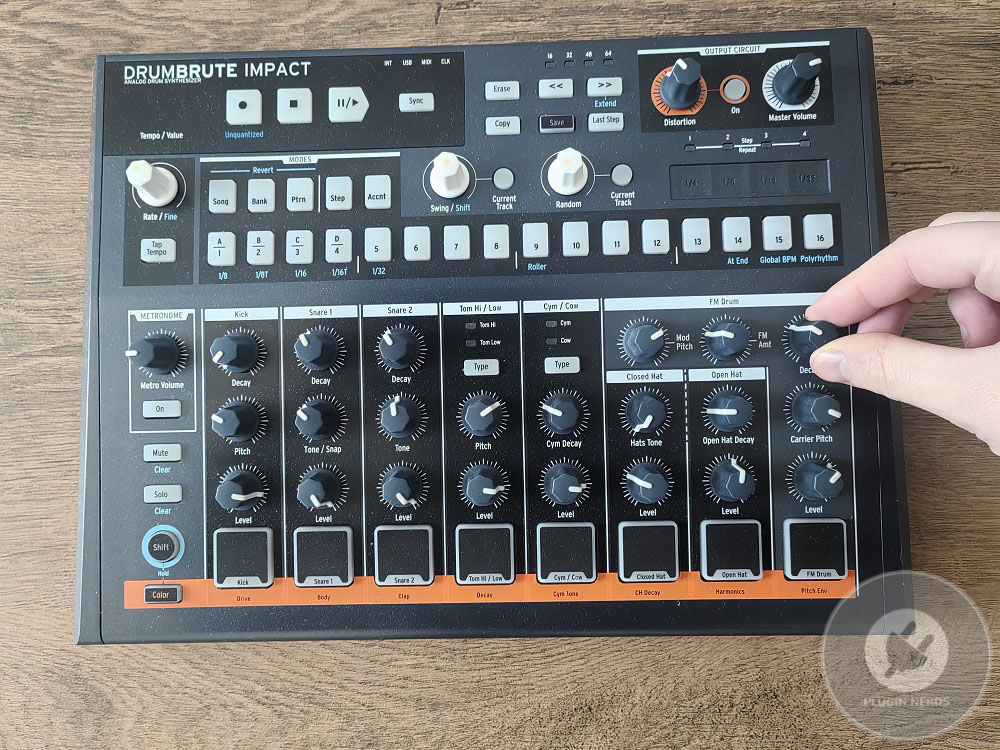
You also get synths like Minifreak and MicroFreak that are just awesome for sound design.
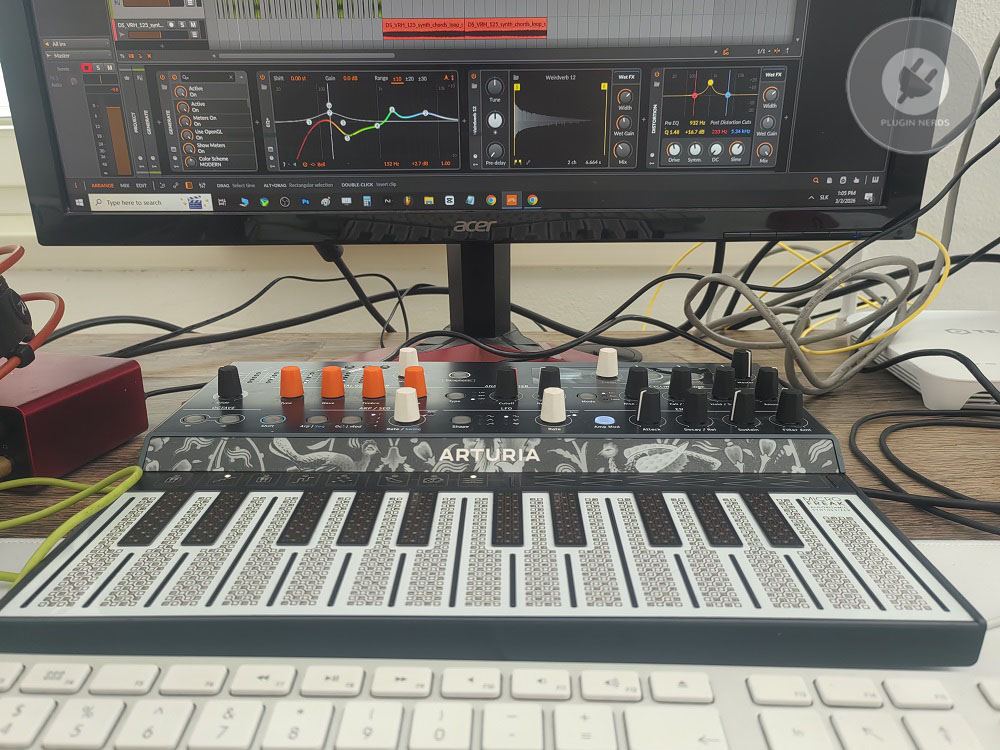
About Universal Audio

Universal Audio traces its history to 1958, when Bill Putnam Sr. founded the original Universal Audio and built the 1176 FET compressor and 610 tube console that became central pieces of professional studio equipment.
The company was revived by his sons in 1999 and spent the following two decades building the UAD platform, a DSP-accelerated plugin ecosystem that ran exclusively on UA’s own hardware DSP cards and Apollo audio interfaces.
The model was: pay for the hardware DSP unit, then buy individual plugin licenses that ran on that hardware at near-zero latency, enabling real-time tracking through famous compressors and EQs without straining your computer’s CPU.
The catalog built under that model became one of the most respected plugin libraries in the professional audio world, covering Neve consoles and channel strips, API processing, SSL channel strips, Studer and Ampex tape machines, Teletronix LA-2A and UA 1176 compressors, Fairchild limiters, Lexicon 224 and EMT 140 reverbs, Roland RE-201 Space Echo, and many others, all developed under official licensing agreements with the original hardware manufacturers or their rights holders.
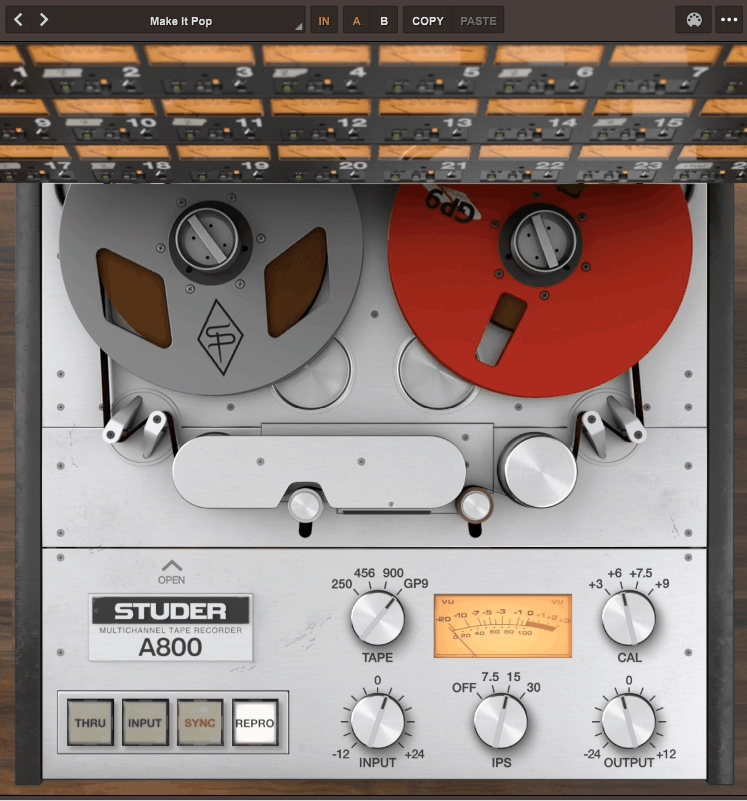
UAD Spark, launched in 2022, made this catalog accessible natively without requiring UA hardware, running on any Mac or Windows computer as a subscription at $19.99 per month or $149.99 per year.
The Spark subscription gives you access to more than 60 UAD native plugins covering the brand’s most celebrated compressors, EQs, preamps, tape machines, reverbs, delays, and instruments, and the library continues to expand with new additions. For existing UAD hardware owners, purchasing perpetual licenses for UAD plugins also includes native versions.
Effect Plugins
- SoundToys
SoundToys’ effect catalog is the smallest of the three in terms of total count, but the quality and specificity of the individual plugins is the highest of any brand when it comes to the particular territory they cover.
EchoBoy is widely considered the most comprehensive and musically useful delay plugin on the market, containing faithful models of the EchoPlex, Space Echo, Memory Man, DM-2, TelRay oil can delay, and digital delays alongside the Rhythm Echo feature that lets you program tempo-synced delay patterns on a grid.
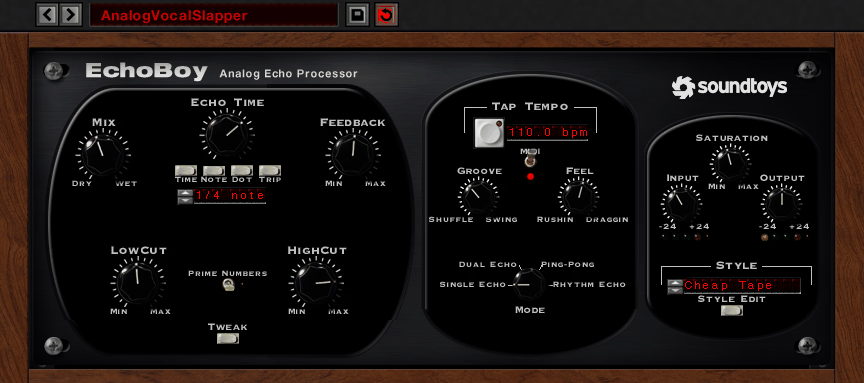
Producers and engineers who have owned EchoBoy for years describe it as one of the few plugins that never gets replaced regardless of what else enters the studio.
Decapitator has five hardware-inspired saturation modes and the kind of dynamic responsiveness to input signal that distinguishes it from most software saturators: you can hear it breathing with the track rather than sitting on top of it statically.
Next, SuperPlate models five specific plate reverb units with a density and bloom character that algorithmic reverbs generally don’t replicate at the same level.
What SoundToys doesn’t offer in its effects catalog is traditional precision mixing tools: there’s no transparent EQ, no full-featured dynamics compressor for surgical mix work, and no mastering tools. The Sie-Q is the only EQ in the catalog and it’s a vintage-voiced tube EQ that adds color rather than offering surgical correction.
This is a deliberate choice, and it means that SoundToys works best as a complement to a mixing toolkit that already handles precision processing rather than as a standalone mixing solution.
- Arturia
Arturia’s FX Collection covers way more ground than SoundToys, giving you 34 effect plugins in version 5 (and more with the version 6 update) spanning pretty much every studio processing category you’d actually reach for.
On the preamp and EQ side, you get recreations of the Neve 1073 (Pre 1973), the Neve A-Range (Pre TRIDA), and the V76 tube console (Pre V76), plus the EQ SITRAL-295 equalizer.
Compressors hit the classics: Comp FET-76 (1176), Comp VCA-65 (DBX 165A), and Comp TUBE-STA (Universal Audio 175B).

The reverb lineup covers plate, room, spring, and digital, with the Rev PLATE-140 (EMT 140), Rev LX-24 (Lexicon 224), Rev SPRING-636 (Grampian 636), and the original Rev INTENSITY for more creative work.
Delays run from the Delay TAPE-201 (Roland RE-201 Space Echo) and Delay BRIGADE (Boss CE chorus delay) to the more modern Delay ETERNITY.
For distortion and saturation, there are three tools handling different flavors: Dist COLDFIRE (dual-engine), Dist TUBE-CULTURE (tube drive), and Dist OPAMP-21 (op-amp saturation).
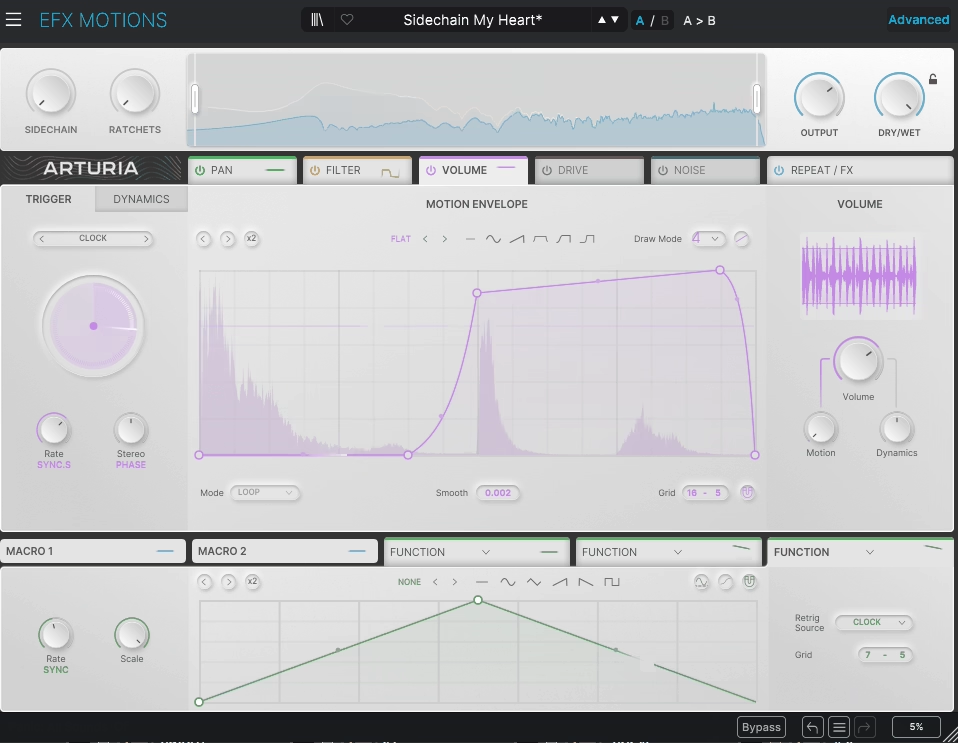
Then the creative and modulation stuff fills out the collection, filters modeled after the Moog, MS-20, SEM, and M12 circuits, chorus recreations of the Dimension-D and Juno-6, and the multi-effects playgrounds Efx REFRACT and Efx MOTIONS.
- UAD
UAD’s effect catalog through Spark goes deeper than almost anything else when it comes to authentic hardware documentation and official licensing. The Neve 1073 Legacy and 1073 Preamp & EQ Collection were built in direct collaboration with AMS Neve, working from the original circuit diagrams and component measurements.
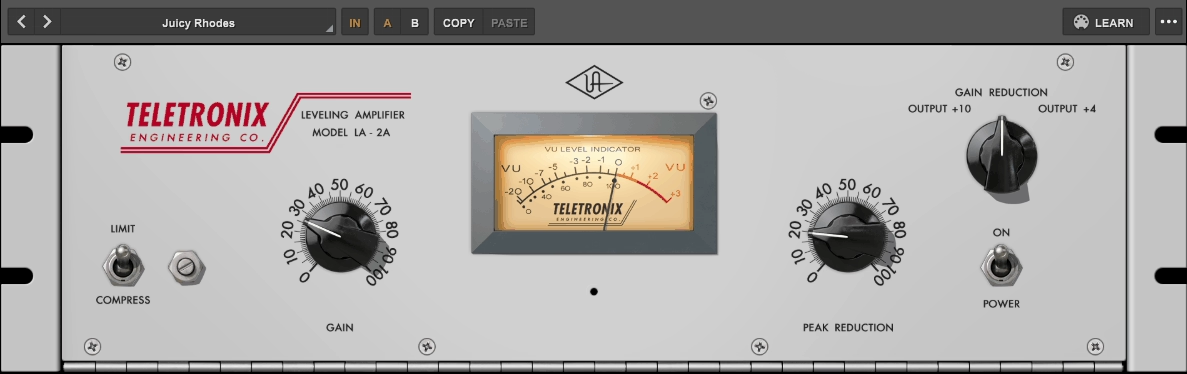
The Teletronix LA-2A Studio Compressor was developed with the current manufacturer’s cooperation and full historical documentation of the original unit. The Fairchild 660 and 670 limiters are among the most detailed software reproductions of those notoriously complex machines you’ll find anywhere.
And the Studer A800 Multichannel Tape Recorder doesn’t just recreate the sound, it captures the behavior and noise character of the specific tape machines that defined the golden age of studio recording.
That level of official access and hardware documentation is something neither SoundToys nor Arturia can match across most of their catalogs.
The reverb lineup through Spark is just as serious: the Lexicon 224 and 480L, the EMT 140 Plate, and the UA Capitol Chambers, which is a real room reverb modeled on the actual echo chamber facility at Capitol Studios in Hollywood.
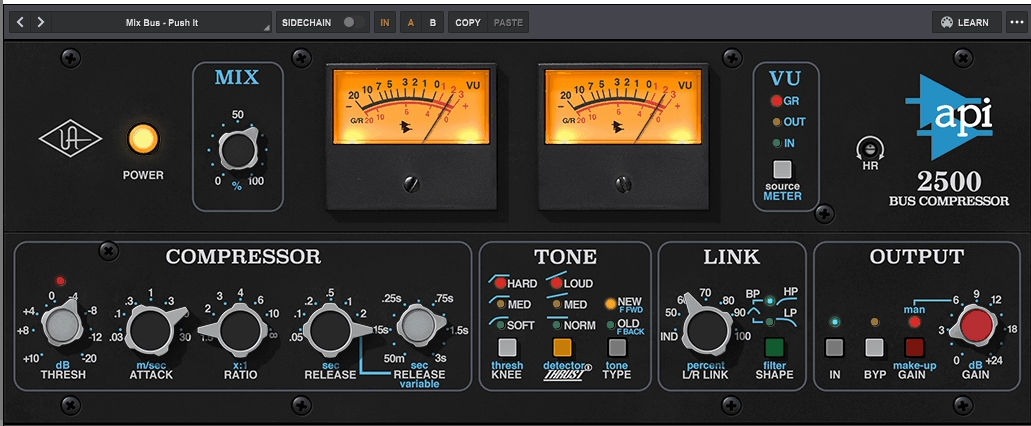
Compressors cover the 1176 in its SE, Rev A, and AE variants, plus the LA-2A, Fairchild, and API 2500. The EQ side runs through the Neve 1084 and 1073, the Pultec, and the Harrison 32C, among others.
Instrument Plugins
- Arturia: V Collection
This is where Arturia leaves both SoundToys and UAD behind for producers who actually write their own music. V Collection is a library of over 40 vintage synthesizer and keyboard emulations, built on Arturia’s TAE technology and spanning instruments from the 1960s through the early 2000s.
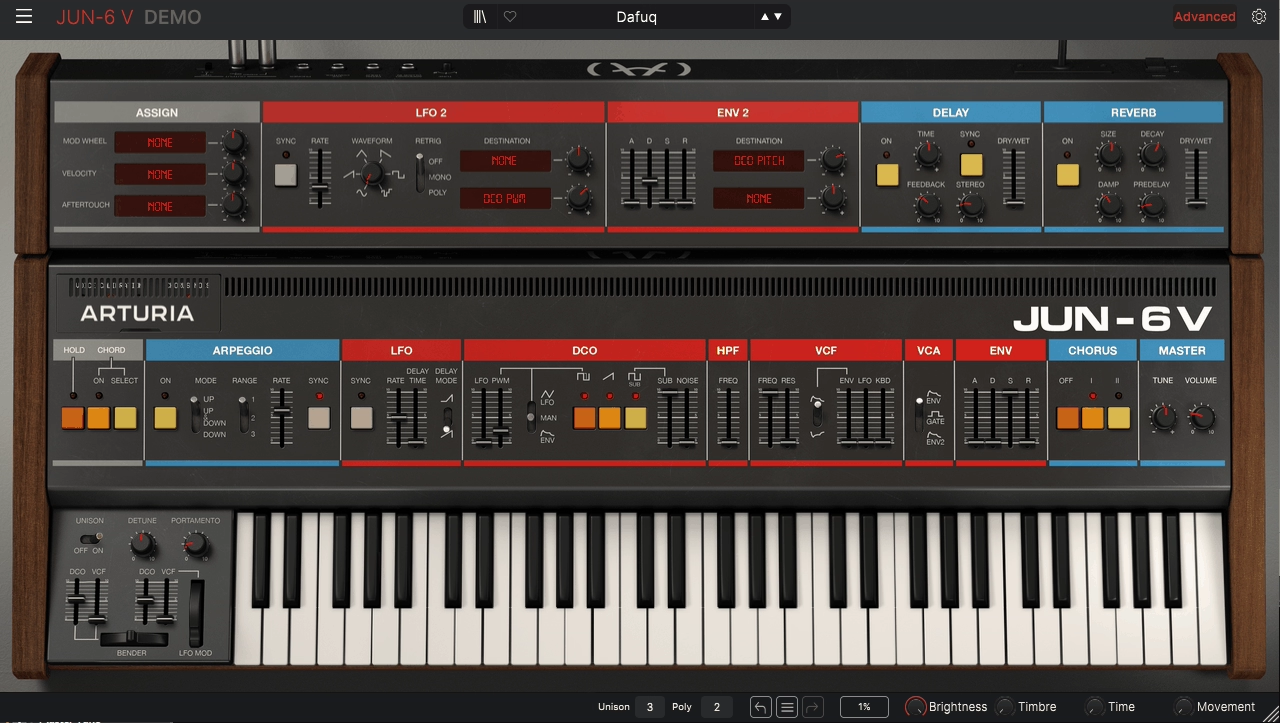
You get the MINI V for classic monosynth bass and leads, the Prophet-5 V for warm analog polyphony, and the JUN-6 V with Jup-8 V if you want that Roland analog polysynth sound. The CS-80 V captures the specific expressive quality of Yamaha’s most famous analog synth, and the OP-Xa V nails that thick, layered character that defined a certain era of 80s pop.
On the more experimental side, there’s the ARP 2600 as a semi-modular emulation, the Modular V for free-form modular work, and the Buchla Easel for west coast synthesis weirdness.

Arturia also throws in original modern instruments like Pigments, their flagship wavetable-analog hybrid synth, along with Augmented STRINGS, Augmented VOICES, and a few others.
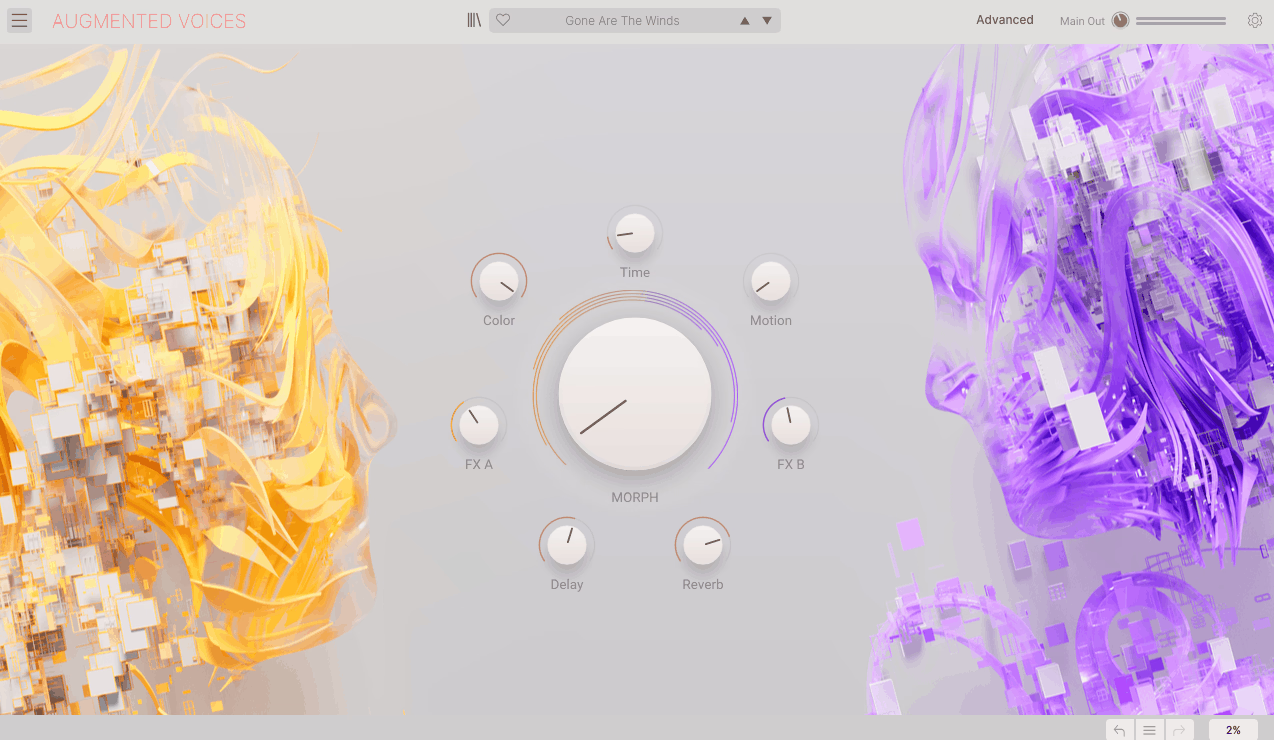
The practical upshot: if you’re building tracks from scratch and you need effects too, V Collection 10 paired with FX Collection 6 gives you a complete production setup without touching another company’s catalog. Neither SoundToys nor UAD can really offer that. SoundToys doesn’t make instruments at all, and UAD’s instrument selection is thin compared to what Arturia actually delivers.
- UAD
UAD includes a small but genuinely high-quality instrument lineup through Spark. The standout is the Moog Minimoog Synth, an officially licensed Model D emulation developed by UA that ranks among the better software Minimoogs out there.
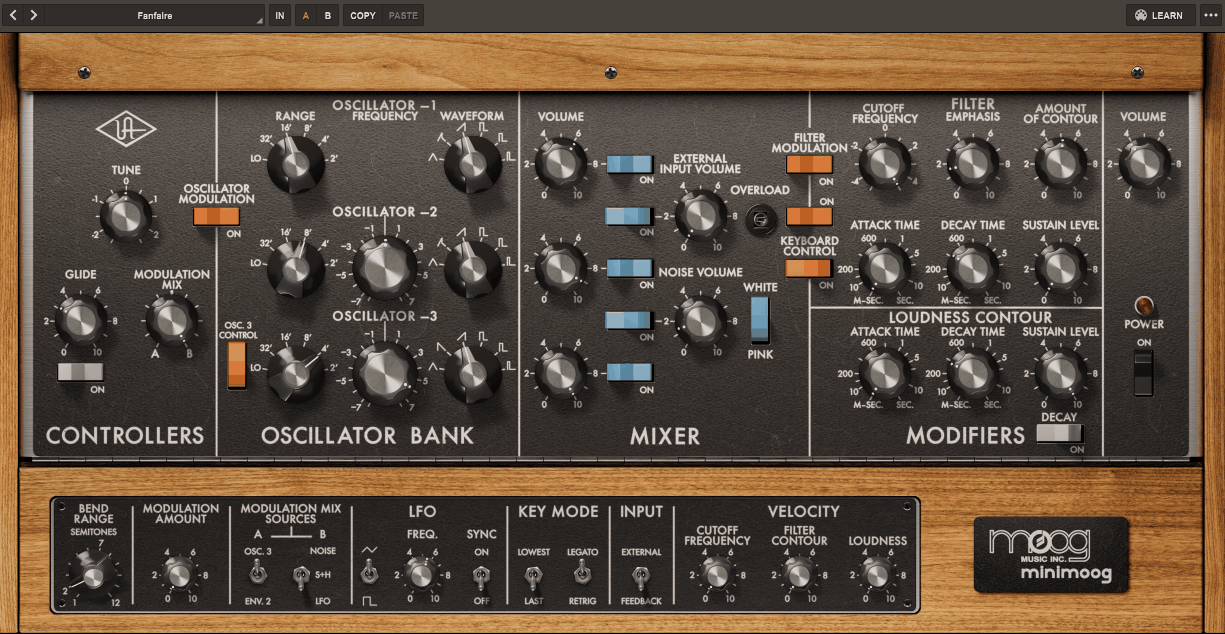
The Opal Morphing Synthesizer is UAD’s original wavetable/analog hybrid, built from the ground up. The Waterfall B3 handles organ territory, the Ravel Grand Piano covers high-quality sampled piano, and the PolyMAX Synth brings a modern polysynth to the table.

These are strong additions to the Spark subscription, but they’re not in the same league as Arturia’s V Collection when it comes to breadth across vintage synthesis styles and eras.
- SoundToys
SoundToys doesn’t make instruments. Not a synth, not a keyboard, not a single virtual instrument in the catalog.
If you need that side covered, you’re looking elsewhere, and there’s no sign that’s changing anytime soon.
Sound Character
- SoundToys
SoundToys’ sound is all about organic, physical character borrowed from analog hardware. The saturation in Decapitator, the warmth of EchoBoy‘s tape modes, the density of SuperPlate‘s plate emulations, the way FilterFreak‘s analog filter sweeps actually move, all of it shares one quality: it feels present and physical in the mix rather than clean and transparent.
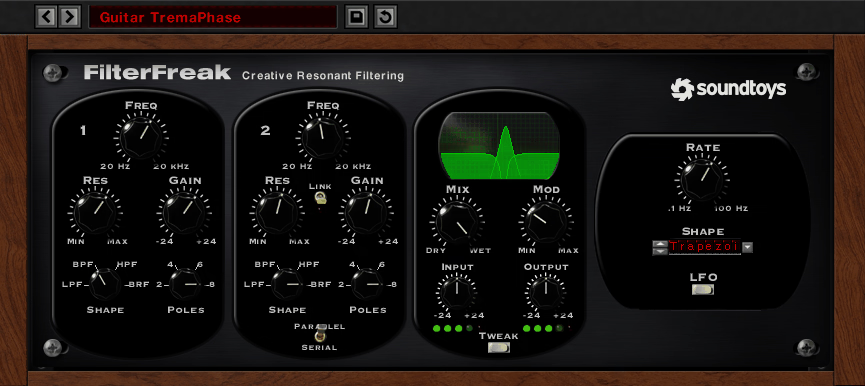
SoundToys plugins make tracks feel like they’ve been through real hardware. That’s the whole point of the brand.
It’s a specific character that’s hard to replicate with Arturia or UAD tools when you’re specifically after the SoundToys textures, which have become embedded in how contemporary pop, hip-hop, R&B, and electronic music actually sounds.
- Arturia
Arturia’s sound character splits across its two product lines. The V Collection instruments have a specific quality that comes from TAE modeling of the original analog circuits: the MINI V (Minimoog) has the unmistakable character of the original’s Moog ladder filter, the CS-80 V captures the vocal quality of the original’s resonance behavior, the Prophet-5 V has the slight instability and warmth of the original’s CEM chips.
If you grew up on these instruments or care about their specific character, Arturia’s emulations are credible alternatives that capture most of what made the originals special.
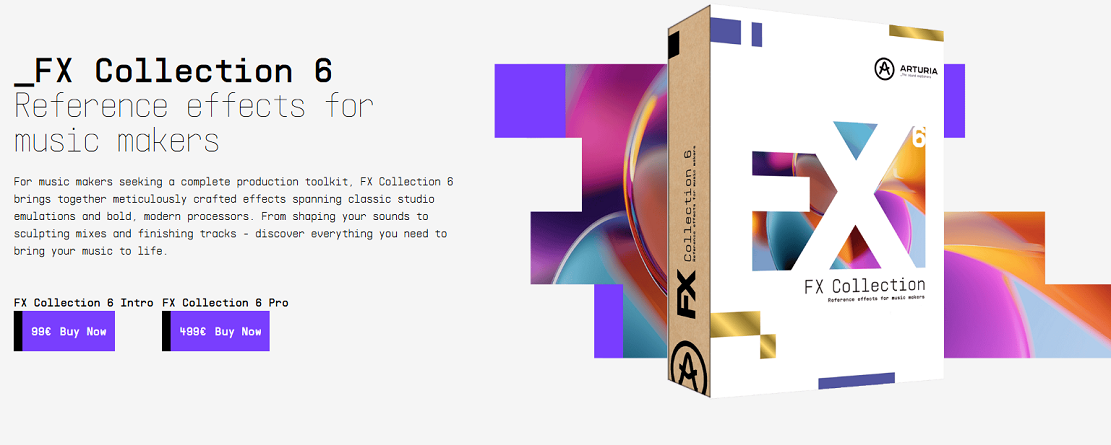
The FX Collection effects range from highly accurate hardware emulations like the named channel strips and compressors to original creative effects with their own modern identity. The reverbs and delays are well-regarded for musicality and usability, even if they don’t always match UAD’s documentation depth for specific hardware.
- UAD
UAD’s sound character comes from official licensing and deep hardware documentation. The authenticity in UAD’s Neve preamp emulations, the 1176 in all its variants, the Fairchild limiter, the Studer tape machine, it’s higher than what most other software developers can pull off, because UA had access to the original hardware, often the original engineers, and the official support of the manufacturers.
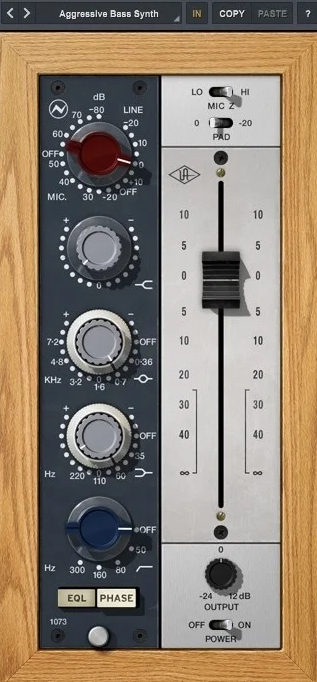
When you use the UAD Neve 1073 on a vocal, you’re getting something that was developed directly with AMS Neve. That official documentation translates into sonic authenticity you can actually hear in how the channel strips breathe and respond to signal levels.
It’s the reason mix engineers who’ve worked with the real hardware tend to find UAD plugins credible in a way generic emulations just aren’t.
Analog Modeling Depth
This is one of the most practically important distinctions between the three brands, and it reflects fundamentally different approaches to building hardware emulations.
- SoundToys
SoundToys builds its plugins around the character and behavior of hardware rather than circuit-level documentation of specific units. Decapitator is inspired by the Culture Vulture hardware but isn’t a direct circuit-level emulation.
EchoBoy models the character of specific delay hardware in its various modes, but the goal is the musical result rather than perfect circuit documentation.
This approach produces tools that are musically excellent and immediately usable, though engineers who need to match a specific piece of hardware exactly may find them less satisfying than UAD’s licensed emulations.
- Arturia
Arturia uses its TAE technology for oscillator and filter modeling in the V Collection, aiming for circuit-accurate reproduction of the specific analog components that give each synth its character. For the FX Collection’s hardware emulations, Arturia brings similar care, and the filter emulations in particular (MINI, MS-20, SEM, and M12) are widely regarded as among the best available for those specific circuits.
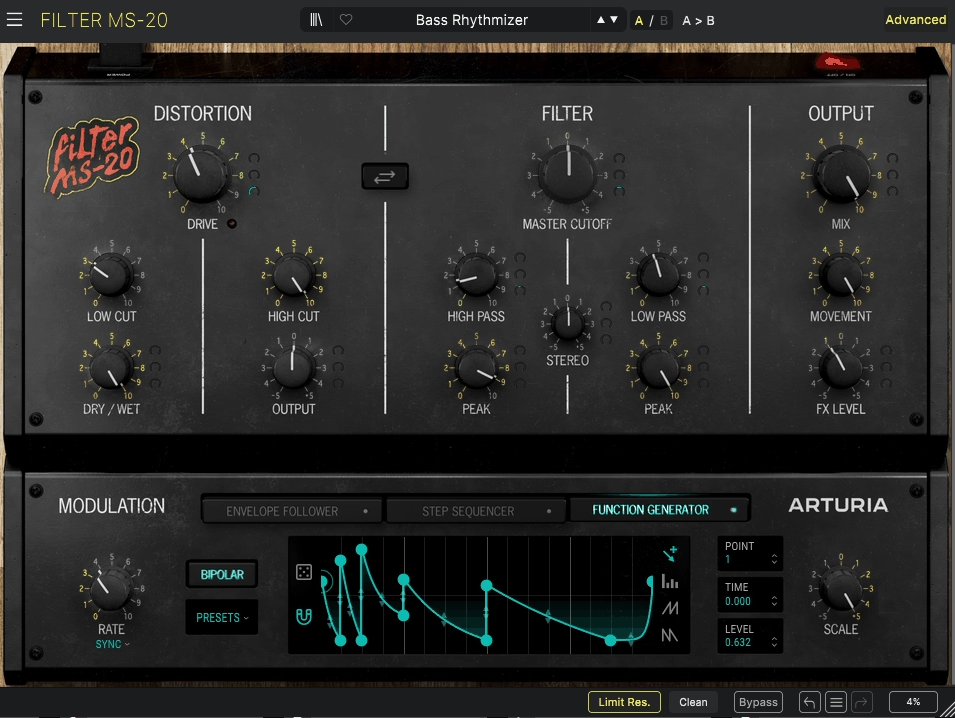
Where the modeling depth gets more variable is in tools like the console preamp emulations, where the absence of official manufacturer licensing means the modeling is done from analysis and measurement rather than direct access to original circuits and documentation.
- UAD
UAD has the deepest official hardware documentation of any plugin developer for the specific pieces of hardware it emulates. The official licensing relationships with Neve, API, Teletronix, Studer, Fairchild, Lexicon, and others typically include access to original schematics, component measurements, and in some cases direct collaboration with the hardware engineers themselves.
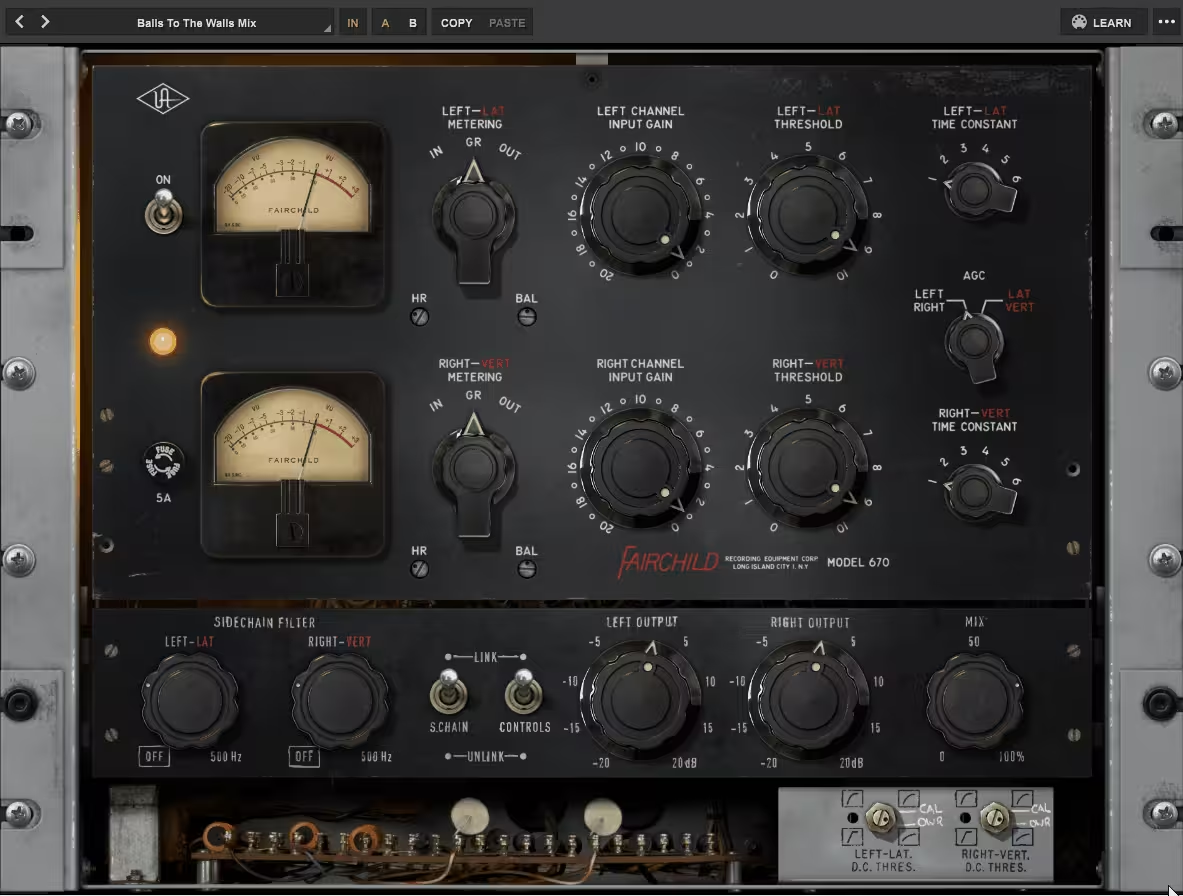
This is the primary argument for UAD over competing hardware emulations: the models were built closer to the source, and that proximity tends to produce more convincing results for engineers who have real-world experience with the original hardware.
Creative Sound Design Tools
- SoundToys
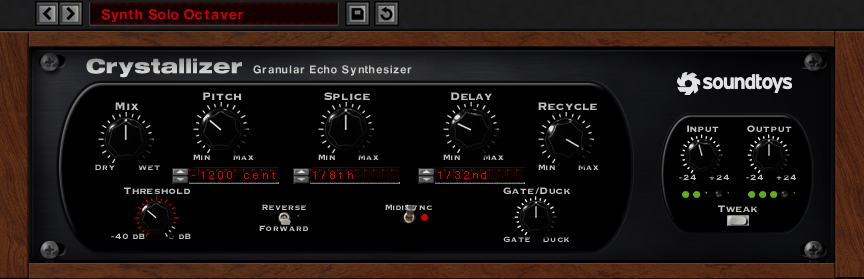
SoundToys’ strongest creative sound design territory sits in a few specific plugins. Crystallizer is the granular reverse echo processor based on the Eventide H3000, pulling textures out of any audio input from subtle shimmer to completely transformed soundscapes.
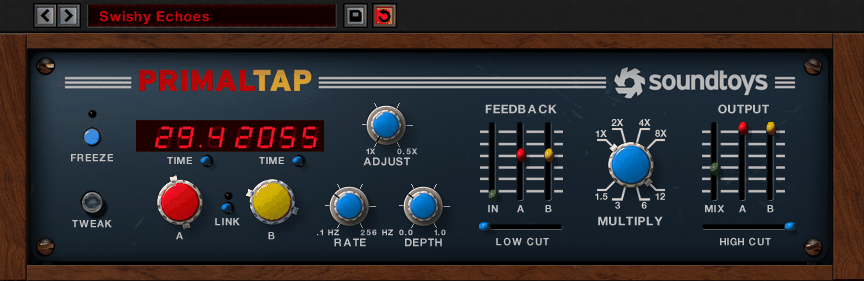
PrimalTap is a lo-fi tape delay with freeze, LFO modulation, and pitch modulation, letting you grab a chunk of audio and turn it into something entirely new. FilterFreak in its dual-filter version creates rhythmically modulated filter sweeps that feel physical and analog in a way plugins rarely do.
SpaceBlender is the newest addition to the bundle, an experimental algorithmic reverb inspired by swarm synthesis that morphs between reverb types in real time and builds spaces that don’t correspond to any real acoustic environment. These tools are genuinely creative outliers, and they don’t have obvious equivalents in the Arturia or UAD catalogs.
- Arturia
Arturia’s creative sound design reach spans both the FX and V Collections. On the effects side, Efx REFRACT and Efx MOTIONS are the most creative FX Collection additions: Motions puts effects in continuous motion with tempo-synced modulation, and Refract is a multi-effects processor built for experimental textures.

Efx FRAGMENTS is a granular processor with a unique approach to fragmenting and reassembling audio. Rev INTENSITY is Arturia’s most ambitious reverb, with freeze, reverse, and automated rhythmic modes that push way past standard reverb territory.
On the instrument side, Pigments is Arturia’s most forward-looking instrument, a multi-engine synth combining wavetable, virtual analog, sample, and harmonic engines with a visual modulation system and a serious arpeggiator and sequencer section, making it a complete production instrument in its own right.
- UAD
UAD’s creative tools are mostly about accessing specific vintage hardware with a creative legacy rather than providing modern experimental processors. The Empirical Labs Distressor is a favorite of creative engineers for its compression styles and saturation modes.
The Roland RE-201 Space Echo combines spring reverb and tape echo in one creative delay tool. The Cooper Time Cube is a weirdly specific hardware unit from 1971 based on a garden hose (literally) that produces comb filtering and pitch effects with a character nothing else replicates.
The Trident A-Range is a specific console EQ with a warmth and musicality that recording engineers reach for when they want creative EQ decisions rather than surgical ones.
Instrument Plugins: Arturia’s Advantage
Let’s talk about the instruments again. This section deserves its own focus because it’s the clearest and most significant area where Arturia separates itself from both SoundToys and UAD as a complete producer solution.
V Collection 10 covers the history of synthesis from the Minimoog and ARP 2600 in the 1970s, through the Yamaha DX7 and Roland D-50 digital synthesizers of the 1980s, all the way to the modern original instruments Arturia has built for contemporary production.
If you’re working in-the-box and want the specific character of these instruments without hunting down functional vintage hardware, V Collection is one of the most comprehensive options at any price point.
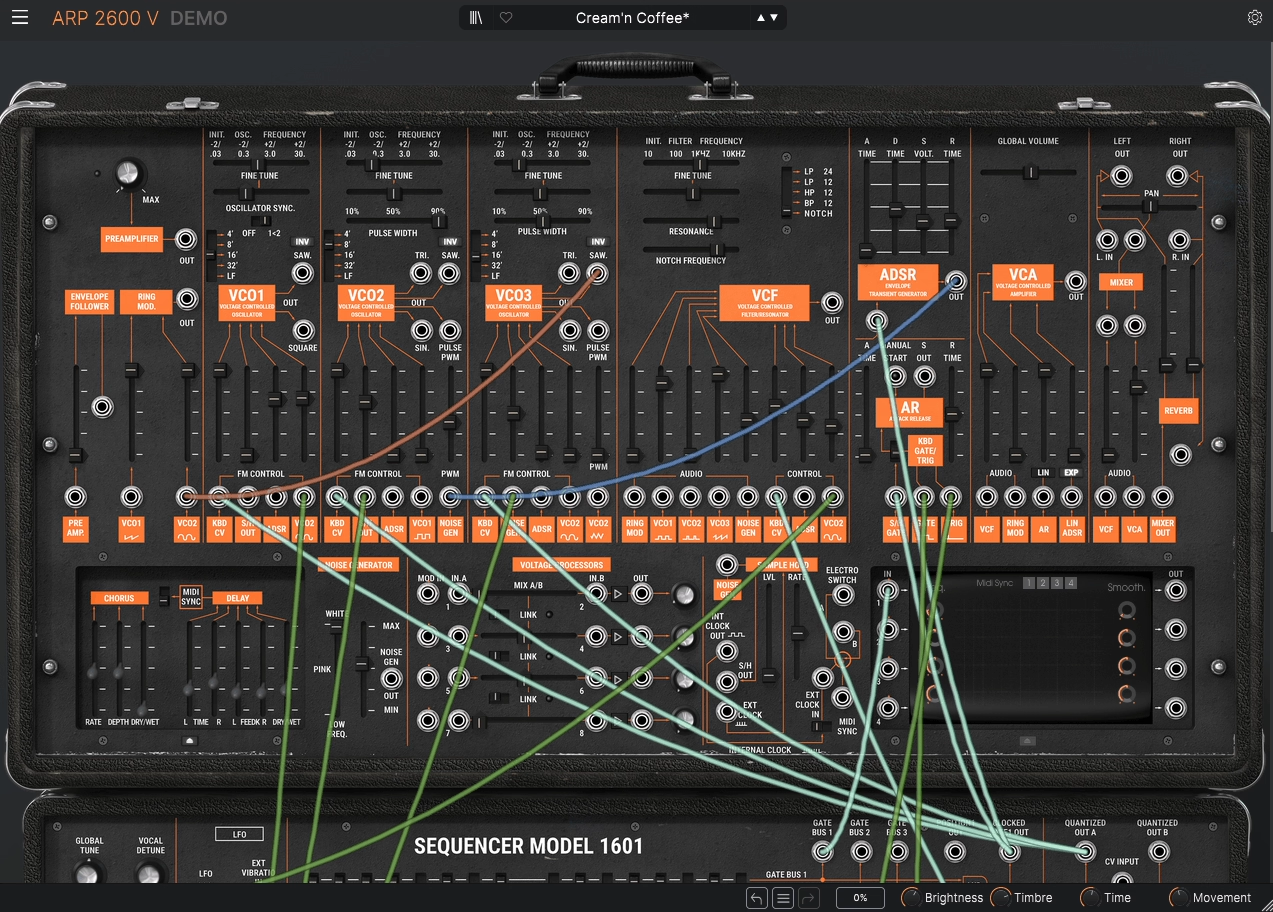
It’s also the only way you’re getting an Arturia-developed emulation of the CS-80‘s filter character or the Buchla Easel‘s west coast synthesis architecture without actually tracking down the hardware.
A few specifically notable instruments in the collection:
- Pigments: Arturia’s flagship modern synth with wavetable, virtual analog, sample, and harmonic engines, one of the most capable soft synths on the market.
- CS-80 V: One of the most respected emulations of the Yamaha CS-80 in software, with the polyphonic aftertouch sensitivity and filter character that made the hardware famous.
- Jup-8 V5: A detailed recreation of the Roland Jupiter-8, including the layered unison and patch morphing players loved on the hardware.
- SEM V: Recreation of the Oberheim SEM’s specific two-pole filter architecture.
- Mellotron V: The classic tape-replay instrument in software form, with the mechanical imprecision and timbral warmth of the original.
UAD has some synth coverage through Spark, but it doesn’t come close to V Collection’s breadth, and SoundToys has none at all. If instrument plugins matter in your workflow, Arturia is the only one of these three to take seriously as a primary instrument source.
DSP Hardware Requirements (UAD)
This one matters because it was historically the defining limitation of UAD, and it’s changed significantly.
UAD’s old model required a UAD-2 DSP card or Apollo audio interface to run any UAD plugin, and the number of instances you could run depended on the DSP power of your specific hardware. That produced excellent-sounding plugins with very low tracking latency, but it created a real cost barrier and an ecosystem dependency a lot of producers found limiting.
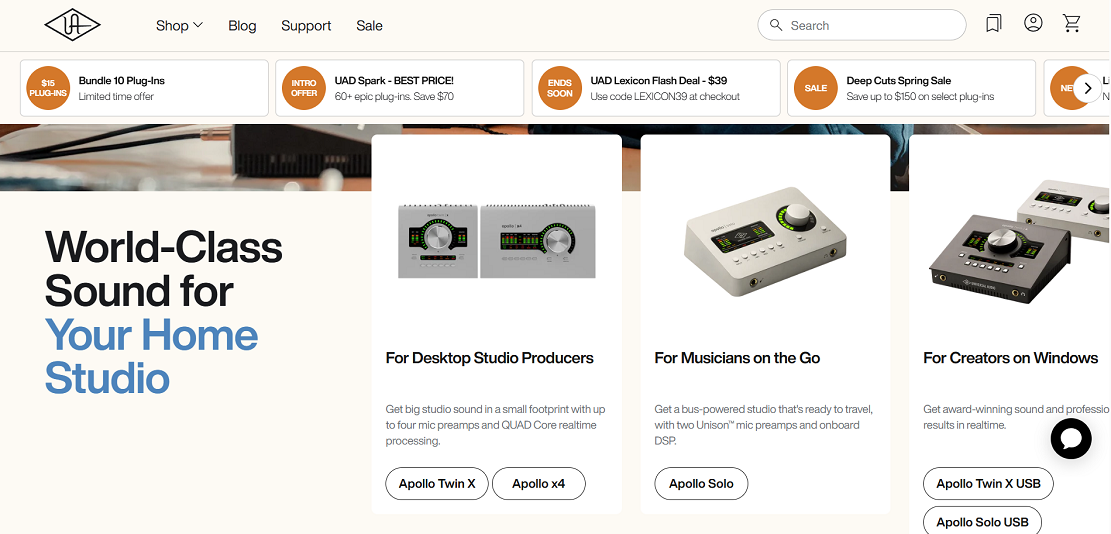
UAD Spark changes this completely for producers who work natively in their DAW without needing real-time hardware DSP. Through Spark, UAD plugins run natively on your CPU, just like any other developer’s plugins, with no UA hardware required.
You can run as many instances as your CPU can handle, there’s no latency limitation beyond what your audio interface introduces, and every supported format (VST3, AU, AAX) works in any DAW.
The only scenario where UAD hardware still matters is real-time tracking through UAD plugins with near-zero latency using an Apollo interface. The Apollo’s DSP processes UAD plugins in the tracking signal path with latency measured in microseconds rather than milliseconds, which makes it practical to record vocals or instruments while monitoring through complex processing chains.
It’s a valuable workflow for studios doing a lot of live tracking, but it’s a separate consideration from using UAD plugins for mixing.
For most in-the-box producers, UAD Spark at $19.99 per month or $149.99 per year ($79 first year) gives you access to a class of hardware emulations that’s genuinely hard to match at any price, and modern CPUs handle the native processing easily enough that the old DSP limitation just isn’t a practical concern anymore.

Bundle Options and Pricing
- SoundToys
The Soundtoys 5 bundle contains all 23 plugins at a regular price around $499, but SoundToys runs significant sales regularly where the bundle drops to $249-$399 depending on the promotion. Individual flagship plugins like Decapitator, EchoBoy, and Little AlterBoy are available separately at prices between $99 and $199.
Several “Little” versions of plugins (Little MicroShift, Little PrimalTap, Little Radiator, EchoBoy Jr., and Devil-Loc) only exist inside the bundle and can’t be bought separately, which pushes most producers toward the bundle if they want the complete collection.
SoundToys also doesn’t charge for bundle updates. Version 5.5 with SpaceBlender and resizable interfaces was a free update for every existing Soundtoys 5 owner.
- Arturia
Arturia prices its two major collections independently. FX Collection 6 is around $499 at full price (launch pricing typically runs around $399), with upgrade pricing from previous versions around $99-$199 depending on your current version.
V Collection 10 is around $599 at full price with similar upgrade and loyalty pricing. Both collections are available individually, and individual plugins from either collection sell for roughly $99 each.
Arturia runs aggressive seasonal sales where bundle pricing frequently drops 40-50%. Buying both FX Collection and V Collection during a sale at reduced combo pricing knocks the combined cost down meaningfully.
Arturia also offers loyalty pricing for existing customers that reduces the bundle price based on what you already own, and the whole pricing structure feels friendly toward people building their collection over time rather than buying everything at once.
- UAD Spark
The UAD Spark subscription at $19.99 per month or $149.99 per year gives you access to more than 60 UAD native plugins as long as the subscription is active. You can pause the monthly subscription if you’re not actively using it.
Perpetual licenses are also available for individual UAD plugins at prices ranging from around $49 to $299 depending on the title, and some promotional packages offer groups of perpetual licenses at significant discounts. Existing UAD hardware owners who’ve purchased perpetual DSP licenses get the corresponding native UADx versions at no additional cost.
Spark is one of the most economical ways to access the UAD catalog if you’re planning to use a significant portion of it, since the monthly cost adds up to less than the price of two or three individual perpetual licenses per year. If you only want one or two specific UAD plugins permanently, perpetual licenses might make more financial sense.

Best for Which Genres?
- SoundToys
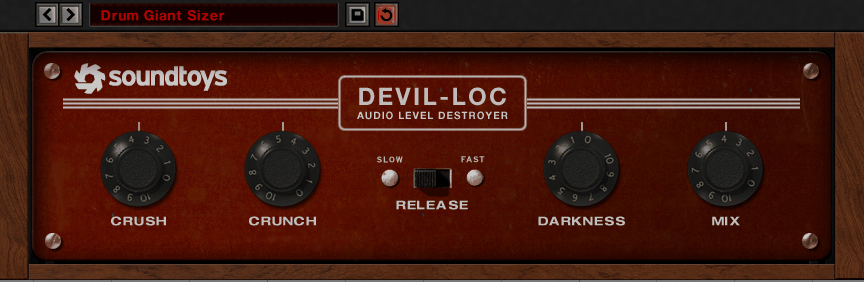
SoundToys’ strongest genre associations follow the specific plugins each genre leans on. Hip-hop and trap production leans hard on Decapitator for 808s and bass, and Devil-Loc for drum bus compression that’s meant to sound aggressive rather than transparent.
Pop and R&B vocal production relies on EchoBoy for vocal echo and Little AlterBoy for pitch and formant effects that have become standard in modern vocal chains. Electronic music uses FilterFreak and PhaseMistress for rhythmically modulated filter and phase effects, Crystallizer for experimental textures, and SpaceBlender for non-standard reverb environments.
Rock and indie production pulls Decapitator and Radiator for analog warmth on guitar, drums, and bass. The theme throughout: SoundToys shines brightest when the character of the effect is meant to be felt and heard rather than staying transparent and corrective.

- Arturia
Arturia’s genre coverage depends heavily on which collection you’re working with. V Collection earns its keep for genres where vintage synthesis is core to the sound: ambient and electronic music drawing on 70s and 80s synthesis character, synthwave and retro production referencing that era directly, cinematic and film scoring where the CS-80, D-50, and Mellotron V are foundational textures, and pop production where the Minimoog, Prophet-5, and JUN-6 V provide the classic bass, lead, and pad voices.
Beyond the core V Collection, Arturia has a few standalone instruments that slot into specific genre niches really well.
Arturia CMI V recreates the Fairlight CMI sampler that defined a huge chunk of 80s electronic and art pop, and it’s become a staple for electronic producers who want that specific digital-meets-organic texture.

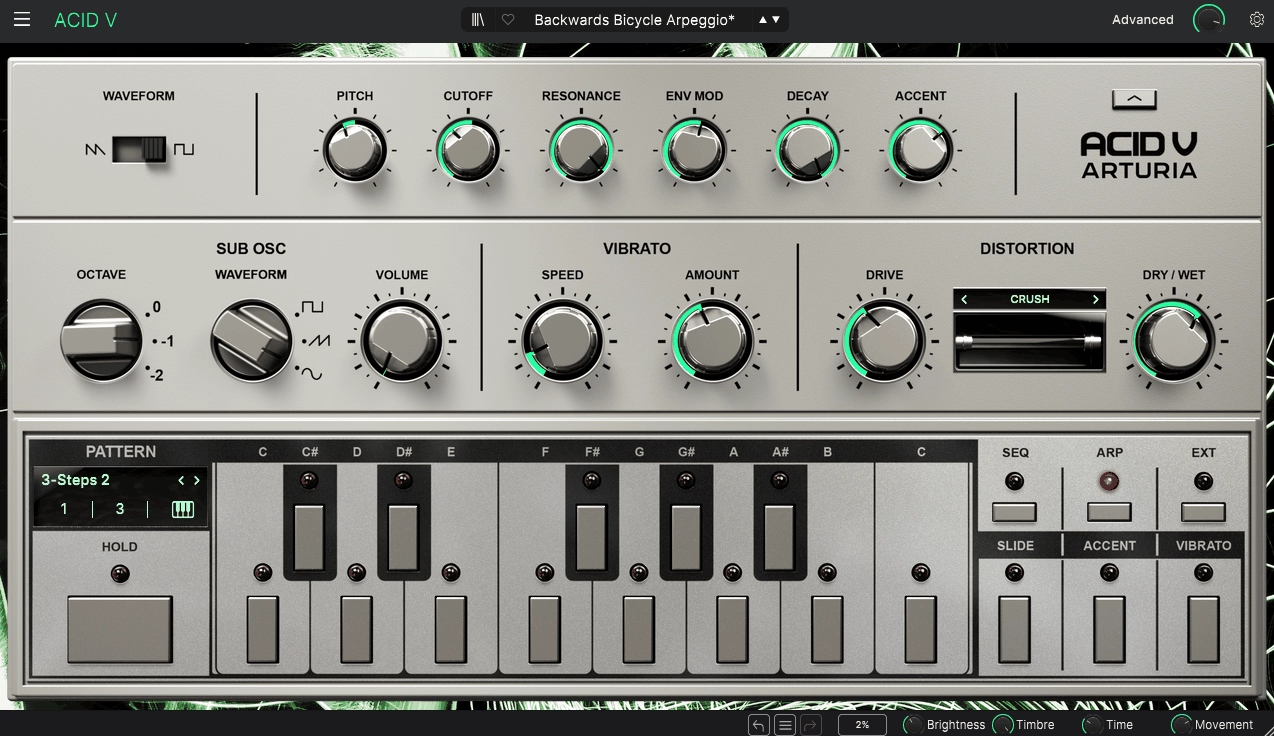
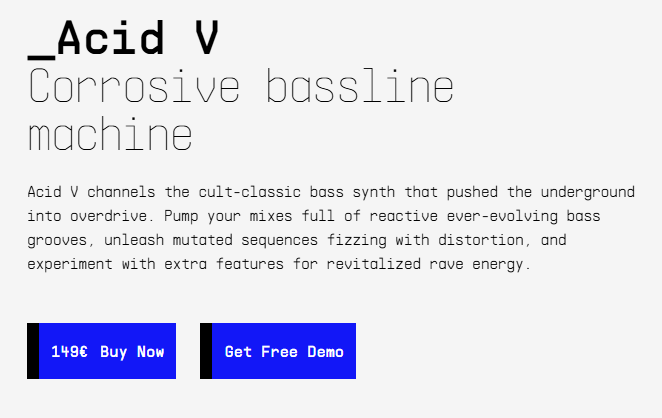
Arturia Acid V is built specifically around the Roland TB-303 sound, which makes it essential for techno, acid house, and anything in that lineage where the squelchy 303 bassline is the whole point.
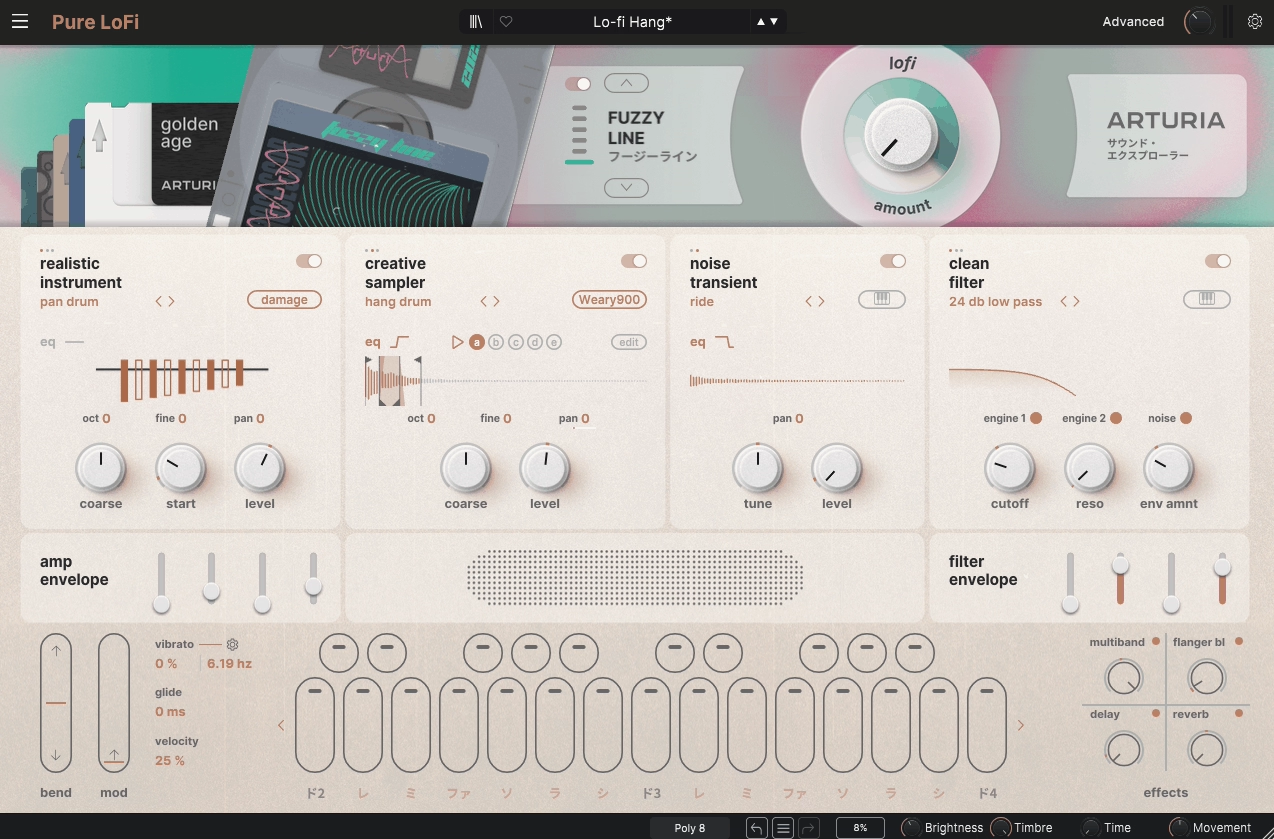
And then there’s Arturia Pure LoFi, which is purpose-built for lo-fi hip-hop, chillhop, and hazy bedroom production vibes, adding tape wobble, vinyl noise, and that warm, slightly degraded character that defines the genre.
FX Collection covers pretty much all genres through its broad effect selection, from mix bus compression and EQ tools that suit anything to creative effects that shine in experimental and electronic contexts.
- UAD
UAD’s catalog is most transformative for genres and recording contexts where classic studio hardware is the reference. Music that references the 60s, 70s, and 80s, where Neve consoles, LA-2A compression, and Studer tape machines were the actual tools of production, gets the most authentic treatment through UAD’s officially licensed emulations of that same gear.
Hip-hop and R&B production drawing on the warmth of those studio eras benefits from UAD’s console preamp and tape emulations for adding the kind of analog character that defines those sounds.
For pianists and songwriters working in these genres, the UAD Electra 88 Vintage Keyboard Studio brings together classic electric piano sounds (Rhodes, Wurlitzer, Clavinet) with the vintage effect chains that made them famous on records from that era.
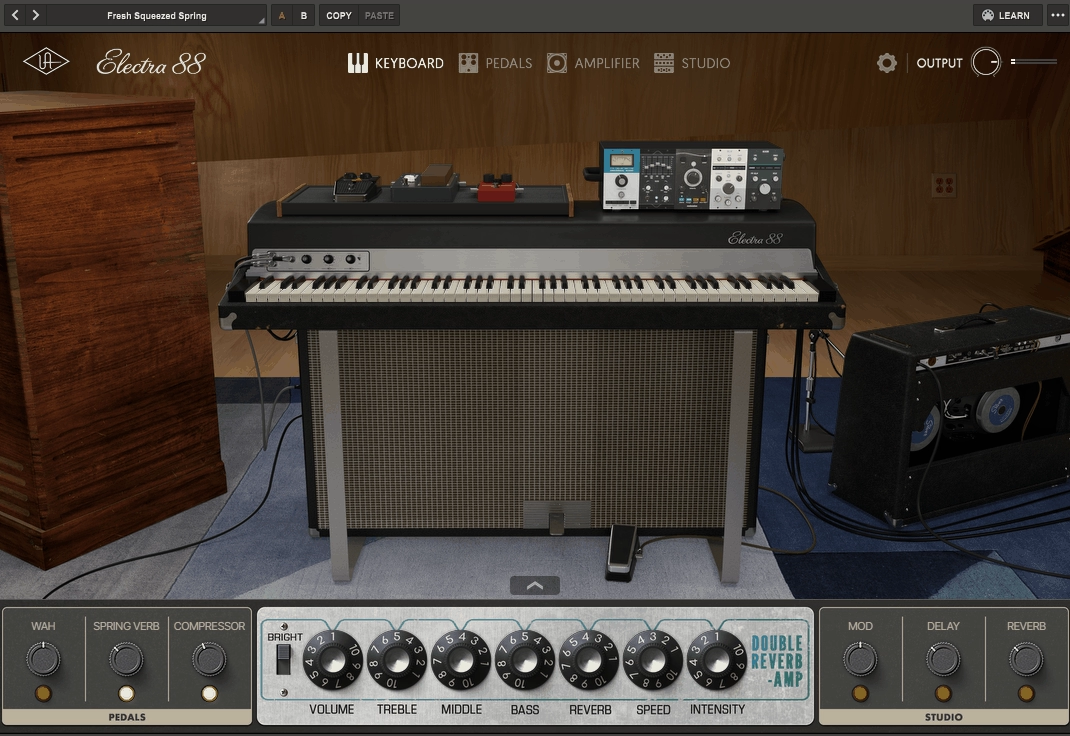
Opal, UAD’s original morphing synthesizer, sits comfortably in EDM, house, drum and bass, techno, and most modern electronic production, covering the kind of evolving pad, lead, and bass territory those genres actually need.
Professional mixing across any genre benefits from UAD’s compressor and EQ emulations, which remain some of the most trusted in the professional mixing community, whether you’re cutting hip-hop, tracking indie rock, or mastering an electronic release.
Trials and Demo
- SoundToys
SoundToys offers a 30-day fully functional trial of the complete Soundtoys 5 bundle with no output limitations or watermarks. You download the full bundle, use all 23 plugins exactly as you would the purchased version for 30 days, and decide whether to buy.
This is the most fair and useful trial arrangement in the industry, and it gives you real production time to evaluate the tools before committing.
- Arturia
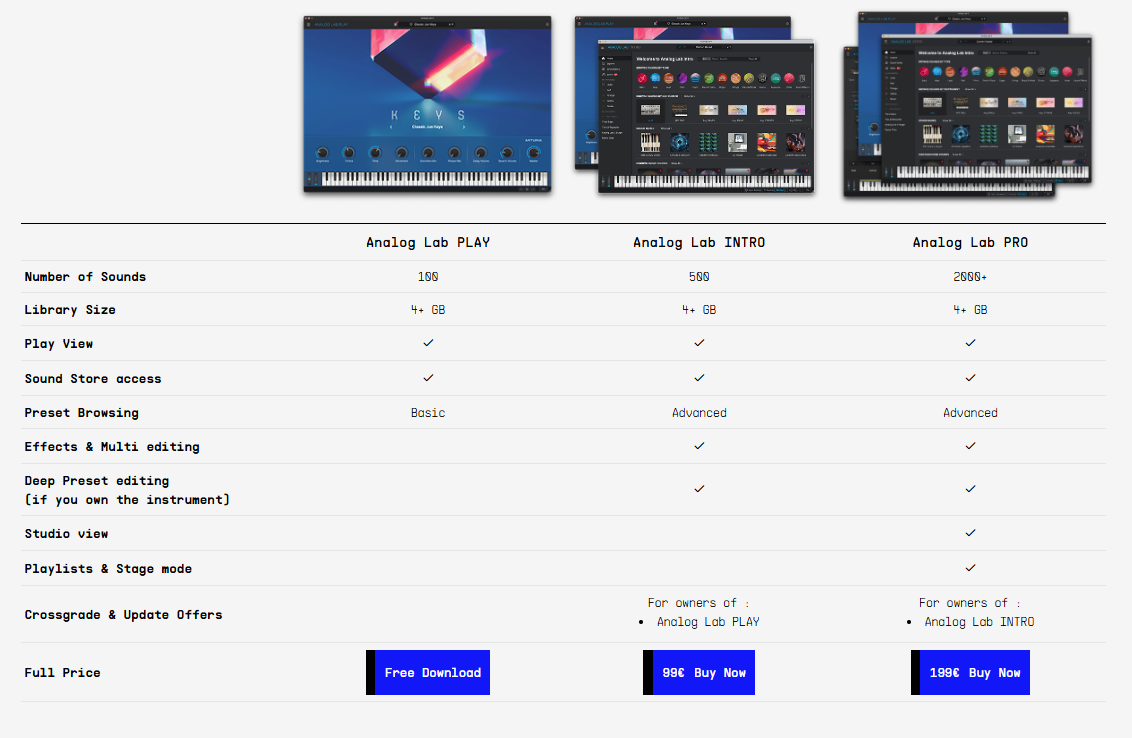
Arturia offers a 30-day trial per plugin through their Arturia Software Center, with full functionality during the trial period. Given the size of both FX Collection and V Collection, you can evaluate the whole catalog over multiple trial periods by trying individual plugins separately, though doing them all at once requires installing the full bundle trial.
The free standalone version of Analog Lab gives you a limited free taste of V Collection sounds without full synthesis programming access.
- UAD
UAD Spark offers a 14-day free trial with full access to every plugin in the Spark catalog. Owners of Volt USB audio interfaces from UA get an extended 30-day trial.
The trial is complete and unrestricted, giving you full access to the entire Spark plugin library during the evaluation. Given the breadth of Spark, 14 days may not be enough to evaluate every plugin you’re interested in, but it’s enough to get a real sense of the quality and workflow.
How to choose
Here’s the thing about SoundToys, Arturia, and UAD: trying to pick a single winner misses the point entirely. These three have completely different identities, and the actual useful question isn’t “which is best” but “which one belongs where in my workflow.”
Going with SoundToys makes sense when character is what you’re chasing, that analog hardware vibe, especially if delay, saturation, and modulation are signature parts of how your mixes sound. EchoBoy or Decapitator is usually where people start, and either one alone makes the case for what SoundToys does that nothing else really does.
Once you’re regularly reaching for three or more of the individual tools, the bundle pays for itself. And the sales run often enough that picking up the complete Soundtoys 5 collection at a reasonable price isn’t exactly a stretch given what you’re getting.
Arturia is the call when you want both instruments and effects living in the same ecosystem, particularly if vintage synthesis is part of your sound and you want serious analog emulations of classic synths sitting next to a full effects toolkit.
If synthesis is central to how you produce, V Collection is the bigger investment of the two. FX Collection, meanwhile, is the most well-rounded single effects bundle out there if you want broad coverage rather than the deep-in-one-category specialism that SoundToys and UAD bring. Only budget for one broad effects bundle and not chasing UAD’s hardware-documentation depth? Arturia FX Collection is genuinely strong value.
Lastly, UAD Spark is where you land when officially licensed studio hardware emulations matter more than anything else, especially if your mixes reference the Neve/API/Studer/Fairchild studio sound, or you’re tracking through an Apollo interface for hardware-quality processing.
At $19.99/month, the Spark subscription is one of the cheapest ways to get this level of hardware emulation into your sessions. The catalog is also deep enough that most professional mix engineers who subscribe end up with more tools than they’ll realistically ever learn.
For most serious producers, all three end up in the toolkit eventually. They just don’t really step on each other, SoundToys for character and vibe, Arturia for instruments and broad effects, UAD for the most authentic studio hardware emulations you can get in software.
Get the Free Plugin Starter Kit
The genuinely useful free DAWs and plugins worth installing. No filler. Straight to your inbox.

Hello, I’m Viliam, I started this audio plugin focused blog to keep you updated on the latest trends, news and everything plugin related. I’ll put the most emphasis on the topics covering best VST, AU and AAX plugins. If you find some great plugin suggestions for us to include on our site, feel free to let me know, so I can take a look!