
Free used to mean compromised. You’d download something, load it up with some optimism, and end up with a thin, unstable mess that sounded like it was built on a Tuesday afternoon. That era is genuinely over.
The free synth landscape right now is staggering, and some of what’s available at zero cost competes directly with plugins that cost hundreds of dollars. The ten synths on this list are proof of that.
They cover everything from deep multi-engine powerhouses to quirky oscillator experiments, from dead-simple beginner tools to chaos-theory sound machines, and every single one of them costs nothing. Whether you’re building out your first plugin folder or just hunting for something new to add to a collection that already has Serum and Massive, there’s something here worth your time.
From the Pluginerds Store
Before you go further into this list, something worth having sorted first. A stand at the right height and a sustain pedal give you the physical control to actually perform these instruments properly rather than clicking notes in.


1. XG Surge (Best overall)

Let me be upfront about something right away: Surge XT is the synth behind this listing, originally built by Vember Audio, then open-sourced in 2019, and now maintained by the Surge Synth Team as a completely free and actively developed instrument. The production community knows it well, and the consensus is consistent.
What makes Surge XT such a remarkable instrument is that it doesn’t just cover one type of synthesis well. It covers almost all of them, and it covers them at a professional level, with a modulation system that rivals anything you can buy.
I love how this synth keeps evolving without ever charging you for the updates. The community behind it has added entire filter algorithms borrowed from other open-source synths, new oscillator types, convolution reverb, and a formula modulator that lets you write custom modulation curves in Lua scripting. It’s genuinely one of those plugins where you can spend months and still be discovering things.
Key Features:
- Twelve Oscillator Algorithms:
Surge XT ships with twelve distinct oscillator types including Classic (a morphable pulse, saw, dual-saw design with sub-oscillator), Modern, Wavetable with 614 included wavetables, Window, Sine, FM2, FM3, String (physical modeling inspired), Twist, Alias, S&H Noise, and Audio Input. Each type has meaningfully different behavior, not just a waveform selector but a genuinely distinct synthesis architecture. Three oscillators are available per scene, giving you a lot of layering potential before you’ve even touched the filter section.
- Two Scenes Per Patch:
Each patch in Surge XT contains two fully independent scenes, each running a complete instance of the synthesis engine (minus effects). You can use these for layered patches, for split keyboard arrangements, or for creating two sounds that share an effects chain. This is a structural feature that sets Surge XT apart from most synths at any price point and opens up considerably more sound design territory than a single-engine approach.
- MSEG and Formula Modulator:
Surge XT’s modulation system goes well beyond standard LFOs and envelopes. The Multi-Segment Envelope Generator (MSEG) supports up to 128 nodes and a large variety of curve types, allowing you to draw essentially any modulation shape you can imagine. The Formula Modulator uses Lua scripting to let you write completely custom mathematical expressions for modulation output, which is a level of depth you don’t typically find in free software or even in most commercial synths.
- Filter Selection Including Borrowed Algorithms:
The filter section includes K35 and Diode Ladder filters borrowed directly from the Odin 2 synthesizer, 12 and 24 dB/oct multimode filters from OB-Xd, and unusual additions like Cutoff Warp, Resonance Warp, and Tri-Pole filters. The total selection is massive, and the filters support self-oscillation with fast response to cutoff changes, which makes percussive filter sweeps feel snappy and immediate.
Get the Free Plugin Starter Kit
The genuinely useful free DAWs and plugins worth installing. No filler. Straight to your inbox.
2. Vital (2nd best)

Few synth releases have had the kind of immediate community impact that Vital made when Matt Tytel dropped it. Within days of launch, producers were calling it “the free Serum,” which is somewhat reductive given how differently the two instruments actually behave, but it captures the spirit of the reception. The free basic version gives you the complete synthesis engine with 75 presets and 25 wavetables, and that is not a hobbled demo. It’s the full instrument. Paid tiers add more content and unlimited text-to-wavetable, but they don’t unlock any synthesis features that the free version locks away. I think that decision alone says something meaningful about what Tytel was trying to build.
For me, what separates Vital from other wavetable synths is how visual and intuitive the modulation system is. You drag a modulation source directly onto any parameter, and you instantly see an animated ring appear around the knob showing you the modulation depth in real time. For learning synthesis and for fast creative work, that visual feedback changes the whole experience. I found that I was making modulation decisions much faster in Vital than in synths where routing lives in a separate matrix page.
Key Features:
- Spectral Warping on Wavetables:
Vital’s spectral warping system lets you manipulate the harmonic content of a wavetable in ways that most wavetable synths don’t offer. You can stretch, shift, smear, and skew harmonics up and down the frequency spectrum, which creates timbres that would be impossible to achieve by simply switching between frames in a wavetable. This is what genuinely distinguishes Vital from a basic wavetable synth and gives it the capacity for sounds that feel new rather than familiar.
- Three Wavetable Oscillators Plus Sample Slot:
You get three wavetable oscillators, each with full access to spectral warping and the wave editing system, along with a sample slot for importing external audio as an additional texture or noise source. The sample slot isn’t a full sampler but it’s genuinely useful for layering, and the combination of three wavetable oscillators already gives you enormous sonic range before you’ve touched any modulation.
- Thirty-Two Filter Types:
Vital includes 32 filter types across its two filter slots, ranging from clean low-pass shapes to the Dirty filter types that model the Korg MS-20’s saturating resonance behavior. The filters sound musical rather than clinical, which matters especially when you’re pushing resonance hard.
- Four Audio-Rate LFOs and Three Envelopes:
The modulation system gives you three envelopes, four LFOs that can run at audio rate, two randomizers, and additional modulation sources. Audio-rate LFOs are particularly useful for FM-like effects and for creating timbres that are more complex than a static wavetable can produce. The drag-and-drop assignment system means you can route any of these to any parameter without ever opening a separate modulation page, which keeps your creative momentum intact.
- GPU-Optimized Animated Interface:
All of Vital’s graphical displays run at 60 frames per second with GPU acceleration, which means the animation budget is offloaded from the CPU that’s actually processing audio. You see real-time waveform displays, filter response curves, LFO shapes, oscilloscopes, and spectrograms, all moving smoothly, and none of it eats into your audio performance.
- Wavetable Import and Custom Editor:
The wavetable editor lets you draw wavetables from scratch, import your own audio and convert it to a wavetable using pitch-splice or vocoder methods, and generate wavetables from text input (with some limitations on the free tier). This means your sonic palette is effectively unlimited since any audio file you own can become a playable wavetable inside Vital.
3. ujam Usynth DRIVE
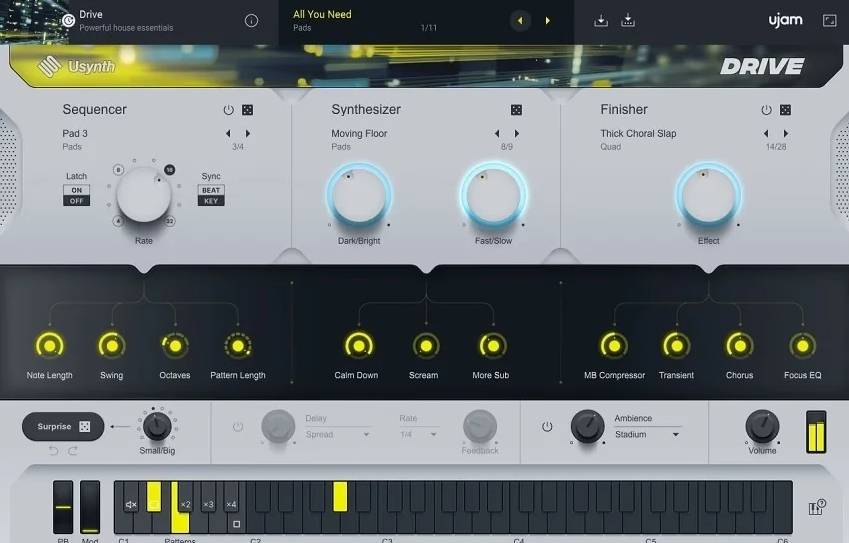
Image credit: Integraudio
Usynth DRIVE comes from a company co-founded by Pharrell Williams and Hans Zimmer, and it takes a completely different design philosophy from anything else on this list.
Rather than exposing all the synthesis controls, DRIVE hides a genuinely complex engine (Virtual Analog, Wavetable, FM, and Multisample in a two-layer architecture) behind a focused, intuitive interface inspired by what UJAM calls the Instagram filter approach to synthesis. You don’t need to know what a modulation matrix is to use it well.
I appreciate that this doesn’t try to be everything. It’s specifically aimed at deep house and electronic music production, and the sound design curated into those 100 Synth Modes reflects that focus.
Key Features:
- Complex Hidden Engine:
Despite the simple surface, DRIVE runs two synthesis layers per voice, each capable of Virtual Analog, Wavetable, FM, and Multisample synthesis. A multi-mode filter, five-stage envelopes, LFOs, and a 12-way modulation matrix are all working underneath every preset. You’re getting a genuinely advanced synth engine; you’re just not being forced to manage all of it manually.
- 100 Synth Modes and 90 Finisher Modes:
The Synthesizer section contains 100 Synth Modes covering basses, pads, polys, and leads, each with Brightness and Speed controls for quick tonal adjustment. The Finisher section contains 90 Finisher Modes, which are complete effects chain presets that you control with four macro knobs. This means you can take any Synth Mode and radically change its character with a single Finisher selection.
- Surprise Button for Instant Randomization:
A Surprise button generates a fully randomized preset, with options for “small” and “big” randomization that control how far the result deviates from your current settings. UJAM describes it as a quick inspiration tool, and in practice it does produce results that are more useful than a fully random patch usually generates because the underlying curation of synth modes keeps the engine parameters sensible.
4. Helm

Before Matt Tytel built Vital, he built Helm, and the creative DNA is obvious once you’ve used both. Helm is a polyphonic subtractive synthesizer with a modulation system, visual feedback, and an intuitive layout that still holds up well against newer free synths. I have to say, it has a genuinely distinct character.
I want to note that Helm is technically still a beta release that hasn’t been updated in some time, so stability can vary depending on your system and DAW version. On most modern setups it runs fine, but it’s worth being aware of. The musical output is absolutely worth the occasional quirk.
- Dual Oscillators with Cross Modulation and Fifteen Unison Voices:
Helm’s two oscillators each support up to 15 voices of unison, and they can cross-modulate each other for FM-like behavior. A Harmony mode lets you spread voices across musical intervals rather than just detuning them, which gives you the kind of chord stacks and harmonic layering that adds instant richness to pads and leads. Twelve waveforms are available across the two oscillators.
- Seven Filter Types with Drive:
The filter section includes seven filter types with key tracking, and a Drive control adds saturation before the filter for warm, overdriven character. DataBroth’s review specifically highlighted the filter’s ability to handle fast modulation for percussive sounds, which makes it useful for plucks, stabs, and bass lines that need snappy filter movement rather than smooth sweeps.
- Stutter Effect:
One of Helm’s most memorable features is its built-in stutter effect, which creates rhythmic, glitchy repetitions of the audio signal.
- Arpeggiator with Up to Four Octaves:
Helm includes a simple arpeggiator with up to four octaves and five playback patterns, and crucially, you can modulate the arpeggiator settings using the same modulation system as any other parameter.
- Formant Filter Effect:
The effects section goes beyond the standard delay and reverb to include a formant filter, which shapes the harmonic content of the sound to resemble vowel-like vocal formants. Combined with Helm’s sharp oscillator character, this produces some particularly distinctive textures that are hard to get from a standard subtractive setup.
5. TheWaveWarden Odin 2
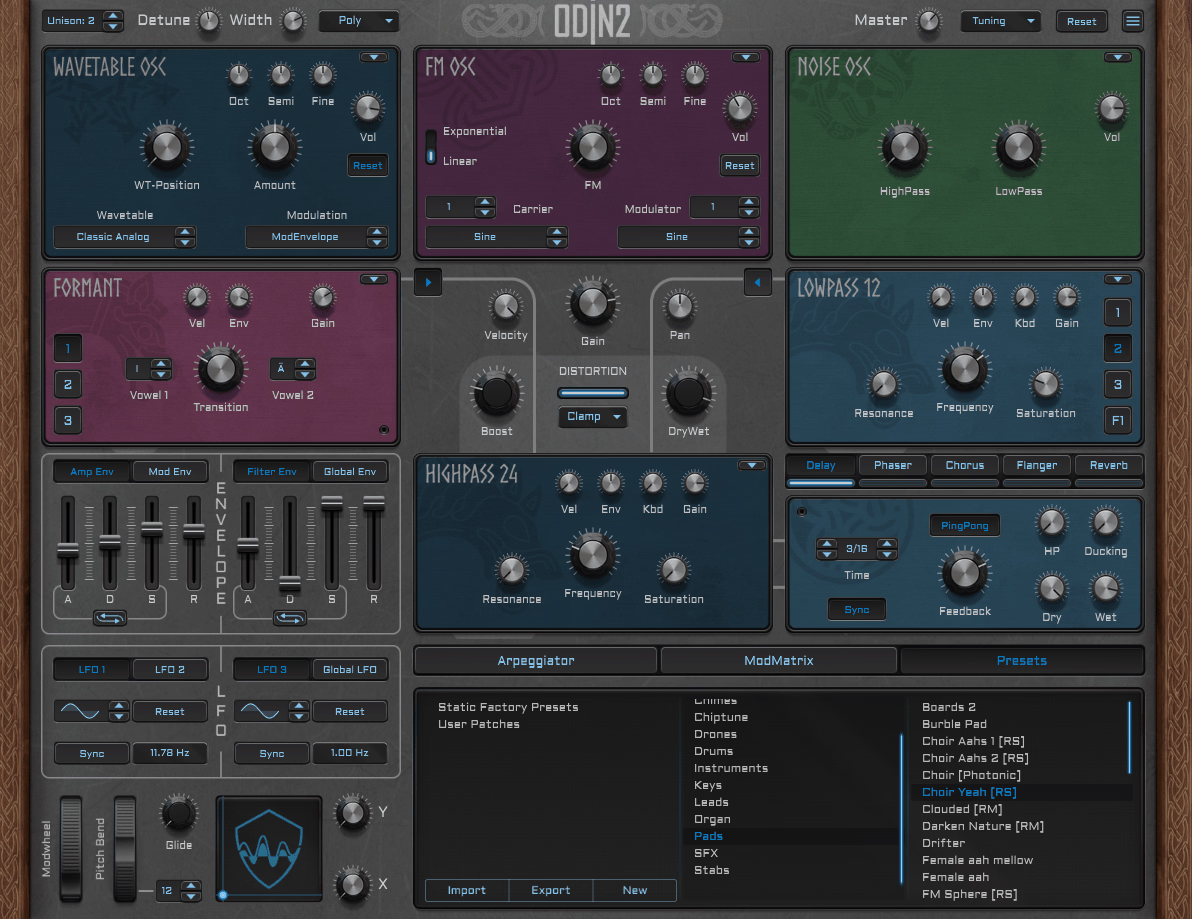
The Wave Warden built something genuinely ambitious here: a 24-voice polyphonic semi-modular synthesizer with virtual analog, wavetable, FM, and phase distortion synthesis in a single interface, plus three filter slots with emulations of legendary analog filters, plus a full arpeggiator, step sequencer, and modulation matrix, plus onboard effects. All open-source. All free.
In my opinion, the filter collection is where Odin 2 really earns its reputation. The filter emulations, particularly the Moog Ladder and Korg-35 models, give the synth an organic character that’s harder to achieve in more digitally transparent instruments.
Key Features:
- Three Oscillators with Waveform Drawing:
Odin 2 gives you three independent oscillators that can run in virtual analog, wavetable, FM, or phase distortion mode, plus three waveform drawing modes: Wavedraw (time domain drawing), Chipdraw (8-bit style drawing), and Specdraw (frequency domain/spectral drawing).
- Three Filter Slots with Analog Emulations:
The synth includes three filter slots with high-quality emulations of legendary hardware, including the Moog Ladder, the Korg-35, the SEM filter, and additional types.
- Full Modulation Matrix:
The modulation matrix lets you route LFOs, envelopes, the XY pad, MIDI velocity, aftertouch, key tracking, and other sources to almost any parameter in the synth. With four LFOs and four ADSR envelopes available, the modulation depth is substantial.
The XY pad is a particularly useful performance tool since you can assign two parameters to it and perform modulation by moving your cursor or finger in two dimensions simultaneously.
- Arpeggiator and Step Sequencer:
Odin 2 includes an arpeggiator with standard playback patterns and a step sequencer with multiple rows for programming melodic patterns directly inside the synth.
For live performance and for creating self-contained musical phrases without requiring a MIDI clip in your DAW, this combination is genuinely useful and not something every free synth bothers to include.
6. Newfangled Audio Pendulate
There are synths that do familiar things well, and then there are synths that do things you genuinely haven’t encountered before.
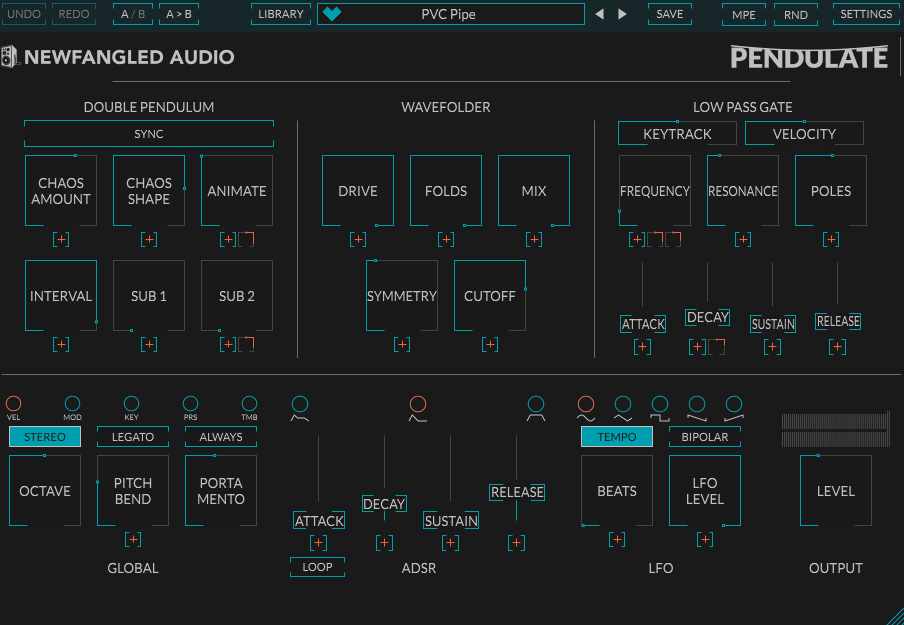
Eventide & Newfangled Audio Pendulate is a free chaotic monosynth built around a double-pendulum oscillator, which is a physics simulation of a mechanical double pendulum running at audio rate.
The result is an oscillator that can smoothly fade from a pure sine wave to total chaos, with a vast expanse of complex, unpredictable territory in between. I
I realized that spending time with Pendulate genuinely changes how you think about what a synth oscillator can do. It doesn’t sound like a Moog or a Serum or anything else I know. It has its own character, and that character is both chaotic and somehow coherent, which is exactly what makes it musically interesting rather than just noisy.
Key Features:
- Double-Pendulum Chaotic Oscillator:
The oscillator is based on a simulation of a double pendulum’s physics, a system that is chaotic in the mathematical sense: sensitive to initial conditions, containing feedback loops, self-similarity, and fractal patterns.
The Chaos Amount controls how far from sine wave behavior the oscillator goes, and the Chaos Shape determines the character of that chaos. The Animate parameter detunes the chaotic generator from the sine wave component to introduce motion, and the Interval control sets the musical interval between them. Two sub-oscillators (at one and two octaves below) add depth to the fundamental.
- Buchla 259-Inspired Wavefolder:
The wavefolder section is modeled on the Buchla 259 Complex Waveform Generator’s wavefolder, which folds the waveform back on itself to generate additional harmonics.
The Folds parameter controls how many times the waveform is folded (more folds means more harmonics), the Symmetry parameter determines whether those harmonics are odd, even, or mixed, and the Drive and Cutoff parameters shape the character of the folding. A Mix control blends between the folded and unfolded signal.
- Buchla 292-Inspired Low Pass Gate:
The Low Pass Gate is modeled on the Buchla 292 dual low-pass gate, which functions as a combination of a VCA and a low-pass filter controlled by the same signal. Unlike a conventional filter, the Low Pass Gate has a naturally organic response that Buchla users describe as sounding more like acoustic instruments. The Poles and Resonance controls further shape its character.
- Up to 221 Modulation Points:
Pendulate’s modulation system allows every modulation output to connect to every parameter, resulting in up to 221 simultaneous modulation connections in a single-pane view.
An ADSR envelope and a syncable LFO each generate multiple outputs simultaneously (like a modular synth would), and MPE support is included for use with controllers like the Roli Seaboard or Haken Continuum. Animated visualizations in each module show you exactly how modulation is affecting the oscillator, wavefolder, and gate in real time.
- Randomize Button
- No iLok Required
7. U-He Triple Cheese

Image credit: Integraudio
Most synths want to be the most versatile tool in your folder. Triple Cheese from u-he wants to be the strangest one, and it succeeds. Rather than oscillators, filters, and standard subtractive building blocks, Triple Cheese generates and processes sound exclusively through comb filters, which u-he describes as very short, chromatically tuned delays.
Three of these modules are arranged in series, each either generating its own signal or processing the output of the previous module.
I believe Triple Cheese is one of those synths where you load up the presets, find a few that surprise you, and then spend the afternoon chasing that sound through the three-module architecture. It’s not always immediately obvious why something sounds the way it does, which is actually part of the appeal.
Key Features:
- Three Comb Filter Modules in Series:
The entire synthesis is built from three comb filter modules, each with eight different modes (eleven in total across the full plugin), arranged so each module either self-generates or processes the output of the module before it.
- Modulation from Multiple Sources:
Key parameters in each module can be modulated by velocity, modwheel, pressure, key follow, or automatic sources including two envelopes, an LFO with multiple waveforms, and a vibrator. The modulation depth and routing are manageable enough that you can set meaningful motion in the sound without the complexity becoming overwhelming, which suits the overall plug-and-play character of Triple Cheese.
- Delay-Based Effects Including Chorus, Flanger, Phaser, and Reverb:
Triple Cheese includes a delay-based effects section covering chorus, flanger, phaser, delay, and reverb, with a dedicated LFO for speed and depth controls on those effects. The effects aren’t the most sophisticated in isolation, but they interact well with the comb filter character of the synth, adding warmth and movement that emphasizes the organic quality of the sound.
- MTS-ESP Microtuning Support:
The updated version of Triple Cheese includes full MTS-ESP support, the microtuning standard developed by ODDsound and Aphex Twin that allows microtuning to be applied across multiple compatible plugins simultaneously from a single control source.
- 254 Included Presets and Skinnable Interface:
Triple Cheese ships with 254 presets covering an eclectic range of textures, plucks, basses, and atmospheric sounds. The interface is skinnable as with all u-he plugins, and the 2021 update gave it a significantly improved preset browser. You get 16-voice polyphony with duophonic and monophonic (retriggered and legato) voice modes.
8. Hercules V3
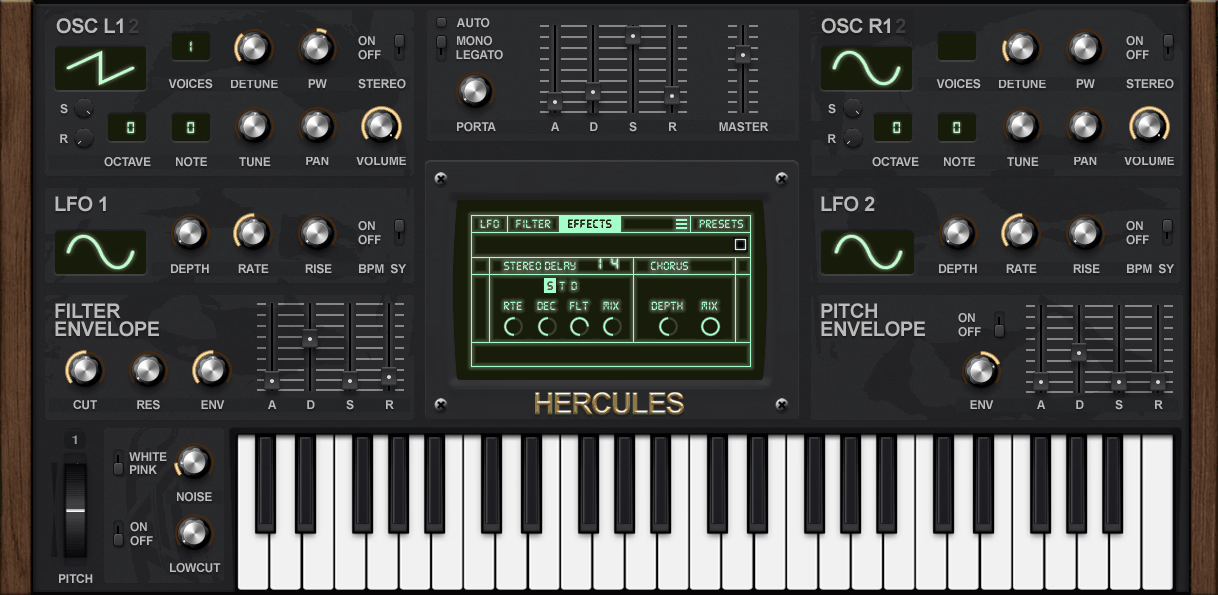
Not every producer needs a synth with a 128-node MSEG and Lua scripting. Sometimes you need something that loads instantly, makes sense on first glance, and gets you to a usable sound in under two minutes without a manual. Hercules V3 from Fruitymasterz is exactly that. B
I suggest treating Hercules V2 as a first synth or a quick-sketch tool rather than a deep sound design environment. The developer built it specifically for producers who couldn’t afford expensive plugins, and the clarity of the interface reflects that mission. It’s a supersaw synthesizer at heart, and it excels at the kind of wide, rich lead and pad sounds that electronic music production has always needed.
Key Features:
- Dual Oscillator Supersaw Engine:
Hercules V2 runs a dual-oscillator subtractive engine focused on supersaw-style sounds, with each oscillator producing the wide, detuned stacked-saw character that’s been central to trance, EDM, and electronic pop since the early 2000s. Two additional noise oscillators were added in V2, giving you pink and white noise for layering texture under the main sound.
- Three ADSR Envelopes:
The synth provides three independent ADSR envelopes for volume, filter, and oscillator pitch respectively, which covers the three most important modulation targets in basic subtractive synthesis. Having a dedicated pitch envelope separate from the amp and filter envelopes means you can create sounds where the pitch snaps to a note and then settles, useful for plucks, basses, and punchy leads.
- Two LFOs and Filter Section:
Two LFOs handle parameter modulation, and a filter module provides cutoff and resonance control for standard subtractive shaping. The filter envelope gives you dynamic filter movement tied to note triggers, and the filter and LFO routing is straightforward enough to understand immediately from the interface without any manual consultation.
- Ping-Pong Delay and Chorus FX:
The FX section contains a ping-pong delay and chorus, which are exactly the two effects that pad and lead sounds need most for width and depth.
- Windows Only, VST2 and VST3:
One important practical note: Hercules V2 is Windows only, available in 32-bit and 64-bit VST2 and VST3 formats. Mac users will want to look elsewhere on this list, but for Windows producers, it’s a clean, free, immediately useful virtual analog synth that installs and works without complications.
9. Primer 2
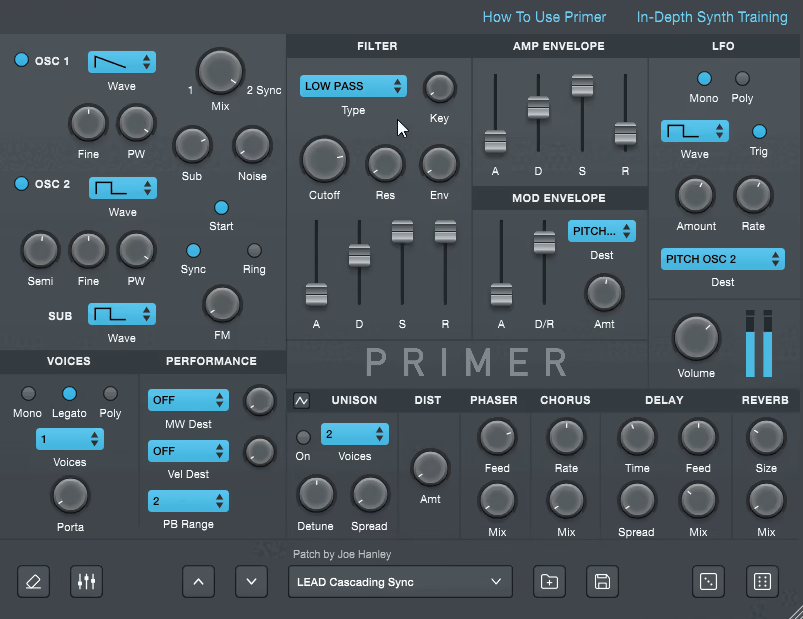
You might know Primer 2 from Audible Genius as the companion synth to Syntorial, the award-winning synthesizer training application. But here’s the thing that matters for this list: even if you’ve never touched Syntorial and have no interest in it, Primer 2 is still a capable, completely free subtractive synthesizer with 400 presets, real-time visual feedback, a genuinely smart randomizer, and five onboard effects.
For me, Primer 2 earns its place on this list not because it’s the deepest synth here, but because it does something genuinely different from the others: it prioritizes clarity and immediately readable synthesis over feature density.
If you’re a producer who has always wanted to understand synthesis better, or someone who needs a lightweight synth that loads fast and doesn’t demand any synthesis knowledge to produce good sounds right away, Primer 2 is the one I’d recommend.
Key Features:
- Three Oscillators with FM and Ring Modulation:
Primer 2 includes two main oscillators with waveform, pitch, pulse width, and mix controls, plus a sub-oscillator with its own waveform and volume control.
An FM knob adds frequency modulation between oscillators, and oscillator sync is available for creating the bright, aggressive sync tones that are a staple of electronic music. Saw, Pulse, Triangle, and Sine waveforms cover the standard subtractive palette.
- Real-Time Visualizer:
One of Primer 2’s most practically useful features for anyone learning synthesis is the real-time Visualizer, an animated display showing the envelope, LFO, and filter behavior as it actually happens during playback.
- Dual Randomization Engines:
Primer 2 includes two creative randomization systems: one for standard random patch generation and one called Flowtones that gives you control over how experimental or musical the result will be.
- Famous Sounds Preset Library:
The version 2.0 update introduced a Famous Sounds Preset Library with recreated patches of iconic synth sounds from well-known songs, accessible from the preset menu or via Syntorial’s website. This gives you a reference point for what great preset programming looks like in a clean, educational interface, and it’s a genuinely useful resource both for learning and for quickly accessing classic sounds.
From the Pluginerds Store
One thing worth mentioning again before you go: however good the plugin, performing it properly needs a stand at the right height and a pedal underfoot — small things, easy to forget until you're mid-session.


Get the Free Plugin Starter Kit
The genuinely useful free DAWs and plugins worth installing. No filler. Straight to your inbox.

Hello, I’m Viliam, I started this audio plugin focused blog to keep you updated on the latest trends, news and everything plugin related. I’ll put the most emphasis on the topics covering best VST, AU and AAX plugins. If you find some great plugin suggestions for us to include on our site, feel free to let me know, so I can take a look!