
EDM, house, and trance have a specific relationship with hardware synths that other genres don’t share.
The supersaw leads that define trance, the rolling acid bass lines that drive house, the massive pads that fill festival sound systems, these sounds were born on hardware synthesizers and the genre’s sonic identity is still shaped by what physical circuits and digital engines produce.
You can absolutely make electronic music entirely in the box with plugins, but there’s a reason producers keep coming back to hardware for the sounds that need to hit hardest.
What I find interesting about the hardware landscape for electronic music in 2026 is how varied the options are. You’re not limited to choosing between a 303 clone and a supersaw machine anymore.
The current generation includes hybrid synths that combine analog warmth with digital versatility, FM engines that produce the metallic stabs and bell sounds that define certain subgenres, polyphonic analog flagships that handle everything from pads to leads, and compact instruments that deliver more capability per dollar than anything available even five years ago.
I’ve selected twelve hardware synths that cover the specific sounds and workflows that EDM, house, and trance production demands, from affordable starting points through serious studio centerpieces.
1. Arturia MiniFreak
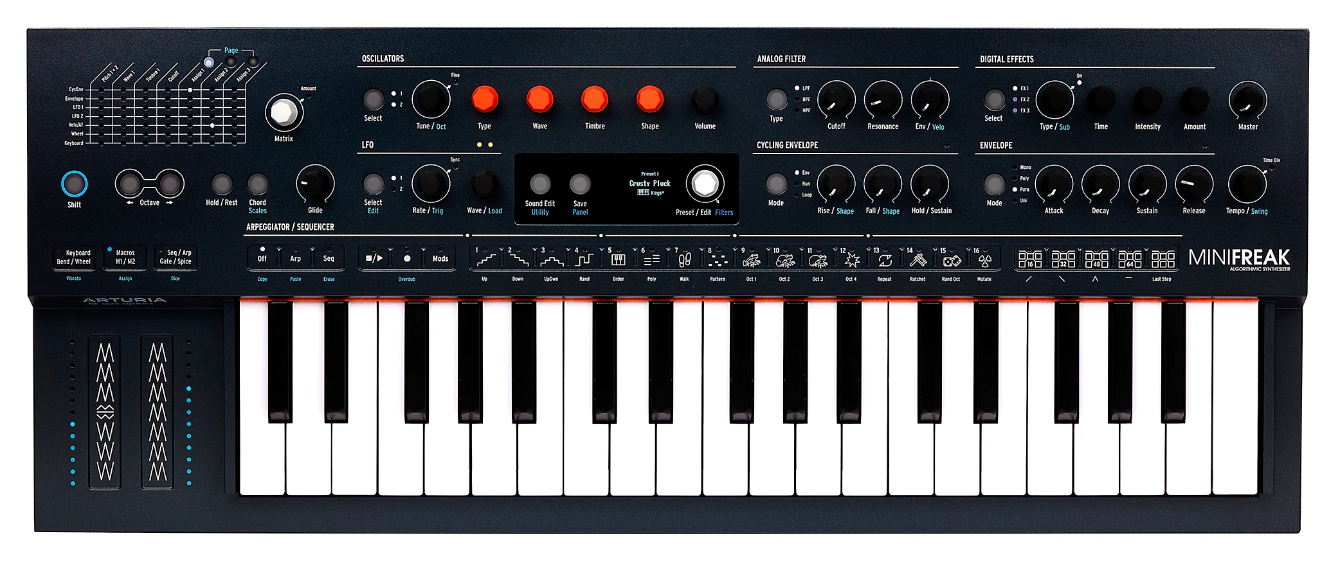
If you’re looking for the single most versatile hardware synth for electronic music production at an accessible price, the Arturia MiniFreak is where I’d start. It combines two digital oscillator engines (each with over a dozen synthesis types) routed through a real analog Steiner-Parker filter, giving you a range of tonal territory that would require multiple synths to cover otherwise.
The hybrid architecture means you get digital variety with analog warmth, which is a combination that suits electronic music particularly well.
For EDM specifically, the MiniFreak covers ground from thick unison basses through supersaw-style stacked leads to evolving pad textures and percussive plucks, all from a single compact instrument that costs less than most individual synth modules.
- Engine Stacking
The two oscillator slots each offer over a dozen synthesis engines including virtual analog, wavetable, superwave, FM, Karplus-Strong, and granular.
You combine any two freely, meaning you can run a superwave engine for trance leads stacked with a wavetable oscillator for harmonic movement. The engine variety gives you starting points for virtually any electronic subgenre from a single instrument.
- Analog Filter
The real Steiner-Parker analog filter adds warmth, resonance, and the specific nonlinear saturation that analog circuits produce. For electronic music, the analog filter is what gives MiniFreak sounds their weight in a mix.
Sweeping the cutoff during a build-up or breakdown produces the kind of fat, musical filter movement that defines house and trance production.
- Spice & Dice
The Spice and Dice randomization applies controlled variation to your sequences, randomly adjusting pitch, velocity, and gate length within boundaries you define.
For EDM production, this creates evolving, non-repetitive patterns from simple sequences that keep your loops interesting over extended arrangements without manual programming.
- Effects Chain
Three simultaneous effects slots with multiple routing options process the sound within the synth. The built-in chorus, delay, reverb, and distortion handle the processing that electronic music typically needs, meaning you can save complete, effects-processed patches as presets and recall them instantly.
Get the Free Plugin Starter Kit
The genuinely useful free DAWs and plugins worth installing. No filler. Straight to your inbox.
2. Behringer DeepMind 12
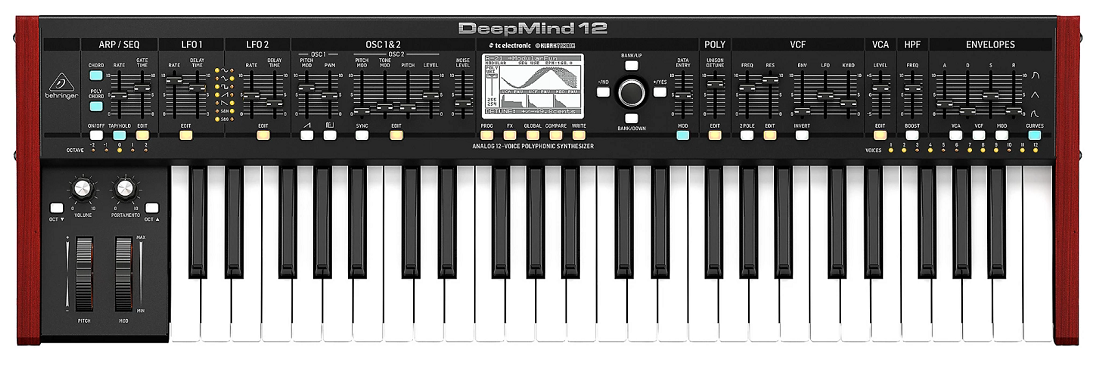
For trance producers specifically, this is one of the most compelling hardware synths available at any price. Behringer DeepMind 12 gives you twelve voices of true analog polyphony with a comprehensive effects section and deep modulation, producing the lush, wide, evolving pads and stacked supersaw-adjacent leads that trance music demands.
The voice count alone sets it apart from most analog hardware at this price.
The real secret weapon for trance is the effects section. Twelve voices of analog polyphony running through chorus, phaser, delay, and reverb with extensive modulation routing produces the kind of massive, shimmering, spatial sounds that trance is built on.
- Twelve Voices
Twelve voices of analog polyphony give you enough headroom for dense, sustained chord pads without voice stealing. For trance, where pads often sustain across multiple bars while leads and bass play on top, twelve voices means your pads don’t cut out or thin down when other parts enter.
The analog voice count at this price point is genuinely remarkable and nothing else in the range comes close.
- Effects Engine
A 32-slot effects engine with four simultaneous effect slots covers chorus, flanger, phaser, delay, reverb, overdrive, and more.
The effects quality and variety go well beyond what you’d expect from a budget analog polysynth. For trance, running the analog pads through chorus and phaser simultaneously with tempo-synced delay creates the massive, shimmering spatial quality that the genre needs.
- Mod Matrix
An 8-slot modulation matrix connects any source to any destination with extensive routing flexibility. The mod matrix is where you create evolving trance pads where the filter, effects parameters, and oscillator settings all move in coordinated patterns. Without deep modulation, analog pads sound static. With the DeepMind’s matrix, they breathe and evolve.
- Wi-Fi Editor
A wireless tablet editor app provides full visual access to every parameter including the effects and modulation matrix.
- Patch Memory
1024 patch locations give you massive storage for organizing sounds by type, genre, or set. For electronic producers working across multiple subgenres or building live performance sets, having extensive patch memory means you can store hundreds of genre-specific presets organized however suits your workflow.
3. Moog Matriarch
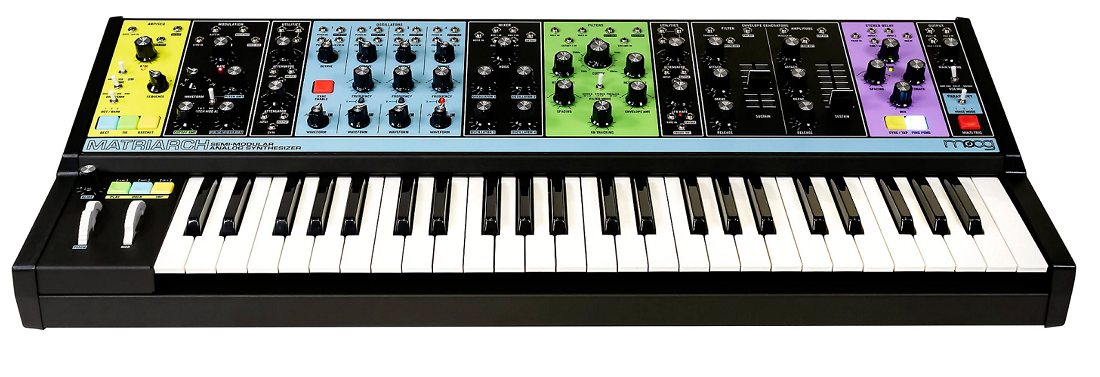
When you need bass that hits like a physical force and pads that feel like warm analog blankets, the Moog Matriarch delivers both from a four-voice paraphonic architecture with the unmistakable Moog sound.
The four analog oscillators through dual Moog ladder filters with an analog BBD delay and 90-point patch bay give you a sound design platform that’s as deep as your patience allows.
For EDM production, the Matriarch excels at the bass and lead sounds that need to carry a track, and the semi-modular architecture means you can create sounds that no preset synth produces.
- Moog Bass
Four Moog analog oscillators through the Moog ladder filter produce bass tones with a weight and harmonic density that sits in the chest of a club sound system. The Moog bass sound has defined electronic music’s low end for decades, and the Matriarch delivers it with the benefit of four oscillators you can stack, detune, or spread across intervals.
- Analog Delay
A real BBD analog delay built into the signal path adds warmth, movement, and spatial character that digital delays don’t replicate. For electronic music, the analog delay with feedback pushed into self-oscillation becomes a sound source that produces rising tones, rhythmic patterns, and evolving textures. The delay is as much a creative tool as the oscillators.
- Patch Bay
A 90-point patch bay lets you rewire the signal flow, create feedback loops, cross-modulate between oscillators, and route the delay into the filter. For electronic music production and live performance, the patch bay enables you to create unique sounds that no preset menu offers and that other producers can’t simply download.
4. Arturia PolyBrute 12
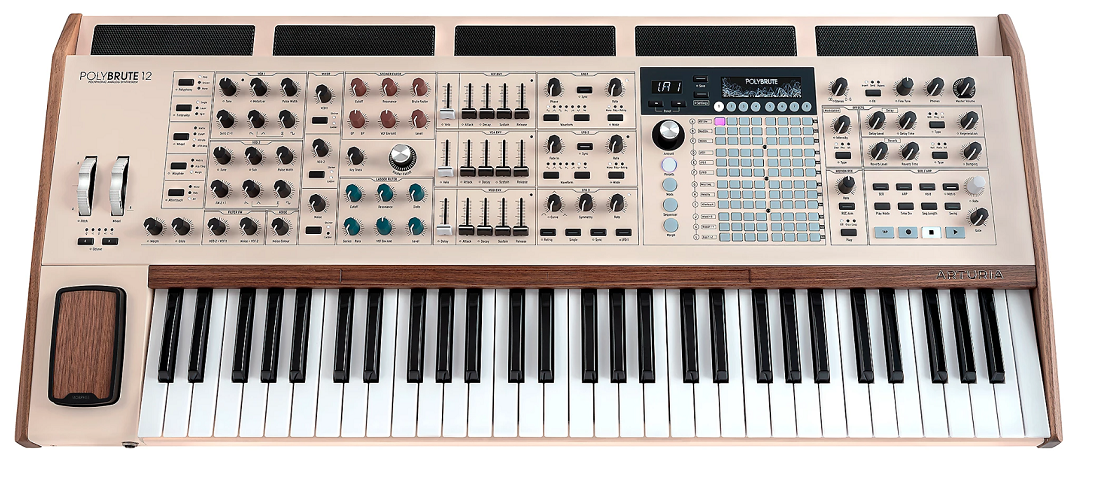
Twelve voices of full analog polyphony with a morphing system that lets you smoothly transition between two completely different sound states.
Arturia PolyBrute 12 is one of the most expressive and powerful analog polysynths available, and for electronic music its morph capability creates the kind of evolving, transforming sounds that define builds, breakdowns, and transitions.
The morphing is the killer feature for EDM. You set up a soft pad as Sound A and an aggressive lead as Sound B, then sweep the morph during a build-up and the sound transforms continuously from one to the other. No other analog polysynth does this.
- Morph System
The Morph knob smoothly interpolates between two complete patch states with every parameter moving simultaneously. For EDM production, this means you can create build-ups where the sound itself transforms rather than just filtering or adding effects. Assigning the morph to an expression pedal, aftertouch, or an automation lane gives you a single control that changes everything at once.
- Dual Filters
Every voice has access to a Steiner-Parker filter and a ladder filter that can run in parallel or series. The dual filter architecture gives you tonal shaping options that single-filter synths can’t touch. For electronic music, switching between the smooth ladder character and the aggressive Steiner-Parker character (or blending both) covers the range from warm pads to cutting leads.
- FullTouch Keys
The keyboard responds to polyphonic aftertouch and vertical finger movement, adding expressive dimensions that standard keyboards don’t have. For live electronic performance, the FullTouch response lets you modulate sounds per-note by pressing and sliding on individual keys, creating expressive variations within chords that bring static pads to life.
- Matrix Routing
An extensive modulation matrix with visual LED feedback shows active connections and intensities at a glance. The matrix depth lets you build patches where LFOs modulate envelopes, envelopes modulate filter blends, and aftertouch modulates everything simultaneously, creating the kind of complex, living sounds that electronic music at its best demands.
5. Roland Jupiter-Xm
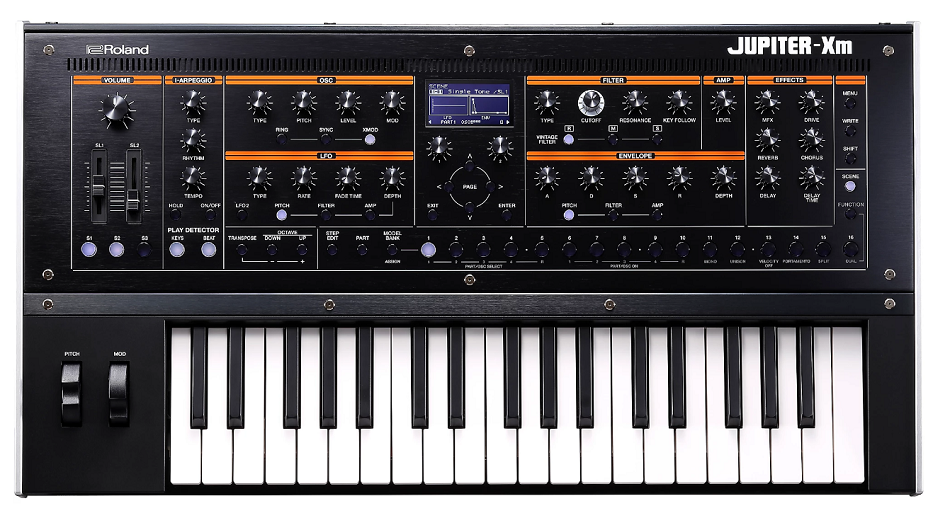
A compact, portable synthesizer that gives you access to Roland’s ZEN-Core engine alongside modeled recreations of classic Roland instruments that shaped electronic music history.
Roland Jupiter-Xm packs the sound of the Jupiter-8, Juno-106, SH-101, and JX-8P into a battery-capable desktop format with a mini keyboard and built-in speaker.
For electronic producers who want a single instrument that covers the classic Roland sounds heard on decades of dance records, the Jupiter-Xm delivers those specific tonal characters in a format you can throw in a backpack.
- Classic Models
Model Expansion packs recreate the specific behavior and character of legendary Roland synths including the Jupiter-8 (the polysynth that defined 80s electronic music), Juno-106 (the pad and chord machine of house music), and SH-101 (the mono lead and bass staple of techno). Each model captures the specific quirks and tonal qualities of the original rather than generic approximations.
- ZEN-Core Engine
The modern ZEN-Core synthesis platform provides virtual analog oscillators, PCM waveforms, and comprehensive effects alongside the vintage models. The ZEN-Core engine handles contemporary sounds that the vintage models can’t reach, meaning you’re not limited to recreating the past when you need modern timbres for current production styles.
- Portable Format
Battery operation, built-in speaker, and compact size make the Jupiter-Xm genuinely portable for sketching ideas, performing live, or producing away from your studio. The portability factor matters for electronic producers who perform live sets and need a hardware synth that travels easily alongside a laptop and controller.
6. Roland Juno-X
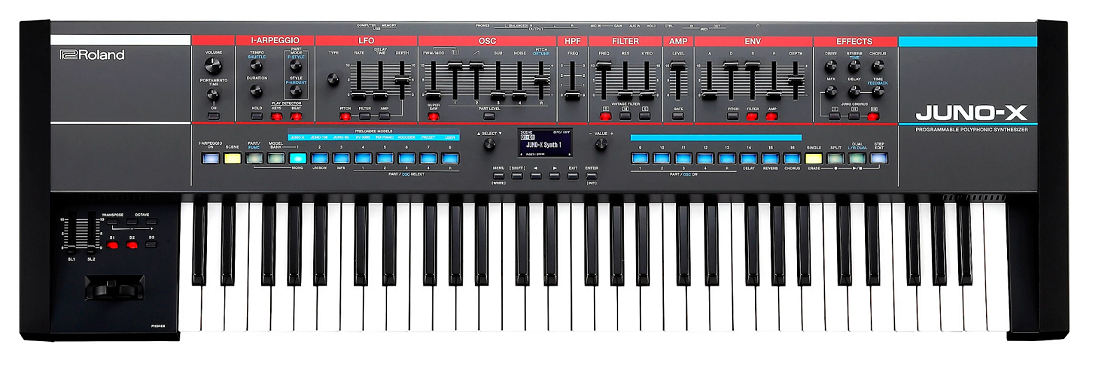
The Juno sound is trance and house history, and the Roland Juno-X gives you authentic recreations of both the Juno-60 and Juno-106 alongside the modern ZEN-Core engine in a full-size, performance-ready keyboard format.
If you’ve ever wanted the specific pad, brass, and string sounds that defined early house music and 90s trance, the Juno-X delivers them with convincing accuracy.
I include this specifically for trance producers because the Juno pad sound, that warm, chorus-drenched, slowly evolving wash, is one of the genre’s foundational textures and the Juno-X nails it.
- Juno Models
Dedicated Juno-60 and Juno-106 models reproduce the specific oscillator character, filter behavior, and legendary chorus effect of both original synths.
The Juno-60’s warmer, slightly grittier character and the Juno-106’s cleaner, brighter sound are both available, and switching between them gives you the specific Juno flavor each track needs. The chorus models are particularly important because the Juno chorus is one of the most recognizable effects in electronic music.
- Performance Controls
A dedicated performance section with the I-Arpeggio intelligent arpeggiator generates musically aware patterns that go beyond standard note cycling. For live electronic performance, the I-Arpeggio creates complex, evolving sequences from simple chord inputs, which is useful for building energy during sets.
- Scene Layers
A dual-layer scene system lets you combine two complete sound configurations and crossfade between them. For trance and progressive house, the scene morphing creates smooth transitions between different timbral states during breakdowns and builds, similar to the PolyBrute’s morph concept but implemented differently.
- Full Keyboard
The 61-note full-size keyboard with velocity sensitivity provides the playing surface that mini-key and desktop synths lack. For producers who play parts rather than program them, the full keyboard makes the Juno-X a proper performance instrument rather than a sound module you trigger from something else.
- Model Expansion
Beyond the Juno models, downloadable Model Expansions add entirely new synthesis engines to the instrument. The expandable architecture means the Juno-X grows over time as Roland releases new classic recreations and contemporary engines, which protects your investment against future needs.
7. Moog Subsequent 37
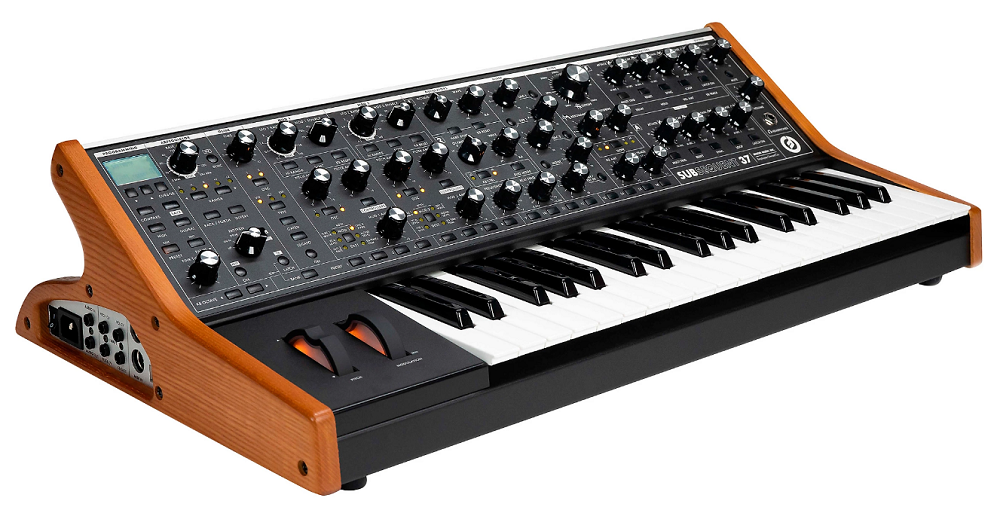
The flagship Moog monosynth handles bass, leads, and aggressive sequences with the kind of analog authority that electronic music demands from its most prominent sounds.
Moog Subsequent 37 gives you two Moog oscillators through the Moog ladder filter with Multidrive saturation, a duo paraphonic mode, and the build quality of an instrument designed to last decades.
For house and techno production, the Subsequent 37 produces the kind of bass and lead tones that cut through a dense mix on a club system without needing extensive processing. The Moog sound has earned its place in electronic music for a reason.
- Multidrive
The Multidrive circuit adds analog saturation ranging from subtle harmonic warmth to aggressive overdrive.
For electronic music, the Multidrive serves a dual purpose: it adds the upper harmonics that help bass and leads translate on smaller speakers while also providing the aggressive tonal character that harder electronic styles demand. The saturation is voiced to complement the Moog tone rather than fight it.
- Duo Mode
Duo paraphonic mode splits the two oscillators across two notes, letting you play bass intervals, octave stacks, and two-note patterns that monophonic mode can’t produce. For electronic bass lines that use octave jumps or fifth intervals, duo mode gives you harmonic complexity while maintaining the Moog signal path character on both notes.
- Preset Storage
Extensive patch memory lets you save and organize sounds by genre, type, or live set. For electronic producers juggling multiple projects and live performances, having a comprehensive library of production and performance patches stored within the synth itself means you’re not reprogramming from scratch every session.
8. Yamaha Reface DX
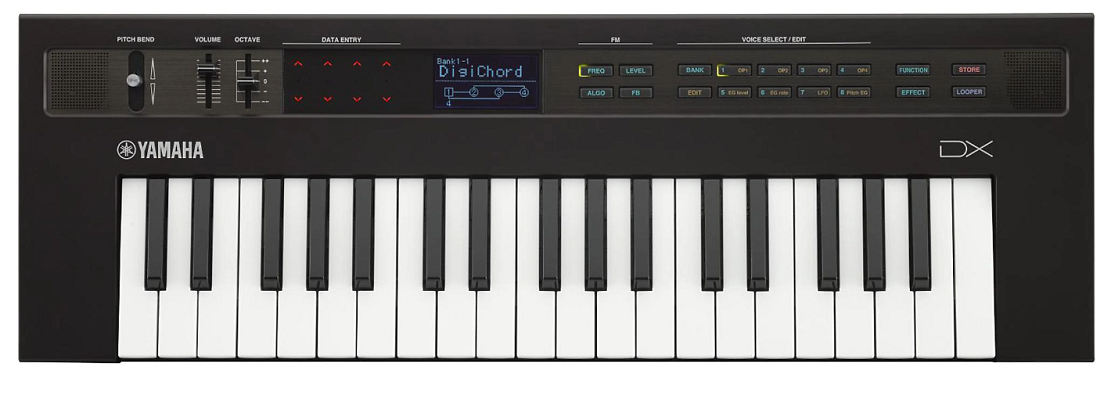
If you need FM synthesis sounds for your electronic productions and you want them from hardware, the Yamaha Reface DX puts a four-operator FM engine in a tiny, battery-powered format that makes FM accessible rather than intimidating.
The metallic stabs, glassy keys, bell sounds, and complex evolving textures that FM produces are essential elements in many electronic subgenres, and the Reface DX is the most approachable way to create them.
FM synthesis produces sounds that no analog or subtractive synth can make. The harmonic complexity that comes from operators modulating each other generates timbres that are fundamentally different from filtered waveforms, and for electronic music that needs to stand out sonically, FM gives you textures that are immediately distinctive.
- FM Access
Four FM operators with the touchscreen interface make FM synthesis more intuitive than any previous hardware implementation. You can see the operator relationships visually and adjust them by touch, which removes the abstract, mathematical barrier that historically made FM programming a specialist skill.
For electronic producers who want FM stabs, bells, and metallic textures without spending days learning DX7 programming, the Reface DX gets you there faster than anything else.
- Portability
Battery-powered operation in a pocket-friendly format means you can sketch FM sound design ideas anywhere. For electronic producers who travel to gigs, festivals, or just want to design sounds away from the studio, the Reface DX is the most portable FM option available.
- Looper
A built-in phrase looper records and overdubs in real time, letting you layer FM textures into complex arrangements from a single device. The looper turns the Reface into a one-person performance tool where you can build FM soundscapes live.
- DX Legacy
The four-operator architecture produces sounds that connect to decades of FM synthesis in electronic music, from the DX7 bass stabs of 80s house through the metallic percussion of 90s IDM to the complex FM textures in modern electronic production. The FM sound palette is deeply embedded in electronic music’s DNA.
9. Novation Bass Station II
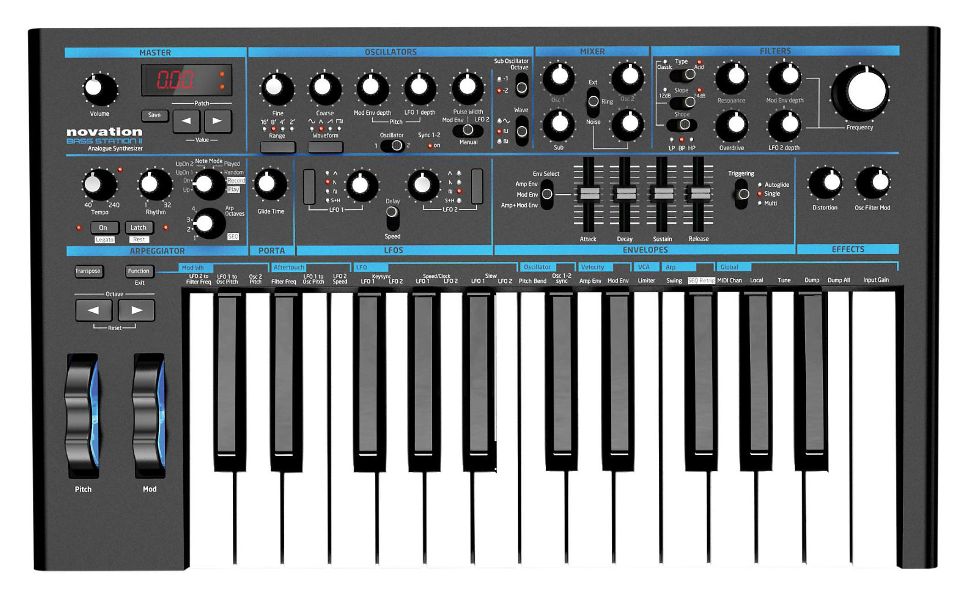
A dedicated analog monosynth that excels at the aggressive bass lines and acid sequences that drive house, techno, and bass music.
Novation Bass Station II gives you two selectable filter types (classic and acid), a sub-oscillator, and an arpeggiator in a compact keyboard format that handles everything from deep sub-bass to screaming acid leads.
The dual filter selection is what makes this particularly useful for electronic music, because you can switch between smooth, controlled bass and nasty, squelching acid tones from the same instrument.
- Acid Filter
The acid filter type produces the specific self-oscillating, squelching, screaming resonance that defines the TB-303 acid bass sound. For house and techno producers who need that acid character, the Bass Station II’s acid mode delivers it from a fully featured analog synth with proper keyboard, arpeggiator, and patch storage that the 303 itself never had.
- Sub Oscillator
A dedicated sub-oscillator adds pure fundamental content underneath the main oscillators. For electronic bass, the sub provides the physical low-end weight that you feel on a club system while the filtered main oscillators handle the tonal character above. The combination of sub weight and filtered harmonics is the architecture of almost every great electronic bass sound.
- Sequencer
The built-in arpeggiator and step sequencer with multiple modes generate the rhythmic patterns that drive electronic bass lines. The sequencer creates acid-style rolling sequences where filter sweeps and accent patterns make the bass line feel alive and musical rather than static and programmed.
- Patch Memory
128 patch locations let you save and recall bass sounds instantly, which is a practical advantage over analog synths that require manual reprogramming. For electronic producers who need a library of go-to bass patches organized by genre or set, having instant recall means you spend your time making music rather than recreating sounds from scratch every session.
- Paraphonic Mode
A paraphonic mode lets you play multiple notes through a single filter, adding harmonic complexity to bass parts that strictly monophonic instruments can’t produce. For electronic bass lines that use octave stacks, fifth intervals, or chord stabs, the paraphonic capability extends the Bass Station II beyond single-note territory into the kind of harmonic bass work that modern electronic production often demands.
10. Roland GAIA 2
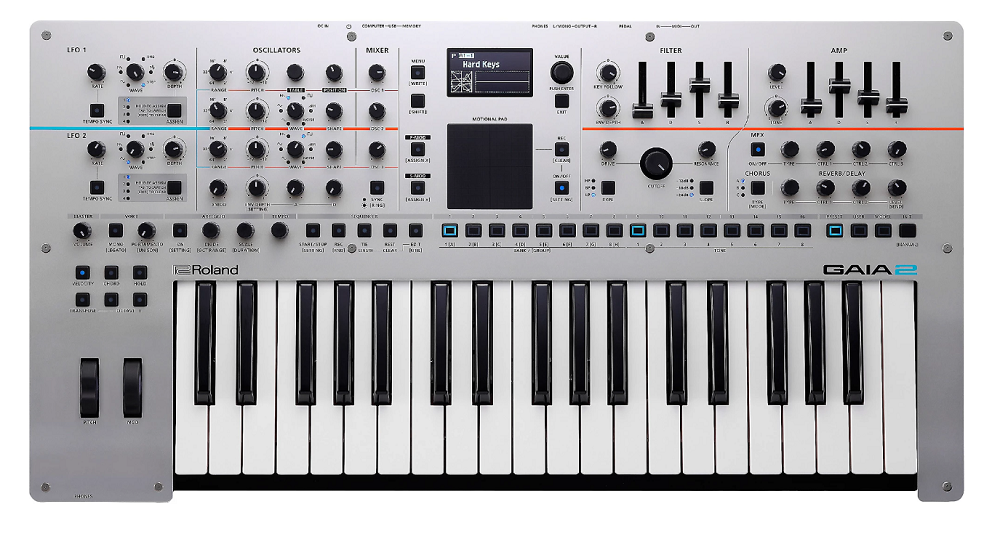
Specifically designed for hands-on, immediate sound creation with an interface that puts every major parameter on a dedicated control.
Roland GAIA 2 uses a virtual analog engine with three tone generators that you layer, split, and process through extensive effects, all with a level of front-panel immediacy that makes it ideal for producers who want to shape sounds by turning knobs rather than navigating menus.
For trance specifically, the GAIA 2 produces supersaws, wide pads, and layered lead sounds with the kind of immediate, hands-on control that genre demands during live performance and real-time sound design.
- Three Tones
Three independent tone generators that you can layer, split, or combine give you the building blocks for complex, stacked sounds.
Each tone has its own oscillator, filter, amp envelope, and LFO, meaning you can build a sound from three independent layers controlled from a single patch. For trance leads and pads, stacking three slightly different tones with different filter settings creates the wide, thick textures the genre requires.
- No Menu Diving
Every major parameter has a dedicated front-panel control with no hidden menus required for basic sound design. The direct interface means you can shape sounds in real time during performance by reaching for any knob and hearing the result immediately. For electronic producers who perform live, the no-menu-diving philosophy means you can make dramatic tonal changes mid-set without looking at a screen.
- D-50 Engine
Access to Roland’s D-50 synthesis engine alongside the virtual analog models adds the digital pad sounds and layered textures that the D-50 contributed to electronic music history. The D-50 engine produces sounds that complement the virtual analog tones with a different character, extending the GAIA 2’s palette beyond standard subtractive territory.
- Effects Quality
The effects section draws from Roland’s extensive effects library with reverb, delay, chorus, and more at a quality level that matches standalone effects units. For trance and progressive house, the effects quality means you can create finished, spatial, processed sounds within the synth without requiring external effects chains.
11. ASM Hydrasynth Deluxe
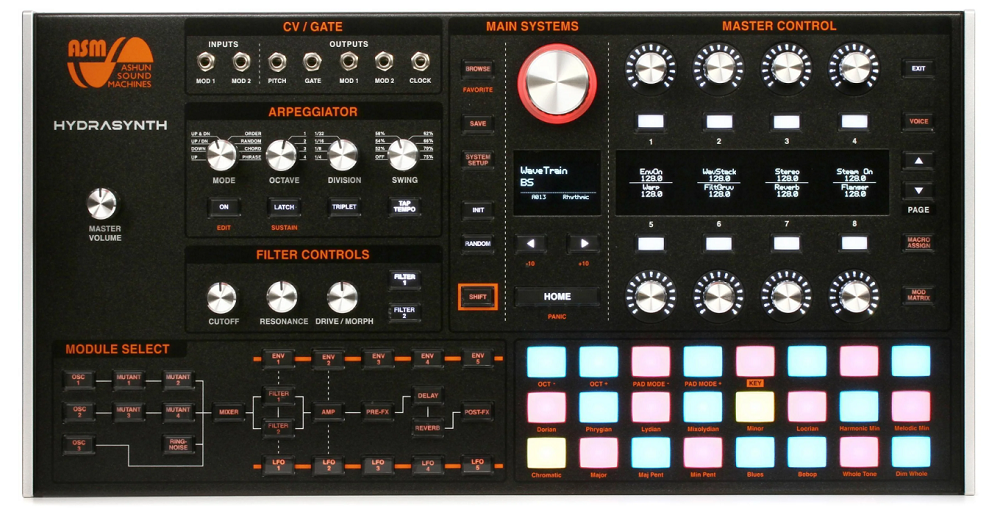
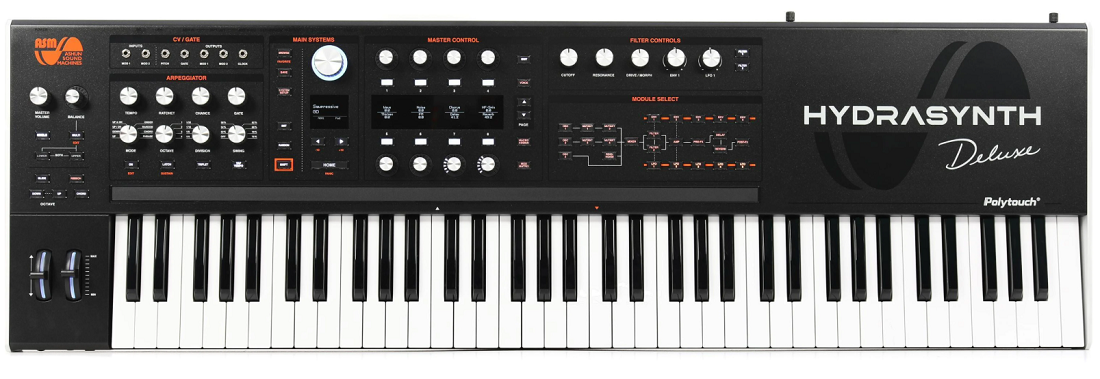
The full-size version of ASM’s critically acclaimed digital synthesizer, with 16-voice polyphony, polyphonic aftertouch, and one of the deepest modulation systems in any hardware synth.
ASM Hydrasynth Deluxe produces sounds that range from conventional analog-style tones to completely unique digital textures, all controlled by a ribbon controller and macro system designed for real-time performance.
For electronic music production and live performance, the Hydrasynth Deluxe’s combination of deep modulation, poly aftertouch, and extensive effects creates evolving, responsive sounds that react to your playing in ways that static preset machines can’t match.
- Wave Morphing
The wave morphing synthesis engine with three oscillators per voice goes beyond standard wavetable scanning by allowing you to assign eight waves per oscillator and morph between them using modulation sources. For electronic music, the morphing creates timbral evolution within sustained notes and chords that makes pads breathe and leads develop over time rather than sitting static.
- Mutant Modes
Mutant oscillator interactions apply FM, wavestack, and wavescan between oscillators in combinations that produce timbres far more complex than individual wavetables alone. The mutant modes are where the Hydrasynth creates its most distinctive sounds, and for electronic producers looking for textures that don’t sound like everyone else’s presets, the mutant combinations are a genuine creative advantage.
- Poly Aftertouch
Polyphonic aftertouch on the 49-note keyboard provides per-note pressure sensitivity where each note in a chord responds independently to your touch.
For electronic performance, pressing harder on the root note of a chord to open its filter while the other notes remain static creates expressive, dynamic sounds from what would otherwise be a static chord hold.
- Mod Depth
A modulation matrix with 32 slots connects any source to any destination with precision control. The matrix depth approaches what modular synthesizers offer, letting you build patches where everything modulates everything in complex, self-evolving networks. For electronic music that needs constantly shifting textures, the modulation depth turns simple patches into living, breathing soundscapes.
- Macro System
Eight performance macros assign multiple parameter changes to single controls, letting you sweep complex timbral shifts with one knob during live performance. For DJs and live electronic performers, the macros mean you can create build-ups, transitions, and dramatic sound transformations from a single gesture rather than trying to adjust multiple parameters simultaneously.
- Ribbon Controller
A touch-sensitive ribbon above the keyboard provides smooth, continuous parameter control for pitch sweeps, filter modulation, and effect manipulation. The ribbon encourages performance gestures that knobs and sliders don’t facilitate, adding a physical dimension to electronic music performance that buttons and faders lack.
12. Korg opsix MKII
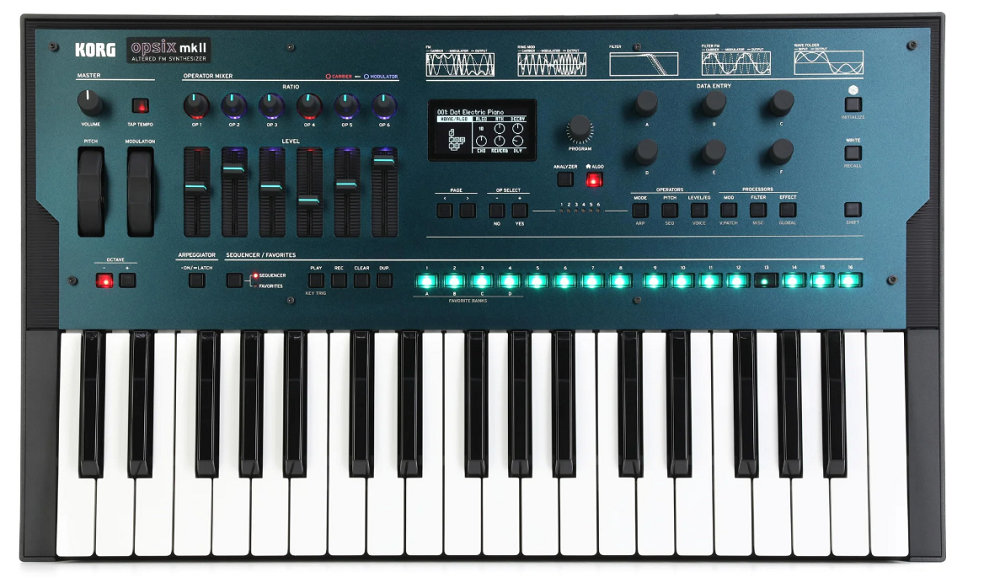
A six-operator FM synthesizer that makes FM synthesis accessible through a hands-on, knob-per-function interface rather than the menu-driven approach that historically made FM intimidating.
Korg opsix MKII gives you more operators than the Reface DX with a larger keyboard, more effects, and deeper sequencing, making it the more complete FM option for producers who want FM as a primary sound source rather than an occasional texture.
For electronic music, the opsix MKII produces the metallic stabs, complex bass sounds, crystalline leads, and percussive textures that FM synthesis is uniquely capable of generating, and the hands-on interface means you can actually program these sounds in real time rather than relying on presets.
- Six Operators
Six FM operators with 30+ algorithms provide significantly more harmonic complexity than four-operator designs. The extra operators mean you can create more complex, layered FM timbres with simultaneous modulator and carrier relationships that produce sounds four-operator engines can’t reach. For electronic music, the additional complexity translates to richer, more detailed textures.
- Hands-On Control
Dedicated knobs for every operator parameter replace the screen-based menu diving that made classic FM synths frustrating to program. You can adjust operator ratios, levels, feedback, and envelopes by reaching for physical controls and hearing the result immediately.
For live electronic performance, the knob-per-function approach makes real-time FM sound design practical rather than theoretical.
- Filter Section
An added multimode filter that the classic DX7 never had gives you subtractive shaping on top of the FM engine. For electronic music, the filter lets you apply the kind of sweeps, resonance, and frequency shaping that producers expect, taking raw FM timbres and molding them into mix-ready sounds. FM plus filtering produces results that neither synthesis method achieves alone.
Get the Free Plugin Starter Kit
The genuinely useful free DAWs and plugins worth installing. No filler. Straight to your inbox.

Hello, I’m Viliam, I started this audio plugin focused blog to keep you updated on the latest trends, news and everything plugin related. I’ll put the most emphasis on the topics covering best VST, AU and AAX plugins. If you find some great plugin suggestions for us to include on our site, feel free to let me know, so I can take a look!