
Goa and psytrance have some of the most specific sonic requirements of any electronic genre. The squelching acid leads, layered supersaw textures, rapid-fire arpeggiated sequences, and evolving, hypnotic pad washes that define the genre aren’t easily achieved with just any synthesizer.
You need instruments that can produce complex, harmonically rich timbres that sustain interest over the extended, repetitive structures that Goa and psy are built on. A sound that works for a four-bar loop in a pop track needs to be far more texturally interesting to hold up across an eight-minute psytrance journey.
What I find fascinating about hardware for psytrance specifically is that the genre benefits enormously from real-time tweaking and performance manipulation.
The filter sweeps, resonance dives, and timbral shifts that build tension across a psy track are more musical when they come from your hands turning physical controls than from automated curves drawn in a DAW.
The five synths on this list each approach psytrance production from a different angle, covering everything from a standalone multi-engine powerhouse that gives you access to decades of synthesis history, through digital wavetable engines with deep modulation, down to a semi-modular analog patchable that generates the kind of aggressive, acid-tinged textures that the genre thrives on.
1. Arturia AstroLab 37
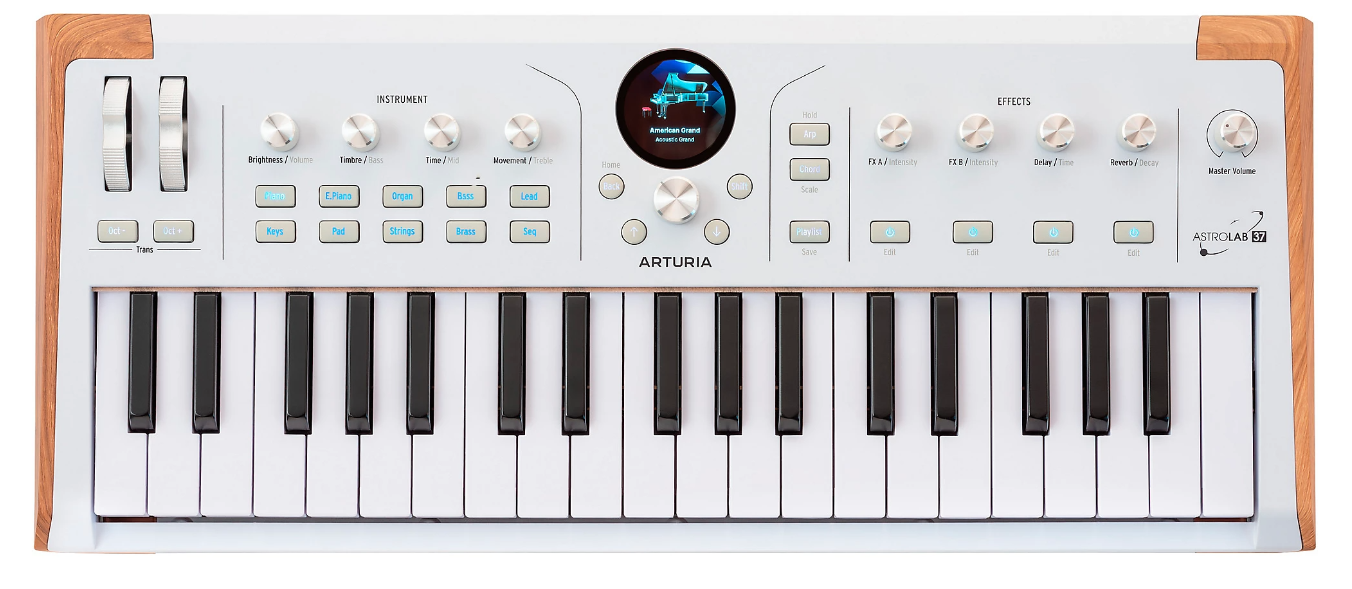
Putting a stage keyboard first on a psytrance list might seem unconventional, but what the AstroLab 37 offers is something no other instrument here can match: access to 11 different synthesis engines and over 1,800 presets from Arturia’s entire V Collection in a compact, standalone hardware format.
That means you have virtual analog, FM, wavetable, granular, physical modeling, phase distortion, vector synthesis, harmonic, and Karplus-Strong engines all running natively on the hardware without a laptop.
For Goa and psytrance production, the AstroLab 37 functions as a one-stop sound source that covers every role in the arrangement.
Acid leads from the Mini V engine, lush pads from the Jup-8 V, metallic FM stabs from the DX7 V, evolving textures from Pigments’ granular engine, all accessible from dedicated preset buttons and shaped in real time through four macro controls.
- Eleven Engines
The 11 synthesis engines running natively give you access to virtually every synthesis method that Goa and psytrance draws from. You’re not limited to one oscillator architecture or one tonal palette. Virtual analog handles the classic acid leads and supersaw pads. FM synthesis produces the metallic stabs and percussive textures.
Wavetable and granular engines create the evolving, morphing soundscapes that sit behind psy arrangements. Physical modeling adds the plucked, struck, and resonant textures that give variety to otherwise electronic productions. Having all of these in a single portable unit means you don’t need a rack of different synths to cover the genre’s sonic requirements.
- Macro Shaping
Four performance macro controls (Brightness, Timbre, Time, Movement) provide immediate, hands-on tonal manipulation across any loaded patch. For psytrance live performance and production, the macros let you sweep filters, shift timbral character, adjust envelope times, and control modulation depth in real time from dedicated hardware controls. You can assign macros to the specific parameters that matter most for your performance and recall those assignments as part of each preset.
- Preset Management
Playlists and favoriting let you organize 1,800+ presets into setlists, genre collections, or production session groups. For a psytrance live set where you need to move between acid leads, atmospheric pads, bass sounds, and effect textures quickly, the playlist system means you’re not scrolling through thousands of sounds mid-performance. The dedicated category buttons (Keys, Bass, Lead, Pad, etc.) provide instant filtering that gets you to the right sound type in a single press.
- Standalone Operation
The hardware runs independently without any computer connection required, which means you can perform and produce with the full V Collection engine set without the reliability concerns of a laptop running plugins. The synthesis engines are processed internally by the same CPU used in the larger AstroLab models. For live psytrance performance, the laptop-free operation removes the single biggest point of failure from your setup.
Get the Free Plugin Starter Kit
The genuinely useful free DAWs and plugins worth installing. No filler. Straight to your inbox.
2. Modal ARGON8
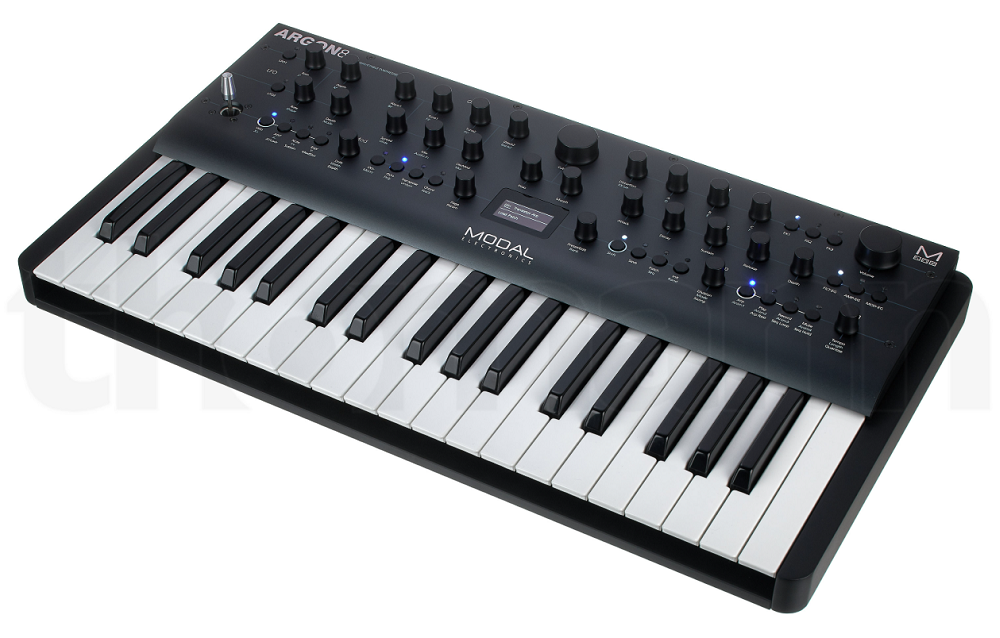
A wavetable polysynth with eight voices and a deeply modular modulation system that excels at the complex, evolving textures and aggressive lead sounds that psytrance demands.
ARGON8 uses virtual analog and wavetable oscillators with up to 120 digital wavetable sets and 24 static digital waveforms, processed through a morphable filter section that blends between low-pass, band-pass, and high-pass responses continuously.
What makes the ARGON8 particularly suited to psytrance is the morph-able everything approach. The oscillators morph between wavetables, the filter morphs between types, and the modulation system keeps everything moving. Static sounds are the enemy of psytrance, and the ARGON8 produces sounds that are constantly shifting and evolving.
- Wavetable Depth
120 wavetable sets with morphable oscillator waveforms provide an enormous palette of starting timbres that go far beyond basic analog waveforms.
Each of the four oscillators per voice (two standard plus two modifiers) can scan through wavetable positions continuously, creating timbral movement within sustained notes. For psytrance leads and pads, the wavetable scanning produces the harmonic evolution that keeps sounds interesting across extended arrangements.
- Modulation System
Eight assignable modulation slots with comprehensive source and destination routing, plus three LFOs and three envelopes with per-slot depth and polarity control. The modulation depth is what transforms basic wavetable patches into the living, breathing textures that psytrance needs. You can create patches where the filter morphs while the wavetable position scans while the amplitude trembles, all at different rates, producing sounds that evolve in complex, layered patterns without any manual intervention.
- Morphable Filter
A dual filter that morphs continuously between low-pass, band-pass, high-pass, and notch responses with resonance that remains musical across the full morph range.
For psytrance, the filter morphing means you can automate a single control and get timbral shifts that would require switching between different filter types on a conventional synth. The continuous morph produces smooth tonal transitions that suit the genre’s gradual build-up aesthetic.
- FX Engine
Three simultaneous effects with delay, reverb, chorus, flanger, tremolo, and distortion processed at the engine level. For psytrance, the built-in delay with tempo sync and the reverb with extensive tail control handle the spatial processing that the genre relies on without needing external effects units. The distortion is useful for pushing leads into more aggressive territory.
- Sequencer
A real-time and step sequencer with up to 512 steps and four recordable animation lanes captures knob movements alongside note data. For psytrance, the sequencer’s animation lanes let you record filter sweeps, wavetable position changes, and modulation depth shifts directly into your sequences, creating evolving, automated patterns that play back with your melodic content.
- MPE Support
MPE (MIDI Polyphonic Expression) compatibility provides per-note expression from MPE controllers, meaning each note in a chord can have independent pitch bend, slide, and pressure.
For psytrance performance, MPE adds an expressive dimension to pad and lead playing that standard MIDI controllers don’t provide, allowing individual note manipulation within sustained chords that brings static harmonies to life.
3. Arturia MicroFreak
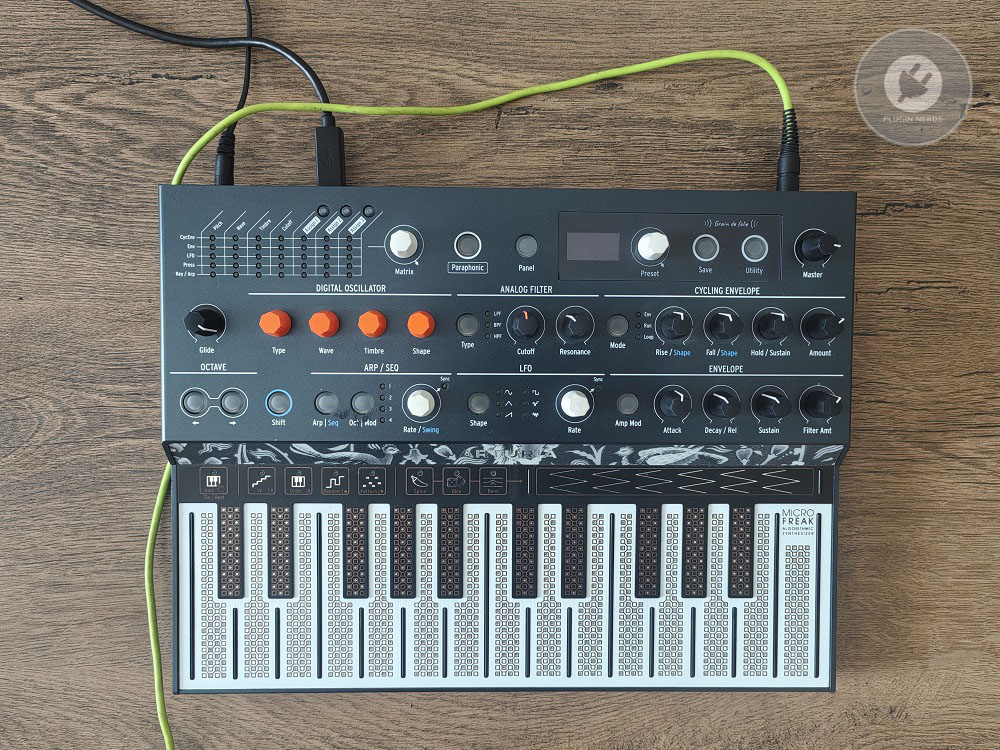
Compact, affordable, and packed with enough synthesis variety to cover most of what Goa and psytrance production requires from a single instrument.
Arturia MicroFreak gives you multiple digital oscillator engines routed through a real analog Steiner-Parker filter, which is a combination that produces everything from acid-style resonant leads to granular atmospheric textures to harsh digital noise depending on which engine you load.
The MicroFreak makes this list because it offers the widest range of timbral possibilities at the lowest cost of any hardware on this list, which matters for psytrance producers who need variety across an arrangement without buying five separate synths.
- Engine Range
Over a dozen synthesis engines covering virtual analog, wavetable, FM, Karplus-Strong, modal, granular, and noise provide the timbral vocabulary that psytrance production draws from.
You can switch between a resonant acid lead from the virtual analog engine, an evolving granular texture for atmospheric layers, and a metallic FM stab for rhythmic accents all within the same instrument. The engine range means one MicroFreak handles multiple roles in a psytrance arrangement.
- Analog Filter
The real Steiner-Parker analog filter adds the resonant, squelchy, aggressive character that psytrance leads need to cut through a dense mix.
The filter’s resonance behavior at high settings produces the specific screaming, acid-tinged quality that defines many classic psytrance lead sounds. The analog circuit’s nonlinear saturation makes filter sweeps feel fat and musical rather than thin and digital.
- Sequence Randomization
The Spice and Dice randomization applied to the sequencer creates controlled variation that keeps patterns evolving over time.
For psytrance, where loops need to sustain interest across extended sections, the randomization prevents the repetitiveness that static sequences inevitably develop. You set boundaries for pitch, velocity, and gate variation, and the sequencer introduces chaos within those limits.
4. Behringer Neutron
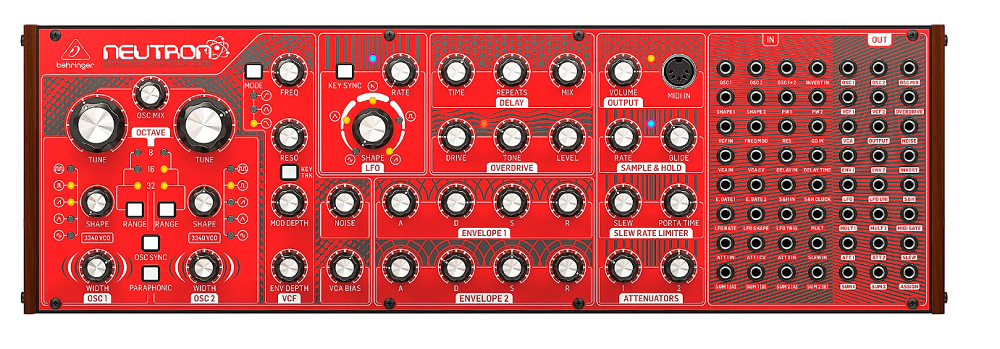
A semi-modular analog synthesizer that produces some of the most aggressive, raw, and acidic tones available at any price, let alone at the Neutron’s remarkably affordable cost.
Behringer Neutron gives you two analog oscillators, a multimode filter with overdrive, and a 56-point patch bay that lets you rewire the entire signal path for experimental sound design and extreme timbral manipulation.
For psytrance specifically, the Neutron’s strength is the aggressive, in-your-face analog character combined with the patch bay’s ability to create feedback loops, cross-modulation paths, and signal routing configurations that produce sounds you couldn’t get from any preset-based synth.
- Patch Bay
The 56-point patch bay provides extensive modulation routing, signal path overrides, and feedback loop capability. For psytrance, the patch bay is where you create the screaming, evolving, acid-drenched lead sounds that define the genre’s more aggressive side.
Routing the filter output back into the oscillator input creates feedback-driven tones. Cross-modulating the oscillators at audio rate produces metallic harmonics. The patch bay turns the Neutron from a standard monosynth into an experimental sound design tool capable of textures that preset synths can’t touch.
- Overdrive Circuit
Built-in analog overdrive in the filter section pushes sounds from clean into aggressive, saturated territory. For psytrance leads, the overdrive adds the harmonic density and edge that helps lead sounds cut through a full arrangement with bass, kick, and atmospheric layers competing for space. The continuous overdrive control lets you dial in exactly the right amount of aggression.
- Dual Oscillators
Two analog VCOs with multiple waveforms, hard sync, and tone modulation provide the raw harmonic content. The oscillators track well enough for melodic playing while also being capable of the detuned, aggressive tones that psytrance leads use. Hard sync between the oscillators produces the sharp, harmonically bright sweep sounds that add intensity to builds and transitions.
- BBD Delay
An integrated bucket-brigade analog delay adds spatial depth with the specific warmth and degradation character that analog delays provide. For psytrance, the BBD delay with feedback pushed high creates rising, self-oscillating pitch spirals that are a staple of the genre’s transition effects and build-up textures.
5. Arturia MiniFreak
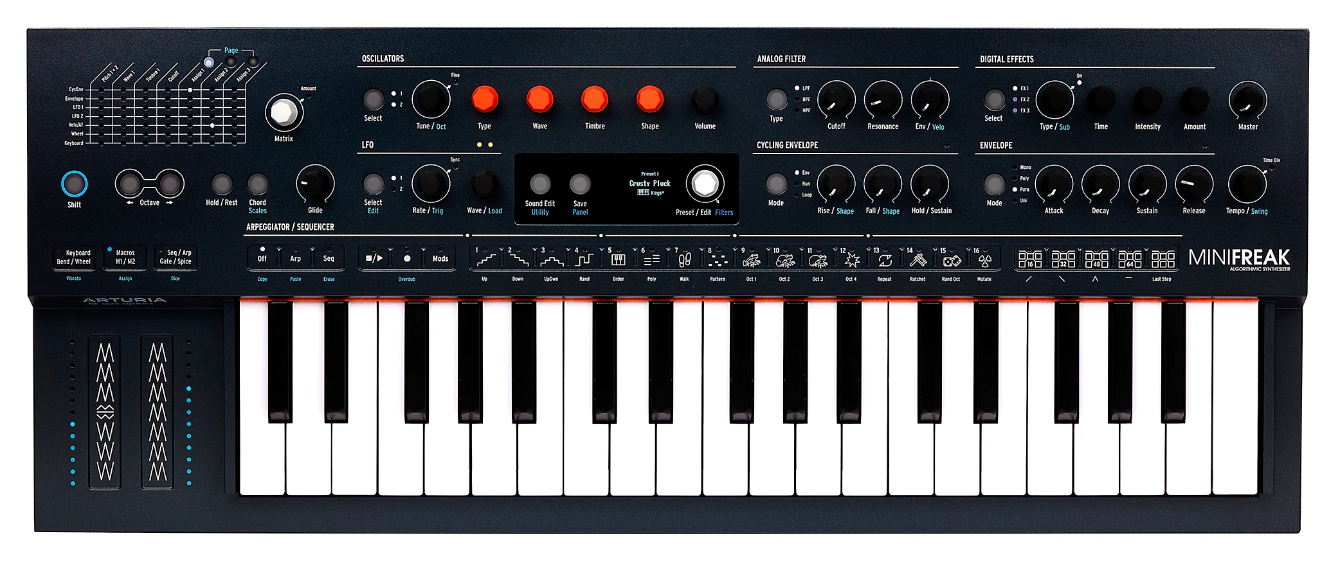
The polyphonic big sibling of the MicroFreak, with six voices, built-in effects, and the same hybrid digital/analog architecture scaled up for more complex parts.
Arturia MiniFreak gives you everything the MicroFreak does but with proper polyphony for pads and chords, a 37-note velocity-sensitive keyboard with aftertouch, and three simultaneous effects that let you create finished, processed sounds within the synth itself.
For Goa and psytrance, the MiniFreak fills the role that the MicroFreak can’t: polyphonic pads, evolving chord textures, and layered atmospheric washes that require multiple simultaneous notes sustained through effects processing.
- Polyphonic Pads
Six-voice polyphony (or twelve voices in paraphonic mode) lets you play full chords and sustained pads that the monophonic MicroFreak can’t produce. For psytrance, the polyphonic capability handles the wide, evolving pad layers that sit behind the leads and bass providing atmospheric depth.
The pads benefit from the same diverse engine selection as the MicroFreak, meaning your atmospheric layers can use granular, wavetable, or modal synthesis for textures that standard analog pads don’t reach.
- Effects Processing
Three simultaneous effect slots with chorus, delay, reverb, phaser, flanger, and distortion process the sound within the synth.
For psytrance, the effects are essential because the genre’s characteristic wide, spatial, processed textures require reverb and delay as fundamental parts of the sound rather than afterthoughts. Saving patches with their effects processing included means your psytrance pad presets recall with the full spatial character intact.
- Aftertouch Control
Velocity-sensitive keys with aftertouch provide real-time expressive control over filter, modulation depth, and other parameters while playing. For psytrance performance, pressing harder into a sustained pad chord to gradually open the filter or introduce vibrato creates the kind of evolving, responsive timbral shifts that make live-played pads feel more musical than static, automated sweeps.
Get the Free Plugin Starter Kit
The genuinely useful free DAWs and plugins worth installing. No filler. Straight to your inbox.

Hello, I’m Viliam, I started this audio plugin focused blog to keep you updated on the latest trends, news and everything plugin related. I’ll put the most emphasis on the topics covering best VST, AU and AAX plugins. If you find some great plugin suggestions for us to include on our site, feel free to let me know, so I can take a look!