
Two brands that keep coming up in serious plugin discussions are IK Multimedia and Universal Audio. They’ve both been around long enough to build deep catalogs and loyal followings, and they’ve both made analog emulation a central part of their identity. But the way each brand approaches that goal, what they charge for it, and who they’re really built for are genuinely different stories.
They occupy different spaces in the plugin world, and the right choice depends heavily on what you produce, how you work, and what you already own. I’ve spent time with both and I want to give you the real picture, not just a feature list side by side.
Quick Comparison
| Feature | IK Multimedia | UAD (Universal Audio) |
|---|---|---|
| Core Identity | Broad production ecosystem, guitar-centric, mastering | Premium vintage hardware emulation |
| Flagship Effects Suite | T-RackS 6 | 200+ plugin catalog; Spark subscription |
| Amp Simulation | AmpliTube 5, TONEX (AI capture) | OX Amp Top Box (hardware), Paradise Studio (plugin) |
| Subscription Option | Group Buy / bundles (perpetual-focused) | UAD Spark: $19.99/month or $149.99/year |
| Perpetual Licenses | Yes (primary model) | Yes (individual plugins, hardware bundles) |
| Hardware Required | No (optional iRig/AXE I/O for guitar) | No for Spark/native; Apollo for DSP + zero-latency tracking |
| Analog Modeling Approach | DSM (Dynamic Saturation Modeling), VIR, physical modeling | Deep circuit-level emulation, DSP + Neural Networks |
| Instruments Available | SampleTank 4, Syntronik 2, Hammond B-3X, MODO Bass/Drum | Opal Synth, Waterfall B3, Electra 88, Ravel Grand Piano, PolyMAX |
| Room Correction | ARC System 3 (with mic measurement) | Not available |
| Free Trial | T-RackS CS free tier; AmpliTube CS free | 14-day Spark trial; try-before-buy on DSP hardware |
| Entry Price | Free (Custom Shop tiers for both T-RackS and AmpliTube) | $19.99/month (Spark); individual plugins from $29 |
| Genre Fit | Guitar music, rock, metal, pop, lo-fi, mastering | All genres, especially mixing/mastering at professional level |
| Learning Curve | Moderate (AmpliTube deep; T-RackS approachable) | Low to moderate (skeuomorphic UIs closely mirror hardware) |
Sound Character
The most honest way I can frame this: IK Multimedia and UAD don’t sound the same, and they’re not trying to. They each have a distinct character that shapes what you reach for depending on what the track needs.
- IK Multimedia’s Sound
IK’s sound character tends to be full, warm, and well-suited to the kind of saturation and harmonic coloration that makes guitar and bass recordings feel alive. The T-RackS processors lean toward musical warmth over clinical accuracy, and the processing often adds a pleasing density to audio that works beautifully on rock, metal, folk, and any music where organic texture matters.
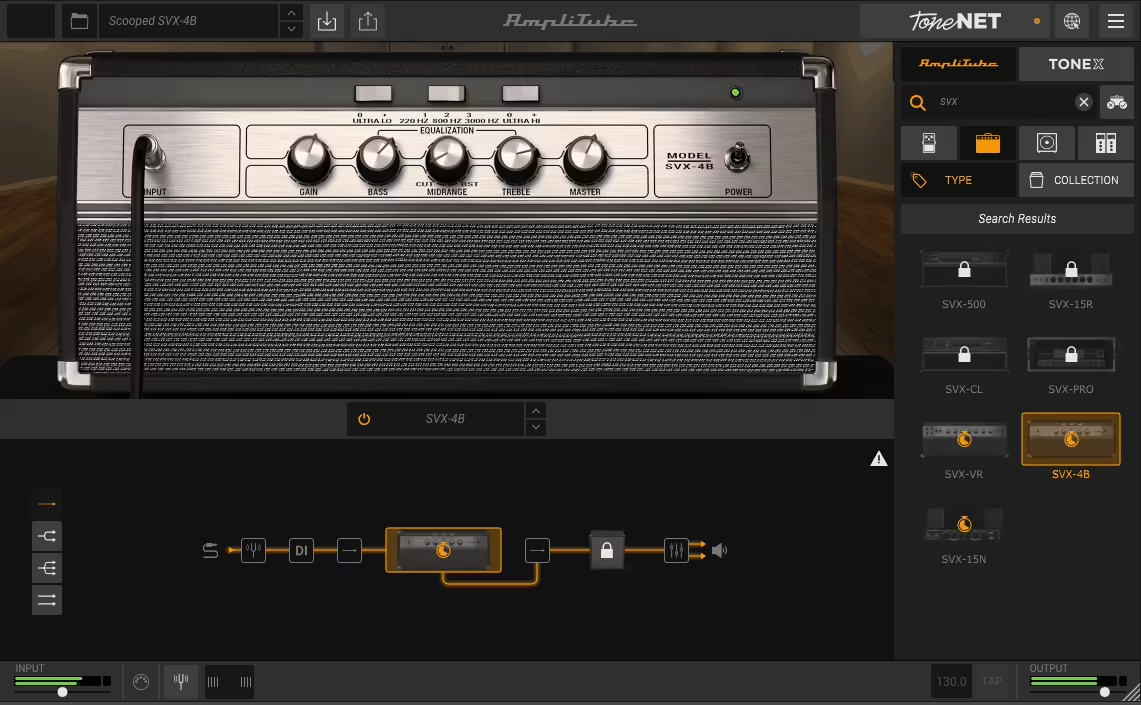
The guitar amp simulations in AmpliTube have improved significantly in recent years with technologies like VIR (Volumetric Impulse Response), which captures mic placement in a genuinely three-dimensional way using up to 600 impulse responses per speaker.
I believe the most significant step IK has made recently is TONEX, which takes a fundamentally different approach by using AI to capture the actual nonlinear behavior of real amplifiers rather than modeling them from circuit analysis. The results on well-captured amps are often remarkably convincing and have earned TONEX a serious following in the guitar community.
- UAD’s Sound Character
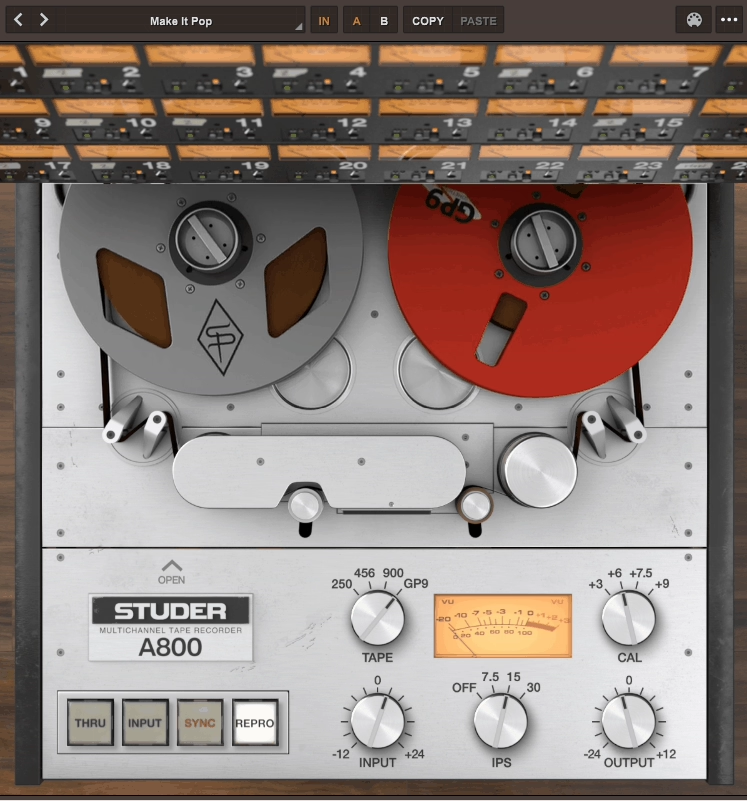
UAD’s reputation for the past two decades has been built on one thing: analog emulation that feels like the real hardware. The 1176 limiter collection, the LA-2A leveler, the Pultec EQ collection, the Neve 1073 preamp and EQ, the SSL G Bus Compressor, the Studer A800 tape machine, and others are widely considered the reference-level software implementations of those specific pieces of hardware, and engineers who have worked with the originals often describe UAD’s versions as the most convincing they’ve used.
The sonic character isn’t one-size-fits-all: UAD’s catalog spans the warm and punchy character of the 1176, the transparent musical glue of the Pultec, the aggressive clarity of the SSL console, and the lush smoothness of Lexicon reverb. What unifies all of it is a commitment to capturing the physical behavior of the original circuits in a way that makes decisions about processing feel intuitive rather than technical.
Effect Plugins Overview
- IK Multimedia Effects
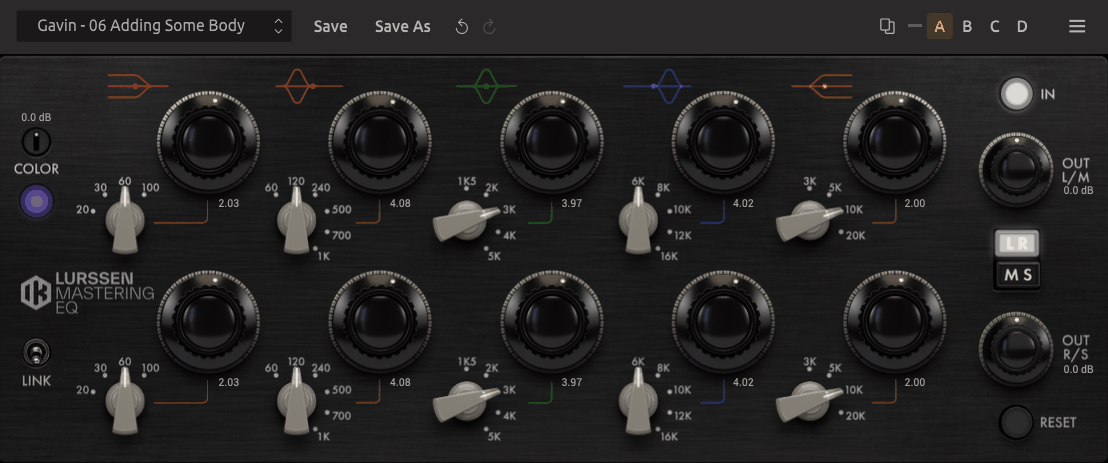
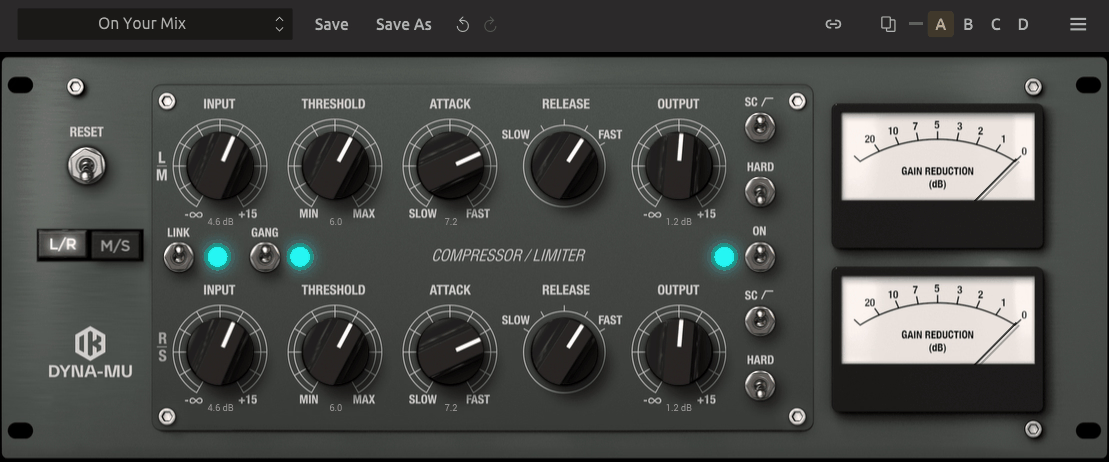
T-RackS 6 is IK’s primary effects vehicle for mixing and mastering, covering EQs including the EQ-73 (Neve 1073 style), EQ-81 (Neve 1081 style), EQ 550, and Lurssen Mastering EQ; compressors including the Bus Compressor, Dyna-Mu (Fairchild/Vari-Mu style), and White 2A (LA-2A optical compression style); tape machines including the Tape Machine 99 and Tape Echo; and dozens of additional mastering processors including limiters, stereo enhancers, and harmonic saturators.
Mixbox bundles over 70 IK processors into a single 500-series-style plugin host, pulling from T-RackS, AmpliTube, and SampleTank processing into one interface. For producers who want a single plugin with a wide variety of processing tools in a streamlined workflow, Mixbox is a practical and underrated option.
- UAD Effects
UAD’s effects catalog is where the brand has built its legend. The 1176 Classic Limiter Collection includes three distinct revisions of the hardware (Rev A Blue Stripe, Rev E Blackface, AE Anniversary Edition) with genuinely different sonic characters between them. The Teletronix LA-2A Leveler Collection covers the original Silver and later Grey panels. The Pultec Passive EQ Collection covers the EQP-1A, MEQ-5, and HLF-3C.
Beyond those flagships, UAD has the Neve 1073 Preamp and EQ, the SSL 4000 G Bus Compressor, the Fairchild 670, the Manley Variable MU, the Empirical Labs Distressor, the Lexicon 480L and 224 reverbs, the Capitol Chambers room reverb, the Studer A800 tape machine, and many others spanning virtually every piece of classic studio hardware worth emulating.
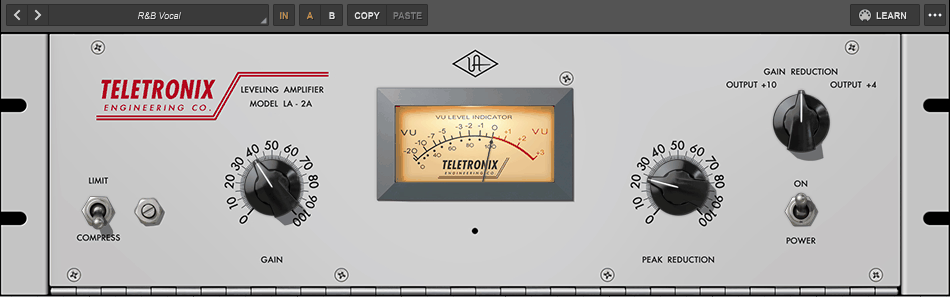
The breadth and depth of UAD’s effects catalog is simply unmatched in the plugin world. The difference between UAD and most competitors isn’t just about sound quality, it’s about the specificity of the emulations and the level of obsessive accuracy applied to each one.
Instrument and Amp Simulation Plugins
- IK Multimedia Instruments and Guitar Tools
IK’s instrument lineup is genuinely comprehensive. SampleTank covers orchestral, acoustic, electronic, and hybrid sounds across thousands of samples with a deep editing engine. Syntronik 2 emulates classic hardware synthesizers including the Moog Minimoog, ARP Odyssey, Sequential Prophet-5, and many others. Hammond B-3X is an extremely detailed physical model of the tonewheel organ that also integrates the Leslie speaker cabinet simulation.
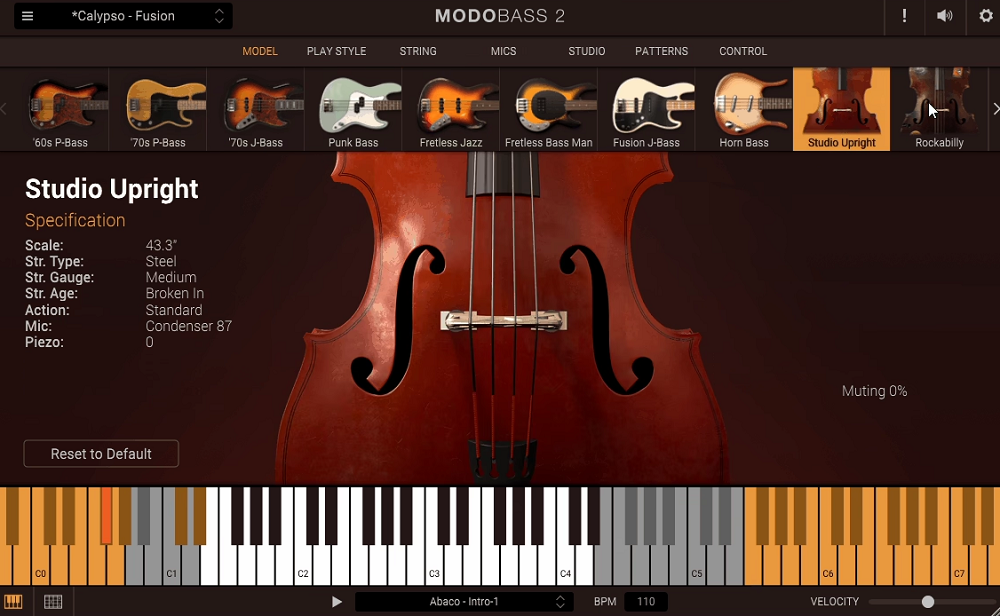
MODO Bass 2 uses physical modeling rather than samples to recreate the actual mechanical behavior of a bass instrument with controllable string type, pickup position, playing style, and technique. MODO Drum applies the same physical modeling approach to acoustic drum kits.
For guitar specifically, AmpliTube 5 MAX includes over 400 amp models, cabs, mics, and effects, covering officially certified partnerships with Mesa/Boogie, Fender, Marshall, ENGL, Orange, and others. The signal chain is fully drag-and-drop, and the mixer window allows multi-mic blending with up to 23 T-RackS-derived rack effects. TONEX adds a separate AI-powered capture system that has already developed a large community of shared amp profiles.
- UAD Instruments and Guitar Tools
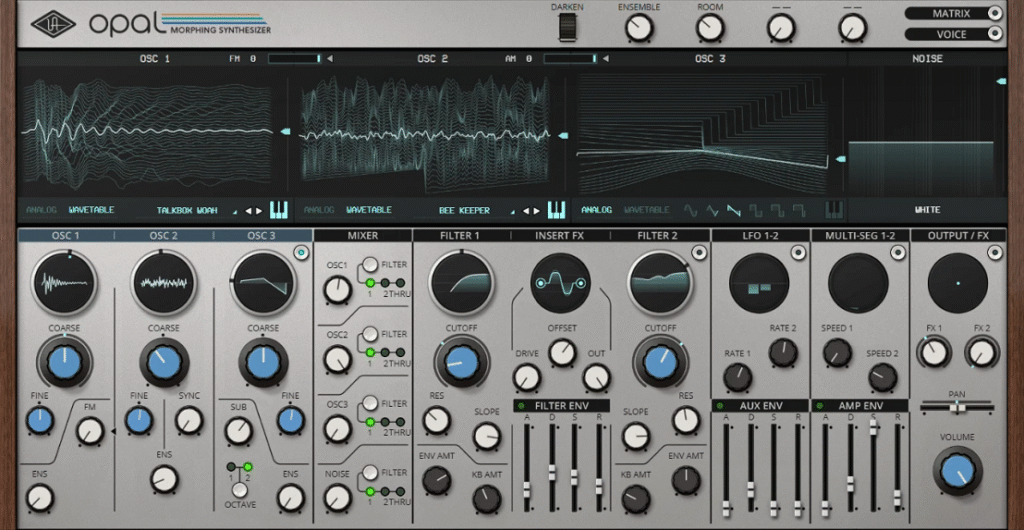
UAD’s instrument offerings are smaller in quantity but high in quality. The Opal Morphing Synthesizer is a wavetable and analog hybrid with three oscillators, 91 wavetables, morphing filters, and 12-voice unison, and it’s exclusive to the Spark subscription as a new original instrument rather than a hardware emulation.
Waterfall B3 is UAD’s tonewheel organ emulation while Electra 88 covers the classic electric piano territory with deep sampling and vintage effect chains.

Ravel Grand Piano is a deeply sampled concert grand. PolyMAX Synth is a polysynth with a wide preset library.
For guitar and amp simulation specifically, UAD takes a different approach than IK: their main guitar-focused product is the OX Amp Top Box, a hardware amp attenuator and reactive load that captures the character of real amp speakers, and the Paradise Guitar Studio plugin, which covers amp and effect modeling. UAD doesn’t have anything that competes directly with AmpliTube’s breadth or TONEX’s AI capture system in the software-only guitar space.
Hardware Integration and DSP Requirements
- IK Multimedia Hardware
IK makes hardware primarily for guitar players: the AXE I/O and AXE I/O Solo are audio interfaces with dedicated Hi-Z guitar inputs designed to integrate tightly with AmpliTube 5. The iRig series covers mobile guitar interfaces for iOS and Android. The ARC System 3 requires a measurement microphone to calibrate your room acoustics. None of IK’s plugins require IK hardware to run, and all of them work as standard VST/AU/AAX plugins on any compatible system without additional hardware.
- UAD Hardware
The UAD hardware story is central to the brand’s identity in a way that has no equivalent at IK. The Apollo interface family ranges from the compact Apollo Solo to the rack-mounted Apollo x16, with each device containing dedicated SHARC DSP chips that process UAD plugins in real time. The primary advantage is Unison technology: when you load a UAD preamp plugin into a Unison slot on an Apollo, the interface physically changes the input impedance of its preamp circuit to match the hardware being modeled, which affects how your microphone and instrument interact with the preamp in a way native software cannot replicate.
For producers who work in fully in-the-box environments without tracking live instruments, UAD Spark on a capable CPU now provides the same sonic results as DSP-based processing without any hardware. For engineers who need to track multiple live sources through processed signals with zero latency, the Apollo hardware remains genuinely irreplaceable.
Analog Modeling Approach
- IK Multimedia’s Modeling Technology
IK uses several distinct technologies depending on the plugin. For guitar amp simulation, AmpliTube 5 employs Dynamic Interaction Modeling (DIM) to capture how real amplifier components interact with each other and with the input signal, alongside VIR for cabinet simulation.
TONEX takes a completely different path using AI-based non-linear capture that doesn’t require circuit analysis at all: you play audio through a real amp and the AI learns its behavior from the input-output relationship. This produces results that can be strikingly accurate on high-gain amps where traditional modeling struggles.
For effects and mastering processing in T-RackS, IK uses circuit modeling approaches for specific hardware emulations alongside more general processing for tools that aren’t direct hardware clones. The quality across the T-RackS range is variable: some processors like the Neve-style EQs and the Dyna-Mu compressor are genuinely excellent, while others function more as general-purpose tools with a particular character rather than precise hardware emulations.
- UAD’s Modeling Technology
UAD’s approach is circuit-level emulation taken as far as the engineering team can push it. The goal with every hardware emulation in the catalog is to model the specific behavior of that piece of equipment down to the interaction of individual circuit components, transformer characteristics, tube saturation curves, tape oxide formulations, and the subtle physical imperfections that give vintage hardware its character.
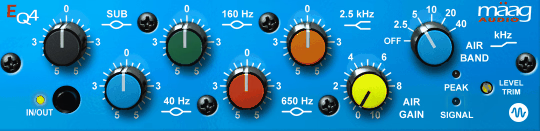
For the Spark subscription, UAD has also introduced Waves Neural Networks technology and partners with developers like Brainworx to expand the catalog. The 2025 update to the Maag EQ4 MS introduced TMT (Tolerance Modeling Technology) by Brainworx, which captures the natural channel-to-channel variations in the actual hardware to create a more realistic stereo response. This level of detail is characteristic of how UAD approaches emulation broadly.
Bundle Options and Pricing
- IK Multimedia Pricing
IK Multimedia’s pricing structure is centered on perpetual licenses with periodic deep discounts. Both T-RackS and AmpliTube have free Custom Shop tiers that provide a functional starting point with a subset of processors at no cost. From there, you can buy individual processors or upgrade to full suites: AmpliTube 5 SE at $149, AmpliTube 5 at $199, and AmpliTube 5 MAX at $399 covering over 400 models. T-RackS 6 Pro gives you a comprehensive mastering and mixing suite. The Total Studio bundles combine multiple IK product lines at significant discounts.
The Group Buy program is IK’s most distinctive pricing mechanism.
During active promotions, existing customers earn free plugins by referring new buyers, and the rewards scale with participation. Some Group Buys have delivered several hundred dollars worth of plugins for free to active participants. This model rewards the IK community and has made the brand’s comprehensive ecosystem genuinely accessible to budget-conscious producers who are willing to engage with the program.
- UAD Pricing
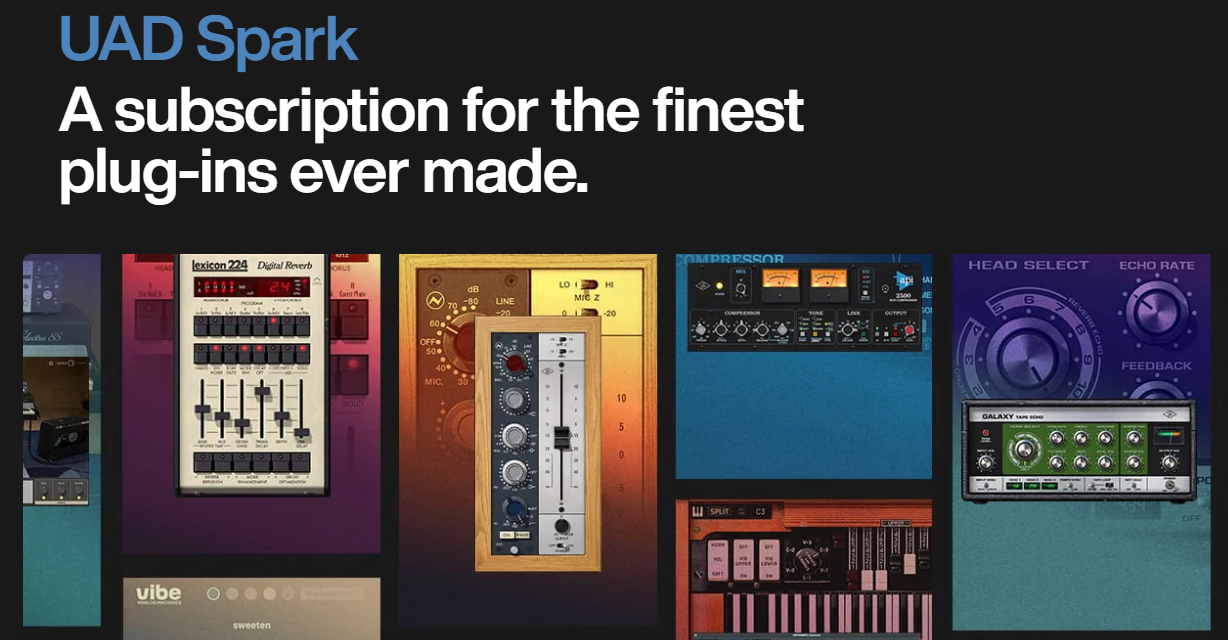
UAD operates two main pricing paths: the Spark subscription and perpetual individual plugin licenses. Spark at $19.99 per month or $149.99 per year gives you access to the full Spark catalog of 60+ plugins without hardware. Individual perpetual plugin licenses range from around $29 on sale to over $200 at full price for flagship emulations, and UAD runs frequent sales including a current promotion offering annual Spark access for as low as $79.
For existing Apollo hardware owners, perpetual UAD-2 licenses automatically include the native UADx versions for Spark-compatible plugins at no additional cost, which is a genuinely good deal for long-term UAD users who want to switch between DSP and native processing across different systems.
Subscription vs Perpetual Licensing
- IK Multimedia: Perpetual-First
IK Multimedia has not moved to a subscription model as its primary offering. You buy plugins and own them. The Group Buy structure creates a community-driven alternative that functions somewhat like a subscription in terms of ongoing engagement, but the licenses you earn are yours permanently. For engineers and producers who dislike the idea of losing access to tools if they stop paying, IK’s model is significantly more future-proof.
I appreciate this approach because it respects the long-term relationship between a musician and their tools. A plugin you owned five years ago still works five years from now without any monthly obligation.
- UAD: Both Paths Available
UAD now offers genuine choice between subscription access through Spark and permanent ownership through individual plugin purchases. The Spark model is excellent value if you want broad access to a curated selection of their best plugins without wanting to evaluate and purchase dozens of individual tools.
The perpetual path rewards careful selection: owning the specific compressors and EQs you reach for daily as permanent licenses is a financially sound long-term strategy for engineers who know exactly which UAD tools they use on every session.
For hardware Apollo owners, the economics of UAD have always been a consideration: the upfront cost of hardware plus plugin licenses is a meaningful investment, and the fact that Spark now provides an alternative entry point significantly lowers the barrier to experiencing UAD quality.
Genre Fit
- IK Multimedia
IK’s genre strengths are particularly evident in guitar-centric music. Rock, metal, blues, country, and indie productions that center on guitar tones benefit enormously from AmpliTube 5’s library of officially licensed amp models, particularly the Mesa/Boogie collection for high-gain applications and the Fender and Marshall models for cleaner territory.
The TONEX community has built an extensive library of captured amps spanning everything from boutique single-coils to high-gain monsters, and the results on specific amps can be striking.
T-RackS also serves the pop, R&B, and lo-fi production communities well, particularly for mastering, where the overall approach is musical and forgiving rather than hyper-precise. The physical modeling of MODO Bass and MODO Drum works across virtually any genre where realistic but programmable rhythm section sounds are needed.
- UAD
UAD’s broad depth makes it relevant in virtually every genre at a professional level. The compressor and EQ collection covers the classic signal chains used on virtually every major recorded genre from the 1960s through today. The tape machine emulations are useful on everything from indie to hip-hop to classical. The reverb library, including the Lexicon 480L and 224 and the Capitol Chambers room simulation, covers spaces from intimate rooms to large concert halls.
For mixing engineers specifically, UAD’s library is arguably the most comprehensive professionally relevant toolkit available, covering every key processor in the classic studio chain with a quality of emulation that holds up in professional contexts.
Learning Curve
- IK Multimedia
T-RackS and Mixbox are reasonably approachable: the individual processors are clearly labeled, the controls are accessible, and the mastering chain metaphor makes it intuitive to build a signal path from scratch. AmpliTube 5’s depth is where the learning curve steepens noticeably.
The drag-and-drop signal chain is powerful but navigating hundreds of amp models, cabs, mics, and effects and understanding how they interact takes genuine time investment. TONEX is actually one of the simpler tools in IK’s lineup to use: load a capture, adjust the input, play.
The breadth of the IK ecosystem can also feel overwhelming at first. A new user confronted with T-RackS, AmpliTube, SampleTank, Syntronik, MODO Bass, MODO Drum, and ARC simultaneously faces a steep orientation period before everything clicks into place.

- UAD
UAD’s skeuomorphic interface design is one of the most polarizing aspects of the brand. Each plugin looks like a photo-realistic recreation of the hardware it models, which means the knob layouts and control names often don’t follow modern software conventions. For engineers who have used the actual hardware, this is instantly familiar and reassuring. For producers coming from a purely software background, it can feel confusing at first.
Once you understand the philosophy, though, working with UAD plugins teaches you how the hardware actually behaves, which is a genuine educational benefit. I found that spending time with the Pultec EQ in UAD form gave me a much clearer understanding of how shelf-based passive equalization actually sounds than any more modern interface could have. That’s the upside of the skeumorphic approach done well.
Trials and Demo
- IK Multimedia Trials
IK makes both T-RackS and AmpliTube available through fully functional Custom Shop (CS) versions that are free to download and use indefinitely. The CS versions include a limited but functional set of processors: AmpliTube CS ships with 39 models and T-RackS CS includes a core set of processors that covers basic mixing and mastering tasks. This is a genuinely useful way to evaluate IK’s interface and workflow without spending anything.
- UAD Trials
UAD offers a 14-day free trial of Spark with no purchase required, and Volt interface owners get a full free month. For hardware owners, UAD has long offered a try-before-you-buy system where every plugin in the full catalog can be auditioned in sessions using DSP hardware before purchasing, with a time-limited trial that requires no additional commitment.
This system is one of the better evaluation tools in the plugin industry: you can load any UAD plugin into a real session, hear what it does on your actual material, and make a purchasing decision based on that experience rather than demos or marketing language.
Which Brand Offers Better Value?
The value question is where personal workflow and priorities make the biggest difference, and I’d say both brands offer compelling value in ways that the other doesn’t.
- IK Multimedia’s Value Case
IK Multimedia gives you one of the most comprehensive production ecosystems available at genuinely accessible pricing, particularly through Group Buys and bundles. The range from guitar amp simulation to physical modeling instruments to room acoustic correction under a single brand with interconnected tools is hard to match. If you produce guitar-centric music and want mastering tools alongside your amp sim without juggling multiple brand ecosystems, IK’s all-in-one breadth is a real advantage.
The perpetual license model also means your investment compounds over time without recurring costs, and the free Custom Shop entry points let you evaluate the tools before spending anything. For the independent producer building a studio toolkit on a controlled budget, IK offers more plug-in coverage per dollar than almost any comparable professional brand.
- UAD’s Value Case
UAD’s value case is harder to quantify precisely but easier to feel when you’re actually working. The compressor and EQ collection represents something close to the definitive software versions of hardware that engineers have been reaching for since the 1960s, and having access to those tools in a session changes the quality of processing decisions you make. Spark at $149.99 per year gives you 60+ of these tools, and the per-month cost to access the full collection is lower than purchasing even two or three comparable perpetual licenses from other premium brands.
The Apollo hardware adds a dimension of value that has no equivalent elsewhere: real-time tracking through Unison-enabled preamp and compressor emulations with zero latency is an experience that genuinely affects how you record and how your recordings sound. For studios that track live instruments, the hardware investment pays for itself in ways that are difficult to replicate with any software-only solution.

Hello, I’m Viliam, I started this audio plugin focused blog to keep you updated on the latest trends, news and everything plugin related. I’ll put the most emphasis on the topics covering best VST, AU and AAX plugins. If you find some great plugin suggestions for us to include on our site, feel free to let me know, so I can take a look!