
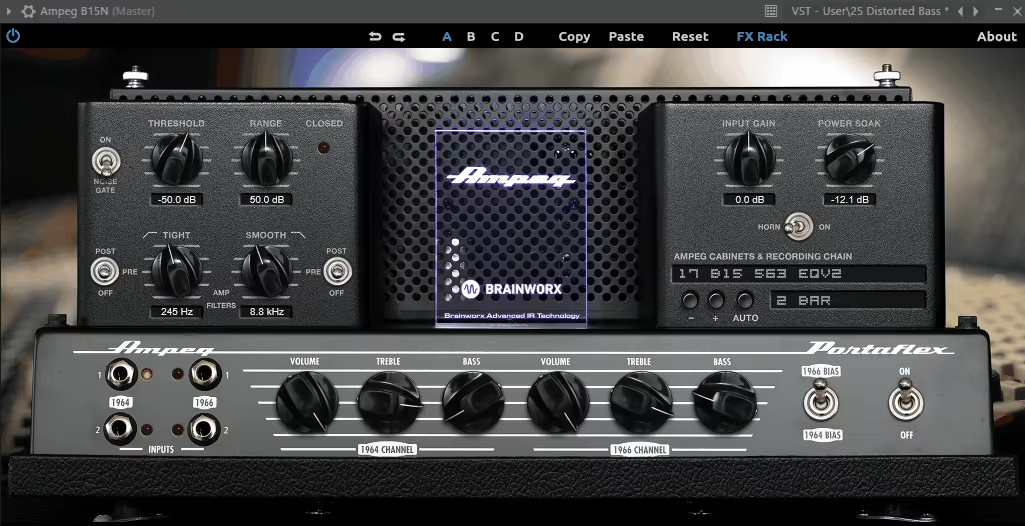
If you’ve ever tracked bass through a real Ampeg B-15N, you already know what that amp does to a signal. There’s a warmth, a roundness, and a certain kind of vintage weight that’s hard to put into words and even harder to replicate. The fact that only 250 Heritage B-15N hardware units were ever built makes it one of the most exclusive pieces of bass gear in existence, which means most of us will never get our hands on one. That’s where Brainworx comes in.
I think what makes this plugin worth talking about is the sheer level of detail that went into building it. Brainworx didn’t just slap a “B-15N” label on a generic bass amp sim. They modeled the actual circuitry, replicated the dual 6L6-powered tube topology, and gave you access to both the 1964 and 1966 Heritage operating modes, each with its own feel and character. For bass players and producers who care about authenticity, that actually matters.
I’d say this is absolutely worth it if your workflow lives in the vintage-to-warm-modern zone. It’s not trying to be everything to everyone, and that focus is exactly why it works so well. If you’re recording R&B, funk, soul, Motown-influenced music, or even indie rock bass parts where you want some real texture underneath the notes, this delivers in a way that a lot of broader amp sims simply can’t touch.
Two Amps in One
The real starting point with this plugin is choosing which era you’re working from. The 1964 mode runs a 25-watt cathode-biased circuit, and I mean this in the most musical sense possible: it feels soft and organic. When you play softly, it stays clean and pillowy.
When you dig in a little, it gives back with this gentle, natural compression that just sounds right. I found it perfect for soul and jazz-influenced bass tracks where you want the note to breathe.
The 1966 mode steps it up to 30 watts on a fixed-bias circuit, and the difference is immediately noticeable. There’s more headroom here, more midrange presence, and a sense of authority that the ’64 doesn’t quite have. For me, the 1966 is where I go when the bass needs to cut through a denser arrangement or when you want that slightly more assertive, growling low end that drives a funk groove. Both modes also include switchable bias controls that let you tweak the character further without fully committing to one sound, which is a detail I really appreciate.
The Baxandall EQ on each channel is simple by design, but it’s the right kind of simple. Bass and treble controls that interact the way they do on the real amp, musical and smooth rather than surgical.
Get the Free Plugin Starter Kit
The genuinely useful free DAWs and plugins worth installing. No filler. Straight to your inbox.
The Recording Chain Setup
Here’s where Brainworx did something that I think is genuinely smart. Rather than giving you a collection of adjustable mic placements that could send you down a rabbit hole, they captured 42 complete recording chains using their Neve VXS 72 console. What you get is a set of fully-cooked, production-ready cabinet and mic combinations that you can just scroll through and pick.
You’re working with four different cabinets, including the original matching Ampeg 1×15″ speaker along with an 8×10″, a 4×10″, and an additional 1×15″ option. Each cabinet has been captured with multiple mic positions, and about half of the presets feature that original Ampeg cab which is, unsurprisingly, where the most authentic vintage character lives. I noticed that the chains recorded flat versus those captured with some desk EQ baked in have noticeably different characters, and having both options available gives you real flexibility without adding decision fatigue.
The tradeoff here is that you can’t swap in your own IRs. The cabinets are fixed. For some users, that’s a dealbreaker, but I’d argue most people picking up this particular plugin aren’t looking for that level of modularity. They want the B-15N sound, and the included chains deliver it extremely well.
Here’s a quick breakdown of what the recording chain section offers:
- 42 preset recording chains captured on a Neve VXS 72 console
- Four cabinets: original Ampeg 1×15″, 8×10″, 4×10″, and an alternative 1×15″
- Multiple mic options including classic dynamic and condenser placements
- Flat and desk-EQ versions of each chain for clean or colored starting points
- Immediate A/B browsing so you can flip through options quickly
The FX Rack and How to Actually Use It
The built-in FX Rack is where you do your cleanup and shaping work, and I think a lot of people overlook it because the amp controls are the flashier part of the interface. But I’d actually recommend spending time here because it makes a real difference to how the plugin sits in a mix.
You get a Noise Gate with a Range control, which is genuinely useful for keeping DI bass tracks clean, especially if you’re dealing with any hum or pickup noise. The high-pass filter (labeled “Tight”) and low-pass filter (labeled “Smooth”) each have independent Pre and Post switching, meaning you can use them to clean up the input signal before it hits the amp or tame the output after. I found running a gentle high-pass in pre mode helped the amp respond more consistently, which is a workflow tip worth trying if you haven’t.
The Input Gain before the preamp stage gives you control over how hard you’re driving the circuit, and combined with the Power Soak on the output side, you have a pretty expressive amount of control over where the saturation and breakup happen.
It’s not going to give you aggressive, hairy distortion. That’s not what the B-15N does. But you can coax out a very satisfying, harmonically rich warmth that has a lot of personality without becoming harsh.
Sound and Fit in a Real Mix
I want to note something that came up consistently in how I tested this: the Brainworx Ampeg B-15N has a way of locking a bass part into a mix almost automatically. I realized that with a lot of amp sims, you dial in a sound that sounds great in isolation and then spend time wrestling with it in context. This one tends to behave differently. The fundamental note sits with real weight, and the way the upper harmonics are shaped means it rarely fights with the midrange of guitars or keys.
For Precision bass with flatwounds through the 1964 circuit, it’s about as close to a classic James Jamerson-era Motown bass sound as you’re going to get in the box.
Through the 1966 circuit with a Jazz bass and some drive, you get into Donald “Duck” Dunn territory, that warm but defined session-bass character that holds down a groove without calling too much attention to itself. I love how the plugin responds dynamically to playing intensity too. It actually feels like an amp in that regard, not just a static tone processor.
It also handles modern active basses more gracefully than you might expect for something so vintage-oriented. It’s not the plugin you’d reach for if you’re tracking heavy modern metal bass, but if you’re looking for controlled growl or a vintage-flavored DI alternative for heavier tones, it holds up better than its heritage would suggest.
Worth Knowing Before You Buy
The plugin is available through Plugin Alliance and runs as VST2, VST3, AU, and AAX on both Mac and Windows. It’s also available in the UAD ecosystem for Apollo users, where the Unison technology can provide better input impedance matching at tracking time. If you’re running a UA Apollo, that version is worth considering for live tracking, but for everything else, the native Plugin Alliance version is the one to get and the pricing on Plugin Alliance is significantly more accessible, especially when their frequent sales are factored in.
There are no traditional presets in the conventional sense since the 42 recording chains serve as your preset system for the cabinet and mic side, and the amp controls themselves are minimal enough that you dial them in by ear. If you’re the type of producer who relies heavily on browsable preset libraries, this approach might feel sparse. I’d say lean into it though, because the recording chains are genuinely excellent starting points that cover a wide range of useful bass tones.
Check here: Brainworx Ampeg B-15N
Get the Free Plugin Starter Kit
The genuinely useful free DAWs and plugins worth installing. No filler. Straight to your inbox.

Hello, I’m Viliam, I started this audio plugin focused blog to keep you updated on the latest trends, news and everything plugin related. I’ll put the most emphasis on the topics covering best VST, AU and AAX plugins. If you find some great plugin suggestions for us to include on our site, feel free to let me know, so I can take a look!