
I’ve spent years trying to build convincing rock and blues tracks entirely inside a DAW, and I can tell you the plugins you choose make a massive difference in whether the final result sounds like a real band or a MIDI demo.
The biggest challenge isn’t any single instrument. It’s getting guitars, drums, bass, keys, and organ to all sound like they belong in the same room, played by the same group of musicians who actually listen to each other.
The good news is that we’ve reached a point where virtual instruments can genuinely deliver on rock and blues material. I’m not talking about “close enough for a demo” quality. I mean results that can sit in a professional mix and hold their own against live recordings.
The tools on this list are the ones I keep coming back to because they sound right, they respond naturally to performance input, and they don’t require hours of tweaking to get usable results.
What you’ll find here are twelve plugins covering every instrument a rock or blues production needs.
Multiple guitar models for different tonal flavors, two distinct drum engines with different philosophies, a physically modeled bass, vintage keys and Hammond organ, an analog synth for those classic rock keyboard moments, and even a rotary speaker sim for authentic Leslie tones.
Whether you’re demoing songs, producing full arrangements, or scoring to picture, this collection will get you there.
1. Ample Sound Ample Guitar LP (Les Paul Guitar)
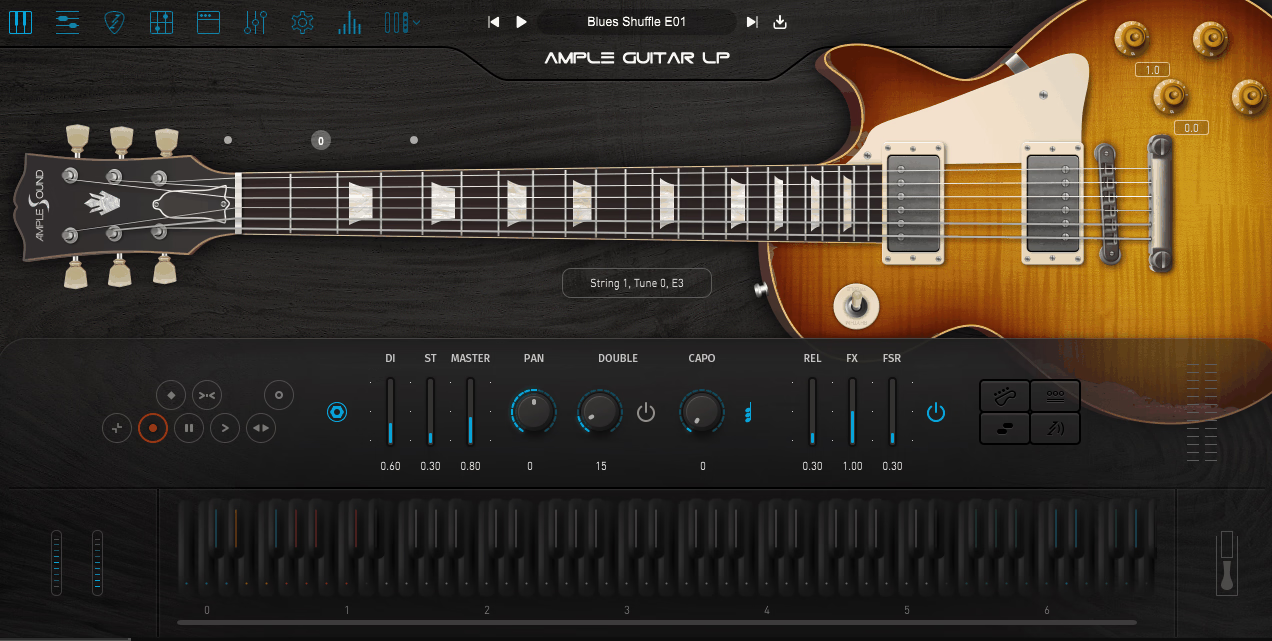
The Les Paul is probably the single most iconic rock guitar ever built, and if you’re producing in this genre without one in your plugin folder, you’re working with one hand tied behind your back. Ample Sound Ample Guitar LP samples a Gibson Les Paul 1958 Reissue across multiple pickup positions with a depth of detail that genuinely surprised me the first time I loaded it up. The warmth of those humbuckers, the natural sustain on lead lines, the way palm mutes thud with real weight. It all feels right in a way that most virtual guitars don’t.
What convinced me to make this my go to Les Paul plugin is how it handles the stuff between the notes. I’m talking about the transition from one note to another, the way a slide accelerates and slows down realistically, how a hammer on at low velocity sounds completely different from one played hard. These details are what separate a performance that sounds programmed from one that sounds played, and Ample Sound clearly obsessed over getting them right.
- Four Pickup Libraries
You get four separate sample sets: Neck, Bridge, Both, and a Fingerstyle library added in version 4 that was recorded with a 1959 Reissue. The Neck position gives you that round, fat tone perfect for blues leads. Bridge is brighter and more aggressive for rock rhythm. Both blends them naturally. The Fingerstyle set adds 3.6 GB of clean, intimate samples that open up a completely different side of the instrument.
- Polyphonic Legato
The Polyphonic Legato system handles smooth note transitions across any interval and speed, which means fast lead runs don’t sound like a machine gun of individual samples. It works across chords too, so sliding between chord voicings sounds fluid and natural. Drop tuning goes down to D1 for heavier applications.
- Built In Amp Sim
Seven amp models cover the full spectrum from Fender cleans to Marshall crunch to Mesa high gain, paired with 8 cabinets and 8 mic positions each. Built in effects include EQ, compression, delay, and convolution reverb. For most rock and blues work, you won’t need to load a separate amp plugin at all.
- Riffer 4 Editor
The dedicated Riffer 4 MIDI editor understands guitar performance in ways that a standard piano roll can’t. The Strum Note system treats chords as single objects with unified control over strum time, velocity gradient, and legato. Combined with authentic fingering logic, strummed passages sound remarkably close to a real player.
Available in VST2, VST3, AU, AAX, and standalone formats. Library size is over 20 GB and an SSD is strongly recommended.
Get the Free Plugin Starter Kit
The genuinely useful free DAWs and plugins worth installing. No filler. Straight to your inbox.
2. Steven Slate Drums 5 (Rock Drums)

There’s a specific drum sound that I associate with professional rock records. Tight, punchy, big sounding but controlled. Steven Slate Drums 5 nails that sound right out of the box because that’s exactly what it was designed to do. While other drum libraries try to cover every genre from jazz brushes to electronic percussion, SSD5 stays laser focused on rock, metal, and hard hitting pop drums that sit perfectly in a dense mix.
The philosophy behind Steven Slate Drums 5 is that you shouldn’t have to be a mix engineer to get great sounding drums. The samples ship with tasteful EQ, compression, and room tone already baked in, the kind of processing that top rock mixers spend hours dialing in. I find this approach incredibly practical because it means you load a kit and it already sounds like it belongs in your track.
- Multi Mic Channels
Every kit provides separate close, overhead, and room microphone signals that you blend to taste. Close mics deliver tight, controlled attack for each shell. Overheads capture natural cymbal shimmer and overall kit cohesion. Room channels add the sense of a real acoustic space with depth and ambience that sample triggered drums often lack.
- Mix Ready Presets
The preset library is designed by professional rock and metal mix engineers, giving you starting points that require minimal tweaking. I’ve loaded presets that sounded 90% finished on the first try. Categories cover everything from modern tight and controlled to vintage roomy and explosive, and they’re organized intuitively by genre and character.
- MIDI Groove Library
A comprehensive collection of professionally programmed rock patterns covers intros, verses, choruses, fills, endings, and transitions. Every groove is draggable as standard MIDI directly into your DAW for editing and customization. For sketching out songs quickly, this library alone is worth the price of admission.
- Internal Mixer
The built in mixer provides per drum level, pan, and processing controls including EQ, compression, transient shaping, and reverb on every channel. Multiple output routing lets you break out individual drums to your DAW’s mixer if you want even more detailed control. I typically use the internal mixer for rough arrangements and then route out for final mixing.
- Kit Customization
Individual kit pieces can be swapped between different expansion packs, letting you build hybrid kits that combine your favorite kick from one pack with a snare from another. Each piece retains its own mic channel configuration and the mixer adjusts automatically. The tuning, dampening, and velocity curve controls per piece let you dial in exactly the response you want.
- Expansion Packs
Additional kit expansions cover specific studios, drum aesthetics, and production styles. Rock focused packs include vintage kits, modern metal shells, classic 70s drums, and raw unprocessed recordings for engineers who prefer to apply their own processing chain. Each expansion integrates seamlessly with the core engine.
Available in VST, VST3, AU, and AAX formats.
3. Arturia Stage 73 V (Keys)
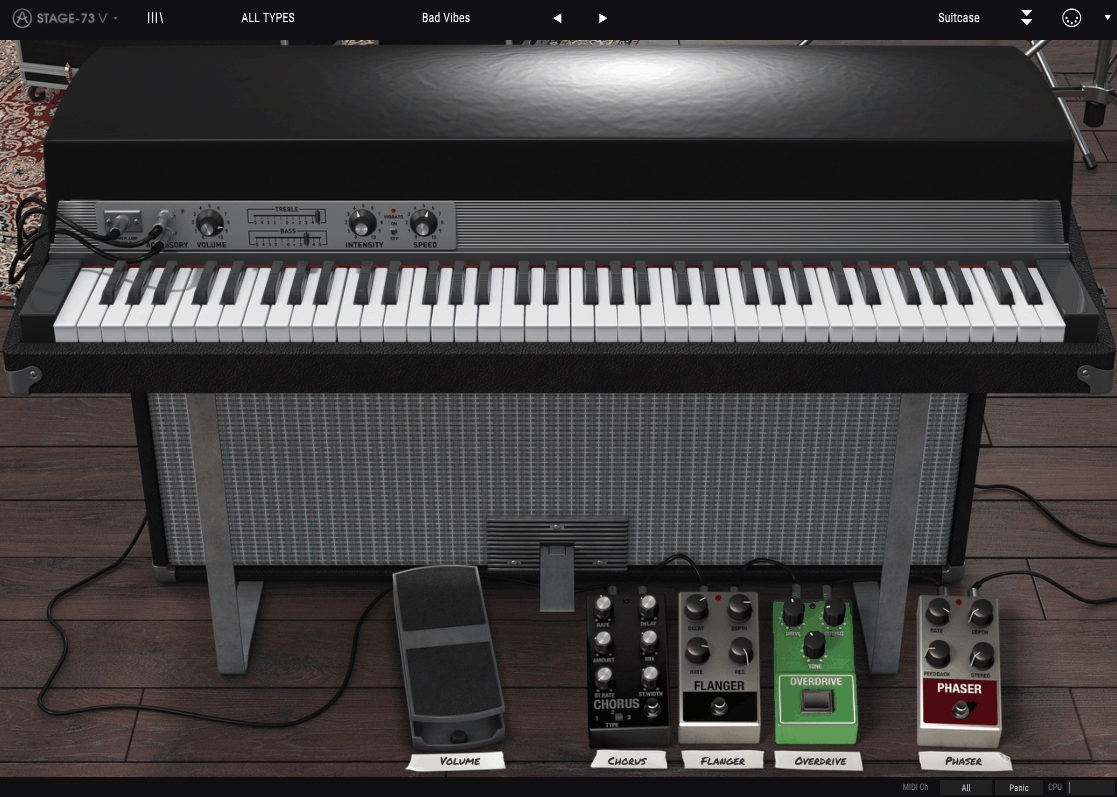
You’ve heard the Fender Rhodes on thousands of records whether you realized it or not. That warm, bell like tone with a slight bark when you play harder. It’s one of those sounds that instantly makes a track feel more musical and more human. Stage 73 V recreates the Fender Rhodes Stage 73 using physical modeling rather than samples, which means every note responds to your touch in a continuous, organic way that static recordings simply can’t match.
I think what makes Arturia Stage 73 V special for rock and blues is how it handles dynamics. Play softly and you get this gorgeous, mellow shimmer. Dig in hard and the tone develops a growl and harmonic complexity that sounds alive. The physical modeling captures that mechanical behavior of tines, tonebars, and pickups interacting in real time, and the result is an instrument that feels like you’re actually sitting behind the real thing.
- Tine Aging Controls
You can adjust pickup distance, tine volume, noise level, and decay to age the virtual instrument from pristine factory condition to a well worn vintage unit with all the character and imperfections that come with decades of use. I personally prefer the slightly aged settings because they add warmth and a bit of unpredictability that makes the sound feel more real.
- Amp Modeling
The built in amp section adds warmth and harmonic drive for overdriven Rhodes tones that work beautifully in rock. Think of the gritty, aggressive electric piano sounds on records by The Black Keys or early Radiohead. The drive responds naturally to how hard you play, creating more distortion on louder notes without any additional programming.
- Classic Effects Chain
A complete effects section models the specific pedals and rack units associated with vintage Rhodes setups: tremolo, autopan, chorus, phaser, wah, delay, and reverb. These aren’t generic effects. They’re voiced specifically for the Rhodes frequency range and respond musically to the physical model’s output.
Available from Arturia in VST, VST3, AU, and AAX formats.
4. Ample Sound Ample Guitar SC (Stratocaster)
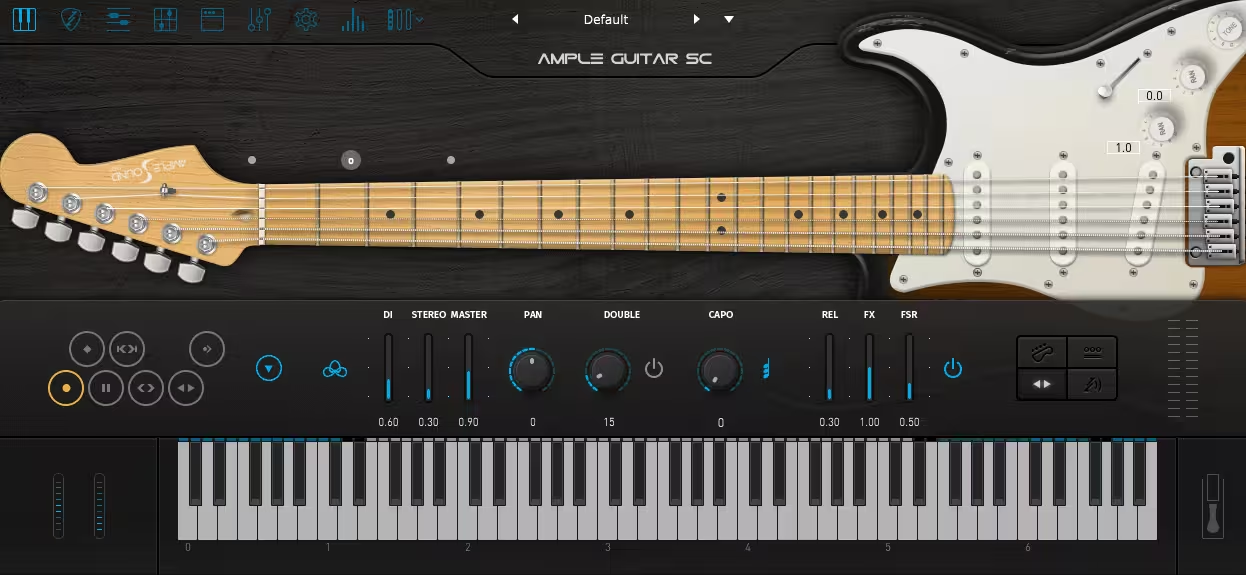
If the Les Paul is the warm, fat side of rock guitar, the Stratocaster is its bright, snappy counterpart. Ample Sound Ample Guitar SC captures a Fender Stratocaster with the same meticulous approach as the LP, delivering the glassy, articulate single coil tone that defined everything from Hendrix’s blues to Mark Knopfler’s fingerpicking to Stevie Ray Vaughan’s scorching Texas shuffle. You simply cannot make authentic sounding rock and blues without access to this tonal palette.
I reach for Ample Sound Ample Guitar SC whenever a track needs clarity and bite that humbuckers can’t provide. The difference between loading the SC versus the LP is immediately dramatic, just as it would be if you swapped real guitars in a studio session. The Strat’s bright, defined attack cuts through a mix in a completely different way, and those in between pickup positions produce the famous “quack” that no other guitar can replicate.
- Pickup Positions
Three distinct positions capture the Stratocaster’s full tonal range. The neck is warm and vocal for blues leads. The bridge delivers bright, biting attack for funk and aggressive rock. Positions 2 and 4 produce the classic out of phase “quack” that’s become one of the most recognizable sounds in popular music.
- Single Coil Voicing
Every articulation is specifically voiced for single coil response characteristics, meaning a palm mute on the SC sounds distinctly different from the same technique on the LP. The brighter, more detailed frequency response of single coils comes through naturally across all 10 playing articulations including sustain, harmonics, slides, hammer ons, and pinch harmonics.
- Clean Amp Pairing
The included amp models interact with single coil pickups very differently than with humbuckers. The 65 Twang and 65 Delight (Fender style) amps in particular pair beautifully with the SC, producing that sparkling, three dimensional clean tone that defines the classic Stratocaster sound. I find this combination handles blues and classic rock rhythm parts exceptionally well.
- Shared Ample Engine
The full v4 engine provides the same Riffer 4 MIDI editor, strumming system, polyphonic legato, and drop tuning down to D1 as the LP. The interface and workflow are identical, so if you know one Ample guitar, you know them all. The only difference is the tonal character of the instrument itself.
Available in VST2, VST3, AU, AAX, and standalone formats.
5. UAD Waterfall B3 Organ (Organ)

Blues rock without a Hammond organ is like a Fender Twin without reverb. It technically works, but something fundamental is missing. UAD Waterfall B3 Organ is one of the most detailed Hammond B3 emulations I’ve ever played, and I’ve tried most of them. It captures the tonewheel generation, drawbar blending, key click, and percussion with a level of accuracy that makes you forget you’re playing a plugin.
The Hammond is a notoriously difficult instrument to emulate because so much of its character comes from mechanical and electrical behavior that’s inherently complex. The way tonewheels interact, the scanner vibrato disc, the tube amp saturation. UAD modeled all of these elements, and the result is an organ that responds to your playing with the same immediacy and expressiveness as the real hardware.
- Drawbar Harmonics
Full nine drawbar control per manual lets you build organ tones from the ground up by blending different harmonic footages (16′, 5 1/3′, 8′, 4′, 2 2/3′, 2′, 1 3/5′, 1 1/3′, 1′). The drawbar behavior responds realistically to rapid changes, and the way these harmonics interact and reinforce each other is what gives the Hammond its enormous tonal range from mellow jazz pads to screaming rock leads.
- Key Click
The characteristic percussive click at the note onset is modeled with adjustable level, replicating the electrical contact bounce that Hammond engineers originally considered a defect but that players came to love. This click is fundamental to how the organ cuts through a band mix, and adjusting its intensity changes the instrument’s character dramatically.
- Scanner Vibrato
The rotating scanner disc that creates the Hammond’s signature modulation is fully modeled with all six original settings: V1, V2, V3 for vibrato and C1, C2, C3 for chorus. Each produces a distinctly different depth and character, and switching between them mid performance is a classic Hammond technique that this plugin handles convincingly.
Available through Universal Audio for UAD and UADx platforms.
6. Ample Sound Ample Guitar TC (Telecaster)
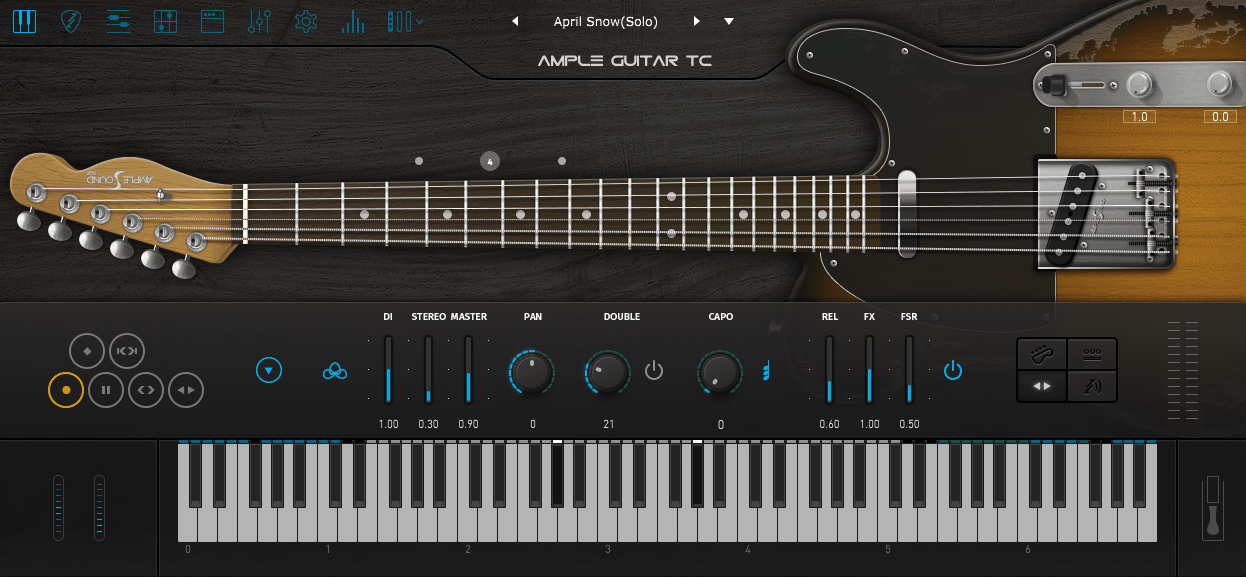
Leo Fender’s original solid body electric guitar has been at the center of rock, country, blues, and rockabilly since the early 1950s, and its no nonsense character remains as relevant today as it was seventy years ago. Ample Guitar TC captures the bright, twangy, direct tone that makes the Telecaster such a distinctive voice in a band context. When you need a guitar sound that cuts through everything with clarity and purpose, this is the one I reach for.
What separates the Telecaster from the LP and SC isn’t just the pickups. It’s the entire construction philosophy. The bolt on neck, the simple bridge design with the pickup mounted to a metal plate, the lightweight body. All of these contribute to a tighter, more percussive response with faster note definition. Ample Sound Ample Guitar TC captures these characteristics, and when you A/B it with the LP or SC in the same session, the family resemblance is there but the personality is completely different.
- Bridge Pickup Character
The Telecaster bridge pickup has a bright, percussive attack with a characteristically nasal midrange that is unlike anything else in the guitar world. This is the sound that country, rockabilly, and blues players have chased for decades. The plugin captures that distinctive bite with convincing accuracy, and combining it with a clean Fender amp model produces one of the most recognizable guitar tones in popular music.
- Chicken Picking
The articulation set handles the hybrid picking and chicken picking techniques that are essential for country and blues Telecaster work. The pick attack angle control lets you dial in the snappy, percussive “spank” that defines the country Tele sound. I find this control surprisingly effective at changing the feel of a performance without adjusting any other parameters.
- Neck Pickup Warmth
The Telecaster’s neck pickup produces a surprisingly warm, round tone that contrasts dramatically with the bright bridge position. This gives you a genuinely versatile instrument within a single plugin, capable of handling both snappy rhythm parts and the smoother, rounder lead tones that blues playing demands. I often switch between positions within the same song for tonal variety.
- Drop Tuning
Full drop tuning support extends down to D1, with tuning changes affecting all articulations, strumming patterns, and the Riffer editor naturally. Heavier blues rock arrangements in drop D or lower tunings sound authentic rather than pitch shifted. The low end retains its definition and character even at the lowest settings.
- Full v4 Engine
The complete Ample Sound engine provides Riffer 4, Strum Note technology, 7 amp heads, 8 cabinets, and the full effects chain. The Tele’s naturally bright fundamental character shines through clean amplification in a way that’s distinctly different from how the LP or SC respond to the same amp settings.
Available in VST2, VST3, AU, AAX, and standalone formats.
7. IK Multimedia MODO BASS 2 (Bass Collection)

Most virtual bass guitars work by playing back multi sampled recordings, which means there’s always a finite ceiling on how expressive and dynamic the performance can be. IK Multimedia MODO BASS 2 breaks through that ceiling entirely by using physical modeling to simulate the actual mechanics of bass guitar strings, bodies, pickups, and electronics in real time. Every note is generated on the fly from physics, not triggered from a recording.
This approach matters enormously for rock and blues bass because the genre depends on groove, feel, and subtle variation. When I program a bass line with MODO BASS 2, slides between notes don’t crossfade between samples. They model the actual string movement along the fret. Ghost notes, hammer ons, finger position changes. Everything responds continuously rather than switching between discrete pre recorded options. The result is bass performances that breathe and groove in a way that sampled instruments struggle to match.
- 22 Bass Models
MODO BASS 2 includes physically modeled recreations of 22 iconic instruments from the Fender Precision and Jazz to the Music Man StingRay, Rickenbacker 4003, Hofner Violin Bass, and beyond. Each model captures the specific body resonance, scale length, string gauge, and pickup configuration of the original. Switching between them produces the same tonal differences you’d experience swapping real basses in a recording session.
- Playing Techniques
Controls for plucking position, finger versus pick attack, string action, and fret noise shape the character for any genre. A slide, bend, and vibrato system responds to pitch wheel and aftertouch for expressive real time performance. The slap and pop engine handles funk techniques with convincing string snaps and thumb attacks. I find the finger position control particularly useful for dialing in different tonal colors without touching the EQ.
- Amp and Pedalboard
A complete signal chain includes models of classic bass amplifiers from Ampeg SVT to Fender Bassman, plus a pedalboard with compression, overdrive, chorus, envelope filter, octave, and more. The amp models respond authentically to the physically modeled signal, and you can reorder the entire chain to experiment with different routing configurations.
Available from IK Multimedia in VST, VST3, AU, and AAX formats.
8. XLN Audio Addictive Drums 2 (Drums)

Where Steven Slate Drums gives you processed, mix ready drums, Addictive Drums 2 takes the opposite approach: beautifully recorded samples with independent mic channels that you shape and mix entirely yourself. If you’re the kind of producer who wants full control over the drum sound from the ground up rather than starting with someone else’s processing decisions, this is your engine.
I’ve used Addictive Drums 2 on projects where the drum tone needed to be specific and customized in ways that pre processed samples wouldn’t allow. The raw quality of the recordings is excellent, the internal mixer is well designed, and the ADpak expansion system means you can keep adding kits and styles as your needs grow. It’s also notably light on CPU, which matters when you’re running a full rock session with 40 or 50 tracks.
- ADpak Expansions
The expansion system provides dozens of additional kit packs recorded in different studios with different drums and aesthetics. Rock specific packs include vintage kits, modern metal shells, classic 70s recordings, and raw unprocessed captures. Each ADpak integrates seamlessly with the core engine and internal mixer, and you can mix kit pieces across different packs to build custom hybrid setups.
- Channel Mixer
Each kit provides separate close, overhead, room, and bus microphone signals with fully independent processing per channel including parametric EQ, compression, tape saturation, transient shaping, and send effects. This granular control mirrors what you’d have with a multi tracked live recording and gives you a complete drum mixing environment inside the plugin itself.
- Beat Transform
Beyond the extensive MIDI groove library covering rock, blues, funk, and pop, the Beat Transform feature generates rhythmic variations on existing patterns by shifting timing, swapping kit pieces, and randomizing dynamics. This is incredibly useful for quickly exploring different feels without programming everything from scratch. All grooves are draggable as standard MIDI into your DAW for detailed editing.
- Kit Piece Swapping
Individual drums can be swapped between different ADpaks, letting you build hybrid kits that combine a kick from one recording session with a snare from another and cymbals from a third. Each piece retains its own mic channel configuration, and the mixer adjusts automatically. I use this constantly to find the perfect snare for a track without being locked into a single kit’s aesthetic.
Available from XLN Audio in VST, AU, and AAX formats.
9. u-he Diva (Analog Synth)
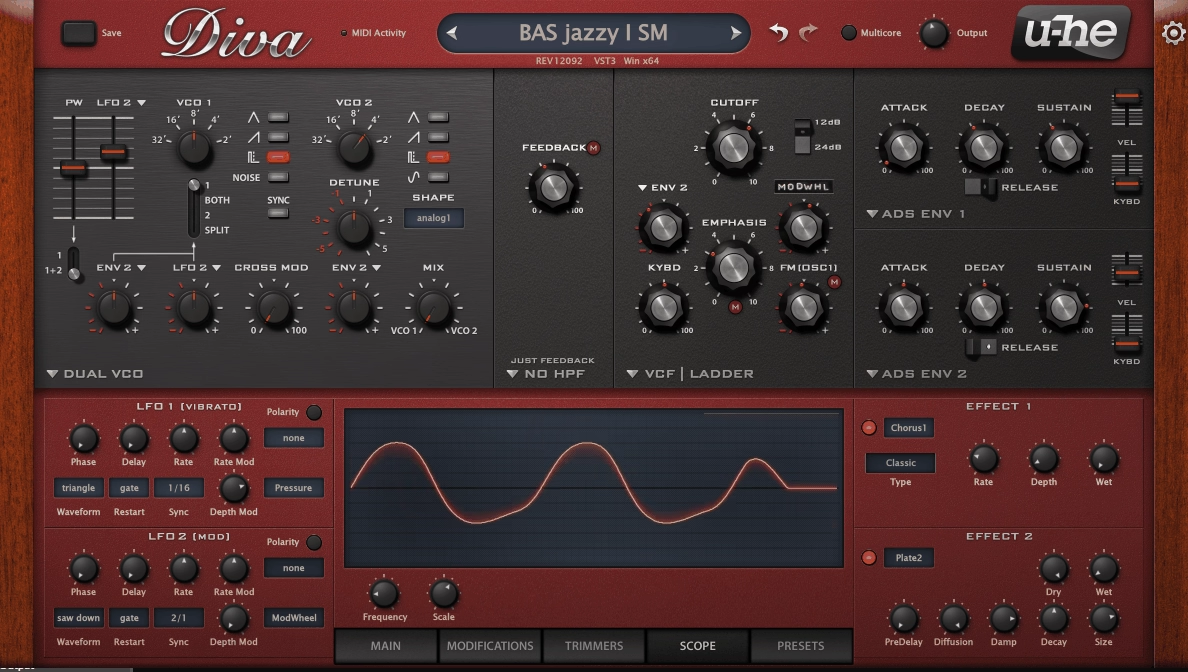
An analog synth on a rock and blues list might catch you off guard, but consider the history for a moment. Analog synthesizers have been part of rock music since Keith Emerson wrestled a Moog on stage in the early 1970s. Pink Floyd’s sweeping leads, Van Halen’s synth driven “Jump,” The Doors’ bass lines. These sounds are woven into rock’s DNA, and u-he Diva reproduces them with a fidelity that makes experienced hardware players genuinely struggle to tell the difference.
What sets Diva apart from every other virtual analog isn’t a marketing claim. It’s the modeling technology. Zero delay feedback circuit simulation at the component level means the filters self oscillate naturally, the oscillators drift subtly over time, and the overall behavior captures the specific imperfections and instabilities that give analog gear its warmth. The tradeoff is higher CPU usage, but for the sonic quality you get back, I’ve never once regretted the hit.
- Hardware Mixing
Diva lets you combine oscillators from a Minimoog with filters from a Korg MS 20 and envelopes from a Roland Jupiter, creating hybrid patches that no single piece of hardware could produce. Five classic synth architectures are available as interchangeable modules. The combinations are vast, and stumbling into unexpected tonal territory is half the fun.
- Circuit Drift
The modeled circuits include subtle oscillator drift, filter variations, and envelope inconsistencies that mirror the behavior of aging analog hardware. This isn’t random noise. It’s the specific kind of organic variation that makes each note slightly different from the last, which is exactly why analog synths sound “alive” compared to their digital counterparts.
- 1,200 Plus Presets
The included library of over 1,200 presets covers classic analog territory comprehensively: warm pads, fat basses, screaming leads, evolving textures, and atmospheric effects. For rock applications specifically, the Minimoog style bass patches and Prophet style polyphonic pads are immediately useful. The preset quality is exceptional, with many designed by professional sound designers who understand genre specific needs.
- Multicore Processing
Because the ZDF modeling is CPU intensive, Diva includes a multicore option that distributes the processing load across multiple processor cores. There’s also a draft mode for composing that uses less CPU, letting you switch to full quality for the final render. I typically work in draft mode during arrangement and only enable full quality when I’m printing stems.
- Vintage Envelopes
Each envelope module is modeled after a specific hardware synth’s envelope behavior, capturing the particular curve shapes, retriggering behavior, and timing characteristics of the original circuits. A Minimoog envelope feels different from a Jupiter envelope even at identical settings, because the underlying analog response is different. This level of detail is what makes Diva feel like playing actual hardware.
Available from u-he in VST, VST3, AU, AAX, and CLAP formats.
10. Ample Sound Ample Guitar Semi Hollow
There’s a sound that sits right between the solid body punch of a Les Paul and the airy resonance of a full hollowbody, and only a semi hollow guitar can get you there. AG Semi Hollow captures that specific character with the detailed sampling approach I’ve come to expect from the Ample Sound range. It’s the guitar sound you hear on everything from BB King’s blues to Noel Gallagher’s Britpop to early Radiohead.
What makes a semi hollow body guitar different isn’t just marketing or aesthetics. The air chamber inside the body physically interacts with the string vibrations, amplifying certain resonant frequencies and adding a woody warmth that solid body guitars genuinely cannot produce. When you play clean tones through this plugin, you immediately hear a richness and three dimensionality that the LP and SC don’t have. Add a touch of overdrive and the guitar retains a complexity that stays musical even as you push the gain.
- Resonant Body Character
The sampling captures the semi hollow’s distinctive acoustic resonance, including how the air chamber adds depth and warmth that solid body guitars lack. Clean tones have a fullness that’s immediately recognizable, and overdriven tones retain a complex, woody quality rather than compressing into a flat wall of distortion. This natural resonance is what makes semi hollows the preferred choice for blues players who need expressiveness.
- Full Performance Engine
All 10 standard articulations plus the polyphonic legato system, strumming engine, and Riffer 4 MIDI editor are present and voiced for the semi hollow’s response characteristics. The body resonance interacts with each articulation differently, so slides and hammer ons have a warmer, more rounded quality compared to the same techniques on the LP or SC.
- Amp Optimization
The integrated amp sim pairs exceptionally well with the semi hollow’s natural warmth, particularly on clean Fender amps and moderate crunch Marshall settings where the guitar’s resonant character comes through most clearly. I find you need significantly less gain with this guitar to achieve a full, satisfying tone compared to the solid body models. The semi hollow does more of the tonal heavy lifting on its own.
- Distinct Pickup Voicing
The pickup positions on the semi hollow produce a wider tonal spread than you might expect, with the bridge having genuine bite despite the guitar’s overall warmth and the neck position delivering an almost acoustic like roundness. This range makes it surprisingly versatile for rock and blues where you might need both clean rhythm and singing lead tones from the same instrument.
Available in VST2, VST3, AU, AAX, and standalone formats.
11. UJAM Virtual Guitarist IRON 2
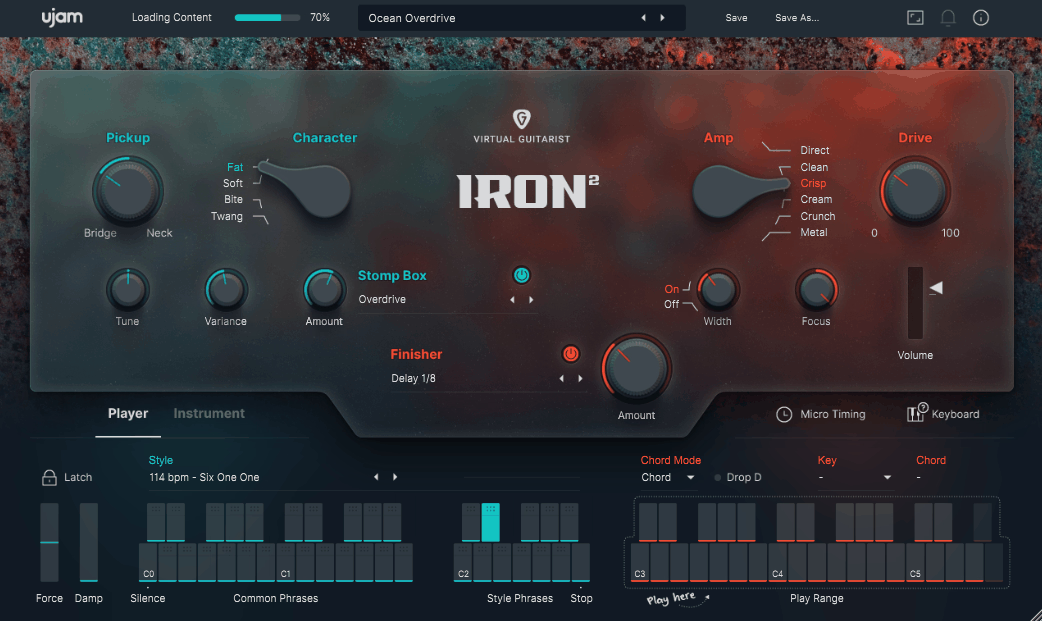
Not every producer wants to program guitar parts note by note, and that’s perfectly fine. IRON 2 takes a completely different approach to the Ample Sound guitars by giving you a virtual rock guitarist who plays pre recorded riffs and phrases that you trigger and shape from your MIDI keyboard. Think of it less as a sample library and more as having a session player on call who shows up ready to track.
For songwriters and composers working on deadlines, UJAM IRON 2 is a genuine time saver that I’ve come to rely on for quick arrangements. The phrase library is extensive, the performances are played by real guitarists with real feel, and the amount of variation you can extract from each style is impressive. You won’t fool a guitarist into thinking it’s a live player, but you’ll absolutely get results that work in a mix.
- Style Phrases
Dozens of playing styles cover hard rock, alternative, indie, punk, metal, and blues rock. Each style contains multiple phrase variations triggered from the lower keyboard octaves while you play chords in the upper range. The phrases adapt to your chord voicings in real time, transposing and reshaping to fit whatever harmonic context you provide.
- Finisher Section
The built in Finisher provides one knob access to complex, curated effect chains that transform the tone from clean and intimate to heavily processed. Instead of loading separate distortion, modulation, and ambient plugins, a single control sweeps through a designed tonal journey specific to each guitar sound. I find this approach surprisingly effective for quickly auditioning different tones.
- Player Controls
Performance parameters like complexity, swing, humanize, and accent adjust how the virtual guitarist plays, from simple and steady to complex and expressive. These affect the underlying MIDI performance rather than just the audio processing, which means the variations sound natural rather than artificially generated. You can also lock specific phrase elements while varying others for controlled evolution.
Available from UJAM in VST, VST3, AU, and AAX formats.
12. UAD Waterfall Rotary Speaker

Nearly every legendary blues rock organ recording features a Leslie cabinet, and there’s a reason for that. The rotary speaker effect creates a kind of movement, warmth, and harmonic richness that no chorus pedal, tremolo, or digital effect can truly replicate.
UAD Waterfall Rotary Speaker models a Leslie cabinet with the obsessive physical detail that Universal Audio brings to all their emulations, capturing the mechanical, acoustic, and electronic behaviors that make a real Leslie such a magical and characterful piece of equipment.
I use this plugin on everything from organ to guitar to vocals, and it transforms whatever you run through it. The Doppler pitch shifting from the spinning horn, the amplitude modulation from the rotating drum, the cabinet resonance, the tube amp saturation. These elements interact with each other in complex ways that produce a sound genuinely greater than the sum of its parts. It’s the kind of effect that immediately makes a track feel more vintage, more organic, and more alive.
- Dual Rotor Physics
The plugin independently models the horn (treble) and drum (bass) rotors with their own speed, acceleration, and deceleration curves. The ramp up and ramp down when switching between slow chorale and fast tremolo captures the mechanical inertia of real spinning elements. This acceleration behavior is one of the most expressive aspects of the Leslie sound, and UAD nails the feel of it.
- Tube Amp Saturation
The built in tube amplifier model generates the warm, harmonically rich overdrive that’s fundamental to the classic Leslie tone. Pushing the input harder increases saturation gradually from gentle warmth to full singing tube distortion. Combined with the rotary modulation, this produces the thick, swirling sound that has defined organ tones on records by Allman Brothers, Deep Purple, and Stevie Winwood.
- Mic Positioning
Virtual microphone distance and angle controls replicate the technique engineers use when recording a real Leslie cabinet. Close positioning emphasizes modulation intensity and direct tone. Pulling the mics back introduces room character and a smoother, more blended sound. This is the kind of control that lets you place the Leslie effect exactly where it needs to sit in your mix.
- Cabinet Options
Different cabinet models and horn deflector configurations change the spatial character of the rotary effect. Narrower deflectors create a tighter, more focused modulation. Wider deflectors produce a broader, more diffuse swirl. You can also engage a brake function that stops the rotors for the warm, stationary cabinet tone, and the transition between spinning and stopped is one of the most dramatic effects in the Leslie player’s toolkit.
- Stereo Spread
Adjustable stereo width controls determine how wide the rotary effect appears in the stereo field. Narrow settings keep the Leslie focused in the center for dense mix contexts. Wide settings exploit the natural phase differences between the spinning elements to create an immersive, room filling rotary effect that sounds spectacular on organ pads and sustained guitar tones.
Available through Universal Audio for UAD and UADx platforms.
Get the Free Plugin Starter Kit
The genuinely useful free DAWs and plugins worth installing. No filler. Straight to your inbox.

Hello, I’m Viliam, I started this audio plugin focused blog to keep you updated on the latest trends, news and everything plugin related. I’ll put the most emphasis on the topics covering best VST, AU and AAX plugins. If you find some great plugin suggestions for us to include on our site, feel free to let me know, so I can take a look!