
Let’s discuss some of the best tube compressor plugins I’ve tried and want to share with you, covering both commercial options and free alternatives that actually deliver results for vocals, bass, mix bus and some other applications as well!
Tube compressors handle dynamics differently than fast peak controllers. Instead of grabbing transients aggressively, they build gain reduction progressively and release smoothly, which is why they work so well where you need leveling without obvious compression artifacts.
In this list I will talk about plugins such as Softube Tube-Tech CL 1B Mk II, UAD Teletronix LA-2A Tube Compressor, Waves CLA-2A and some more including free options as well.
The challenge is knowing which ones deliver that smooth, musical response without requiring constant adjustment or falling apart when pushed hard. Some add noticeable tube warmth, others stay cleaner and more transparent, and certain designs work better on individual tracks while others excel on buses.
The focus here is on tools that provide controlled dynamics and cohesion rather than excitement or obvious character, identifying which ones work across different sources without needing perfect conditions.
From the Pluginerds Store
Before you get into the plugins on this list, something most mixing and mastering guides do not mention. A compact IEM pair as a second reference at low volume catches what your main headphones are smoothing over.


1. Softube Tube-Tech CL 1B Mk II

Softube Tube-Tech CL 1B Mk II is a focused, professional level tube/opto compressor plugin built to replicate the real-world behavior of the Tube-Tech hardware. In fact, this is not a nostalgic model or creatively exaggerated take but a controlled, modern rebuild that reflects how the CL 1B is actually used in real mixes today.
When it comes to compression curve, it’s inherently program dependent, meaning, it reacts to signal density rather than just peak amplitude. It’s useful when you need controlled vocal dynamics where consistency matters more than dramatic compression artifacts, and it remains stable even with long release settings on bass and sustained synth material.
- Three Compression Modes
In a big picture, the Mk II interface includes three compression modes that influence how the optical circuit reacts to incoming signal. Fixed mode emphasizes program dependency, Manual gives more predictable control over timing, and Fixed Manual blends the two behaviors.
These modes are not cosmetic but materially affect how the compressor feels under continuous signal. You can switch between them depending on whether you want the compressor to react more naturally to the source material or behave in a more controlled, predictable way.
In addition to that, Fixed mode works particularly well on vocals where you want the compressor to breathe with the performance, while Manual mode gives you tighter control when you need consistent gain reduction across varying input levels. You can start with a Fixed mode and switch to Manual when you areworking with more dynamic performances that need tighter control.
- Sidechain High Pass Filter
I think a built-in sidechain high-pass filter is one of the most important functional upgrades. This allows low frequencies to pass without dominating gain reduction, which is essential when you’re working with proximity heavy vocals or bass rich sources.
The sidechain filter is intentionally simple and avoids unnecessary tuning complexity, but it solves a major problem with optical compressors where low end can trigger excessive pumping. You can engage this filter to keep the compressor reacting to midrange and high frequency content while letting the low end stay more natural. I encourage you to try it on a vocal track because it prevents the compressor from overreacting to plosives and low frequency proximity buildup.
- Console 1 Integration
Also, the plugin also integrates with Softube Console 1 for users working in hybrid or tactile workflows. This gives you hardware style control over compression parameters without breaking your mixing flow.
If you mix with Console 1, having the CL 1B Mk II available as a channel tool rather than a floating plugin window speeds up workflow significantly. The physical knobs make adjusting attack, release, and threshold feel more intuitive than mouse control.
- Optimal Gain Reduction Ranges
On vocals, this plugin excels at controlled gain reduction in the 2 to 6 dB range, which is where it sounds most transparent and stable. At 7 to 10 dB, the sound becomes denser but still coherent, avoiding harsh clamping or exaggerated envelope distortion.
This makes it especially suitable for modern vocal production where you need consistency without obvious compression artifacts. For instance, the compressor doesn’t exaggerate note transitions and remains stable even when you’re pushing into heavier gain reduction territory, which is why it works so well across different vocal performances and recording qualities. I find that staying in the 4 to 6 dB range gives me the best balance between control and naturalness on lead vocals.
Get the Free Plugin Starter Kit
The genuinely useful free DAWs and plugins worth installing. No filler. Straight to your inbox.
2. UAD Teletronix LA-2A Tube Compressor
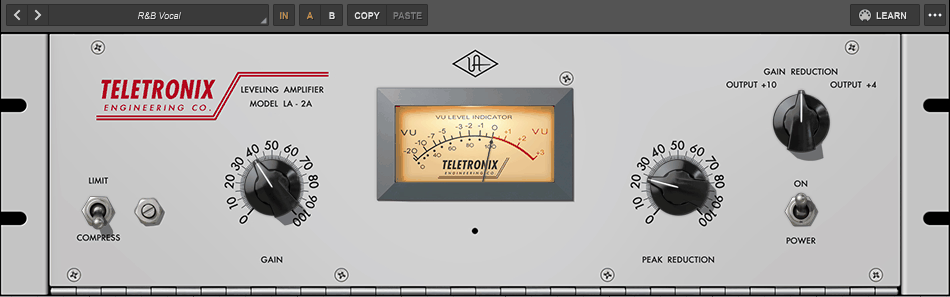
The defining characteristic of electro-optical compression is how it controls dynamics without sounding like compression. Gain reduction is program dependent, driven by an electro-optical element combined with tube amplification, and there are no adjustable attack or release controls because those behaviors are built into the circuit model. The UAD Teletronix LA-2A Tube Compressor stays very close to this classic workflow, bringing the LA-2A into modern DAWs without requiring DSP hardware.
The response adapts automatically to signal density and duration, which is exactly why it works so well on vocals and bass. I would reach for this when I need leveling rather than shaping, and on vocals the compressor naturally settles into 3 to 7 dB of gain reduction without drawing attention to itself.
- Program Dependent Compression with No Attack or Release Controls
There are no adjustable attack or release controls because those behaviors are built into the circuit model. The response adapts automatically to signal density and duration, which is exactly why it works so well on vocals and bass.
On vocals, this tube compressor plugin naturally settles into 3 to 7 dB of gain reduction without drawing attention to itself. The vocal remains forward, stable, and consistent even when the performance varies significantly in level. Push it harder into 8 to 10 dB, and the sound becomes thicker and more saturated, but still controlled.
This makes it particularly useful for lead vocals that need leveling rather than shaping. On bass, the LA-2A excels at smoothing note transitions and maintaining perceived loudness without clamping transients aggressively, which helps preserve low end movement.
- Compress and Limit Mode Switch
You get Peak Reduction, Gain, a Compress and Limit mode switch, and basic metering. That simplicity is not a limitation in practice but forces you to work by ear and focus on balance rather than settings.
Compress mode is the most commonly used and is ideal for vocals and bass. Limit mode applies a higher ratio and firmer control, which can be useful on parallel buses or dense material. The mode switch changes how aggressively the unit clamps, giving you two distinct intensity behaviors without complex ratio controls.
- Optimal Gain Reduction Ranges for Different Sources
On drum buses or room mics, this works best when used subtly, often in the 2 to 4 dB range, adding cohesion rather than impact. Because the behavior is program dependent, small changes in Peak Reduction can result in meaningful differences in feel, especially on dynamic material.
The compressor is rarely the only dynamics processor on a track in real sessions. It’s commonly paired with a faster compressor either before or after it. For example, you might use a faster VCA or FET compressor to catch peaks, followed by the LA-2A for overall leveling.
3. Rockruepel COMP.TWO
The Rockruepel COMP.TWO is a modern all-tube vari-mu compressor that takes the behavior of classic tube gain control and places it into a workflow designed for current production realities, and it’s not a retro clone trying to recreate a single piece of vintage hardware.
Developed by Process Audio in collaboration with Rockruepel, COMP.TWO focuses on how vari-mu compression is actually used today across bass, vocals, and drum material. I recommend this when you need controlled, progressive compression that works across multiple source types without constant adjustment, and the midrange remains intact even when pushing heavier gain reduction.
- Progressive Vari-Mu Gain Reduction
Gain reduction increases progressively as input level rises, which is the defining trait of vari-mu compression. This results in compression that feels proportional and musical rather than reactive and corrective.
On vocals, COMP.TWO works comfortably in the 2 to 6 dB range where it smooths performance inconsistencies without softening articulation. Push it to 7 or 8 dB and the sound becomes thicker and more forward, but it never collapses into audible pumping. On bass, the compressor excels at controlling low frequency energy without killing note definition, maintaining weight while subtly evening out dynamics, especially on bass guitar and sustained synth bass.
The compressor is built around continuous gain reduction behavior rather than stepped emulation, which makes it feel closer to a mastering grade vari-mu in daily use, even when inserted on individual tracks.
- Style Control
One of the most important aspects of COMP.TWO is its style control, which shifts the internal response of the compression circuit. Different styles alter how quickly gain reduction builds and how firmly it holds under sustained signal.
I can say this allows the compressor to move from gentle leveling to firmer bus control without changing tools. The style control expands the usable range of the plugin without adding complexity, giving you different compression philosophies within a single interface.
- Attack and Release Interaction with Vari-Mu Curve
Attack and release are continuously variable, but they interact with the vari-mu gain curve rather than overriding it. This means changes feel musical rather than technical.
You’re not fighting the compression behavior when you adjust timing but shaping how the vari-mu character responds. This interaction is what separates COMP.TWO from digital compressors that just have fast and slow settings without any relationship to the underlying gain reduction topology.
- Natural Harmonic Density
Harmonic content is subtle but present. There’s no exaggerated saturation control, but the compression itself introduces natural density as gain reduction increases.
This makes the plugin suitable for mix and bus duties where added tone should remain secondary to control. COMP.TWO adds density and cohesion without imposing a heavy signature, making it easy to integrate into modern productions that already rely on layered processing.
4. IK Multimedia Vintage Tube Compressor/Limiter Model 670

The defining quality of vari-mu compression is how gain reduction builds progressively as signal level increases. Compression doesn’t suddenly engage or release but grows into the material and holds in a way that feels continuous rather than reactive. This is classic vari-mu behavior, and it’s what makes this style so effective on buses and sustained material.
Vintage Tube Compressor Model 670 is a deliberate take on one of the most recognizable vari-mu designs, built around weight, density, and long envelope control rather than speed or modern compression tricks.
Developed by IK Multimedia as part of the T-RackS ecosystem but also working standalone, this is clearly aimed at engineers who already understand vari-mu behavior.
- All Tube Signal Path
The compressor features an all tube circuitry that enriches timbre and adds presence and harmonics to the signal. This tube signal path is what gives the compressor its musical and emotional character, particularly noticeable on vocal tracks.
The tube stage isn’t just cosmetic coloration but affects both the signal path and the gain reduction mode, which is why material passing through it tends to sound more cohesive and polished. This is especially effective on vocals where the tube circuitry adds body and air without making the sound feel overly processed.
- Progressive Gain Reduction Across Different Sources
On vocals, the Model 670 works best when used conservatively. In the 1 to 4 dB range, it provides level stability and tonal thickness without smearing articulation. Pushed to 5 or 6 dB, vocals start to feel denser and more forward, but it remains smooth rather than clamped.
This is not a vocal rider and it’s not meant to be the only compressor in a vocal chain. It excels as a tone shaping and leveling stage after faster control has already happened. On bass, this compressor shines because bass guitar and synth bass benefit from the way the Model 670 stabilizes low frequency energy without flattening note movement.
With 2 to 5 dB of gain reduction, the bass sits deeper in the mix while maintaining size. On drums, it’s best used on drum buses or room channels rather than individual hits, where 2 to 4 dB of compression adds glue and depth without killing punch.
- Stereo Linking and Mid Side Behavior
One of the most important aspects of the Model 670 tube compressor plugin is its stereo linking and mid side behavior. The plugin allows different channel linking behaviors that affect how the left and right channels interact under compression.
I believe this is particularly useful on drum buses and full mixes where you want center elements to remain stable while allowing the sides to breathe naturally. The stereo behavior separates this from simpler bus compressors that just lock both channels together without giving you control over how they interact.
- T-RackS Ecosystem Integration
As part of the T-RackS ecosystem, the Model 670 integrates smoothly with other IK processors, but it doesn’t require the full suite to function properly. Licensing and authorization are straightforward, and performance is stable across modern DAWs.
5. Arturia Comp TUBE-STA

The Comp TUBE-STA is built around a very specific idea of tube compression, leaning into density, tone, and level control that feels slow and deliberate rather than chasing neutrality. It’s modeled after a classic tube limiter design but expanded with modern controls that make it more usable across bass, vocals, and drum buses.
It works especially well as a bus compressor or as a secondary dynamics stage after faster compression has already handled transient control. The defining feature of Comp TUBE-STA is how gain reduction builds gradually and stays engaged in a way that feels weighty rather than reactive.
On vocals, the compressor works best when used as a secondary dynamics stage. In the 2 to 5 dB range, it smooths performance dynamics while adding thickness to the midrange, making vocals feel more anchored in the mix without losing presence.
Push it beyond 6 dB, and the sound becomes noticeably denser, which can be useful for aggressive or intimate vocal styles, but it’s rarely subtle at that point. On bass, Comp TUBE-STA performs extremely well because bass guitar and synth bass benefit from how the compressor stabilizes low end energy while preserving movement. With 3 to 6 dB of gain reduction, bass lines feel more consistent and controlled without sounding flattened, which makes it especially effective for bass buses or main bass tracks in dense arrangements.
- Dual Time Constant Behavior
One of the most important features is the dual time constant behavior, which allows the compressor to react differently to short peaks versus sustained material. This makes it more adaptable than older tube designs without turning it into a modern surgical tool.
Attack and release behavior are largely program dependent, but Arturia adds controls that let you influence how quickly the compressor responds and recovers. This dual behavior means the compressor can handle transient material and sustained signals intelligently within the same processing chain.
- Sidechain High Pass Filter
A sidechain high pass filter is included to prevent low frequencies from driving excessive gain reduction, which is essential when working with bass heavy sources.
6. Waves CLA-2A
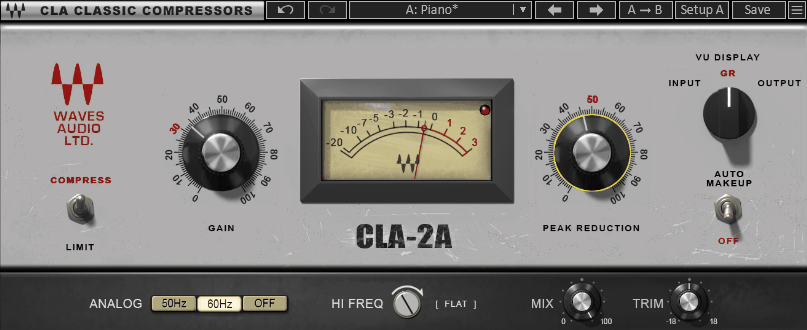
With CLA-2A, you get smooth gain control, predictable behavior, and a tone that works across bass, vocals, and certain drum applications without asking for constant adjustment.
It’s a leveling compressor that focuses on one thing and sticks to it, and it’s been around for years but remains relevant because it reflects how this type of compressor is actually used in real mixes.
Developed by Waves in collaboration with Chris Lord-Alge, the CLA-2A is not presented as a technical clone with multiple revisions but as a practical interpretation aimed at speed and repeatability. Consider it when you want usable, musical compression in seconds without diving into parameters, and it works particularly well on vocals and bass where you need forward tone and controlled dynamics.
- Program Dependent Optical Compression
The CLA-2A delivers program dependent optical compression that behaves very much like a classic tube leveling amplifier. While not a textbook vari-mu circuit, its compression curve and release behavior overlap heavily with vari-mu usage in practice, especially on vocals and bass where smooth level control matters more than envelope precision.
On vocals, the plugin naturally settles into 3 to 6 dB of gain reduction with very little effort. The vocal stays present and controlled without sounding squeezed. When pushed to 7 or 8 dB, the sound thickens and becomes more assertive, which can work well for rock or pop vocals that need to stay locked in front of dense arrangements.
On bass, the CLA-2A is one of those tools that simply works because bass guitar and synth bass benefit from the way it evens out note dynamics without flattening low end movement. In the 2 to 5 dB range, bass feels more consistent and easier to place in the mix.
- Compress and Limit Modes
The interface includes Peak Reduction, Gain, and a switch between Compress and Limit modes. There are no attack or release controls because those behaviors are program dependent, and that simplicity is intentional and central to how the plugin is meant to be used.
Compress mode is the most commonly used and offers gentle leveling suitable for vocals and bass. Limit mode applies a higher ratio and firmer control, which can be useful for parallel processing or bus work when more containment is needed. This plugin rewards decisive moves rather than fine tuning, where a small change in Peak Reduction can shift the entire feel of the compression, especially on dynamic material.
- Light CPU Usage
- Paired Compression Workflow
In real mixes, the CLA-2A is rarely used as a standalone dynamics solution but is commonly paired with a faster compressor either before or after it. For example, a fast VCA or FET compressor might catch peaks first, followed by the CLA-2A for overall leveling and tone.
This layered approach is where the CLA-2A shows its strength because it handles the smooth, sustained gain control while letting a faster compressor deal with transient management. I find this pairing approach more effective than trying to make one compressor do everything.
7. SPL Iron

The defining characteristic of mastering grade dual-tube compression is how it builds progressively and holds signal in a very controlled way. Gain reduction doesn’t jump or clamp but increases smoothly as level rises, and this is exactly what makes it effective on buses and sustained material.
The SPL Iron is a vari-mu compressor that approaches dynamic control from a mastering first perspective but translates exceptionally well to bass, vocals, and drum buses when used with intent.
Developed by SPL in collaboration with Brainworx and available through Plugin Alliance, this compressor is built around density, balance, and long term stability rather than character or excitement.
While the hardware version has strong roots in mastering, the software version expands its usability by making the response more accessible inside a DAW environment.
- Progressive Vari-Mu Compression Across Sources
The defining characteristic of SPL Iron is how compression builds progressively and holds signal in a very controlled way. Gain reduction doesn’t jump or clamp but increases smoothly as level rises, which is classic vari-mu behavior, but with a tighter and more modern feel than vintage designs like a Fairchild style unit.
On vocals, Iron works best when you’re shaping overall level and tone rather than fixing problems. In the 1 to 3 dB range, it adds stability and subtle density without pulling attention to itself. Pushing it to 4 or 5 dB introduces a firmer hold that can work well on lead vocals in dense arrangements, but it rarely sounds flattering beyond that unless used in parallel.
On bass, Iron is extremely effective because bass guitar and synth bass benefit from its ability to control low frequency energy while preserving note shape. With 2 to 4 dB of gain reduction, bass becomes more even and sits deeper in the mix without losing weight. It doesn’t exaggerate sustain or smear transients, which makes it useful in both electronic and acoustic contexts.
- Rectifier Modes
One of the most important features is the choice of rectifier modes, which changes how the compressor responds to signal peaks. These modes significantly affect feel and are often more impactful than small threshold adjustments.
This gives Iron flexibility across different material while staying grounded in its core design. You can switch between rectifier modes depending on whether you want a faster, more reactive response or a slower, more relaxed hold on the dynamics.
- Stereo Channel Linking Behavior
Stereo behavior is another strong point. The compressor allows different channel linking behaviors, which is critical on buses and full mixes. This lets center elements like vocals and kick remain stable while the sides retain movement.
This is a key reason Iron works so well beyond mastering scenarios and why it’s effective on drum buses where you want the kick and snare centered but need the overheads and room mics to maintain natural width and movement.
Extra:
Millennia TCL-2 Twin T

The defining quality of clean vari-mu compression is how it manages gain without leaving fingerprints on tone. The Millennia TCL-2 is a vari-mu style compressor that sits firmly on the clean and controlled end of the tube compression spectrum, designed around precision, stability, and transparency while still delivering natural dynamic behavior.
Developed by Millennia Media and released through Plugin Alliance, this is not a nostalgic or character driven processor. I woudl say use thic compressor in case you need to control dynamics without altering tone, and it’s particularly valuable on bass, vocals, and drums where transparency matters more than vibe or obvious compression artifacts.
- Progressive Gain Reduction Without Tonal Alteration
The defining quality of the TCL-2 Twin T is how smoothly it manages gain without altering tone. Compression builds progressively and releases in a way that feels continuous rather than reactive, with no exaggerated thickness, no obvious harmonic bloom, and no sense of compression grabbing transients.
On vocals, the TCL-2 works best in the 1 to 4 dB range, where it evens out performance dynamics while preserving clarity and articulation. The vocal stays natural and open, making this compressor especially useful for clean recordings, acoustic material, and genres where transparency matters.
Even at 5 to 6 dB of gain reduction, the sound remains composed, though it’s rarely flattering to push it harder than that. On bass, the plugin excels at controlling low frequency dynamics without softening attack. Bass guitar and synth bass benefit from the way it stabilizes level while keeping note definition intact, and with 2 to 5 dB of gain reduction, bass sits consistently in the mix without added weight or saturation.
- Twin Topology Design
I think the key feature is the Twin Topology design, which allows the compressor to operate in either tube based or solid state influenced behavior depending on configuration. In practice, this translates into subtle differences in response and feel rather than dramatic tonal shifts.
This flexibility allows the compressor to adapt to different material while staying true to its clean identity. You’re not switching between completely different compressors but adjusting the response character within a transparent framework.
- Precise Timing Control
Unlike vintage designs, the TCL-2 offers precise control over timing, which makes it more predictable and easier to integrate into modern workflows. You get threshold, ratio, attack, release, and output gain, all interacting with a vari-mu style compression curve.
The precision here separates this from vari-mu compressors that rely entirely on program dependent behavior. You have real control over how the compressor responds without losing the smooth vari-mu character.
Freebie:
Analog Obsession VariMoon

Musical tube style gain control without endless options is what the Analog Obsession VariMoon delivers, and that’s exactly why it has built a reputation despite being a free and donation supported plugin. It’s not positioned as a mastering grade reference tool but targets real world mixing needs where speed and musical response matter more than surgical precision.
Developed by Analog Obsession and distributed through Patreon and free plugin sites, this varimu/tube compressor plugin focuses on usable vari-mu behavior that sounds right quickly and holds together under real mix conditions.
It’s good when you want tone and cohesion on vocals, bass, and drums without overthinking compression decisions, and the straightforward interface encourages listening rather than constant tweaking.
- Smooth Progressive Compression Behavior
VariMoon follows the core principle of vari-mu compression where gain reduction increases progressively as signal level rises. Compression feels smooth and proportional rather than reactive, with no sense of hard clamping even when pushed harder than intended.
On vocals, VariMoon works well in the 2 to 5 dB range, where it smooths level inconsistencies and adds subtle density. Vocals sit more evenly without losing clarity, and the midrange remains intact. When pushed to 6 or 7 dB, the compression becomes more obvious, adding thickness that can work for aggressive vocal styles but may feel too heavy for clean or acoustic material.
On bass, this compressor performs better than its simplicity suggests because bass guitar and synth bass benefit from how VariMoon controls low end movement while maintaining note shape. With 3 to 6 dB of gain reduction, bass feels more stable and easier to place in a dense mix without adding massive weight or saturation.
- Program Dependent Timing
The interface includes input, threshold, attack, release, and output gain, all interacting with a vari-mu style compression curve. The attack and release controls influence how quickly compression builds and recovers, but the behavior remains program dependent rather than strictly timed.
This means the compressor adapts naturally to the signal instead of following rigid millisecond values. You’re shaping general response character rather than setting precise timing, which keeps the compression musical.
- Optimal Performance on Drum Buses
On drums, I would say the VariMoon is best used on buses or parallel chains. On a drum bus, 2 to 4 dB of compression adds cohesion and softens excessive peaks without killing punch.
It’s not designed for transient shaping or aggressive drum compression but works well for glue and overall movement. The smooth nature makes it effective at bringing drum elements together without obvious pumping or compression artifacts.
From the Pluginerds Store
Before you commit to any mix decision made with the plugins above, it's worth checking it on a second reference. A compact IEM pair at low volume catches things your main headphones smooth over.


- Extremely Light CPU Usage
Lastly, the main limitation is lack of advanced control because there’s no sidechain filtering, no parallel blend, and no stereo linking options beyond basic behavior. While the sound quality is impressive for a free tool, it doesn’t compete with high end vari-mu compressors in terms of depth or flexibility, working best when used deliberately within its intended role.
Get the Free Plugin Starter Kit
The genuinely useful free DAWs and plugins worth installing. No filler. Straight to your inbox.

Hello, I’m Viliam, I started this audio plugin focused blog to keep you updated on the latest trends, news and everything plugin related. I’ll put the most emphasis on the topics covering best VST, AU and AAX plugins. If you find some great plugin suggestions for us to include on our site, feel free to let me know, so I can take a look!