
Most producers who are unhappy with their mixing decisions eventually upgrade their monitors. Very few of them think about what the monitors are sitting on before they do.
The problem isn’t always the monitors. A studio monitor placed directly on a desk couples acoustically to the desk surface — the low-frequency vibrations the speaker generates travel through the cabinet into the surface and back out again as secondary acoustic energy. The desk resonates at its own frequencies. The monitors’ vibrations excite those resonances. What you hear at the listening position includes both the direct output of the speakers and the acoustic contribution of whatever they’re sitting on, which is colouring your low-end decisions whether you’re aware of it or not.
Isolation pads address this by physically decoupling the monitor cabinet from the supporting surface. They absorb the vibrations at the contact point and prevent them from coupling into the desk. The monitoring you hear becomes cleaner and more accurate in the low-midrange and low end — the frequency range where mixing decisions are hardest to get right and where desk coupling does the most damage.
The improvement isn’t dramatic in the way that a new plugin is dramatic. It’s the kind of change that makes previously confusing EQ decisions suddenly make sense — not because the monitors changed, but because you’re finally hearing what they’re actually producing rather than what they’re producing plus what your desk is adding.
The options range from simple foam pads under £15 through to height-adjustable isolation stands with full tilt control. I’ve picked six that cover every point in that range, starting with the most accessible option in the Pluginerds store.
1. Speaker Isolation Pads Acoustic Foam Monitor Stands — from $12.99

The foam isolation pad is where every home studio producer should start before considering anything more expensive. The improvement from placing foam decoupling pads under monitors that are currently sitting directly on a desk is immediate and audible — the low-end definition tightens, the low-midrange clears up, and the sense of muddiness that many producers attribute to their room or their monitors often turns out to be partly desk coupling all along.
The Speaker Isolation Pads Acoustic Foam Monitor Stands give you a pair of high-density acoustic foam isolation pads in three size options — 30×17cm, 30×20cm, and 33×27cm — to match different monitor footprints, from $12.99. The angled design tilts the monitor slightly toward the listening position as well as decoupling it from the surface, which is a secondary benefit that improves high-frequency dispersion when monitors are positioned below ear level.
The three size options are the practical detail that matters most here. An isolation pad that’s undersized for your monitor provides less contact area, reducing its effectiveness and potentially making the monitor unstable. Measuring your monitor’s base footprint and selecting the closest size match gives you both maximum decoupling surface and a stable, level monitor position.
- Acoustic Foam Decoupling
High-density acoustic foam absorbs vibrations at the monitor’s contact point, preventing them from coupling into the desk surface and exciting desk resonances. The density of the foam is the critical variable — denser foam supports the weight of the monitor without compressing fully and maintains the air gap that provides the acoustic decoupling benefit.
Budget foam pads that compress under the weight of a monitor lose their decoupling effectiveness because the monitor ends up resting on a compressed, rigid surface rather than a compliant one. The density of these pads is matched to monitor weights in the typical home studio range.
- Three Sizes for Different Monitor Footprints
30×17cm, 30×20cm, and 33×27cm options cover the footprint range from compact 5-inch monitors through to larger 8-inch units. Matching the pad size to the monitor’s base footprint maximises the decoupling contact area and keeps the monitor stable on the tilted surface.
For producers with monitors in the 5-6 inch range the 30×17cm option is typically the correct match. The 33×27cm is designed for 8-inch monitors and larger nearfields where a smaller pad would leave the cabinet’s weight concentrated over a small contact area.
- Angled Tilt for Listening Position
The angled foam design tilts the monitor approximately 5-8 degrees toward the listening position when placed on a flat desk. This is particularly useful in setups where the monitors sit below ear height — on a desk surface rather than on dedicated stands — because it aims the high-frequency dispersion axis more accurately toward the listening position rather than projecting it above the producer’s head.
Shop at Pluginerds — Speaker Isolation Pads from $12.99
2. t.akustik ISO-Pad 5
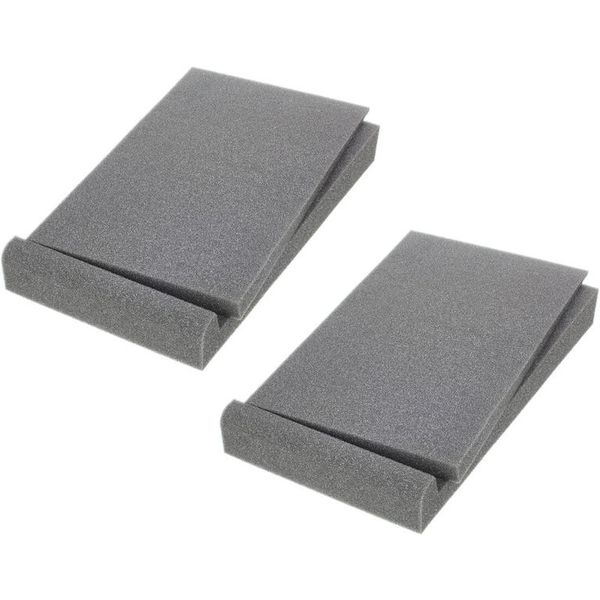
The ISO-Pad 5 is the monitor isolation pad that most home studio producers on a budget end up with, and the reason they stay with it after trying alternatives is the tilt system. Each pad consists of two separable components — a base layer and an angled wedge — and combining them at different orientations gives you three positions: flat, 4-degree tilt, and 8-degree tilt. That’s the detail that separates it from single-piece foam pads that lock you into one position regardless of whether it suits your monitoring height.
t.akustik ISO-Pad 5 is a foam isolation pad for acoustic decoupling of studio monitors consisting of two separable components that allow horizontal positioning plus 4° and 8° tilt angles, with a load capacity of 12kg per pad. Over 3,000 customer ratings at 4.6/5 on Thomann makes this one of the most validated monitor isolation products at its price point.
- Three-Position Tilt System
The two-component construction gives you a flat position and two angled positions by rotating or flipping the wedge component. 4 degrees suits setups where the monitors are close to ear height and need minor angle correction. 8 degrees is the practical option when monitors sit significantly below ear level and need a more pronounced upward tilt to direct the high-frequency axis toward the listening position.
The ability to adjust angle after installation, without replacing the pads, is a practical advantage for producers who set up their monitoring position and then find the high-frequency focus is slightly off.
- 12kg Load Capacity
At 12kg per pad, the ISO-Pad 5 handles 5-inch and most 6-inch monitors comfortably. Monitors above 10-12kg should use the ISO-Pad 6 or 7 instead, which have higher load ratings matched to larger cabinets. Using a pad rated below the monitor’s weight causes the foam to compress under the load, which reduces decoupling effectiveness and can create unstable resting positions.
The ISO-Pad 5 and 6 differ in size as well as load rating — the 6 is physically larger to match the base footprint of bigger monitors.
- Proven Track Record at the Price
The ISO-Pad 5 has been in production at Thomann long enough to accumulate the kind of real-world user base that makes 3,006 ratings meaningful. The practical feedback from that volume of users is that it does what foam isolation pads are supposed to do — the low-end definition improves, the desk coupling reduces, and the monitoring becomes more reliable for mixing decisions.
3. t.akustik ISO-Pad 6
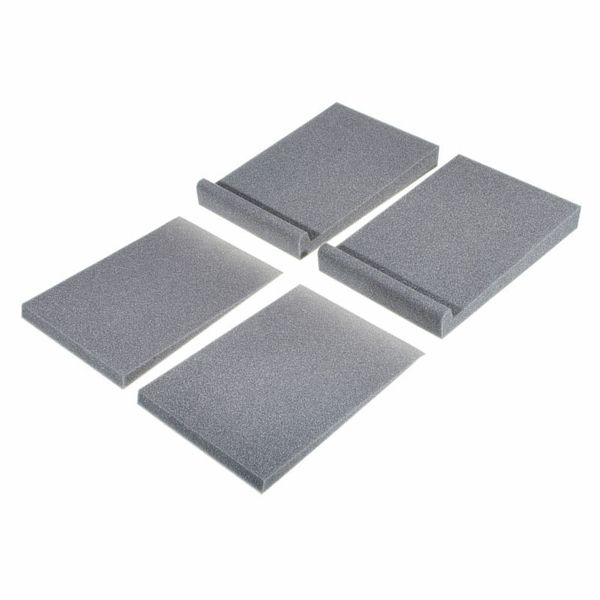
The ISO-Pad 6 is the version of the ISO-Pad system for producers running monitors in the 6-8 inch range. The physical difference from the ISO-Pad 5 is not just load rating — the pad surface is larger to properly support the base footprint of bigger monitor cabinets, which matters for stability as much as for decoupling effectiveness. A pad that’s undersized for a monitor’s base sits the cabinet on a smaller contact area, concentrating the load and increasing the risk of the monitor shifting if the desk is disturbed.
t.akustik ISO-Pad 6 is a decoupling pad for acoustic isolation of studio monitors consisting of two components for horizontal and 4°/8° angled positioning, with an increased load capacity matched to larger monitor cabinets. The same tilt system as the ISO-Pad 5, scaled up to the footprint and weight of 6-inch and 8-inch monitors.
- Sized for 6–8 Inch Monitors
The larger surface dimensions support the wider base footprint of 6-inch and 8-inch studio monitors fully, preventing the front-to-back overhang that creates an unstable resting position when a 5-inch pad is used under a larger monitor. Stable contact across the full base footprint also maximises the decoupling surface area, which improves the effectiveness of the vibration absorption.
The practical test for sizing is whether the monitor’s base sits fully within the pad’s surface. If the monitor overhangs the pad on any side, move up to the next size.
- Same Tilt System as ISO-Pad 5
The two-component tilt system carries over from the ISO-Pad 5 — flat, 4 degrees, and 8 degrees, achieved by combining the base and wedge components at different orientations. For producers upgrading from 5-inch to 6-inch or 8-inch monitors who are already familiar with the ISO-Pad system, the ISO-Pad 6 is the direct upgrade path without any learning curve.
The consistency of the product system means mixing pad sizes across a stereo pair — one monitor needing the ISO-Pad 5 and one the ISO-Pad 6, for example — doesn’t affect the tilt angle options available, since both use the same two-position wedge approach.
- Upgrade Path From the ISO-Pad 5
Producers who started with the ISO-Pad 5 on smaller monitors and have since moved to larger cabinets will find the ISO-Pad 6 performs identically in terms of setup and adjustment. The upgrade is straightforward and the acoustic outcome — reduced desk coupling, cleaner low-end monitoring — is the same as with the smaller version, scaled to the monitor size.
4. EQ Acoustics AirSpace MonPads
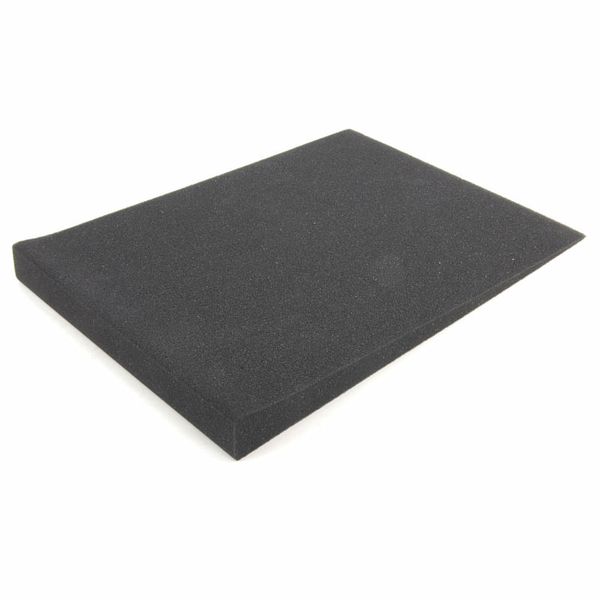
The AirSpace MonPads take a different approach to decoupling from the foam pad alternatives. Instead of foam compression absorbing the vibration, the AirSpace system uses a layered structure with an air gap — the principle being that an air layer between the monitor and the supporting surface provides a degree of acoustic isolation that dense foam cannot, because air transmits very little vibration energy compared to a solid material at the same thickness. The result is a pad with a more rigid feel underfoot that nevertheless performs well for decoupling because the mechanism is different from foam compression.
EQ Acoustics AirSpace MonPads are absorber plates for studio monitors with a total depth of 330mm, a monitor support surface of 240 × 315mm, inclination inserts for angle adjustment, and priced per pair. The larger support surface covers the footprint of most nearfield monitors without overhang.
- Air-Gap Isolation Principle
The AirSpace construction uses the acoustic isolation properties of an air gap alongside the absorbing material layers. Vibration that passes through a solid material loses very little energy, but vibration crossing an air boundary loses significantly more — which is why the air gap approach produces isolation at lower frequencies than foam pads of comparable thickness.
For mixing in the low-end and low-midrange, where desk coupling causes the most meaningful distortion of the monitoring signal, the air-gap approach provides useful performance at frequencies where basic foam is less effective.
- Inclination Inserts for Angle Adjustment
Included inclination inserts allow the monitor’s tilt angle to be adjusted, similar to the wedge system in the t.akustik ISO-Pads. The inclination options let you correct the high-frequency aim axis without repositioning the monitor stand or shimming the cabinet manually.
The 240 × 315mm support surface accommodates most 6-inch and 8-inch nearfield monitors without overhang, providing full contact across the base footprint for both stable support and maximum decoupling surface area.
- A Different Construction Philosophy
The AirSpace MonPads are the option worth considering when producers have already tried foam pads and want to understand whether a different isolation mechanism produces a noticeably different acoustic result in their specific setup. The air-gap approach and the foam compression approach both reduce desk coupling, but the frequency range where each is most effective differs — and the right choice depends on where the desk coupling is most audible in a given room.
5. IsoAcoustics ISO-130
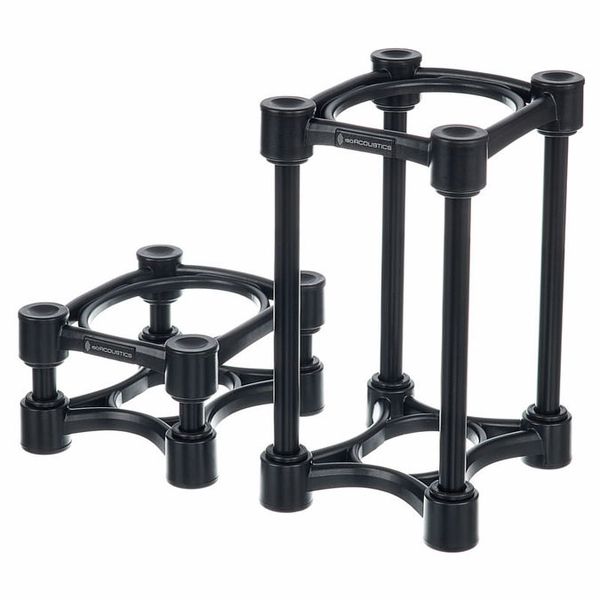
IsoAcoustics builds isolation stands rather than isolation pads — the distinction matters because a stand that isolates also controls the monitor’s height and angle independently, which foam pads can only approximate. The ISO-130 is their entry-level desktop stand for monitors up to about 18kg, with height adjustable from 80mm to 203mm and tilt angle adjustable in both axes. For producers who need their monitors at a specific height and angle that foam pads can’t achieve at the correct load — either because the foam compresses too much or doesn’t lift the cabinet high enough — the ISO-130 is the product that solves both problems simultaneously.
IsoAcoustics ISO-130 is a table stand for speakers and monitors, sold as 2 units, with height adjustable from 80 to 203mm, adjustable inclination, and designed to isolate the studio monitor from the supporting surface while allowing precise positioning. IsoAcoustics’ isolation mechanism uses a proprietary internal construction that decouples the monitor from the stand’s base column, which addresses the resonance path that rigid stands allow.
- Height Adjustment From 80 to 203mm
The 80–203mm height range covers the gap between a monitor sitting on a desk surface and one raised to approximate ear-height listening position on most desk setups. For producers whose desk height and seating position put ear level above where foam pads would place the monitor, the ISO-130 provides the height adjustment that pads can’t offer while maintaining the acoustic decoupling that matters for monitoring accuracy.
The adjustable height also allows stereo pairs to be precisely matched, which is important for maintaining a consistent monitoring height across both monitors when the desk surface isn’t perfectly level.
- IsoAcoustics Isolation Mechanism
IsoAcoustics’ internal isolation design decouples the monitor from the stand’s base through a proprietary mechanism that addresses the resonance path through the stand’s column — a path that exists in conventional rigid stands that have no isolation component. Placing a rigid stand on an isolation pad addresses desk coupling but not stand-column resonance. The ISO-130’s internal isolation addresses both in a single unit.
The practical result is cleaner monitoring than a rigid stand of the same height, particularly in the upper bass and low-midrange where stand-column resonance typically contributes most.
- Adjustable Tilt for Precise Aim
Adjustable inclination in addition to height means the monitor’s high-frequency axis can be aimed precisely at the listening position regardless of height. The combination of height and tilt adjustment covers the full range of desktop monitoring positions without compromise — unlike foam pads where tilt and height are fixed by the pad’s geometry, the ISO-130 lets both be set independently.
6. IsoAcoustics ISO-430
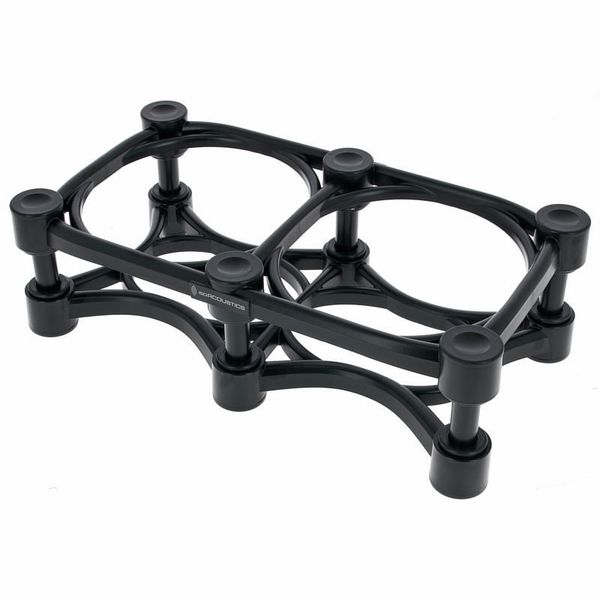
The ISO-430 is the IsoAcoustics stand for larger monitors and the situations where the ISO-130 reaches its load or size limits. It handles up to 45kg, accommodates monitors with larger base footprints — 430 × 230mm — and provides tilt adjustment up to 6.5 degrees. For producers running 8-inch monitors or larger nearfields that exceed the ISO-130’s specifications, the ISO-430 covers the same performance goals at the appropriate scale. It also works for guitar and bass amps where isolation from the floor or a stage is needed, which is a secondary use case worth noting for producers who record amplified instruments.
IsoAcoustics ISO-430 is a decoupled stand for loudspeakers, monitors, guitar and bass amps with a tilt angle up to 6.5 degrees, a maximum load of 45kg, and dimensions of 430 × 230 × 90mm. The IsoAcoustics isolation mechanism scales across the product range, so the decoupling performance principle is the same as the ISO-130 at a footprint and load capacity appropriate for larger cabinets.
- 45kg Load Capacity for Large Monitors
The 45kg maximum load covers virtually all nearfield studio monitors including the larger 8-inch units that push past the ISO-130’s practical ceiling. Using a stand rated well above the monitor’s actual weight means the isolation mechanism operates within its optimal load range rather than at its limit, which maintains decoupling effectiveness over time as the stand settles into position.
For producers running high-end nearfields in the 15-25kg range, the ISO-430’s generous load margin is the appropriate match.
- 430mm Support Width for Large Footprints
The 430mm platform width accommodates the wider base footprints of larger monitor cabinets without overhang. A monitor whose base extends beyond the stand’s platform creates an unstable contact condition and a lever moment that the stand has to resist — which compromises both stability and isolation effectiveness.
The 430mm dimension matches the base widths of most 8-inch nearfield monitors at the maximum end of the home studio range.
- Dual Use for Amps and Monitors
The ISO-430’s load and size specification also makes it usable for guitar and bass amplifiers where isolation from a wooden stage or concrete floor matters for the recorded tone. Stage coupling is the same problem as desk coupling in a different context — vibrations from the speaker travel into the floor, excite the room’s acoustic modes, and feedback into the amplifier’s cabinet as additional acoustic energy.
For producers who record guitar or bass amplifiers and want to improve the consistency of their recorded tone, the ISO-430 provides the same decoupling benefit for an amp that it does for a studio monitor.

Hello, I’m Viliam, I started this audio plugin focused blog to keep you updated on the latest trends, news and everything plugin related. I’ll put the most emphasis on the topics covering best VST, AU and AAX plugins. If you find some great plugin suggestions for us to include on our site, feel free to let me know, so I can take a look!