

This isn’t a collection assembled from acquisitions or rushed releases: every tool in it reflects a coherent set of priorities around warmth, character, and musical behavior, and that shared sensibility is what makes the Effect Rack feel like a cohesive creative environment rather than a random assortment of processing tools.
The collection covers fourteen plugins spanning distortion, delay, filtering, modulation, pitch effects, tremolo, panning, compression, EQ, and more.
I think what distinguishes Soundtoys from other effects developers is that their tools consistently have a point of view: they make things sound more interesting rather than simply more processed, and there’s a specific warmth and musicality to their character that you can often hear even at subtle settings. Unlike other great plugin bundles that throw in as many tools as possible to justify the price, Soundtoys clearly prioritized character and coherence over count, and it shows.
For producers who work across multiple genres and want effects with genuine personality, the Effect Rack is worth the investment. The breadth of the collection means you can build an entire effects chain from it without reaching outside it, and the quality of each individual tool means you won’t be settling when you do.
Crystallizer
Granular pitch-shifting echo is not a category that most producers have dedicated tools for, and that gap in most plugin collections is exactly what Crystallizer fills. It takes incoming audio, granularizes it, pitch-shifts the grains, and feeds them back through a delay line in ways that create shimmering, pitch-transformed echoes that range from subtle harmonic shimmer through to heavily transformed, reversed, and transposed echo textures.
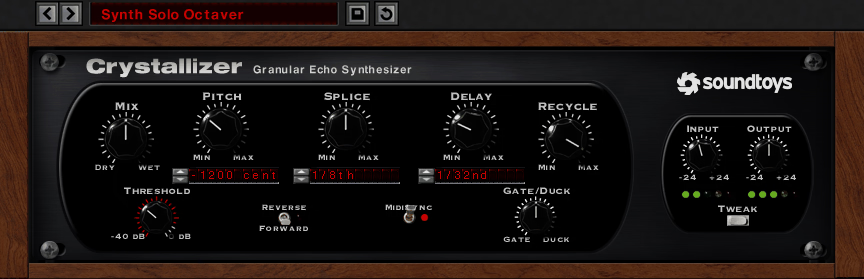
- Granular pitch shifting applied to the delay echoes rather than to the dry signal, so the transformation lives in the echo tail rather than the source
- Pitch interval control for setting how much the echoes are transposed up or down relative to the input, from unison through to octaves and beyond
- Reverse mode that reverses the grains for the specific backwards-swelling quality that makes pitch reversal effects sound like they’re building toward something rather than decaying away from it
- Feedback control for building cascading, cascading layers of pitch-shifted echoes
I love how Crystallizer sits in a creative space that’s genuinely its own: it’s not quite a standard delay, not quite a reverb, and not quite a harmonizer, but something that combines qualities of all three in a way that’s immediately recognizable once you’ve heard it.
Decapitator
Analog saturation and distortion is one of the most contested plugin categories, and the one that most justifies its reputation in Soundtoys’ collection is Decapitator. It models five different analog saturation styles from real hardware sources, covering the spectrum from clean, warm tube saturation through to aggressive transformer overdrive and harsh transistor clipping.
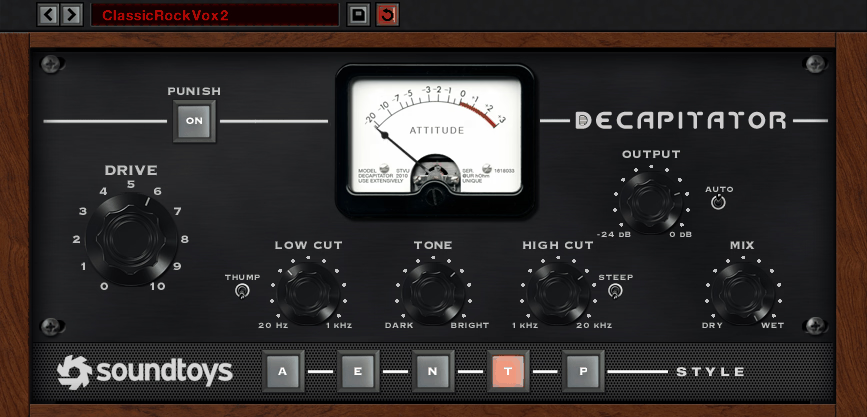
- Five saturation styles labeled A through E and T, each derived from a different hardware circuit with genuinely distinct harmonic character
- Drive and tone controls for adjusting how aggressively the saturation engages and how the output frequency response is shaped before and after the distortion
- Punish button that adds extreme gain and a high-pass filter for aggressive, focused distortion rather than full-spectrum saturation
- Mix control for parallel processing, blending the saturated signal with the dry input at any ratio
For me, Decapitator is the most broadly useful plugin in this bundle because subtle analog saturation is something almost every track benefits from, and the range of styles covers applications from gentle warmth on a mix bus through to deliberate distortion as a creative effect.
Devil-Loc Deluxe
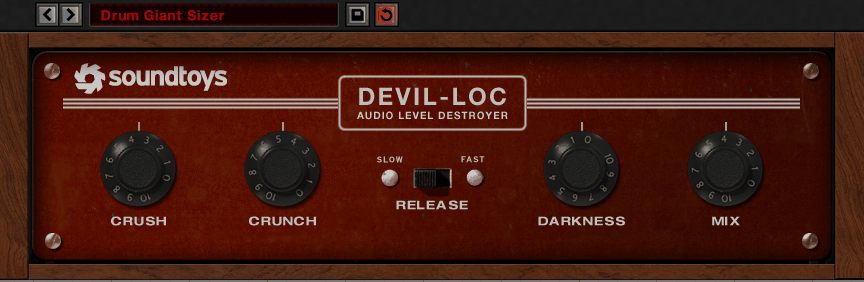
Compression with deliberate coloration and aggression rather than transparency is what separates Devil-Loc Deluxe from the clinical dynamics processors in most mixing toolkits. It’s based on the Shure Level-Loc, an early solid-state limiter that was never designed for transparency and became beloved specifically for its ability to destroy dynamic range in a musical and characterful way.
- Crush control for setting how aggressively the compressor clamps down on transients, from heavy squashing through to complete dynamic annihilation
- Sustain control that adjusts the release time and the way the compression tail behaves, from punchy and fast through to swelling and sustained
- Tone control for shaping the coloration the compressor adds to the signal
- Blend control for mixing the heavily compressed signal with the original in parallel, preserving transient clarity while adding the compressed character underneath
I believe Devil-Loc Deluxe is the right tool specifically for drums and percussion where you want the specific character of overdriven compression adding density and presence rather than a transparent compressor managing peaks.
EchoBoy
The most comprehensive and most widely used delay plugin in the collection is EchoBoy, and its position as the primary delay tool in so many professional setups reflects how much sonic ground it covers. It models over thirty different analog and digital delay hardware units with genuine character differentiation between them, from the specific warmth of tape delay through to the clean precision of early digital delays and the gritty character of older solid-state echo units.
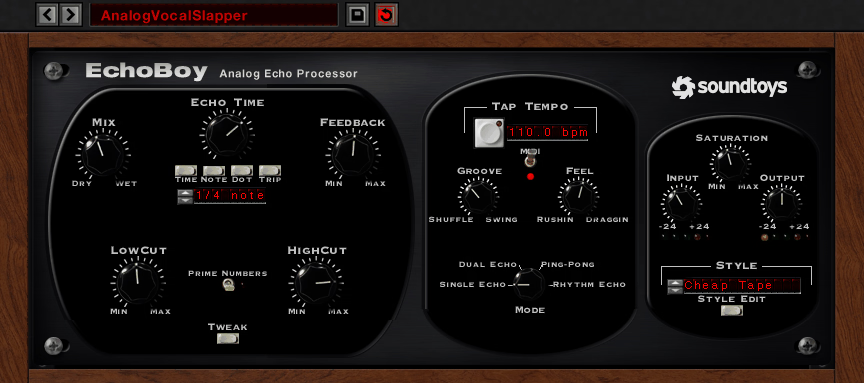
- 30+ echo styles modeled from specific hardware units, each with distinct frequency response, saturation, and timing behavior
- Single, dual, ping-pong, and rhythmic modes for configuring how the delays are arranged in the stereo field and how the left and right channels relate to each other
- Groove control for introducing timing variation and swing to the echo repeats, making them feel less metronomically perfect and more like a performance
- Saturation, filtering, and modulation per echo style that reflects the specific circuit character of the hardware being modeled
I have to say EchoBoy is one of the few delay plugins where switching between different styles produces results that are musically distinct rather than superficially similar, and that breadth of character is what makes it a tool you keep returning to for different applications rather than settling into one setting.
Also, you get a streamlined version of EchoBo – EchoBoy Jr. It provides access to the same echo styles and core functionality with a simplified interface that trades the full depth of controls for faster workflow on tracks where you want the delay character without spending time dialing in every parameter. The same hardware-derived echo styles are available, just in a more immediate format.
I’d say EchoBoy Jr. is most useful when you’re moving quickly through a mix and need to place delay on many tracks without interrupting the creative flow: you get the character of the full version with a quicker path to a usable result.
FilterFreak
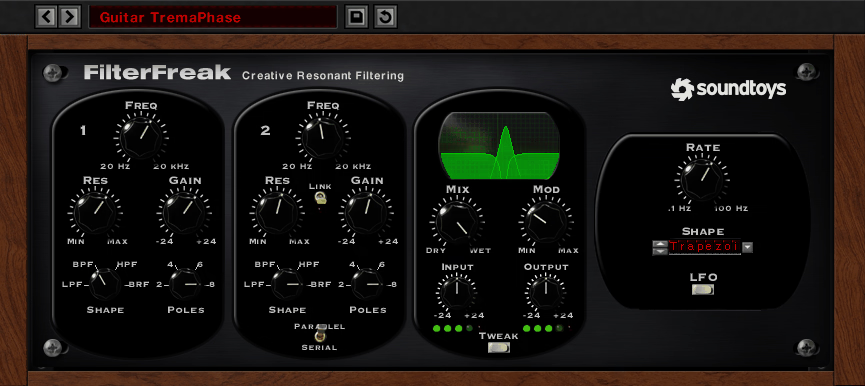
FilterFreak providing a dual-filter configuration that allows series, parallel, and stereo split routing between two independent filter stages. The filters themselves are modeled on classic analog filter circuits with the specific resonance and saturation character that makes filtered audio feel warm and alive rather than clinical.
- Multiple filter modes including lowpass, highpass, bandpass, and notch with the specific resonance behavior of analog circuits
- Rhythm sequencer that applies the filter cutoff modulation in a tempo-synced pattern rather than a continuous LFO sweep, creating rhythmic filter movement that locks with the groove
- LFO modulation in addition to the sequencer for continuous filter animation
- Drive and saturation built into the filter path for harmonic coloring alongside the filtering
- Dual filter routing in FilterFreak 2 for complex filter configurations including series and parallel arrangements
I realized that the rhythm sequencer is what sets FilterFreak apart from a standard filter plugin: the ability to program specific filter movement patterns tied to the tempo creates rhythmic timbral variation that feels composed rather than automated, and that specificity is what makes the results so musical.
MicroShift
Stereo width from pitch detuning and timing offset is a technique with a specific, recognizable character, and the plugin that Soundtoys built to deliver it is MicroShift. It models the specific widening algorithms from the Eventide H3000, which used small pitch variations and timing differences between left and right channels to create a very specific kind of stereo width that’s been used on vocal and instrument production for decades.
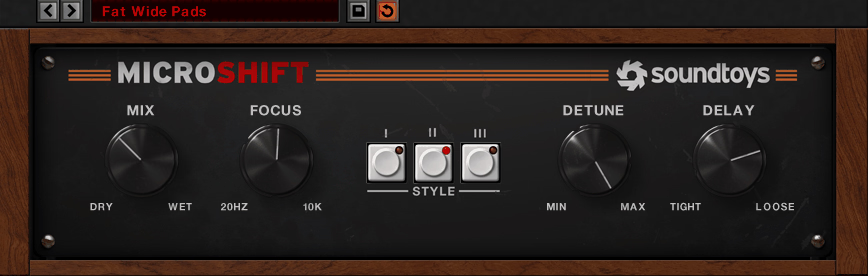
- Three widening styles each derived from a different H3000 algorithm with different width character and tonal coloring
- Detune amount for controlling how much pitch variation contributes to the stereo spread
- Timing offset for adjusting how much of the widening comes from timing differences between channels
- Mix control for blending the widened signal with the mono original
I noticed that the specific character of MicroShift is different from modern stereo wideners in a way that’s immediately audible on vocals: it adds width without sounding processed, and the slight pitch movement gives the widened signal a sense of being alive rather than artificially spread.
PanMan
Autopanning with tempo sync and panning pattern control is what PanMan handles, providing rhythmic stereo movement that can range from subtle continuous motion through to hard-cutting left-right panning effects synced to the project tempo.
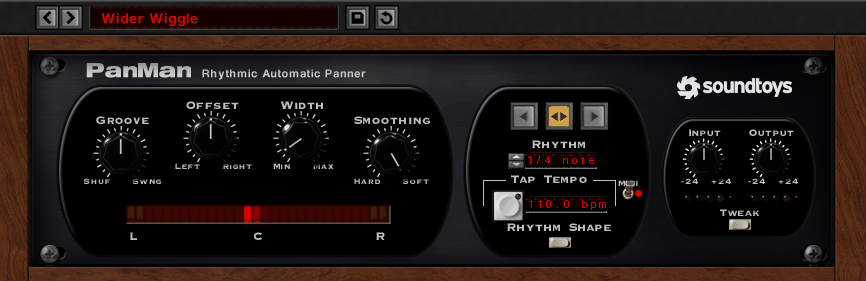
- Multiple pan shapes including sine, triangle, square, and random for different pan movement characters
- Tempo sync with note value selection for locking the panning rhythm to the project BPM
- Rhythm patterns for programmed panning sequences rather than continuous LFO movement
- Stereo width control for adjusting how wide the panning swings between left and right
I suggest PanMan most specifically for electronic music contexts where rhythmic panning movement is a compositional element rather than a mixing decision: it’s the tool you reach for when you want the stereo field itself to have a rhythm.
PhaseMistress

With over thirty phaser modes derived from classic hardware units, the range of phasing character available in PhaseMistress spans from subtle, barely perceptible phase movement through to wide, dramatically sweeping effects that transform the character of any source material significantly. The different modes reflect the different circuit designs of the hardware units they’re modeled on.
- 30+ phaser styles with genuinely distinct character between them
- LFO rate and depth for controlling the speed and intensity of the phase sweep
- Feedback control for increasing the notch depth and making the phase effect more pronounced
- Rhythm patterns for synced, rhythmic phase modulation rather than continuous sweep
In my opinion, the breadth of phaser modes in PhaseMistress is most valuable when you’re trying to match the specific character of a reference rather than just applying a generic phase effect: the hardware-derived modes give you access to specific vintage phaser sounds that matter in context.
PrimalTap
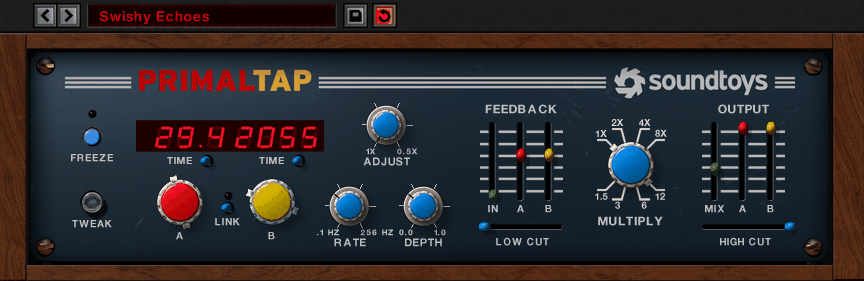
The Lexicon Prime Time is an early digital delay unit from 1978 with a specific character that comes from its limited digital precision and the specific way its memory architecture colors the delay echoes, and the software version of that hardware is PrimalTap. This is a character delay rather than a neutral one: the lo-fi, slightly grainy quality of the echoes is the point, not a limitation.
- Clock rate control that adjusts the internal sample rate of the emulated hardware, changing the fidelity and character of the delay from relatively clean to heavily degraded
- Ramp control for gradually changing the delay time while audio plays through, creating the specific pitch-shifting and warping behavior of physically varying the tape speed
- Freeze mode that captures the current delay buffer content and loops it
- Vintage-appropriate frequency response reflecting the limited bandwidth of the original hardware
I appreciate PrimalTap for the specific application it’s designed for: whenever I want delay that sounds like it came from an early studio recording rather than from modern software, the character is immediately right without any additional processing.
Radiator
Channel strip coloration with the warmth of tube amplifier circuitry is what Radiator provides, modeled on the Altec 1567A tube mixer, a piece of hardware known for the specific harmonic richness and transformer character it imparts to audio passing through it.

- Tube saturation with the specific even-harmonic character of triode tube circuits
- Transformer character that adds the specific frequency response coloration and saturation of the hardware’s transformers
- Drive control for adjusting how much the tube circuit is pushed into saturation
- Mix control for parallel blending with the dry signal
I think Radiator is the subtlest tool in this bundle in terms of what it does, but that subtlety is exactly its value: it adds warmth and presence at very low drive settings in ways that make tracks feel more grounded and physical without sounding processed.
Sie-Q
Vintage EQ character from a hardware unit that was known specifically for how musical its boost and cut curves sounded is what the Sie-Q delivers, modeled on the Siemens W295b equalizer. This is not a precision corrective EQ: it’s a tone-shaping tool whose specific filter curves and saturation character add musical quality to boosts in ways that modern digital EQs don’t naturally replicate.
- Three-band EQ with fixed frequency points that reflect the original hardware’s specific center frequencies
- Proportional Q behavior where the bandwidth narrows as the boost or cut amount increases, automatically focusing as you push harder
- Transformer and tube saturation that colors the signal regardless of whether any EQ is applied, making it a useful tube warmer even at flat settings
I’d say the Sie-Q is most valuable as an add-on character EQ on individual tracks rather than as a primary mixing EQ: it gives you specific tonal character and warmth alongside the EQ adjustment, which is the specific result that vintage hardware EQs are sought out for.
Tremolator
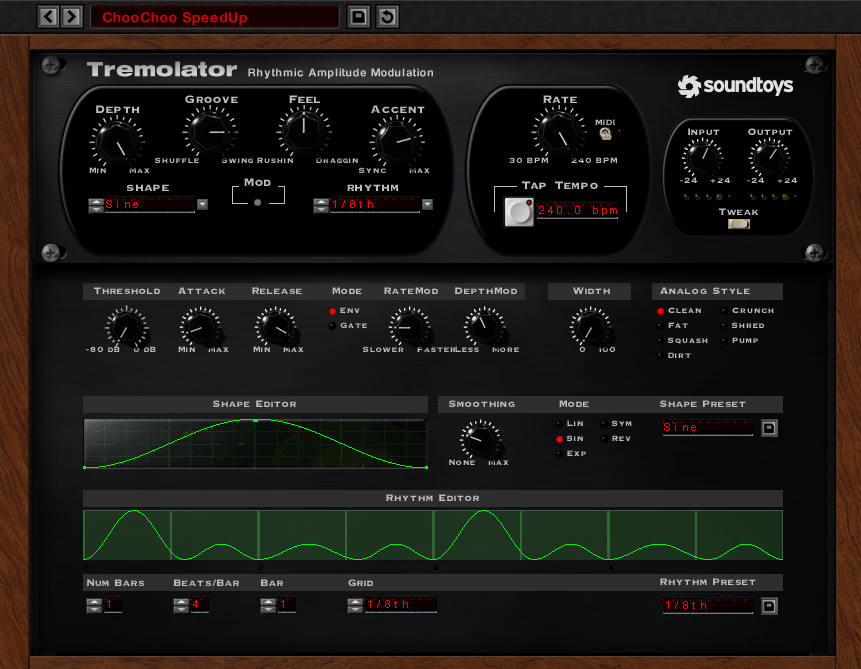
Amplitude modulation with tempo sync and deep pattern control is what Tremolator handles, and what makes it more useful than a simple LFO-based tremolo is the ability to program specific amplitude patterns that create rhythmic volume shapes synced to the tempo rather than simple continuous sine-wave tremolo.
- Rhythm pattern editor for programming specific volume envelope shapes rather than standard LFO waveforms
- Tempo sync with note value selection
- Multiple tremolo shapes including sine, square, and random
- Groove control for adding timing variation to the tremolo pattern
I found Tremolator most compelling on guitars and synthesizers where a programmed rhythmic amplitude pattern creates a sense of groove and motion that continuous LFO tremolo doesn’t produce, because the specific shapes you can program create a more compositional quality to the effect.
Final Thoughts
What gives this collection its coherence is a consistent set of priorities across all fourteen tools: warmth, character, and musical behavior over clinical precision. You can load any Soundtoys plugin and reasonably predict that the result will feel organic and musical rather than processed and artificial, and that consistency of character is what makes the Effect Rack feel like a unified creative environment rather than an assortment of unrelated tools.
The hardware heritage running through the collection also means these tools have a specific connection to the sound of recorded music history: the delay characters from EchoBoy, the tube warmth from Decapitator and Radiator, the vintage phasing from PhaseMistress, and the early-digital character of PrimalTap all reference specific pieces of hardware that appear on recordings you’ve heard throughout your life, and that lineage gives the collection a credibility and relevance that purely modern tools don’t automatically carry.
Check here: Soundtoys Effect Rack

Hello, I’m Viliam, I started this audio plugin focused blog to keep you updated on the latest trends, news and everything plugin related. I’ll put the most emphasis on the topics covering best VST, AU and AAX plugins. If you find some great plugin suggestions for us to include on our site, feel free to let me know, so I can take a look!