
There’s something about a spinning reel of tape that no digital system has ever been able to replicate, and I don’t mean that in a purely nostalgic way. I mean that the physics of what happens when magnetic particles align themselves to an audio signal, running at speed over a precision-lapped head, produces a kind of warmth, glue, and natural saturation that engineers have been chasing in software ever since.
These nine machines represent the format at its absolute finest, from the legendary Swiss professional workhorses that defined the 1980s studio sound, to extraordinary new builds that prove the reel-to-reel is nowhere near finished.
Whether you’re a working engineer, a serious audiophile, or someone who just wants to understand why these machines still command so much respect, this list covers the full spectrum.
1. Studer A-800
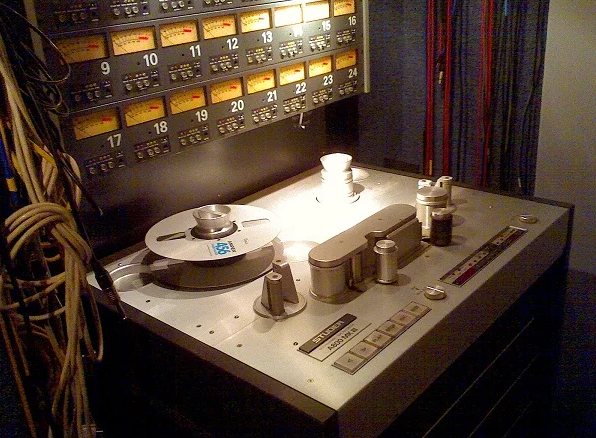
Image credit: Wikipedia
When the Studer A-800 was introduced in 1978, it didn’t just represent an incremental improvement over what came before. It was the world’s first microprocessor-controlled tape machine, and that single fact placed it in a different category entirely from anything that had existed in professional recording up to that point.
I think it’s genuinely hard to overstate how radical that was at the time. Studios were used to purely mechanical transports with analog logic, and here was Studer arriving with a machine that processed every command through a dedicated microprocessor, including local controls, remote controls, and peripheral equipment.
Built in Switzerland from a die-cast chassis with a stainless steel headblock, the A-800 was engineered from the ground up for mechanical stability at the kind of level that only the most demanding multitrack sessions require. The twin half-horsepower spooling motors deliver exceptionally high torque for fast winding and an almost instant reaction time, and the transport responds with a speed and precision that still impresses technicians who work on it today. The whole machine tips the scales at around 900 pounds, which tells you something about the seriousness of its construction.
I love how the A-800’s audio design closely mirrors the logic of its transport electronics. Each channel consists of four printed circuit boards of European standard size: a Record amplifier, a Reproduce amplifier, a Sync amplifier, and an HF driver. That modularity is part of what makes the A-800 so maintainable and so flexible. The Master Bias Setting allows for fast line-up across formats, and the machine is switchable between NAB and CCIR equalization via a master switch. Electronic editing is built in, which was another forward-thinking feature for its era.
In terms of discography, the A-800 is everywhere. Albums by Metallica, Stevie Wonder, Tom Petty, Jeff Buckley, and A Tribe Called Quest were recorded on it, and an A-800 MkIII appears in the opening shot of Guns N’ Roses’ 1988 “Patience” video. Paisley Park Studios ran 8-track A-800 units.
Available in 8, 16, and 24-track configurations using 2-inch tape at speeds of 7.5, 15, and 30 IPS, the A-800 is the definitive multitrack professional tape machine, full stop.
- Microprocessor Transport:
The A-800 was the first tape recorder in history to use a microprocessor for transport control, processing all commands from local, remote, and peripheral sources. This gave the machine its famously fast and precise response, electronic editing capability, and the kind of transport reliability that studios worldwide came to depend on throughout the 1980s and 1990s.
- Die-Cast Chassis and Stainless Steel Headblock:
Mechanical stability in the A-800 comes from an extremely rugged die-cast chassis paired with a stainless steel headblock chassis. The combination resists the kind of micro-flexing under heavy use that compromises head-to-tape contact consistency. At 900 pounds, this machine was built to stay planted and run precisely under every conceivable studio condition.
- Per-Channel Quad-PCB Design:
Every channel in the A-800 runs through four dedicated printed circuit boards: Record, Reproduce, Sync, and HF driver amplifiers. This separation of functions means each stage can be individually aligned, replaced, or upgraded without disturbing the rest of the signal path, which is part of why well-maintained A-800 units still record and play with such cleanliness today.
- Multi-Track Format Flexibility:
The A-800 was available in 8, 16, and 24-track formats, all using 2-inch tape on 14-inch reels at speeds of 7.5, 15, and 30 IPS with NAB/CCIR switchable equalization. The wider track width of the 8-track configuration in particular produces noticeably lower noise and greater fidelity, which is why certain engineers deliberately chose that format over 24-track for specific sessions.
2. Ampex ATR-102
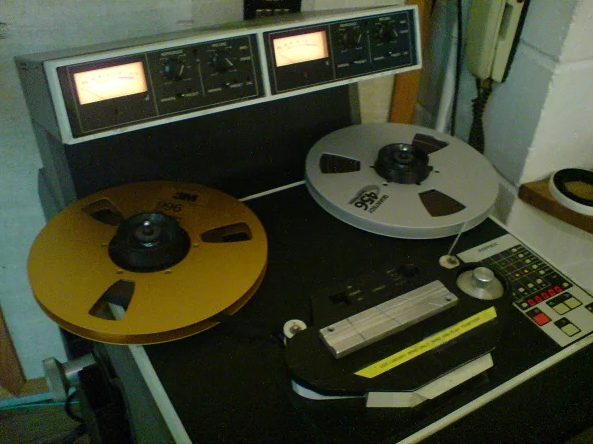
Image credit: Wikipedia
I’d say the Ampex ATR-102 is the machine that mastering engineers reach for when they want the version of tape that’s closest to perfection. Introduced in 1976, it became, in UA’s own description, the “most popular professional 2-track tape machine ever made”, and the case for that claim is nearly impossible to argue with. Its role in recording history is so pervasive that people in the industry half-jokingly say it would be easier to list the classic albums that were not mixed down on an ATR-102 than to enumerate the ones that were.
What made the ATR-102 so revolutionary in its time was a servo-controlled reel motor and capstan system that eliminated the pinch roller entirely. The large capstan without a pinch roller provided nearly non-existent speed drift, with wow and flutter below 0.02%, a figure that remained competitive for decades.
The servo control keeps tape tension smooth and continuous from the first second of playback, and the physical elegance of that solution still draws admiration from engineers who work on the machine.
For me, one of the most interesting aspects of the ATR-102 is how modifiable it is. The interchangeable head blocks allow users to switch between 1/4-inch, 1/2-inch, and 1-inch tape widths in a matter of minutes, with no special tools required.
That 1-inch head modification became a popular “hot-rod” upgrade, especially when running at 15 IPS, because the wider tape captures significantly more signal. Tape speeds include 3.75, 7.5, 15, and 30 IPS, and SNR exceeds 80 dB at 30 IPS (A-weighted). Equalization standards supported are NAB, CCIR, and AES.
- No-Pinch-Roller Capstan System:
The ATR-102’s defining engineering achievement was its large capstan servo drive with no pinch roller, delivering wow and flutter below 0.02%. By eliminating the pinch roller, Ampex removed the primary source of speed instability in conventional tape transports, resulting in tape handling that was smoother, more consistent, and less physically stressful to the tape itself.
- Interchangeable Head Blocks:
Few professional tape machines offer the flexibility of the ATR-102’s swappable head block system, which supports 1/4-inch, 1/2-inch, and 1-inch tape widths via modules that change out in minutes. The 1-inch “hot-rod” configuration at 15 IPS became widely adopted among mastering engineers who wanted the low noise and extended frequency response of wide tape without running at 30 IPS.
- Distortion and Noise Performance:
At its operating level, the ATR-102 holds third harmonic distortion below 0.3% and intermodulation distortion below 0.1%, with an SNR exceeding 80 dB at 30 IPS A-weighted. These figures represent a high-water mark for professional 2-track mastering performance. Combined with the preferred tape formulas of the era, GP9, 456, 900, and 250, engineers had precise control over the color and character of the final product.
- Four Tape Speed Options with Multi-Standard EQ:
The ATR-102 supports 3.75, 7.5, 15, and 30 IPS and is electronically switchable between NAB, CCIR, and AES equalization standards, making it compatible with virtually any professional tape produced across different eras and regions. This combination of speed flexibility and EQ versatility made the ATR-102 equally valuable as a mastering deck and a playback machine for archival and transfer work.
- Servo-Controlled Reel Motors:
Both reel motors in the ATR-102 are servo-controlled, maintaining smooth, continuous tape tension from start to stop rather than relying on mechanical brakes and friction. This servo reel system works in direct coordination with the capstan drive to produce an exceptionally stable and gentle tape path, preserving both the tape and the recorded signal through thousands of operating hours.
- Professional-Grade Output Level:
The ATR-102 delivers a maximum output level of +24 dBm into 600 ohms, which reflects its design intent as a direct-to-console mastering deck. That headroom means the machine can interface with professional mixing and mastering equipment without level compromise or additional gain staging, and the transformer-coupled balanced circuitry maintains signal integrity throughout the chain.
3. TEAC A-3440
Here’s where things get genuinely democratic. The TEAC A-3440 holds a specific and important place in recording history as the first multitrack tape deck aimed directly at the consumer market, and I believe that distinction matters enormously in terms of its cultural impact.
A direct descendant of the A-3340S, which had been built for the quadraphonic market that never quite materialized, the A-3440 took everything TEAC had learned from making professional-standard machines and packaged it at a price that working musicians could actually consider.
The machine runs 4-track, 4-channel on 1/4-inch tape, accepting 7-inch and 10.5-inch reels at 7.5 and 15 IPS. A newly employed CD servo-controlled capstan motor reduced wow and flutter to 0.04% at 15 IPS and 0.06% at 7.5 IPS, which was roughly a third of the A-3340S’s specification and represented a meaningful leap in transport quality. Frequency response reaches 25 Hz to 24 kHz at 15 IPS, with an SNR of 55 dB and THD of 0.8%.
In my opinion, the workflow improvements between the A-3340S and the A-3440 are often underrated. The old Model, Sync, and Monitor switches were reorganized into two cleaner groups: Function and Output select, which significantly reduced the number of switching operations needed to set up recording and sync arrangements.
There’s also a manual cue lever, selective headphone feed that lets you monitor any one or any combination of tracks, and DBX noise reduction loop connections for use with an outboard DBX unit. Home studio recording culture in the late 1970s and early 1980s owes a great deal to this machine.
- First Consumer-Market Multitrack Deck:
The A-3440 was the machine that brought four-track overdub recording within reach of home musicians for the first time in a serious way. TEAC’s experience building the professional-grade Tascam line fed directly into this design, giving the A-3440 a build quality and transport standard that could produce commercially presentable recordings when used well.
- CD Servo Capstan Motor:
The new CD servo-controlled capstan motor brought wow and flutter down to 0.04% at 15 IPS, a figure that would have been considered professional-grade transport accuracy just a few years earlier. This level of speed stability matters in overdub recording because inconsistencies in tape speed between takes are audible and cumulative, particularly on keyboards and synthesized tones.
- Memory Ring Level Controls:
A thoughtful ergonomic detail on the A-3440 was the memory ring fitted to the level controls, which retained the position of a knob when it was turned back down to zero. This let engineers return to a previously dialed-in level without having to look at meter readings or make fine adjustments, a small feature that makes a real difference during active multi-channel recording sessions.
4. Metaxas & Sins Tourbillon T-RX
There is nothing else quite like the Metaxas & Sins Tourbillon T-RX, and I mean that in the most literal sense.
While virtually every other contemporary tape deck on the market is either a refurbished vintage unit or a modest evolution of established design, the T-RX is a completely original, brand-new creation, built from scratch by Kostas Metaxas, an industrial designer and tape recordist based in the Netherlands with nearly four decades of live recording experience using the Stellavox SP-7 and SP-8.
It draws on the SP-8 architecture with the blessing of Stellavox’s Georges Quellet, but it shares almost nothing mechanically with any vintage machine.
The chassis is CNC-machined from a solid block of aluminum with stainless steel mechanisms, giving it a visual presence somewhere between a precision Swiss watch and a piece of contemporary sculpture. That horology comparison is not accidental.
The name “Tourbillon” comes from watchmaking, where a tourbillon is a mechanism designed to counteract gravity’s effect on oscillator accuracy.
Metaxas applied the same concept to tape transport speed regulation through an ARM-CORTEX controller that synchronizes four Maxon motors (two reel, two capstan) plus two linear ACTUONIX motors controlling the dual-capstan retractable bar, making it the first tape recorder to use the tourbillon concept for absolute speed regulation.
The Absolute Sound gave it a 2022 Golden Ear Award, and their reviewer wrote that it was “the highest fidelity audio component I’ve auditioned,” adding that when fed a spool of pre-recorded tape it came closer to recreating the absolute sound than any other playback medium extant.
For me, that kind of critical response, from someone with decades of reference-level listening experience, carries real weight. Specs include a frequency response of 30 Hz to 20,000 Hz (±2 dB), SNR of -67 dB at 38 cm/s, and speeds of 7.5, 15, and 30 IPS with native 10.5-inch reel capacity requiring no adapters. Pricing sits at approximately $36,000 to $49,000 depending on configuration.
- ARM-CORTEX Motor Synchronization System:
The T-RX uses an ARM-CORTEX controller to synchronize four Maxon high-torque motors across both reels and both capstans, with two additional ACTUONIX linear motors managing the dual-capstan bar. This coordination system, borrowed conceptually from precision watchmaking, maintains absolute tape speed accuracy by continuously compensating for load variations across the entire tape path rather than relying on a single drive point.
- Solid Aluminum CNC Chassis:
Every structural element of the T-RX is machined from a solid aluminum billet, with milgauss-grade stainless steel mechanical parts. This is not assembly-line manufacturing; each machine is built to a standard more commonly associated with precision instruments than audio equipment, and the tolerance levels of the resulting mechanism are reflected directly in the machine’s measured stability and the subjective quality of its playback.
- Portable Design with Battery Operation:
Unlike virtually every professional-grade machine on this list, the T-RX is fully portable, with a dedicated carrying case and an external battery box for on-location recording. This was a core design requirement from Metaxas, who has used portable tape recorders for live concert capture throughout his career. The portability does introduce one practical note: you must mute your preamplifier when switching the external power supply on or off to avoid transient pops through the speakers.
- Native 10.5-Inch Reel Compatibility:
Where the Stellavox SP-8 that inspired the T-RX’s architecture required adapters to handle 10-inch reels, the T-RX accepts 10.5-inch reels natively with no modifications required. The proprietary “Hubba Hubba” reel mounting system holds reels securely with a two-part flanged mechanism, though on occasion tight-fitting reels may require partial disassembly to seat correctly.
5. AKAI GX-635D
I feel like the AKAI GX-635D doesn’t get enough credit in discussions of reel-to-reel history, and that’s partly because its descendants, the GX-636, GX-646, and GX-747, tend to get most of the attention. But I’d argue the 635D is the most important of all of them, because it’s the one that established the template.
Released in 1979, it was very likely Akai’s first tape recorder with IC logic-controlled tape function controls, marking a shift from purely mechanical transport switching to the kind of electronic logic that made operation cleaner, more reliable, and more responsive.
The defining characteristic of the GX-635D, and the feature Akai built its later reputation on, is its symmetrical six-head Glass Crystal design with all six heads arranged to permit both recording and playback in both directions.
The GX Glass Crystal heads are legendary in the collector community for their durability. Unlike conventional metal heads that gradually wear down with use, the GX heads resist wear to a degree that technicians still marvel at on units that are now 45 years old. The machine weighs in at 46 pounds and runs at 3.75 and 7.5 IPS on a 4-track, 2-channel stereo format with 7-inch and 10.5-inch reel compatibility.
I must say the motor design is also worth highlighting. The capstan uses a frequency-controlled AC servo direct drive motor, while the reels run on AC eddy current outer rotor direct drive motors. Critically, there are no rubber belts or idlers anywhere in the motor system, which eliminates the noise, vibration, and long-term degradation that belt-drive systems inevitably introduce.
One servicing note worth mentioning for prospective buyers: the 2SC458 transistors in the mic input channels are known to corrode after approximately 40 years, and a thorough restoration will typically replace all 24 of them.
- Six-Head Bidirectional Glass Crystal Design:
The GX-635D uses a symmetrical six-head layout with Akai’s proprietary Glass Crystal (GX) heads that allow recording and playback in both tape directions simultaneously. The GX head material was chosen specifically for its hardness and resistance to wear, and units from the late 1970s are regularly found with heads that remain well within specification after decades of use.
- All Direct Drive Motor System:
With a frequency-controlled AC servo DD capstan motor and AC eddy current outer rotor DD reel motors on both supply and take-up, the GX-635D has no rubber belts, no idlers, and no mechanical friction points in its drive system.
This design choice means the transport maintains consistent tape speed and tension without the maintenance overhead of belt replacement and produces measurably lower vibration during operation.
- IC Logic Control and Auto-Reverse:
The GX-635D was almost certainly Akai’s first open-reel machine with IC logic-controlled transport functions, featuring full auto-reverse, recording mute, a programmable record timer, and pitch control.
The oil-damped tension arms with lock mechanisms for easier tape threading complete a transport design that is considerably more refined than anything Akai had built before it.
- Memory Ring Level Controls and Mic/Line Mixing:
Like the TEAC A-3440, the GX-635D fitted memory rings to the level controls so that settings were retained when a knob was turned down. Independent mic and line input selectors allowed both sources to be mixed during recording, and the complete absence of belts or idlers in the drive system meant that the sonic consistency users were dialing in on those controls actually stayed consistent from session to session.
- Founding Architecture for an Entire Design Lineage:
The GX-635D was not just a single product. It was the template from which Akai derived the GX-636, GX-646, and GX-747, all sharing the same GX heads, the same SCM-200 and XO-24TD motors, and the same fundamental transport design.
This design lineage was commercially successful at a level that only the Teac X-1000 series could match in the same price range and era, which tells you something about how correct the underlying engineering decisions were.
6. Pioneer RT-909
For me, the Pioneer RT-909 is the machine that best represents what the late-1970s consumer reel-to-reel format could genuinely achieve when a manufacturer committed to doing it right.
Produced from 1979 until 1984, it was Pioneer’s top-of-line open-reel deck and, notably, an export-only model that sold particularly well in Germany, where it remained in production until 1984, and the United States. It was never offered in Japan’s domestic market, which makes it feel like a machine designed specifically to compete internationally at the highest consumer level.
The transport centers on a closed-loop dual-capstan drive powered by an FG Servo DC motor with frequency-generator circuitry that monitors and corrects rotational deviation in real time. This configuration is what gives the RT-909 its stability reputation.
Two capstans, each flanked by a dedicated pinch roller, are linked by a continuous belt that isolates the tape at the heads from external interference, keeping head-to-tape contact constant regardless of reel load changes or vibration. Lab testing at the time found the RT-909 regularly exceeded its published specifications, with wow and flutter measured at 0.04% and erase ratio figures notably better than claimed.
I noticed that reviewers consistently mention the deep, rich bass sound quality of the RT-909 relative to comparable Akai and Teac machines of the same period, and that’s an observation that holds up when you compare lab measurements. The frequency response at 7.5 IPS reaches 28 kHz (±3 dB), which is exceptional for a quarter-track machine running at that speed.
The logic-based feather-touch transport controls allow seamless transitions between modes without passing through Stop, and ±6% pitch control adds flexible tuning for playback of misaligned recordings.
- Closed-Loop Dual-Capstan Drive:
The RT-909’s transport is built around a closed-loop dual-capstan system with FG Servo DC motor control, maintaining consistent tape path pressure and head contact across both capstans through a single continuous belt.
This configuration reduces flutter to a measured 0.04% at 7.5 IPS and provides mechanical isolation of the heads from reel-motor torque variations, which is a significant contributor to the deck’s sonic character.
- Four-Head Configuration with Reverse Playback:
With four heads, three motors, and a dedicated reverse playback head, the RT-909 supports auto-reverse and auto-repeat playback via a foil sensor system that detects tape end.
The reverse playback head allows continuous unattended operation for extended sessions, and the auto-repeat function can loop a section of tape indefinitely between a counter position and the foil strip, which is particularly useful for ambient playback.
- Fluroscan LED Meter and Logic Transport:
The RT-909’s distinctively styled Fluroscan LED display delivers a clean, readable level indication that holds up better in varied lighting than VU meters of the period.
Combined with the logic-controlled feather-touch transport buttons, it gives the machine a genuinely modern operational feel for its era. The four-digit tape counter, timer start, and azimuth adjustment for the heads are all features that tip the 909 toward semi-professional territory.
- Frequency Response and Practical Performance:
At 7.5 IPS, the RT-909 measures flat from 20 Hz to 28 kHz (±3 dB) with LH tape, which is broader than most quarter-track machines in its class. At 3.75 IPS the response extends to 18 kHz, still competitive for its format.
The combination of this frequency performance with the richness of the hard permalloy record head and dual hard permalloy playback heads produces a sound character that experienced collectors describe as meaningfully different from Akai or Teac machines of the same vintage.
Lab testing also confirmed the RT-909 regularly exceeded its published specifications, with erase ratio figures notably better than claimed.
7. Balfinger M-063 H5
The Balfinger M-063 H5 is the machine that proved, in the most concrete possible way, that brand-new reel-to-reel tape recorders could be built to a genuinely professional standard in the modern era, without compromise, and with a design sensibility that rivals any industrial product of the last decade.
Unveiled at the Hamburg Hi-Fi Show in February 2017, the M-063 represented the first entirely new analog tape machine in approximately 25 years, designed by Roland Schneider, an industrial designer whose background includes wristwatches, lighting, and precision objects, and manufactured entirely within Balfinger’s own facilities in Germany.
I appreciate that Balfinger made everything themselves: the drive motors, servo units, and pickup systems were all developed in-house rather than sourced from existing suppliers.
The result is a machine that feels completely coherent, where every element from the brushless DC disk-rotor motors to the processor-controlled drive system to the massive aluminum chassis with its 23 mm cast ground plate serves the same design intention.
The H5 is the top configuration in the M-063 range, meaning it comes with balanced XLR inputs and outputs, a three-speed three-motor direct drive, 12-inch reel capacity, and switchable NAB/CCIR replay equalization as standard features rather than options.
I found the ergonomic design philosophy particularly thoughtful. Balfinger organized the front panel so that all playback elements sit on the left, recording controls on the right, and drive functions in the center. A large shuttle wheel controls cueing without touching the tape reels, and the overall usability during hands-on operation is excellent.
The machine runs near-silently even in fast-rewind archive mode, thanks to tacho-controlled winding speeds that keep the tape taut and prevent stretching or loop formation. In 4 available finishes (silver with wood, silver with black panels, all-black, and black with wood), the M-063 H5 can also be a centerpiece of any listening room.
- Entirely In-House Motor and Drive Development:
Balfinger designed and manufactured its brushless DC disk-rotor motors, servo units, and drive electronics internally rather than adapting existing components. This means the capstan drive, reel motors, and electronic control systems are all optimized to work together from first principles, producing the kind of mechanical coherence and tape-path stability that’s difficult to achieve when motors and electronics come from different suppliers.
- Three-Speed Three-Motor Direct Drive:
The M-063 H5 runs at 7.5, 15, and 30 IPS (38 cm/s) via a three-motor direct drive system with processor-controlled speed regulation. The capstan drive can be adjusted ±10% in speed, and the machine handles 1/2-inch or 1/4-inch tape on reels up to 30 cm (11.8 inches). The torsionally rigid aluminum chassis minimizes resonance-induced speed variation.
- Tacho-Controlled Winding:
Rather than using fixed-speed motors for fast-forward and rewind, the M-063 uses tacho-controlled winding speeds that adjust continuously to maintain a constant tape tension as the reel diameter changes. This prevents the tape stretching and loop formation that frequently damages archival material on machines with unregulated high-speed winding, which is particularly relevant given the value of the pre-recorded tapes many M-063 owners are playing back.
- Balanced XLR Inputs and Outputs with Level Controls:
The H5 provides both balanced XLR and unbalanced inputs and outputs with adjustable level control knobs for calibration. The balanced connections use the same +4 dBu professional reference standard found in studio environments, making the M-063 H5 directly compatible with professional amplifiers, preamplifiers, and signal processors without level adaptation or transformer matching.
- German Design Award Nomination:
The M-063 was nominated for the German Design Award 2018 alongside Balfinger’s PS 2 turntable, which reflects the seriousness with which the design community took its industrial design credentials. That nomination was not about nostalgia or novelty. It was recognition that the M-063 represents a genuinely distinguished approach to product design in a category that had been dormant for a quarter century.
- Multiple Configuration Tiers:
The M-063 line spans from the H1 playback-only deck without on-board electronics, through the H3 with integrated playback and recording electronics, to the H5 as the fully equipped professional flagship with all features standard including NAB/CCIR switchable equalization and 12-inch reel support. The HX configuration offers fully bespoke customization. This tiered approach allows users to enter the Balfinger ecosystem at an appropriate level and upgrade as needed.
8. Analog Audio Design TR-1000
What I find most remarkable about the Analog Audio Design TR-1000 is the story behind it. Christophe Martinez, a French engineer who spent 25 years designing flight-simulator electronics and firmware before spending time at Mulann RTM, the manufacturer of Recording the Masters blank tape, spent four years designing and building this machine from scratch in his garage in Pleumeur-Bodou, a small commune in Brittany.
The result is a machine that The Absolute Sound’s Jonathan Valin described as “outstandingly convenient, beautifully made, and both highly musical and highly realistic sounding.”
The TP-1000 playback version came first, earning a 2024 Golden Ear Award from The Absolute Sound and widespread critical acclaim. The TR-1000 is the record and playback version of the same fundamental platform.
Both machines use tape heads from AM Belgium, the same company that inherited the head technical specifications directly from Studer and Revox when those companies shut down their head manufacturing.
The playback head in the TR-1000 is the same specification as the head used in the Studer A800, A810, A812, A820, and A807, which means its signal capture characteristics are rooted in one of the most respected head designs in professional audio history.
I would recommend this machine to anyone who wants a modern recorder that combines the physical tactility of a traditional reel-to-reel with genuinely current engineering. The transport uses a strain-gauge microprocessor-controlled tape tension system accurate to 0.5 grams, and the whole machine is network-connected via RJ45 Ethernet for remote control via browser, smartphone, or tablet, and for firmware updates over the web.
The external aesthetic stays traditional, with dancing VU meters, wooden cabinet panels, recessed side handles, and physical transport buttons, while the lower-right touchscreen display handles advanced settings and diagnostics.
- Strain-Gauge Tape Tension Control:
The TR-1000’s tape path is managed by a strain-gauge microprocessor system that measures and corrects tape tension to within 0.5 grams of accuracy in real time. This precision in tension control is what RX Reels described as treating the tape “with utmost care,” and it prevents the pitch instability and mechanical stress that affect many vintage decks. The system works in coordination with DC servo and belt-drive motors from Swiss manufacturer Maxon.
- AM Belgium Studer-Heritage Tape Heads:
The record and playback heads in the TR-1000 come from AM Belgium, who inherited the original Studer and Revox head specifications when those manufacturing lines closed. The cylindrical head geometry with large contact area reduces head wear and low-frequency head bump while keeping the gap parallel for consistent wear over time. This is not a compromise. These heads are built to a spec that professional studios relied on for decades.
- RJ45 Network Control and Firmware Updates:
Rather than a traditional remote control, the TR-1000 includes an RJ45 Ethernet interface that allows the machine to be controlled from any web browser, smartphone, or tablet on the same network. The same interface delivers over-the-air firmware updates, meaning the machine’s behavior can be refined and expanded by the manufacturer as needed without requiring physical service.
- Touchscreen with Advanced Playback Parameters:
The touchscreen display in the TR-1000 provides access to speed settings in IPS, equalization format selection between NAB and IEC, tape tension adjustment, impedance settings, and automatic tape length calculation based on entered reel diameter. That last feature is particularly useful: when the machine knows the tape length, it can gradually reduce winding speed as it approaches the end of the tape, preventing the sudden stop and potential snap that causes damage on machines without this awareness.
- Switchable 15 and 30 IPS with Automatic Rewind-and-Play:
At 15 IPS the frequency response extends from 30 Hz to 22 kHz (±2 dB), and at 30 IPS it reaches 22 kHz with even greater headroom. The machine supports a user-configurable auto rewind and play mode where, upon reaching the end of a tape, it automatically rewinds and begins playback again, a practical feature for archival listening sessions and events where unattended operation is desirable.
9. Sony TC-765
I realized while researching this list that the Sony TC-765 deserves a specific kind of recognition: it’s the machine that Sony chose to make last. When Sony exited the reel-to-reel market, the TC-765, introduced in 1977 and sold through the early 1980s, was the final chapter. That makes it both a technical culmination and a closing statement, and I think Sony handled that exit with more grace than is usually acknowledged.
The TC-765 is a quarter-track, 4-channel stereo machine running at 3.75 and 7.5 IPS, with a closed-loop dual-capstan drive powered by an AC servo-controlled capstan motor.
Three heads and three motors support the standard professional configuration of separate erase, record, and playback heads. Frequency response at 7.5 IPS extends from 30 Hz to 25 kHz, and SNR reaches 61 dB on FeCr tape. THD is specified at 0.7%, and wow and flutter measures 0.04% at 7.5 IPS, which is a serious figure for a consumer-market machine.
One thing that genuinely sets the TC-765 apart from much of what Sony built during the 1970s is its engineering restraint. A technician who has worked on both noted that Sony typically used significantly more components than necessary in their circuit designs, but the TC-765 kept the electronics lean and straightforward.
The preamp section folds down for access without disassembly of the entire machine, making servicing unusually straightforward. The high-performance Ferrite heads are effectively immune to wear at normal use levels.
The separate 3-way bias and equalization selectors allow precise calibration for different tape formulations, which explains why users running FeCr tape report particularly strong results. It weighs 58.5 pounds and was sold new in the UK for £579 in 1978.
- Closed-Loop Dual-Capstan with AC Servo Motor:
The TC-765 uses a closed-loop dual-capstan drive with an AC servo-controlled capstan motor, the same configuration that made the Pioneer RT-909 and Sony’s own TC-880-2 so well regarded for speed stability. The dual-capstan path isolates the heads from reel tension variation and maintains consistent tape-to-head contact across the full range of recording and playback conditions.
- High-Performance Ferrite Heads:
Sony specified high-performance Ferrite heads for the TC-765, and the collector community’s experience confirms that these heads outlast conventional metal heads by a very significant margin.
The Ferrite material resists wear at a level that means heads in properly maintained TC-765 units are routinely found fully within specification after 45 years of periodic use, with frequency response good to 24 kHz at 7.5 IPS on well-maintained examples.
- Three-Way Bias and EQ Selectors:
The separate 3-way bias and equalization selectors allow the TC-765 to be precisely calibrated for different tape formulations, including the iron-oxide, chromium dioxide (CrO2), and iron-chromium (FeCr) tapes available at the time of its production.
This flexibility, combined with the serviceability of the electronics and the longevity of the Ferrite heads, is why the TC-765 remains one of the most practically usable vintage decks at a reasonable market price today.
- Direct Coupling of Playback Head to First Amplifier Stage:
One of the more interesting circuit decisions in the TC-765 is the direct coupling of the playback head to the first stage of the amplifier, eliminating coupling capacitors from the signal path at the most critical point.
This design choice reduces phase distortion and extends low-frequency response at the input stage, and it’s the kind of detail that explains why the TC-765 sounds cleaner and more extended than its specifications might suggest on paper.
- Serviceability-First Electronics Layout:
Sony engineers built the TC-765 with maintenance in mind in a way that was unusual for a consumer product of its era. The entire preamp section folds down for access without requiring full disassembly, and the overall component count was kept intentionally lean relative to Sony’s typical approach.
One technician noted that while most Sony decks of the period used three transistors where one would suffice, the TC-765 was refreshingly direct in its circuit design, making it one of the easiest 1970s Sony machines to work on.
- Final Reel-to-Reel from Sony:
The TC-765 holds a specific place in history as the last open-reel tape recorder Sony ever produced, introduced in 1977 and sold into the early 1980s before Sony shifted its full attention to the Walkman cassette format.
For a company that had been making tape recorders since the early 1950s and building its reputation on them, the TC-765 was the closing statement on that entire lineage, and I believe it’s a genuinely worthy one.

Hello, I’m Viliam, I started this audio plugin focused blog to keep you updated on the latest trends, news and everything plugin related. I’ll put the most emphasis on the topics covering best VST, AU and AAX plugins. If you find some great plugin suggestions for us to include on our site, feel free to let me know, so I can take a look!