
Shimmer reverb has a very specific and well-documented origin. It comes from a recording session for U2’s The Unforgettable Fire, where producers Daniel Lanois and Brian Eno ran a reverb through an Eventide pitch-shifting unit, feeding the pitch-shifted output back into the reverb and creating a cascading halo of harmonics that seemed to rise infinitely around the source material.
That technique was expensive, fragile, and dependent on having specific hardware in the signal chain at the right moment.
What the plugins on this list give you is access to that same fundamental idea in forms that range from the direct descendant of that original gear to fully modern designs that use the concept as a launchpad for something entirely more adventurous.
If you work in ambient, cinematic, post-rock, shoegaze, or any genre where space and texture are compositional elements in their own right, these are the tools worth knowing.
1. Eventide ShimmerVerb
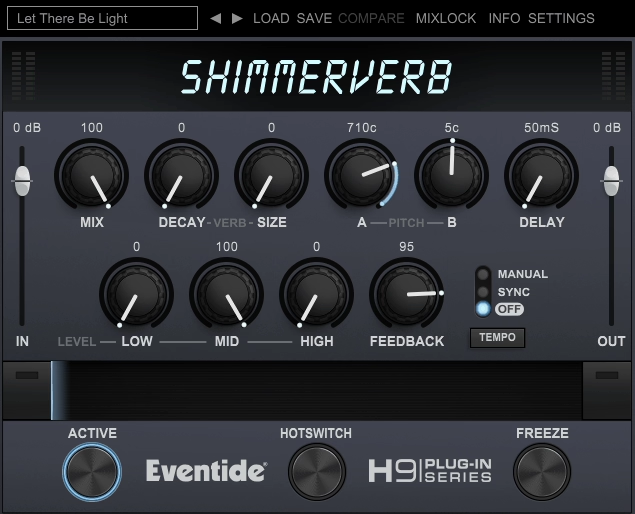
Eventide has as strong a claim as anyone to being the inventors of the shimmer reverb technique. The H910 and H3000 hardware pitch-shifters were the units Lanois and Eno were using to create the effect on U2’s records in the early 1980s, and ShimmerVerb is Eventide’s own software distillation of that legacy into a single plugin.
Ported from the H9 hardware effects platform, it combines an algorithmic reverb with dual parallel pitch-shifters and an EQ-controlled crossover feedback network.
- Dual Parallel Pitch-Shifters in the Feedback Loop:
Rather than pitch-shifting the reverb output and calling it done, ShimmerVerb places two independent pitch-shifters in the feedback loop of the reverb, meaning the pitch-shifted signal feeds back into the reverb input rather than just sitting in the tail.
The result is a cascading shimmer that builds and transforms over time. Each pitch-shifter covers four octaves of range from two octaves down to two octaves up, with MicroPitch tuning available around perfect intervals for very precise harmonic placement.
- Low, Mid, and High Crossover Network:
The feedback section includes a three-band crossover network that determines which frequencies are fed back into the reverb, allowing you to specify whether the bass, mids, or high frequencies of the shimmer are emphasized or suppressed in the feedback path.
This is the level of control that distinguishes ShimmerVerb from simpler shimmer effects, and I found targeting high-frequency content in the feedback while rolling off the lows produces the clearest, most transparent shimmer on guitars and piano.
- The Ribbon Performance Controller:
ShimmerVerb includes The Ribbon, a performance parameter that lets you morph between two completely different sets of plugin settings in real time, assignable to any combination of controls including feedback amounts, pitch values, reverb size, and mix.
Drag horizontally or map to the MIDI modulation wheel, and the plugin transforms in a way that’s genuinely musical rather than just a static A/B switch.
- FREEZE and HOTSWITCH:
FREEZE locks the reverb into an infinitely sustained state, smearing whatever was happening in the tail into a static texture that you can play over the top of.
HOTSWITCH instantly jumps between two stored parameter states within the same preset, making it possible to switch octave settings, toggle pitch-shifters in or out, or change mix level mid-performance without a second plugin loaded.
2. Valhalla Shimmer
The $50 price tag for Valhalla Shimmer has probably made it the most widely used shimmer reverb on the market. Skrillex uses it. Seven Lions has specifically mentioned it as a tool for creating reverb tails into pads. Fred again runs it in his sessions.
The reason for this adoption level is simple: ValhallaShimmer sounds exceptional and remains completely stable, CPU-efficient, and deeply tweakable without ever becoming complicated. Sean Costello at ValhallaDSP spent years developing the core pitch-shifting algorithm, which uses randomization to avoid the comb filtering artifacts that simpler pitch-shifters produce.
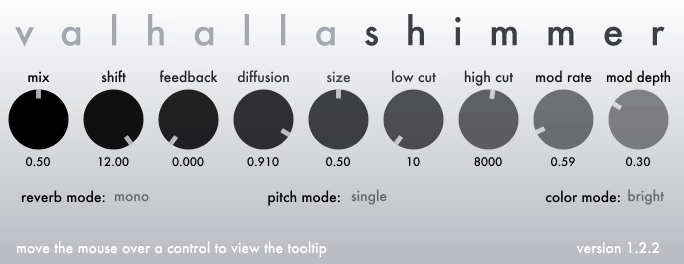
That research shows in the result. Setting pitch to +12 semitones with Feedback at 0.5 or above produces the classic Eno/Lanois shimmer immediately, but the plugin has enough range to go well beyond that into reverse reverbs, orchestral drones, and spring-like spaces.
- Four Reverb Modes:
The four modes Mono, Small Stereo, Medium Stereo, and Big Stereo represent different reverb algorithm sizes and densities, ranging from the very large Mono algorithm that takes a long time to fade in, to the Big Stereo mode that’s the classic setting for the traditional shimmer effect with its randomization-induced noisy sidebands.
Each mode changes the perceived size, the echo density, and the way the pitch-shifted feedback builds in the tail.
- Three Pitch Shift Modes:
Single shifts the feedback signal up or down. Dual shifts both up and down simultaneously, producing a symmetrically voiced harmonic texture that feels more like a small ensemble than a single added voice.
SingleReverse and DualReverse reverse the grains within the pitch-shifting process for a smoother, more organ-like response that is less crystalline and more continuous. The interaction between shift amount and mode defines the entire character of the shimmer.
- Fully Real-Time Automatable Controls:
All nine sliders respond to real-time automation with a smoothed, click-free response specifically designed for live adjustment.
This is not a throwaway feature as it means automating the Feedback or Shift values over time produces musical, gradual transitions rather than stepping artifacts. Diffusion and Size control the attack and sustain of the reverb decay, giving you granular control over how the shimmer blooms.
- HiCut and Color:
A HiCut control trims high-frequency content from the reverb tail when it becomes fizzy or harsh, which happens quickly when using high Shift values or extended Feedback.
The Color switch changes the overall tonal character of the reverb between brighter and darker responses, and at darker settings the shimmer takes on a more subdued, atmospheric quality that works more naturally in dense mixes.
- CPU Efficiency:
Despite the scale of what it generates, ValhallaShimmer is highly CPU-optimized in a way that allows multiple instances across a session without load issues. It runs on every Mac and Windows DAW format including AAX, and the lightweight footprint means you can use it on multiple tracks simultaneously for layered shimmer textures.
- $50 Permanent License:
At $50 with a personal keyfile and no subscription or iLok requirement, Valhalla Shimmer is one of the most straightforwardly acquired professional-quality reverb tools available. There are no tiers, no cloud activation, and no renewal fees. You pay once, you own it.
3. Heavyocity MicroFX Shimmer
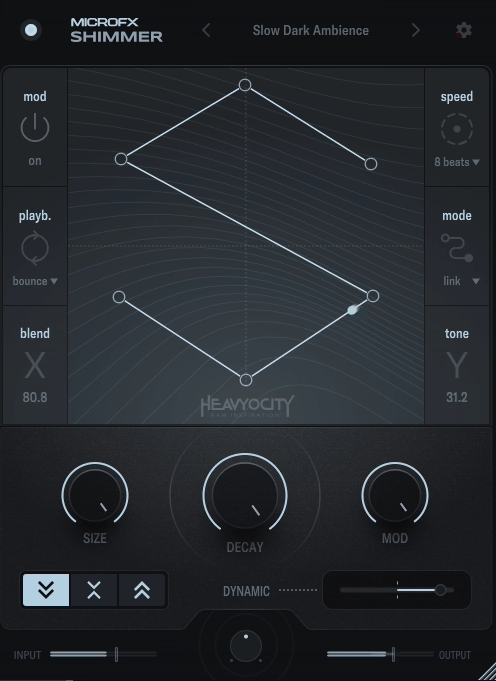
MicroFX Shimmer from Heavyocity takes a very different approach from every other plugin on this list. Rather than giving you an array of detailed parameters to adjust individually, the plugin centers the entire interaction on an X/Y pad where dragging around a single point controls the most critical parameters simultaneously.
It was released as part of Heavyocity’s MicroFX collection in September 2024 alongside a distortion and filter plugin, and the philosophy is speed and feel over depth. I found it to be the fastest shimmer reverb to produce something usable from a blank state, and the animated preset paths give it a genuinely performative dimension that more traditional plugin layouts don’t match.
- X/Y Pad with Shimmer Blend and Tone Control:
The X-axis controls Shimmer Blend, adjusting how much of the pitch-shifted delay is mixed into the reverb. The Y-axis adjusts Tone, shaping the damping and brightness of the reverb tail.
Dragging a single point across the pad simultaneously adjusts both parameters in whatever proportion the position dictates, meaning you can go from subtle shimmer with warm tone to intense shimmer with bright presence in a single gesture. MIDI and mouse control both work.
- Animated X/Y Modulation:
Beyond manual control, the X/Y pad supports animated modulation paths with up to 15 programmable nodes that the cursor follows automatically at a set speed and direction. You can draw simple loops, complex figure-eights, or irregular paths, and the plugin traces them in real time.
This is what makes MicroFX Shimmer genuinely performance-oriented rather than just a set-and-forget shimmer effect, and the variety of movement it introduces to what would otherwise be a static sound is immediately compelling.
- Octave UP, DOWN, and BOTH Modes:
Three pitch modes let you shift the internal pitch-shifter up one octave, down one octave, or both simultaneously for a wider harmonic stack.
The BOTH mode produces the densest, most orchestral shimmer texture and is the most effective for pad thickening and string enhancement. Size, Decay, Modulation, and Dynamics controls below the pad provide additional shaping without cluttering the workflow.
4. Antelope Audio Shimmer
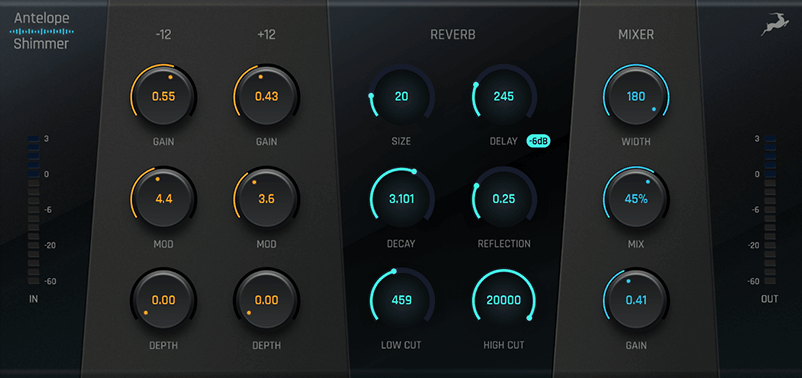
Released as a standalone plugin in Antelope’s Cosmos collection, Shimmer brings Antelope’s analog modeling pedigree to the shimmer reverb concept with a focus on decay length, warmth, and precision frequency shaping of the feedback path.
The plugin offers up to 30 seconds of decay time, which is a genuinely enormous number for a shimmer reverb and puts it firmly in the cinematic scoring and ambient composition territory.
- Up to 30 Seconds of Decay:
Adjustable decay times up to 30 seconds keep the reverb tail smooth and cohesive even at extreme settings, according to Antelope, making it suitable for ambient washes and cinematic swells where other reverbs would either ring out too quickly or become unstable at long feedback settings.
I found the decay behavior at the longer settings to be genuinely smooth rather than artificial-sounding.
- Independent Octave Up and Down Control:
The pitch-shifting section provides precise individual control over both the octave-up and octave-below voices of the source signal, with dedicated level controls for each. This lets you blend the higher harmonic shimmer independently from a lower, darker octave doubling effect, or use just one direction for a more specific tonal result.
- Integrated Delay and Early Reflection Shaping:
Built-in delay controls and reflection shaping tools let you craft the sense of space within the shimmer before the long reverb tail develops, creating a more three-dimensional result than a simple shimmer-into-reverb chain would produce on its own.
- Low and High Cut Filters on the Reverb Tail:
Low Cut and High Cut filters give frequency-specific control over the reverb tail content, keeping bass frequencies from accumulating in the shimmer build-up and trimming harshness from the high end of the pitch-shifted voices. These are practical controls for fitting shimmer into a full mix without having it dominate the frequency spectrum.
5. Tritik Irid
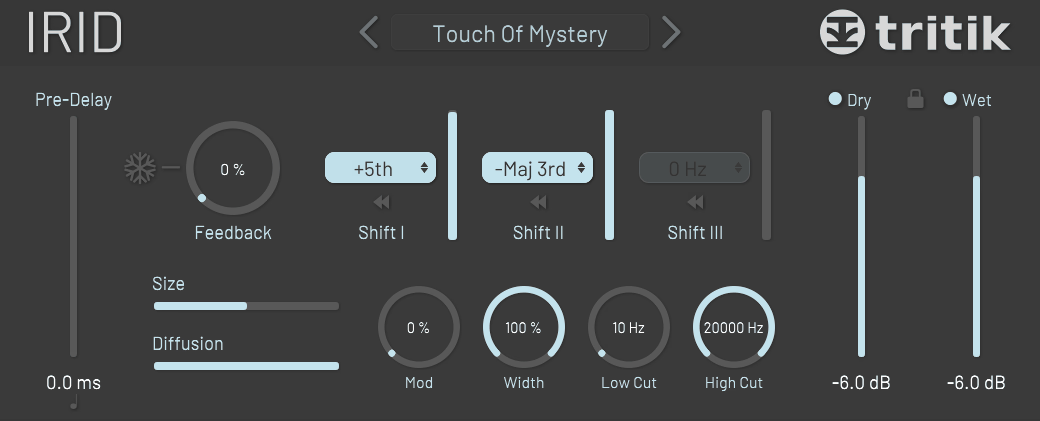
What makes Irid from Tritik different from every other plugin on this list is the addition of a frequency shifter as the third voice alongside two standard pitch-shifters, and the reverse mode available on each individual voice.
Each of the three shimmer voices, two pitch-shifters covering -1 octave to +2 octaves, and one frequency shifter covering -100Hz to +2000Hz, has an independent output level control and a Reverse button that time-reverses the sound grains within that specific voice.
Combining a reversed upper voice with a forward lower voice produces an asymmetric texture that no standard shimmer reverb can approximate, and the frequency shifter’s non-octave-based tuning range is what enables the dissonant and dark ambiances that set Irid apart for sound design work.
- Versatile Reverb Engine:
The underlying reverb is a dedicated algorithmic processor with feedback, size, diffusion, and a syncable pre-delay that can produce sounds ranging from grainy delay-like effects to rich, lush spaces depending on where those parameters sit.
Irid sounds different from other shimmer reverbs partly because the reverb itself has a distinctive character, which reviewers consistently describe as more crystalline and less noisy than Valhalla Shimmer.
- 80+ Presets by Richard Devine and Others:
The factory library includes over 80 presets designed by Richard Devine, emptyVessel, Andrew Madden, and Audilepsy, covering Classic shimmer sounds, Echo-based presets, FX-oriented patches, and complex Texture presets. These cover the full range of what Irid can do and serve both as inspiration and as practical starting points for common use cases.
- Resizable Interface with Touchscreen Support:
As with all Tritik plugins, the interface scales to any size with high-resolution support, and the large knob and slider design makes it comfortable on touchscreens. The layout is minimal and immediately readable even without the manual, which I found notable given how many parameters the plugin actually contains.
6. Flowsonics Intercosm
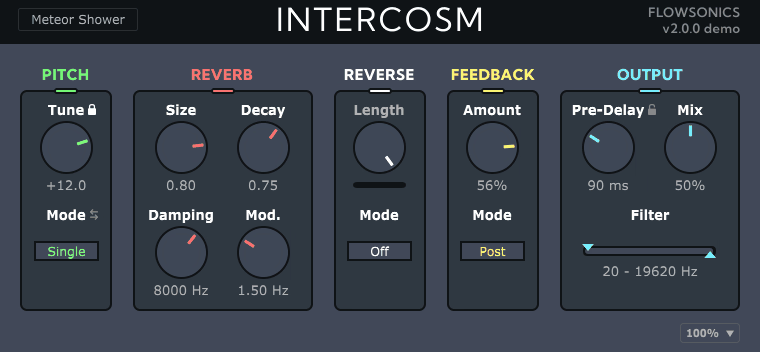
Intercosm from Flowsonics is the most affordable dedicated shimmer reverb on this list at around $30, and it justifies that positioning with a granular pitch-shifting approach that produces results distinctly different from the other options here.
The fundamental architecture sends a pitch-shifted signal into an eight-delay-line stereo FDN reverb, then feeds the output back into the pitch-shifter, either pre or post the reverb, selectable by the user.
That feedback routing option is the key creative decision in the design: Pre feedback creates pitch-shifted delay loops that don’t quite resolve into traditional shimmer, while Post feeding creates the more familiar cascade of harmonic reverb.
- Three Granular Pitch Modes:
Single mode blends the input signal with the pitch-shifted signal cleanly. Inverse mode runs dual pitch-shifters in opposite directions simultaneously. Solo mode outputs only the pure pitch-shifted signal with no dry blend.
These three modes represent genuinely different sound design approaches rather than just different amounts of the same effect, and the inverse mode’s twin opposing pitch-shifts produce a particularly wide, interesting shimmer character.
- Pre and Post Feedback Routing:
Switching between Pre and Post feedback modes changes the fundamental architecture of the plugin: Pre sends the reverb output back into the pitch-shifter before it re-enters the reverb, while Post feeds back after the pitch-shifter re-enters the reverb.
- Audio Reversal with Visualizer:
Intercosm includes three reversal modes like Grains, Input, and Output that reverse the audio at different points in the signal path, along with a visual buffer display and adjustable reversed signal length.
The Grains mode uses square-windowed grain reversal for a glitchy, artifact-heavy texture, while Input and Output reversal use crossfading Hamming windows for smoother results. This is a feature set I haven’t seen in any other shimmer reverb at any price.
- Stereo Eight-Delay-Line FDN Reverb:
The reverb engine is a stereo Feedback Delay Network with eight delay lines offering controls for size, decay, damping, and modulation. The FDN architecture produces a particularly dense and uniform reverb tail that works well as the carrier for the shimmer effect without imposing too much of its own character on the result.
7. IK Multimedia Prism Reverb
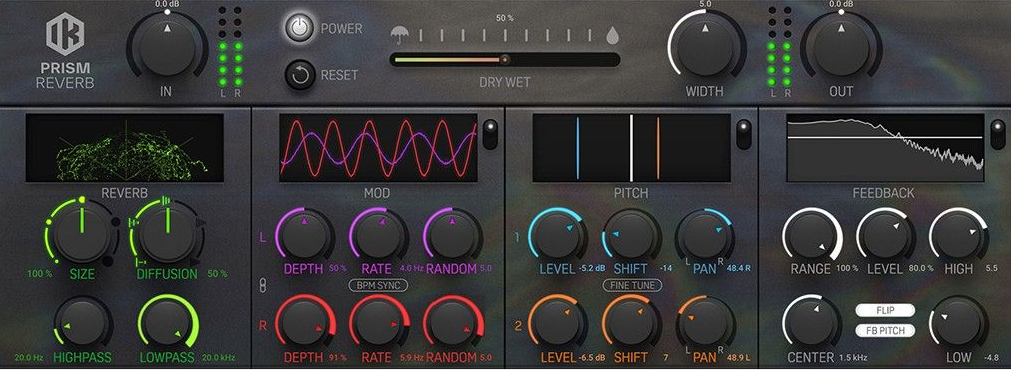
Released in July 2025 as part of the T-RackS 6 suite, Prism Reverb is IK Multimedia’s most ambitious spatial effects design to date.
You get Reverb, Mod, Pitch, and Feedback, each with its own bypass switch, allowing you to engage or remove sections of the effect chain dynamically. Free for owners of T-RackS 6 MAX and Total Studio 5 MAX, making it extraordinarily valuable for anyone already in the IK ecosystem.
- Four-Module Modular Architecture:
The signal flows through Reverb, Mod, Pitch, and Feedback modules in sequence, and each can be bypassed independently. This means you can run the reverb alone, add modulation, engage the pitch-shifters, and then bring in the feedback with separate controls over each stage.
The color-coded visual design makes the signal path legible at a glance, and I found that having named module bypass switches rather than a single wet/dry knob makes experimental sound design considerably more intuitive.
- Independent L/R Modulation per Channel:
The Mod section contains two independent LFO-based modulation paths, one for left and one for right, with Depth, LFO Rate, and optional randomization controls per channel.
Because each channel’s modulation runs independently, the shimmer tail develops asymmetrically in stereo rather than moving in the same phase on both sides. This is the feature that gives Prism its particularly organic, living quality compared to shimmer reverbs with a single shared modulation source.
- Two Independent Pitch-Shifters with ±2-Octave Range:
The Pitch module offers two individually pannable pitch-shifters with a ±2-octave range and ultra-fine tuning down to 1/100th of a semitone, each with dedicated level and pan controls. The extreme fine-tuning resolution is not a cosmetic feature:
- FB PITCH Switch and FLIP Function:
The Feedback module includes a frequency-specific feedback filter with Range and Center controls alongside low and high cut filters, but its most interesting features are the FB PITCH switch, which places the pitch-shifters inside the feedback loop for cascading harmonic regeneration, and the FLIP function, which swaps the stereo channels on each feedback pass.
FLIP is subtle but cumulative: over multiple passes the stereo field of the shimmer subtly rotates and expands in a way that’s immediately audible once you toggle it off.
- T-RackS 6 Shell Integration:
Beyond standalone use, Prism Reverb operates within the T-RackS 6 modular shell, which provides up to 16-processor chains, series and parallel routing, A/B/C/D comparison, and processing up to 192kHz/32-bit floating-point.
For producers who already use T-RackS 6 as a mastering environment, this means Prism Reverb can be incorporated into complex processing chains alongside IK’s compressors, EQs, and limiters in ways that standalone plugin use doesn’t allow.
- Free for T-RackS MAX Owners:
Prism Reverb is free for all registered owners of T-RackS 6 MAX or Total Studio 5 MAX, downloaded via the IK Product Manager with no additional purchase or separate activation required. Standalone it’s priced at around $80 at introductory pricing, climbing to $99 at regular price.

Hello, I’m Viliam, I started this audio plugin focused blog to keep you updated on the latest trends, news and everything plugin related. I’ll put the most emphasis on the topics covering best VST, AU and AAX plugins. If you find some great plugin suggestions for us to include on our site, feel free to let me know, so I can take a look!