
Playing live with MIDI controllers is a completely different animal from studio production. In the studio, you can take your time, redo a take, tweak things with a mouse.
On stage, you need everything accessible, reliable, and fast. The controller has to work in the dark when you can’t read tiny labels, survive being shoved into a gig bag, and give you the kind of real-time expression that makes your performance actually feel like a performance rather than someone pressing play on a laptop.
I’ve seen too many live electronic acts where the performer is just staring at a screen and clicking, and the right controller is what separates those sets from ones that genuinely captivate an audience.
What matters for live use is different from what matters in the studio. You need a keybed that responds to your dynamics in the heat of the moment, controls you can reach without looking, and ideally some kind of arpeggiator, sequencer, or performance mode that generates musical content on the fly.
Portability matters too, because you’re hauling this thing to venues, rehearsals, and sound checks. I’ve put together nine controllers that handle live performance well, from deeply expressive instruments that reimagine what a keyboard can do to compact production controllers that keep your laptop set tight and responsive on stage.
1. Expressive E Osmose
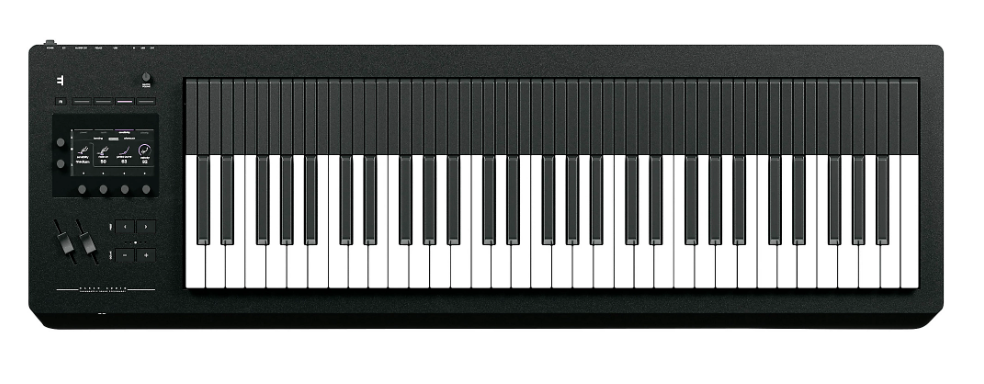
Nothing else on this list plays like this. Nothing else on the market plays like this, honestly. The Expressive E Osmose is a 49-key synthesizer and MPE controller with a keybed that responds to pressure, lateral movement, and initial strike independently per key, turning every note into a three-dimensional expression point. You press a key and the sound responds.
You push it sideways and the pitch bends on that note alone while your other notes stay put. You press harder and the timbre shifts. It’s the closest I’ve felt to playing a truly acoustic instrument on a keyboard.
For live performance, the Osmose changes what’s possible because you stop thinking about controllers and parameters and start thinking about gesture and feel. Your audience sees you physically shaping sound with your hands, which is a fundamentally different visual and musical experience from twisting knobs.
- Poly Expression
The per-key pressure, slide, and strike sensing sends independent expression data for every note you play simultaneously. In practice, this means you can vibrate one note with lateral finger movement while bending another note’s pitch by pressing sideways, all within the same chord.
For live performance, this level of per-note control makes your playing visually and musically expressive in ways that standard keyboards physically cannot achieve. The audience can see your fingers shaping each note differently, and they hear the result immediately.
- Internal Engine
The built-in EaganMatrix synthesis engine means the Osmose functions as a complete standalone synthesizer without any external software. You bring the Osmose to a gig, plug it into the PA, and you have hundreds of deeply expressive patches ready to play.
No laptop, no crash risk, no boot time. For live performers who want the simplest possible signal chain, having the synth engine onboard eliminates an entire category of things that can go wrong on stage.
- MPE Output
The Osmose sends full MPE (MIDI Polyphonic Expression) data over MIDI and USB, meaning you can drive any MPE-compatible software synth with the same per-note expression the internal engine uses.
If your live set runs through Ableton or another DAW, the Osmose controls MPE plugins like Equator, Pigments, or Plasmonic with the full three-axis expression, giving you that same organic expressiveness through your entire software rig.
- Stage Ready
The build quality and compact footprint of the Osmose handle the realities of gigging. It’s sturdy enough for transport, the 49-key format isn’t too heavy to carry, and the controls are arranged so you can reach everything without fumbling in low light. I’ve seen performers take this to club gigs and festival stages, and the physical instrument holds up to the demands.
2. Arturia KeyStep Pro
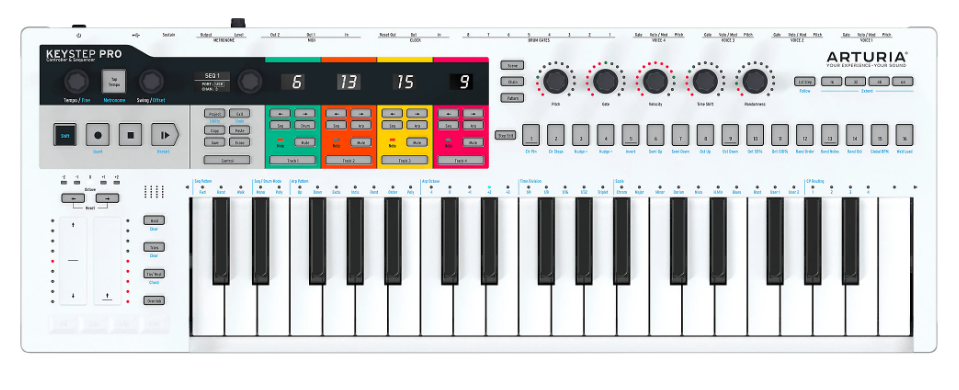
The controller I’d recommend first to anyone running a multi-synth live rig, because the Arturia KeyStep Pro lets you sequence and control four instruments simultaneously from one compact surface.
You have four independent sequencer tracks with their own outputs, a 37-key keyboard with aftertouch, dedicated CV/Gate outputs for analog gear, and an arpeggiator that can drive the whole thing while you perform over the top.
On stage, the KeyStep Pro functions as the brain of your hardware setup. You program your sequences before the show, trigger them during performance, and play live over them from the keyboard. The combination of pre-programmed sequences and live improvisation is what makes electronic live sets actually interesting, and the KeyStep Pro handles both sides of that equation from one device.
- Multi-Track Sequencer
Four polyphonic sequencer tracks running simultaneously let you pre-program bass, chords, melody, and drums as independent parts that you trigger and mute during your live set.
Each track can drive a different synth over its own MIDI channel or CV output, meaning your entire backing arrangement plays from the KeyStep Pro while you perform lead parts live on the keyboard. The ability to mute and unmute individual tracks in real time is your main arrangement tool during performance.
- CV/Gate Array
Four CV/Gate output pairs plus eight drum triggers connect directly to analog synths and drum modules without MIDI conversion. For live performers with analog rigs, the CV connectivity means tighter timing and more reliable triggering than MIDI provides.
The eight drum triggers give your drum modules or Eurorack percussion their own dedicated gate signals, which keeps your rhythmic timing rock solid even when the rest of your MIDI chain is busy.
- Arp Engine
The arpeggiator generates patterns from held chords that route to any of your connected instruments, giving you instant melodic content by simply holding down keys. During a live set, the arp lets you create evolving musical textures with minimal physical effort, freeing up your attention for other performance tasks like adjusting effects or triggering transitions.
- Scene Memory
Project and sequence storage lets you pre-load your entire setlist as saved states that you recall between songs. You program your sequences and arrangements at home, save them to the KeyStep Pro, and recall them on stage without rebuilding anything. The scene recall means your transitions between songs can be as fast as pressing a button.
- Compact Format
The 37-key format keeps the controller manageable for transport and small stage setups while providing enough range for comfortable live playing. Three octaves covers most lead and bass performance needs, and the slim keys keep the overall footprint smaller than a full-size 37-key controller.
- Sync Options
MIDI clock, USB clock, and analog clock output sync everything in your rig to a single tempo source. Whether your other instruments sync over MIDI, USB, or analog clock signal, the KeyStep Pro can drive them all from one master tempo. Keeping everything locked tight is non-negotiable for live performance, and the multiple clock formats ensure compatibility regardless of what gear you’re running.
3. Novation Launchkey 49 MK4
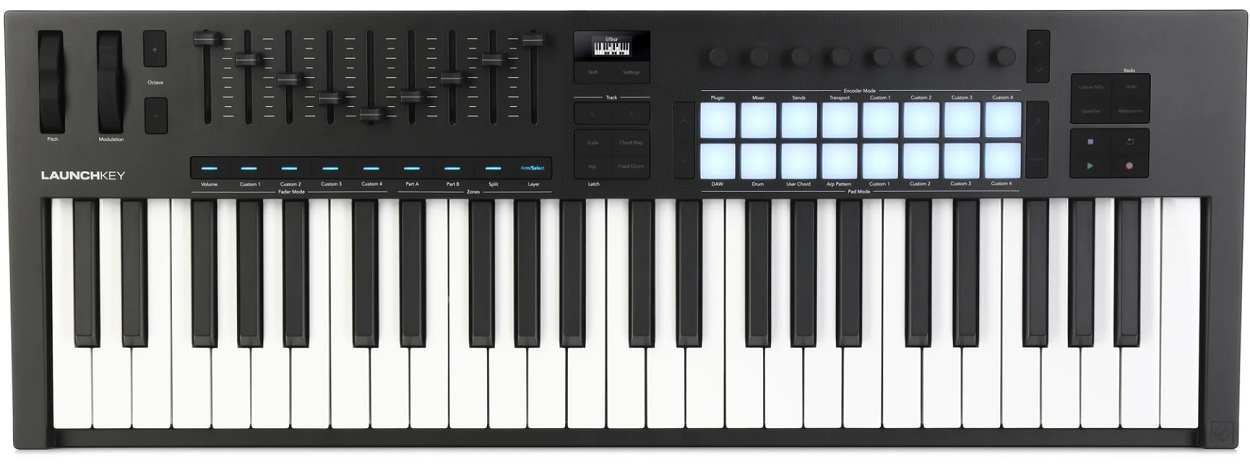
The go-to if your live set runs through Ableton and you want a proper keyboard alongside clip launching and mixer control.
Novation Launchkey 49 MK4 gives you four octaves of full-size keys with aftertouch, sixteen pads for Session View clips, nine faders for live mixing, and the kind of Ableton integration where your pads light up to match your clip colors so you know exactly what you’re triggering in a dark venue.
I’ve seen this controller on stages at small to mid-size shows where the performer needs to play parts live while managing an Ableton set, and the combination of real keys, responsive pads, and visual feedback handles that workflow with confidence.
- Ableton Session
The deep Ableton Live integration maps your pads directly to Session View clips with color-matched RGB feedback. On stage, you see your clip colors on the hardware, you launch clips by pressing pads, and you know immediately what’s playing, what’s queued, and what’s stopped. The visual certainty matters enormously in live performance where you can’t afford to trigger the wrong clip.
- Live Faders
Nine physical faders give you real-time mix control during performance. You ride your synth levels, bring effects in and out, and manage your overall balance from the hardware. In a live context, being able to adjust your mix instantly with physical faders rather than mouse-clicking feels natural and keeps you connected to the audience instead of buried in your screen.
- Performance Keys
49 full-size keys with channel aftertouch let you play actual keyboard parts during your set with dynamic expression. The aftertouch responds to sustained pressure for vibrato, filter sweeps, or any assignable modulation, adding expression to held chords and sustained notes that velocity alone can’t provide during a performance.
4. Novation Launchkey Mini 37 MK4
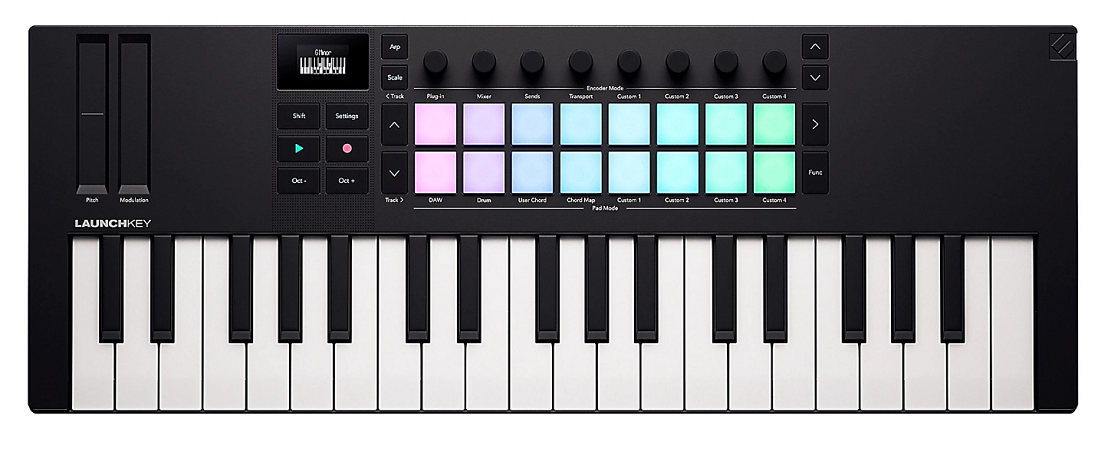
The portable option that squeezes three octaves of keys, sixteen pads, eight encoders, and MIDI output into something you can genuinely carry in one hand alongside your laptop bag.
Launchkey Mini 37 MK4 is for live performers who travel light and play smaller venues where a full-size controller would be overkill.
Thirty-seven mini keys won’t give you the playing feel of a concert keyboard, and I won’t pretend otherwise. But for performers who trigger clips, play synth lines, and manage their Ableton set from a single compact surface, the Mini 37 handles all of that at a fraction of the size and weight.
- Travel Size
The entire controller fits in a messenger bag alongside your laptop, cables, and maybe a small audio interface. For gigging musicians who take public transit, fly to shows, or simply don’t want to lug heavy gear, the Mini 37’s portability is its main selling point. You can show up to a venue with one bag and have your entire performance rig ready to go.
- Pad Grid
Sixteen velocity-sensitive RGB pads map to Ableton’s Session View for clip launching with visual feedback. On a dark stage, the lit pads show you your clip layout clearly, and the velocity sensitivity means your drum performances and sample triggers carry dynamic variation.
- Arp & Chords
A built-in arpeggiator and chord mode generate musical content from simple key presses, which is useful during live sets when you need to produce complex melodic patterns while managing other aspects of your performance. You hold a chord, the arp runs, and your attention is free to handle transitions, effects, or crowd interaction.
- MIDI Out
Hardware MIDI output connects the Mini 37 to external synths for performers who include hardware instruments in their live rig. The MIDI out means you can drive a desktop synth module directly from the controller without routing through your computer, which simplifies the signal chain and reduces potential failure points on stage.
5. AKAI MPK Mini Plus
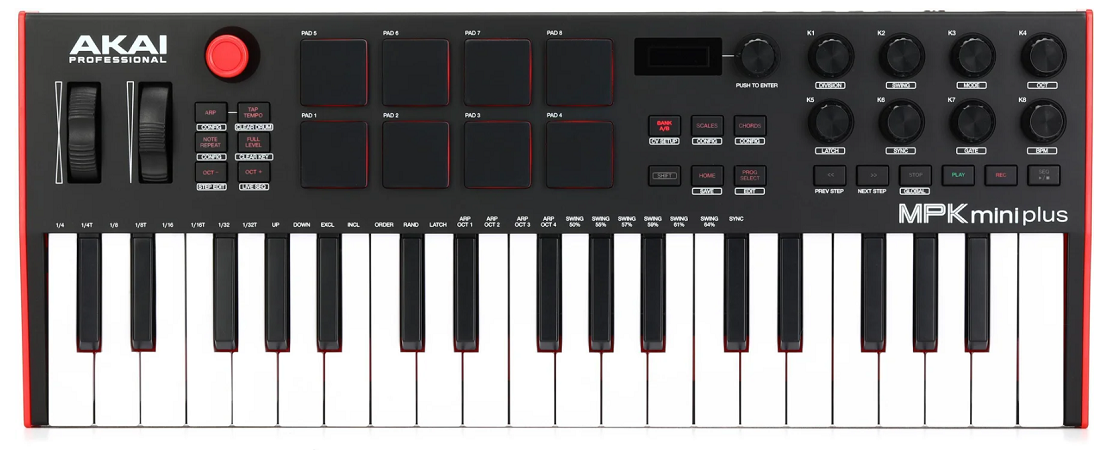
AKAI’s upgraded compact controller adds a built-in speaker and sound engine to the familiar MPK Mini formula, giving you a practice and warm-up tool that doubles as a performance controller.
MPK Mini Plus carries 37 mini keys, 8 MPC pads, 8 encoders, pitch/mod wheels, and onboard sounds that play without any computer connection.
The standalone sound engine is what makes this relevant for live performers specifically. You can warm up backstage without booting your laptop, sketch ideas during soundcheck, and if your computer crashes mid-set (it happens), the built-in sounds give you a backup instrument to keep the show going.
- Onboard Sounds
Built-in instrument sounds with a speaker and headphone output let you play without any external equipment. Backstage at a gig, during travel between shows, or as an emergency backup when technology fails, the onboard sounds keep you making music regardless of what else is working. The sounds aren’t going to replace your main rig, but they give you a safety net that purely MIDI controllers don’t provide.
- MPC Pads
Eight velocity-sensitive MPC-style pads carry AKAI’s legendary pad feel for drum performance and sample triggering during your set. The pads are large enough for confident finger drumming at tempo, and the velocity sensitivity captures your playing dynamics.
- Compact Weight
At well under a kilogram, the MPK Mini Plus disappears into your gig bag without adding meaningful weight to your load. For performers who carry multiple pieces of gear to every show, every gram matters, and the Mini Plus is light enough that bringing it is never a burden.
6. Arturia KeyLab 61 Mk3
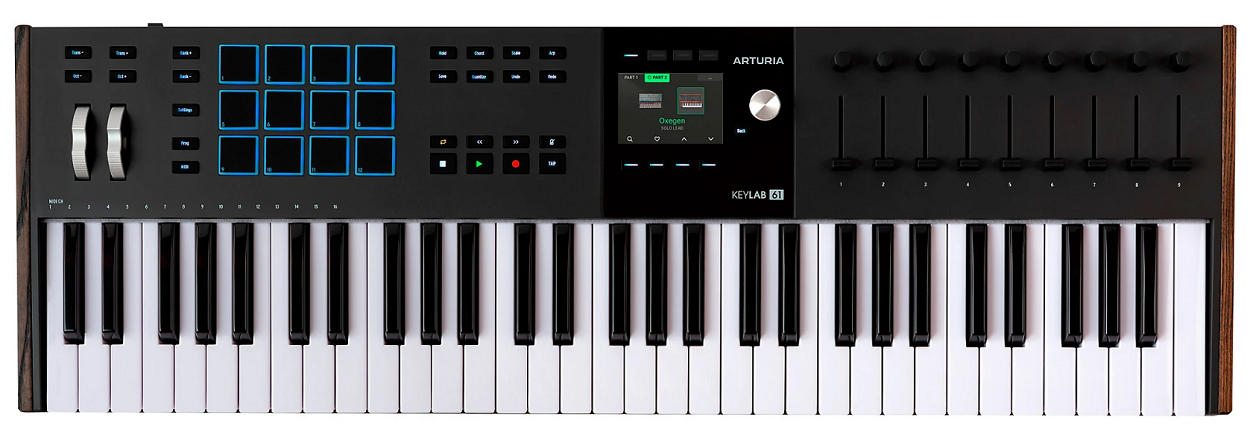
Arturia KeyLab 61 Mk3 brings motorized faders, polyphonic aftertouch, a large color display, and serious build quality to the stage, giving you the playing surface and control depth that smaller controllers compromise on.
This is for performers who play keyboard as a primary instrument during their set and need the range, expression, and feature depth to deliver a convincing performance. Five octaves of poly aftertouch means your sustained chords can breathe with individual per-note expression, and the motorized faders recall your mixer positions instantly when you switch between songs.
- Poly Aftertouch
Polyphonic aftertouch detects pressure independently on each key, letting you shape individual notes within a chord during performance. You add vibrato to a melody note while the rest of the chord stays clean, or gradually open a filter on a bass note while your upper notes remain static. On stage, the per-note expression makes your keyboard playing look and sound like you’re sculpting sound rather than pressing buttons.
- Motor Faders
Nine motorized faders snap to the correct positions when you recall a new song or switch presets, which means your levels are always accurate between songs. In a live context where you switch between different arrangements, the motorized recall eliminates the guesswork of where your faders should be. You load a new song, the faders move, and your mix is correct before you play a single note.
- Color Display
The large color screen shows preset names, parameter values, and control assignments in a format that’s readable from a performance position even in low light. On stage, being able to confirm your current preset and parameter state at a glance prevents the kind of uncertainty that causes mistakes during performance.
- Analog Lab
Arturia Analog Lab integration puts thousands of performance-ready presets at your fingertips with the hardware controls pre-mapped to each sound’s most useful parameters. During a live set, being able to switch presets and immediately have the knobs and faders controlling the right parameters saves you from mid-performance MIDI mapping that breaks the flow.
- Build Quality
The chassis, knobs, faders, and keybed are built with touring durability in mind. For a controller that’s going to get loaded into vans, set up on wobbly stage risers, and packed up at 2 AM, the construction quality directly affects how long the instrument survives the realities of regular gigging.
7. Novation 61SL MKIII
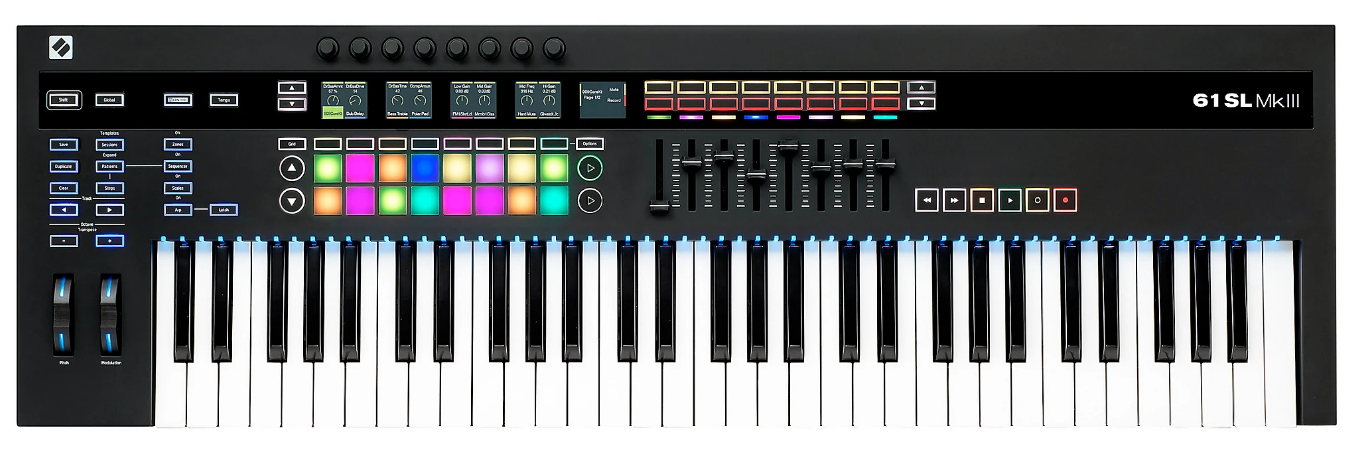
The controller for performers running hybrid rigs where a laptop coordinates with analog synths, Eurorack, and drum machines on stage.
Novation 61SL MKIII includes an 8-track internal sequencer and CV/Gate outputs alongside its DAW integration, making it the bridge between your software set and your hardware instruments during performance.
If your live rig includes a couple of synthesizers and some modular gear alongside your Ableton or Bitwig set, the SL MKIII ties it all together from one keyboard. The internal sequencer runs your hardware patterns independently while your DAW handles the software side, and everything syncs from one master clock.
- Live Sequencer
The 8-track internal sequencer drives your hardware synths independently of your DAW, which means your analog bass line and hardware arp keep running even if your computer hiccups during a set. The sequencer’s independence from the DAW adds reliability that pure software sequencing can’t guarantee in a live context. You program your hardware patterns ahead of time and trigger them from the SL during performance.
- CV/Gate Live
CV/Gate outputs drive your analog synths and modular gear directly from the stage keyboard with tighter timing than MIDI. For live performers with analog rigs, the CV connection gives you the snappy, precise triggering that audiences can feel in the low end and the transients.
- Semi-Weighted
A 61-key semi-weighted keybed with aftertouch provides the playing range and expression that performance demands. Five octaves means you cover bass, chords, and lead without octave switching mid-song, and the aftertouch adds pressure-based expression for sustained passages.
8. Native Instruments Komplete Kontrol S88 MK3
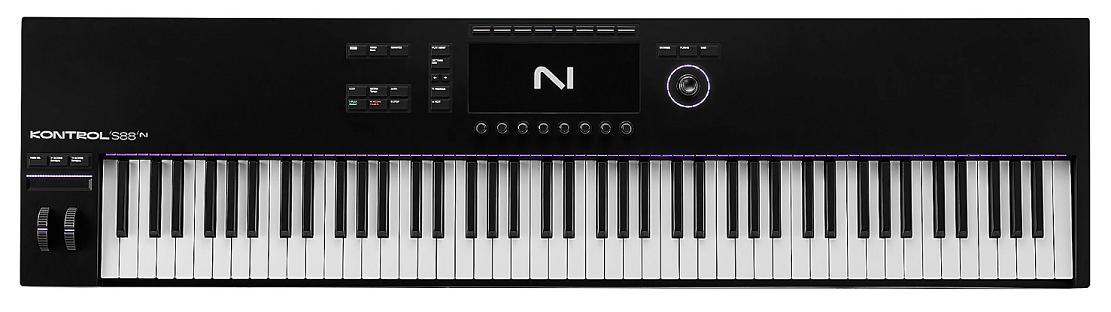
The full-range performance keyboard for pianists, keyboard players, and performers who need 88 weighted keys with poly aftertouch on stage.
NI S88 MK3 puts a Fatar hammer-action keybed under your fingers alongside a color display, eight touch-sensitive encoders, and the Light Guide that visually maps your keyboard layout during performance.
I’m including the S88 because some live performers genuinely need 88 keys. If your set includes piano pieces, extended orchestral parts, or synth performances that span the full register, a 49 or 61-key controller forces you to compromise. The S88 doesn’t.
- Fatar Stage
The fully weighted Fatar keybed provides the piano-quality playing response that stage keyboard performance demands. When you’re performing exposed piano parts or expressive synth solos in front of an audience, the keybed quality directly affects your confidence and your musicality. The Fatar action has the consistency and feel that professional keyboardists expect.
- Light Guide
Per-key RGB LEDs illuminate scale notes, split zones, and drum mappings directly on the keys. On a dark stage, the Light Guide shows you where your split point is, which keys trigger which sounds, and which notes are in your current scale. The visual guidance reduces the cognitive load of performing complex multi-instrument setups.
- Poly Aftertouch
Polyphonic aftertouch sends per-note pressure data for expressive performances where individual notes within chords respond independently to your touch. During a live piano piece or a synth pad performance, the poly aftertouch captures the subtle pressure variations in your playing that make the difference between a mechanical and a musical performance.
- NKS Recall
Automatic parameter mapping for NKS-compatible instruments means switching presets between songs automatically reassigns your encoders to the new instrument’s key parameters. During a live set, the instant parameter mapping means you change sounds and immediately have hardware control over the new patch without any manual reconfiguration between songs.
9. M-Audio Oxygen Pro 49
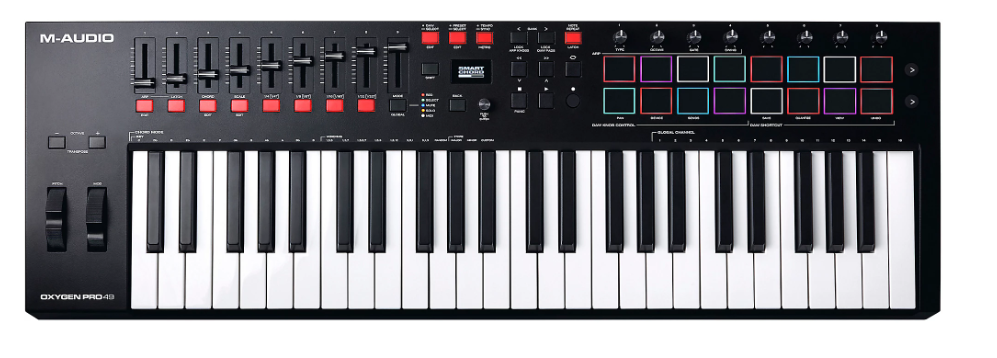
Closing with a practical mid-range option for performers who need a capable 49-key controller for live software sets without a flagship budget.
M-Audio Oxygen Pro 49 gives you four octaves of semi-weighted keys, sixteen pads, faders, encoders, and DAW auto-mapping in a controller that handles the live production workflow at a cost that won’t hurt if it gets banged up during transport.
I think there’s something to be said for bringing a reliable mid-range controller to gigs rather than risking your expensive flagship on a sticky club stage. The Oxygen Pro handles the job, and if it takes a knock during load-in, you’re not out a month’s rent.
- Gig Practicality
The mid-range cost and solid build make the Oxygen Pro a practical choice for regular gigging where equipment takes abuse. Every controller on this list eventually gets dropped, spilled on, or loaded wrong into a vehicle. Having a controller that handles the job well at a cost you can stomach replacing takes genuine pressure off your performance.
- Auto-Map Live
Pre-configured DAW profiles assign the Oxygen Pro’s controls to your DAW’s transport, mixer, and instrument parameters automatically. During soundcheck, you don’t waste time configuring MIDI assignments. You plug in, the profiles load, and your faders, pads, and encoders are already mapped to the right functions.
- 16 Pads
Sixteen velocity-sensitive pads handle clip launching, drum performance, and sample triggering during your set. The pad count and velocity sensitivity give you a responsive performance surface for the percussive and triggering elements of your live show.
- Fader Mix
Nine faders give you physical level control during performance for balancing your mix in real time. On stage, being able to quickly adjust the balance between your synths, drums, and effects with physical faders keeps you responsive to the room’s acoustics and the energy of the moment.
- Semi-Weighted
Semi-weighted keys provide enough resistance for dynamic playing without the weight penalty of hammer-action. For live sets where you’re switching between aggressive synth leads and softer pad passages, the semi-weighted feel responds well to both playing styles.
Hello, I’m Viliam, I started this audio plugin focused blog to keep you updated on the latest trends, news and everything plugin related. I’ll put the most emphasis on the topics covering best VST, AU and AAX plugins. If you find some great plugin suggestions for us to include on our site, feel free to let me know, so I can take a look!