
Synthwave and retrowave are built on a specific sonic vocabulary that comes directly from hardware synthesizers. The lush, chorus-drenched pads that fill the background. The punchy, resonant bass lines that drive the low end. The bright, soaring lead tones that carry the melodies.
The arpeggiated sequences that pulse underneath everything. These sounds originated on analog and early digital hardware in the late 1970s and 1980s, and while you can approximate them with software, there’s a reason hardware synths remain the preferred tools for producers serious about getting the genre’s tonal character right.
What matters for synthwave specifically isn’t just that a synth sounds analog or vintage. It’s whether it produces the particular qualities the genre demands: filters that sweep musically, oscillators that carry weight in the low end while staying present in the mids, chorus and effects that create width without losing definition, and a character that sits comfortably in the aesthetic space between nostalgia and modern production.
I’ve selected thirteen hardware synths that each handle different aspects of the synthwave palette, from instruments that nail the Oberheim pad sound and Moog bass weight to modern designs that cover the full range of the genre’s needs from a single instrument.
1. Behringer UB-Xa
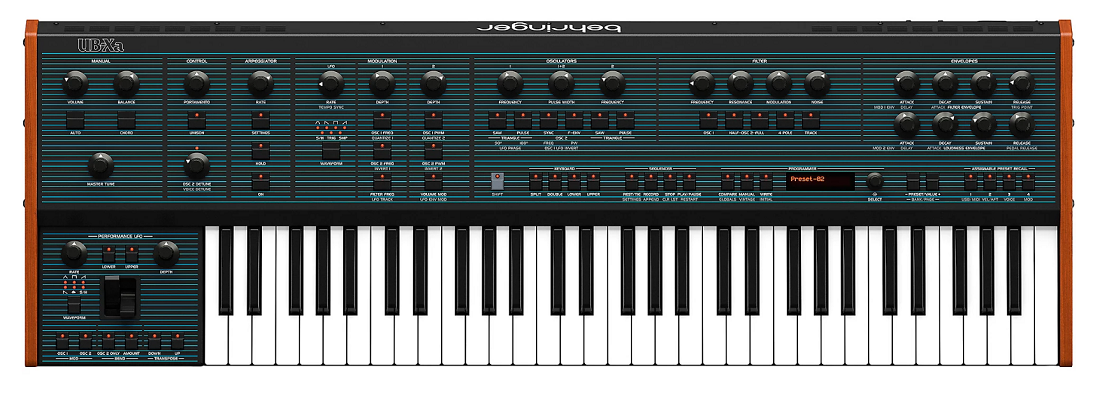
The Oberheim pad is arguably the single most important texture in synthwave, and the Behringer UB-Xa gives you the OB-Xa voice architecture that defined that sound at a fraction of what the original commands. Eight voices of analog polyphony with the specific warm, midrange-rich Oberheim filter character produce the wide, lush, harmonically dense pads that form the foundation of the genre.
For synthwave producers who consider the Oberheim sound essential, the UB-Xa is the most affordable path to that specific tonal territory with a genuine analog signal path.
- Oberheim Filter
The multimode filter following the Oberheim topology produces the specific warm, rounded, midrange-rich character that defines the synthwave pad sound.
When you close the filter slowly on a sustained chord, the UB-Xa creates the particular tonal darkening with harmonic warmth that Oberheim instruments are known for. The filter character is what separates the Oberheim pad from Juno pads, Prophet pads, and every other analog polysynth sound. For synthwave, this specific filter quality is foundational.
- Eight Voices
Eight analog voices provide the polyphony needed for the sustained, wide chord voicings that synthwave pads demand. The genre uses extended chord holds where notes ring for entire sections, and eight voices ensures those sustained chords maintain their full harmonic content without notes cutting off. Voice stealing is the enemy of synthwave pads, and eight voices keeps it at bay.
- Bi-Timbral
Bi-timbral capability lets you run two different patches simultaneously, which is useful for synthwave production where you might want a pad on one layer and a brass-style lead on the other. The dual-patch operation means you can cover two distinct roles in the arrangement from a single instrument without bouncing between presets.
- Unison Mode
Variable unison stacking concentrates all eight voices on single notes for massive, thick lead tones. Synthwave leads need to cut through dense arrangements, and the UB-Xa’s unison mode creates the kind of fat, attention-grabbing monophonic lead that carries a melody over layers of pads and bass.
Get the Free Plugin Starter Kit
The genuinely useful free DAWs and plugins worth installing. No filler. Straight to your inbox.
2. Roland Juno-X
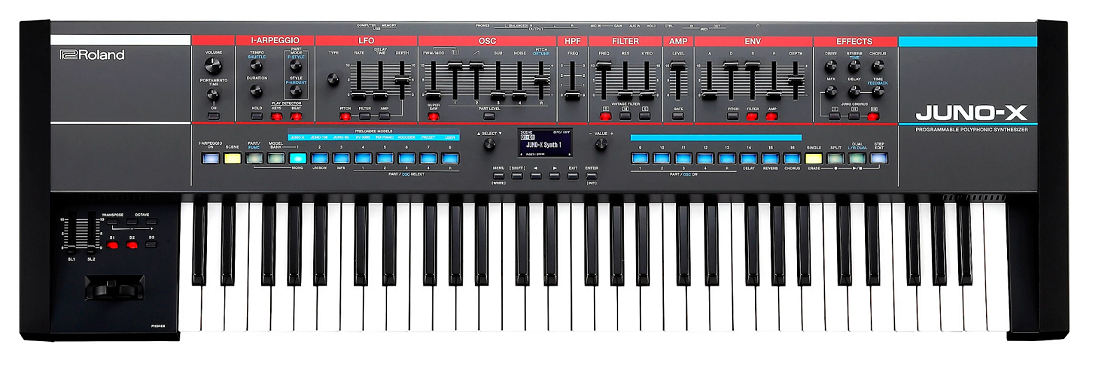
The Juno sound is synthwave’s other essential pad texture alongside the Oberheim, and the Roland Juno-X delivers faithful recreations of both the Juno-60 and Juno-106 in a modern performance keyboard.
The Juno chorus, that wide, shimmering, slightly detuned wash, has appeared on countless synthwave records because it creates a specific atmospheric quality that no other effect quite replicates.
If you listen to synthwave and hear a pad that sounds like it’s glowing, warm and wide with a gentle shimmer, you’re probably hearing a Juno. The Juno-X gives you both classic Juno models alongside the modern ZEN-Core engine for broader coverage.
- Juno-60 Model
The Juno-60 recreation captures the original’s warmer, slightly grittier character with the specific chorus behavior that produces a darker, more saturated widening. For synthwave, the Juno-60 model suits tracks that need a moodier, more atmospheric pad quality. The warmth of the 60’s chorus creates a hazy, dreamlike backdrop that complements the nostalgic aesthetic of the genre.
- Juno-106 Model
The Juno-106 recreation delivers the brighter, cleaner Juno tone with the more defined chorus that became ubiquitous on dance and synthpop records. For more upbeat, driving synthwave tracks, the 106’s character provides pads with enough clarity to sit in a dense mix without turning to mush. The two Juno models give you the full range of Juno pad textures from dark and moody to bright and present.
- I-Arpeggio
The I-Arpeggio intelligent arpeggiator generates musically aware patterns that respond to your chord voicings, which is directly useful for synthwave because arpeggiated sequences are a core element of the genre. The I-Arpeggio produces results that sound composed rather than mechanically cycled, giving you arpeggiated content with musical intelligence.
- Scene Morphing
The dual-scene system creates smooth transitions between two complete sound configurations. For synthwave production and live performance, morphing from a soft, filtered pad into a bright, open wash during a build creates the kind of evolving textural movement that the genre thrives on.
- Model Expansion
Downloadable expansions add other vintage Roland engines including the Jupiter-8 and SH-101. The Jupiter-8 produces the kind of brass-tinged polysynth sounds that complement Juno pads, while the SH-101 delivers the monophonic bass and lead tones that form the rhythmic backbone of many synthwave tracks.
The expandable library means the Juno-X covers more of the synthwave palette over time.
- Full Keyboard
The 61-note full-size keyboard provides the playing range that synthwave requires, where bass lines, pad chords, and lead melodies all need to be played from the same instrument during performance or recording. The full range means you don’t need to switch octaves constantly when moving between parts.
3. Sequential Prophet 10
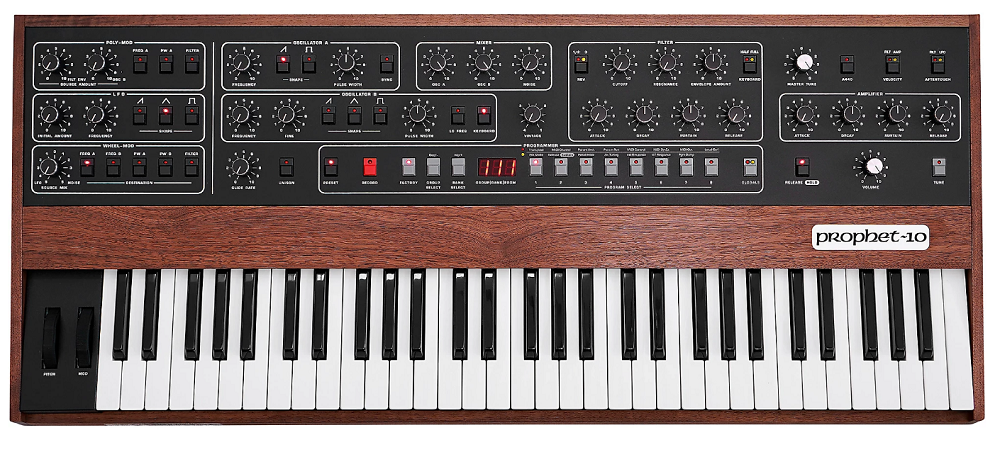
Ten voices of the legendary Prophet analog architecture produce the kind of rich, musical, harmonically complex polysynth sounds that sit at the heart of synthwave’s tonal identity.
Sequential Prophet 10 gives you Curtis oscillators and filters with the Poly-Mod sound design section that creates metallic, evolving timbres beyond standard subtractive territory.
The Prophet sound is warm but articulate, which makes it versatile across synthwave’s needs from pads through brass to arpeggiated sequences.
- Prophet Voice
Ten analog voices with Curtis CEM oscillators and dual selectable filters produce the warm, musical tone that the Prophet name is built on. The Prophet filter character is slightly different from Oberheim or Juno, sitting somewhere between the warmth of the Oberheim and the clarity of the Juno. For synthwave, the Prophet covers the middle ground where pads need to be both warm and defined.
- Poly-Mod
The Poly-Mod section routes oscillator and filter signals as modulation sources, creating metallic, complex, FM-like timbres from an analog signal path. For synthwave, Poly-Mod produces the kind of bell-like, evolving textures that add complexity to arrangements. The metallic tones complement standard pads and bass, adding a layer of harmonic interest.
- Ten Voices
Ten voices of polyphony give you more room than most analog polysynths for sustained, overlapping chords with long release times. Synthwave production uses extensive sustain and reverb on pads, which consumes voices quickly. Ten voices provides a comfortable margin for the genre’s playing style.
4. Oberheim TEO-5
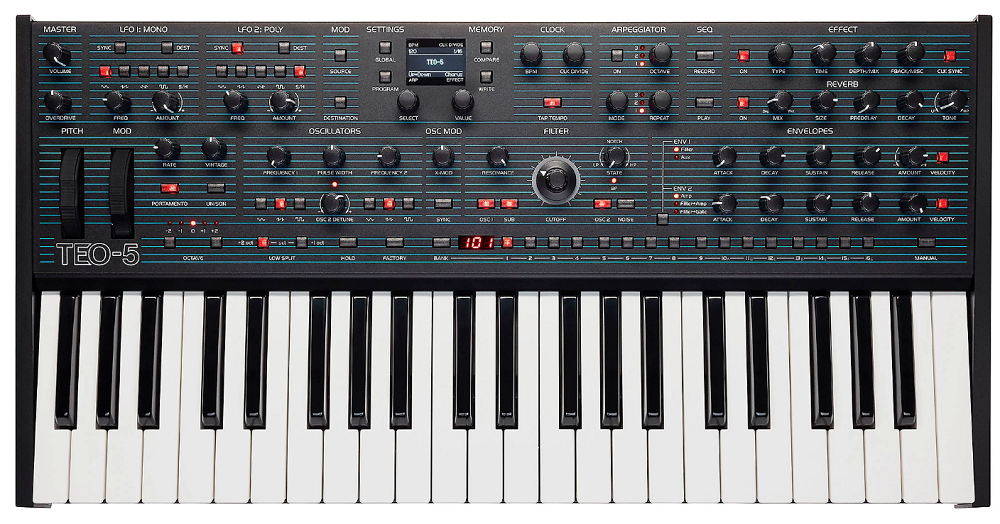
The most affordable Oberheim with the genuine SEM filter, giving you the authentic Oberheim tone in a compact, five-voice format.
Oberheim TEO-5 delivers the specific midrange warmth and filter character that defines the Oberheim sound, with through-zero FM, a polyphonic sequencer, and classic Oberheim effect emulations including the phase shifter and ring modulator.
For synthwave producers who want real Oberheim character without the cost of the OB-X8, the TEO-5 puts that specific tonal quality within reach.
- SEM Filter
The discrete SEM-lineage state-variable filter is the same basic topology that defined the Oberheim sound across decades. The SEM filter morphs continuously from low-pass through notch to high-pass with a switchable band-pass mode, giving you the full range of Oberheim frequency shaping. For synthwave pads, the low-pass setting with moderate resonance produces the characteristic warm, rounded tone the genre requires.
- Through-Zero FM
Through-zero frequency modulation on the oscillators adds harmonic complexity that standard subtractive synthesis doesn’t generate. For synthwave, the FM capability produces metallic, bell-like overtones that add shimmer to pads and leads without leaving the analog signal path. The FM extends the tonal palette into territory that pure subtractive filtering can’t reach.
- Phase Shifter
A digitally emulated Oberheim phase shifter reproduces the specific phasing effect from Tom Oberheim’s original outboard processor. The Oberheim phaser has a particular swooshing, liquid quality that’s been heard on countless records. For synthwave, the phaser adds movement and animation to pads that would otherwise sit statically.
- Polyphonic Seq
A 64-step polyphonic sequencer programs melodic and chordal patterns within the synth. For synthwave, where arpeggiated and sequenced patterns are core elements, having a polyphonic sequencer means you can program chord progressions and melodic phrases that play back with the full analog character of the TEO-5’s voice architecture.
5. Moog Subsequent 37
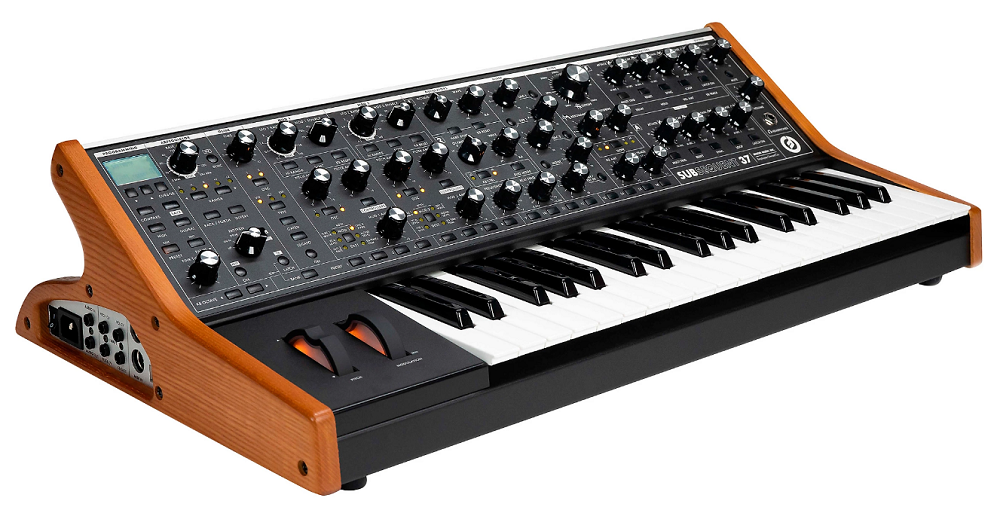
When a synthwave track needs bass that hits with physical weight and authority, the Moog Subsequent 37 is where you reach.
The dual Moog oscillators through the Moog ladder filter produce low-end content with a density, warmth, and presence that no other architecture replicates at the same level. The Sub 37 handles the bass duties that every synthwave track demands.
The Moog bass sound is so fundamental to synthwave that the genre effectively requires it or a convincing approximation of it, and the Subsequent 37 is the real thing.
- Ladder Filter
The Moog ladder filter shapes bass frequencies with the specific warm, thickening resonance that adds body to the low-mids rather than thinning them. For synthwave bass, the ladder filter is the gold standard because it maintains fundamental weight while adding harmonic interest through resonance. The filter’s behavior at low frequencies is what gives Moog basses their characteristic chest-hitting quality.
- Multidrive
The Multidrive circuit adds analog distortion that ranges from subtle harmonic warmth to aggressive saturation. For synthwave bass, the Multidrive provides the upper harmonic content that helps bass lines translate on smaller speakers while maintaining the fundamental depth on full-range systems.
- Duo Mode
Duo mode splits the two oscillators across two notes for paraphonic bass lines where you can play root-fifth intervals, octave patterns, and two-note phrases. Synthwave bass lines frequently use these intervals, and duo mode lets you play them from a single instrument with both notes carrying the full Moog character.
6. Behringer Poly D
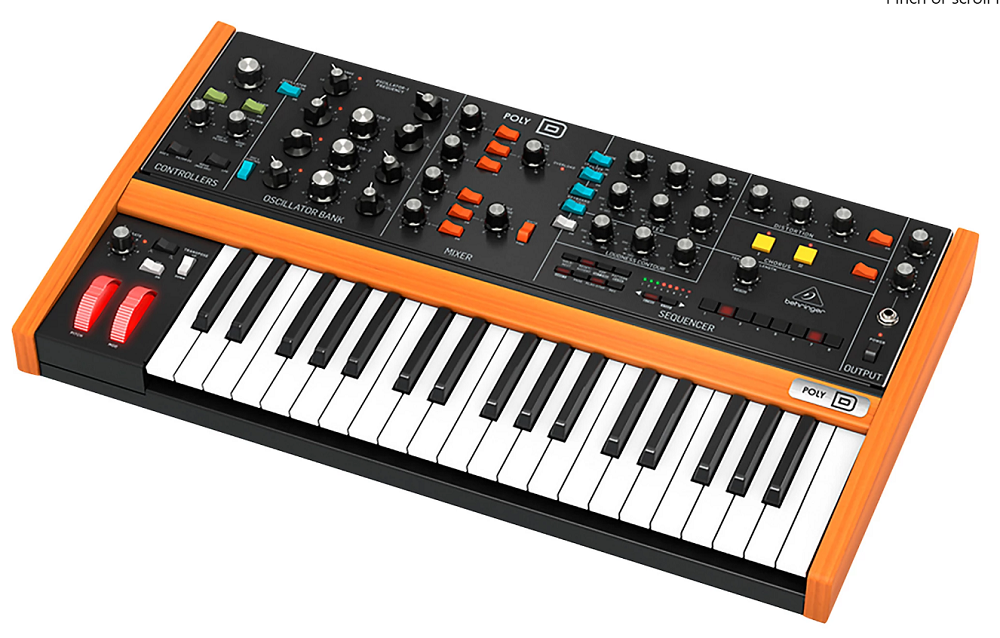
Four Minimoog-style analog oscillators through a ladder filter at a price that makes the Moog bass and lead sound accessible to any budget.
Behringer Poly D gives you more raw oscillator power than a standard Minimoog design with its fourth VCO and paraphonic voicing, creating bass tones and unison leads with a thickness and harmonic density that two-oscillator designs can’t match.
For synthwave producers who need convincing Moog-style bass and lead tones without the Moog price tag, the Poly D delivers the fundamental character at a fraction of the cost.
- Four VCOs
Four analog oscillators stacked in unison with slight detuning create bass and lead tones with significantly more harmonic content than typical monosynths. For synthwave, the four-oscillator unison produces the kind of massive, chorused lead tone that soars over pad arrangements, and the stacked bass has the low-end weight that the genre demands.
- Ladder Character
The 24dB/oct ladder filter shapes the four oscillators with the warm, musical resonance that defines the Moog bass sound. The filter’s specific behavior, thickening the low-mids and adding body rather than hollowing, is what makes the Poly D’s bass suitable for synthwave where low-end weight and warmth are essential.
- Distortion Circuit
Built-in analog distortion adds harmonics that help bass and lead sounds cut through dense synthwave mixes. The distortion ranges from subtle warmth to aggressive drive, letting you dial in the right amount of edge for the context.
- Paraphonic Chords
Four-voice paraphonic mode lets you play chord stabs and power intervals through the shared filter. Synthwave uses punchy chord stabs as rhythmic elements, and the Poly D’s paraphonic capability handles those with the Moog tonal character intact.
- Classic Aesthetic
The Minimoog-inspired tilted panel with wood enclosure gives the Poly D a visual presence that connects to the vintage aesthetic synthwave celebrates. The instrument looks the part alongside the music it produces.
7. Behringer DeepMind 12
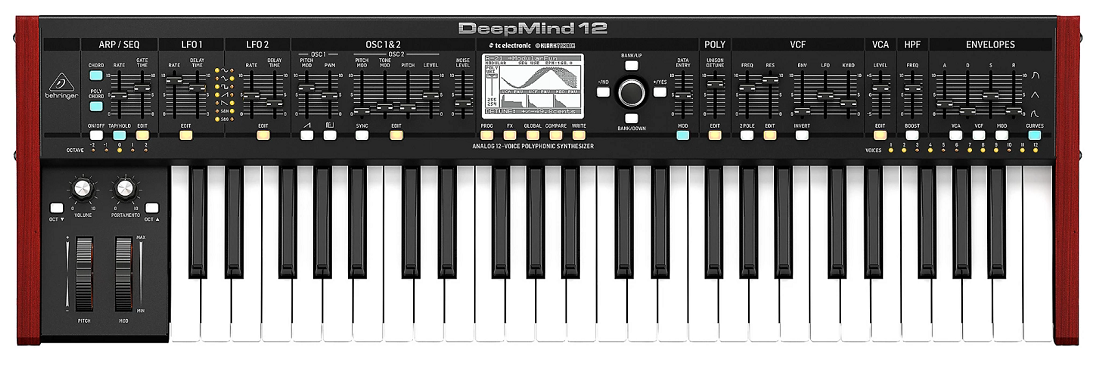
Twelve voices of analog polyphony with a comprehensive effects section at a cost that’s genuinely remarkable for what you’re getting.
Behringer DeepMind 12 produces the kind of wide, shimmering, effects-processed analog pads that synthwave producers need, with enough voices that sustained chords never thin out from voice stealing.
I come back to the DeepMind 12 specifically for synthwave because the combination of twelve analog voices with the onboard chorus, delay, and reverb creates finished pad textures without any external processing.
- Chorus Quality
The chorus implementation produces the specific wide, detuned, shimmering pad texture that’s fundamental to synthwave. Running twelve analog voices through layered chorus creates the genre’s signature atmospheric wash that fills the stereo field with warm, gently moving harmonic content.
- Effects Depth
The 32-slot effects engine processes the analog voices with multiple simultaneous effects including chorus, phaser, delay, and reverb. For synthwave, the ability to chain effects internally means your patches come out of the synth as complete, spatial, atmospheric sounds rather than dry signals that need further processing.
- Voice Count
Twelve analog voices provide the headroom synthwave pad playing demands. Extended sustains, overlapping chord changes, and layered textures consume voices rapidly, and twelve voices ensures your pads maintain their full density throughout long, sustained sections.
8. Roland Jupiter-X
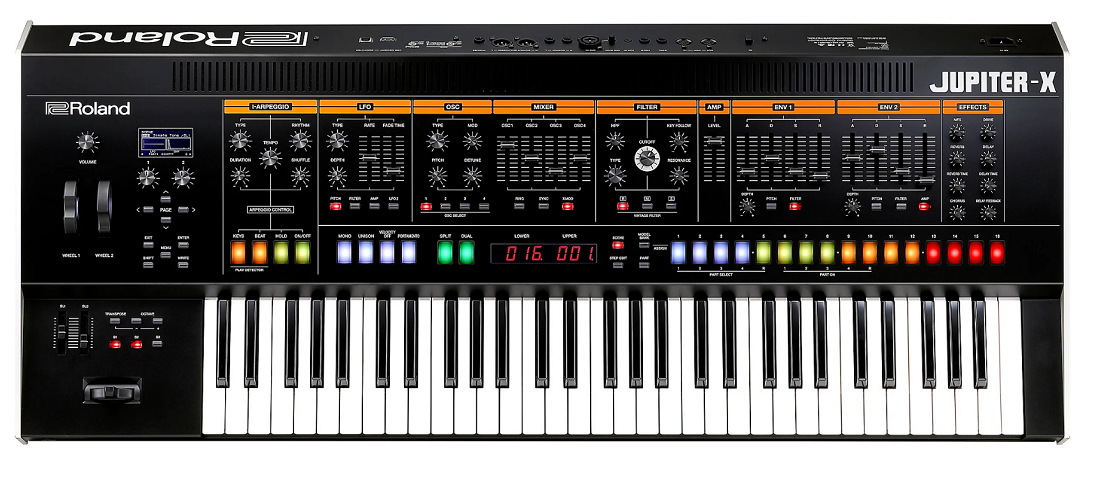
Roland’s flagship gives you access to the specific classic Roland instruments that shaped the sonic landscape synthwave draws from.
Jupiter-X delivers modeled recreations of the Jupiter-8, Juno-106, SH-101, and other legendary synths through the ZEN-Core platform, with the I-Arpeggio system and scene morphing adding performance capabilities that no single vintage instrument offered.
The Jupiter-8’s brass and pad sounds, the Juno-106’s chorus-drenched textures, the SH-101’s bass lines: these are specific instruments that appear on synthwave records constantly, and the Jupiter-X consolidates them into a single keyboard.
- Jupiter-8 Model
The Jupiter-8 Model Expansion reproduces the specific oscillator warmth, filter character, and voice behavior of the original, including the subtle analog drift that gives the JP-8 its organic quality.
For synthwave, the Jupiter-8 produces the particular brass-like polysynth tones and wide, evolving pads that defined a generation of electronic music and remain core textures in the genre today.
- SH-101 Model
The SH-101 expansion delivers the monophonic bass and lead sounds that form the rhythmic and melodic backbone of many synthwave tracks. The SH-101’s specific filter character, a smooth, musical resonance that screams when pushed, produces acid-influenced bass lines and driving lead tones that cut through pad-heavy mixes.
- Scene Layers
The dual-scene system lets you run two vintage Roland engines simultaneously, layered or split across the keyboard. Combining a Jupiter-8 pad with a Juno-106 texture creates hybrid sounds that draw from two different legendary tonal characters, producing pads with complexity that neither model achieves alone.
- I-Arpeggio
The intelligent arpeggiator generates contextually aware patterns suited to arpeggiated synthwave sequences. The I-Arpeggio produces melodic content that responds to harmonic context rather than following mechanical note-cycling rules, which creates arpeggiated passages that sound written rather than generated.
9. Moog Muse
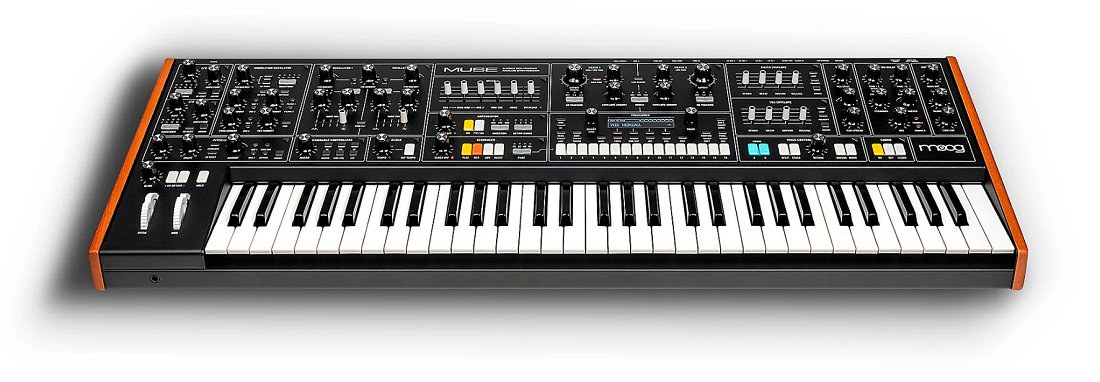
Moog’s eight-voice bi-timbral polyphonic synthesizer brings the full weight of the Moog sound to polyphonic territory for the first time in decades.
Moog Muse gives you dual Moog oscillators per voice, a modulation oscillator that functions as a third VCO, dual transistor ladder filters with stereo routing, and a Diffusion Delay that produces the atmospheric spatial processing synthwave demands.
For synthwave producers who want Moog bass weight and character extended across polyphonic pads, leads, and arpeggiated sequences, the Muse is the instrument that finally delivers all of that from a single Moog keyboard.
- Dual Filters
Two Moog transistor ladder filters per voice with selectable series, parallel, and stereo routing give you frequency-shaping options that single-filter designs can’t approach.
For synthwave, the stereo filter routing creates pads with genuine spatial dimension where each side of the stereo field has its own filter behavior. The dual filters add width and movement that single-filter analog polysynths don’t produce.
- Diffusion Delay
A vintage-digital-inspired multi-tap Diffusion Delay adds atmospheric spatial processing that transforms dry sounds into immersive, reverberant textures.
For synthwave, where spatial depth is essential to the genre’s aesthetic, the Diffusion Delay produces the hazy, echoing, dreamlike quality that pads and leads need to sit properly in the mix. The delay’s character is unique to the Muse and adds a spatial quality that standard digital delays don’t replicate.
- Modulation VCO
A per-voice modulation oscillator that can function as a third audio-rate VCO with sine, sawtooth, reverse saw, square, and noise waveforms. For synthwave, having three oscillators per voice means you build thicker, more harmonically complex pad textures from a single patch. The modulation oscillator adds depth to unison leads and complexity to arpeggiated sequences.
- Bi-Timbral
Bi-timbral operation splits the eight voices across two independent patches with individual filter, modulation, and effects settings. For synthwave live performance and production, you run a Moog pad on one layer and a Moog bass on the other, covering two essential roles from a single instrument. The bi-timbral capability means the Muse fills the roles that would otherwise require separate instruments.
- CP3 Mixer
The CP3-style saturating mixer adds harmonic saturation to the oscillator signal before it reaches the filters, recreating the behavior of Moog’s vintage modular mixers. For synthwave, the saturation adds warmth and presence to every sound, giving patches the particular Moog character that software emulations work hard to approximate.
10. Groove Synthesis 3rd Wave
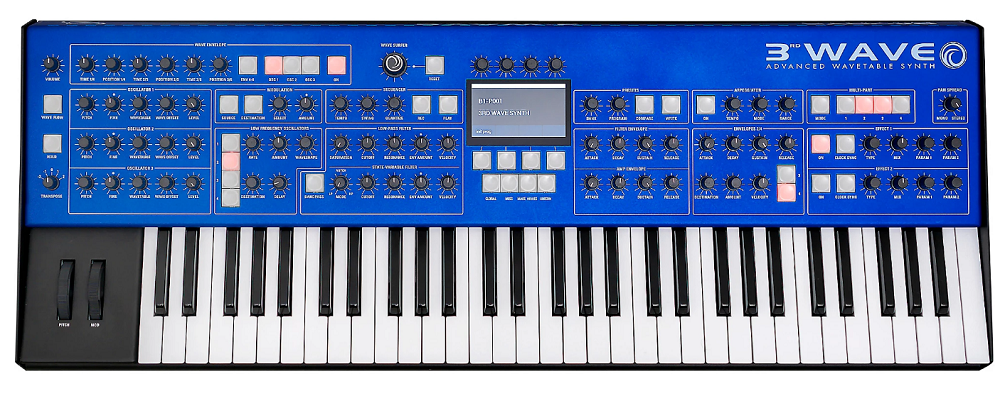
Wavetable synthesis built on the legacy of the PPG Wave with 24 voices distributed across four multitimbral parts. Groove Synthesis 3rd Wave delivers evolving, morphing digital textures alongside analog-style wavetable content, with a workflow designed by former Sequential engineers that makes deep wavetable sound design surprisingly accessible.
For synthwave producers who want digital textures alongside or instead of analog pads, the 3rd Wave produces the kind of crystalline, evolving wavetable content that complements the genre’s warm analog foundations.
- Wavetable Engines
Three wavetable engines (original PPG, new 96kHz, and analog-style) give you fundamentally different starting points for wavetable synthesis. The PPG engine provides the gritty, characterful digital tone of the original. The 96kHz engine adds modern clarity. The analog-style engine bridges the gap between digital wavetable and analog subtractive. For synthwave, this variety means you access both the raw digital textures of the era the genre references and cleaner modern sounds.
- Four Parts
Four multitimbral parts with six voices each effectively turn the 3rd Wave into four independent wavetable synths running simultaneously. For synthwave production, you can dedicate separate parts to pad, lead, arp, and bass duties, building complete wavetable arrangements within a single instrument.
- Modulation Depth
Extensive modulation routing shapes wavetable parameters in real time, creating textures that evolve and morph over sustained notes. For synthwave, the modulation depth produces pads that shift timbral character across their duration, adding movement and interest that static wavetable patches don’t provide.
- Intuitive Workflow
The screen and hands-on control interaction designed by engineers with Sequential heritage makes wavetable programming more immediate than most wavetable synths. For synthwave producers who want evolving digital textures without spending hours learning a complex interface, the 3rd Wave’s workflow lowers the barrier to wavetable sound design.
11. Behringer MonoPoly
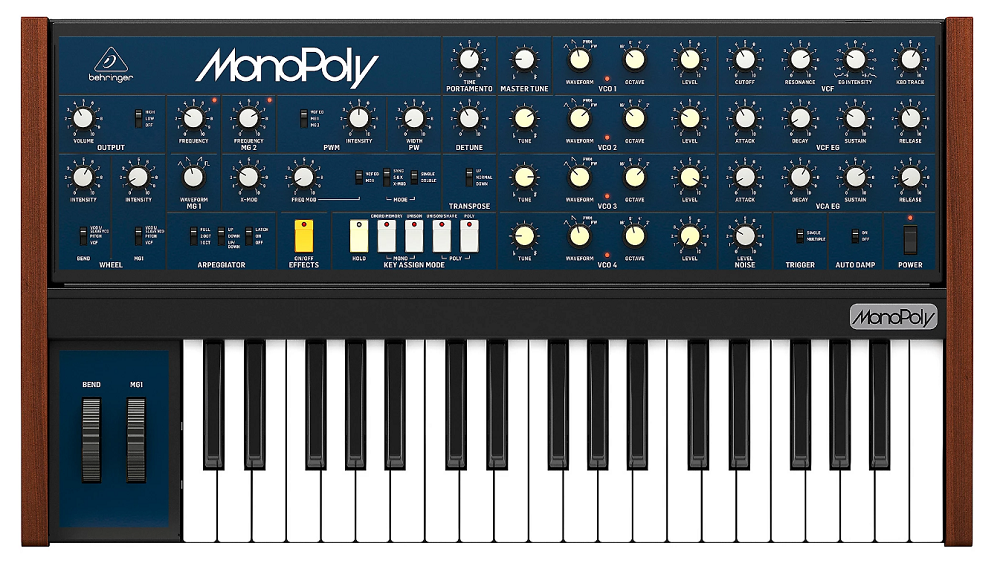
Four oscillators with switchable voicing modes that cover synthwave’s need for both thick unison leads and four-voice chord stabs from a single instrument. Behringer MonoPoly transitions between mono, unison, poly, and chord memory modes, giving you the flexibility to handle multiple roles in a synthwave arrangement.
The mode switching is what makes the MonoPoly particularly versatile for synthwave, where you might need a massive unison lead for one section and polyphonic chord stabs for another.
- Unison Weight
Four oscillators stacked in unison with detuning produce the thick, chorused lead tones that synthwave melodies demand. The unison sound carries enough harmonic density to soar over dense pad arrangements without getting lost, which is essential for the genre’s characteristic soaring lead lines.
- Chord Memory
Chord memory mode lets you program a specific chord voicing and then transpose it with single key presses. For synthwave, where rhythmic chord stabs are a production staple, the chord memory means you play complex voicings with one finger while your other hand adjusts filter and modulation parameters in real time.
- Sync Leads
Oscillator sync produces the hard, bright, harmonically rich sync sweep lead sound that’s been a staple of electronic music since the early 1980s. For synthwave leads that need aggressive, attention-grabbing character, the sync sweep is one of the most effective tools available.
- Cross-Mod
Audio-rate oscillator cross-modulation adds metallic, FM-like harmonic content that standard detuning doesn’t produce. For synthwave, the cross-mod creates textural interest in bass and lead sounds that helps them stand out in a mix without relying solely on filtering and effects.
- Arpeggiator
A built-in arpeggiator with multiple modes and tempo sync generates rhythmic patterns from held chords, taking full advantage of the four-voice architecture. For synthwave, where arpeggiated sequences are a defining production element, the MonoPoly’s arp produces patterns with the specific analog character of the instrument’s oscillators and filter.
- External Input
An audio input routes external signals through the MonoPoly’s filter and modulation, which means you can process drum machines, other synths, or any audio through the instrument’s analog character. For synthwave production, running a drum machine through the MonoPoly’s filter adds analog coloring to rhythmic elements that ties the mix together tonally.
12. Oberheim OB-X8
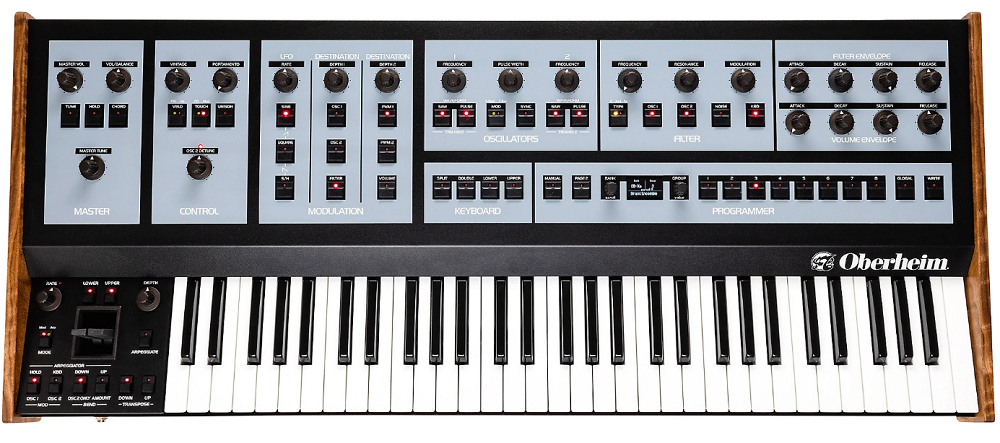
The flagship Oberheim analog polysynth combining the best of the OB-X, OB-Xa, and OB-8 into a single eight-voice instrument.
Oberheim OB-X8 represents the definitive Oberheim sound with genuine analog oscillators, Curtis filters, and the presets from all three original instruments loaded and ready to play.
If budget is no concern and you want the most authentic, richest Oberheim pad sound available in a current production instrument, the OB-X8 is where the conversation ends.
- Three Synths
Voice architecture and presets from the OB-X, OB-Xa, and OB-8 give you three different eras of Oberheim sound from a single keyboard. For synthwave, each era has a slightly different character, and having all three means you can match the specific Oberheim quality that each track needs. The OB-Xa’s lush warmth suits certain tracks, while the OB-8’s slightly tighter character serves others.
- SEM Modes
Additional SEM filter modes add high-pass, band-pass, and notch configurations alongside the classic Oberheim low-pass. For synthwave, the expanded filter options mean you can shape pads in ways the originals couldn’t, thinning the low end with the HPF for ethereal textures or creating resonant peaks with the BPF for distinctive tonal coloring.
- Vintage Control
A vintage parameter introduces adjustable voice-to-voice variation that recreates the tuning drift of original analog instruments. For synthwave, dialing in subtle vintage instability adds the organic, living quality that makes analog pads sound warm and authentic rather than static and sterile.
13. Roland Jupiter-Xm
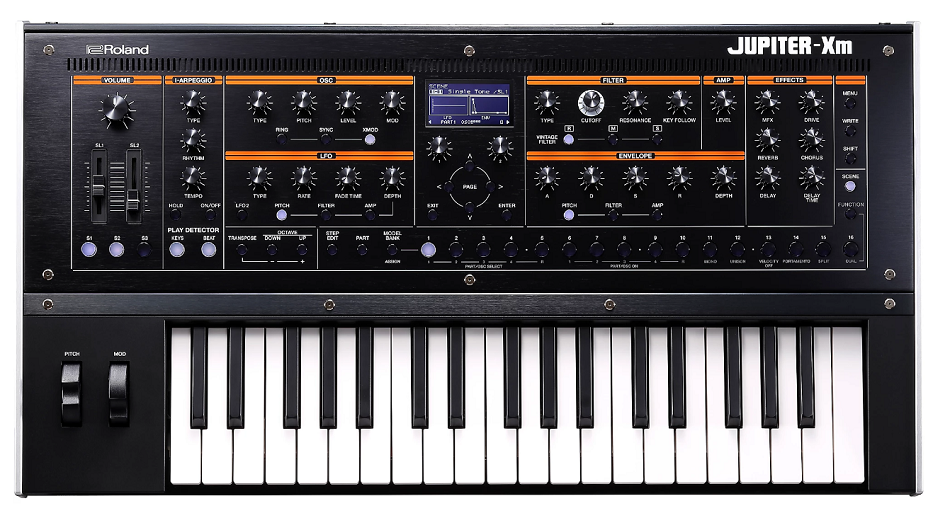
Everything the Jupiter-X offers packed into a portable, battery-capable format with a mini keyboard and built-in speaker. Roland Jupiter-Xm gives you the same ZEN-Core engine, Model Expansions, I-Arpeggio, and scene system as the flagship in a size you can carry in a backpack.
For synthwave producers who need access to the classic Roland sound library (Jupiter-8, Juno-106, SH-101) in a portable format for live performance, traveling, or compact studio setups, the Xm delivers the full sonic capability in a fraction of the footprint.
- Portable Classics
The identical Model Expansion library and ZEN-Core engine as the Jupiter-X means every classic Roland sound, Jupiter-8 pads, Juno-106 chorused textures, SH-101 bass lines, works identically on the Xm. For synthwave performers and producers, the portability means you can bring the essential Roland sound palette to gigs, sessions, and writing environments where the full-size Jupiter-X wouldn’t be practical.
- Battery Operation
Battery power frees the Jupiter-Xm from power outlets, which genuinely changes where and how you can work with it. For synthwave producers who write on the go, sketch ideas while traveling, or perform in venues with limited power infrastructure, the battery capability is a practical advantage over every other synth with comparable sonic depth.
- Scene Presets
The scene system with complete dual-layer configurations and morphing lets you build complex synthwave sound combinations that recall instantly. You save a scene with a Juno pad on one layer and a Jupiter lead on the other, recall it at a gig, and you’re immediately set up with two complementary vintage Roland sounds ready to perform.
- Built-in Speaker
A built-in speaker lets you audition patches and sketch ideas without headphones or external amplification. For quick writing sessions and patch browsing, the self-contained audio means you can evaluate sounds anywhere without additional equipment.
Get the Free Plugin Starter Kit
The genuinely useful free DAWs and plugins worth installing. No filler. Straight to your inbox.

Hello, I’m Viliam, I started this audio plugin focused blog to keep you updated on the latest trends, news and everything plugin related. I’ll put the most emphasis on the topics covering best VST, AU and AAX plugins. If you find some great plugin suggestions for us to include on our site, feel free to let me know, so I can take a look!