

Korg has one of the most diverse hardware synth lineups of any manufacturer in 2026. While some companies focus on a single synthesis approach or price bracket, Korg covers everything from palm-sized analog bass synths through hybrid polysynths and deep wavetable engines to full workstation keyboards, and they do it across a price range that stretches from genuinely impulse-purchase affordable to serious studio investment.
The breadth of the current catalog means there’s almost certainly a Korg synth that fits your specific needs regardless of your budget, genre, or experience level.
What I appreciate about Korg’s approach is that each instrument in the lineup has a clear identity and purpose rather than trying to be everything to everyone. The Minilogue XD is the accessible entry point.
The Modwave is the wavetable sound design tool. The Wavestate is the evolving texture generator. The MS-20 is the aggressive analog character machine. They all sound distinctly different from each other, which means building a collection of Korg instruments gives you genuine variety rather than overlapping capabilities.
I’ve selected eleven current Korg synths that represent the best of their range, from compact budget units through mid-range workhorses to their most powerful instruments.
1. Korg Modwave MKII
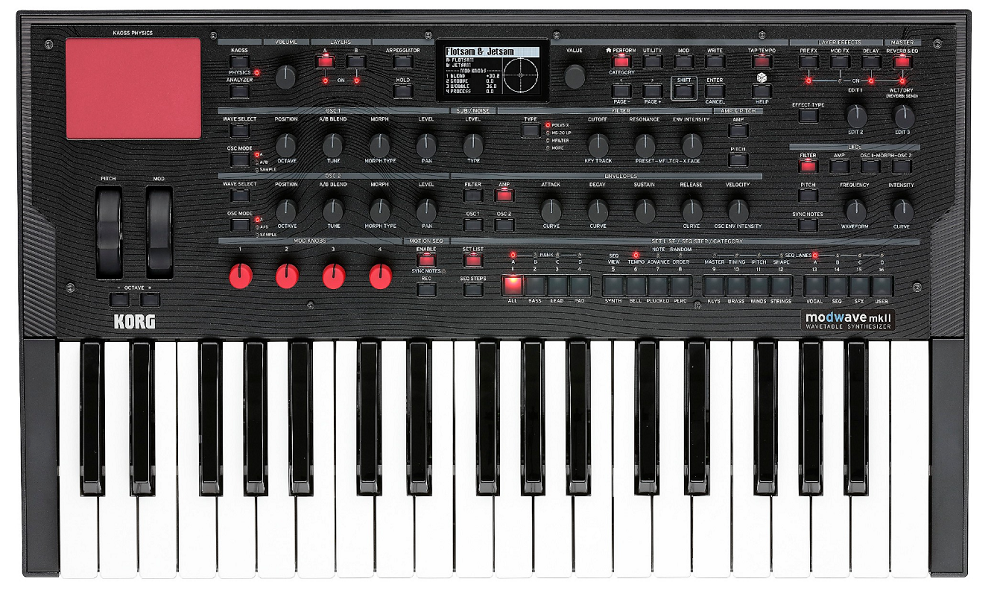
The updated version of Korg’s wavetable synthesizer takes an already impressive sound design platform and refines the experience. Korg Modwave MKII combines two wavetable oscillators with the Kaoss Physics XY pad, motion sequencing, and sample import capability in a compact 37-key format that packs genuinely deep synthesis into a footprint that doesn’t dominate your desk.
For sound designers and electronic producers who need a hardware synth that goes well beyond standard subtractive synthesis, the Modwave MKII delivers timbral territory that none of Korg’s analog instruments can reach.
- Kaoss Physics
The Kaoss Physics XY pad generates modulation by simulating a ball bouncing and rolling across a virtual surface with adjustable friction, gravity, and boundary behavior.
The physics-based modulation creates curves that standard LFOs and envelopes can’t replicate because they’re derived from simulated physical forces rather than mathematical waveforms. You flick the ball and it produces organic, unpredictable modulation that evolves differently every time.
- Wavetable Depth
Two wavetable oscillators with access to over 200 wavetable sets provide an enormous palette of starting timbres. You can morph between wavetable positions smoothly or scan at audio rate for entirely new timbres, and the wavetable engine handles both conventional synth tones and abstract digital textures depending on how aggressively you modulate the table position.
- Sample Import
You can load your own audio samples into the wavetable engine via SD card, which means field recordings, vocals, drum hits, or any other audio becomes raw material for wavetable synthesis. The sample import extends the Modwave beyond its factory content into genuinely personal territory where your unique source material defines the sounds you create.
- Motion Sequence
The motion sequencer records knob movements and plays them back as per-step parameter automation. For each step in your sequence, the filter cutoff, wavetable position, effects level, and other parameters can have different values captured from your live performance. The motion recording adds the organic quality of human gesture to automated sequences.
Get the Free Plugin Starter Kit
The genuinely useful free DAWs and plugins worth installing. No filler. Straight to your inbox.
2. Korg Minilogue XD
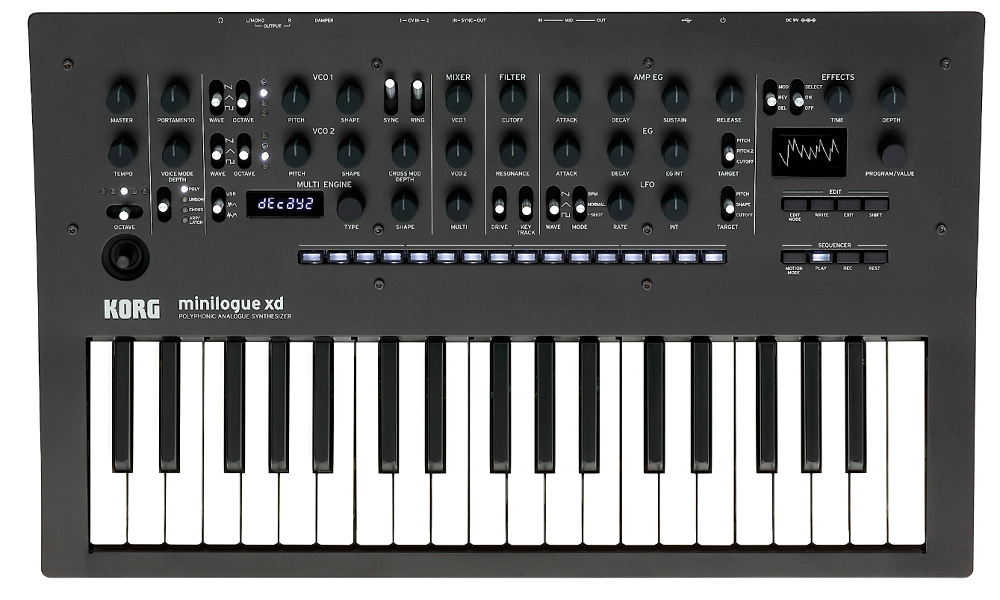
If I had to recommend a single hardware synth for someone buying their first, the Korg Minilogue XD would be at the top of a very short list.
It gives you four voices of true analog polyphony with a digital Multi-Engine oscillator, built-in effects, a motion sequencer, and an interface where everything is laid out clearly on the front panel. The XD straddles the line between accessibility and depth better than any other synth at its price point.
What makes the Minilogue XD special isn’t any single feature but rather how everything works together. The analog oscillators sound warm and musical, the digital Multi-Engine adds timbral variety the analog section can’t provide, and the effects and sequencer turn it into a self-contained creative instrument.
- Hybrid Engine
Two analog VCOs paired with a digital Multi-Engine per voice give you the warmth of analog combined with the timbral variety of digital synthesis.
The Multi-Engine adds VPM (Variable Phase Modulation), user-loadable oscillator types, and digital noise that extend the Minilogue XD into territory that a pure analog synth at this size and price simply can’t reach. The hybrid approach means you’re not choosing between analog warmth and digital versatility. You get both.
- Motion Sequencing
The motion sequencer records knob movements and plays them back as per-step automation, turning the Minilogue XD into a self-contained composition tool where textures evolve without requiring a DAW.
You twist the filter cutoff, adjust the oscillator mix, change the effect depth, and the sequencer captures your movements for playback on every loop. The motion recording preserves the organic quality of your physical gestures rather than generating mathematically perfect automation.
- OLED Oscilloscope
A built-in OLED display shows the output waveform in real time as you adjust parameters, which is both educational and practically useful.
Watching the waveform respond to filter sweeps, pulse width changes, and oscillator sync helps you understand what synthesis parameters actually do to the sound. For beginners learning synthesis, the visual feedback connects what you hear with what you see in a way that menus and numbers don’t.
- CV Inputs
Two CV inputs let you connect the Minilogue XD to modular synthesizer systems, expanding its role from standalone synth to part of a larger modular or semi-modular setup. The CV connectivity adds integration options that most synths at this price don’t include, and it opens up modulation possibilities from external sources that the onboard modulation alone can’t provide.
- User Content
The user-loadable Multi-Engine oscillators and effects can be expanded with community-created content.
You can download third-party oscillator algorithms and effect types that add new synthesis capabilities beyond what Korg shipped, which means the Minilogue XD grows over time as the community develops new content. The expandability extends the instrument’s useful life significantly.
- Joystick
A real-time joystick controller provides simultaneous pitch bend and modulation control from a single physical interface. The joystick encourages performance gestures that separate pitch and mod wheels don’t facilitate as naturally, and it adds an expressive control option that many competing synths at this price lack.
3. Korg MS-20 Mini
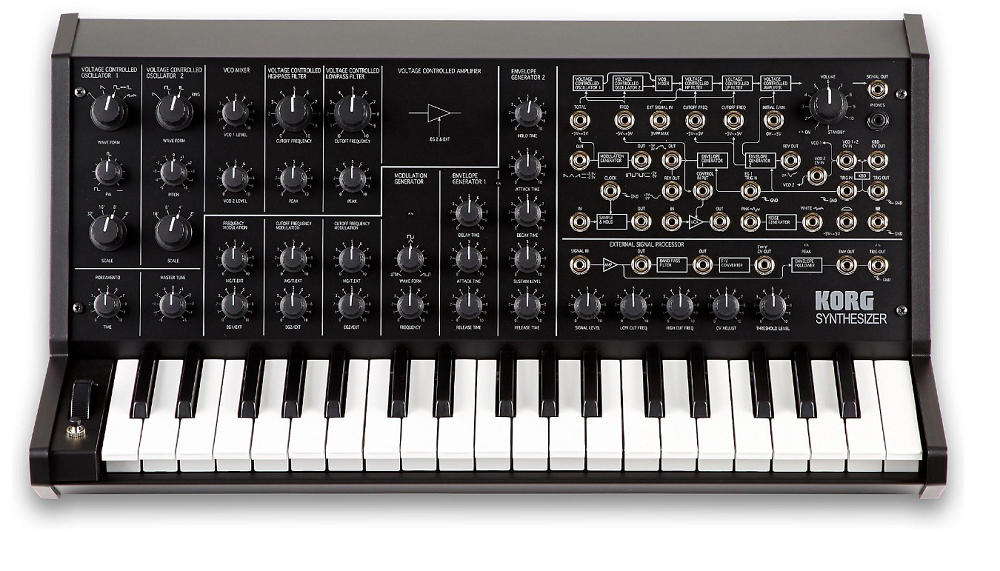
One of the most iconic synthesizers ever made, and the mini version brings the aggressive, raw, semi-modular analog character of the original into a compact, affordable format.
Korg MS-20 Mini gives you the same dual-filter architecture and patch bay that made the original a favorite of electronic musicians, noise artists, and sound designers for over four decades, scaled down to roughly two-thirds the size.
The MS-20 sound is immediately recognizable. It’s raw, aggressive, and unpolished in a way that more refined analog synths deliberately avoid, and that rawness is exactly what makes it essential for producers who need character and edge.
- Dual Filters
The high-pass and low-pass filters in series create the aggressive, resonant character that no other filter architecture replicates.
When both filters are resonating and you sweep them against each other, the interaction produces screaming, nasty textures that are the MS-20’s signature. The dual filter sound has defined genres from industrial through techno to noise music.
- Patch Bay
The patch bay on the front panel provides signal routing overrides, external audio processing, and modulation connections that transform the MS-20 from a standard monosynth into a semi-modular sound design tool.
You can feed external audio through the filters, create feedback loops, route the envelope to unexpected destinations, and break the default signal path in creative ways that no preset synth allows.
- ESP Module
The External Signal Processor with envelope follower and pitch-to-CV converter tracks incoming audio and generates control voltages from it. Your voice can play the synth. A drum machine can control the filter. A guitar can drive the oscillator pitch. The ESP opens up reactive, performance-driven processing that connects the MS-20 to the world outside its own circuits.
4. Korg Wavestate MKII
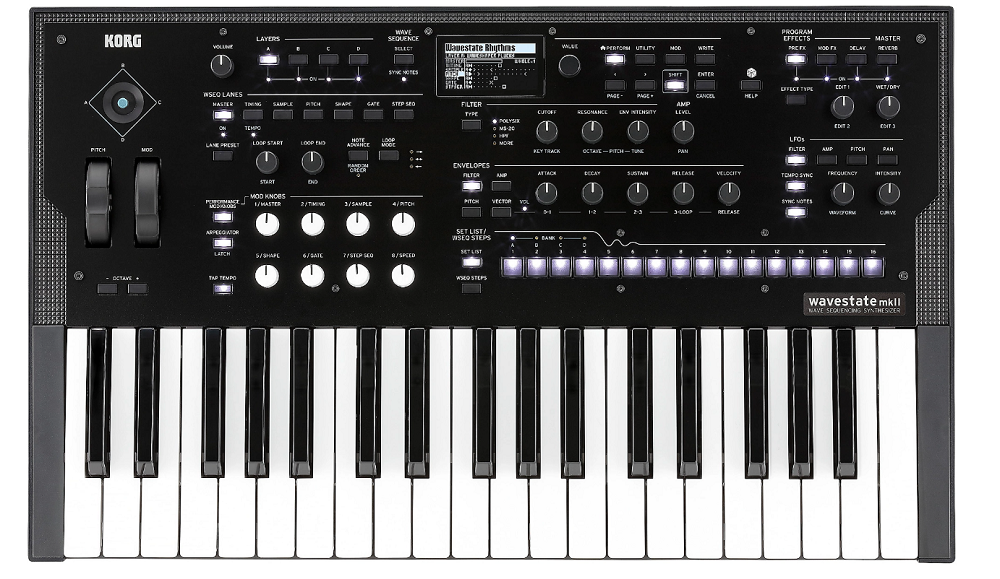
Deep wave sequencing synthesis with 96-voice polyphony and the kind of evolving, complex textures that no other synthesis method quite produces.
Korg Wavestate MKII revives and expands the wave sequencing concept pioneered by the original Korg Wavestation, where independent lanes for waveform, pitch, timing, and amplitude each follow their own sequence independently, creating patterns that shift and evolve in ways that standard synthesis doesn’t achieve.
The Wavestate isn’t for everyone. It’s a deep, complex instrument that rewards patience and experimentation. But if you want sounds that constantly evolve and never quite repeat, nothing else in Korg’s lineup (or anyone else’s) does what the Wavestate does.
- Wave Sequencing 2.0
The wave sequencing engine with independent lanes for waveform, pitch, timing, and shape creates textures where each parameter follows its own sequence length and pattern.
The independent lanes produce polyrhythmic, constantly shifting timbres that develop over time without manual intervention. A four-step pitch sequence running against a seven-step waveform sequence against a five-step timing sequence creates patterns that don’t repeat for hundreds of steps.
- 96 Voices
96-voice polyphony ensures that even the most complex, sustained wave sequences never run out of voices. The massive voice count is essential for the Wavestate’s synthesis approach because wave sequences with long release times and multiple overlapping layers consume voices rapidly. With 96 voices, you can sustain complex textures without hearing notes cut off prematurely.
- Randomization
Built-in randomization tools generate new wave sequence configurations as creative starting points.
The randomization is particularly powerful with the wave sequencing engine because randomized parameters across multiple independent lanes produce results that deliberate programming rarely achieves. You randomize, listen, adjust what you like, randomize again, and gradually sculpt the result toward something musically useful.
- Performance Controls
Dedicated front-panel knobs provide real-time access to the most important wave sequence parameters alongside standard filter and amplitude controls. The performance controls make the deep synthesis engine accessible without menu diving for the most common tweaking tasks, which matters when you’re performing or experimenting in real time.
5. Korg multi/poly
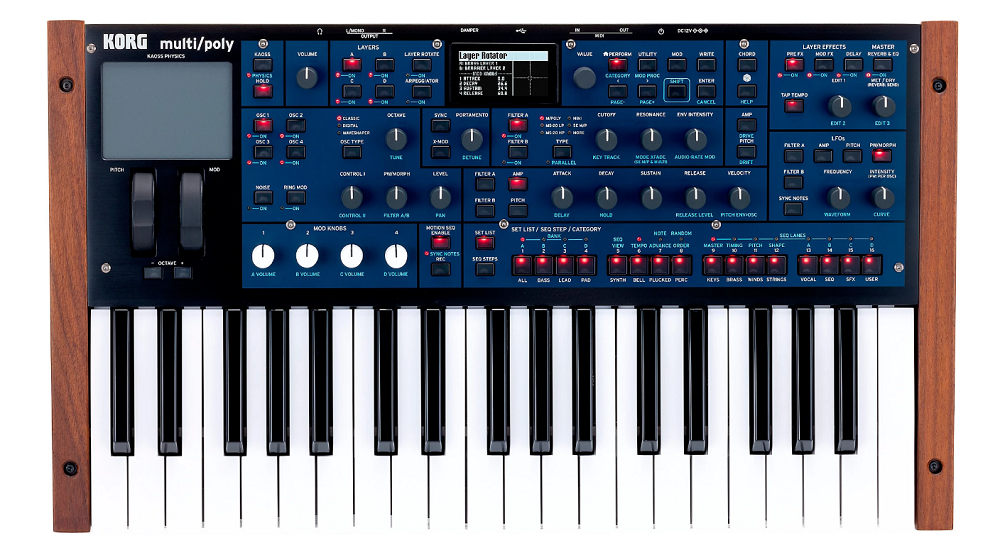
A genuinely different approach to polyphonic synthesis where each voice has its own independent signal path that can be configured, modulated, and processed separately.
Korg multi/poly gives you four independent analog voices that you can play polyphonically, but unlike conventional polysynths where all voices share the same patch, each voice on the multi/poly can run a completely different sound simultaneously.
The independent voice architecture opens up creative possibilities that conventional polysynths can’t touch, from playing four different instruments from a single keyboard to creating layered textures where each note triggers a different timbre.
- Independent Voices
Each of the four analog voices has its own oscillator, filter, and modulation settings that can be programmed independently. You can set up one voice as a bass, another as a pad, a third as a lead, and the fourth as a percussive pluck, then play all four from the same keyboard with the note assignment distributing your playing across the different timbres.
The independence creates performance and compositional possibilities that unified-patch polysynths fundamentally can’t replicate.
- Motion Sequencing
Per-voice motion sequencing captures knob movements independently for each of the four voices, creating a situation where each voice evolves on its own timeline.
The per-voice motion recording means your four independent sounds can each have their own parameter automation running simultaneously, creating extraordinary textural complexity from a four-voice instrument.
- Analog Quality
The analog oscillators and filters provide the warm, organic tone quality that Korg’s analog circuits are known for. Each voice carries the harmonic richness and subtle variation of real analog components, and having four independent analog signal paths means the tonal variety comes from genuinely different analog settings rather than digital parameter changes applied to identical voices.
6. Korg opsix MKII
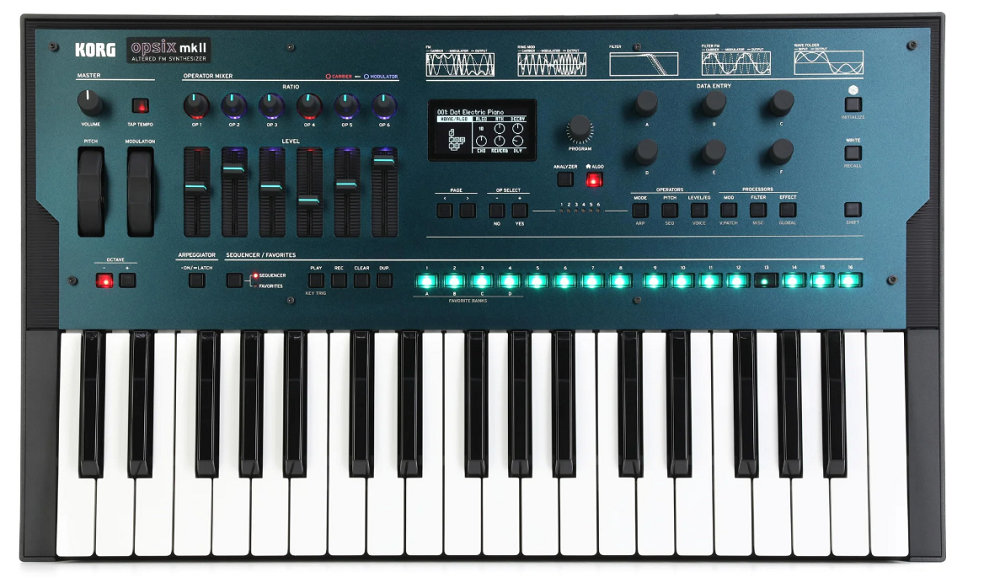
FM synthesis made genuinely accessible through a hands-on, knob-per-function interface that replaces the menu-driven complexity that historically made FM intimidating.
opsix MKII gives you six FM operators with 30+ algorithms and the kind of direct physical control over operator parameters that the DX7 never offered, making it practical to design FM sounds in real time rather than relying on presets.
For producers who want metallic stabs, crystalline bells, complex bass sounds, and the specific harmonic richness that FM synthesis produces but have been put off by the traditional programming complexity, the opsix MKII removes that barrier.
- Six Operators
Six FM operators with over 30 algorithm configurations provide significantly more harmonic complexity than four-operator designs.
The extra operators mean you can create layered, detailed FM timbres with simultaneous modulator and carrier relationships that produce sounds four-operator engines can’t reach. The algorithm variety gives you different operator interaction structures that fundamentally change the harmonic character of the output.
- Hands-On Control
Dedicated knobs for every operator parameter replace the screen-based programming that made classic FM synths frustrating to learn. You can adjust operator ratios, levels, feedback, and envelopes by reaching for physical controls and hearing the result immediately.
The knob-per-function approach makes FM synthesis feel as intuitive as subtractive synthesis, which is a significant achievement given FM’s historical reputation for complexity.
- Filter Addition
A multimode filter that classic FM synths never included gives you subtractive shaping on top of the FM engine. The filter lets you apply the kind of sweeps, resonance, and frequency shaping that producers expect from any modern synth, taking raw FM timbres and molding them into more conventional, mix-ready sounds when needed. FM plus filtering produces results that neither synthesis method achieves alone.
- Altered Modes
Beyond standard FM, the opsix includes altered operator modes (ring modulation, waveshaping, filter mode) that expand each operator beyond pure sine-wave FM into more complex territory. The altered modes mean the opsix isn’t limited to traditional FM sounds.
It can produce timbres that are part FM, part ring mod, part waveshaper, combining different synthesis approaches within a single algorithm.
- MIDI/USB
Full MIDI and USB connectivity integrates the opsix into DAW-based workflows with the ability to send and receive CC data for all parameters. The connectivity means you can automate every aspect of the FM engine from your DAW, which is useful for detailed FM sound design where you want to record parameter changes precisely.
7. Korg Volca Bass
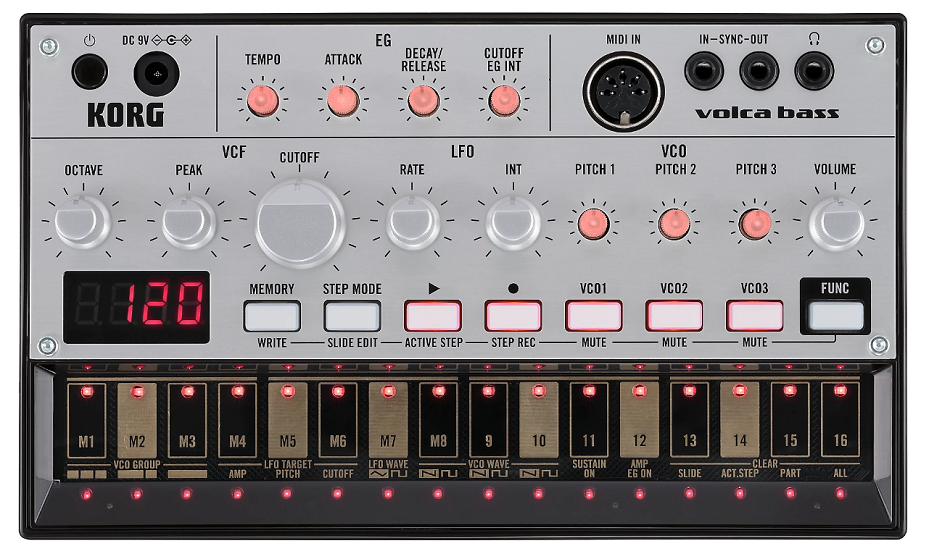
Proof that a genuinely useful analog synthesizer can fit in the palm of your hand. Korg Volca Bass gives you three analog oscillators with independent tuning and waveform control, a resonant analog filter, and a step sequencer in a format smaller than most effects pedals.
At its price, the Volca Bass is practically an impulse purchase, but the sounds it produces are anything but throwaway.
The three-oscillator design is what elevates the Volca Bass above other ultra-budget analog synths, because you can detune the oscillators against each other for thick, chorused tones that single-oscillator designs can’t match.
- Three Oscillators
Three analog VCOs with individual pitch, waveform, and octave control give you harmonic complexity that’s unusual at this price and size. You can stack all three for massive unison bass, spread them across octaves for layered content, or detune slightly for thick, warm chorus-like textures.
The three-oscillator architecture means the Volca Bass produces sounds with significantly more depth than its tiny form factor suggests.
- Palm Size
The entire instrument fits in your hand and runs on batteries, which means it goes literally anywhere. The Volca format is the most space-efficient way to add real analog synthesis to any setup, taking up less desk space than a coffee mug while delivering genuine analog tone.
- Sync Chain
3.5mm sync connects to other Volcas and compatible gear for synchronized multi-instrument setups. Building a complete hardware production chain from multiple Volcas (Bass for low end, FM2 for melodic content, Drum for percussion) creates a system that collectively costs less than many single synths while covering multiple synthesis types.
8. Korg Wavestate SE
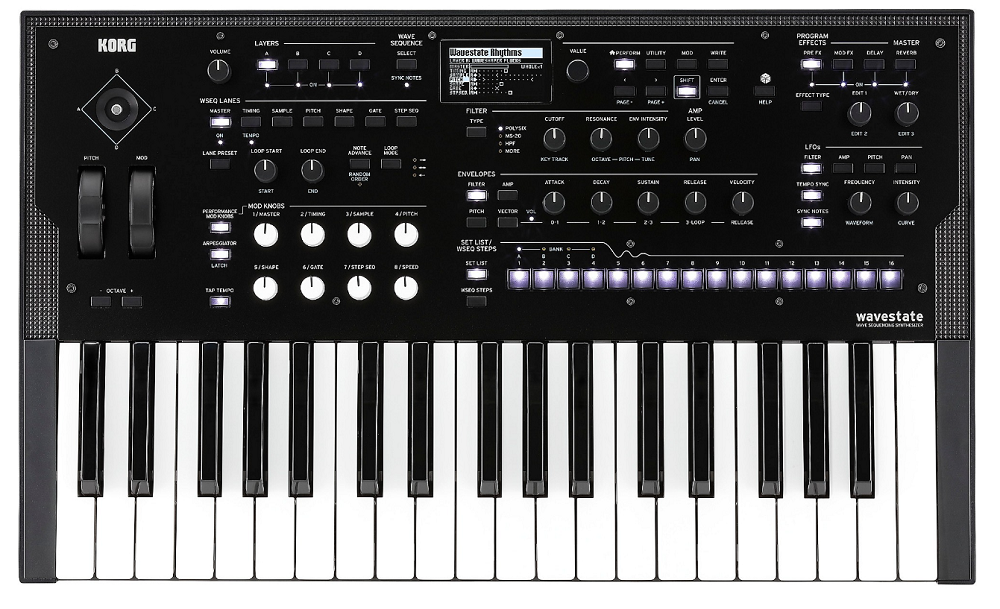
The premium version of the Wavestate with a 61-note keyboard, improved build quality, and the same deep wave sequencing engine in a format suited to serious studio use and live performance.
Korg Wavestate SE takes everything that makes the standard Wavestate compelling and puts it in a full-size keyboard package with the playing range and build quality that professional applications demand.
For keyboardists and performers who love the Wavestate’s synthesis but need more than 37 keys and want a more substantial instrument, the SE delivers the complete experience.
- 61-Note Keyboard
The full-size 61-note keyboard provides five octaves of playing range that the standard Wavestate’s 37 keys can’t match.
The expanded range matters for wave sequencing because the synthesis responds differently across the keyboard, and having five octaves means you can explore the full tonal range of wave sequence patches from the lowest bass textures through the highest shimmering harmonics without octave switching.
- Build Quality
The SE features upgraded construction with a more robust chassis and better-quality keybed compared to the standard version. The improved build makes the SE suitable for touring and stage use where the standard version’s lighter construction might be a concern. The premium feel of the instrument also makes a difference during extended studio sessions where you’re interacting with the synth for hours.
- Same Engine
The identical wave sequencing engine with 96-voice polyphony, independent parameter lanes, randomization tools, and the full effect section means you sacrifice nothing sonically by choosing the SE. Every sound, patch, and capability of the standard Wavestate is present in the SE. You’re paying for the keyboard and build quality, not for additional synthesis features.
- Performance Layout
The expanded front panel accommodates the controls more comfortably than the compact standard version, with slightly more space between knobs and buttons. The roomier layout makes real-time tweaking more comfortable during performance, where cramped controls can lead to accidental parameter changes.
9. Korg microKORG
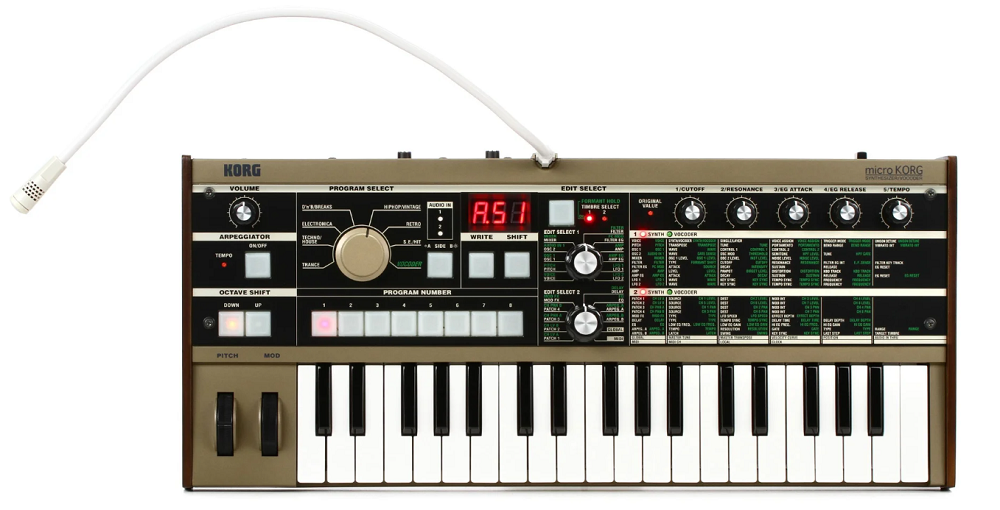
The synth that has probably been on more stages, in more bedrooms, and in more studios than any other compact keyboard in the past two decades.
Korg microKORG (now in its latest iteration) remains one of the most popular small synths ever made, with a virtual analog engine, built-in vocoder, and a compact format that’s become iconic in its own right.
The microKORG’s longevity speaks for itself. It’s been in continuous production because nothing else quite fills the same niche of affordable, portable, great-sounding, and vocoder-equipped in a single compact package.
- Vocoder
The built-in vocoder with microphone input turns the microKORG into a vocal processing instrument alongside its synthesis duties.
The vocoder has been a defining feature since the original model, and having it in a package this affordable and portable makes the microKORG the most accessible hardware vocoder available. For live performers who use vocoded vocals, no other compact synth combines a vocoder with a quality synthesis engine this effectively.
- Iconic Workflow
The two-knob-plus-matrix editing system provides access to deep parameters without a screen, using a combination of parameter select and value adjustment that’s become familiar to a generation of synth players. The editing approach takes some learning, but once you internalize the matrix layout, programming sounds is faster than menu-based systems because you navigate by muscle memory rather than visual navigation.
- Preset Library
A generous preset library covering pads, leads, basses, effects, and vocoder patches gives you a broad range of usable sounds immediately. The presets are well-designed starting points that cover the most common performance and production needs, and the preset quality is one of the reasons the microKORG has remained popular. You can load a useful sound within seconds of powering on.
- Portability
Battery operation and a lightweight, compact chassis make the microKORG genuinely portable for gigs, sessions, and travel. The combination of battery power, small size, and low weight means the microKORG goes anywhere without adding significant bulk or weight to your setup.
- Timeless Design
The microKORG’s physical design has become recognizable as a cultural object beyond the synthesizer world. The compact form factor with the distinctive panel layout has appeared in music videos, live performances, and studios across every genre, which gives it a visual identity that transcends its technical specifications.
10. Korg Minilogue
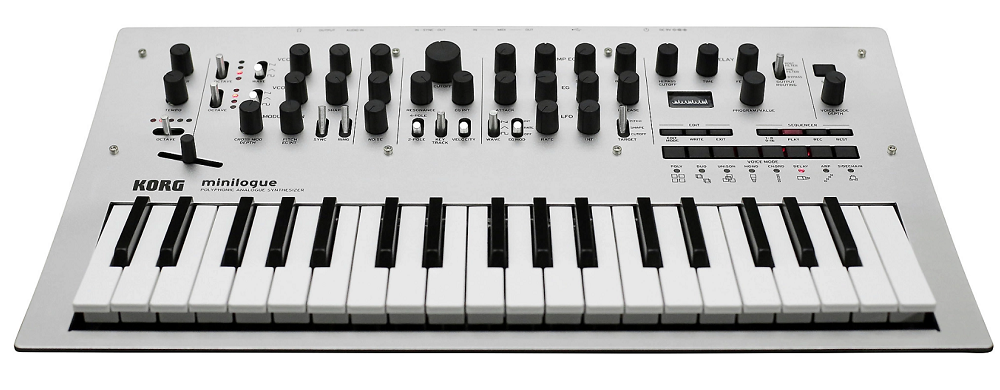
The original Minilogue that started Korg’s modern analog polysynth renaissance and remains a viable choice even alongside the newer XD version. Korg Minilogue gives you four voices of true analog polyphony with a clear, hands-on interface and the specific tonal character that made it one of the most successful analog polysynths of the 2010s.
While the XD added the digital Multi-Engine and updated effects, the original Minilogue has its own character. Some producers actually prefer its slightly different filter voicing and more focused, purely analog sound.
- Pure Analog
The fully analog signal path with two VCOs, a resonant filter, and analog VCA per voice delivers a warm, organic tone that’s inherently musical.
Unlike the XD with its digital Multi-Engine, the original Minilogue is purely analog in its oscillator section, which gives it a specific tonal consistency where every part of the sound comes from the same analog circuitry. For producers who want uncompromised analog character without any digital element in the oscillator stage, the original Minilogue provides that.
- Voice Modes
Multiple voice modes including poly, duo, unison, mono, chord, delay, arp, and sidechain provide different ways to use the four analog voices.
The voice modes extend the Minilogue far beyond simple polyphonic playing, letting you stack voices for thick unison, create automated sidechain-style pumping effects, or trigger the voices in delayed sequence for pseudo-echo effects. Each mode fundamentally changes how the synth responds to your playing.
- Oscilloscope
The built-in OLED oscilloscope provides real-time waveform visualization that helps you understand what your parameter adjustments are doing. The visual feedback is particularly valuable for learning synthesis because you can watch the waveform change shape as you adjust pulse width, add sync, or sweep the filter, connecting the visual representation with the audible result.
- Sequencer
A 16-step sequencer with motion recording captures both notes and knob movements for looping playback. The sequencer turns the Minilogue into a self-contained pattern generator that you can program without a DAW, and the motion recording adds the kind of evolving parameter automation that keeps sequences interesting over extended playback.
11. Korg Kross 2-61
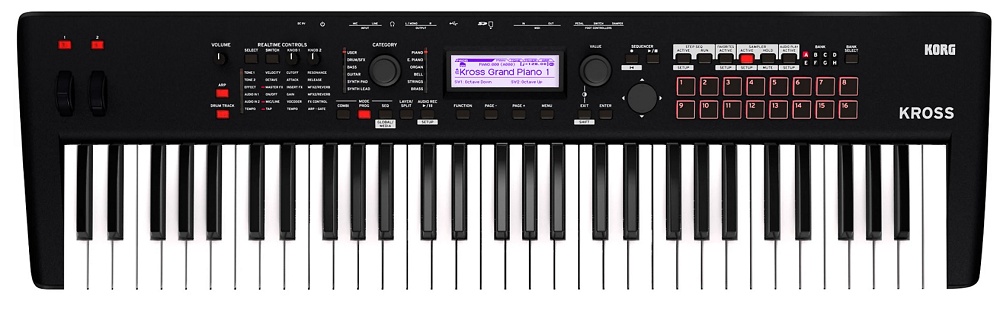
Closing the list with an entirely different kind of instrument. The Korg Kross 2-61 is a workstation synthesizer rather than a dedicated synth, which means it combines synthesis, sampling, drum kits, effects, a sequencer, and an audio recorder in a single lightweight keyboard.
For producers and performers who need one instrument that covers everything from piano and organ through synth pads and bass to drum programming and arrangement, the Kross 2 is Korg’s answer to the “I need everything in one box” problem.
The Kross 2 won’t win sound design contests against the dedicated synths on this list, but it covers more ground from a single instrument than any of them.
- Sound Variety
Over 1000 preset sounds covering pianos, organs, strings, brass, synth pads, leads, basses, drum kits, and sound effects give you a complete production palette from one instrument. The sound library covers virtually every instrument category you’d encounter in music production, which means the Kross 2 functions as a one-stop-shop for arranging and performing across any genre.
- Lightweight
At around 3.8kg, the Kross 2-61 is one of the lightest 61-key keyboards available, which makes it genuinely practical for gigging musicians who need to carry their instrument to venues. The lightweight construction doesn’t feel cheap. It’s deliberately engineered for portability rather than cut for cost. For keyboardists who perform regularly, the weight savings over heavier workstations add up quickly.
- 16-Track Sequencer
A built-in 16-track MIDI sequencer lets you build complete arrangements within the keyboard itself without a computer. The sequencer handles drums, bass, chords, melody, and additional parts across sixteen independent tracks, which is enough for complete song production. For songwriters and performers who want to sketch and arrange ideas directly on their performance instrument, the onboard sequencer provides a complete workflow.
- Audio Recorder
An integrated audio recorder captures performances directly to the keyboard’s storage, meaning you can record ideas, demos, and performances without an external recorder or computer. The audio recording capability turns the Kross 2 into a self-contained production tool where you program sequences, add live parts, and record the result all from the same instrument.
- Drum Kits
Dedicated drum kits with velocity-layered samples and multiple kit configurations give you rhythm programming capability alongside the melodic instruments. The drum kits cover acoustic, electronic, and percussion styles, and you can trigger them from the keyboard, sequence them with the onboard sequencer, or use the drum track function for quick rhythm accompaniment.
- Pad Sampler
16 sampling pads let you record, import, and trigger your own audio samples alongside the factory sounds. The pad sampler adds a custom dimension where you can incorporate vocal samples, found sounds, or any other audio into your performances and sequences. The sampling capability extends the Kross 2 beyond its factory content into personal territory.
Get the Free Plugin Starter Kit
The genuinely useful free DAWs and plugins worth installing. No filler. Straight to your inbox.

Hello, I’m Viliam, I started this audio plugin focused blog to keep you updated on the latest trends, news and everything plugin related. I’ll put the most emphasis on the topics covering best VST, AU and AAX plugins. If you find some great plugin suggestions for us to include on our site, feel free to let me know, so I can take a look!