
Few pieces of music hardware have shaped entire genres the way Roland’s x0x drum machines and bass synths have. The TR-808 gave hip hop and trap their signature sub bass and claps. The TR-909 became the backbone of house, techno, and trance.
The TB-303 spawned acid house almost by accident when producers started abusing its squelchy filter in ways Roland never intended. And the TR-606, often overlooked, provided a crunchier, more lo fi alternative that found its way into new wave, industrial, and minimal productions.
The originals are expensive, fragile, and increasingly difficult to find in working condition.
That’s where software emulations come in. Some of these plugins model the original circuits with extreme accuracy. Others take the core character and expand it with modern features like extended tuning ranges, built in effects, and deeper sound shaping that the original hardware never offered. I’ve included a mix of both approaches here, along with several genuinely useful free options that can get you started without spending anything.
What you’ll find below are fifteen plugins covering 303 bass synths, 808 drum machines and sub bass generators, 909 emulations, and a few that bundle multiple machines together. Whether you’re producing trap, techno, acid, house, or hip hop, there’s something here for every x0x related production need.
From the Pluginerds Store
Before you get into the list below, a wireless pad controller gives you the velocity sensitivity to build patterns live alongside your main unit — a genuinely useful complement to any groovebox or sampler here.


1. FAW SubLab XL (808 Sub Bass)

If you produce trap, hip hop, or any genre that relies on deep 808 sub bass, you’ve probably spent time trying to make a standard synthesizer produce the kind of low end that shakes speakers without turning muddy. FAW SubLab XL was built specifically for this purpose, providing a dedicated sub bass workstation with synthesis, sampling, and processing all focused on the frequencies below 200 Hz.
The reason I recommend SubLab XL over just using a regular synth for 808 work is the focused workflow. Everything in the interface is oriented around crafting sub bass that translates across different playback systems. The X Sub engine generates harmonics that make your sub audible on laptop speakers and earbuds where pure sine waves would be inaudible, which is a real world problem that most producers deal with constantly.
- X Sub Engine
The proprietary X Sub synthesis engine generates controlled upper harmonics from your sub bass signal, ensuring the low end remains audible on small speakers without adding harsh or unmusical overtones. This solves the fundamental problem of sub bass production: making frequencies that physically cannot be reproduced by small speakers still perceivable through harmonic content.
- Sampler Layer
A dedicated sample layer lets you load and layer your own 808 kicks and sub samples alongside the synthesized content. The sampler includes pitch envelope, amplitude envelope, and filtering for shaping imported samples to fit your production. You can blend the synthesized sub with a sampled transient for a complete 808 sound in a single plugin.
- Distortion Rack
A multi stage distortion section provides saturation specifically voiced for sub bass frequencies. The distortion adds grit, presence, and harmonic weight without destroying the fundamental, which is the challenge with running sub bass through general purpose distortion plugins that weren’t designed for low frequency content.
- Keyboard Tracking
The processing adapts as you play different notes across the keyboard, maintaining consistent perceived volume and character whether you’re hitting a low C or a higher octave. Without this compensation, sub bass patches typically fall apart when you move away from the root note they were designed around.
Available from Future Audio Workshop in VST, VST3, AU, and AAX formats.
Get the Free Plugin Starter Kit
The genuinely useful free DAWs and plugins worth installing. No filler. Straight to your inbox.
2. Roland TB-303 (Official 303 Plugin)
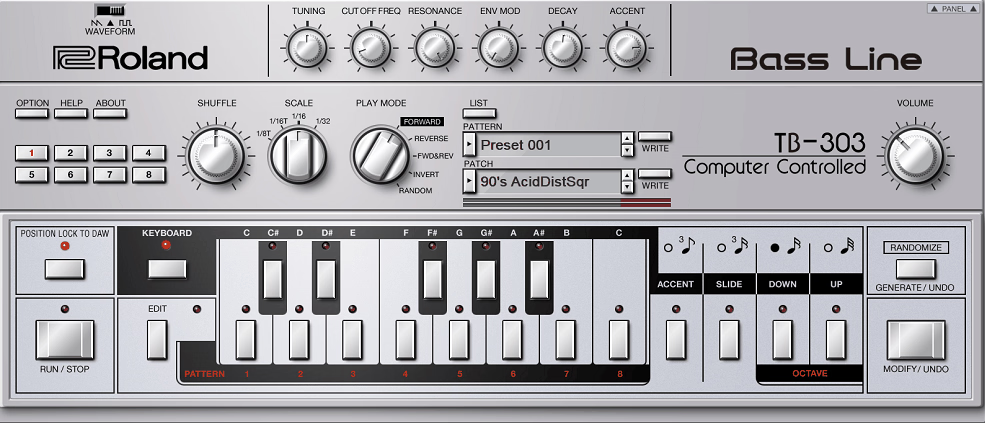
Roland’s own TB-303 plugin is the official software version of the synth that launched acid house, and it carries the advantage of being developed by the original manufacturer with access to the actual hardware schematics and component measurements. The emulation covers the VCO, VCF, VCA, and envelope circuits of the original, including the specific filter resonance behavior that gives the 303 its unmistakable squelch.
What I find worth noting about the Roland TB-303 plugin compared to third party alternatives is the inclusion of the original step sequencer. The 303’s sequencer with its accent and slide functions was central to how acid lines were created, and the randomness of programming it contributed to the genre’s characteristic unpredictable patterns. Having that sequencer faithfully reproduced means you can work the way the original producers did rather than programming acid lines note by note in a piano roll.
- Circuit Modeling
Roland’s ACB (Analog Circuit Behavior) technology models the original TB-303 at the component level, capturing the specific nonlinearities, tolerances, and interactions between the VCO, VCF, and VCA that define the 303 sound. The filter’s self oscillation behavior and the way the accent circuit interacts with the envelope are both accurately reproduced.
- Step Sequencer
The original 303 step sequencer is faithfully recreated, including the specific way notes, rests, accents, slides, and ties are entered. The sequencer’s quirky input method was partly responsible for the genre of acid house, because the difficulty of programming precise patterns encouraged happy accidents.
- Overdrive Section
A built in overdrive pushes the output into saturation, which is how most producers use the 303 in practice. The overdrive adds the aggressive, screaming character that defines acid bass lines at higher resonance settings, taking the sound from subtle squelch to full distortion.
- Scatter Function
Roland’s Scatter feature applies real time rhythmic variations to the sequencer pattern, introducing syncopation, note repeats, and pattern mutations that create evolving acid lines from static sequences. This is a modern addition that the original hardware lacked.
- Patch Memory
Unlike the original hardware which had no patch storage, the plugin provides full preset management for saving and recalling sounds. You can build a library of 303 tones and recall them instantly, which is a practical convenience the hardware never offered.
- Roland Cloud
Available through Roland Cloud as part of the subscription or as an individual purchase, with Lifetime Key options for permanent ownership. The plugin runs in VST, AU, and AAX formats across both Mac and Windows.
Available from Roland in VST, AU, and AAX formats.
3. D16 Phoscyon 2 (303 Emulation)
Among third party 303 emulations, D16 Phoscyon 2 has long been considered one of the most accurate and widely used options. D16 Group has a reputation for precise analog modeling of classic hardware, and Phoscyon 2 reflects years of refinement in capturing the specific filter behavior, accent circuit interaction, and slide characteristics that define the TB-303 sound.
I’ve compared Phoscyon 2 against the Roland TB-303 plugin and several other alternatives, and where Phoscyon consistently stands out is in the filter resonance range. The way the resonance interacts with the cutoff at extreme settings, producing that screaming, almost vocal quality, feels particularly close to recordings of the original hardware. It’s also a plugin that experienced 303 users tend to gravitate toward for serious acid production.
- Filter Accuracy
The filter modeling captures the specific diode ladder filter behavior of the original TB-303, including how resonance affects the signal level, how the cutoff responds to the envelope, and the way self oscillation behaves at extreme resonance settings. The filter is where the 303 sound lives, and Phoscyon 2 gets this right.
- Accent Circuit
The accent system models the original circuit’s interaction between accent level and filter envelope depth, where harder accents simultaneously increase volume, filter cutoff, and resonance. This three way interaction is what gives accented 303 notes their characteristic aggressive bite that a simple volume boost can’t replicate.
- Effects Section
A built in effects chain includes distortion and delay tailored for 303 processing. The distortion models the specific types of overdrive that acid producers typically apply to the 303, from subtle warmth to aggressive screaming saturation.
Available from D16 Group in VST, VST3, AU, AAX, and CLAP formats.
4. Arturia Acid V (303 Synth)
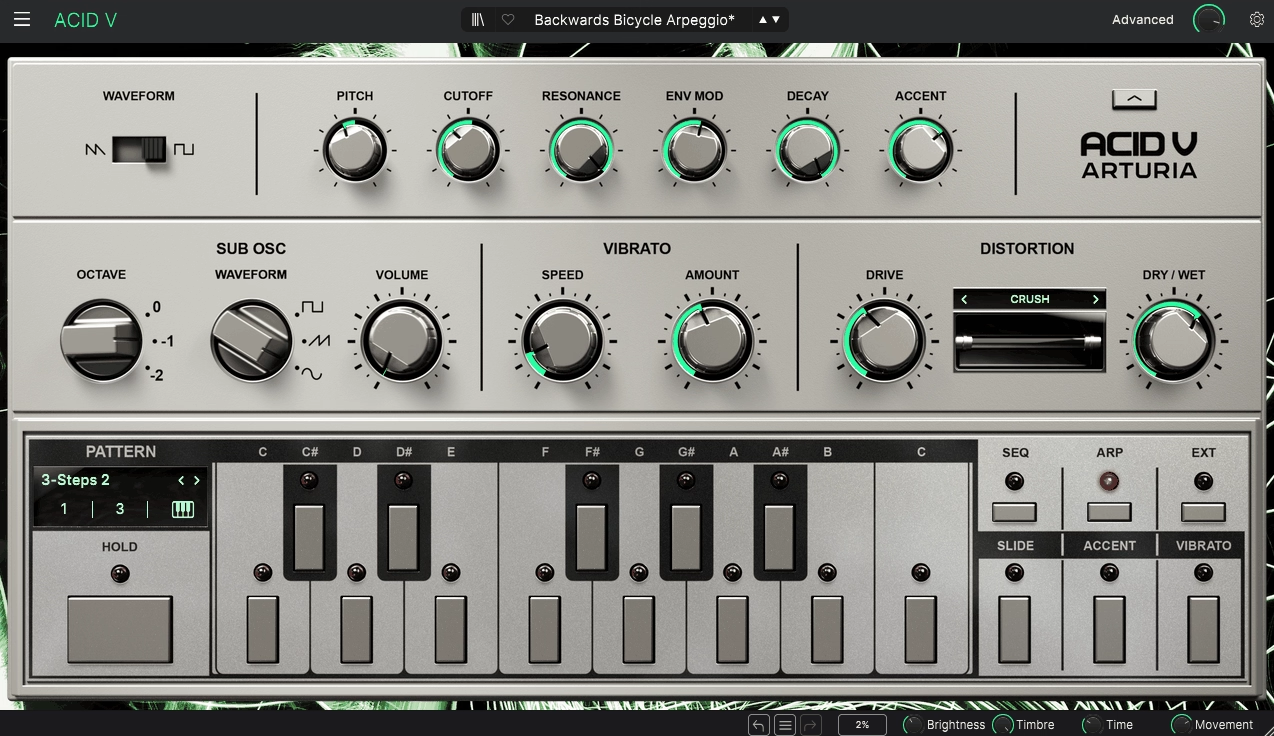
Arturia Acid V takes a different approach to 303 emulation than pure accuracy focused plugins like Phoscyon. While it starts with a faithful reproduction of the TB-303 circuit using Arturia’s TAE (True Analog Emulation) technology, it then expands the instrument with additional oscillators, effects, modulation, and an advanced sequencer that go well beyond what the original hardware could do.
If you want a plugin that can produce authentic 303 acid bass but can also venture into territory the original never could, Acid V is the strongest option available. I reach for it when I want the 303 character as a starting point but need more flexibility in sound design. The extended sequencer with probability, ratcheting, and per step parameter locks is particularly useful for creating complex evolving acid patterns that would be impossible on the original hardware.
- TAE Modeling
Arturia’s True Analog Emulation technology models the original TB-303 circuit with attention to component tolerances, signal path behavior, and filter characteristics. The core 303 sound is authentic before any of the expanded features are engaged, which means you can use Acid V as a straight 303 emulation when that’s all you need.
- Extended Oscillator
Beyond the original single oscillator design, Acid V adds a second oscillator and a sub oscillator that expand the tonal range while maintaining the 303 character. The additional oscillators can be mixed with the original for thicker, more complex bass tones that retain the acid quality.
- Advanced Sequencer
The sequencer goes far beyond the original 303’s capabilities with probability per step, ratcheting, parameter locks, and variable sequence lengths. You can program sequences where filter cutoff, resonance, and accent vary independently per step, creating patterns with far more movement than the original sequencer allowed.
- Modulation Matrix
A full modulation matrix with LFOs, envelopes, and random sources provides deep modulation routing that lets you create evolving, animated 303 tones. The modulation system connects the expanded sound engine to the extended sequencer for patches that develop over time.
Available from Arturia in VST, VST3, AU, and AAX formats.
5. Initial Audio 808 Studio 2 (808 Drum Machine)
The 808 sound in modern production usually means one specific thing: a tuned sub bass kick that sustains and pitches across the keyboard. Initial Audio 808 Studio 2 is built around this usage, providing 808 kick and bass sounds that are designed for trap, drill, and hip hop production where the 808 is pitched and played as a melodic element rather than just triggered as a single drum hit.
What makes 808 Studio 2 practical for this type of production is the combination of high quality 808 samples with real time synthesis controls. You’re not just scrolling through samples hoping one fits. You’re loading an 808 and then shaping the pitch envelope, saturation, sustain, and sub harmonic content to match your track. The sounds are designed to sit correctly in a modern mix without extensive post processing.
- 808 Library
A large collection of 808 kick and bass samples provides the core sounds, each designed for pitched playback across the keyboard. The samples cover a range from clean, round sub kicks to heavily saturated, distorted 808s that suit different production styles.
- Pitch Envelope
A detailed pitch envelope controls the initial pitch drop that defines the 808 kick character. The attack pitch, drop time, and sustain pitch are all adjustable, letting you shape everything from tight, punchy 808 hits to long, sweeping bass drops.
- Saturation Control
Built in saturation adds harmonics that help the 808 cut through on smaller speakers. The saturation amount and character are adjustable, so you can keep the 808 clean for sub focused mixes or drive it harder for more aggressive productions.
Available from Initial Audio in VST, VST3, AU, and AAX formats.
6. Maxsynths DR-910 Rhythm Maker (Free 909)
For a free TR-909 emulation, the Maxsynths DR-910 provides a surprisingly faithful reproduction of the original drum sounds with a few practical extras that the hardware never had. Each drum voice (kick, snare, toms, hi hats, cymbals) has been modeled to match the analog synthesis and sample based hybrid approach of the original 909, where some sounds were synthesized and others used short digital samples.
I should be upfront about the limitations: the DR-910 is Windows only, 32 bit VST, and hasn’t been updated in years. MaxSynths eventually made all their plugins free when they stopped development. If you’re on Windows and can run 32 bit plugins (or use a bridge like jBridge), it’s a genuinely useful free 909 that sounds better than you’d expect for the price. If you need cross platform support or modern plugin formats, you’ll want to look at the D16 or Roland options instead.
- Sound Accuracy
Each drum voice is modeled after the corresponding 909 circuit, capturing the specific analog kick synthesis, the snappy snare, and the metallic hi hats that define the 909 sound. The kick in particular captures the pitched, punchy character that made the 909 essential for house and techno.
- Built In FX
The plugin includes a reverb unit with independent send controls per drum voice, a compressor designed specifically for drum processing, and a lo fi effect for degrading the sound. These extras let you process the drums within the plugin without needing external effects.
- Multi Output
Four stereo output pairs let you route individual drum voices to separate mixer channels in your DAW for independent processing. This is essential for any serious drum mixing work where you need separate EQ and compression on kick, snare, and hi hats.
- Pan Controls
Individual pan controls per drum voice let you position each element in the stereo field directly within the plugin. The panning is immediately accessible without needing to route to separate channels first.
- Tune and Level
Each drum voice has independent tuning and level controls that go beyond what the original 909 offered. The extended tuning ranges let you pitch the kick and toms into territory the hardware couldn’t reach, which is useful for genres that use tuned 909 kicks.
Available from Maxsynths as a free download. Windows 32 bit VST only.
7. D16 Group Drumazon 2 (909 Emulation)
If you’re looking for the most accurate TR-909 emulation available in a modern plugin format, D16 Drumazon 2 is the standard that other 909 plugins are measured against. D16 Group’s component level modeling captures every voice of the 909 with the kind of detail that experienced producers and engineers can verify against the original hardware.
What separates Drumazon 2 from simpler 909 emulations is the depth of control over each drum voice. The original 909 had minimal controls per sound. Drumazon 2 exposes additional parameters that let you shape each voice beyond what the hardware allowed, while maintaining the authentic 909 character as the foundation. The built in sequencer with swing and shuffle reproduces the specific timing feel that made the 909 essential for dance music.
- Voice Modeling
Each of the eleven drum voices (bass drum, snare, low/mid/high toms, rim, clap, hi hat closed/open, crash, ride) is modeled at the component level, capturing the specific synthesis circuits and their interactions. The bass drum’s punchy, pitched decay and the snare’s distinctive snap are particularly well reproduced.
- Extended Controls
Beyond the original hardware parameters, Drumazon 2 provides additional tuning, envelope, and tone shaping controls per voice that let you push each sound into territory the original 909 couldn’t reach. The extended ranges are useful for producers who want 909 character but need sounds that fit modern production contexts.
- Step Sequencer
A built in step sequencer reproduces the 909’s pattern based workflow with swing, shuffle, and flam controls that affect the rhythmic feel. The sequencer’s shuffle implementation captures the specific timing character that defined the 909’s groove in classic house and techno records.
Available from D16 Group in VST, VST3, AU, AAX, and CLAP formats.
8. Midilab JC-303 (Free 303 Emulation)
The best free 303 emulation I’ve found is the Midilab JC-303, an open source plugin built on the Open303 DSP engine that has benefited from over fifteen years of community driven development and reverse engineering by TB-303 enthusiasts. The engine was developed through oscilloscope analysis and circuit reverse engineering of actual 303 hardware, and the results are impressive for a free plugin.
JC-303 won’t replace the polish and features of commercial options like Phoscyon 2 or Acid V, but the core sound is remarkably close to the real thing. The filter behavior, the slide characteristics, and the way the accent interacts with the envelope all feel authentic. The recent addition of an AI based overdrive section with over 180 pedal and amp models is a bonus that gives you a surprising amount of tonal variety from a free plugin.
- Open303 Engine
The sound engine is built on Open303, a project born from a KVRAudio community effort to create the most accurate open source 303 emulation possible. Over fifteen years of development, contributors analyzed real hardware with oscilloscopes and reverse engineered the original circuits to achieve accurate filter, oscillator, and envelope behavior.
- AI Overdrive
A GuitarML based overdrive section uses machine learning models trained on real pedal and amplifier recordings to reproduce the sound of actual hardware overdrive. The plugin ships with 37 built in models, and over 180 additional models are available for download, giving you a huge range of distortion characters.
- Devilfish Mods
Some of the famous Devil Fish modifications (created by Robin Whittle in 1993 and considered the most sought after third party modification of the original 303) are available as adjustable parameters. These modifications expand the tonal range of the 303 beyond what the stock hardware could produce.
- Waveform Control
Where the original TB-303 had a simple sawtooth/square switch on the back panel, JC-303 provides a continuous waveform knob that lets you blend between waveform shapes. This gives you a broader range of tonal options from the oscillator section than the binary switch on the original hardware.
Available from Midilab in VST2, VST3, LV2, CLAP, and AU formats. Free and open source.
9. BPM Series Cassette 606, 808 and 909 (Free Bundle)
Getting started with classic drum machine sounds doesn’t have to cost anything, and the BPM Series Cassette collection proves it by bundling free 606, 808, and 909 plugins into a single download. These aren’t deep emulations with component level modeling. They’re sample based instruments loaded with recordings of the original hardware that have been processed through cassette tape for a warmer, slightly degraded vintage character.
The cassette processing is actually what makes these interesting rather than just “another free drum machine sample set.” The tape saturation, the subtle wow and flutter, and the frequency roll off give the sounds a lo fi warmth that sits differently in a mix than clean digital samples. For producers working in lo fi hip hop, vaporwave, or vintage inspired electronic music, that built in character is a feature rather than a limitation. Just be aware that if you need pristine, clean 808 or 909 sounds, these aren’t the right tools.
- Three Machines
The bundle includes separate plugins for the 606, 808, and 909, each loaded with multi velocity samples of every drum voice from the respective original machine. Having all three machines available in a single free download gives you a broad palette of classic drum sounds to work with.
- Cassette Character
All samples have been recorded through actual cassette tape, adding the specific saturation, frequency coloring, and subtle pitch instability that tape introduces. This processing gives the sounds a vintage, worn quality that’s different from clean digital samples of the same machines.
- Velocity Response
The instruments respond to MIDI velocity with multiple sample layers, providing dynamic variation that single sample drum machines lack. Harder velocity triggers brighter, more transient rich samples. Softer velocity produces rounder, quieter hits. This makes programmed patterns feel more realistic.
- Individual Voices
Each drum voice can be individually tuned and mixed within the plugin, with level and panning controls per sound. The individual voice controls let you balance the kit to your production without needing to route every sound to a separate channel.
- Zero Cost
The entire three plugin bundle is completely free with no registration requirements, trial limitations, or in app advertising. The download is lightweight and the plugins are straightforward to install and use.
Available from BPM Series in VST and AU formats. Free.
10. AIR Sub Factory (808 Sub Bass)
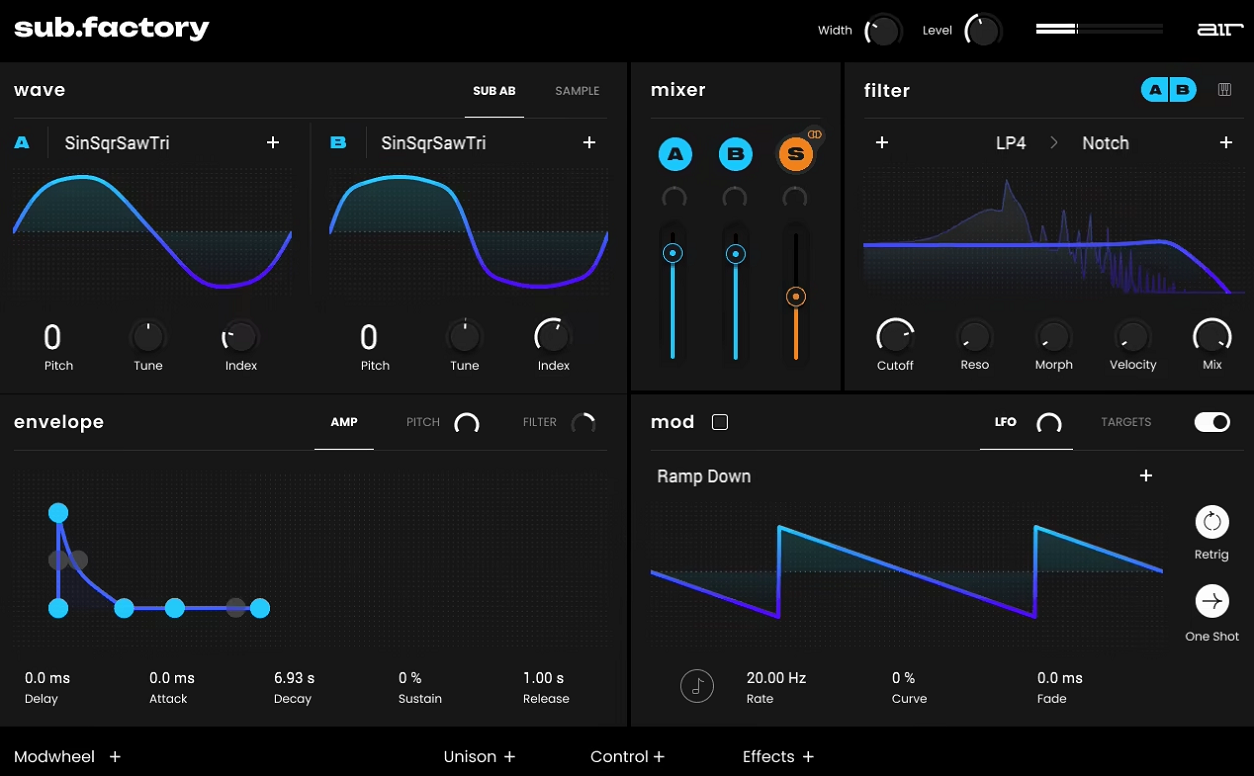
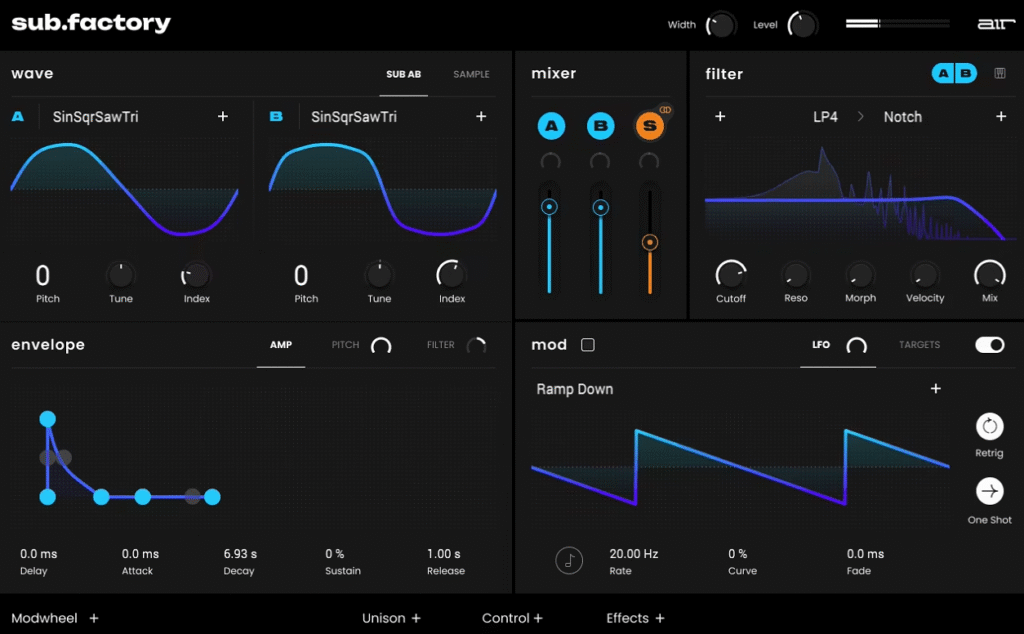
Sub Factory takes a stripped down approach to 808 sub bass generation that prioritizes simplicity over depth. The interface provides a small set of essential controls for shaping a clean, powerful sub bass tone without the complexity of a full synthesizer or the feature overload of more elaborate 808 plugins.
I recommend Sub Factory for producers who want a reliable, no fuss 808 sub bass generator that loads fast and gets out of the way. It’s not the deepest plugin on this list, and it doesn’t have the extensive preset libraries or visual feedback of tools like SubLab XL or X-EIGHT 2. What it does offer is a clean, focused sub bass engine with enough control to shape the sound to your needs without overwhelming you with options. Sometimes the simplest tool is the right one.
- Simple Interface
The controls are limited to the essential parameters: tuning, envelope shape, tone, and output level. There are no unnecessary pages or hidden menus. You see everything the plugin does on a single screen, and you can have a usable 808 bass sound within seconds of loading it.
- Clean Sub Tone
The synthesis focuses on producing clean, powerful sub bass without unnecessary harmonic complexity. The fundamental is strong and well defined, which gives you a solid foundation that you can process further with external saturation or distortion if you want a dirtier sound.
- CPU Efficient
The lightweight design means minimal CPU impact, which matters when you’re running the plugin alongside dozens of other instruments and effects in a dense production session. You can load multiple instances without worrying about performance.
Available from AIR Music Technology in VST, VST3, AU, and AAX formats.
11. Roland TR-909 Rhythm Composer (Official 909 Plugin)
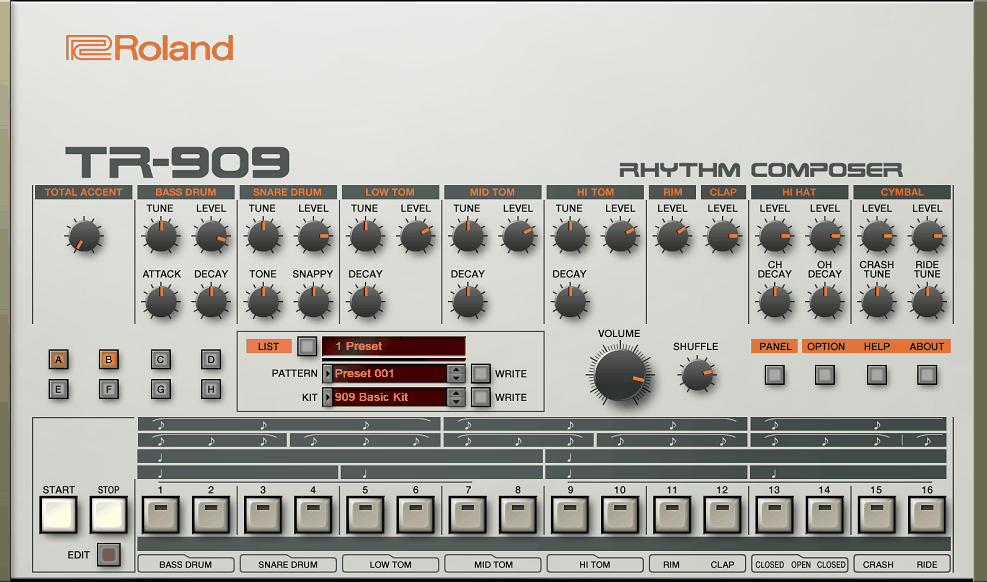
Just as Roland offers the official TB-303 plugin, the Roland TR-909 Rhythm Composer brings the manufacturer’s own 909 emulation to your DAW with the same ACB modeling technology. The advantage here is identical to the 303 situation: Roland built the original hardware and has access to the actual schematics, component specifications, and engineering documentation that third party developers have to reverse engineer.
I use the Roland TR-909 plugin when I need the 909 character to be unquestionable. The kick’s pitched decay, the snare’s layered analog/sample hybrid, and the open hi hat’s metallic shimmer are all convincingly reproduced. The inclusion of the original step sequencer with its specific shuffle and flam behavior is important because the 909’s groove feel was inseparable from how the sequencer quantized and swung patterns.
- ACB Technology
Roland’s Analog Circuit Behavior modeling recreates each 909 voice at the component level, including the unique hybrid design where some voices (kick, snare, toms) use analog synthesis while others (hi hats, cymbals) use PCM samples through analog filters. This hybrid architecture is what gives the 909 its distinctive character.
- TR-REC Sequencer
The original TR-REC step sequencer is faithfully reproduced with accent, flam, shuffle, and pattern chaining. The sequencer’s specific timing and swing behavior is part of what made the 909 groove feel unique, and this implementation captures those timing characteristics.
- Scatter Effects
Roland’s Scatter function applies real time rhythmic variations to the pattern, introducing fills, stutters, and pattern mutations. This modern addition creates variation from static patterns without requiring manual programming of fills.
- Expanded Tuning
Each voice has extended tuning and parameter ranges beyond what the original hardware offered, letting you push 909 sounds into modern production territory while maintaining the authentic character as the foundation.
Available from Roland in VST, AU, and AAX formats.
12. D16 Nepheton 2 (808 Emulation)
Completing D16 Group’s trilogy of Roland drum machine emulations, Nepheton 2 provides what many producers consider the most detailed TR-808 software emulation available. Like Drumazon 2 for the 909, Nepheton 2 models each 808 voice at the component level with the kind of accuracy that has made D16’s drum machine plugins the reference standard for serious electronic music production.
The 808’s sound is deceptively simple on the surface. A kick, snare, toms, congas, claves, cowbell, and hi hats. But the specific character of each voice, particularly the long decaying kick, the snappy snare, and the crispy analog hi hats, requires precise modeling of circuits that interact in complex ways. Nepheton 2 captures these interactions, and the result sounds like an 808 in a way that sample based alternatives don’t quite match.
- Component Modeling
Every drum voice is modeled from the original 808 circuit schematics, capturing the specific bridged T network oscillator of the kick, the noise based snare synthesis, and the analog hi hat generation. The modeling goes deep enough that the sounds respond to parameter changes the way the original hardware does.
- Extended Parameters
Beyond the original 808’s limited controls, Nepheton 2 provides additional envelope, tuning, and tone shaping parameters per voice. The extended kick decay and tuning range is particularly useful for modern productions that use the 808 kick as a melodic sub bass instrument pitched across the keyboard.
- Built In Sequencer
A step sequencer reproduces the 808’s pattern programming workflow with the addition of swing, shuffle, and probability per step. The sequencer captures the timing feel of the original while adding modern features that expand its creative potential.
- Multi Output
Individual drum voices can be routed to separate outputs in your DAW for independent processing. This is essential for the kind of detailed drum mixing that modern production requires, where each voice needs its own EQ, compression, and spatial treatment.
- Per Voice FX
Each drum voice has access to independent effects processing including saturation, filtering, and envelope shaping. This per voice approach lets you process individual sounds without affecting the rest of the kit.
- Preset Management
A comprehensive preset system stores complete kit configurations including sequencer patterns, effect settings, and output routing. The preset library covers a range of genres from classic electro and hip hop to modern trap and techno.
Available from D16 Group in VST, VST3, AU, AAX, and CLAP formats.
13. Roland TR-808 Rhythm Composer (Official 808 Plugin)
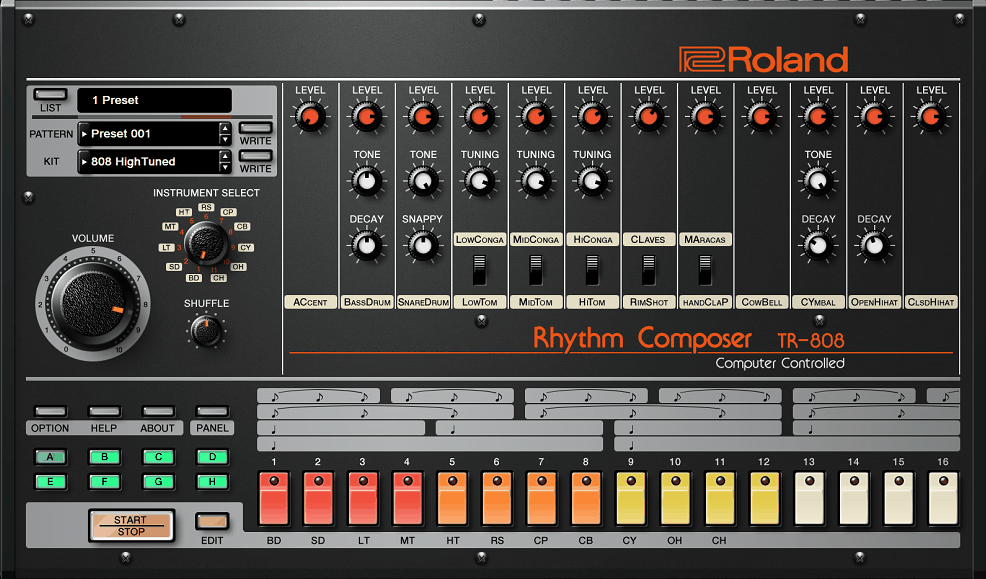
The TR-808 is Roland’s official plugin version of the drum machine that arguably shaped more genres than any other piece of electronic music equipment. Built with the same ACB modeling used in the TB-303 and TR-909 plugins, it provides an 808 emulation backed by the original manufacturer’s engineering resources.
For producers who want the definitive 808 sound without debating which third party emulation is closest, the Roland version settles the question. The kick’s long decay and sub bass weight, the cowbell’s distinctive metallic ring, and the maracas’ crispy analog noise are all reproduced with the authority of the company that designed the original circuits. The step sequencer with its specific shuffle implementation is included.
- ACB Accuracy
Roland’s Analog Circuit Behavior technology models each 808 voice from the original schematics, capturing the specific oscillator, filter, and envelope circuits that define each sound. The kick drum’s characteristic long, booming decay that became the foundation of hip hop and trap is particularly well reproduced.
- Step Sequencer
The TR-REC step input method is faithfully reproduced, including the accent pattern, instrument muting, and pattern variations that defined the 808’s workflow. The sequencer’s timing and feel are modeled to match the original hardware’s behavior.
- Extended Controls
Each voice includes additional parameter controls beyond the original hardware’s limited knobs, providing more shaping options while maintaining the authentic 808 character as the foundation.
Available from Roland in VST, AU, and AAX formats.
14. United Plugins SubBass Doctor (808 Sub Bass)
Taking a completely different approach from traditional 808 emulations, United Plugins SubBass Doctor is an effect plugin rather than an instrument. Instead of generating 808 sounds from scratch, it analyzes your existing audio and generates sub bass content that tracks the pitch of whatever you feed it. You can use it on a thin 808 sample to add real sub weight, or apply it to any bass sound to extend it into sub territory.
I find SubBass Doctor most useful as a complement to other 808 plugins and sample libraries. Sometimes you have an 808 sample that has the right character in the mids but lacks real sub bass weight below 60 Hz. Rather than replacing the sample, you can use SubBass Doctor to generate the missing low frequency content while keeping the original’s character intact. It’s also useful on bass guitars, synth basses, and kick drums where you want more sub presence.
- Pitch Tracking
The plugin analyzes the pitch of the incoming audio in real time and generates a sub bass signal that follows the detected fundamental. The tracking is accurate enough to follow melodic bass lines without glitching or losing pitch lock, which is essential for 808 bass runs that move across different notes.
- Sub Synthesis
The generated sub bass uses a clean sine wave synthesis approach that adds weight without introducing unwanted harmonics or muddiness. The synthesis is focused specifically on the sub bass frequency range where you need the additional energy.
- Blend Control
A mix control blends the generated sub bass with the original signal, letting you add exactly the right amount of low end without overwhelming the source material. For subtle enhancement, a small amount fills out the bottom end. For dramatic effect, pushing the blend heavier creates massive sub presence.
- Filter Section
A crossover filter defines the frequency boundary between the original signal and the generated sub bass, giving you precise control over where the enhancement begins. Setting the crossover correctly ensures the sub generation doesn’t interfere with the existing bass content above it.
Available from United Plugins in VST, VST3, AU, and AAX formats.
15. Thenatan X-EIGHT 2 (808 Bass)
Thenatan X-EIGHT 2 is a focused 808 bass instrument designed specifically for trap and hip hop production where the 808 needs to be tuned, pitched, and played as a melodic bass instrument. Rather than emulating the entire TR-808 drum machine, X-EIGHT 2 concentrates exclusively on the 808 kick/bass sound and provides deep control over every aspect of it.
The plugin ships with a large library of 808 bass presets that cover the full range of modern 808 styles, from clean and subby to distorted and aggressive. What I find useful is the real time visual feedback that shows you the pitch envelope, harmonic content, and waveform shape as you adjust parameters. For producers who are still learning how different 808 parameters affect the sound, that visual feedback is educational as well as practical.
- 808 Focus
The entire plugin is dedicated to a single purpose: creating the best possible 808 bass sounds. Every control, every preset, and every visual element is oriented around shaping tuned 808 sub bass. This focus means you’re not navigating a full drum machine interface when all you need is the kick/bass sound.
- Pitch Envelope
A detailed pitch envelope controls the attack pitch, drop curve, and sustain pitch that define the 808’s characteristic pitch sweep. The envelope shape determines whether the 808 hits as a tight, punchy kick or as a long, sustained bass note.
- Distortion Engine
Multiple distortion types add harmonic content and aggression to the 808 signal. The distortion is voiced for low frequency content, adding grit and presence without destroying the sub bass fundamental. Different distortion types suit different production styles, from subtle warmth to heavy saturation.
From the Pluginerds Store
If you're leaning toward one of the samplers above, a wireless pad controller is worth adding to the order — it extends what you can do live without touching a mouse.

- Visual Feedback
A real time waveform and spectrum display shows the 808’s pitch envelope, harmonic content, and amplitude in response to your parameter changes. The visual feedback makes it easier to understand what each control does to the sound, which speeds up the sound design process.
- Preset Library
A curated 808 preset collection covers modern trap, drill, hip hop, and bass music production styles. The presets range from clean sub bass to heavily distorted 808s and provide starting points that can be further customized.
Available from Thenatan in VST, VST3, AU, and AAX formats.
Get the Free Plugin Starter Kit
The genuinely useful free DAWs and plugins worth installing. No filler. Straight to your inbox.

Hello, I’m Viliam, I started this audio plugin focused blog to keep you updated on the latest trends, news and everything plugin related. I’ll put the most emphasis on the topics covering best VST, AU and AAX plugins. If you find some great plugin suggestions for us to include on our site, feel free to let me know, so I can take a look!