
Ambient music asks something specific from a synthesizer that other genres don’t. You need sounds that sustain beautifully, that evolve slowly over time without becoming boring, and that carry enough harmonic depth and textural interest to hold a listener’s attention across minutes of minimal arrangement.
A synth that sounds impressive for a two-bar hook can fall apart completely when you hold a single chord for thirty seconds, because every flaw in the tone, every static quality, every digital artifact becomes exposed when there’s nothing else in the mix to hide behind.
What I’ve found through years of working with ambient music is that the hardware synths that excel at it share a few qualities.
They have rich, deep polyphony so sustained chords don’t thin out when new notes arrive. They have extensive modulation that keeps textures alive without manual intervention.
They have quality effects built in, because ambient sound design without reverb and delay is like painting without a canvas. And ideally, they have a hands-on interface that encourages the slow, meditative process of shaping a sound over time rather than rushing through preset banks. I’ve selected nine hardware synths that each approach ambient production from a different angle, from affordable analog polysynths through digital wavetable and granular engines to semi-modular instruments built for drone and texture creation.
1. Behringer DeepMind 12
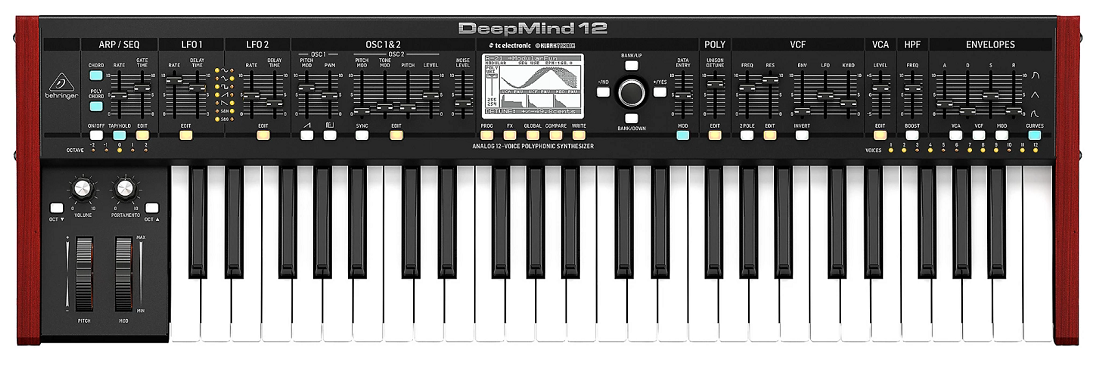
Starting with this one because it might be the best value proposition for ambient music in all of hardware synthesis. Behringer DeepMind 12 gives you twelve voices of true analog polyphony with a 32-slot effects engine and deep modulation routing at a price that makes the competition look almost absurd.
For ambient music specifically, the combination of that voice count with those effects produces the kind of massive, shimmering, evolving pad textures that the genre lives on.
Twelve analog voices means you can hold full chords with sustain pedal, layer notes on top, and nothing drops out. The effects section then wraps those analog tones in chorus, phaser, reverb, and delay that transform raw analog into finished ambient soundscapes without touching your DAW.
- Twelve Voices
Twelve voices of analog polyphony give you the sustain headroom that ambient music demands. You can hold a six-note chord with the sustain pedal and play a melody on top without voices stealing from your pad. For ambient production where pads sustain across entire sections and new notes layer on top continuously, twelve voices means your textures maintain their full harmonic density rather than thinning out as the voice allocator reclaims notes.
- Effects Depth
The 32-slot effects engine with four simultaneous effect slots covers chorus, flanger, phaser, delay, reverb, overdrive, EQ, and more. The effects quality and routing flexibility go far beyond typical analog synth effects.
For ambient music, running analog pads through triple-chorus into long reverb with a tempo-synced delay feeding back creates the vast, immersive spatial quality that defines the genre. You can build complete ambient soundscapes within the synth without any external processing.
- Mod Matrix
An 8-slot modulation matrix connects sources to destinations with enough flexibility for complex, self-evolving patches. For ambient, the matrix lets you create sounds where filters drift, chorus depth oscillates, reverb size breathes, and the entire texture shifts slowly over time without you touching anything. The modulation is what prevents ambient pads from sounding static and lifeless.
- Wi-Fi Editor
A wireless tablet editor provides visual access to every parameter including the effects and modulation routing. The tablet editor solves detailed programming tasks while keeping the meditative, screen-free experience of playing the hardware for performance. You program the deep parameters on the tablet, then put it away and play the synth with your hands.
Get the Free Plugin Starter Kit
The genuinely useful free DAWs and plugins worth installing. No filler. Straight to your inbox.
2. Arturia AstroLab
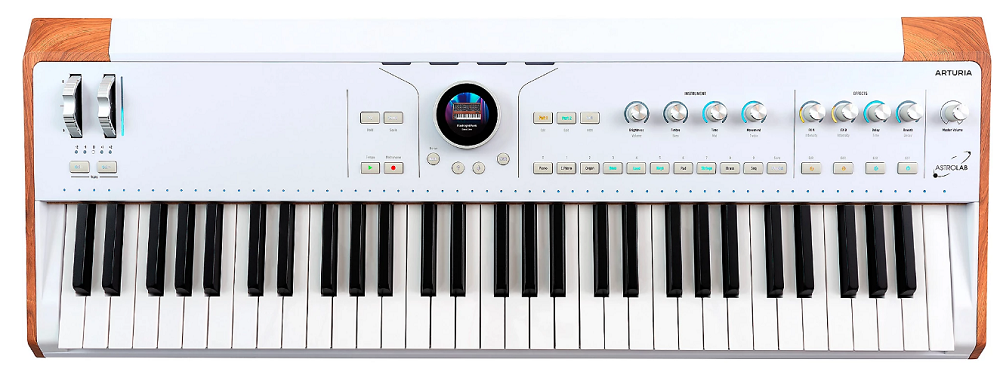
Access to 11 different synthesis engines and the entire Arturia V Collection in a standalone hardware format gives you the broadest possible ambient palette from a single instrument. AstroLab runs virtual analog, FM, wavetable, granular, physical modeling, phase distortion, vector synthesis, and more natively on the hardware without requiring a computer connection.
For ambient music, the AstroLab’s value is the variety of texture sources it provides. You can create a pad from the Mellotron V engine, layer an evolving texture from Pigments’ granular engine, and add a drone foundation from the CS-80 V model, all from the same instrument with instant preset recall.
- Granular Access
The Pigments engine running natively gives you access to granular synthesis on the hardware, which is one of the most powerful tools for ambient texture creation. You can freeze moments of audio, scatter grains across the stereo field, and create slowly evolving clouds of sound that conventional synthesis can’t produce. The granular capability alone makes the AstroLab worth considering for dedicated ambient producers.
- Engine Layering
Dual-layer capability lets you combine two different instruments simultaneously, meaning a string ensemble from Solina V layered with a wavetable pad from Pigments creates hybrid textures that neither engine produces alone. For ambient music where sonic depth comes from layering complementary textures, the dual-layer architecture doubles the creative possibilities.
- Preset Depth
Over 1,800 presets across 40+ instruments provide an enormous starting point library. For ambient producers who work by finding inspiring sounds and evolving them through performance, having nearly two thousand presets to explore means you’ll find unexpected starting points that push your music in directions you wouldn’t have programmed deliberately.
- Macro Controls
Four performance macros (Brightness, Timbre, Time, Movement) provide immediate, hands-on tonal shaping across any loaded patch. For ambient performance, slowly sweeping the Brightness macro to open a filter across a pad while adjusting Movement to increase modulation depth creates the gradual, evolving timbral shifts that ambient music relies on.
The macros are assignable per preset, meaning each sound has its own optimized set of performance controls.
- Standalone Operation
The hardware runs all synthesis engines independently without requiring a computer connection, which means you can create ambient music away from your studio in environments that inspire atmospheric composition.
Parks, quiet rooms, late-night sessions without screen glow. The standalone capability means the AstroLab works as a self-contained ambient instrument rather than a controller dependent on a laptop.
- Effects Processing
Two effect slots with 12 available effects plus dedicated delay and reverb buses process the sound within the hardware.
For ambient music where effects are fundamental rather than optional, having quality reverb, delay, chorus, and other spatial processing built in means your atmospheric textures are complete as saved presets. The dual bus architecture lets you run reverb and delay simultaneously on different send levels.
3. Korg Minilogue XD
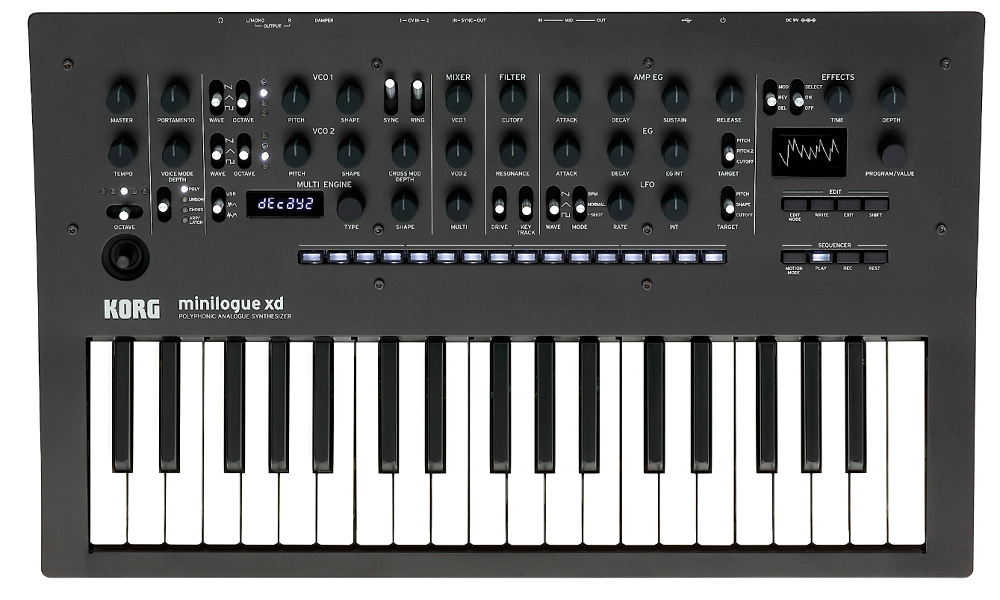
An affordable hybrid analog/digital synth that gives you four voices of analog polyphony plus a digital Multi-Engine oscillator for additional timbral territory. Minilogue XD is the most accessible entry point into hardware ambient production, with enough synthesis depth and built-in effects to create convincing atmospheric textures without spending polysynth money.
Four voices is admittedly limited for ambient work, but the Minilogue XD compensates with motion sequencing that records knob movements and the Multi-Engine that adds digital noise, VPM, and user-loadable oscillator types to the analog foundation.
- Multi-Engine
The digital Multi-Engine oscillator adds VPM (Variable Phase Modulation), user-loadable oscillator types, and digital noise alongside the two analog oscillators.
For ambient, the Multi-Engine extends the Minilogue XD beyond standard analog territory into metallic FM textures, custom waveform synthesis, and noise-based drones that pure analog synths at this price can’t produce. The combination of analog warmth from the main oscillators with digital complexity from the Multi-Engine creates hybrid textures suited to atmospheric music.
- Motion Sequencing
The motion sequencer records knob movements and plays them back as per-step parameter automation.
For ambient music, recording slow filter sweeps, resonance changes, and oscillator mix adjustments into the motion sequencer creates evolving, automated textures that shift on every loop without manual intervention. The motion recording captures the organic quality of your physical knob movements rather than mathematically perfect automation curves.
- Analog Warmth
The analog VCOs and analog filter provide the warm, organic foundation that ambient textures need. Digital synths can approximate analog warmth, but the Minilogue XD delivers it natively because the oscillators and filter are real analog circuits. For sustained pad work, the analog signal path produces a tonal richness and harmonic depth that makes simple chords sound full and complete.
4. Waldorf Iridium
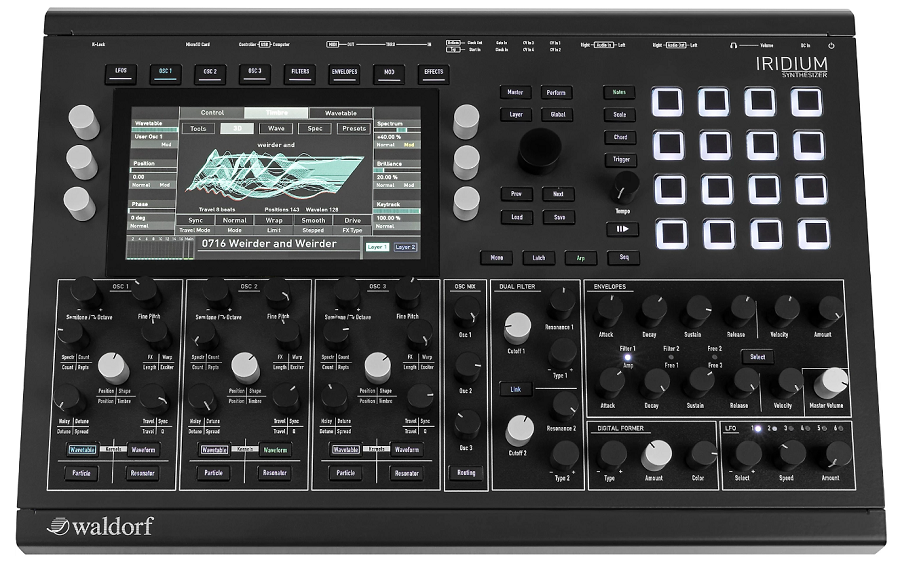
The most sonically deep synthesizer on this list, with wavetable, granular, resonator, particle, and kernel synthesis engines available across three oscillator slots.
Waldorf Iridium is a dedicated sound designer’s instrument that produces ambient textures of extraordinary complexity and detail, controlled through a large touchscreen interface that makes the deep engines accessible without endless menu navigation.
For serious ambient producers, the Iridium offers synthesis capabilities that no other hardware on this list can match, particularly in granular processing and resonator synthesis where you can create textures that evolve in ways conventional synthesis simply doesn’t achieve.
- Granular Engine
The particle synthesis engine provides real-time granular processing with control over grain size, density, pitch, position, and spatial placement.
You can load your own field recordings and transform them into slowly evolving granular clouds, frozen textures, and scattered ambient particles. For ambient music, granular synthesis is one of the most powerful tools available because it produces sounds that feel organic and unpredictable while remaining tonally beautiful.
- Synthesis Variety
Three oscillator slots each offering wavetable, virtual analog, particle, resonator, and kernel synthesis give you combinatorial possibilities that approach infinite. Running a wavetable oscillator into a resonator while a granular engine processes a field recording simultaneously creates textures of extraordinary layered complexity. The synthesis variety within a single instrument exceeds what most producers would achieve with multiple separate synths.
- Sample Import
USB sample import lets you load your own recordings into any of the synthesis engines. Field recordings of rain, wind, room tone, acoustic instruments, or any other source become raw material for the Iridium’s processing engines. For ambient music where personal, unique source material defines a producer’s identity, the sample import turns the Iridium into a genuinely personal instrument.
- Touchscreen
The large color touchscreen provides visual editing of wavetable positions, granular grain behavior, resonator tuning, and modulation routing. For ambient sound design where you’re building complex, multi-layered textures with interacting modulation paths, the visual interface makes the process intuitive rather than abstract. You can see what you’re hearing, which accelerates the experimental process.
5. Sequential Prophet 6
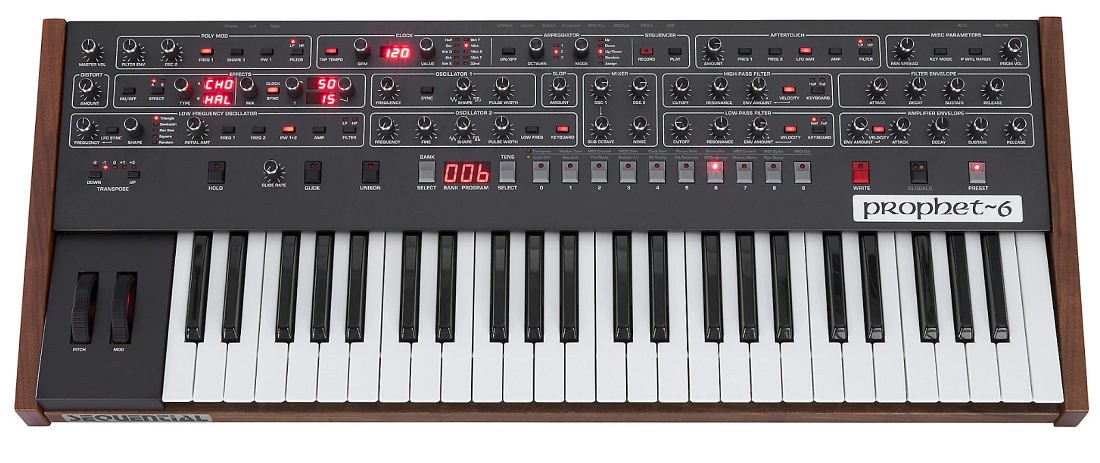
Sometimes the best ambient textures come from the simplest analog architecture handled with exceptional quality. Sequential Prophet 6 gives you six voices of true analog polyphony with two VCOs per voice, a Curtis analog filter, and built-in effects in an architecture that prioritizes sound quality over feature count.
The Prophet 6 makes this list because its analog tone is so inherently rich and warm that sustained chords sound beautiful without complex processing. Where other synths need effects and modulation to make pads interesting, the Prophet 6 sounds gorgeous with just the raw oscillators and filter.
- Analog Quality
The Curtis oscillators and filters produce a tonal quality that’s widely regarded as one of the finest in modern analog synthesis. For ambient pads, the raw analog signal path carries enough harmonic richness, warmth, and organic character that simple sustained chords sound complete and emotionally resonant without extensive processing. The quality of the analog components means less work to achieve beautiful results.
- Poly-Mod
The Poly-Mod section provides oscillator and filter frequency modulation that creates complex, evolving timbres from simple waveforms. For ambient music, Poly-Mod generates slowly shifting metallic overtones, subtle timbral movement, and harmonic complexity that keeps sustained sounds interesting over extended durations without external modulation sources.
- Built-in Effects
Chorus, delay, and distortion effects process the analog signal within the synth. The chorus thickens pads into wider, more immersive textures. The delay adds spatial depth and rhythmic interest. For ambient production, having quality effects integrated means your sustained pad sounds are processed and spatially complete as saved presets rather than requiring external effect chains.
6. Roland GAIA 2
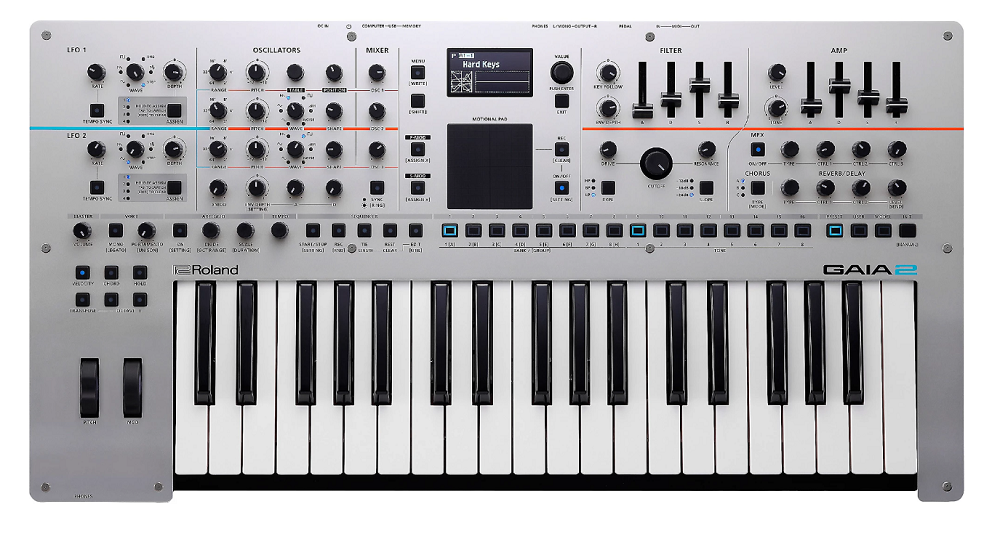
A virtual analog synthesizer with three tone generators and a fully hands-on interface where every major parameter has a dedicated knob. Roland GAIA 2 approaches ambient from a different angle than most synths on this list: instead of deep modulation systems and complex synthesis engines, it gives you immediate, physical control over layered sounds with zero menu diving required.
For ambient producers who work by slowly shaping sounds in real time rather than programming complex patches, the GAIA 2’s fully hands-on design lets you treat sound creation as a meditative, ear-first process where your hands guide the texture while your eyes stay closed.
- Three Tones
Three independent tone generators that you layer, split, or combine give you the building blocks for rich, stacked textures. Each tone has its own oscillator, filter, envelope, and LFO, meaning a single patch can contain three independently shaped layers. For ambient pads, stacking three slightly different tones with different filter settings and envelope times creates depth and movement that single-layer patches lack. One tone handles the warm foundation, another adds airy brightness, and a third introduces slow modulation.
- No Menus
Every major parameter has a dedicated front-panel control with no hidden menus for basic sound design. The direct interface means you shape ambient textures by reaching for knobs and listening rather than navigating screens. For ambient production, where the creative process benefits from slow, contemplative sound shaping, the menu-free workflow keeps you in a flow state where the connection between your hands and the sound is unbroken.
- D-50 Engine
Access to Roland’s D-50 synthesis engine alongside the virtual analog models adds atmospheric digital textures and layered pads that the D-50 contributed to ambient and new age music history. The D-50 sounds are a natural fit for ambient production, with their characteristic breathy attacks, evolving sustains, and spatial quality that complements the GAIA 2’s virtual analog tones.
- Effects Quality
The effects section with reverb, delay, chorus, and more processes the layered tones at a quality level that suits finished ambient production. For atmospheric music where effects are fundamental components of the sound rather than optional additions, the effect quality means your ambient textures are complete within the synth without needing an external effects chain.
- Scene Morph
A dual-layer scene system lets you save two complete sound configurations and crossfade between them in real time. For ambient music, morphing between two different pad textures creates the slow, evolving timbral transitions that define the genre’s aesthetic. You set up a warm, dark pad as Scene A and a bright, airy texture as Scene B, then slowly sweep between them over the course of a section.
7. Moog Matriarch
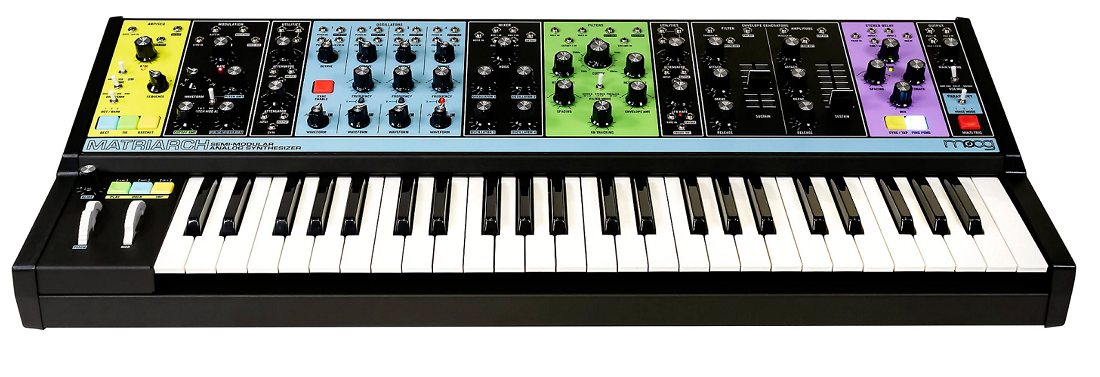
A four-voice paraphonic semi-modular from Moog that excels at the specific subset of ambient music built on drones, evolving analog textures, and sustained tonal exploration. Moog Matriarch gives you four analog oscillators through dual Moog ladder filters with an analog BBD delay and a 90-point patch bay in an instrument designed for long, meditative sessions of tonal discovery.
The Matriarch approaches ambient differently from the polysynths on this list. Instead of polyphonic pad chords, it specializes in rich, harmonically complex single tones and paraphonic textures that evolve through patching and modulation into slowly shifting ambient landscapes.
- Analog Delay
The built-in BBD analog delay is the Matriarch’s ambient secret weapon. Analog delay repeats naturally degrade, gaining warmth, pitch wobble, and harmonic saturation with each repetition. For ambient music, pushing the delay feedback high creates self-generating textures that evolve on their own as the repeats interact with new input. The analog delay character adds a quality that digital delays approximate but don’t replicate, where the repeats feel alive and organic rather than mathematically decaying copies.
- Patch Bay
The 90-point patch bay lets you create feedback loops, cross-modulation paths, and modulation routing that transform the Matriarch into a drone and texture generator. Patching the delay output back into the filter input while modulating the oscillator pitch creates self-evolving ambient systems that produce content with minimal intervention. For ambient producers who work with generative, self-sustaining sound systems, the patch bay is where the Matriarch becomes genuinely unique.
- Moog Warmth
Four Moog analog oscillators through Moog ladder filters produce the warm, fat, harmonically rich tone that carries an inherent beauty in sustained notes. For ambient drones and sustained textures, the Moog sound provides a tonal foundation that’s immediately emotionally engaging without complex processing. A single sustained Moog note through the analog delay with gentle filter modulation is, on its own, a convincing ambient piece.
8. Roland Jupiter-X
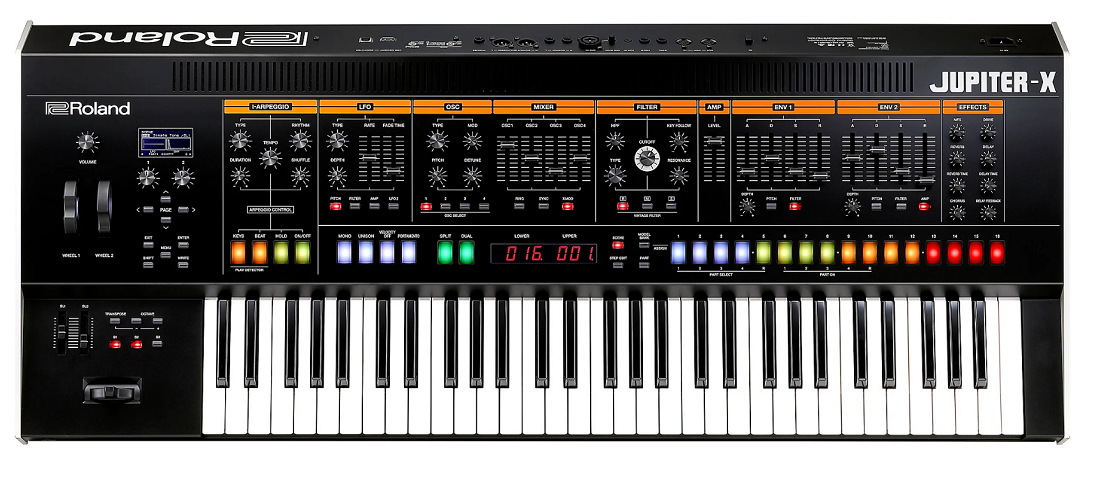
Access to modeled recreations of classic Roland instruments alongside the modern ZEN-Core engine gives you a library of sounds that covers ambient production’s full tonal range from a single instrument. Roland Jupiter-X provides the lush pads of the Jupiter-8, the chorused warmth of the Juno-106, and the modern digital capabilities of ZEN-Core in one keyboard.
For ambient music, having multiple Roland legacy voices available means you can move between different eras of pad and texture character without switching instruments, and the scene layering creates complex textures from combining different models.
- Jupiter-8 Pads
The Jupiter-8 Model Expansion reproduces the lush, wide, harmonically rich pad sounds that made the original Jupiter-8 one of the most beloved ambient synthesizers ever built. The Jupiter-8 sound has appeared on countless ambient and electronic records, and having access to that specific pad character with modern reliability and preset storage gives you a direct connection to one of the genre’s foundational instruments.
- Juno Chorus
The Juno-106 Model Expansion delivers the specific warm, chorused pad sound that defined an era of ambient and electronic music.
The Juno chorus effect is one of the most recognized sonic signatures in synthesis, adding a shimmering, widening, slowly undulating quality to sustained sounds that makes even simple patches feel vast and immersive.
For ambient music, the Juno chorus sound is practically a genre requirement.
- Scene Layers
Dual-layer scene system combines two complete sound configurations with real-time crossfading. Layering a Jupiter-8 pad with a Juno-106 texture and morphing between them creates evolving ambient textures that draw from two different legendary sound characters simultaneously. The scene morphing produces the gradual timbral evolution that ambient music thrives on.
- Model Expansion
Downloadable Model Expansions continuously add new synthesis engines and classic recreations. For ambient producers, each new expansion potentially adds another flavor of pad, texture, and atmospheric sound to the Jupiter-X’s capabilities. The expandable architecture means the instrument grows over time rather than remaining static.
9. Arturia MiniFreak
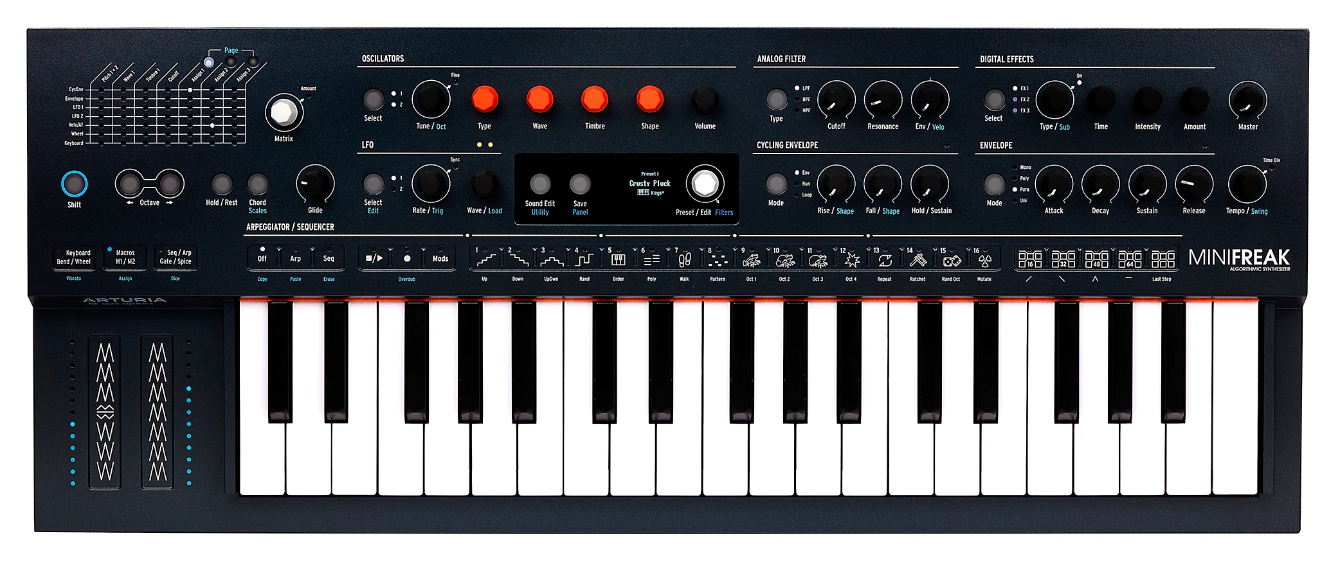
Closing the list with the most affordable polyphonic option that still delivers genuine ambient production capability. Arturia MiniFreak gives you six voices of hybrid digital/analog synthesis with multiple oscillator engines, a real analog filter, and three simultaneous effects in a compact format that handles atmospheric textures with surprising depth for its size and cost.
The MiniFreak earns its place on an ambient list because the variety of oscillator engines combined with the analog filter warmth and built-in effects processing lets you create finished ambient textures that would require multiple, more expensive instruments to replicate separately.
- Atmospheric Engines
The oscillator engines most useful for ambient include granular (for frozen, evolving textures), wavetable (for slowly scanning timbral shifts), modal and Karplus-Strong (for resonant, plucked, bell-like tones), and superwave (for wide, chorused pad layers).
Having all of these available in a single affordable instrument means your ambient palette extends well beyond what any single synthesis method provides. Switching between engines within a session gives you textural variety across different sections of an ambient piece.
- Analog Warmth
The Steiner-Parker analog filter adds warmth and organic character to whatever the digital engines produce. For ambient textures, the analog filter’s gentle resonance and smooth frequency response round off the digital oscillators’ output into something that feels natural and immersive rather than cold and clinical.
Slow filter sweeps through the analog circuit produce the kind of gradual, musical tonal shifts that ambient music relies on.
- Effects Chain
Three simultaneous effect slots with routing flexibility handle the spatial processing that ambient textures require as a fundamental component.
Reverb for depth, delay for spatial repetition, chorus for width, all running simultaneously and saved as part of each preset. For ambient production, having quality effects integrated means every saved patch is a complete, spatially processed texture rather than a dry starting point that needs external processing.
- Motion Recording
The macro motion recorder captures knob movements across up to four macros simultaneously, creating looping modulation patterns from your physical gestures. For ambient music, recording slow, organic filter movements and oscillator parameter shifts into the motion recorder creates patches that evolve on their own with the natural, imperfect quality of human hand movements rather than mathematically perfect automation.
- Spice & Dice
The randomization system applied to the sequencer creates controlled variation in pitch, velocity, and gate length. For ambient music where repetition needs subtle variation to maintain interest, Spice & Dice introduces enough change on each loop that patterns feel alive and slowly shifting rather than mechanically identical. The randomization boundaries let you control exactly how much variation is introduced, from barely perceptible drift to obvious mutation.
Get the Free Plugin Starter Kit
The genuinely useful free DAWs and plugins worth installing. No filler. Straight to your inbox.

Hello, I’m Viliam, I started this audio plugin focused blog to keep you updated on the latest trends, news and everything plugin related. I’ll put the most emphasis on the topics covering best VST, AU and AAX plugins. If you find some great plugin suggestions for us to include on our site, feel free to let me know, so I can take a look!