
Sound design on hardware hits differently than working inside a plugin. You twist a knob and the sound changes under your fingers in real time. You patch two things together that shouldn’t connect and something unexpected comes out.
The physical interaction with real circuits, real filters, and real oscillators produces creative results that mouse clicks on virtual interfaces rarely replicate, not because the sound is necessarily better, but because the workflow leads you to different decisions.
Hardware makes you work with your ears first and your eyes second, and that distinction matters more for sound design than for almost any other production task.
That said, picking the right hardware synth for sound design in 2026 means knowing what each instrument actually excels at rather than buying the most expensive thing with the most features. A $300 analog monosynth can be more useful for sound design than a $4,000 flagship if it puts the right controls under your hands for the textures you’re after.
I’ve selected thirteen synths (plus one bonus pick) that cover a wide range of approaches, from pure analog circuits through digital wavetable engines to hybrid architectures that combine both worlds, each with specific strengths for creating sounds that don’t exist yet.
1. Korg Modwave MKII
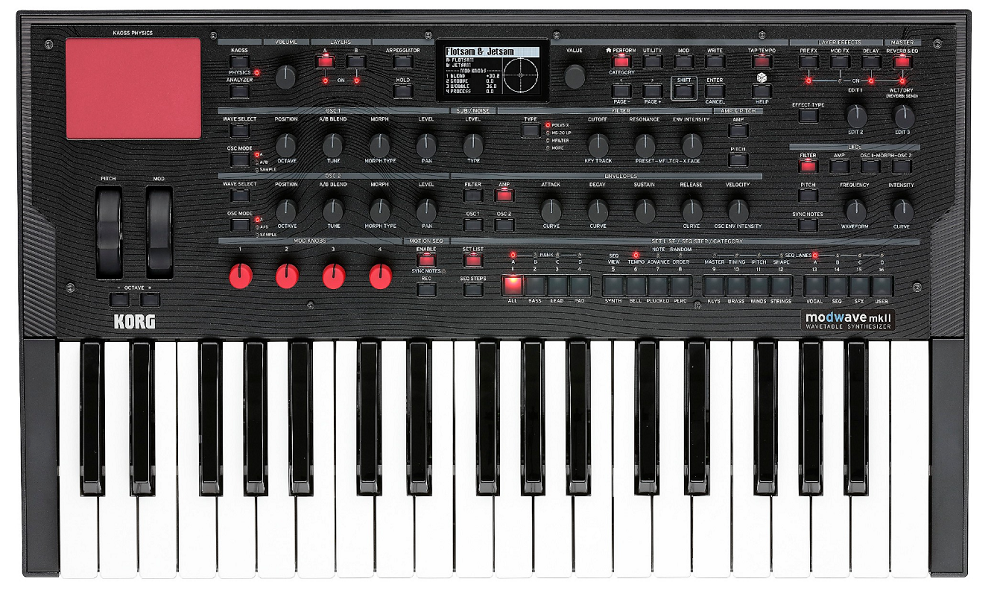
The updated version of Korg’s wavetable powerhouse takes an already deep sound design platform and makes it more immediate to use. Korg Modwave MKII combines wavetable synthesis with Kaoss Physics modeling where you throw a virtual ball across an XY surface and its movement generates modulation data based on simulated physics. It’s one of those features that sounds gimmicky on paper but genuinely produces modulation curves you’d never program manually.
For sound design specifically, the Modwave MKII stands out because of the sheer range of tonal territory it covers. You can go from crystalline digital textures to warm analog-style pads to aggressive, metallic noise all within the same architecture.
- Kaoss Physics
The Kaoss Physics XY pad simulates a ball bouncing, rolling, and colliding across a virtual surface, and the resulting motion data modulates any assignable parameter. You flick the ball and it generates organic, complex modulation patterns based on the physical properties you’ve set (friction, gravity, boundary behavior).
The physics-based modulation produces curves that are fundamentally different from standard LFOs or envelopes because they respond to simulated physical forces rather than mathematical waveforms. For sound design, this means textures that evolve in unpredictable, organic ways.
- Wavetable Engine
Two wavetable oscillators with access to 200+ wavetables provide the raw tonal material. You can morph between wavetable positions smoothly, and the engine handles audio-rate wavetable scanning where the position moves fast enough to create entirely new timbres rather than smooth transitions.
The wavetable depth gives you everything from conventional synth tones to abstract digital textures depending on how you scan and modulate the tables.
- Motion Sequencing
The motion sequencer records knob movements and plays them back as per-step modulation, letting you create evolving, rhythmic parameter changes that loop with your sequence. You perform the modulation live by twisting knobs, the sequencer captures it, and every step in your sequence can have different filter, pitch, and effect settings. For sound design, this means textures that shift and morph on every beat.
- Sample Import
You can load your own samples into the wavetable engine, which means any audio you record or create can become the basis for wavetable synthesis. Field recordings, vocal samples, acoustic instruments, anything you import gets sliced into wavetable frames that you can then morph, modulate, and process through the synth’s architecture.
Get the Free Plugin Starter Kit
The genuinely useful free DAWs and plugins worth installing. No filler. Straight to your inbox.
2. Arturia MiniFreak
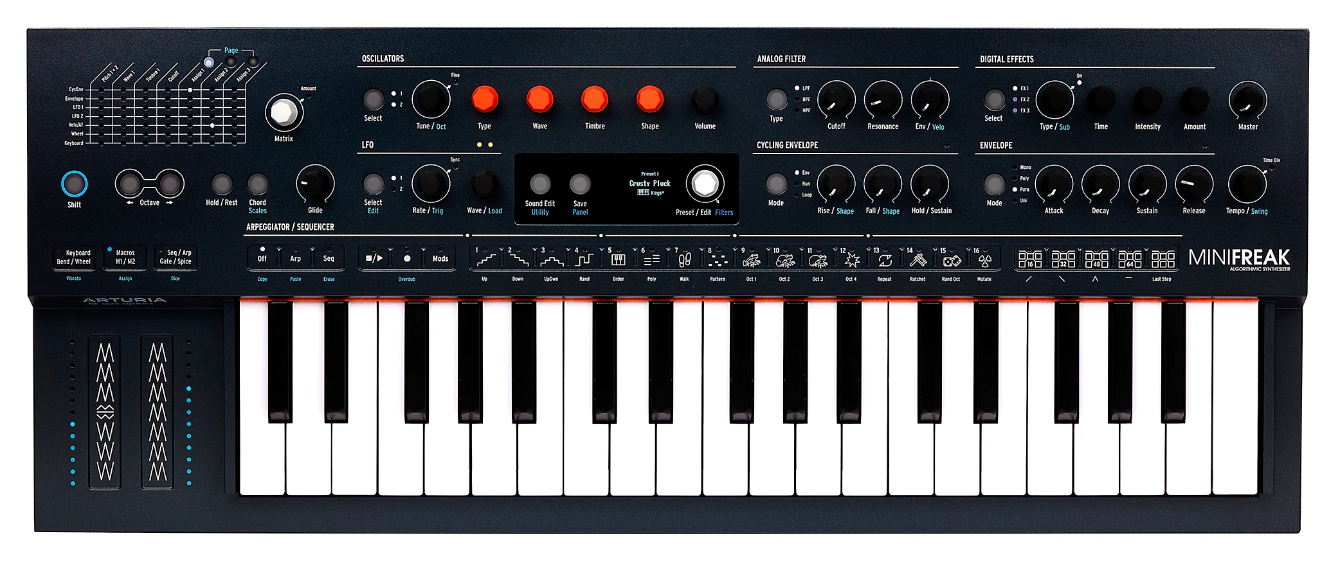
MiniFreak packs an absurd amount of synthesis variety into a compact, affordable package, which makes it one of the most versatile sound design tools at its price point. Arturia’s MiniFreak gives you a hybrid analog/digital architecture where two digital oscillator engines feed into an analog Steiner-Parker filter, combining the timbral variety of digital with the warmth and character of analog filtering.
What makes it particularly useful for sound design is the sheer number of different synthesis engines available in those two oscillator slots, giving you combinatorial possibilities that would require multiple separate synths to replicate otherwise.
- Synthesis Variety
The two oscillator slots each offer over a dozen different synthesis engines including virtual analog, wavetable, superwave, harmonic, Karplus-Strong, modal, FM, granular, and noise models.
You can combine any two engines freely, meaning a granular oscillator feeding into a Karplus-Strong model or FM synthesis mixed with modal resonance are just a menu selection away. The range of starting timbres is enormous before you even touch the filter or effects.
- Analog Filter
A real Steiner-Parker analog filter processes the digital oscillators, adding warmth, resonance, and analog character that purely digital synths lack. The analog filter is what gives the MiniFreak sounds their weight and body.
Sweeping the cutoff on this filter sounds and feels different from sweeping a digital filter model because the real analog circuit introduces subtle nonlinearities and saturation that change with the signal level.
- Touch Keyboard
The capacitive touch keyboard responds to pressure and finger position, providing expressive control that a standard keyboard doesn’t offer.
For sound design, the touch response means you can use finger pressure to modulate filter cutoff, oscillator parameters, or effects in real time while playing, creating performances where the timbre changes with your touch intensity.
- Motion Record
The macro motion recorder captures knob movements across up to four macros simultaneously, creating looping modulation patterns from your physical gestures. You twist four knobs, the synth records your movements, and the modulation plays back in a loop.
The gesture-based recording produces modulation that feels human and organic rather than mathematically perfect.
- Effects Chain
Three simultaneous effects slots with routing options including serial, parallel, and insert configurations. The effects quality is good enough for final sound design rather than just previewing, and the routing flexibility means you can create complex processing chains within the synth itself.
A reverb feeding into a distortion feeding into a phaser is a single preset, no external processing needed.
- Mod Matrix
A comprehensive modulation matrix connects any source to any destination with positive or negative amounts.
The matrix is where the MiniFreak’s sound design depth really opens up, because connecting unexpected sources to unexpected destinations produces results that the standard controls don’t suggest. The depth of the modulation routing extends the synth far beyond what the front panel controls alone would imply.
3. Sequential Prophet REV2-16
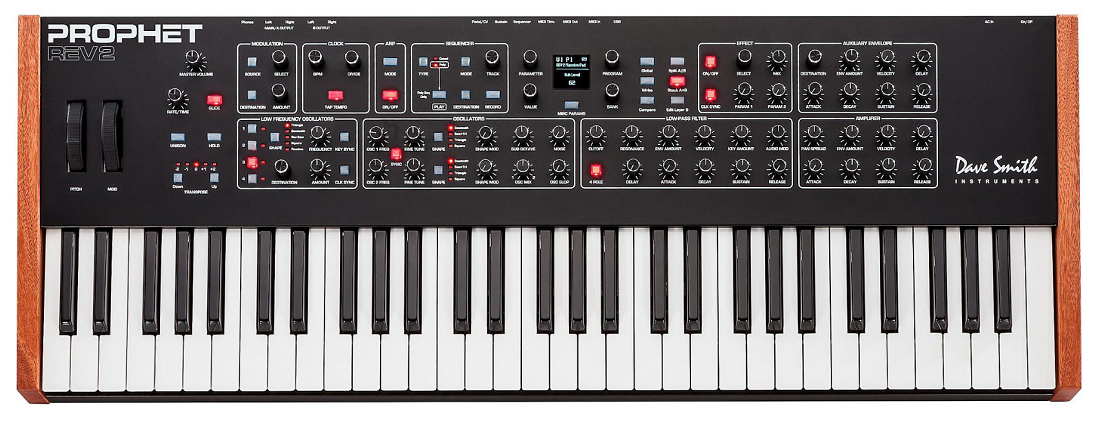
If you need deep, rich polyphonic analog pads and textures with enough modulation depth for serious sound design work, the Sequential Prophet REV2-16 gives you 16 voices of true analog synthesis with a modulation matrix that goes deeper than most hardware polysynths. The REV2 has been around for a while, but it remains one of the best sounding analog polysynths at its price point.
The 16-voice architecture means you can build massive, layered sounds where multiple voices contribute different timbral elements to a single key press, which is sound design territory that smaller voice counts can’t reach.
- 16 Analog Voices
Sixteen voices of analog synthesis with Curtis chip oscillators and filters give you the polyphony to build stacked, layered sounds without running out of voices.
Each voice has two oscillators, a noise source, analog low-pass filter, and analog VCA. Having 16 real analog voices means your pads and textures have the depth and complexity that comes from multiple independent analog circuits running simultaneously, each with their own slight variations.
- Mod Depth
The modulation matrix provides extensive routing between sources and destinations with enough flexibility for complex, evolving patches. You can assign LFOs, envelopes, pressure, velocity, and mod wheel to virtually any parameter, and stack multiple modulation sources on the same destination.
The modulation depth is what transforms the REV2 from a straightforward polysynth into a serious sound design tool.
- Layered Mode
A bi-timbral layer system splits the 16 voices into two independent 8-voice synths that can be layered, split, or stacked. Each layer has its own complete signal path, effects, and modulation settings.
Layering two different patches creates textures that are more complex than what any single patch can produce, and you can build sounds where one layer provides the body and another provides movement or texture.
4. Novation Bass Station II
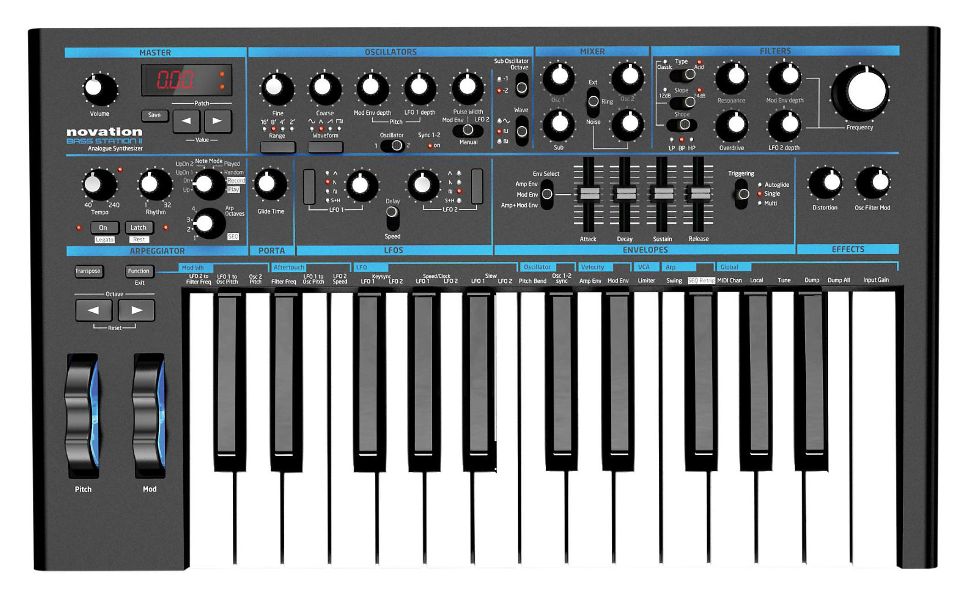
A monophonic analog bass synth that punches well above its weight for sound design because of its flexible architecture and surprisingly deep modulation options.
Bass Station II is compact, affordable, and gives you access to raw analog oscillators, sub-oscillator, two filters, and a modulation matrix that opens up far more than just bass sounds despite the name.
The two selectable filters alone make this more versatile for sound design than most mono synths at any price.
- Dual Filters
Two selectable filter types (classic and acid) with different resonance characters give you fundamentally different tonal shaping from the same oscillator input. The classic filter is smooth and musical.
The acid filter is aggressive and squelchy with the self-oscillating, screaming resonance that defines the TB-303 sound. Having both available means you can switch between clean sound design and aggressive acid textures without changing synths.
- Paraphonic Mode
A paraphonic mode lets you play multiple notes through a single filter, which is unusual for a monosynth and useful for sound design because you can create chordal textures and intervals that monophonic restrictions normally prevent. The paraphonic behavior isn’t true polyphony, but it gives you harmonic complexity beyond single notes.
- Arpeggiator
The built in arpeggiator and step sequencer with multiple modes and divisions creates rhythmic patterns that interact with the filter and modulation in real time. For sound design, the arpeggiator turns sustained sounds into rhythmic textures, and the step sequencer lets you program specific pitch and modulation sequences.
- Modulation
A modulation matrix with multiple LFOs, envelopes, and performance sources provides more routing flexibility than most monosynths offer. The modulation depth is what separates the Bass Station II from simpler analog monosynths where the modulation is limited to basic LFO-to-filter routing.
5. Behringer Odyssey
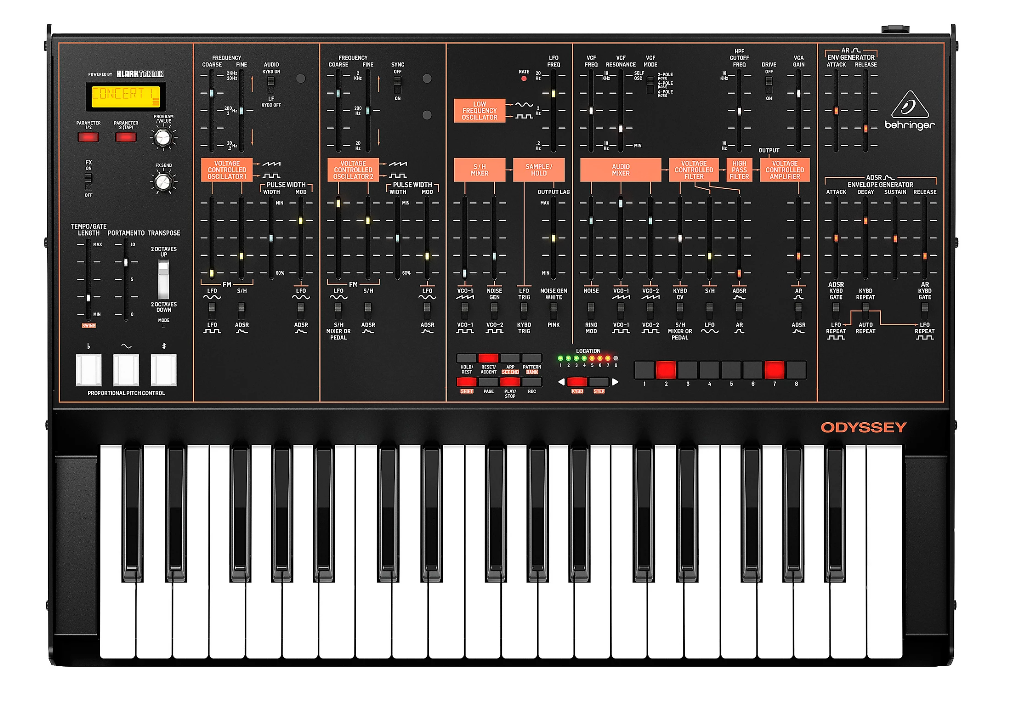
A faithful recreation of the ARP Odyssey at a fraction of the original price, and one of the most aggressive, characterful duophonic analog synths you can buy. Behringer’s Odyssey gives you the raw, unfiltered analog character that made the original ARP Odyssey a sound design favorite for decades.
The Odyssey’s strength for sound design is its ring modulator, sample-and-hold, and the interaction between its two oscillators which produce metallic, dissonant, and unpredictable textures that polite polysynths don’t touch.
- Ring Modulator
The built in ring modulator multiplies the two oscillators together, producing metallic, inharmonic, bell-like tones that are a hallmark of the Odyssey sound. The ring mod is essential for sound design because it generates frequency content that neither oscillator alone contains, creating textures that sound alien and mechanical.
- Three Filter Modes
Switchable between three different filter revisions (Mk I, Mk II, Mk III) that each have a distinctly different resonance character. The Mk I is raw and screamy. The Mk II is smoother and more musical. The Mk III sits between them. Having three filter voices from a single synth gives you tonal variety that most recreations don’t offer.
- Sample & Hold
The sample-and-hold circuit generates random modulation that’s been a staple of science fiction sound design since the 1970s. The S&H produces the classic random stepping modulation that creates bleeping, bubbling, and erratic pitch movements.
6. Korg MS-20 Mini
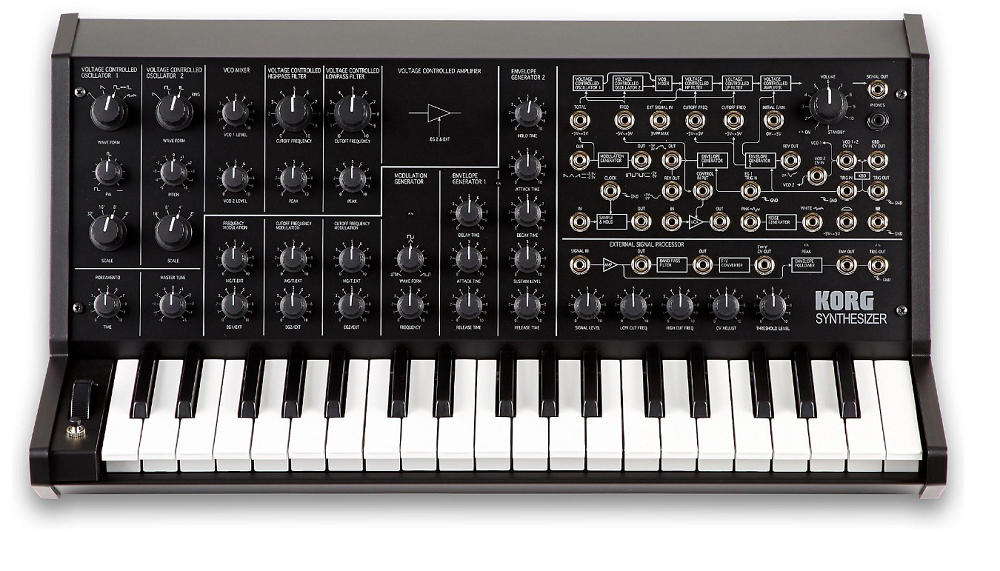
The MS-20 is one of the most iconic sound design synths ever made, and the mini version brings its aggressive, raw, semi-modular analog character to a compact format. Korg MS-20 Mini gives you the same dual-filter architecture and patch bay that made the original a favorite of electronic musicians, noise artists, and film sound designers for over four decades.
The semi-modular patch bay is what sets this apart for sound design work, because it lets you break the normal signal flow and create connections that the standard routing doesn’t allow.
- Patch Bay
The patch bay on the front panel provides external signal processing, modulation routing, and signal path overrides that turn the MS-20 from a standard synth into a semi-modular sound design tool. You can feed external audio through the filters, cross-modulate between the two oscillators, route the envelope to unexpected destinations, and generally break the synth’s default signal path in creative ways. The patch bay is where the MS-20 becomes genuinely unpredictable.
- Dual Filters
Two different filter types in series (a 12dB/oct high-pass followed by a 12dB/oct low-pass) create the aggressive, resonant character that defines the MS-20 sound. When both filters are resonating simultaneously and you sweep them against each other, the interaction produces screaming, aggressive textures that no other filter architecture quite replicates. The dual filter sound is raw, nasty, and immediately recognizable.
- External Input
An external signal processor lets you feed any audio through the MS-20’s filters and envelope follower. Running drums, vocals, guitars, or any other source through the MS-20’s filter section with the envelope follower tracking the input dynamics creates processed sounds that combine the character of the source with the aggressive coloration of the MS-20’s analog circuits.
- ESP Module
The envelope follower and pitch-to-CV converter (External Signal Processor) tracks incoming audio and generates control voltages from it. The pitch tracker can control the oscillators while the envelope follower controls the filter, meaning your voice can play the synth and your dynamics shape the timbre. For sound design, the ESP opens up reactive, performance-driven processing.
- Ring Mod Access
The patch bay provides access to a ring modulator for creating metallic, inharmonic tones by multiplying the oscillator signals. Combined with the dual filter architecture, the ring mod output can be further shaped into textures that range from subtle metallic coloration to full-on alien frequencies.
7. Moog Matriarch
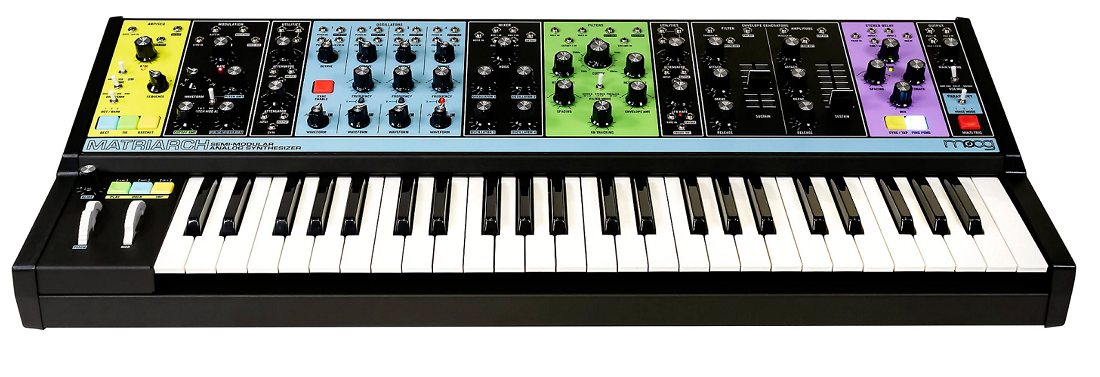
A four-voice paraphonic semi-modular analog synthesizer from Moog that combines four analog oscillators, a dual filter section, analog delay, and an extensive patch bay in a single instrument. Moog Matriarch gives you the lush, fat, unmistakably Moog sound with enough modulation and routing flexibility for complex sound design work.
The combination of the Moog filter character with the semi-modular patch bay makes this one of the most creatively flexible analog synths available for texture and drone creation.
- Moog Sound
Four Moog analog oscillators feeding through Moog ladder filters produce the warm, massive, harmonically rich tone that defines the Moog legacy. The sound is immediately recognizable and carries a weight and presence that competing analog synths approach but don’t quite match. For sound design, the Moog tone provides a foundation of organic warmth that you can then mangle, process, and transform.
- Patch Bay
A 90-point patch bay provides extensive modulation routing, signal path overrides, and external connectivity that transforms the Matriarch from a keyboard synth into a semi-modular sound design workstation. You can break the default signal flow, create feedback loops, cross-modulate oscillators, route the delay into the filter, and generally rewire the entire instrument for experimental results.
- Analog Delay
A real analog BBD delay built into the signal path adds warmth, movement, and spatial depth without external processing. The analog delay has a character that digital delays don’t replicate, with natural degradation of repeats, pitch wobble, and saturation that becomes part of the sound rather than just an effect applied on top. For sound design, the delay is as much a sound source as the oscillators when you push the feedback.
8. Sequential Take 5
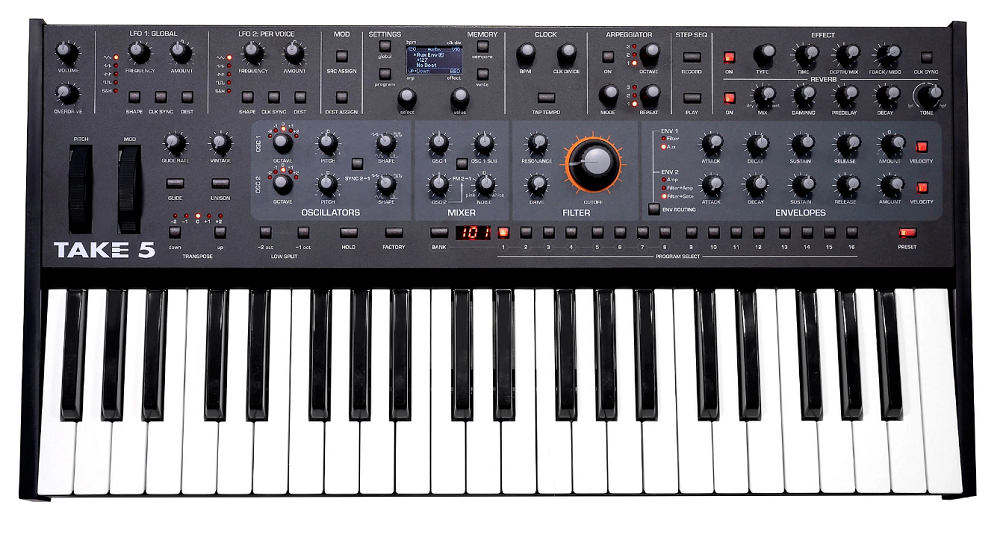
Compact, affordable, and packing five voices of genuine analog polyphony into a package that weighs almost nothing. The Sequential Take 5 gives you the same Curtis chip architecture found in Sequential’s flagship instruments but in a format that’s designed for portability and immediacy. It’s the most accessible entry point into real Sequential analog sound.
For sound design, the Take 5 matters because it’s one of the few hardware analog polysynths that you can take anywhere and set up in minutes, which means it ends up getting used rather than sitting in a rack collecting dust.
- Sequential Tone
The Curtis oscillators and filters deliver the warm, precise, characterful analog tone that Sequential instruments are known for. Five voices of this quality produce pads and textures with the depth and organic variation that only real analog polyphony provides. Each voice has two oscillators with waveshaping, a low-pass filter with resonance, and a VCA, giving you a complete analog signal path per voice.
- Vintage Knob
A Vintage control introduces analog drift and instability to the oscillators and filters, simulating the behavior of older, less stable analog circuits. At low settings, the drift adds subtle warmth and movement. At high settings, the synth sounds progressively more unstable and unpredictable. For sound design, the Vintage knob lets you dial in exactly how “broken” you want the analog behavior to be.
- Compact Format
The small footprint and light weight make it genuinely portable for field recording sessions, live sound design work, and studio situations where desk space is limited. A full-featured analog polysynth that fits in a backpack is a practical advantage that larger flagships can’t match.
- Effects Section
Three built-in effects (reverb, delay, and a distortion/chorus section) process the analog signal within the synth. The effects are good enough for finished sound design rather than just previewing, and having them integrated means you can save complete, effects-processed patches as presets.
9. Roland Jupiter-X
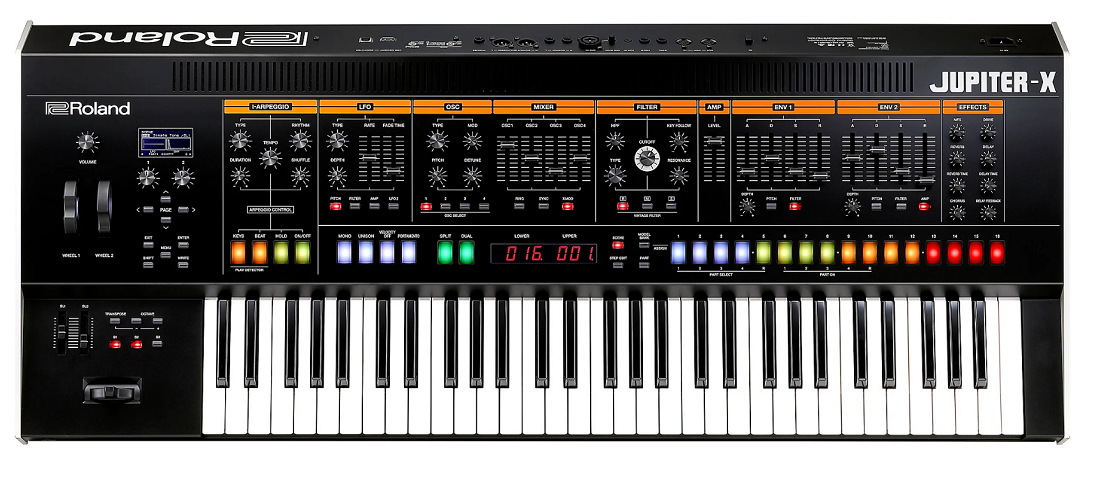
A modern synthesizer that models the sound and behavior of classic Roland instruments including the Jupiter-8, Juno-106, SH-101, and JX-8P alongside its own contemporary engine. Roland Jupiter-X uses their ZEN-Core architecture to provide multiple synthesis models within a single instrument, giving you a library of classic Roland sounds combined with modern digital synthesis.
For sound design, the Jupiter-X’s value lies in having access to the sonic DNA of multiple legendary instruments without owning each one individually.
- Model Expansion
Downloadable Model Expansion packs add entirely new synthesis engines to the Jupiter-X, including recreations of the SH-101, JX-8P, Jupiter-8, Juno-106, and others. Each expansion replicates the specific behavior and character of the original instrument rather than just approximating the sound. The expandable architecture means the synth grows over time as Roland releases new models.
- ZEN-Core Engine
The ZEN-Core synthesis engine provides a powerful, modern synthesis platform alongside the vintage models. You get virtual analog oscillators, PCM waveforms, a flexible filter section, and comprehensive effects that can produce sounds the vintage models can’t reach. The modern engine ensures you’re not limited to recreating the past.
- I-Arpeggio
An intelligent arpeggiator generates musically aware patterns that go beyond standard note cycling. The I-Arpeggio creates chord progressions, evolving sequences, and rhythmic patterns that respond to what you play rather than following fixed rules. For sound design, the intelligent pattern generation produces melodic and rhythmic material that’s more interesting than standard arpeggiation.
- Scene Memory
Dual-layer scene system lets you save two complete sound configurations and crossfade between them in real time. For sound design, the scene morphing creates smooth transitions between completely different timbral states, which produces evolving textures that shift character over the course of a performance.
- Performance Pads
The performance pad section provides real-time control over sound parameters, sample triggering, and effects manipulation. The pads add a tactile, percussive interface to sound design work that knobs and keyboards don’t provide.
10. Waldorf Iridium Keyboard
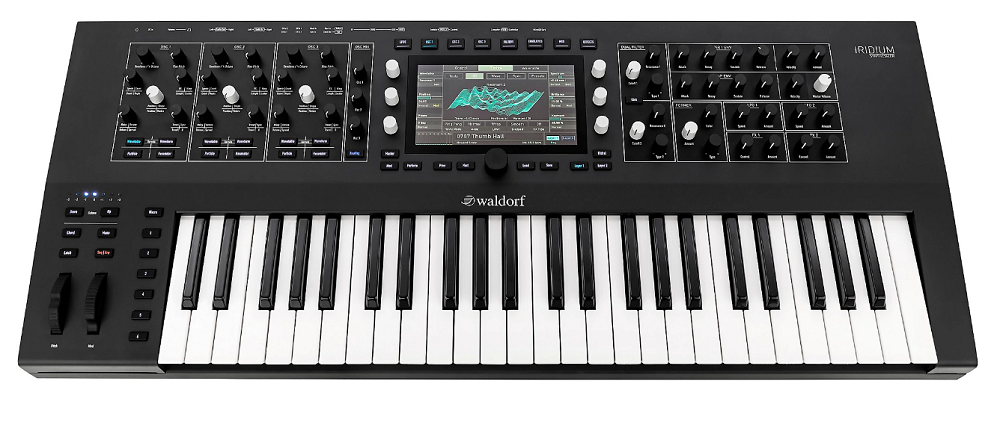
The keyboard version of Waldorf’s digital synthesis powerhouse, combining wavetable, granular, resonator, and particle synthesis engines with Waldorf’s signature approach to deep, detailed digital sound. Iridium is one of the most comprehensive digital synthesizers available for sound design, offering synthesis methods that most hardware synths don’t touch.
The touchscreen interface with direct parameter editing makes the deep synthesis engines accessible without endless menu diving, which matters when you’re designing sounds and need to experiment quickly.
- Synthesis Engines
Three oscillator slots each offer multiple synthesis engines: wavetable, virtual analog, particle (granular), resonator, and kernel synthesis. You can combine different engine types across the three slots, meaning you can run wavetable plus granular plus resonator simultaneously. The synthesis variety within a single instrument is broader than almost anything else in hardware.
- Touchscreen
A large color touchscreen provides direct, visual parameter editing for every aspect of the synthesis engine. The touchscreen makes the deep synthesis engines accessible by showing you the wavetable position, granular grain behavior, or resonator tuning visually while you edit. For sound design, the visual feedback accelerates experimentation because you can see what you’re hearing.
- Granular Processing
The particle synthesis engine provides real-time granular processing with control over grain size, density, pitch, position, and spatial placement. You can load your own samples into the granular engine and process them in real time, turning any audio source into granular textures. The granular capability alone would justify this synth for dedicated sound designers.
- Sample Import
You can import your own audio samples via USB and use them across any of the synthesis engines, meaning field recordings, vocals, acoustic instruments, or any other audio becomes raw material for the Iridium’s processing. The sample import is where the synth becomes truly personal, because your unique source material combined with the multiple synthesis engines produces results that nobody else can replicate.
11. Arturia PolyBrute 12
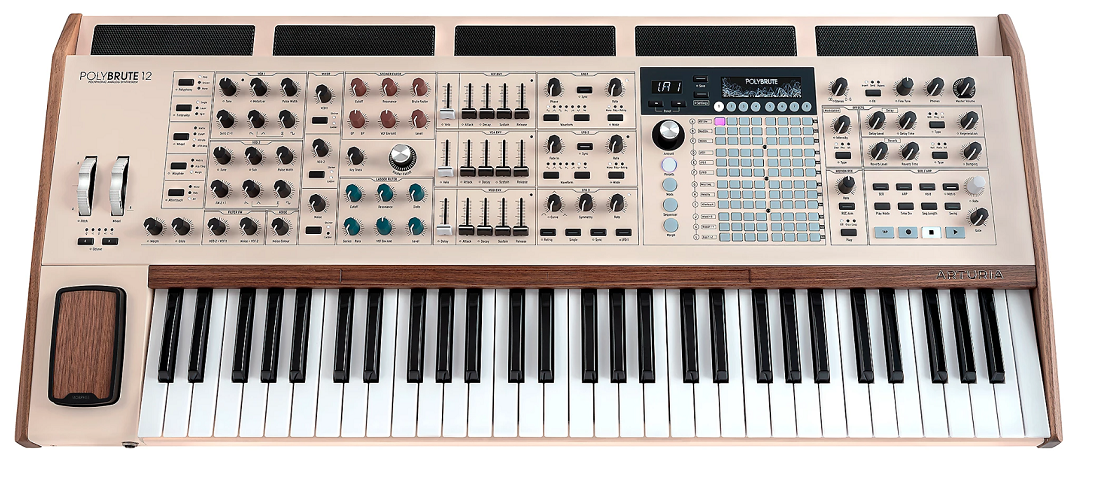
Taking the original PolyBrute’s concept and expanding it to twelve voices of full analog polyphony with a morphing architecture that lets you smoothly transition between two completely different sound states. Arturia’s PolyBrute 12 is one of the most expressive analog polysynths ever made, with a focus on performative sound design through its morphing system and ribbon controller.
The morphing is the headline feature for sound design, because it lets you create textures that evolve continuously between two timbral extremes rather than being static patches.
- Morph System
The Morph knob smoothly transitions between two complete patch states (Sound A and Sound B), interpolating every parameter simultaneously. You set up two different sounds and the Morph control blends between them with everything moving at once: oscillator settings, filter positions, envelope shapes, effects levels. For sound design, the morphing produces evolving textures where the timbre shifts continuously, and assigning the morph to an expression pedal or aftertouch makes it performable in real time.
- Twelve Voices
Twelve voices of full analog polyphony with two VCOs, a Steiner-Parker filter, and a ladder filter per voice. The dual filter architecture means every voice has access to two different filter characters, which you can use in parallel or series for complex tonal shaping. Twelve voices provide enough polyphony for massive, layered pads where every note contributes its own analog variation.
- FullTouch Keys
The PolyBrute’s keyboard responds to polyphonic aftertouch and vertical movement (sliding your finger toward or away from you on the key surface).
The vertical dimension adds an expressive axis that most keyboards don’t have, letting you modulate parameters by moving your finger on the key after pressing it. For sound design, this means timbral changes that respond to physical gesture in two dimensions rather than just velocity and pressure.
- Ribbon Strip
A long ribbon controller above the keyboard provides smooth, continuous control over assigned parameters. The ribbon is particularly useful for pitch sweeps, filter modulation, and morph control during performance. The physical length of the ribbon gives you fine resolution over parameter changes, making subtle adjustments easy.
- Matrix Routing
An extensive modulation matrix with visual LED feedback on the front panel shows you which connections are active and at what intensity. The visual routing display makes complex modulation patches understandable at a glance, which matters when you’re building sound design patches with multiple interacting modulation paths.
- Dual Sequencer
Two independent sequencers can run simultaneously with different lengths, rates, and content, creating polyrhythmic modulation patterns. Running two sequences at different lengths against each other produces patterns that don’t repeat for extended periods, which creates evolving textures that stay interesting over time.
12. ASM Hydrasynth Desktop
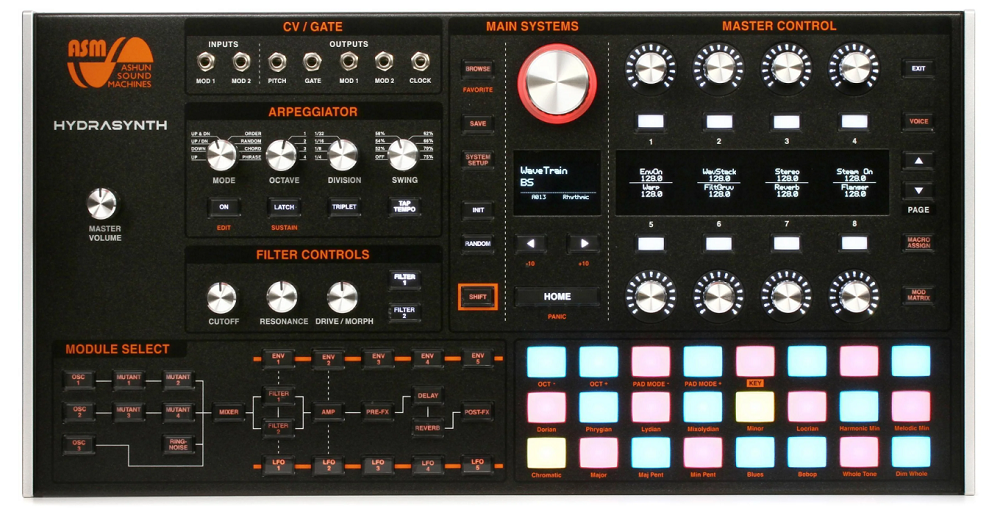
A digital wavetable synthesizer in desktop format with one of the most extensive modulation systems in any hardware synth, period. ASM Hydrasynth Desktop gives you eight voice polyphony with three oscillators per voice and a mutant modulation engine that can produce modulation routings of extraordinary complexity without requiring a modular synth setup.
The Hydrasynth has earned a reputation specifically for sound design because the modulation depth lets you create patches where everything is moving, shifting, and evolving constantly.
- Mutant Engine
The mutant oscillator modes apply FM, wavestack, wavescan, and pulse-width modulation between oscillators in combinations that create timbres far more complex than standard wavetable synthesis alone. The mutant modes are where the Hydrasynth produces its most distinctive sounds, generating tonal complexity from the interaction between oscillators rather than from the individual waveforms.
- Mod Depth
A modulation matrix with up to 32 simultaneous modulation slots connects any source to any destination with amount and depth control. The matrix depth is staggering for a hardware synth, approaching the flexibility of modular synthesis. You can create patches where LFOs modulate envelope times, envelopes modulate LFO rates, and the whole system creates self-evolving textures with no external input.
- Poly Aftertouch
Polyphonic aftertouch on the ribbon controller and compatible external keyboards provides per-note pressure sensitivity that modulates parameters independently for each note you’re holding. For sound design, polyphonic aftertouch means you can press harder on one note in a chord and only that note’s filter or pitch responds, creating expressive, nuanced timbral variation within a single chord.
13. UDO Audio Super Gemini
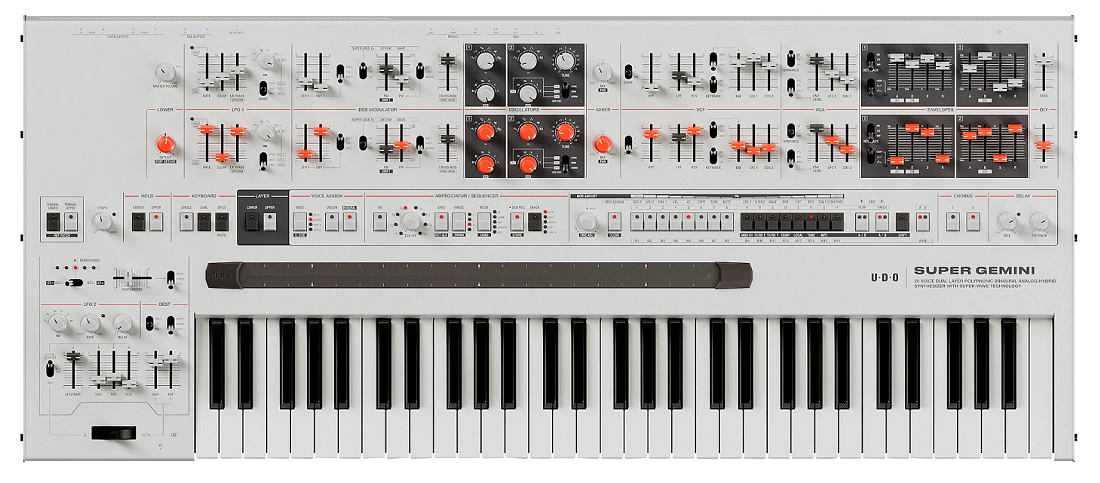
This is the flagship on the list, and it earned its place. UDO Audio Super Gemini is a 20-voice bitimbral analog-hybrid synthesizer with a dual-layer architecture that effectively gives you two complete synth engines with dedicated controls for each layer, a binaural signal path that creates true stereo imaging at the voice level, and build quality that feels like it was designed to last thirty years.
The binaural architecture is the Super Gemini’s defining feature. Instead of panning mono voices across a stereo field, each voice is a stereo pair where left and right channels have their own independent synth parameters.
- Binaural Voices
In binaural mode, the 20 voices pair into 10 stereo “super voices” where left and right channels each have their own complete synthesizer voice with independent parameter control.
The binaural imaging creates stereo depth that conventional mono-voice polysynths with panning can’t achieve, because the left and right ears are receiving genuinely different synthesis rather than the same signal positioned in the stereo field. For sound design, the spatial quality is immediately apparent and produces textures that feel three-dimensional.
- Dual Layers
Two complete, independent synth layers with dedicated physical controls for each (white faders for upper, orange for lower). Each layer has its own oscillators, filters, envelopes, LFOs, arpeggiator, and effects. You can split, layer, or run them independently as two separate synths from your DAW.
The dual control layout means you can adjust both layers simultaneously with both hands, which encourages real-time sound design where both timbral components evolve together.
- Hybrid Architecture
FPGA-based digital oscillators feed into analog SSI-based VCFs and VCAs, combining the alias-free precision and waveform variety of digital with the warmth and organic character of analog filtering and amplification.
The digital oscillators offer classic waveforms plus 64 unique single-cycle waveforms with wave morphing, while the analog signal path adds the harmonic richness and saturation that pure digital lacks.
- Ribbon Controller
A custom ribbon controller provides continuous, touch-sensitive expression that can be assigned to virtually any parameter through the modulation matrix. The ribbon captures position and pressure, allowing fluid sweeps, microtonal pitch bends, and rhythmic gating gestures that knobs and wheels can’t replicate. For sound design performance, the ribbon adds a dimension of physical expression.
Extra: Yamaha Reface DX
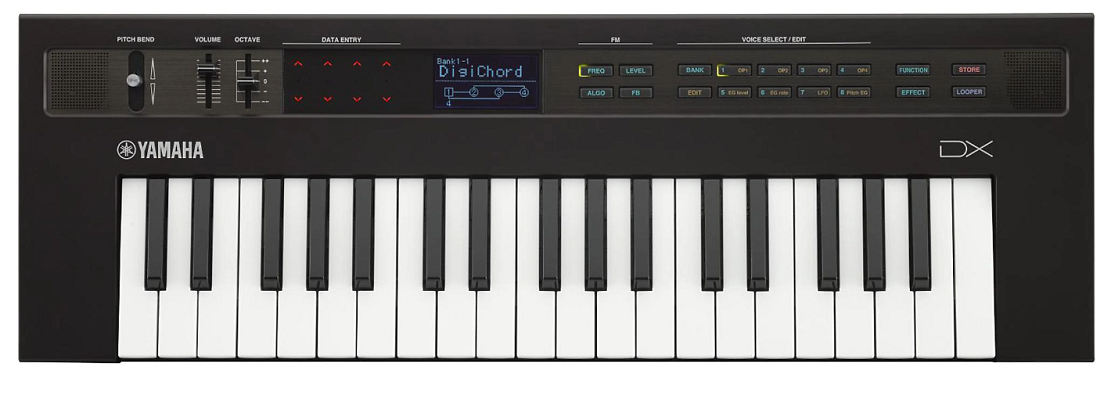
I’m adding this as a bonus because it represents a completely different approach to sound design at a fraction of the cost of everything else on this list.
Yamaha Reface DX is a four-operator FM synthesizer in a tiny, portable, battery-powered format that gives you access to FM synthesis with a touchscreen interface that makes this historically complex synthesis method more approachable than ever.
FM synthesis generates sounds that no other synthesis method produces. The metallic bells, glassy keys, evolving textures, and impossible harmonic content that FM creates are unique to the architecture, and the Reface DX is the most accessible way to explore it.
- FM Synthesis
Four FM operators with multiple algorithm configurations provide the mathematical frequency manipulation that creates FM’s distinctive timbral character. The harmonic relationships between operators produce sounds ranging from pure sine tones to complex, evolving, harmonically rich textures that subtractive synthesis can’t achieve. FM is where you go when you need sounds that don’t sound like any acoustic instrument or analog synth.
- Touch Interface
The touchscreen provides direct, visual manipulation of the FM parameters (operator levels, ratios, feedback, envelopes) in a way that makes FM synthesis more intuitive than traditional slider-based DX7 interfaces.
The visual feedback shows you the relationship between operators and how your adjustments affect the harmonic content, which dramatically reduces the learning curve that historically made FM synthesis intimidating.
- Portability
Battery-powered operation in a tiny form factor means you can do FM sound design anywhere. On a train, in a park, at a coffee shop. The portability is what makes the Reface DX special as a sound design tool, because you can capture ideas in the moment rather than waiting until you’re back at your studio.
- Looper
A built in phrase looper records and overdubs in real time, letting you layer FM textures on top of each other and experiment with combinations. The looper turns the Reface from a single-patch instrument into a layering tool where you can build complex FM soundscapes from multiple passes, which is surprisingly powerful for a device this small.
- Feedback Control
Each operator has adjustable feedback that feeds its own output back into its input, creating distortion and complex overtones. The feedback is where FM synthesis gets aggressive and unpredictable, and having per-operator feedback control gives you fine-grained control over how much harmonic chaos each operator introduces.
Get the Free Plugin Starter Kit
The genuinely useful free DAWs and plugins worth installing. No filler. Straight to your inbox.

Hello, I’m Viliam, I started this audio plugin focused blog to keep you updated on the latest trends, news and everything plugin related. I’ll put the most emphasis on the topics covering best VST, AU and AAX plugins. If you find some great plugin suggestions for us to include on our site, feel free to let me know, so I can take a look!