
No other manufacturer in 2026 offers this much real analog circuitry at these prices. Behringer’s synthesizer lineup spans desktop modules, full-size keyboards, polyphonic flagships, and everything in between, with the common thread being genuine analog signal paths at costs that consistently undercut the competition. Some of these instruments recreate legendary vintage designs.
Others represent original Behringer engineering. All of them put hardware analog synthesis within reach of producers who might otherwise be limited to plugins.
I want to be straightforward about what you’re getting here. Behringer synths prioritize value and accessibility over premium build quality and cutting-edge innovation. The knobs won’t feel like a Moog’s. The chassis isn’t built like a Sequential.
But the circuits inside produce real analog sound with real analog character, and for many producers, that’s the part that actually matters when you’re recording and mixing.
I’ve picked nine Behringer synths that I think represent the strongest options across different needs, from wide polyphonic pads and ambient textures through heavy bass tones to unique instruments that don’t fit neatly into any standard category.
1. Behringer DeepMind 12
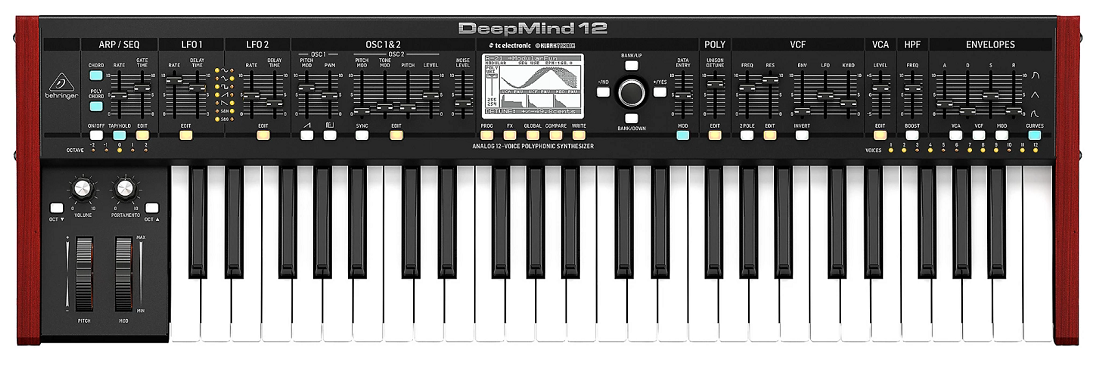
This is Behringer’s original flagship, and years after its release it still holds up as one of the best values in hardware synthesis. Behringer DeepMind 12 delivers twelve voices of analog polyphony with a built-in effects section and modulation routing that genuinely compete with instruments costing three or four times as much. The twelve-voice architecture alone sets it apart from nearly everything else at this price point.
Where the DeepMind 12 really shines is ambient and pad work, because those twelve voices through the onboard effects create soundscapes with a width and depth that fewer-voice synths struggle to match.
- Effects Section
The 32-slot effects engine with four simultaneous slots is the DeepMind 12’s genuine trump card. You get access to chorus, flanger, phaser, delay, reverb, overdrive, EQ, and several more types, with flexible routing options that let you chain them in different configurations.
Running twelve analog voices through layered chorus and reverb produces immersive, spatial textures that would otherwise require the synth plus a separate multi-effects unit.
- Modulation Routing
An 8-slot modulation matrix connects sources to destinations with enough flexibility to create patches that evolve on their own over time. You can set up patches where the filter slowly drifts, effects depth breathes in and out, and timbral character shifts without you touching a control.
The modulation depth is what turns static analog pads into living, moving soundscapes.
- Tablet Editor
A wireless editing application gives you full visual access to every parameter on a tablet screen, solving the one practical challenge of programming complex patches on the DeepMind’s relatively small onboard display. You lay out modulation routes, configure the effects chain, and tweak detailed parameters on a large visual interface, then put the tablet down and perform.
- Voice Count
Twelve analog voices give you the polyphony headroom for complex, sustained chords where notes overlap and ring naturally. You hold a wide voicing and every note sustains fully without the thinning and cutting that happens on synths with fewer voices. For ambient work specifically, the voice count is what lets you build truly dense textures.
Get the Free Plugin Starter Kit
The genuinely useful free DAWs and plugins worth installing. No filler. Straight to your inbox.
2. Behringer Vocoder VC340
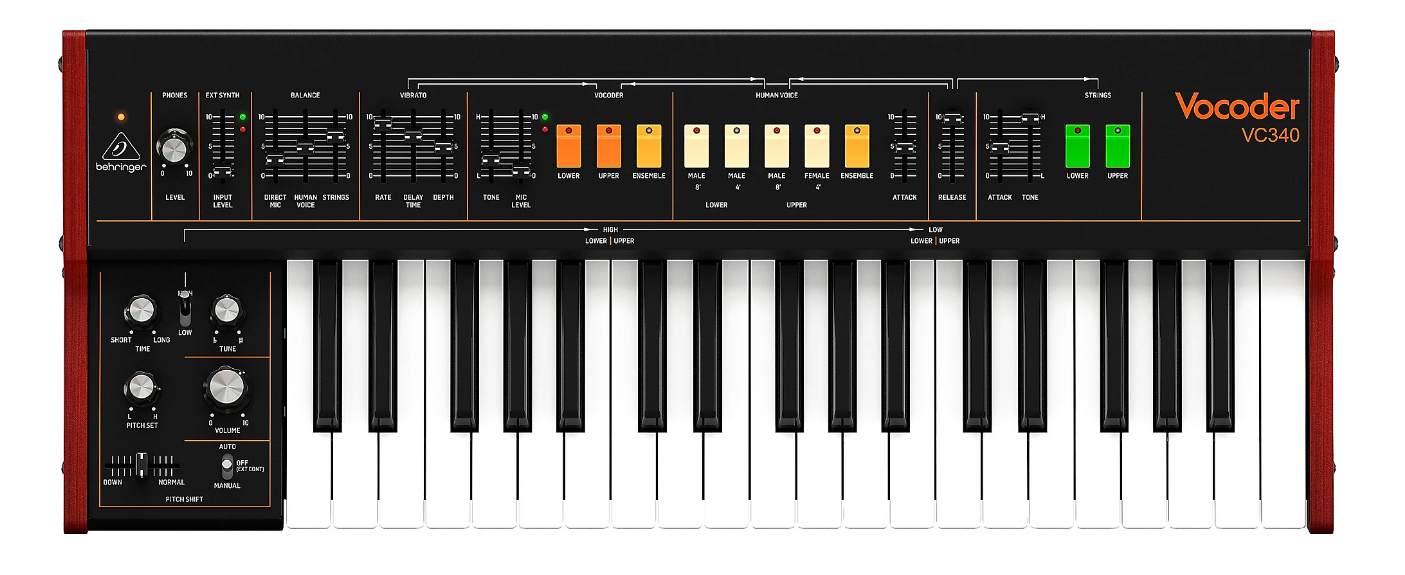
There is genuinely nothing else on the current market that does what this instrument does at anywhere near this price. Vocoder VC340 is a recreation of the Roland VP-330 Vocoder Plus, and it combines three distinct sound sources in one instrument: a vocoder, a string synthesizer, and a choir synthesizer. Each section produces a specific type of sound that standard polysynths don’t replicate.
The VP-330’s particular combination of vocoded vocals, lush analog strings, and synthetic choir textures defined the sound of progressive electronic music in the late 1970s and early 1980s, and those sounds remain useful and distinctive today.
- Vocoder Section
The analog vocoder splits incoming audio (typically your voice through a microphone) into frequency bands and applies the spectral shape to the synthesizer’s output. You sing or speak while playing chords, and the result is your vocal articulation carrying the harmonic content of the keyboard notes.
The vocoder produces the robotic, harmonized vocal textures heard on records from Kraftwerk through Daft Punk, and having it integrated with the string and choir sections means you can blend vocoded content with instrumental textures seamlessly.
- String Machine
The dedicated string synthesizer generates the specific warm, ensemble-processed analog string tone that vintage string machines were known for. This isn’t orchestral sample playback.
It’s the characteristic synthetic string quality, somewhere between real strings and a pad, that carries a particular nostalgic warmth. You hear this sound on records by Tangerine Dream, Jean-Michel Jarre, and throughout early electronic music, and it occupies a timbral space that no standard polysynth preset quite captures.
- Synthetic Choir
A separate choir section produces formant-shaped analog tones that approximate human vocal qualities without being a sampled choir. The synthetic choir creates an ethereal, otherworldly vocal pad texture that sits beautifully underneath melodic content or blends with the string section for hybrid orchestral-vocal pads.
The specific formant processing gives these sounds a quality that’s distinctly different from filtered waveforms on a standard synth.
- Section Blending
Independent level controls for the vocoder, strings, and choir let you mix all three in any proportion, running them simultaneously or isolating individual sections. Blending the strings underneath vocoded vocals creates a rich harmonic foundation for the vocoder output, while combining choir and strings together produces the full vintage VP-330 ensemble sound that defined an era.
- Ensemble Processing
A built-in ensemble effect applies the specific widening and detuning characteristic of vintage string machines to the output. The ensemble processing is what transforms thin oscillator-based sounds into the wide, thick, immersive textures that string machines are prized for.
Without the ensemble, the string and choir sections would sound flat and synthetic. With it, they fill the stereo field.
- Performance Layout
The front panel organizes the three sections with dedicated controls and activation switches, letting you bring sections in and out during performance with single button presses. You start with strings alone, bring in the choir for a build, then activate the vocoder for the main section. The layout makes the VC340 a genuine performance instrument where you manage the three sound sources in real time.
3. Behringer UB-Xa
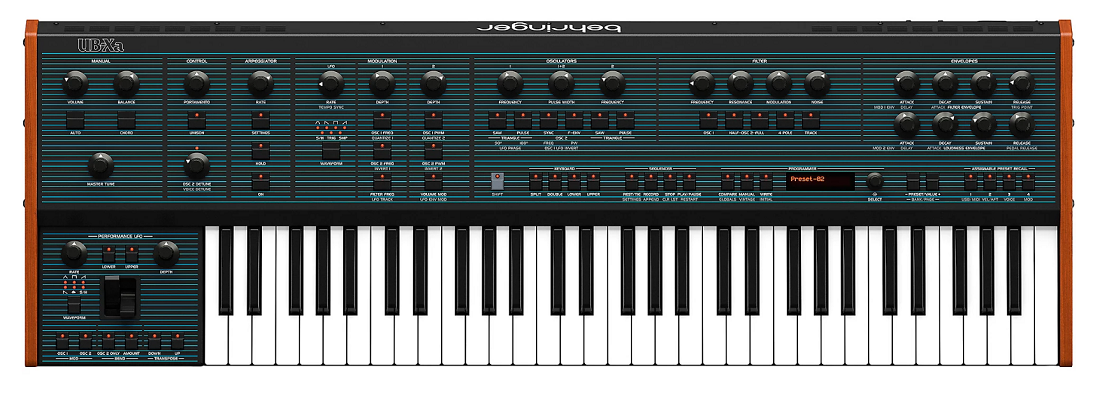
The recreation that put Behringer’s synthesizer ambitions into sharp focus. Behringer UB-Xa takes the circuit design of the Oberheim OB-Xa, one of the most coveted analog polysynths ever made, and delivers it in a new full-size keyboard format.
You get eight analog voices, the warm, rich Oberheim voice architecture, and bi-timbral capability that lets you split or layer two different patches.
The Oberheim sound occupies a specific, immediately recognizable place in the analog spectrum. It’s warmer than a Prophet, thicker in the midrange than a Juno, and carries a harmonic richness that’s particularly suited to pads, brass textures, and lead tones.
- Voice Architecture
The analog signal path follows the Oberheim topology with two VCOs per voice feeding a multimode filter that produces the specific midrange warmth the OB-Xa is known for.
The filter character is what defines the Oberheim sound more than anything else. It rounds the top end in a particular way that gives pads and sustained tones a lush, musical quality that brighter filter designs don’t produce.
- Bi-Timbral
Bi-timbral operation splits the eight voices across two independent patches that can be layered or split across the keyboard. You run a warm pad on one half and a cutting lead on the other, or stack two complementary textures for doubled thickness. The bi-timbral capability effectively gives you two different Oberheim synths from one instrument.
- Eight Voices
Eight voices of analog polyphony provide enough room for full chord voicings with natural sustain and release. Eight voices matches the original OB-Xa specification, which means the kinds of parts and arrangements that defined the original’s sound work identically on the UB-Xa without hitting polyphony walls.
4. Behringer Poly D
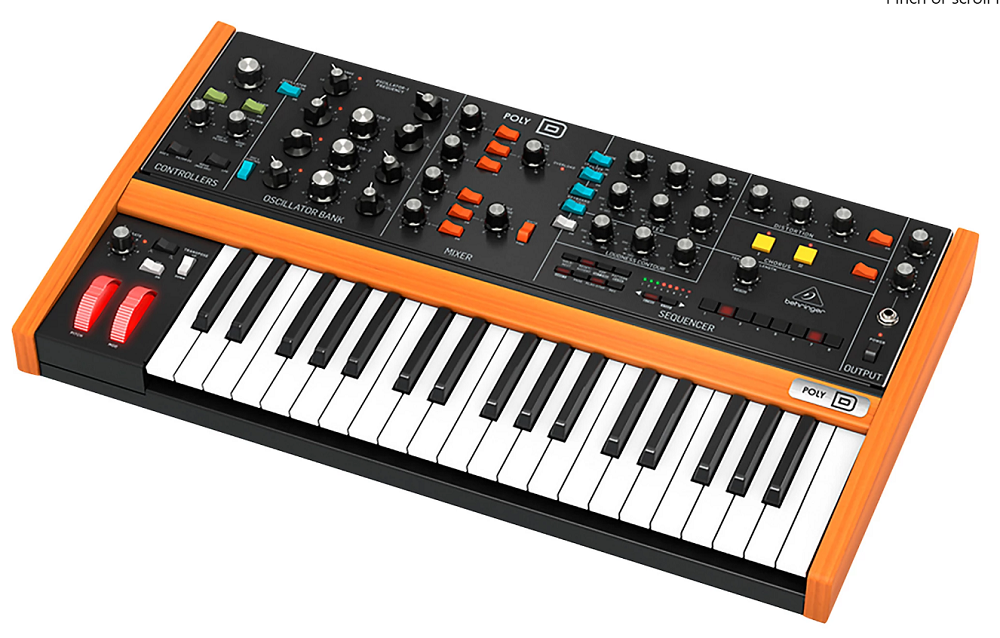
Moog never made a four-oscillator paraphonic instrument, but if they had, it might have sounded something like this. Behringer Poly D takes the Minimoog architecture as a starting point and expands it with a fourth oscillator and paraphonic voicing, creating a bass and lead machine with more raw harmonic power than any standard three-oscillator Minimoog-style design.
The four oscillators stacked through the ladder filter is the whole point of this instrument. Four detuned analog VCOs produce a wall of harmonic content that two or three oscillator designs simply can’t generate.
- Oscillator Stack
Four analog VCOs with independent pitch, waveform, and octave settings create harmonic combinations that go beyond what simpler architectures offer.
You stack all four in tight unison for massive, chorused textures that fill the low-end spectrum. Or you spread them across intervals for layered content where the fundamental, octave, and fifth all ring simultaneously with independent tonal character.
- Ladder Filter
The 24dB/oct ladder filter shapes the four oscillators with smooth, warm resonance that adds body to the low-mids rather than thinning them. The ladder architecture is the historical gold standard for bass synthesis because of how it handles low frequencies. It thickens rather than hollows, and the resonance peak adds musical overtones rather than harsh whistling.
- Analog Distortion
Built-in analog distortion pushes the output from clean and warm to aggressively saturated without external pedals. The distortion adds upper harmonics that help bass and lead sounds project through dense mixes, and the continuous control lets you dial in exactly the amount of grit you need for the context.
- Chord Capability
Four-voice paraphonic mode lets you play up to four notes through the shared filter, opening up the Poly D beyond single-note lines into chord stabs, power intervals, and stacked voicings. The paraphonic behavior shares one filter across all four voices, so it’s not true polyphony, but it adds harmonic complexity that strictly monophonic synths can’t deliver.
5. Behringer Wave
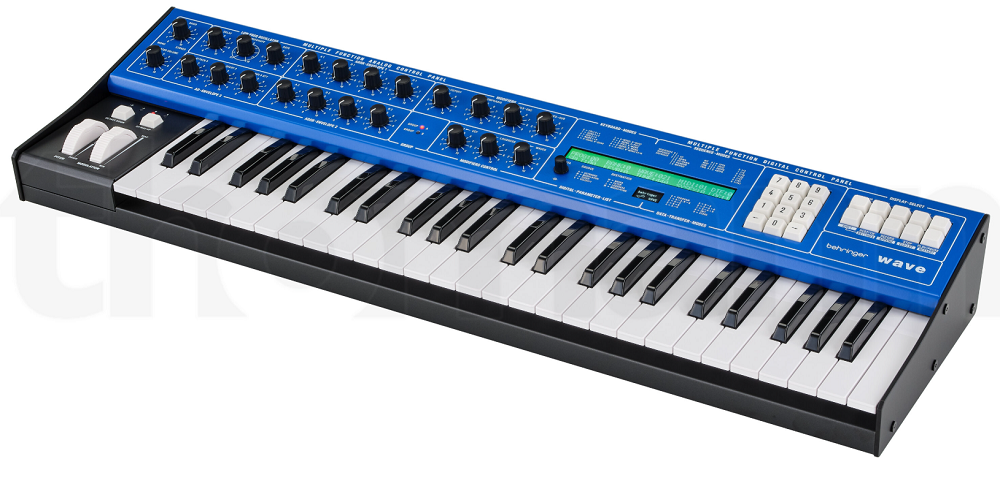
A recreation of one of the most distinctive and historically significant synthesizers ever designed. The Behringer Wave brings the PPG Wave 2.3’s wavetable synthesis back in an affordable format, delivering the specific gritty, aliased, characterful digital tone that the original PPG Wave contributed to electronic music in the 1980s.
The PPG Wave sound is unlike any other synthesis method. Modern wavetable synths are clean and precise. The PPG was raw, crunchy, and full of digital artifacts that became its defining sonic signature.
- PPG Wavetables
The wavetable engine reproduces the specific harmonic content and scanning behavior of the PPG Wave’s original wavetable sets. As you move through table positions, the harmonic content shifts with a gritty, staircase-like quality that comes from the lower-resolution wavetable implementation of the era. The aliasing and stepping aren’t flaws. They’re the specific character that makes the PPG sound identifiable and desirable.
- Table Scanning
Continuous wavetable position scanning via knob or modulation produces timbral movement where the harmonic content changes fundamentally rather than being shaped by a filter.
Modulating the table position with an LFO creates slowly morphing digital textures that analog subtractive synths cannot produce because the harmonic generation method is entirely different from oscillator-through-filter.
- Analog Filtering
The wavetable output feeds through a real analog filter that adds resonance character and warmth to the digital source material. The digital oscillator through analog filter hybrid architecture is what defined the PPG Wave’s appeal. You get the complex harmonic content of digital wavetables shaped by the smooth, musical response of analog filtering.
6. Behringer MonoPoly
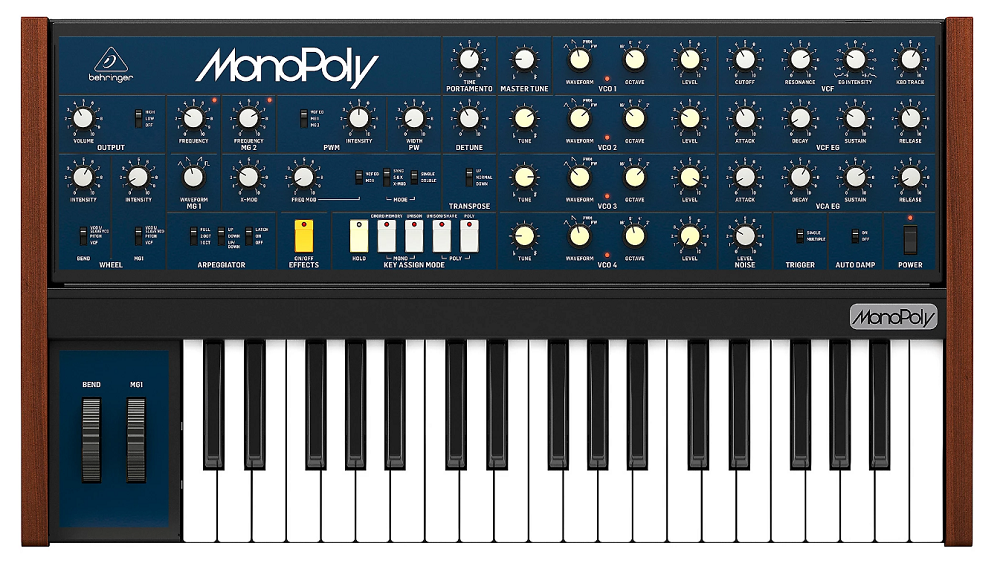
Four oscillators that you can play in four completely different voicing configurations from a single front panel, making the MonoPoly one of the most flexible Behringer synths in terms of how you interact with its oscillator section.
Inspired by the Korg Monopoly, the Behringer MonoPoly switches between mono, unison, chord memory, and four-voice polyphonic modes, each one fundamentally changing how the synth responds to your playing.
The mode switching is what makes this more than just another four-oscillator monosynth. You move from stacked unison thickness to independent polyphonic voices to memorized chord shapes on the same instrument during the same session.
- Four Modes
Mono, unison, poly, and chord memory give you four fundamentally different instruments from one synth. Mono focuses all four oscillators on a single note for maximum tonal focus. Unison stacks them with detuning for enormous thickness.
Poly distributes one oscillator per note for four-voice chords. Chord memory lets you program a chord shape and then transpose it with single keys, which is particularly useful for playing stacked chord stabs in house and techno.
- Audio-Rate Mod
Oscillator cross-modulation at audio rate generates complex overtones by having one oscillator modulate another’s frequency. The cross-mod adds metallic, bell-like harmonic content that standard detuning doesn’t produce, and the intensity control lets you dial in anywhere from subtle enrichment to aggressive, dissonant textures.
- Sync
Oscillator sync locks one oscillator’s cycle to another, producing the characteristic hard, bright, harmonically rich sync lead sound when you sweep the synced oscillator’s pitch. The sync sweep is one of the most distinctive lead sounds in synthesis, heard on countless electronic and progressive rock records.
- External Processing
An audio input routes external signals through the MonoPoly’s filter and modulation, letting you process drums, other synths, vocals, or any audio source with the instrument’s analog character. The external processing extends the MonoPoly’s usefulness beyond its own oscillators into a studio tool that adds its filter coloration to any sound.
- Arpeggiator
A built-in arpeggiator generates rhythmic patterns from held notes, with multiple mode and octave range options. The arp takes particular advantage of the four-voice architecture, creating patterns that cycle through polyphonic content rather than just single notes.
7. Behringer Odyssey
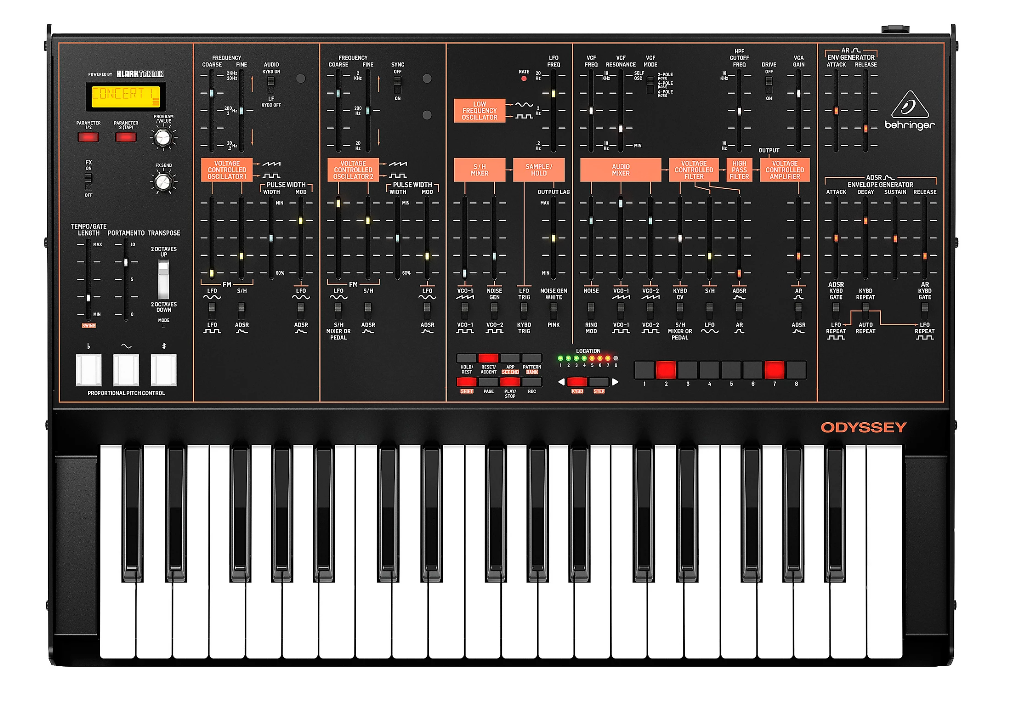
Raw, aggressive, and unmistakably its own thing. The Behringer Odyssey recreates the ARP Odyssey in desktop format, delivering the duophonic analog signal path with ring modulator, sample-and-hold, and the specific three-revision switchable filter that gave the original its reputation as one of the most characterful monosynths ever produced.
The Odyssey sounds nothing like a Moog, nothing like a Roland, and nothing like a Korg. It has a specific aggression and metallic edge in its voice that’s made it a favorite for lead lines, sound effects, and experimental textures across five decades.
- Ring Modulation
The built-in ring modulator multiplies the two oscillators against each other, generating inharmonic, metallic, bell-like frequencies that neither oscillator contains on its own. The ring mod is what gives the Odyssey its ability to move from musical tones into alien territory with a single knob turn. For electronic and experimental production, the ring mod opens up a sound palette that standard subtractive synths don’t access.
- Filter Revisions
A switch selects between three different filter circuits (Mk I, II, III) that each handle resonance and self-oscillation differently. The Mk I filter is raw and aggressive with harsh self-oscillation. The Mk II is smoother and more controlled. The Mk III sits in between. Having all three in one instrument gives you more tonal variety than any single-revision recreation offers.
- Sample & Hold
The sample-and-hold module generates stepped random modulation, producing the bleeping, bubbling, erratically shifting patterns that became a defining sound effect in science fiction and electronic music. Routing the S&H to pitch creates random melodies. Routing it to filter creates rhythmic tonal shifts. The randomness adds unpredictability that programmed modulation doesn’t replicate.
8. Behringer MS-5
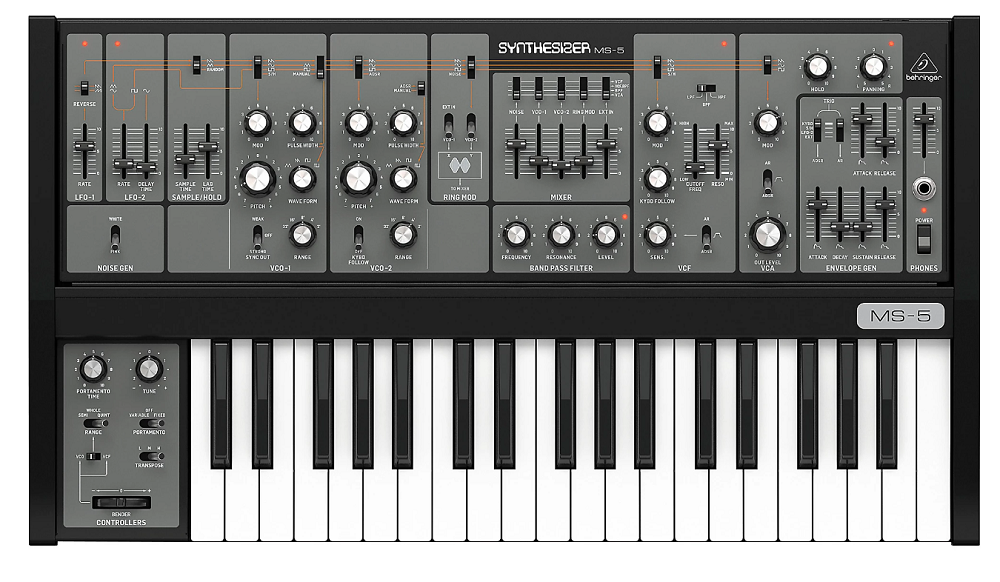
Based on a lesser-known but arguably more interesting Roland design than the famous SH-101, the Behringer MS-5 recreates the Roland SH-5 in a compact desktop module. What sets the SH-5 apart from simpler Roland monosynths is its independent high-pass and low-pass filters operating as separate modules, giving you frequency-sculpting precision that single-filter designs can’t match.
The dual independent filter architecture is the MS-5’s defining characteristic, and it produces a tighter, more precisely shaped tone than you’d get from a standard multimode filter where modes share one circuit.
- Independent Filters
Separate high-pass and low-pass filters with their own cutoff, resonance, and modulation controls let you carve the frequency spectrum from both ends simultaneously. You set the HPF to remove low rumble while the LPF shapes the top, or push both into resonance at different frequencies for dual-peak tonal sculpting that creates a focused, vocal-like quality in the midrange.
- Ring Modulator
A built-in ring modulator adds metallic, inharmonic overtones to the oscillator signal, extending the MS-5 beyond standard subtractive territory into more experimental sound design. The ring mod combined with the dual filter gives you tools to both create unusual harmonics and then precisely shape them, which is a combination that most compact monosynths lack.
- Desktop Size
The compact desktop module format adds the full SH-5 voice to your setup without claiming keyboard space. You trigger it from your existing MIDI controller and keep the footprint minimal, which matters in setups where desk real estate is shared between multiple instruments and a computer.
- Audio Input
An external audio input feeds outside signals through both filters and the ring modulator, transforming the MS-5 into an analog effects processor for drums, other synths, or any audio source. Processing external content through the independent dual filters adds the MS-5’s specific tonal character to sounds you’ve already created elsewhere.
9. Behringer Pro-VS Mini
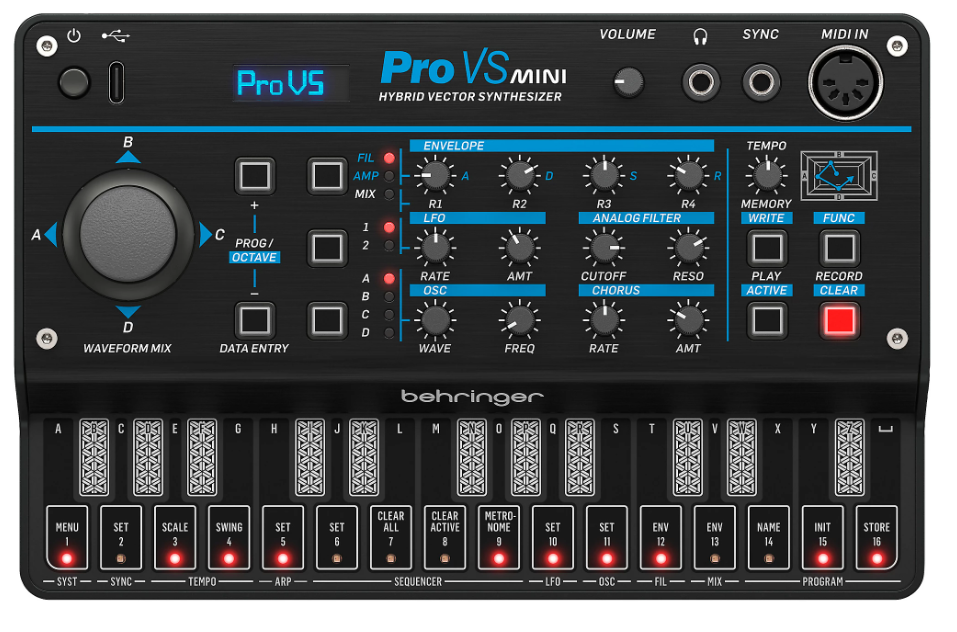
Ending this list with an instrument that approaches synthesis from a fundamentally different angle than everything else here. The Behringer Pro-VS Mini is a vector synthesizer inspired by the Sequential Prophet VS, where sound creation happens by blending between four waveform sources simultaneously using a joystick rather than filtering a single oscillator source.
Vector synthesis produces a distinct quality of timbral movement because you’re crossfading between complete sounds rather than sculpting one. The resulting textures shift and morph in ways that subtractive and even wavetable synthesis handle differently.
- Vector Joystick
The vector mixing joystick positions you within a four-corner sound space, where each corner represents a different oscillator waveform. Moving the stick traces a continuous blend through all four sources simultaneously, and the resulting sound reflects your exact position. The physical interaction feels genuinely performative because the timbral morphing follows your hand in real time with immediate, organic response.
- Waveform Set
Access to the Prophet VS waveform library gives you the specific digital waves that defined vector synthesis. These waveforms have a particular clarity and harmonic structure distinct from analog oscillators and from modern high-resolution wavetable content. The character suits pads, evolving atmospheres, and textural sounds where the digital precision of the waveforms creates defined, articulate harmonic movement.
- Curtis Filters
Real analog Curtis filters process the digital vector output, bringing warmth and resonance shaping to the otherwise clean digital source. The hybrid digital oscillator through analog filter configuration mirrors the original Prophet VS topology, blending the precision of digital waveform generation with the organic response of real analog filtering.
- Vector Envelope
A programmable vector envelope automates joystick movement over the duration of each note, creating four-way waveform morphing sequences that play back without manual control. You define a path through the four-corner vector space, and the envelope traces that path from note-on through sustain to release. Sounds that develop and transform across their entire lifespan emerge from the vector envelope without any performance input required.
- Module Format
The compact desktop module makes vector synthesis accessible without the cost and space commitment of a keyboard instrument. You control the Pro-VS Mini from whatever MIDI keyboard you already own, paying for the synthesis engine rather than a redundant playing surface.
Get the Free Plugin Starter Kit
The genuinely useful free DAWs and plugins worth installing. No filler. Straight to your inbox.

Hello, I’m Viliam, I started this audio plugin focused blog to keep you updated on the latest trends, news and everything plugin related. I’ll put the most emphasis on the topics covering best VST, AU and AAX plugins. If you find some great plugin suggestions for us to include on our site, feel free to let me know, so I can take a look!