
The upright double bass is one of the most expressive and physically demanding instruments to play, and that expressiveness makes it equally challenging to sample convincingly.
The way a bassist digs into a pizzicato note, the woody resonance of an arco sustain, the percussive thump of a walking bass line all involve complex interactions between the player’s hands, the strings, and the massive resonating body of the instrument.
Capturing that in a virtual instrument requires deep sampling, intelligent scripting, and careful attention to the transitions between notes.
Whether you need upright bass for jazz, orchestral scoring, folk, cinematic underscore, or contemporary pop, the plugins on this list cover the range from deeply sampled acoustic instruments to physically modeled engines that generate the sound mathematically.
Some excel at solo realism where every note is under scrutiny. Others prioritize pattern based playability that gets you a convincing bass part quickly without extensive MIDI programming. I’ve selected nine options (eight plus a bonus) that represent the best current approaches to virtual double bass.
1. Vir2 Instruments MOJO: Upright Bass
One of the earlier dedicated upright bass libraries that set a standard other developers have been chasing since its release, Vir2’s MOJO provides a deeply sampled acoustic double bass with a particular strength in jazz and session style playing. The library captures the full tonal range of the instrument across both pizzicato and arco techniques.
What drew me to MOJO initially was the character of the pizzicato samples, which have the woody, resonant thump that defines a great jazz upright bass sound. The instrument doesn’t sound polished to the point of sterility.
- Jazz Character
The sampling captures the specific tonal quality of a jazz upright bass, including the woody resonance, string buzz, and body thump that give pizzicato bass its distinctive character.
The sound isn’t overly clean or processed, which is actually what you want for jazz because the imperfections and resonances are what make a real upright bass sound alive and present in a mix. You get the sense of fingers on strings and wood vibrating that polished, sterile samples strip away.
- Arco & Pizzicato
Both bowed (arco) and plucked (pizzicato) playing techniques are deeply sampled with multiple dynamic layers and round robins.
The arco sampling captures the sustained, singing quality of the bowed instrument with enough velocity layers that you can program passages moving from gentle pianissimo to full bodied fortissimo. The pizzicato side covers everything from soft, ghosted notes to hard, percussive plucks that define walking bass lines.
- Slide Articulations
Recorded slide transitions between notes capture the specific way an upright bassist slides from one pitch to another, including the finger pressure variation and string noise that accompany real slides. The slides are what prevent your bass parts from sounding like a series of disconnected notes, adding the connective tissue that makes a programmed bass line feel like a continuous performance.
- Round Robins
Multiple round robin samples for each note and dynamic level prevent the machine gun repetition that plagued earlier bass libraries when the same note was triggered repeatedly.
The variation is particularly important for walking bass lines where the same note can occur multiple times within a few bars, and hearing the identical sample repeated instantly destroys the illusion of a real player.
2. MODO Bass 2 by IK Multimedia
Taking a fundamentally different approach from every other library on this list, MODO Bass 2 doesn’t use samples at all.
The instrument generates its sound through physical modeling, mathematically simulating the interaction of strings, body, pickups, and the player’s hands to produce bass tones in real time. The physical modeling covers both electric bass guitars and acoustic upright double bass.
The modeling approach means MODO Bass 2 responds to your playing in ways that sampled instruments can’t replicate. There are no sample boundaries, no round robin cycling, and no articulation switching keyswitches to manage.
The engine generates every note fresh based on the physical parameters you’ve configured, which produces a continuous, responsive playing experience.
- Physical Modeling
The entire instrument is generated through mathematical modeling of the physical instrument rather than playback of recorded samples.
The modeling simulates string vibration, body resonance, bridge behavior, finger interaction, and acoustic radiation in real time, producing sound that responds continuously to your MIDI input without the discontinuities and repetition that sampled instruments exhibit. Every note is unique because it’s generated from physics rather than recalled from a fixed set of recordings.
- Upright Model
The double bass model specifically simulates the acoustic properties of an upright bass including the large body resonance, string length, bridge characteristics, and the differences between arco and pizzicato excitation.
The physical model captures the way the instrument responds to different playing forces, where harder plucks produce not just louder notes but tonally different ones with more overtones and string buzz, exactly as the real instrument behaves.
- Player Controls
You can adjust parameters that model the player’s physical interaction with the instrument, including finger position on the string, plucking force, bowing pressure, and string damping behavior.
These player parameters give you control over aspects of the performance that sample libraries can’t vary continuously, letting you shape the playing style from gentle and restrained to aggressive and percussive without switching between separate articulation patches.
- No Repetition
Because every note is generated mathematically rather than played back from samples, there’s no repetition or cycling through a fixed set of recordings. The absence of repetition means rapid repeated notes, ostinato passages, and walking bass lines never exhibit the telltale signs of sample based instruments where you hear the same recording triggering multiple times.
- String Setup
You can configure the physical properties of the strings including material, gauge, age, and tuning, which affects the tonal character and response of the instrument. Fresh strings produce a brighter, more articulate tone while aged strings are darker and warmer, and the modeling reproduces this tonal difference accurately because it’s simulating the actual physical properties rather than applying EQ to a fixed recording.
- Amp & Effects
A built in signal chain with amplifier modeling, cabinet simulation, and effects processing lets you shape the final tone within the plugin. For the upright bass model, the amp and effects section lets you add the kind of pickup coloration, room simulation, and tonal processing that a recording engineer would apply to a close miked upright bass in a studio session.
3. Ample Bass Upright
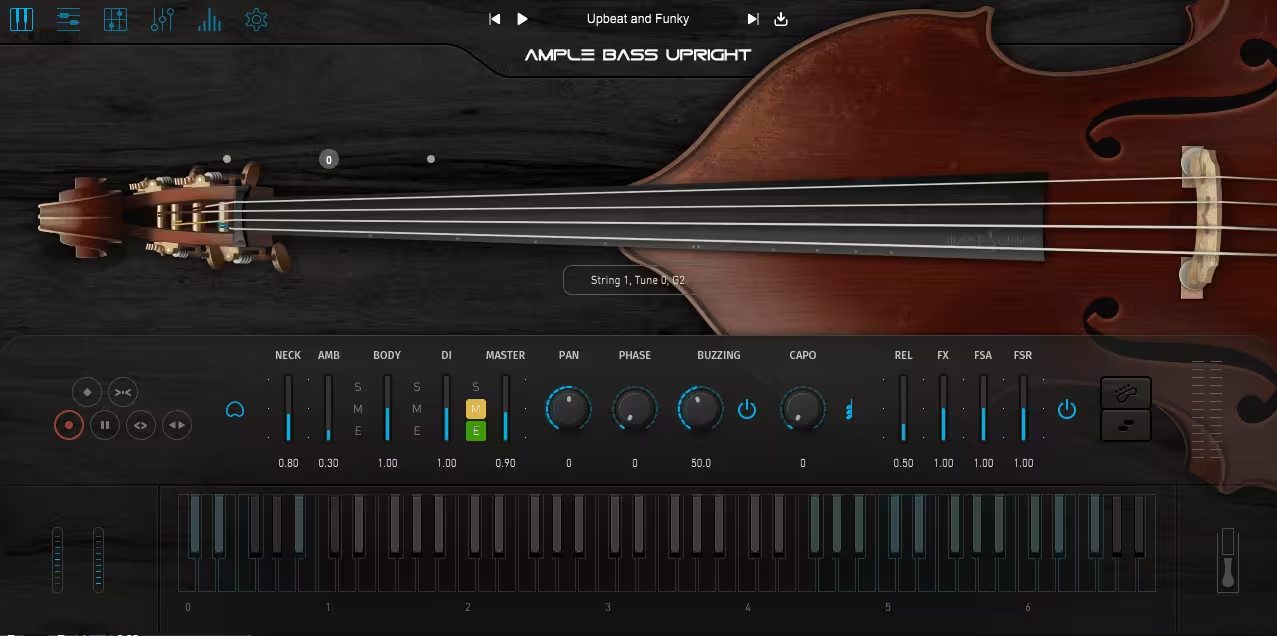
From the developers behind some of the most detailed guitar sampling available, Ample Sound’s Bass Upright applies the same deep sampling and scripted performance approach to the double bass. The library provides extensive articulations with intelligent performance scripting that handles realistic playing behavior automatically.
Ample Sound’s approach emphasizes technical completeness, with enough articulations and performance features that you can program convincingly detailed bass parts for exposed solo passages.
- Articulation Set
A comprehensive collection of sampled articulations covers sustain, staccato, natural harmonics, slides, hammer ons, pull offs, buzzing, and multiple special techniques that give you the vocabulary for realistic upright bass programming. The articulation depth goes beyond basic sustain and pizzicato to include the transitional and incidental sounds that real bassists produce, which are the details that separate convincing virtual performances from obviously programmed ones.
- Tab Player
An integrated tablature player lets you import bass tablature files and have the instrument perform them with automatically applied articulations, finger positioning, and string selection. The tab import is useful for converting written bass parts into performed virtual instrument output without manually programming every articulation switch and performance detail.
- Legato Engine
A scripted legato system handles the transitions between notes with recorded interval samples that capture the specific way an upright bass moves from one pitch to another. The legato scripting produces connected phrases that sound like continuous playing rather than a sequence of individually triggered notes, which is essential for any melodic or lyrical bass passage.
4. Acousticsamples The Upright
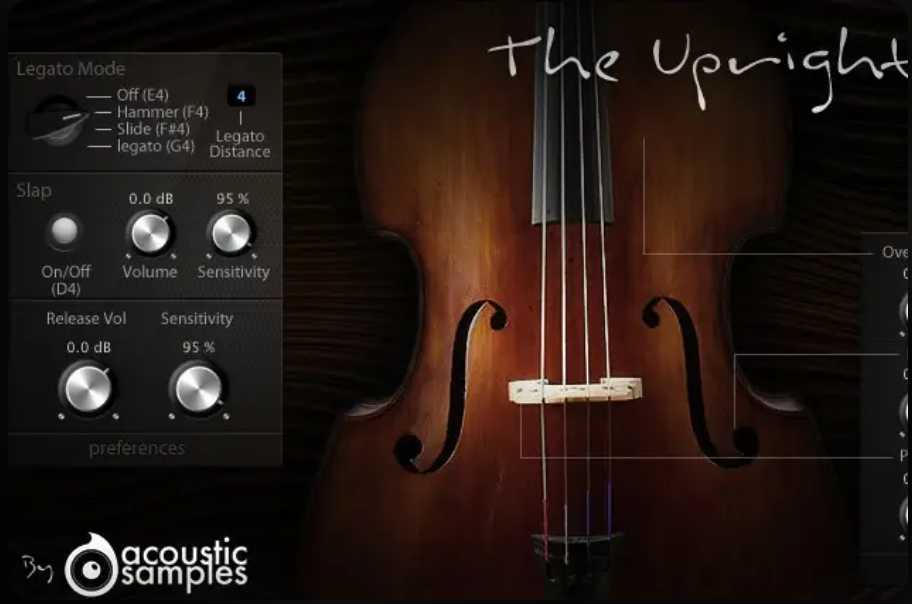
Image: Acousticsamples
A library that focuses on capturing the warm, resonant character of a high quality upright bass with a recording approach that emphasizes the instrument’s natural acoustic properties. The Upright is built for producers who want an upright bass sound that’s organic, detailed, and responsive to dynamic playing.
The library shines in contexts where the bass is exposed and needs to sound genuinely acoustic rather than processed or synthetic.
- Recording Quality
The sampling captures the full acoustic character of the upright bass including body resonance, string noise, and the spatial quality of the instrument’s large physical size. The recording setup preserves the natural relationship between the direct string sound and the body radiation, producing a tone that has the dimensional quality of hearing a real upright bass in a room rather than the flat, close miked character that some libraries exhibit.
- Velocity Response
The dynamic sampling depth provides smooth transitions across a wide velocity range, from barely touched ghost notes to fully committed fortissimo plucks. The velocity response is mapped to feel natural under your fingers on a MIDI keyboard, with the tonal character changing alongside the volume as it does on the real instrument where harder playing produces not just more volume but more overtones, more string buzz, and more body resonance.
- UVI Engine
The library runs in the UVI Workstation (free) or Falcon, providing a dedicated playback engine with scripted performance features tailored to the specific instrument. The UVI platform handles the articulation switching, legato behavior, and dynamic response in an interface designed for the library’s specific needs.
- Finger Noise
Recorded finger and string noise adds the incidental sounds that accompany real upright bass playing, including the subtle slides, position shifts, and string contact sounds that happen between notes. These noises are what make a virtual performance sound like it involves a physical instrument being played by a person rather than a series of perfect, isolated notes triggered by a machine.
5. SWAM Double Bass
Another physical modeling approach, but from Audio Modeling rather than IK Multimedia, and with a focus on orchestral and classical double bass rather than the jazz/session orientation that MODO Bass emphasizes. SWAM (Synchronous Wavelength Acoustic Modeling) Double Bass generates the sound through real time physical modeling with particular emphasis on bowed playing.
The SWAM engine excels at arco performance, producing bowed sustains with the continuous dynamic and tonal variation that makes orchestral bass parts convincing.
- Bowed Realism
The physical modeling provides exceptionally realistic arco (bowed) performance with continuous response to bow pressure, speed, and position modulation. The bowed sound transitions smoothly across the entire dynamic range without the sample switching artifacts that interrupt sustained bowed passages in sampled libraries. You can control the bowing parameters in real time through MIDI controllers, producing expressive performances that feel responsive and musical rather than pre-recorded.
- Breath Controller
The engine responds particularly well to breath controller input, which provides an intuitive way to control bowing dynamics because the physical gesture of breathing maps naturally to the physical gesture of bowing. Using a breath controller with SWAM produces performances with a natural dynamic arc that’s difficult to achieve with a mod wheel, because your breathing instincts naturally shape musical phrases the way a real bassist’s bowing arm would.
- Continuous Response
Because the sound is generated in real time rather than played back from recordings, every parameter responds continuously without stepping, switching, or cycling through fixed samples. The continuous response means crescendos and diminuendos are perfectly smooth, vibrato depth and speed change instantly, and the tonal character morphs fluidly as you adjust performance parameters. There are no boundaries between dynamic layers or articulation patches.
6. NI Session Bassist Upright Bass
Part of Native Instruments’ Session series, this library takes the pattern based approach where you trigger pre-performed bass lines, rhythmic patterns, and walking figures rather than playing individual notes. Session Bassist Upright Bass prioritizes getting convincing bass parts into your production quickly.
If you need a realistic upright bass accompaniment for a song without spending hours programming individual notes and articulation switches, the pattern engine gets you there faster than any other approach on this list.
- Pattern Engine
A library of pre-performed bass patterns covering walking lines, root note rhythms, fingerpicking figures, and genre specific grooves gives you immediately usable bass accompaniment. The patterns are performed by a real bassist, which means they carry the timing feel, dynamic variation, and technique of genuine human playing. You select a pattern, play your chords, and the engine adapts the performed bass line to follow your harmonic input, producing results that sound played rather than programmed.
- Chord Following
The patterns respond to your chord input in real time, transposing and revoicing the bass line to match whatever harmonic content you provide from your MIDI controller. You can change chords freely and the bass pattern adapts intelligently, selecting appropriate voicings and note choices that a real bassist would make when following chord changes. The chord following handles everything from simple root movement to more complex jazz voicings.
- Style Selection
Genre specific style presets configure the pattern library and performance behavior for particular musical contexts, from jazz walking bass to folk accompaniment to pop/rock foundational bass. The style system means you can switch the entire character of the bass accompaniment to match different production contexts without rebuilding your approach from scratch.
- NKS Integration
Full NKS compatibility provides tagged browsing, hardware parameter mapping, and light guide display on NI keyboards. The integration means you can browse patterns and styles from your keyboard’s display, audition them in context, and control performance parameters from hardware knobs without touching your mouse.
- Humanize Controls
Adjustable humanization parameters control the amount of timing variation, velocity randomization, and performance imperfection in the output. The humanization prevents the patterns from sounding mechanically perfect, adding the subtle looseness that makes bass parts feel performed rather than quantized. You can dial the humanization from tight and precise to relaxed and loose depending on the musical context.
7. ujam Virtual Bassist MELLOW
Following ujam’s approach of prioritizing playability and instant results over deep sampling complexity, this plugin provides an upright bass sound designed to get you a usable bass part with minimal setup and programming effort. Virtual Bassist MELLOW handles the performance aspect automatically through its pattern and groove engine.
The ujam philosophy trades the deep articulation control of traditional libraries for speed and convenience, which suits producers who use upright bass as an accompaniment element rather than a featured solo instrument.
- Instant Playability
The performance engine generates convincing bass parts from simple chord input without requiring you to program individual notes, articulation switches, or performance details. You focus on the harmony and arrangement while the engine handles the bass performance, which makes adding upright bass to a production a quick, frictionless process rather than a detailed programming exercise. The approach is ideal for songwriters and producers who want bass accompaniment without the learning curve of complex sampling instruments.
- Groove Presets
Pre-configured groove patterns covering multiple styles give you immediately usable bass performances that lock to your project tempo. The grooves capture specific playing styles from mellow ballad accompaniment to more rhythmically active patterns, and switching between them lets you quickly audition different bass approaches for your track without rebuilding the bass part from scratch.
- Tone Shaping
Built in tonal controls let you adjust the character of the bass from dark and thumpy to bright and articulate within the plugin interface. The tone shaping goes beyond simple EQ, affecting the overall character of the plucked and sustained sounds in ways that change how the bass sits in your mix. You can match the bass tone to the production context without needing external processing.
8. XPERIMENTA Audio Classica Double Bass
Classica Double Bass provides the arco sustains, detache bowing, spiccato, and pizzicato techniques that orchestral bass writing demands. The orchestral focus means this library serves a different purpose from the jazz and pop oriented options above, providing the specific techniques and tonal character that classical and film scoring contexts require.
The sampling covers orchestral specific articulations including sustained arco, detache, spiccato, staccato, tremolo, and col legno alongside standard pizzicato techniques. The articulation set addresses the specific requirements of orchestral bass writing where the bowing technique determines the character of each passage.
The depth of bowing articulations goes beyond what jazz or pop oriented upright bass libraries typically provide, because orchestral writing uses a wider variety of bowing techniques than non-classical contexts.
- Dynamic Layers
Multiple dynamic layers with smooth crossfading between them produce natural crescendos and diminuendos that don’t exhibit obvious sample switching during sustained bowed passages. The dynamic layering is particularly important for arco playing where the bow pressure and speed change continuously, and hearing stepped dynamic transitions immediately destroys the illusion of real bowed performance. The layers are mapped to produce a natural, continuous dynamic response.
- Solo Exposed
The sampling quality is designed to withstand solo exposure where the double bass plays alone or in small ensemble contexts without other instruments masking imperfections. The solo suitability means the recordings are clean enough, detailed enough, and natural enough that you can use them for exposed bass passages in chamber music, solo concerto contexts, or intimate scoring moments where the instrument has nowhere to hide.
- Section Building
Multiple instances can be layered to build a bass section with the slight pitch, timing, and tonal variation between instances creating the natural blend of multiple players. The layering approach produces a convincing section sound because each instance introduces subtle differences that mimic the variation between real players in an orchestral bass section.
Extra: Toontrack Upright EBX
An expansion pack for EZbass rather than a standalone instrument, this library adds upright double bass content to Toontrack’s bass guitar platform. Toontrack’s Upright EBX provides the specific upright bass tone and performance patterns within the EZbass engine that EZbass owners already know and use.
If you own EZbass, this expansion is the most convenient way to add upright bass to your toolkit because you’re working within an engine you already understand.
- EZbass Integration
The expansion runs within the EZbass engine, which means all of EZbass’s song building, groove editing, and performance features apply to the upright bass content. You get the upright bass tone combined with the MIDI pattern library, song arrangement tools, and bass line generation features that make EZbass a productive songwriting tool. The integration means no new interface to learn and no separate plugin to load.
- Song Creator
The EZbass Song Creator generates complete bass arrangements from your project’s chord progression, which applies equally to the upright bass expansion as it does to the electric bass content. You input your chords and the engine creates a musically appropriate upright bass arrangement that follows the harmony, which is the fastest path from no bass part to a complete one.
- MIDI Library
A collection of MIDI performance patterns tailored to upright bass playing styles gives you pre-performed grooves, walking lines, and accompaniment figures. The MIDI patterns are designed specifically for the upright bass rather than adapted from electric bass patterns, which means the note choices, rhythmic patterns, and dynamic shapes reflect how real upright bassists actually play.
- Tone Customization
The EZbass tone shaping tools apply to the upright bass expansion, letting you adjust the character from warm and thumpy to bright and defined. The tonal controls combined with the amp modeling options in EZbass give you a range of upright bass sounds from pure acoustic to lightly amped, covering different production contexts from folk and jazz to pop and cinematic scoring.
- Groove Editing
The EZbass groove editor lets you modify the timing, velocity, and note choices of the MIDI patterns to customize them for your specific arrangement. You can adjust individual notes, shift timing for a looser or tighter feel, and change articulation assignments without rebuilding the pattern from scratch. The editing flexibility means the pre-performed patterns serve as starting points that you shape to fit your track rather than fixed arrangements you have to work around.

Hello, I’m Viliam, I started this audio plugin focused blog to keep you updated on the latest trends, news and everything plugin related. I’ll put the most emphasis on the topics covering best VST, AU and AAX plugins. If you find some great plugin suggestions for us to include on our site, feel free to let me know, so I can take a look!