
Hardware synths output audio, and that audio needs to get into your DAW somehow. If you own one synth, your existing two-input interface probably handles it fine. But once your collection grows past two or three units, the limitations of a basic interface become obvious fast.
You run out of inputs, you spend half your session replugging cables, and the workflow of working with hardware starts feeling more like cable management than music-making.
A synth-focused audio interface solves this by giving you enough inputs to keep multiple synths connected permanently, line-level inputs that match synth output levels properly, and the monitoring flexibility to blend hardware and software sources together in real time.
What I look for in a synth interface is different from what I’d want for vocal recording or guitar tracking. You need line-level inputs, not just mic preamps, because most synths output at line level and running them through a mic preamp at minimum gain wastes a channel’s potential.
Stereo inputs matter because most synthesizers output in stereo, and MIDI connectivity is useful if you want your DAW to control your synths’ timing. Low latency matters for live playing, and enough outputs to route audio back to hardware effects or to feed a separate headphone mix makes a real difference in workflow.
Here are eight interfaces that handle hardware synth setups well across different scales and budgets.
1. USB Audio Interface 24 Bit 192kHz Recording — $114.99

Before the hardware synth-specific interfaces below, one accessible option from the Pluginerds store that covers the basic requirement of getting a hardware synth into a DAW.
The USB Audio Interface 24 Bit 192kHz Recording gives you two inputs, 24-bit/192kHz conversion, direct monitoring, and USB-C connectivity at $114.99. A hardware synth’s audio output — whether stereo line or mono mono — runs straight into the interface’s line inputs and records into your DAW at high resolution. This is the essential function any synth interface needs to perform, and this does it cleanly at a price significantly below the specialist options below. What the interfaces further down this list add is multi-channel capability for recording multiple synths simultaneously, dedicated impedance controls, and in some cases onboard DSP for hardware-synth-style zero-latency monitoring.
- 24-bit/192kHz
24-bit/192kHz conversion captures your hardware synth’s audio at a resolution level that preserves the full character of the analog circuitry — the harmonic content, the filter resonance, the natural dynamics of the oscillators.
Recording your synth at 24-bit depth gives you the headroom to capture its full dynamic range from the softest pad swell to the loudest lead hit without the noise floor or clipping that 16-bit introduces at the recording stage. The 192kHz option matters specifically for hardware synths where oversampling and later sample rate conversion keeps the analog character intact.
- Line Inputs
Two balanced line-level inputs accept the stereo output of any hardware synth directly — standard 6.35mm TRS or via adapter from RCA — without requiring a dedicated instrument input or DI box for most keyboard-style synths.
The line input is what differentiates a proper audio interface from a laptop’s built-in sound card for synth recording. Instrument-level inputs are for guitars and basses. Line-level inputs are what hardware synths, drum machines, and grooveboxes need.
- Direct Monitoring
Direct monitoring lets you hear your hardware synth in your headphones without any computer processing latency, which means you can play and monitor the synth exactly as it sounds without the buffer delay that software monitoring introduces.
Shop at Pluginerds — USB Audio Interface 24 Bit 192kHz $114.99
Get the Free Plugin Starter Kit
The genuinely useful free DAWs and plugins worth installing. No filler. Straight to your inbox.
2. Arturia AudioFuse Studio
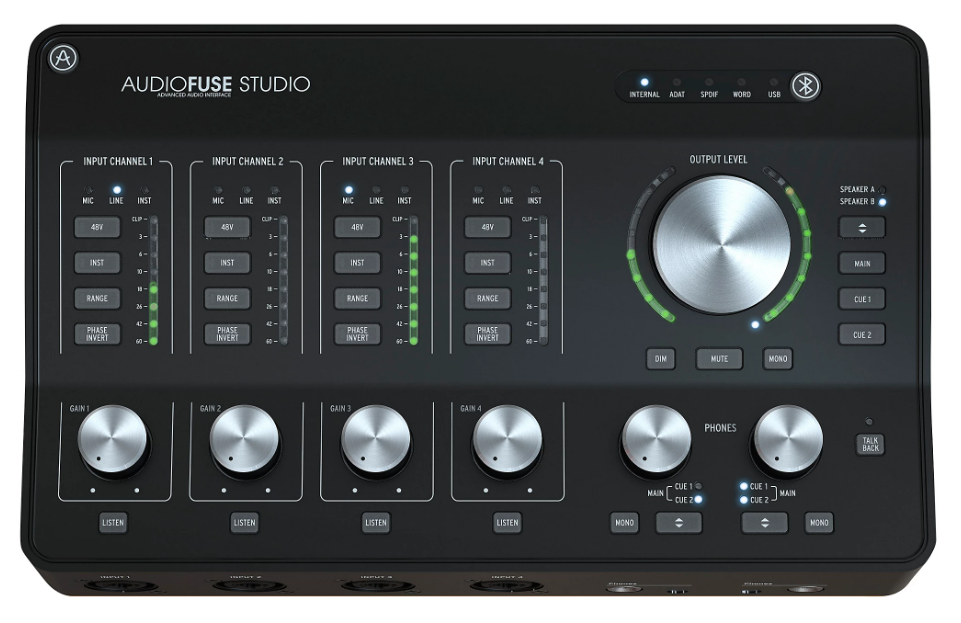
Built by a company that understands synthesizers better than almost any other interface manufacturer, because Arturia has been making synths and synth software for over two decades.
Arturia AudioFuse Studio provides four DiscretePRO mic/line preamps with inserts on each channel, four additional rear-panel line inputs (two switchable to phono for vinyl sampling), DC-coupled reamp outputs for sending CV to modular synths, ADAT and S/PDIF digital expansion, Bluetooth audio, MIDI I/O, and a comprehensive monitor controller with speaker switching, talkback, dim, and mono functions.
For synth users specifically, the AudioFuse Studio offers features that most interfaces don’t even consider. DC-coupled outputs mean you can send control voltage from your DAW directly to modular gear. A built-in phono preamp lets you sample vinyl without extra hardware.
Bluetooth lets you stream reference tracks to your monitors from your phone. And the eight analog inputs keep a meaningful collection of synths connected permanently.
- DC-Coupled Outputs
Arturia’s DC-coupled reamp/aux outputs can send control voltage signals from your DAW to modular synthesizers and Eurorack gear, bridging the gap between software sequencing and analog hardware control.
Most interface outputs filter out the DC component that CV signals require, but the AudioFuse Studio’s outputs pass it through, meaning you can use DAW automation to control filter cutoffs, oscillator pitch, and other voltage-controlled parameters on your modular setup.
For hybrid producers who combine DAW sequencing with modular synthesis, this feature eliminates the need for a separate CV interface.
- Eight Analog In
Eight analog inputs across four front-panel preamp channels and four rear-panel line inputs give you enough connectivity to keep a serious synth collection patched in permanently. Your polysynth, drum machine, monosynth, and sampler all stay connected, ready to play and record at any moment without replugging cables. For producers who work spontaneously with hardware, having everything permanently connected removes the friction that kills creative momentum.
- Phono Input
A built-in phono preamp with RIAA equalization on two of the rear-panel inputs lets you connect a turntable directly and sample vinyl without an external phono stage. Sampling records is a foundational production technique in hip-hop, electronic, and lo-fi genres, and having the phono preamp built into your main interface means vinyl sampling is always available as part of your normal workflow. You don’t need to buy, connect, or power a separate phono preamp.
- Monitor Section
A full monitor controller with speaker A/B switching, dim, mono, mute, and talkback provides the monitoring infrastructure that hardware-heavy studios need.
Switching between speaker sets lets you check your synth mix on different systems, mono collapse reveals phase issues in stereo synth patches, and talkback communicates with collaborators without leaving your desk.
Most interfaces in this category force you to buy a separate monitor controller for these functions.
3. UAD Apollo Twin X USB Heritage
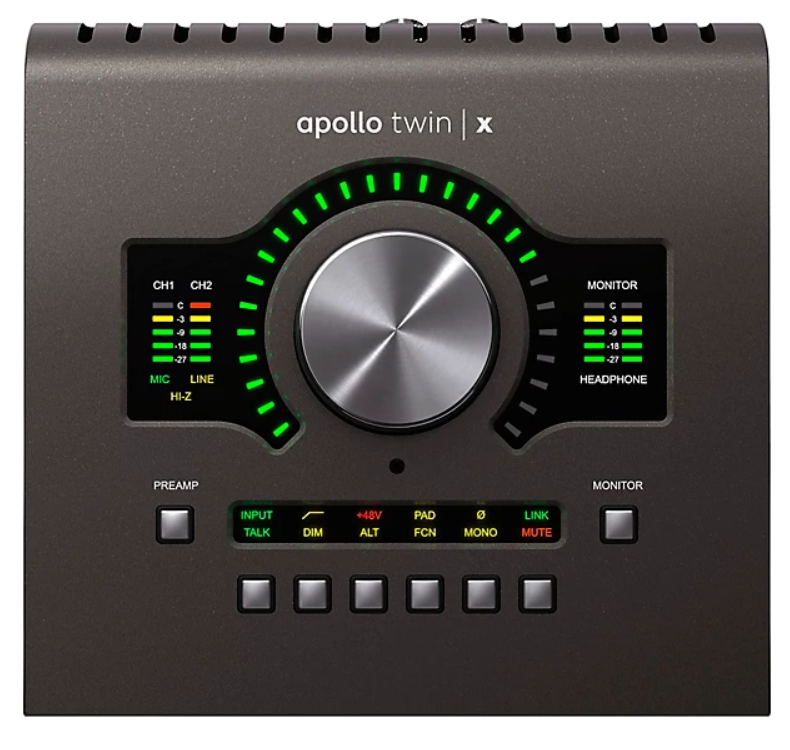
Professional conversion quality and real-time UAD plugin processing from the company that defined outboard analog studio hardware.
Apollo Twin X USB Heritage features two Unison mic preamps that model classic hardware at the circuit level, the Heritage Edition plugin bundle with vintage EQs, compressors, and channel strips, real-time UAD processing through the onboard SHARC DSP chip, a monitor controller with speaker switching, ADAT expansion for adding more inputs, and conversion quality that competes with standalone converters costing significantly more.
For synth users, I find the Apollo Twin X interesting because the Unison preamps and UAD processing let you apply classic hardware coloration to your synth recordings in real time.
Running a pad through a modeled Neve preamp and LA-2A compressor while tracking gives you a produced, finished sound from the recording stage rather than relying entirely on mixing later.
- Unison Preamps
UA’s Unison technology models classic microphone preamps at the hardware circuit level, changing the Apollo’s input impedance and gain staging to match the original equipment.
Running your synth through a modeled Neve 1073 or API 512c via Unison gives your recording the genuine harmonic character and gain behavior of those classic preamps, not just an EQ approximation.
For synth recordings that need analog warmth and coloration, Unison provides hardware-level authenticity that plugin processing alone doesn’t achieve.
- Heritage Bundle
The Heritage Edition plugin collection includes vintage EQs, compressors, tape machines, and channel strips from the UAD ecosystem. You get the Teletronix LA-2A, 1176 compressor, Pultec EQ, Neve channel strip, and other classic processors that add the character of legendary studio hardware to your synth recordings.
For producers who want their hardware synths processed through models of the most revered studio equipment ever made, the Heritage bundle provides that capability without the cost of the original hardware.
- Real-Time DSP
Onboard SHARC DSP processing runs UAD plugins with near-zero latency during recording, which means you hear your synths through compressors, EQs, and effects in real time without waiting for software processing.
Recording a synth through an 1176 compressor and Pultec EQ at near-zero latency lets you make performance decisions based on the processed sound rather than imagining how plugins will change it later.
- ADAT Expansion
ADAT optical input adds up to eight more inputs via an external preamp, expanding the Apollo Twin from a two-input interface to a ten-input system. For synth collections that outgrow two inputs, ADAT expansion lets you add a multi-channel preamp and suddenly have enough connectivity for a full hardware setup without replacing the Apollo.
- Monitor Control
A built-in monitor controller with speaker switching between two sets of monitors and a dedicated headphone output gives you monitoring flexibility that most two-input interfaces lack. Checking your synth mix on different speaker systems reveals how your sounds translate, and the speaker switching eliminates the need for a separate monitor controller.
- Conversion Quality
UA’s AD/DA conversion delivers a dynamic range and signal-to-noise ratio that places the Apollo Twin in professional studio territory.
For synth recordings where the audio quality starts at the synth’s output and the interface’s conversion is the only processing stage before your DAW, the conversion quality determines whether you capture the full fidelity of your hardware. Premium conversion preserves subtleties in your synth patches that lower-quality converters lose.
4. MOTU M4
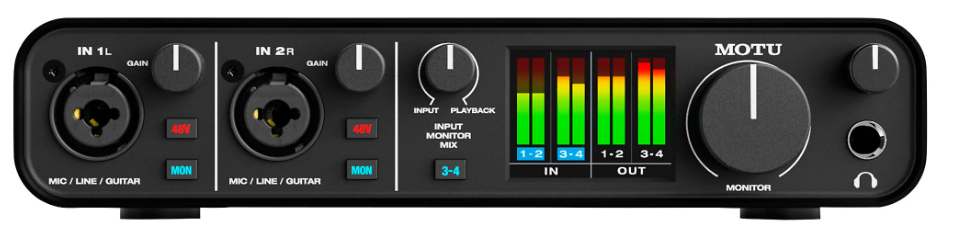
Exceptional conversion quality and metering in an interface that punches well above its level, from a company with decades of professional audio engineering experience.
MOTU M4 delivers four simultaneous inputs (two mic/line and two line), a color LCD display with real-time level metering, and conversion quality that independent measurements have shown competing with interfaces costing several times more.
I keep coming back to the M4 for synth use because it gives you four inputs at a cost where most competitors only offer two, and the conversion quality is genuinely remarkable for what you pay. Running two stereo synths into the M4 simultaneously is practical with its four inputs, and the metering display shows you exactly what’s happening with your levels at a glance.
- Four Inputs
Four simultaneous inputs with two combo XLR/TRS preamps and two dedicated quarter-inch line inputs give you enough connectivity for two stereo synths or four mono sources without the cost of larger interfaces. Most interfaces at this level provide only two inputs, which limits you to one stereo synth at a time.
Having four inputs doubles your simultaneous recording capability, which makes the M4 significantly more practical for multi-synth setups.
- Color Metering
A color LCD display shows real-time input and output level metering directly on the interface, providing visual feedback that helps you set gain correctly and monitor signal health without looking at your DAW.
For synth sessions where you’re adjusting levels on multiple hardware units, the on-device metering lets you optimize your signal levels while your attention stays on your synths rather than your computer screen.
- Overperforming Conversion
Independent measurements by Audio Science Review and other testing sites have shown the M4’s AD/DA conversion delivering dynamic range and signal-to-noise performance that competes with interfaces at much higher costs. For synth recording where clean, accurate conversion preserves the character of your hardware, the M4 provides conversion quality that doesn’t limit the audio your synths produce.
5. RME Babyface Pro FS
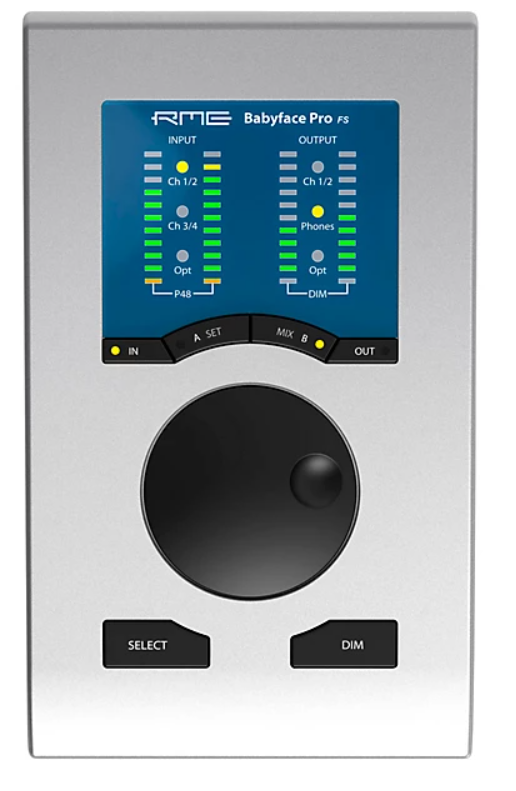
Reference-grade audio engineering from the company whose drivers and conversion set the professional standard. RME Babyface Pro FS provides two mic preamps and two line inputs (four total), SteadyClock FS femtosecond jitter suppression, an incredibly stable low-latency driver, TotalMix FX hardware-based mixer with per-channel DSP effects, and conversion quality that rivals standalone units.
For synth users who demand the lowest possible latency for live playing through software effects, RME’s driver architecture delivers round-trip latencies that make real-time processing genuinely playable. If you run your synth through a plugin reverb or delay and want to perform with that processing in real time, the Babyface Pro FS’s latency performance makes it practical in a way that most interfaces can’t match.
- Ultra-Low Latency
RME’s custom driver architecture achieves the lowest round-trip latencies available in USB audio interfaces, making real-time plugin processing of synth audio genuinely playable.
When you route a hardware synth through a plugin effect chain in your DAW, every millisecond of latency adds delay between your performance and what you hear. RME’s drivers minimize that delay to the point where playing through plugins feels as responsive as playing through hardware effects.
- TotalMix FX
TotalMix FX hardware mixer runs on the interface’s DSP, providing per-channel EQ, dynamics, reverb, and delay for monitoring without CPU load. You create complex monitoring setups for synth sessions, apply reverb to your monitoring without printing it, and route audio to multiple outputs simultaneously.
For hardware synth sessions where you want to hear your synths through effects while recording them dry, TotalMix handles that routing natively.
- SteadyClock FS
RME’s SteadyClock FS jitter suppression provides femtosecond-accurate clocking that produces cleaner, more detailed audio conversion than standard clocking achieves. For synth recordings where you want to capture every nuance of your hardware’s sound, the superior clock accuracy means the digital representation of your audio is more faithful to the original analog signal.
- DURec Standalone
DURec (Direct USB Recording) lets the Babyface record directly to a USB drive without a computer, functioning as a standalone recorder. For synth sessions where you want to jam without your computer running, DURec captures your hardware session to a thumb drive that you import into your DAW later.
6. Universal Audio Volt 476
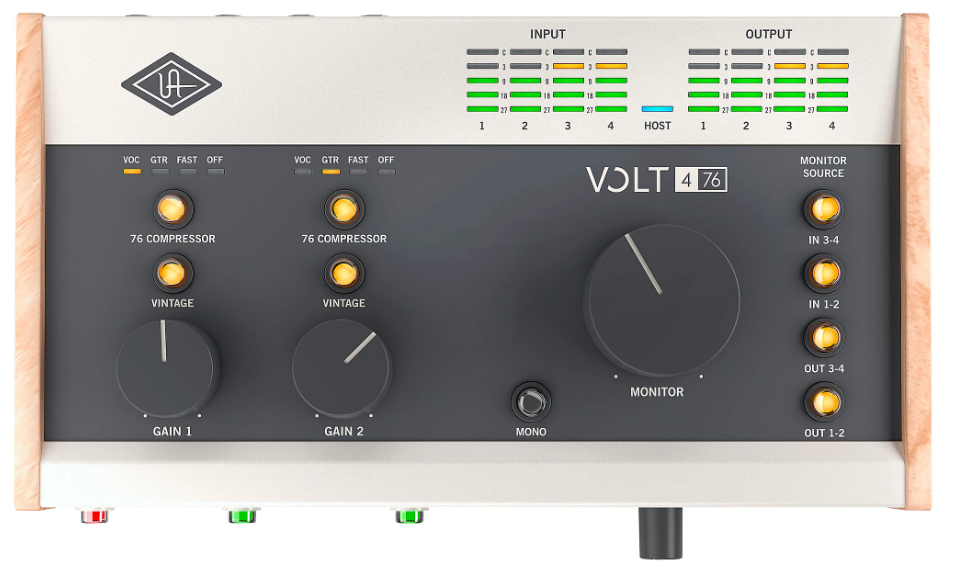
Four-input UA interface with built-in analog compression on every channel, providing analog character and dynamics control for synth recordings that most interfaces don’t offer. Universal Audio Volt 476 features four mic/line inputs each with a built-in 1176-style analog compressor, UA’s Vintage preamp mode, and the monitoring controls needed for a four-input hardware synth workflow.
Having an analog compressor on every input channel is what makes the Volt 476 interesting for synth recording. You compress your bass synth, pad, lead, and drum machine through individual hardware compressors during recording, which gives each track the controlled dynamics and subtle harmonic character that the 1176 circuit provides.
- Per-Channel Compression
Individual 1176-style analog compressors on all four inputs let you apply hardware compression to each synth during recording.
Compressing synth signals during tracking smooths out the dynamic variations that filter sweeps, envelope settings, and performance dynamics create, giving you more controlled recordings that sit better in a mix without post-processing. Having compression on every channel means you treat four synths independently rather than compressing the stereo mix.
- Four Inputs
Four mic/line inputs provide enough connectivity for a mid-sized synth setup without the cost of larger interfaces. You connect a polysynth, bass synth, drum machine, and one more source simultaneously, each through its own input with its own compressor. For producers whose hardware collection fits in four units, the Volt 476 provides exactly the right scale.
- Vintage Character
UA’s Vintage preamp mode adds analog warmth and subtle harmonic saturation to your synth recordings before digital conversion. Combined with the per-channel compression, the Vintage mode gives your synth recordings a produced, analog quality from the recording stage. Running a digital synth through the Vintage preamp and 1176 compressor adds the analog character that purely digital signal paths lack.
7. SSL 2+ MkII
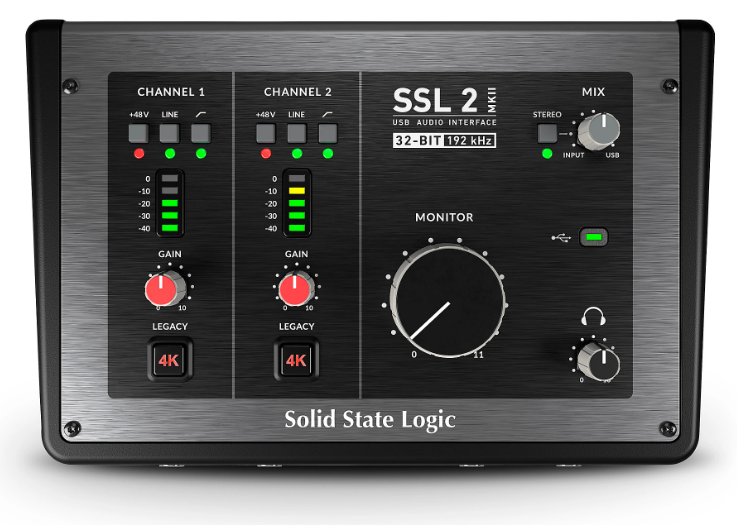
Console-quality audio from the defining name in professional recording, with four outputs that give synth users the routing flexibility that two-output interfaces lack. SSL 2+ MkII features two mic/line inputs with SSL’s Legacy 4K analog enhancement, four balanced line outputs, an independent headphone mix, and the signal quality that comes from SSL’s decades of building the consoles used on more records than any other manufacturer.
What I find practical about the SSL 2+ for synth use is the four balanced outputs. Most two-input interfaces only give you two outputs, which limits you to a single stereo speaker pair. With four outputs, you can run one pair to your main monitors and route the other pair to a hardware effects processor, a secondary monitoring system, or back to your synth setup for external processing.
- Legacy 4K
SSL’s Legacy 4K analog enhancement adds the harmonic character and high-frequency presence of SSL’s classic 4000 series console to your synth recording path.
Engaging 4K on a synth recording adds subtle saturation and top-end shimmer that makes digital synths sound warmer and more present. For producers who want their hardware synths to sound like they were recorded through a professional console, 4K provides that character from a desktop interface.
- Four Outputs
Four balanced line outputs provide routing flexibility that two-output interfaces can’t match. You use two outputs for your main monitors and the other two for feeding hardware effects, a secondary speaker set, or a separate headphone amplifier. For synth setups where you want to send audio back to external effects processors before it returns to your DAW, the additional outputs make that routing possible without a separate output device.
- Independent Phones
An independent headphone mix with its own level control and source selection lets you monitor a different mix from what’s playing through your speakers. During synth sessions, you might want to hear a click track or metronome in your headphones while your speakers play the full synth mix, or monitor a soloed synth channel in your headphones while the speakers play everything.
- SSL Signal Path
SSL’s preamp and conversion quality brings the signal chain heritage of the world’s most recorded-through console manufacturer to your synth recordings.
Every synth signal passing through the SSL 2+ benefits from the same engineering philosophy that has shaped the sound of professional records for decades. For synth recordings where you want the highest possible signal quality from a compact interface, the SSL signal path delivers.
- Software Bundle
SSL’s included production software provides plugins and tools that complement the hardware’s quality level, including SSL-quality dynamics and EQ processing inside your DAW. Running your synth recordings through SSL’s bundled Native Channel Strip during mixing gives you console-style processing that matches the recording quality.
8. Focusrite Scarlett 18i20 4th Gen
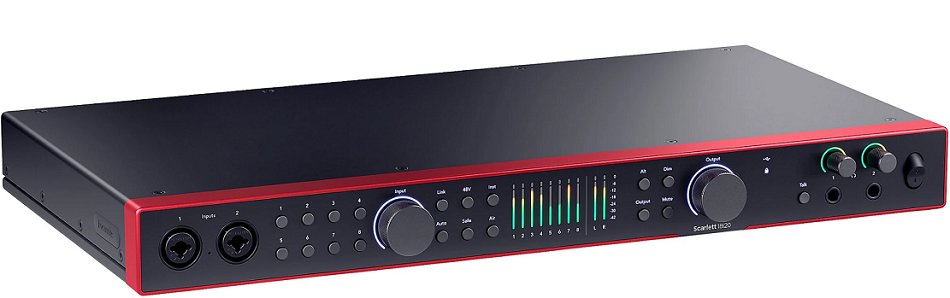
Serious channel count at the Scarlett’s accessible cost, providing enough inputs for even large synth collections in a single rack-mount unit. Focusrite Scarlett 18i20 delivers eight mic preamps with individually switchable Air mode, improved fourth-generation conversion, ADAT expansion for up to twenty inputs total, and Focusrite Control 2 software for comprehensive routing management.
If your synth collection has grown to the point where four-input interfaces leave you replugging cables constantly, the 18i20 gives you eight analog inputs with ADAT expansion for even more. For large hardware setups, having every synth, drum machine, and effects return connected permanently transforms your workflow from cable management to music-making.
- Eight Inputs
Eight analog inputs with combo XLR/TRS connections keep a large synth collection permanently patched and ready to record. You connect your polysynth, monosynth, bass synth, drum machine, sampler, effects return, and two more sources simultaneously without ever unplugging a cable. For hardware-heavy producers, permanent connectivity for your entire rig is what makes the 18i20 worth the step up from smaller interfaces.
- ADAT Expansion
ADAT optical inputs add up to eight more inputs via external preamps, pushing the 18i20 to twenty total inputs. If eight analog inputs aren’t enough for your collection, adding an ADAT-equipped preamp doubles your connectivity. For studios that continue to grow, the expansion capability means the 18i20 scales with your collection rather than becoming a bottleneck.
- Routing Software
Focusrite Control 2 provides comprehensive routing, monitoring, and mix management for sessions using the 18i20’s full complement of inputs and outputs. Creating separate mixes for monitoring, managing loopback, and controlling Air mode engagement across all channels happens through a single software interface. For complex synth sessions where different hardware sources need different monitoring balances, the software handles that routing without external tools.
9. RME Fireface UFX II

Full-scale professional recording interface for producers whose hardware collection and recording needs demand more connectivity and processing than compact desktop units provide.
RME Fireface UFX II delivers twelve analog inputs, twelve analog outputs, ADAT and AES digital expansion for up to thirty channels, SteadyClock FS conversion, the TotalMix FX hardware mixer with comprehensive DSP, and DURec standalone recording to USB drives, all with the driver stability and latency performance that RME is known for.
This is the interface for producers who’ve built a significant hardware studio and need an audio hub that connects everything with reference-quality conversion and rock-solid reliability. Running a dozen synths, multiple effects units, and various monitoring configurations simultaneously is what the UFX II is built for.
- Twelve Analog I/O
Twelve analog inputs and twelve analog outputs provide the connectivity for a fully equipped hardware studio without digital expansion. Your entire synth collection, effects send/returns, monitoring outputs, and additional sources all connect through the analog I/O alone. For producers with large hardware setups, the twelve-channel analog complement eliminates the need for expansion to handle the core collection.
- Expandable to 30
ADAT and AES digital expansion pushes the UFX II to thirty total input channels for studios that need even more connectivity. Adding external preamps via ADAT provides additional inputs for microphones, instruments, or more synths. For professional studios where the hardware inventory continues to grow, the expansion headroom means the UFX II serves as a long-term audio infrastructure investment.
- TotalMix FX Pro
TotalMix FX on the UFX II provides the most comprehensive hardware-based mixing, routing, and DSP processing available in any USB audio interface.
Creating complex monitoring setups, applying per-channel processing, and managing audio routing for dozens of channels simultaneously all run on the interface’s hardware DSP with zero CPU overhead and zero latency. For hardware-heavy studios where multiple synths, effects, and monitoring destinations need independent routing, TotalMix provides the mixing infrastructure that makes complex setups manageable.
- DURec Recording
DURec standalone recording captures all channels simultaneously to a USB drive without a computer, turning the UFX II into a standalone multitrack recorder.
For synth jam sessions where you want to record without booting your computer, DURec captures every input to individual files that you import into your DAW later. Recording a full hardware jam session with twelve synths to a thumb drive and editing later in your DAW is a workflow that only standalone recording capability provides.
Get the Free Plugin Starter Kit
The genuinely useful free DAWs and plugins worth installing. No filler. Straight to your inbox.

Hello, I’m Viliam, I started this audio plugin focused blog to keep you updated on the latest trends, news and everything plugin related. I’ll put the most emphasis on the topics covering best VST, AU and AAX plugins. If you find some great plugin suggestions for us to include on our site, feel free to let me know, so I can take a look!