
Ring modulation is one of the oldest and most genuinely weird effects in electronic music. The concept is simple: two signals are multiplied together, and what comes out is neither of the original signals but rather their sum and difference frequencies. Feed a 440Hz note into a 500Hz carrier and what you get are tones at 60Hz and 940Hz, neither of which were in the input.
At low carrier frequencies you get tremolo. Push the carrier higher and the sound starts to splinter into metallic, inharmonic textures that no other effect produces. The BBC used it to create Dalek voices. Stevie Wonder used it on “Living for the City.”
Thom Yorke reached for it when conventional distortion wasn’t strange enough. These five plugins cover the full range of what ring modulation can do, from faithful hardware emulation to aggressive multiband destruction.
1. Moogerfooger MF-102S RingMod

There is no more historically grounded ring modulator plugin than the MF-102S from Moog. The original MF-102 hardware, designed by Bob Moog himself in 1998, was a direct descendant of the Moog modular synthesizer and became one of the most beloved effects pedals in production history.
Radiohead, Nine Inch Nails, Depeche Mode, and countless film composers used the hardware version. The MF-102S plugin captures that circuit authentically, and at its current $9.99 price point it’s probably the most underpriced plugin of its kind available. Equipboard reviewers noted it was initially considered overpriced before the price drop, and at $9.99 the consensus shifted to “just buy it.”
- Faithful Three-Module Circuit:
The MF-102S preserves the original hardware’s three core modular functions: a ring modulator, a wide-range voltage-controlled carrier oscillator, and a dual-waveform LFO with sine and square options.
The carrier oscillator covers six octaves of range, spanning from slow tremolo effects below 10Hz all the way to audio-rate modulation at 25Hz that pushes into genuinely aggressive timbral territory. Moog describes this as enabling “trills, vibratos, siren effects, and outer space noises,” which is accurate if understated.
- Stereo Carrier with Panning and Reverse:
The original MF-102 was a mono effect. The plugin adds a Stereo Carrier mode that provides independent carrier signals for the left and right channels, with out-of-phase options and a Panning control for additional stereo imaging.
The Reverse option flips the phase relationship between channels for a different spatial character. This feature alone makes the plugin significantly more useful in modern stereo production contexts than the hardware it emulates.
- CV Interconnectivity Between Plugin Instances:
This is the feature that made the original Moogerfooger pedals special, and it carries over intact. Each instance of any Moogerfooger plugin can modulate the parameters of any other instance in the same DAW session, recreating the hardware’s control voltage patching system in software.
The MF-102S CV inputs cover Carrier Frequency, LFO Rate, LFO Amount, and Mix, with digital attenuverters and DC offsets for precise control over modulation depth and direction. If you own other Moogerfooger plugins, this is genuinely transformative.
- Drive Control:
A Drive knob adds warm, analog-style saturation to the signal before ring modulation, giving you control over harmonic richness independent of the carrier settings. Moog’s own documentation describes this as adding “warm, analog-style saturation,” and forum users on Gearspace consistently note the Drive as one of the features that gives the MF-102S its musical character compared to cleaner digital ring mod implementations.
2. MeldaProduction MRingModulatorMB
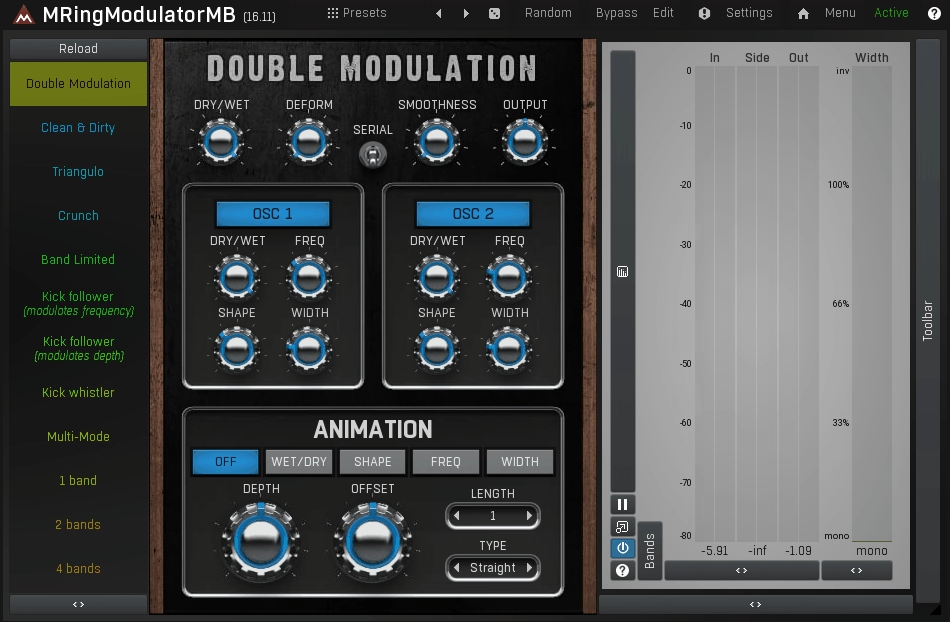
If the MF-102S is about doing one thing with as much analog authenticity as possible, MRingModulatorMB from MeldaProduction is about doing everything ring modulation can do across multiple frequency bands simultaneously. ADSR Sounds describes it as a tool where “one oscillator can make quite a mess, but 2 oscillators with custom shape can cause complete sound destruction. But do it in 6 bands and the results can be quite mild and pleasing.”
That paradox is what makes this plugin genuinely different: the multiband architecture means you can apply aggressive ring modulation without obliterating the sonic character of the source material, because each band can be processed differently.
- Up to Six Independent Bands:
The plugin splits the signal into up to six frequency bands using a choice of three crossover algorithms: analog, linear-phase, and hybrid. Each band can have its own ring modulation settings applied independently, which is the feature that distinguishes MRingModulatorMB from everything else on this list.
- Two Custom-Shape Oscillators with Cross-Modulation:
Each instance gives you two oscillators with fully adjustable waveform shapes, defined through a mix of predefined shapes, custom waveforms drawn using MeldaProduction’s envelope system, step-sequencer patterns, and algorithmic postprocessing.
The two oscillators can also modulate each other, generating complex, evolving carrier shapes that no single-oscillator ring mod can produce. Gearspace users describe this as enabling sounds “you would never have imagined possible” on drum tracks specifically.
- Four Modulators and a Dual GUI:
Four fully-featured modulators can control any parameter including other modulators, each functioning as an LFO, envelope follower, MIDI-triggered ADSR, randomizer, or pitch detector. The dual GUI system gives you a simple Easy Screen for quick use and a full Edit Screen for deep access.
This is genuinely useful: you can hand the plugin to someone who just wants a preset and a few knobs, or go deep into custom oscillator shaping and per-band modulation routing. Up to 16x oversampling, automatic gain compensation, M/S processing, and surround support up to 8 channels round out a feature set that is comprehensively overpowered for a ring mod.
3. Kuassa Efektor Ringmojo
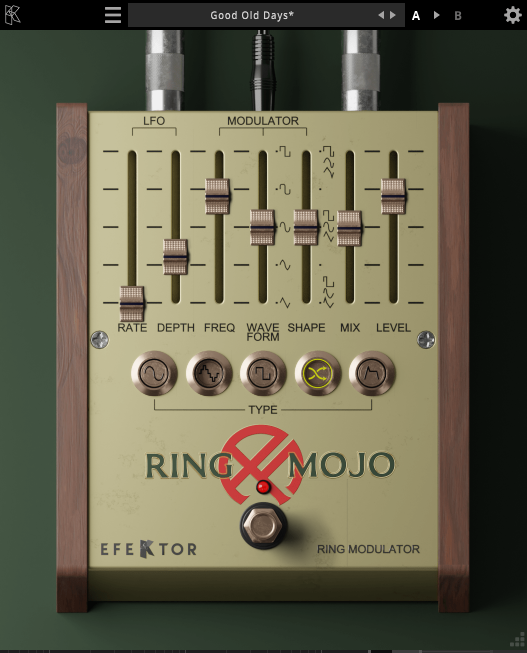
Where the MF-102S worships hardware history and MRingModulatorMB builds an effects laboratory, Efektor Ringmojo from Kuassa takes a practical, single-screen approach designed to be picked up and played with immediately.
Five LFO waveforms, tempo sync, an adjustable center ringing frequency, waveform shape transformation, and a dry/wet blend, all on one screen. Vintage King’s product description calls it a tool for “sonic explorers and avant-garde creators,” which is accurate, but I’d add that it’s also one of the fastest ring modulators to get into and start making something useful out of. For guitarists especially, Ringmojo integrates directly into the Kuassa Amplifikation 360 ecosystem without any additional routing.
- Five LFO Waveforms with Tempo Sync:
Five LFO waveforms modulate the carrier frequency with the option to sync the LFO rate to DAW tempo, keeping modulation rhythmically locked to the arrangement.
This is a feature that matters practically: free-running LFOs in ring modulators can produce interesting chaos, but tempo-synced modulation lets you create rhythmic metallic patterns that work with the music rather than against it. B&H Photo notes this specifically as one of the distinguishing features of the Ringmojo compared to simpler ring mod implementations.
- Waveform Shape Transformation:
A Waveform Shape Transformation control adjusts how the carrier oscillator’s waveform behaves, shifting from smooth sine-based modulation toward more angular, asymmetric shapes. This is separate from the LFO waveform selection and affects the carrier itself, giving you tonal control over the harmonic character of the ring modulation output without changing any of the pitch or rate parameters.
- Adjustable Center Ringing Frequency:
The Center Ringing Frequency sets the tonal center around which the modulation occurs, a control that gives you musical pitch targeting for the ring modulation effect. Dialing this to a frequency harmonically related to your input material keeps the output more musical; pushing it to inharmonic relationships creates the dissonant, metallic character ring modulation is famous for. This is the control that determines whether Ringmojo sounds like a tremolo or a robot.
- A360 Module and Dry/Wet Blend:
Full integration as an Amplifikation 360 module lets guitarists drop Ringmojo directly into a Kuassa signal chain between amp simulations and other Efektor pedals. The dry/wet blend knob enables parallel processing, which is how ring modulation sounds best on most sources: blend the processed signal in gradually rather than going full-wet, where the effect can overwhelm the original material entirely.
4. Numerical Audio RM-1
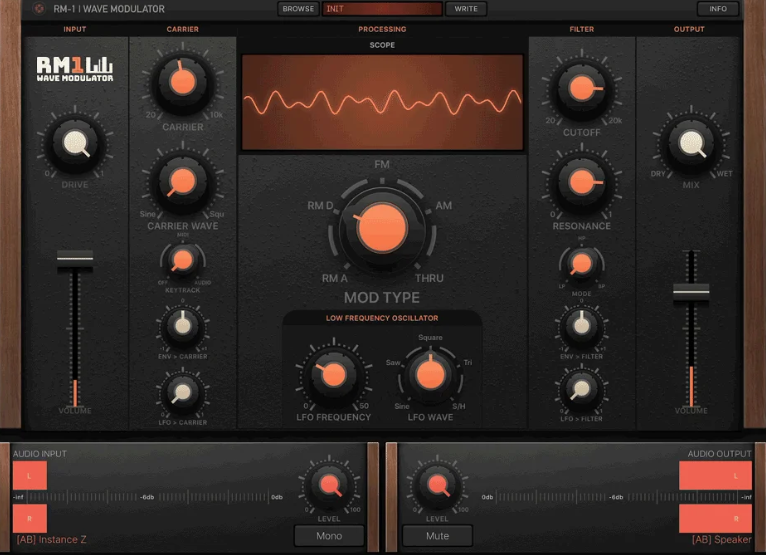
Image credit: Pluginoise.com
RM-1 from Numerical Audio is worth acknowledging clearly upfront: it’s an iOS AUv3 application, not a desktop VST or AU plugin. If you’re running a desktop-only workflow, this one isn’t for you. But if you produce on iPad or use iOS as part of your setup, RM-1 stands out as one of the most comprehensive and genuinely educational ring modulation tools available on any platform for under $3.
RM-1 covers five distinct types of modulation: virtual analog ring modulation, digital ring modulation, amplitude modulation, phase modulation (DX-style FM), and linear frequency modulation.
This is not just multiple ring mod flavors but genuinely different modulation types that produce fundamentally different results. Pluginoise’s review noted the variety as a key differentiator, describing it as useful for “exploring different modulation techniques” rather than just applying one effect with cosmetic variations.
- Variable Wave-Shape Carrier and Multimode Filter:
A built-in carrier oscillator with variable wave-shape between sine and square covers the basic tonal range from clean sine-based modulation to the harsher, odd-harmonic character of a square wave carrier.
The multimode filter (LP, HP, BP) allows post-modulation shaping of the output, which is practically useful because ring modulation tends to generate high-frequency content that benefits from filtering. An envelope follower and LFO round out the internal modulation options.
- iOS AUv3 with Standalone Mode:
RM-1 runs as an AUv3 plugin in any iOS host that supports the format, including GarageBand, AUM, Audiobus, and Loopy Pro, as well as a standalone app with its own built-in walkthrough.
5. KiloHearts Ring Mod (Free)
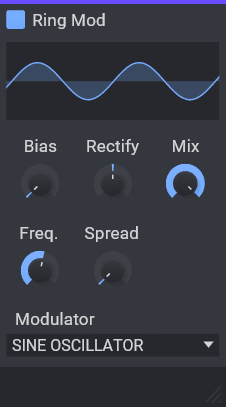
Part of the Kilohearts Essentials free collection alongside their Comb Filter, Chorus, and thirty other Snapins, kHs Ring Mod is the most honest entry point into ring modulation available at any price.
Six knobs, one selector, and it does exactly what it says. It’s not a hardware emulation and it doesn’t pretend to be. It’s a clean, functional ring mod that works as a standalone plugin or as a module inside Kilohearts’ Multipass, Snap Heap, or Phase Plant hosts, where it gains access to the full Kilohearts modulation ecosystem.
- Internal Sine/Noise Generator or Secondary Input:
Ring Mod can use either an internal sine wave or noise generator as the carrier, or accept a secondary external input as the modulation source. Using an external signal as the modulator, rather than an internal oscillator, is what allows genuinely creative cross-signal ring modulation, where one audio source modulates the timbral character of another. Sweetwater notes this secondary input as enabling “seriously creative modulation possibilities” that extend well beyond what a single-oscillator ring mod can do.
- Bias and Rectify Controls:
Bias adds a positive DC offset to the secondary input, which shifts the modulator’s operating point and changes the harmonic character of the output. Rectify applies positive or negative rectification to the modulator signal, folding the waveform in ways that generate additional harmonics.
These two controls are what separate kHs Ring Mod from the simplest possible ring mod implementations: they give you tonal shaping of the modulation process itself rather than just frequency and mix. B&H Photo’s product page specifically highlights Bias and Rectify as the features that give the plugin its character.

Hello, I’m Viliam, I started this audio plugin focused blog to keep you updated on the latest trends, news and everything plugin related. I’ll put the most emphasis on the topics covering best VST, AU and AAX plugins. If you find some great plugin suggestions for us to include on our site, feel free to let me know, so I can take a look!