
Finding solid 32-bit VST plugins that still hold up is harder than it used to be, but a lot of the best ones are still out there, still free, and still genuinely competitive with modern alternatives. Whether you’re running an older DAW, using a 32-bit host by choice, or bridging into a 64-bit environment, this list covers the full toolkit.
The mix here is intentional. You get synths, compressors, EQ, reverb, a noise gate, a de-esser, delay, and a bitcrusher, because a complete 32-bit rig needs all of it. Most of these are completely free, a couple are paid, and all of them are worth having installed.
I want to note upfront: FabFilter Pro-Q 4 and Pro-C 3 are listed as 32-bit Windows only, meaning you get the 32-bit VST build alongside the standard 64-bit formats. Everything else runs natively in both.
From the Pluginerds Store
Before you go further into this list, something that will make more difference to your vocal sound than any plugin on it. Vocal plugins can only work with what you give them — a clean, dry recording is worth more to your vocal chain than any processing.


Newfangled Audio Pendulate
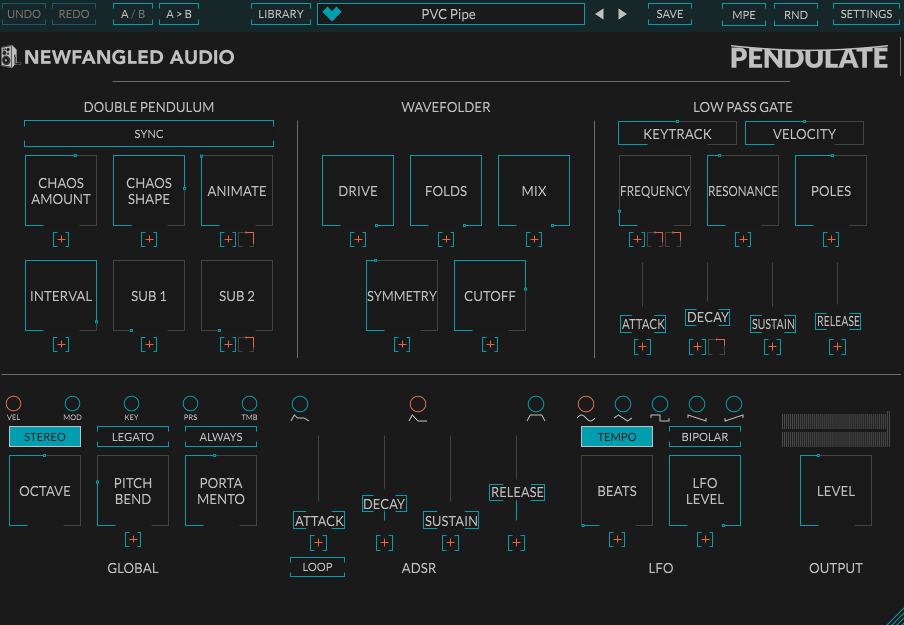
Pendulate is one of the most genuinely original free synths available. It’s a chaotic monosynth built around a double-pendulum oscillator, a physics-based design that produces sounds you simply can’t get from any standard wavetable or subtractive engine. It runs as VST2, VST3, AU, and AAX on Windows and Mac with no iLok required, and ships with 136 presets covering bass, leads, rhythmic, plucks, and FX categories.
What makes it interesting beyond the oscillator is how everything feeds into a Buchla-inspired wavefolder and a low pass gate based on the Buchla 292, giving the signal chain a West Coast synthesis character that sounds nothing like a typical subtractive workflow.
I love how the modulation interface lets you connect any source to any destination in a single pane, and the real-time animations on each module make it easy to understand what the patch is actually doing.
- Double Pendulum Oscillator
A physics-based oscillator derived from the chaotic motion of a double pendulum, capable of smoothly fading from a pure sine wave to complete harmonic chaos with everything in between. The result is tonal textures, biting basses, searing leads, and gritty sounds that no standard oscillator type can replicate.
- Buchla-Inspired Wavefolder
Based on the wavefolder design found in classic West Coast synthesis hardware, with added MIX and CUTOFF parameters. Drive and Symmetry controls shape whether the folding produces odd or even harmonics, giving you direct timbral control over the character of the output.
- Low Pass Gate
A module that combines voltage-controlled filter and VCA behavior in one stage, with a Poles control that shifts the filter slope between a gentle one-pole and a resonant three-pole response. Keytrack and Velocity modulation make it respond dynamically to how you play.
- Full Modulation Matrix with MPE
Every parameter in every module is a valid modulation destination, resulting in up to 221 simultaneous modulation points visible in a single interface pane. The envelope and LFO both generate multiple simultaneous outputs, and full MPE support makes it expressive on polyphonic controllers.
Get the Free Plugin Starter Kit
The genuinely useful free DAWs and plugins worth installing. No filler. Straight to your inbox.
Techivation T-De-Esser 2
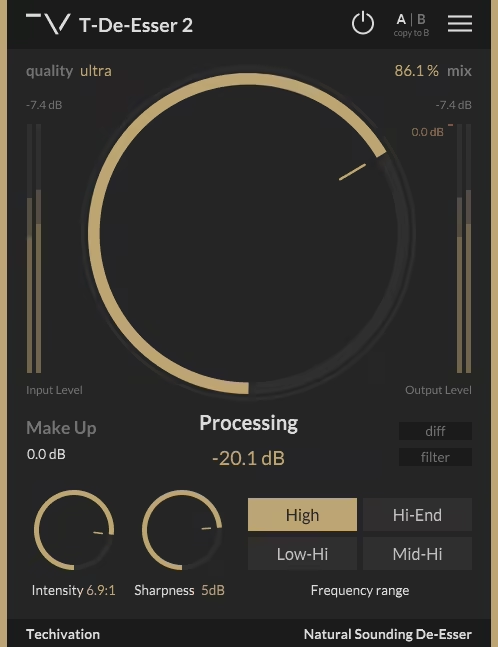
T-De-Esser 2 from Techivation is completely free and handles sibilance in a way that sounds genuinely different from most de-essers. Rather than triggering a compressor when a detection frequency crosses a threshold, it works more like a volume rider for the targeted high-frequency range, which produces significantly more transparent and natural-sounding results on dialogue and vocals. It runs as VST, VST3, AU, and AAX with Apple Silicon native support.
I appreciate how the interface keeps you focused on listening rather than staring at graphs. There’s no spectrum display fighting for attention, just the processing controls, a Filter button to audition the targeted frequency range in isolation, and a Diff button to hear exactly what’s being removed. It’s one of the most transparent de-essers available at any price.
- Volume Rider Approach
Instead of triggering a compressor when a detection frequency crosses a threshold, it rides the gain of the targeted high-frequency range proportionally. This avoids the pumping and over-processing artifacts common in compressor-based de-essers and produces a more natural result on dialogue, vocals, and any material with excessive harshness.
- Four Frequency Range Modes
Four selectable buttons target different parts of the high-frequency spectrum depending on where the sibilance or harshness problem lives. Choosing the right mode before dialing in the Processing control makes the whole setup much faster than sweeping manually.
- Filter and Diff Monitoring
The Filter button outputs only the selected frequency range so you can identify exactly what the plugin is listening to before committing. The Diff button outputs only the removed signal so you can hear precisely what’s being taken out as you adjust Intensity and Sharpness.
- Quality Selector and Dry/Wet Mix
A Quality selector with Standard, Good, Great, and Ultra modes controls the oversampling level for reducing aliasing artifacts in the high-frequency processing. A Dry/Wet mix control allows parallel de-essing without any external routing setup.
- Up to 8x Oversampling
Optional oversampling up to 8x reduces aliasing artifacts, which is particularly relevant when treating very high sibilance peaks above 10 kHz where digital processing artifacts are most audible.
- Free with No Registration
Completely free to download directly from Techivation’s website with no account or email required. Available in all major plugin formats, including AAX for Pro Tools, with Apple Silicon native support for current Mac hardware.
FabFilter Pro-Q 4 (32-bit only for Win)
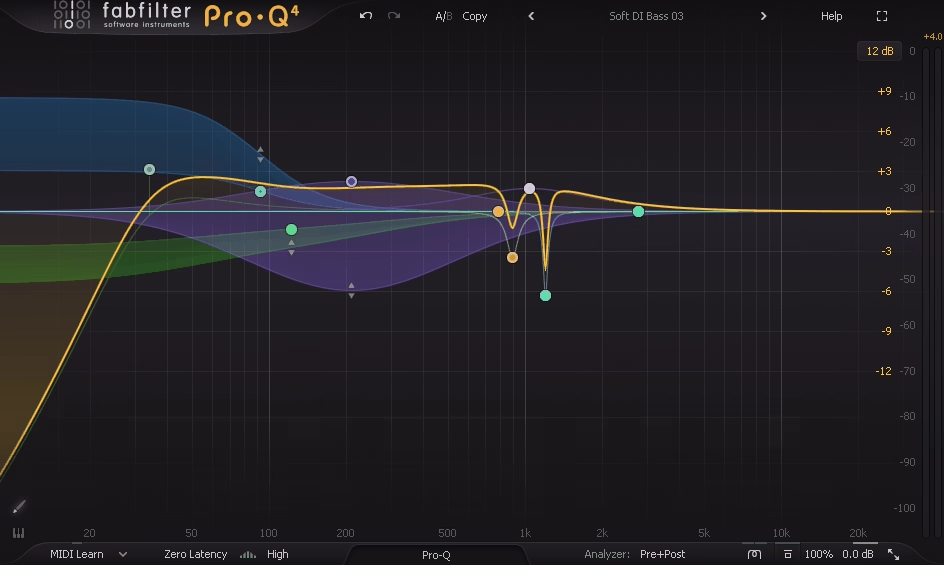
Released in December 2024, FabFilter Pro-Q 4 is the current version of what many engineers reach for as their primary EQ. It adds Spectral Dynamics processing, an Instance List for managing EQ across an entire session from one window, EQ Sketch for drawing curves by hand, and three Character Modes for analog-style saturation. On Windows it includes a 32-bit VST build alongside the 64-bit formats, priced at $179 with upgrade pricing from Pro-Q 3.
I found the Instance List to be the most immediately practical new feature for large sessions, since you can see and adjust every EQ instance across all tracks without opening individual windows. The Spectral Dynamics mode is what genuinely sets it apart from a standard dynamic EQ: it targets only the specific frequencies within a band that cross the threshold, leaving everything else untouched.
- Spectral Dynamics Mode
Per-band processing that applies dynamic compression only to specific frequencies within a band rather than the entire band signal, targeting resonances and peaks without affecting surrounding content. Particularly effective for dialogue in boxy rooms, sibilance control, and frequency problems that only appear at certain dynamics levels.
- EQ Sketch
Draw an EQ curve with a single mouse gesture and the plugin creates the appropriate band types and parameters to match it automatically. This makes it much faster to establish a starting shape on a new track before fine-tuning individual bands.
- Instance List
A single plugin window shows all Pro-Q 4 instances across the entire session, letting you view and edit any track’s EQ without navigating between individual plugin windows. A later update extended this to also include Pro-C 3, Pro-DS, and Pro-G instances.
Analog Obsession BUSTERse

BUSTERse from Analog Obsession is a free emulation of the SSL G-series bus compressor, and it’s consistently one of the first free compressors people recommend for glue work. It’s available free from Analog Obsession’s Patreon with no signup required, and it runs on Windows and Mac as a VST plugin. On a drum bus, mix bus, or any situation where you need elements to gel together, it delivers the characteristic cohesion the hardware became famous for.
For me, the sidechain filter section and the XFORMER switch are what separate it from a basic SSL clone. The HPF in the sidechain solves one of the most common problems with bus compression, which is low-frequency content driving the compressor and causing everything else to pump. The XFORMER switch introduces actual transformer circuit modeling that adds harmonic character beyond the baseline emulation.
- Classic SSL Parameter Set
Delivers the hardware parameter set: Threshold from +15 to -15 dB, six stepped Attack positions from 0.1 to 30 ms, Release from 0.1 to 1.2 seconds plus Auto, and Ratio options of 1.5, 2, 3, 4, 5, and 10. The stepped controls match original hardware behavior exactly.
- Sidechain Filter Section
A high-pass filter sweeping 20 to 500 Hz prevents low-frequency content from disproportionately triggering the compressor, alongside a mid band at around 1500 Hz and a high-frequency control at 10 kHz that reduces compressor sensitivity to high-frequency content. The HPF prevents kick and bass from causing the pumping that ruins bus compression on mixed material.
- Transient Sidechain
A Transient section adds 0 to 10 dB of boost to transient content in the sidechain, with a Tilt control centered at 1 kHz to focus that boost on a specific frequency range. This shifts the compression character toward transient shaping rather than pure sustained dynamic reduction.
- XFORMER and Turbo Modes
XFORMER replaces input and output ICs with a transformer circuit model that introduces impedance characteristics and harmonic coloration not present in a standard SSL emulation. Turbo mode bypasses the internal mid-frequency focus so the compressor affects the full signal spectrum evenly. Both add meaningful personality beyond a straight clone, and 4x oversampling is available by clicking the logo.
Surge XT

Surge XT went open-source and has been developed into something that genuinely rivals paid instruments costing hundreds of dollars. It runs as VST3, AU, LV2, and CLAP across Windows, Mac, and Linux with 32-bit and 64-bit Windows builds. The feature count is extraordinary for a free plugin: 12 oscillator algorithms, two complete synthesis scenes per patch, a Formula Modulator using Lua scripting, and nearly 30 effect types. It also ships with 614 included wavetables and a large factory preset library.
I’d say this is one of the most powerful free instruments ever released. The open-source development means it receives regular meaningful updates rather than sitting untouched, and the community around it has contributed a substantial amount of presets and additional content.
- Twelve Oscillator Algorithms
Twelve distinct synthesis architectures including Classic, Modern, Wavetable with 614 included wavetables, Window, Sine, FM2, FM3, String (physical modeling inspired), Twist, Alias, S&H Noise, and Audio Input. Each algorithm produces fundamentally different raw material, not just variations on the same approach.
- Two Scenes Per Patch
Every patch contains two complete, independent synthesis scenes sharing only the effects chain. Each scene runs its own oscillators, filters, envelopes, LFOs, and modulation routing, giving you layered or split patches equivalent to two full synth voices in a single instance.
- MSEG and Formula Modulator
A Multi-Segment Envelope Generator with up to 128 nodes sits alongside a Formula Modulator that uses Lua scripting for fully custom mathematical modulation output. The Lua modulator is the kind of feature normally found only in modular software environments.
- Massive Filter Selection
The filter section includes K35, Diode Ladder, multimode types, and unusual additions like Cutoff Warp, Resonance Warp, and Tri-Pole filters. All filters support self-oscillation and respond quickly to cutoff changes for snappy percussive sweeps.
- MPE and MTS-ESP Microtuning
Full MPE support for expressive controllers and MTS-ESP microtuning through Scala and KBM files for non-standard scales. The combination of microtuning and MPE in a free instrument is genuinely unusual and reflects the depth of ongoing open-source development.
BPB Dirty LA
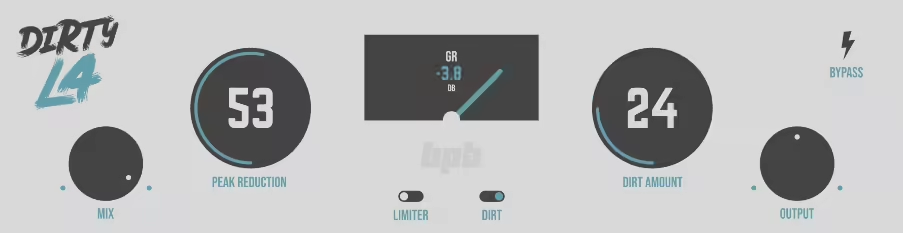
BPB Dirty LA is a free compressor inspired by vintage limiting amplifiers, and it’s one of the most musical-sounding free compressors you’ll find. The workflow is deliberately simple: a Peak Reduction knob controls compression amount, a Dirt algorithm adds saturation, and a Mix knob enables parallel compression. It runs as VST3 and AU on Windows and Mac.
For me, the Dirt algorithm is what makes this worth using over something more technically featured. It adds smooth saturation that warms up the signal while gently taming transients, giving you vintage character that pure dynamic control alone doesn’t produce. It’s the kind of plugin you throw on a track without thinking too hard and it just sounds right.
- Vintage Limiting Amplifier Compression
A compression algorithm inspired by classic limiting amplifier designs, with a fast default attack time and moderate ratio that works immediately on most audio without extensive setup. A Limiter mode switches to faster attack times and a higher compression ratio for mix bus use.
- Dirt Algorithm
A custom saturation stage that adds smooth harmonic distortion and warmth while gently reducing transient energy. At low amounts it adds analog character to the compression; at higher amounts it clearly colors the sound and becomes useful as a creative tool beyond pure dynamic control.
- Parallel Mix Knob
A Mix control blends the dry and compressed signals directly inside the plugin without requiring any external routing, making New York-style parallel compression immediately accessible on any track. Optimized for low CPU so multiple instances are practical in larger sessions.
FabFilter Pro-C 3 (32-bit only for Win)
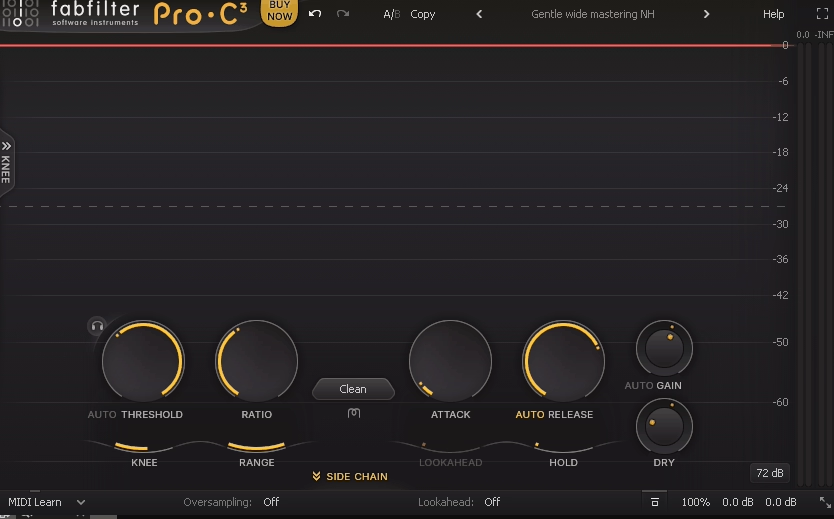
Released in January 2026, FabFilter Pro-C 3 is the current flagship compressor from FabFilter and a significant step forward from Pro-C 2. It ships with 14 compression algorithms including six brand-new styles, a Character panel with three analog saturation modes, a six-band sidechain EQ, and full Dolby Atmos support up to 9.1.6. On Windows it includes a 32-bit VST build alongside the standard 64-bit formats. It’s priced at $199 with upgrade pricing from Pro-C 2.
I believe the Character Modes are what genuinely change this from a technical tool into something that shapes energy and adds life to a mix. The sidechain EQ expanded from three bands in Pro-C 2 to six full bands with brickwall filter options, giving you surgical control over what triggers the compression. It also integrates with FabFilter Pro-Q 4’s Instance List, so you can manage compression and EQ across the entire session from a single window.
- 14 Compression Algorithms
Fourteen distinct styles including Versatile (general purpose), Smooth (low-ratio gluing), Upward (pumping upward compression), TTM (combined downward and upward), Op-El (vintage optical warmth), and Vari-Mu (variable-mu feedback character), alongside the eight styles from Pro-C 2. Each algorithm has a fundamentally different dynamic character.
- Character Modes
Tube, Diode, and Bright character modes introduce analog-style saturation, coloration, and subtle drift. Drive amount is adjustable, and Pre/Post routing determines whether saturation happens before or after the dynamic processing, significantly changing the overall sound.
- Six-Band Sidechain EQ
Expanded from three bands to six full bands, each supporting the same filter shapes as FabFilter Pro-Q 4 including brickwall low-pass and high-pass options. Individual bands can be set to Mid or Side processing for precise control over which frequency content triggers the compression.
- Auto Threshold
Dynamically shifts the compressor’s threshold so the same amount of compression is triggered at different input levels, maintaining consistent dynamic behavior on material where levels change significantly across clips or sections.
- Host Sync Triggering
A trigger mode that outputs a tempo-synced internal pulse at any note value with adjustable Offset and Length controls, making rhythmic ducking effects straightforward without needing an external audio trigger or separate sidechain routing.
- Dolby Atmos and 32x Oversampling
Full immersive audio support up to 9.1.6 for Dolby Atmos work, with oversampling increased to 32x for cleaner high-gain reduction processing. Integrates with the Instance List in FabFilter Pro-Q 4 so compression and EQ settings are manageable across the entire session from one interface.
TAL-NoiseMaker
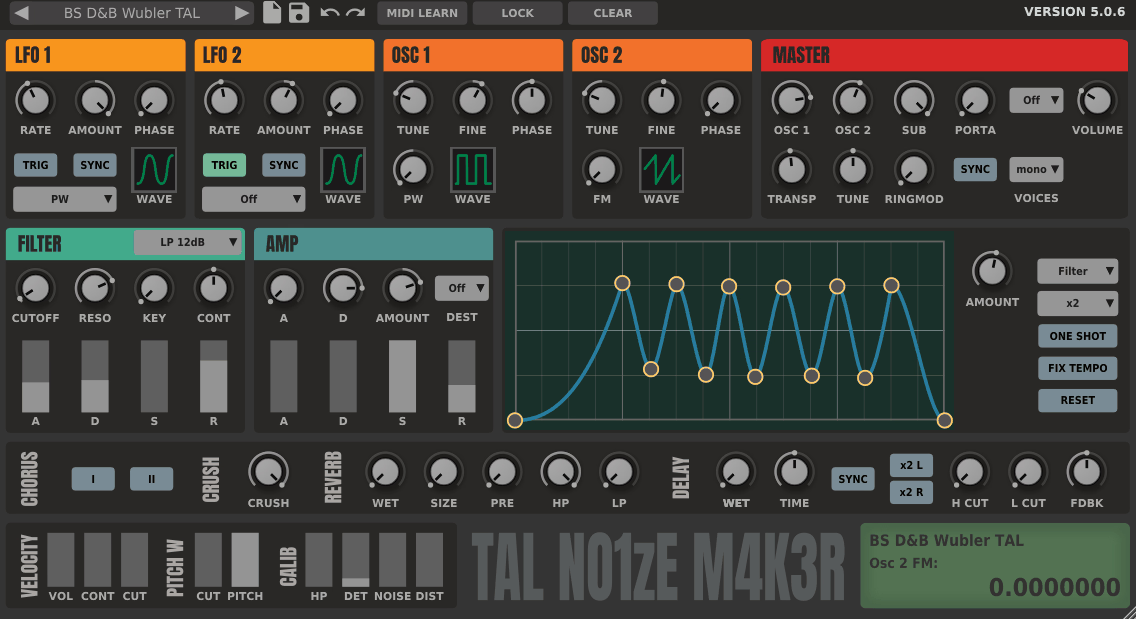
TAL-NoiseMaker from Togu Audio Line is one of the most solid free synthesizers ever made. It’s a three-oscillator virtual analog synth with an 11-mode filter section, two LFOs, two envelopes, a ring modulator, oscillator sync, FM, and a built-in effects section covering reverb, chorus, and bitcrusher.
It ships with 256 presets and runs as VST, VST3, AU, AAX, and CLAP across Windows, Mac, and Linux with 32-bit builds included.
I keep coming back to it because the sound is genuinely fat without being blurry, and the filter section has a quality that competes with paid instruments. For pad and lead work in particular, it’s hard to argue with what you get for free. The chorus modes alone are worth having the plugin installed.
- Three-Oscillator Architecture
Oscillator 1 covers saw, pulse, and noise with pulse width modulation. Oscillator 2 covers saw, rectangle, triangle, and sine with FM modulated by Oscillator 1 and sync to the sub-oscillator. A sub-oscillator adds a rectangle wave beneath both, and ring modulation between oscillators is available.
- Eleven Filter Modes with Self-Resonance
A 4x oversampled filter section covering 24 dB LP, 18 dB LP, 12 dB LP, 6 dB LP, 12 dB HP, 12 dB BP, Notch, and additional state-variable types. All modes self-resonate, and an adjustable Filter Drive adds saturation before the filter stage. The filter envelope is fully independent with its own ADSR.
- Two LFOs with Multiple Destinations
Two LFOs each cover sine, triangle, saw, square, S&H, and noise waveforms, with free running, host-sync, and note-triggered modes. Modulation destinations include filter cutoff, oscillator pitch, FM amount, pulse width, LFO rate, panorama, and volume, with both positive and negative modulation depth.
- Built-In Effects
A Juno-style chorus with multiple modes, a reverb, and a bitcrusher are included as a built-in effects chain. The bitcrusher operates pre-filter for a more integrated sound character rather than adding distortion at the output.
- Free with 32-bit Windows Build
Completely free with no registration required. The 32-bit VST version is included in the Windows installer alongside the 64-bit builds, making it one of the few modern-quality free synths with a native 32-bit option.
HY-Delay4
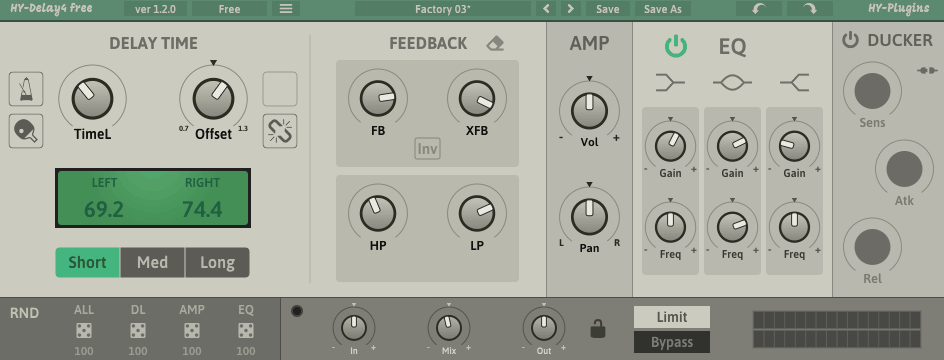
HY-Delay4 from HY-Plugins functions less like a standard echo unit and more like a sound design environment built around delay. It has five distinct delay modes, a reorderable signal chain with six processing blocks, and a drag-and-drop modulation system with four generators each offering five modulation engine types. Priced at $48, it runs as VST and AU on Windows and Mac with 32-bit and 64-bit builds. A free version with a single delay mode is also available.
The combination of the reorderable signal chain and drag-and-drop modulation is what makes this genuinely stand out. Being able to place the waveshaper before or after the delay produces fundamentally different results, and modulating the waveshaper drive with a step-LFO creates rhythmic textural effects that would take multiple plugins to produce anywhere else.
- Five Delay Modes
Simple stereo delay, Dual with two delay lines for rhythmic patterns, Grain for granular pitch-shifted delay clouds, Groove for pattern-based rhythmic delays, and PM inspired by classic warm digital delay character. Each mode produces a distinctly different sonic behavior.
- Reorderable Signal Chain
Six processing blocks (Delay, Amp, Waveshaper, EQ, FX1, FX2) can be rearranged in any order by dragging. Placing the Waveshaper before the Delay feeds distortion into the repeats; placing it after distorts only the repeats. This single feature opens up a wide range of tonal options not available in a fixed-chain delay.
- Drag-and-Drop Modulation
Four modulation generators each support five engine types: LFO, Envelope Follower, Step LFO, Multi-Point Envelope, and Sample and Hold. Assigning any modulator to any parameter is done by dragging the source onto the destination knob, with four macro controls for performance-oriented parameter grouping.
- Two FX Slots with 22 Types Each
Two built-in effect slots each containing 22 different effect types including chorus, phaser, flanger, and distortion, processing the delay output. These can themselves be modulated, turning the delay into a complete processing chain for sound design.
- Sidechain Input and Internal Limiter
A sidechain input feeds the envelope follower and a ducker that reduces the delay volume when the input signal is active, useful for keeping delay tails from cluttering a busy mix. An internal limiter at the end of the chain prevents unexpected peaks from distorted or heavily modulated settings.
- Resizable Interface and Randomizer
A fully resizable interface and a preset randomizer with the ability to lock specific parameters while randomizing others, useful for quickly discovering unusual delay textures without starting from scratch every time.
Density mkII
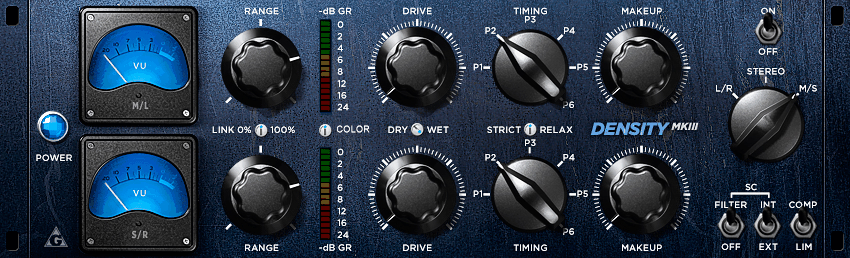
Density mkII by Variety of Sound is a free bus compressor designed specifically for stereo group processing and mix bus work, and it’s a classic of the freeware plugin world. It’s a 32-bit Windows VST exclusively, making it a native 32-bit plugin rather than a compatibility build. It glues material together in a way that’s noticeably musical, and producers have been relying on it for drum buses and mix buses since its release.
What stands out is the VCA color model and the way it handles transients across the full spectrum without the harmonic distortion issues that appeared in earlier versions. The Color control lets you dial in warmth from transparent to clearly present, and the M/S mode makes it practical for stereo bus situations that require different treatment of the mid and side content.
- VCA Color Model
A stateful saturation stage introducing 2nd and 3rd harmonic distortion plus frequency-dependent higher-order harmonics, adjustable from fully transparent to clearly present with the Color control. The saturation character comes from the compressor’s own dynamics behavior rather than being a separate stage bolted on afterward.
- M/S Mode with Range Controls
A single switch engages Mid/Side processing mode where the stereo signal splits into Mid and Side channels compressed independently. Each channel has its own Range control to limit maximum gain reduction, making it practical to compress M and S differently without one side dominating.
- Zero-Latency Processing
No look-ahead and no latency, making it usable for live monitoring and tracking situations in addition to mixing and mastering. The transient response across the full frequency spectrum is precise and consistent on both fast transients and slower sustain material.
- Windows 32-bit Native
A native 32-bit Windows VST that runs directly in 32-bit hosts without bridging. For 64-bit hosts, it runs cleanly through jBridge or similar bridging tools. The minimal CPU footprint makes it practical to run multiple instances across a mix without any performance issues.
Tritik Krush
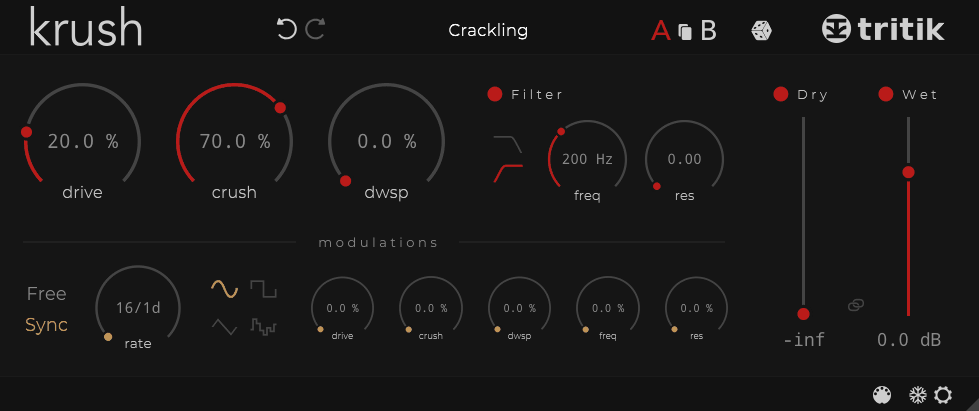
Krush from Tritik is the best free bitcrusher available. It combines a drive stage, bit depth reduction, sample rate reduction, and analog modeled resonant filters in a package that produces everything from subtle lo-fi texture to aggressive digital destruction. It runs as VST, VST3, AU, and AAX on Windows and Mac with 32-bit and 64-bit builds.
The modulation section is what separates it from other bitcrushers. You can dial in a tempo-synced LFO over any parameter and the bitcrusher becomes a rhythmic effect rather than a fixed tonal character. I found this particularly useful on drum buses and pads where subtle low-depth bit reduction synced to the groove adds movement that static processing can’t.
- Three Distortion Stages
A crunchy drive stage, bit depth reduction from 1 to 16 bits, and sample rate reduction operate in sequence to produce the core degradation. The drive stage adds analog-style warmth before the digital distortion, giving the result a warmer character than pure digital downsampling alone.
- Analog Modeled Resonant Filters
Low-pass and high-pass resonant filters with a 20 Hz to 20 kHz range and adjustable resonance shape the output of the bitcrusher. The filters are analog modeled rather than digital, which gives filtered distortion a warmer and more organic quality.
- LFO Modulation on Any Parameter
A single LFO with sine, triangle, square, and noise waveforms runs in free mode or tempo-synced to the host, and it can modulate Drive, Crush, sample rate, filter frequency, and resonance simultaneously. Modulation depth for each target is independently adjustable.
Synth1 by Ichiro Toda
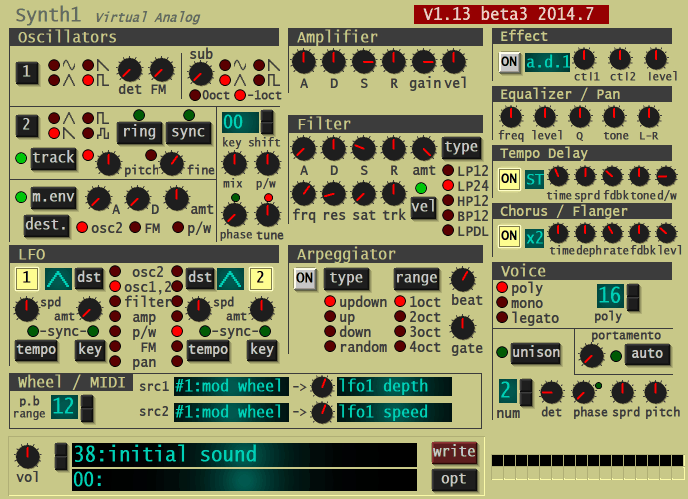
Synth1 is one of the most downloaded VST plugins ever made, and the reason is straightforward: it sounds great, uses almost no CPU, and has an enormous community of preset makers around it. Originally designed as an emulation of the Clavia Nord Lead 2, it’s since become a unique instrument covering 16 voices of polyphony, FM modulation, ring modulation, oscillator sync, 4 filter types, an arpeggiator, and a tempo-synced chorus and delay. It runs natively as a 32-bit and 64-bit VST on Windows and Mac, with factory 128 presets and thousands more community preset banks freely downloadable online.
I suggest downloading at least a few community preset banks at the same time as the plugin itself, because the available library covers virtually every electronic music genre and gives you a much broader starting point than the factory content alone. The synth is most stable and fully functional on Windows.
- Dual Oscillator with FM and Ring Mod
Two main oscillators plus a sub-oscillator cover standard analog waveforms with FM modulation from Oscillator 1 to Oscillator 2, ring modulation between oscillators, oscillator sync, and a modulation envelope for dynamic timbral changes. This gives it a much wider tonal range than a standard two-oscillator subtractive design.
- Four Filter Types with Drive
Four distinct filter architectures including 24 dB LP, 12 dB LP, 12 dB HP, and band-pass, with a dedicated filter ADSR envelope and adjustable pre-filter drive for saturation. The filter responds quickly enough for snappy percussive sweeps and handles heavy resonance well.
- Thousands of Community Presets
Beyond the factory 128 presets, a large community of preset designers has created banks covering basses, leads, pads, strings, organs, and FX, freely downloadable online. Synth1 can load banks directly from compressed zip files without needing to unzip them first, which makes managing large preset collections much more practical.
TAL-Reverb-4
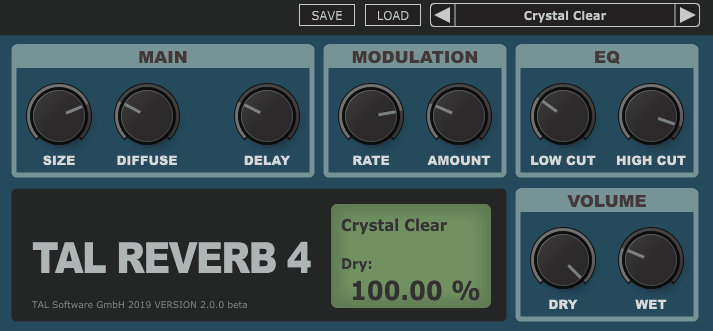
TAL-Reverb-4 from Togu Audio Line is the standalone version of the reverb algorithm from TAL’s own TAL-Sampler instrument. It’s a modulated vintage plate reverb with a fast build-up time, a highly diffuse tail, and a warmth that works especially well on leads, pads, and vocals. It runs as VST, VST3, AU, AAX, and CLAP across Windows, Mac, and Linux with 32-bit and 64-bit Windows builds.
I’d say this is the first reverb I’d put on any 32-bit rig. It does one thing very well, which is produce a lush, slightly colored plate reverb sound that sits naturally in a mix without fuss. Recent updates added a pitch shifter for shimmer effects, a DAMP control for taming resonance on the decay tail, and bit depth and sample rate controls for deliberately degrading the reverb character.
- Modulated Vintage Plate Algorithm
A single high-quality plate reverb algorithm with fast build-up time, very high diffusion, and a warm vintage character. The modulation adds subtle chorusing to the tail that prevents metallic resonances and gives long decays an evolving, organic quality.
- Pitch Shifter and Shimmer
A Tune control applies a pitch shifter to the reverb tail, creating shimmer-style effects where the reverb rises in pitch over its decay. Even at maximum settings it remains part of the reverb rather than overwhelming the dry signal, producing lush spaciousness rather than an obvious effect.
- DAMP Control
A dedicated dampener slider controls how quickly high-frequency content decays in the reverb tail, preventing resonant buildup on longer reverb times and making it practical for bright source material like cymbals and synth leads.
From the Pluginerds Store
If there's one thing worth taking from this list beyond the plugins themselves, it's that a clean, dry recording is still doing more work than any processing chain. Isolation and pop filtering fix that at the source.
- Bit Depth and Sample Rate Reduction
Optional controls degrade the reverb output in a way that recalls grainy early digital hardware reverbs. Used subtly it adds lo-fi character to the tail; at more extreme settings it produces clearly vintage digital artifacts that work as a deliberate creative effect.
Get the Free Plugin Starter Kit
The genuinely useful free DAWs and plugins worth installing. No filler. Straight to your inbox.

Hello, I’m Viliam, I started this audio plugin focused blog to keep you updated on the latest trends, news and everything plugin related. I’ll put the most emphasis on the topics covering best VST, AU and AAX plugins. If you find some great plugin suggestions for us to include on our site, feel free to let me know, so I can take a look!