
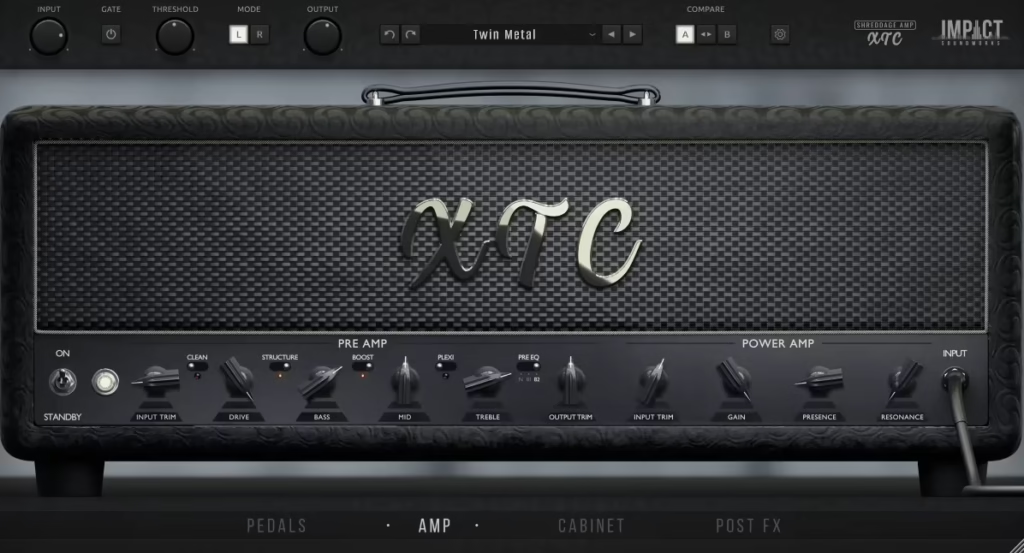
Impact Soundworks has built quite the reputation over the years with their Shreddage series of virtual guitars, so when they decided to step into the amp plugin space, there was a lot of expectation riding on it. Shreddage Amp XTC is their first native guitar amp plugin, and the choice of amp they went with is honestly a bold one: the Bogner Ecstasy, one of the most revered and expensive boutique amplifiers ever built, treasured by guitarists for its exceptional versatility and pure tone.
I mean, this isn’t some generic amp model they slapped together, and that alone makes it worth paying attention to.
What makes this plugin stand out from the crowd is the approach Impact Soundworks took to modeling it. The lead programmer on the project, Eric Tarr, a professor of Audio Engineering Technology at Belmont University and founder of Hack Audio, literally wrote a book on audio DSP, and that level of expertise shows.
The signal path is modeled down to individual tubes and circuits, based on the original Ecstasy circuit diagrams and schematics, including a classic push-pull Class AB power amp section. That’s a level of detail you don’t see in every amp sim on the market.
I think at $79 regular price, Shreddage Amp XTC is genuinely worth it, especially if you’re a composer or producer working with virtual guitars who needs a believable, versatile high-end amp without spending thousands on the real thing.
The Amp
I have to say, the core sound here is really impressive. The Bogner Ecstasy’s signature characteristic is its unique multi-channel design that can cover a remarkably wide range of tones, from glassy, sparkly cleans all the way through to thick, saturated high-gain lead sounds, and the plugin captures that range well. You get standard and clean channels with individual gain and drive controls, along with structure, boost, and plexi toggles, plus three pre-EQ modes and a separate three-band EQ on top of that. For anyone who’s ever played or recorded through a real Ecstasy, there’s a familiar feel to how the gain staging responds, and that’s not easy to pull off digitally.
I noticed that input level matters quite a bit here since the circuit modeling is reactive in the way the real amp would be. If you’re using this with virtual guitar libraries like the company’s own Shreddage 3 Hydra, you’ll want to pay attention to how hard you’re hitting the input, because it directly affects how the amp responds and saturates.
Get the Free Plugin Starter Kit
The genuinely useful free DAWs and plugins worth installing. No filler. Straight to your inbox.
Pedals and Cabinets
This is where I feel Impact Soundworks really went the extra mile rather than just delivering a bare amp model. The pedalboard setup is genuinely flexible, with both pre-amp and post-cab pedalboard sections, each with 6 slots, so you can run pedals in whatever order makes sense for what you’re going for.
The modeled pedals include a Tube Screamer-style overdrive, an MXR Distortion model, a Klon Centaur overdrive, an LA-2A-style optical compressor, BBD-style echo delay, lush chorus, and a three-band parametric EQ. I appreciate that they went with iconic, recognizable reference pedals rather than generic in-house designs because it helps you immediately understand what you’re reaching for.
On the cabinet side, you get 13 distinct cab and speaker IRs, covering modern 2×12 and 4×12 configurations alongside vintage and British models, recorded on and off axis with up to four microphone choices including an SM57, U87, TLM103, and R-121. You can even run two cabinets simultaneously and blend them with individual volume and panning controls, which opens up some really nice stereo width options. And if you have your own IR collection, you can load those in as well.
Presets
For those of you who’d rather start from a solid foundation and tweak from there, the plugin ships with 27 factory presets spanning everything from clean and crunch to smooth lead and high-gain territory. I found them genuinely useful as starting points rather than just filler content, which is not always the case with amp sims. The built-in A/B comparison buttons are a nice touch too, letting you quickly flip between two tone setups without losing your place mid-session.
A few other things worth knowing:
- True stereo processing with an independent L/R signal chain for all components and effects
- Real-time and offline oversampling for better quality at the expense of more CPU
- Resizable vector UI that scales cleanly on ultrawide and HiDPI displays
- No iLok or dongle required, with offline activation available
- Available in VST3, AU, and AAX formats with native Apple Silicon support
Sound Quality
In my opinion, the real test of any amp plugin is how it sounds when you put it up against the actual hardware, and Impact Soundworks did exactly that by releasing a blind shootout between a real Bogner Ecstasy and the plugin running through the same cabinet IR. I’d suggest you look that up and listen for yourself because the results are genuinely close in a way that’s hard to dismiss. For producers working in pop, rock, country, or metal, I believe you’ll find this covers most of what you’d actually need in a session without having to reach for anything else.
The one thing I want to note is that this plugin rewards some dialing-in time. It’s not a one-knob wonder, and the gain staging depth means you’ll get more out of it once you understand how the channels and pre-EQ modes interact. But once you find your sweet spot, it really does hold up in a mix in a way that feels more like a tracked amp than a lot of competitors at this price point.
Check here: Shreddage Amp XTC
Get the Free Plugin Starter Kit
The genuinely useful free DAWs and plugins worth installing. No filler. Straight to your inbox.

Hello, I’m Viliam, I started this audio plugin focused blog to keep you updated on the latest trends, news and everything plugin related. I’ll put the most emphasis on the topics covering best VST, AU and AAX plugins. If you find some great plugin suggestions for us to include on our site, feel free to let me know, so I can take a look!