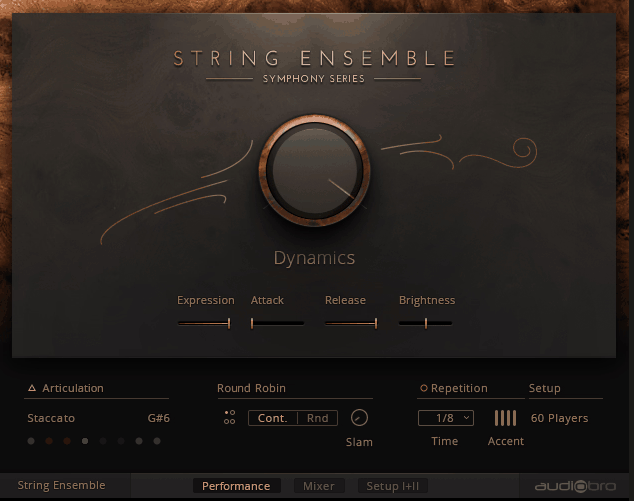
This is a professional orchestral library recorded at Teldex Scoring Stage in Berlin, offering high-quality string ensembles for serious composition work. After using it for few weeks, I can provide a detailed assessment of its capabilities and performance.
Let’s start with the actual size. The library occupies around 33GB of drive space and delivers the kind of sound quality you’d expect from a premium orchestral product.
The library occupies around 33GB of drive space and delivers the kind of sound quality you’d expect from a premium orchestral product. But now, let me break down what you’re actually getting for your investment.
Recording Quality and Sonic Character
First, it captures full string ensemble playing together in the same space, and this ensemble recording approach creates authentic blending between violin, viola, cello, and bass sections in a way that feels genuinely organic.
When you play a chord, the natural phase relationships and acoustic interactions are preserved because the musicians recorded together, and it turns out that this makes a significant difference in the final sound that’s immediately apparent when you start working with the library.
The sonic character is warm and detailed in a way that works across multiple contexts, and I found that these strings work across multiple genres, from intimate chamber pieces to full orchestral arrangements without sounding out of place.
For example you can use it in film scoring, television work, game music, and hybrid electronic productions where organic string textures enhance synthetic elements, and they can deliver professional results that hold up in commercial contexts.
Also, Three microphone positions provide mixing control that gives you real flexibility in shaping the final sound, and at first glance, the close mics deliver clarity and presence while maintaining natural tone. The mid mics capture a balanced room perspective that works well for most applications, and the hall mics add Teldex’s natural acoustics with that characteristic Berlin warmth.
You can blend these positions to shape the sound for your specific needs, from dry and intimate to spacious and cinematic, which I personally think is one of the library’s strongest features because it adapts to different production styles.
When it comes to dynamic range, it’s comprehensive in a way that feels quite natural, and I can say that soft playing maintains delicacy and nuance while louder dynamics deliver power and impact without sounding forced.
In addition to that, velocity layers respond naturally to your playing, creating expressive performances without requiring extensive automation or programming tricks that slow down your workflow. In my opinion, this natural response makes composition feel more intuitive because you can focus on musical ideas rather than fighting the technology.
Lastly, the ensemble patches showcase the library’s strength in delivering cohesive, unified string sections that sound like real musicians playing together. You also get separate section patches for more detailed orchestration control, which is why you have flexibility in how you approach your arrangements depending on whether you need quick results or more granular control.
Articulations and Programming
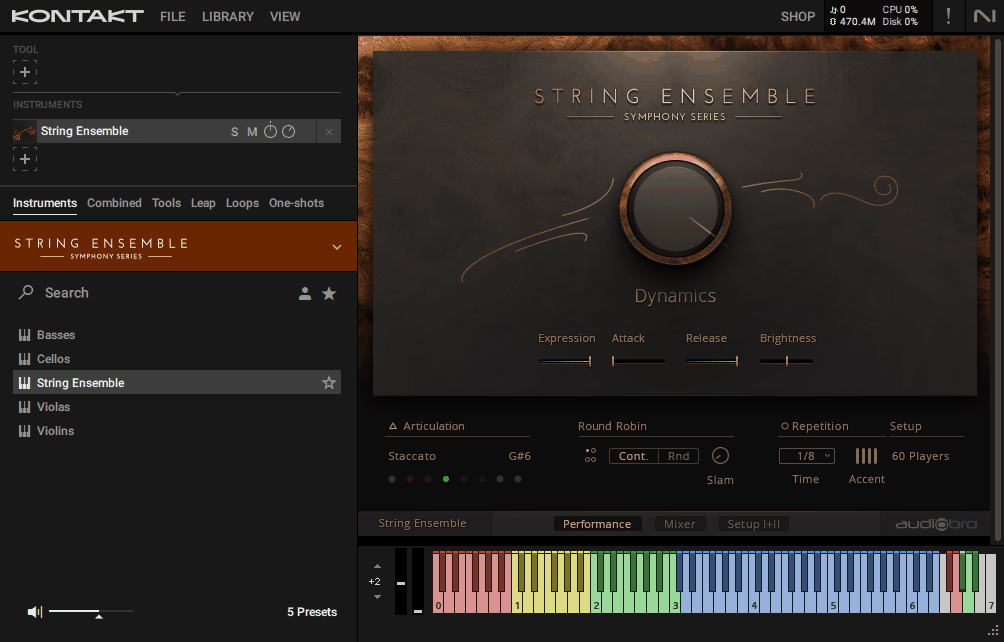
Now, the articulation set covers professional composition needs without overwhelming you with options you’ll rarely use, and overall, you get sustained notes with multiple dynamic layers, legato transitions including both portamento and regular modes, marcato, staccato, spiccato, and pizzicato that all sound polished and ready for production work.
Legato transitions handle melodic lines smoothly in a way that feels natural and convincing in context, and from my experience, the transitions flow naturally between notes, allowing you to write expressive string melodies that sound convincing and musical without obvious artifacts.
Here, programming responds well to different playing speeds and intervals, adapting to your performance style whether you’re playing slowly or moving through faster passages. That being said, it’s worth the investment just for these legatos alone because they handle the kind of melodic writing that often reveals weaknesses in other libraries.
Short articulations provide versatility across different musical styles and contexts, and I like how staccatos have natural bounce and energy that works for both classical and contemporary writing.
When it comes to Spiccatos, they work effectively for both rhythmic patterns and melodic accents, giving you that characteristic articulated string sound that sits well in arrangements.
Pizzicatos deliver solid body and tone that sits well in arrangements without sounding thin or disappointing, and to be honest, I was pleasantly surprised by how well these short notes perform because pizzicatos can often be a weak point in sample libraries.
The articulation selection focuses on practical, frequently used techniques rather than trying to include every possible variation, and this focused approach means you’re not navigating through dozens of obscure articulations you’ll rarely use in actual production. Instead, you get polished versions of the articulations that form the foundation of string writing, which basically keeps your workflow streamlined and efficient so you can spend time composing rather than auditioning samples.
On the other hand, Round-robin sampling ensures natural repetition by cycling through multiple sample variations automatically, and multiple sample variations prevent the mechanical sound that occurs when the same sample triggers repeatedly in succession.
This attention to detail contributes to realistic performances that hold up under scrutiny, and I can only say, you won’t get that obvious machine-gun effect that plagued older libraries and immediately revealed you were working with samples.
System Performance and Workflow
The library performs efficiently on modern production systems without making unreasonable demands on your hardware resources, and at 33GB installed, the footprint is reasonable for a professional orchestral library when you consider what you’re getting plus, loading times are responsive, with the full ensemble and all mic positions loading quickly on current SSDs, and right off the bat, I noticed this was significantly faster than some competing libraries that can take several minutes just to load a single patch.
RAM usage is optimized for practical workflow in a way that respects your system’s limitations, and with all microphones loaded, you can run multiple instances alongside other instruments without exhausting system resources or forcing you to bounce tracks constantly.
This efficiency supports complex templates and large projects where you need multiple instances running simultaneously, and in fact, you can load five or six instances without any system slowdown or performance issues that interrupt the creative flow.
CPU usage remains manageable even when you’re running multiple instances in demanding sessions with other processing-intensive plugins active, which means you can work in real-time without constant interruptions.
The convolution reverb for hall mics uses processing power as you’d expect from any convolution-based reverb, but you can disable it when using external reverb or when CPU efficiency is a priority. At least that gives you options depending on your system capabilities and whether you prefer using the built-in reverb or your own favorites.
The library functions as a standalone Kontakt instrument that doesn’t lock you into purchasing additional products, and you need either full Kontakt or the free Kontakt Player, which means the library remains accessible without requiring massive additional investments.
This flexibility means you can use the library without requiring the complete Komplete bundle, which if you ask me, this accessibility is important for composers who haven’t invested heavily in the NI ecosystem and don’t want to be forced into it.
Sound Comparison and Applications
Symphony Series String Ensemble occupies its own space in the orchestral library landscape with a particular balance that sets it apart from other options. Libraries like Spitfire Symphonic Strings or Orchestral Tools Berlin Strings offer different approaches with their own strengths and particular sonic signatures, and each library brings distinct sonic characteristics and workflow considerations that make them suited to different production needs.
That being said, I believe comparisons help understand where this library fits in the broader market and what makes it unique.
Compared to EastWest Hollywood Strings, Symphony Series delivers excellent sound quality with efficient loading and clear sonic transparency that makes it easier to integrate into modern workflows, and different libraries excel in different contexts based on your specific production needs and the genre you’re working in.
From my perspective, the choice depends more on workflow preferences than pure quality differences because at this level, most libraries can deliver professional results when used appropriately.
Now, I must say that the library excels in hybrid productions where orchestral strings combine with electronic elements, synths, or other instruments in contemporary ways, and the clear recordings integrate naturally in complex mixes while maintaining presence without overwhelming other elements or requiring excessive processing.
I’m a big fan of how these strings sit in electronic contexts without sounding out of place or overly traditional, which makes them particularly valuable for modern production work.
Value Assessment and Recommendations
In the big picture, the versatility of Symphony Series String Ensemble extends across genres in ways that continue to surprise me as you can use the library in different contexts such as film scoring, television composition, game audio, advertising music, and contemporary classical work, as all benefit from the sonic quality and flexibility this library provides. For the most part, it handles whatever you throw at it with professional results that hold up in commercial delivery.
Producers creating hybrid compositions in cinematic genres, electronic orchestral fusion, or modern scoring contexts will find these strings integrate effectively with other sonic elements in ways that feel natural rather than forced.
When it comes to clarity and detail, it support complex arrangements where multiple elements compete for space, and not to mention, the modern recording techniques complement contemporary production styles that demand transparency and definition.
The focused articulation approach supports efficient composition by eliminating decision paralysis and keeping your attention on musical choices, and you get polished, musical articulations that serve practical writing needs without unnecessary complexity that slows you down.
At the end of the day, you need tools that help you work faster and more effectively, and this library does exactly that by staying out of your way and letting you focus on creativity.
The investment reflects genuine professional-grade orchestral sampling that serves serious composition work effectively, so if you need high-quality string ensembles that perform reliably in professional contexts, Symphony Series String Ensemble delivers on its promises without overpromising.

Hello, I’m Viliam, I started this audio plugin focused blog to keep you updated on the latest trends, news and everything plugin related. I’ll put the most emphasis on the topics covering best VST, AU and AAX plugins. If you find some great plugin suggestions for us to include on our site, feel free to let me know, so I can take a look!