Most string libraries promise the world and deliver the same tired formula with different packaging, so I approached NOVO with my usual skepticism. After working with it on few projects over the past few months though, I think there’s actually something worth discussing here.
Heavyocity recorded these strings at Warner Bros. Studios’ Eastwood Scoring Stage and then took an unusual approach with what they captured. Instead of building one comprehensive library, they split everything into two distinct instruments that use the same source recordings but serve completely different purposes.
One side handles traditional orchestral work, while the other transforms those recordings through processing and sound design into something that doesn’t sound like strings anymore. Whether this matters to you depends on what you’re actually trying to accomplish in your music.
Traditional Strings With A Modern Edge
When I started working with the traditional side of Heavyocity NOVO, I noticed immediately that these strings don’t sound like the romantic-era libraries I’m used to. The approach here is much more restrained and modern, which shows up in how the vibrato is kept minimal throughout all the sections.
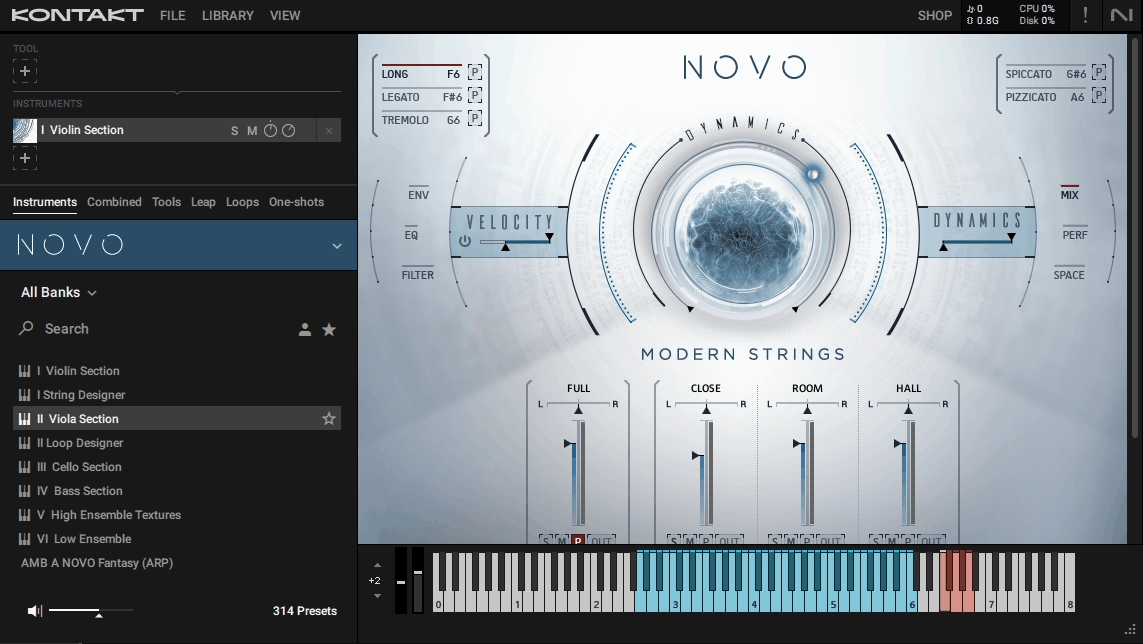
This creates a tighter, more controlled sound that fits better in contemporary scoring than lush, expressive playing would. I’m working with six sections here: Violin, Viola, Cello, Bass, High Ensemble, and Low Ensemble, and each one covers the articulations you actually use regularly in modern work rather than trying to include every possible technique.
The articulation list focuses on what matters for contemporary scoring, giving you long notes, legato, tremolo, spiccato, and pizzicato across all the sections. What’s not here is just as telling as what is, because there are no runs, no glissandos, no trills, and really no extended techniques except in one specific patch I’ll get to.
This focused approach means the developers spent their time making these core articulations sound really good instead of spreading resources thin trying to cover every possible string technique.
Film score mixer Satoshi Noguchi handled the mixing, and his work is immediately apparent when I start playing. Everything sits bright and forward in the mix, which is very much a Hollywood approach rather than the darker, more distant European sound I hear in other libraries. The cellos push forward especially aggressively, helping them cut through dense arrangements where lots of elements are competing for space.
This forward character works brilliantly when you need energy and drive, but it can feel too aggressive when you are going for something softer and more lyrical that should sit back in the arrangement.
The legato works in monophonic playback by default, which prevents those overlapping artifacts that immediately give away fake strings. You can switch to two-voice or four-voice polyphonic modes when you need to play chords without loading multiple instances, but I’ve found that monophonic mode consistently sounds more realistic for melodic lines.
What impressed me about the spiccato articulations is how much thought went into making them feel natural. Beyond the three round-robin variations you’d expect, they recorded separate up-bow and down-bow samples with their own round-robins. NOVO generates bow patterns automatically based on your playing speed, with rate settings from quarter notes down to thirty-seconds, so you don’t waste time programming which notes should be up or down bows.
The High Ensemble Textures patch has become something I really like. It gives me sul ponticello playing where the bow sits near the bridge, creating that glassy, overtone-rich sound that cuts through mixes.
The intermittent octaves, bends, pulses, and tremolo all have this ethereal quality that works perfectly for atmospheric moments. The con sordino bends are particularly useful because some players hold steady notes while others bend microtonally underneath, creating tension you can use in suspense cues.
There’s also col legno for percussive hits with the wood of the bow, and almost two octaves of violin harmonics that sound genuinely ethereal. I would use this patch where I’d normally grab pad synths, and it sits differently in mixes because of its organic quality.
Both the Traditional and Evolved sides give me per-articulation EQ and filtering, which means I can dial in different tones for each playing style. The EQ is a three-band parametric with peaking only, so no shelves, which is slightly limiting but works fine for most surgical work. The filter is resonant multi-mode with two-pole and four-pole responses covering low-pass, high-pass, band-pass, peak, and notch.
What makes this genuinely useful is that settings are stored per articulation and can be set independently for each mic position. You can have deep low end in the Hall mic while the Close mic emphasizes bow noise and attack, and these versions automatically switch when you change positions.
You’re working with three mic positions: Close, Room, and Hall, plus a pre-mixed Full blend. Each has solo, mute, and RAM purge capabilities, and you can route them to separate outputs for individual processing.
String Designer And The Hybrid Side
String Designer is where NOVO stops being a traditional library and becomes something more like a sample-based synthesizer. You get three separate channels, each loading its own string sample as a starting point. Then you apply filters with envelope and key-tracking, ADSR controls, and effects that go far beyond normal string library capabilities.
The Macro control ties to your mod wheel and moves multiple parameters across all three channels simultaneously. You can decide which parameters respond and by how much, so one movement affects volume, filtering, envelope, and effects all at once. The Macro sequencer animates these changes in one-shot, LFO, or step-sequence modes, adding movement even when you’re holding static notes.
The CYCLE engine is granular synthesis designed for string recordings. It controls sample playback position to create rhythmic patterns or sustained textures. I can stretch a pizzicato into an evolving pad or chop a sustain into stuttering rhythms that lock to my tempo. The 57 CYCLE presets give me starting points, but I’ve learned to manipulate playback position myself for custom textures.
The sample browser organizes everything with descriptions and preview functionality so I can audition before loading. You can also build keyboard splits and layers with adjustable crossfades for seamless transitions. In addition, you can build textures that morph across the keyboard, combining traditional samples low with processed sounds high.
String Designer includes over 200 presets that range from subtle to aggressive. Many sound more like electronic music than orchestral instruments, which is exactly the point. Master effects include Punish for compression and saturation and Twist for phaser and filter effects, both as single-knob controls. There’s tempo-synced delay and convolution reverb with 19 impulse responses.
With Loop Designer, you get more than 400 tempo-synced loops across the keyboard, where individual keys trigger single loops and lower octave keys fire multiple loops together. A separate range controls harmonic information for real-time transposition.
The thing is, these loops are finished arrangements, not raw material. Everything is 4/4 time with straight and triplet feels. If you are on deadlines and need something polished immediately, Loop Designer can save you time.
Technical Issues I’ve Encountered
Performance matters when you’re working on real projects, and NOVO demands significant CPU resources. The default setup with all mic positions loaded and effects running strains my system, especially when I stack multiple instances. The library runs in Kontakt 5.6.6 or later and works with free Kontakt Player, which is helpful since I don’t need the full version. That said, download is 25GB on disk with Native Instruments’ lossless compression and includes 21,254 samples.
Switching to the pre-mixed Full perspective helps considerably with CPU, and this has become my usual approach unless I specifically need individual mic control for mixing. You can purge unused samples from RAM and adjust oversampling settings to reduce load, but even with optimization, this isn’t what I’d call lightweight.
Some of the quick articulations don’t speak on time, which becomes noticeable in fast passages. The problem isn’t consistent across notes, making compensation difficult because I can’t just nudge everything forward by the same amount. When I play hard-quantized scales against a click, certain notes lag while others hit perfectly, creating a sloppy feel that undermines realism.
Release samples contain audible noise at high dynamics. After notes end, you get a couple seconds of hiss plus occasional studio sounds like creaks or clicks on cello and bass notes. In dense music with lots happening, this disappears completely. In quiet, exposed passages where strings carry the emotional weight, it becomes noticeable and sometimes distracting enough that I need to manually edit tails.
These feel like programming issues rather than recording problems, and the sample quality overall is excellent. This makes the quirks more frustrating because they seem fixable with better editing.
What You Get And Who This Is For
NOVO includes 308 presets and 432 tempo-synced loops alongside the samples. Pricing sits in the mid-to-high range for orchestral instruments. You could find cheaper libraries with longer articulation lists if feature count matters most to you.
What you are paying for is recording quality from Warner Bros. Studios, sophisticated programming beyond basic multisampling, and hybrid sound design capabilities that don’t exist in traditional libraries. Value depends on whether NOVO’s approach matches your needs.
For modern cinematic work where you need both traditional orchestral sounds and cutting-edge hybrid textures, the tools justify the investment. For classical or romantic styles requiring comprehensive articulations and solo instruments, NOVO isn’t trying to be that library.
This works best when you’re scoring contemporary film, trailers, games or television. The traditional side handles standard scoring competently, while the evolved side enables directions traditional libraries can’t reach without extensive external processing.
For composers preferring classical or romantic approaches needing lush vibrato and lyrical phrasing, NOVO isn’t the right choice. The minimal vibrato and aggressive bow texture create a specific modern character that works for certain styles but fights against others. NOVO excels at modern, atmospheric, and hybrid sounds but isn’t comprehensive enough to cover every orchestral string situation.

Hello, I’m Viliam, I started this audio plugin focused blog to keep you updated on the latest trends, news and everything plugin related. I’ll put the most emphasis on the topics covering best VST, AU and AAX plugins. If you find some great plugin suggestions for us to include on our site, feel free to let me know, so I can take a look!