
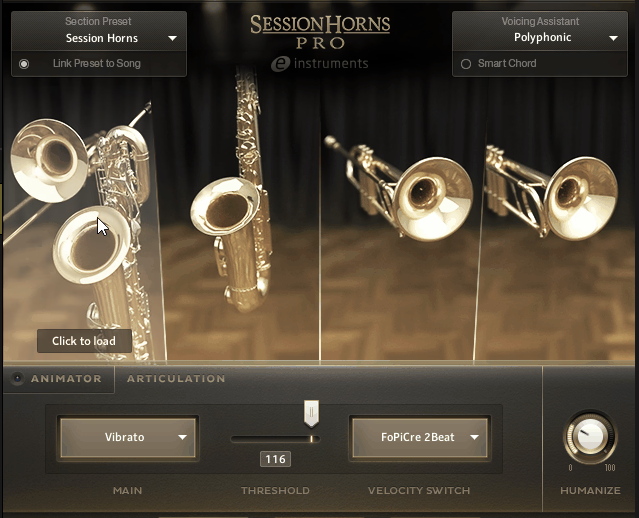
Brass instruments are among the most expressive and most difficult to fake convincingly in a production context, and the libraries that actually succeed tend to be the ones built around a deep understanding of how horn sections function musically rather than just how individual instruments sound in isolation.
Session Horns Pro is Native Instruments’ flagship brass instrument, built around a full horn section with individual instrument access, ensemble presets, and a performance system designed to produce results that feel like a real section was tracked rather than samples being triggered from a keyboard.
The library covers the full range of a typical pop and jazz horn section: trumpets, trombones, alto and tenor saxophone, and bari sax, all recorded with the kind of dynamic range and articulation depth that professional brass recording requires.
When people talk about the best Kontakt libraries for realistic brass, Session Horns Pro consistently comes up because it solves the hardest problem in this category: making a section sound arranged rather than assembled.
I think what distinguishes it from a basic brass sample library is the combination of individual instrument quality with ensemble intelligence: the way the section voices chords, handles lead lines, and responds to playing style reflects a genuine understanding of how brass arrangers and session horn players actually work.
For producers who regularly need convincing brass in pop, funk, soul, jazz, R&B, and cinematic contexts, Session Horns Pro is worth the investment because the quality ceiling of what it can deliver is high enough to use in professional productions without sounding like a sample library approximation. The depth of articulation coverage and the ensemble behavior put it in a different category from basic brass plugins.
From the Pluginerds Store
One more thing before you finish reading: we also stock studio hardware and accessories directly through Pluginerds Shop. Microphones, interfaces, controllers, cables, and the small stuff that never comes included with anything.
Visit Pluginerds ShopThe Instruments
The recorded horn section in Session Horns Pro covers the instruments that appear most commonly in professional pop, funk, soul, and jazz production: lead trumpet, section trumpet, trombone, alto saxophone, tenor saxophone, and baritone saxophone, each recorded by professional session musicians with enough dynamic range and articulation variety to cover the full expressive range these instruments are capable of in a studio context.
- Trumpet
The trumpet recordings cover both a lead trumpet voice with the specific brightness and projection that cuts through a dense mix and a section trumpet voice with a slightly warmer, more blended character that sits better in ensemble writing. Having these as distinct recorded entities rather than EQ variations of the same recording produces genuinely different tonal characters that mirror what you’d hear from a professional two-trumpet section in a real recording session.
The dynamic range across velocity layers captures the specific way trumpet character changes from soft, airy pianissimo playing through to the full, bright fortissimo of an open horn pushed hard, and this dynamic variation is what makes trumpet parts feel expressive rather than mechanically uniform.
- Trombone
The trombone provides the low brass weight that gives a horn section its physical foundation, and the recordings capture the specific slide-position character and breath pressure variation that distinguishes good trombone recording from generic low brass samples.
I noticed that the growl and flutter tongue articulations in the trombone set are particularly convincing: these are the expressive extremes that less carefully recorded libraries tend to underdeliver on, and having them available at this quality level opens up a wider range of stylistic applications.
- Saxophones
The alto, tenor, and baritone saxophone recordings each capture the distinct tonal personalities of their respective instruments rather than sounding like the same saxophone at different pitches.
The alto has the specific bright, cutting quality that puts it in its own register above the tenor, the tenor has the warm, full mid-range character that makes it the workhorse voice in most horn sections, and the baritone provides the low-end saxophone weight that anchors the section harmonically.
I appreciate that the reed noise and breath character in the saxophone recordings are preserved rather than processed out: these are the qualities that make a saxophone sound like a saxophone rather than a synthesized approximation of one, and their presence in the samples is what gives the library its acoustic authenticity under close listening.
Get the Free Plugin Starter Kit
The genuinely useful free DAWs and plugins worth installing. No filler. Straight to your inbox.
Articulations and Playing Techniques
The articulation coverage across Session Horns Pro is comprehensive enough to cover the full range of what professional brass writing requires, from standard sustained notes and short stabs through to the specific ornamental and expressive techniques that give horn section playing its character.
- Sustained and Short Articulations
The sustained articulations include standard open tone, crescendo, diminuendo, vibrato, and fall-off variants that cover the range of sustained playing styles from smooth legato lines through to the specific swelling and falling character of jazz and soul brass writing.
Each of these is recorded with genuine dynamic variation rather than being volume-automated versions of the same sustain, which produces the tonal character changes that real dynamics produce in brass instruments.
The short articulation set covers staccato, sforzando, marcato, and the specific sharp-attack short notes that characterize funk and soul horn stabs. I found the sforzando articulation particularly useful in funk contexts: the specific immediate accent-then-release character of a brass sforzando is one of the defining sounds of funk horn writing, and getting it right from a sample library requires both good recording and good velocity mapping, both of which Session Horns Pro delivers.
- Expressive and Ornamental Techniques
Shakes, falls, doits, and rips are all covered as dedicated articulations rather than requiring manual pitch automation to approximate, which makes writing idiomatic horn section parts significantly faster and more convincing.
These ornamental techniques are what give brass writing its specific stylistic character in jazz, soul, and funk contexts, and having them available as single-note triggers rather than complex MIDI programming means you can focus on the musical decisions rather than the technical execution.
I love how the fall articulations in particular cover different fall lengths and characters: a short, quick fall has a completely different musical feel from a slow, wide fall that decays over several beats, and having both available within the instrument means you’re choosing the right musical option rather than accepting a single approximation.
The Ensemble Engine
This is where Session Horns Pro distinguishes itself most clearly from a library that simply gives you individual brass samples to arrange manually. The Ensemble mode’s automatic voicing and arrangement system analyzes your chord or note input and distributes the section appropriately across the available instruments in ways that reflect real brass arranging practice rather than simply stacking all instruments on the same pitch.
- Chord Voicing
When you play a chord in Ensemble mode, the section spreads the voicing across the instruments in the way a real brass arranger would: the lead trumpet takes the top voice, the trombone covers the bass voice, and the saxophones fill the inner voices in voicings that reflect the natural register and tonal weight of each instrument.
This produces chord clusters that sound like arranged brass rather than unison playing, and the specific way the voicings are constructed changes with the chord type in ways that reflect genuine arranging intelligence.
I must say this voicing behavior is the single most time-saving aspect of the library for producers who need convincing brass quickly: getting a section that sounds arranged rather than randomly stacked is the difference between a professional result and something that immediately signals “sample library” to any listener who knows what live brass sounds like.
- Lead Line Handling
When playing single notes for melodic brass writing, the Ensemble mode handles the unison reinforcement of the lead line across the section in ways that produce the specific blend and weight of a real horn section playing in unison, rather than simply triggering the same sample multiple times at the same pitch. The slight timing and tuning variations between the individual instrument samples create the natural chorus effect of multiple live players, which is what gives a real brass section its characteristic fullness on unison lines.

Playability and Expression
How Session Horns Pro responds to keyboard dynamics and playing matters significantly because the expressive range of brass instruments is wide and the difference between a convincing and an unconvincing brass performance often comes down to whether the library responds to subtle playing differences or produces the same character regardless of how you play.
The velocity response across the library is calibrated to reflect how brass instruments actually behave dynamically: softer velocities produce the more airy, breathier quality of controlled playing, while harder velocities produce the fuller, more projecting tone of louder playing. I have to say that this velocity-to-tone relationship is one of the more sophisticated aspects of Session Horns Pro: brass instruments change tonal character substantially across their dynamic range in ways that aren’t simply loudness variations, and the layering captures those tonal changes accurately.
Round-robin variation across the short and staccato articulations ensures that repeated brass stabs retain a natural irregularity rather than the obvious mechanical repetition that undermines brass arrangements built from simpler libraries. For funk and soul contexts where repeated horn stabs are rhythmically central to the arrangement, this variation is essential rather than a nice-to-have.
Scoring and Production Applications
The production contexts where Session Horns Pro delivers most convincingly cover a genuinely wide range: funk and soul horn sections where the short articulations, stabs, and rhythmic writing are the primary application, jazz where the sustained articulations, vibrato, and ornamental techniques are most heavily used, pop and R&B where the ensemble voicing and clean sustained lines matter most, and cinematic scoring where the full dynamic range and the ensemble size controls allow you to build the scale of brass writing that picture requires.
For me, the library is most compelling in funk and soul production specifically because the combination of the sforzando articulation, the shakes and falls, and the ensemble voicing behavior produces results that are genuinely difficult to achieve with other tools at the same level of quality and workflow speed. Building a convincing funk horn arrangement from scratch in a less capable library requires significantly more time and programming work to achieve the same result.
I suggest spending time specifically with the Individual mode early in your workflow with Session Horns Pro, even if you primarily use Ensemble mode in practice, because understanding what each instrument contributes to the ensemble balance helps you make better musical decisions when using the automatic voicing system and gives you the knowledge to override it intelligently when the arrangement calls for something specific that the automatic system doesn’t produce.
Is It Worth It?
For producers and composers who regularly work in styles where convincing brass is part of the production vocabulary, Session Horns Pro is one of the most complete and musically intelligent brass libraries available in the Kontakt ecosystem. The combination of recording quality, articulation depth, and the ensemble voicing intelligence puts it in a category above basic brass plugins that give you decent samples without the arrangement behavior.
I believe the value is particularly strong for producers who work across multiple brass-oriented styles rather than a single specific genre, because the library’s range from funk stabs through to cinematic writing means you’re not making compromises in one style to get the features you need for another. The depth of the articulation set and the intelligence of the Ensemble mode together represent the kind of investment in musical behavior that justifies premium library pricing, and in practice that investment pays off every time you use it in a real production context.
Check here: Native Instruments Session Horns Pro
From the Pluginerds Store
Before you go — if you're putting together or upgrading a home studio setup, we run our own store alongside the blog at Pluginerds Shop. Everything on it is picked by people who actually make music, not sorted by whoever paid for placement on a marketplace. Worth a look if you're filling in the gaps in your setup.
Visit Pluginerds ShopGet the Free Plugin Starter Kit
The genuinely useful free DAWs and plugins worth installing. No filler. Straight to your inbox.

Hello, I’m Viliam, I started this audio plugin focused blog to keep you updated on the latest trends, news and everything plugin related. I’ll put the most emphasis on the topics covering best VST, AU and AAX plugins. If you find some great plugin suggestions for us to include on our site, feel free to let me know, so I can take a look!