

This particular collection is something genuinely special: software versions of the physical Moogerfooger hardware effects pedals that Moog produced between 1998 and 2018, a line that became beloved by electronic musicians, experimental guitarists, sound designers, and studio engineers for their specific analog character and their unusually flexible CV connectivity.
The hardware units are now only available on the used market at significant prices, which makes this bundle one of the more historically meaningful software releases of the past few years.
What made the original hardware so compelling wasn’t just the sound quality, though that was genuinely excellent. It was the fact that these were Bob Moog-designed analog circuits with control voltage inputs and outputs that allowed them to be patched together in ways that weren’t common in standard effects pedal design, creating the kind of modular-adjacent interconnectivity that synthesizer players and experimental musicians specifically sought out.
I think that heritage gives this bundle a character and a context that most software effects collections simply don’t have.
For producers who want access to genuinely iconic hardware processing without hunting the used market or paying boutique prices, the bundle is worth it. These aren’t generic analog emulations with Moog branding attached; they’re the official software versions of specific, historically significant circuits that influenced how a generation of musicians thought about effects processing.
MF-101S Lowpass Filter
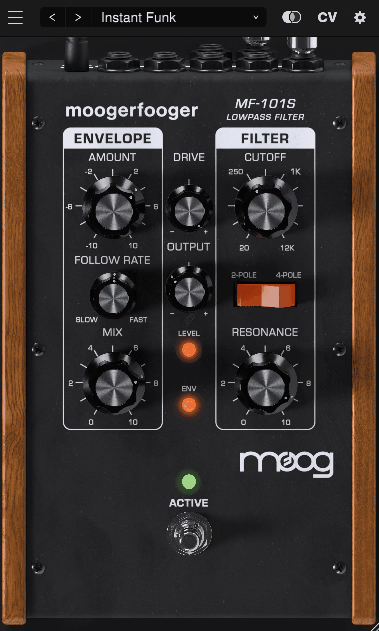
The ladder filter is the circuit that defines the Moog sound, and the software version of the MF-101S faithfully captures the specific behavior of a four-pole, 24dB-per-octave Moog ladder lowpass filter with resonance control and an envelope follower that lets the incoming audio drive the filter cutoff automatically.
This is not a transparent, clinical filter: it has a specific warmth and saturation character that comes from the way the transistor ladder circuit handles signals at and above resonance, and that character is exactly what makes it valuable.
- Four-pole 24dB/octave lowpass filter with the specific warmth and saturation character of Moog transistor ladder circuits
- Envelope follower that tracks the amplitude of the incoming audio and opens or closes the cutoff in response, creating an automatic wah-like filter movement without requiring manual automation
- Drive control for pushing the input stage into saturation before the filter, which changes the harmonic content entering the filter and produces a different kind of resonance character at high settings
- CV input emulation allowing modulation from other sources in a DAW context, preserving the hardware’s modular connectivity philosophy
I love how the envelope follower on the MF-101S responds to different source types: on a bass guitar or synth bass, it creates a natural talking-filter quality that follows the performance dynamics; on a drum bus, it opens the filter on transients and closes between hits, creating a rhythmic filtering effect that follows the groove.
Get the Free Plugin Starter Kit
The genuinely useful free DAWs and plugins worth installing. No filler. Straight to your inbox.
MF-102S Ring Modulator
Ring modulation sits in a specific creative territory between harmonic processing and outright transformation, and the MF-102S is the hardware implementation that Moog built for musicians who wanted to explore it. A ring modulator multiplies two signals together rather than mixing them, producing sum and difference frequencies that create the specific metallic, bell-like, and robotic timbres the effect is known for.

- Carrier oscillator with frequency control covering a wide range from sub-audio modulation frequencies through audio-rate carrier signals
- Carrier shape control for changing the waveshape of the internal oscillator and altering the specific harmonic content of the ring modulation output
- LFO mode at low carrier frequencies for tremolo and amplitude modulation effects rather than tonal ring modulation
- Mix control for blending the ring-modulated signal with the dry input
I believe the most useful applications of the MF-102S are on vocals and synthesizers where you want a metallic, inhuman quality: at carrier frequencies that are harmonically related to the input, the ring modulation produces musical intervals; at inharmonic carrier frequencies, it creates the characteristic clangorous, sci-fi quality that ring modulation is most associated with.
MF-103S 12-Stage Phaser
Twelve stages of phase shifting is more than most phaser effects offer, and what that additional phase depth gives you is a wider, more dramatic sweep with more prominent notches in the frequency response and a more pronounced comb filter quality at extreme settings.

The software capture of the MF-103S preserves the specific character of the analog phase shifting network that gave the original hardware its particularly lush and musical quality.
- 12-stage phase network producing deeper, more complex phase notches than the 4 or 6-stage designs common in most phaser effects
- LFO rate and depth controls for setting the speed and intensity of the sweep from subtle movement through to dramatic, sweeping effects
- Feedback control for increasing the resonance of the phase notches and creating more pronounced, narrower dips in the frequency response
- CV input for modulating the sweep depth from external sources
I must say the twelve-stage design produces a specific quality at slow sweep rates that sounds genuinely organic and alive in a way that shorter phaser chains don’t capture, particularly on pads and sustained synthesizer textures where the slow evolution of the phase sweep creates a sense of continuous movement without an obvious rhythm.
MF-104S Analog Delay
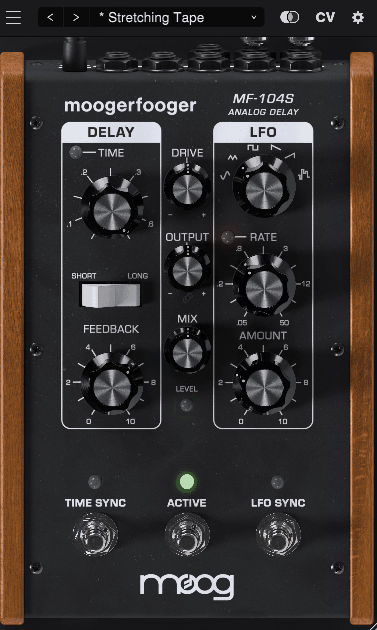
BBD (bucket brigade device) analog delay has a specific warmth and degradation character that comes from the way signal passes through a chain of capacitors rather than being stored and retrieved digitally, and MF-104S is Moog’s implementation of that circuit in a pedal format with unusually wide time range and extensive modulation options.
- BBD-based analog delay with the specific warmth, high-frequency rolloff, and subtle noise character of bucket brigade device circuits
- Delay time range covering short slapback delays through to longer echo times, with the specific pitch behavior of analog BBD circuits as the time is swept
- Feedback and mix controls for dialing in the number and level of repeats relative to the dry signal
- Modulation of the delay time for chorus-like effects at short delay times and warbling, pitch-unstable echo effects at longer times
For me, what distinguishes analog BBD delay from digital delay is how the echoes feel: they’re warmer, less defined at the high end, and the slight pitch modulation from the BBD circuit gives them a quality that feels more like a physical tape or analog system than a mathematically precise digital echo. The MF-104S captures that quality well.
MF-105S MuRF
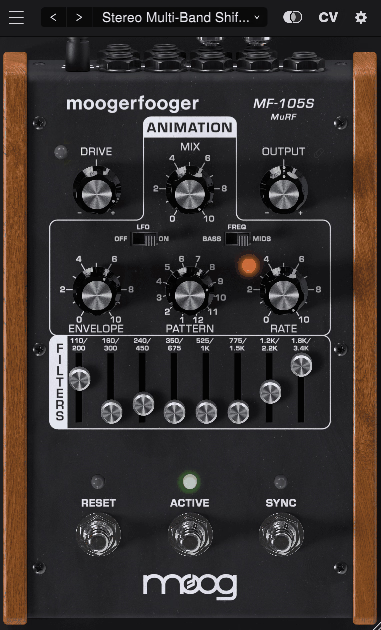
This is the most unusual tool in the collection by a significant margin, and I think understanding what it actually does is what makes it compelling. A resonant filter bank applies multiple simultaneous resonant filters across the frequency spectrum, and what the MF-105S MuRF adds on top of that is a sequencer that can animate the level of each filter band in a tempo-synced rhythmic pattern, creating a kind of timbral arpeggiator that changes the spectral character of the audio in a rhythmic, evolving way.
- Eight resonant filter bands distributed across the frequency spectrum, each with its own level that can be animated by the sequencer
- Pattern sequencer that steps through different combinations of filter band levels at a tempo-synced rate, creating rhythmic timbral variation
- Envelope follower that can control the filter band animation based on the incoming audio’s dynamics rather than a fixed sequencer pattern
- Wide sweep that moves the entire filter bank up or down in frequency while maintaining the relative spacing between bands
I realized that the MuRF is most compelling when you think of it as an animated spectral processor rather than a standard filter: it’s not just shaping the frequency response, it’s creating rhythmic timbral movement that changes the character of the sound over time in a way that feels musical and sequenced rather than random.
MF-107S FreqBox
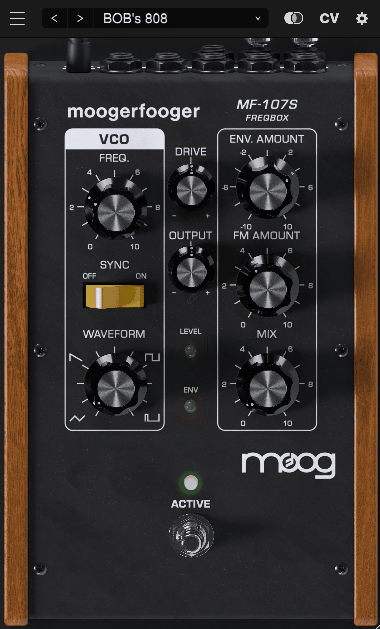
Synthesizer behavior from an effects plugin is not something you encounter often, and MF-107S does exactly that by generating its own oscillator that can be frequency-modulated and hard-synced to the incoming audio signal. This means you can use it to add synthesized tones to any audio input, with the pitch and sync behavior tied to the character of the incoming signal in ways that create a hybrid between the original audio and new synthesized content.
- Oscillator with waveshape control generating its own audio content that can be mixed with the dry signal
- Hard sync to input where the oscillator resets its phase each time the incoming audio crosses zero, locking the oscillator’s pitch and texture to the character of the input
- FM from input where the incoming audio frequency-modulates the internal oscillator, creating complex harmonic relationships between the input and the synthesized content
- Pitch tracking that attempts to follow the fundamental frequency of the incoming audio and tune the oscillator to match
I’d say FreqBox occupies the most experimental territory of any tool in this bundle, because the combination of hard sync and FM from the input creates results that are genuinely difficult to predict and control in the conventional sense, which is either its greatest strength or its biggest limitation depending on what kind of producer you are.
MF-108S Cluster Flux
The specific combination of chorus, flanging, and vibrato in a single plugin reflects the fact that all three of these effects share the same underlying mechanism, which is modulated delay at very short delay times. The MF-108S covers all three by providing control over the delay time, feedback, modulation rate, and depth in combinations that produce each character distinctly or blend between them.
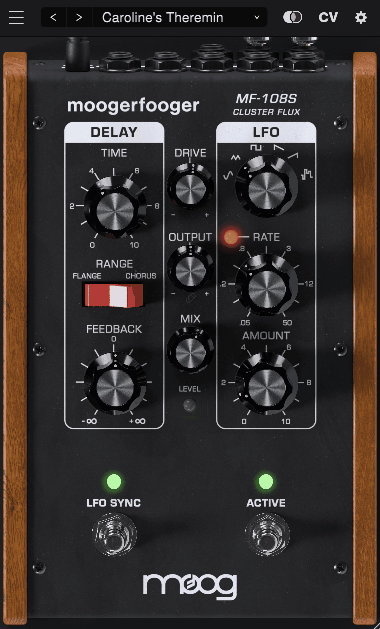
- Chorus mode with the specific character of the Moog circuit, adding width and movement without the obvious pitch modulation artifacts of more aggressive settings
- Flanging with the jet-sweep character that comes from modulated feedback in the short delay circuit, ranging from gentle to extreme
- Vibrato where only the modulated signal is output, creating pure pitch modulation without the comb filter character of chorus or flanging
- LFO rate and depth controls that span the range from very slow, barely perceptible movement through to fast, dramatic modulation
I noticed that the Cluster Flux has a specific quality at moderate flanger settings that sounds distinctly analog: there’s a warmth and unevenness to the modulation that makes it feel like a physical circuit rather than a precisely calculated digital effect, and on guitars and synthesizers that analog character is genuinely flattering.
MF-109S Saturator
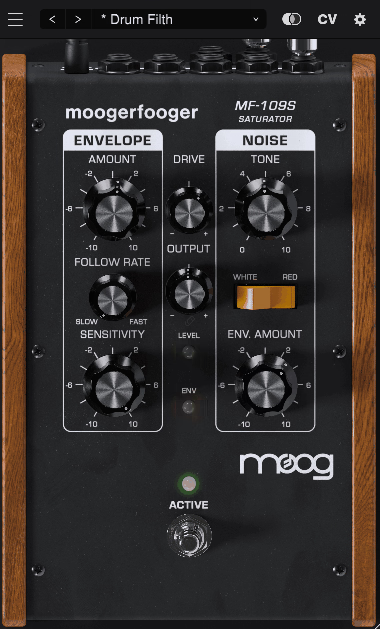
MF-109S covers harmonic saturation from subtle warmth through to heavy distortion, with input drive and output level controls that allow you to precisely dial in how much of the saturation character you want alongside how much level change the saturation introduces.
- Drive control covering the range from barely audible harmonic enrichment through to heavy saturation and distortion
- Tone control for shaping the high-frequency content of the saturated signal, allowing you to add warmth without excessive brightness or control harshness at high drive settings
- Output level control for compensating for the loudness increase that saturation produces and making A/B comparisons at matched loudness meaningful
- Soft and hard clipping behavior that changes character as the drive increases, from smooth soft-knee saturation at lower settings through to harder, more aggressive clipping at maximum drive
For me, the MF-109S is the plugin in this bundle I’d reach for most frequently in a standard production context, because subtle saturation with a Moog-character circuit is genuinely useful on individual tracks, buses, and even mix bus applications where you want harmonic richness and warmth without an obvious effect sound.
Final Thoughts
What holds this collection together is something that most effects bundles don’t have: a shared hardware lineage. All eight of these tools come from the same design era, the same circuit philosophy, and the same approach to connectivity and modulation, which means they feel coherent when used together in a way that a bundle assembled from unrelated tools wouldn’t. Running a synthesizer through the MF-101S lowpass filter, into the MF-104S delay, with the MF-109S adding saturation to the combined output, produces results that feel like a unified system rather than three separate plugins being applied in sequence.
The CV connectivity emulation in the software versions also means you can use them in the kind of cross-modulated configurations the hardware was known for, where the envelope follower output of one unit drives the filter cutoff of another, or the LFO of the delay modulates the cutoff of the filter. In a DAW context this requires routing creativity, but the fact that it’s possible at all reflects Moog’s commitment to preserving what made the hardware distinctive.
I think the honest assessment of the bundle is this: if the specific circuits these plugins are based on don’t mean anything to you, there are more capable and more versatile effects collections available at competitive prices. But if you care about what these pieces of hardware represent historically and sonically, this is the most direct way to access that sound in a software environment, and that makes it a genuinely valuable and irreplaceable collection for the right producer.
Check here: Moogerfooger Effects Plugin Bundle
Get the Free Plugin Starter Kit
The genuinely useful free DAWs and plugins worth installing. No filler. Straight to your inbox.

Hello, I’m Viliam, I started this audio plugin focused blog to keep you updated on the latest trends, news and everything plugin related. I’ll put the most emphasis on the topics covering best VST, AU and AAX plugins. If you find some great plugin suggestions for us to include on our site, feel free to let me know, so I can take a look!