
Comb filters and resonators are among the most misunderstood and underused processing tools in modern production, which is a shame because they do things no other effect category can replicate.
A comb filter mixes a signal with a slightly delayed version of itself, creating peaks and notches at regular intervals across the frequency spectrum, a pattern that looks like the teeth of a comb. Feed that delayed signal back into itself and you get resonance, which means specific frequencies build and ring while others are suppressed.
Depending on how you control those parameters, the result can be anything from a flanging metal texture to a pitched physical modeling resonance that transforms a simple drum hit into something that sounds like a struck piece of steel or glass.
The plugins below represent the full range of what this technology can do, from workhorse multiband tools to extraordinary one-of-a-kind modal engines.
1. MeldaProduction MCombMB
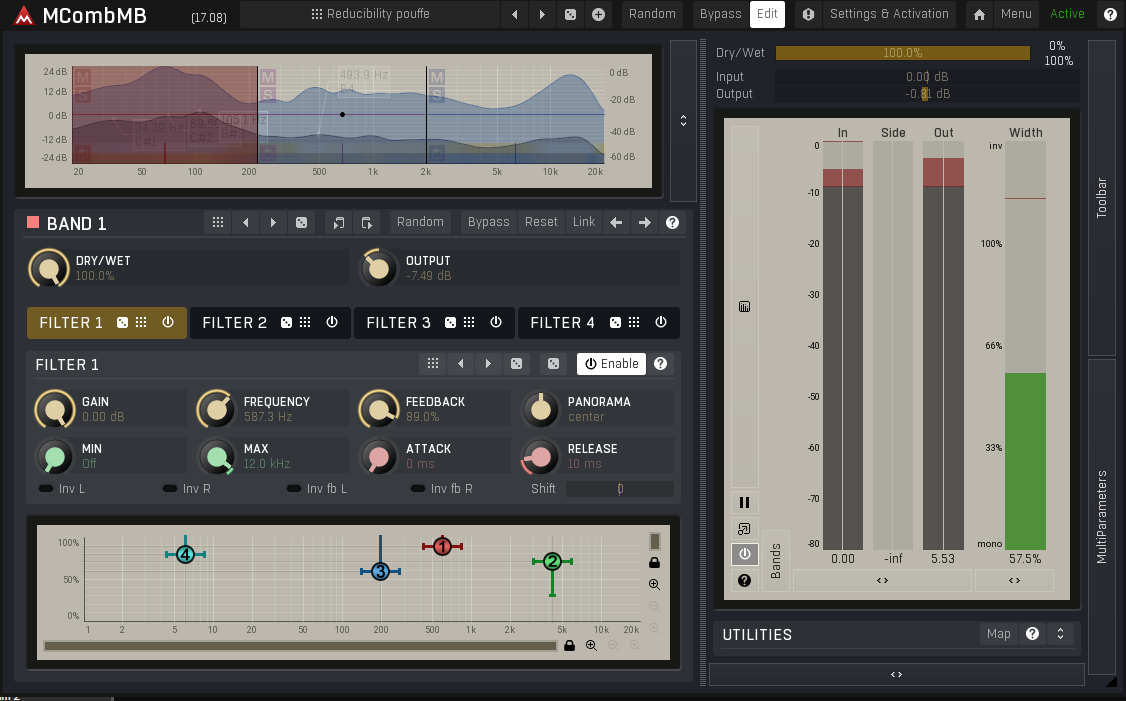
Comb filtering is one of those effects where the sound design potential is essentially infinite, and MCombMB from MeldaProduction is the plugin that makes that potential most tangible. It’s a multi-band comb filter with up to six separate bands, each running up to four comb filters configurable in series, parallel, or any combination. K
MCombMB gives you up to six separate frequency bands, each with up to four comb filters that can be arranged in series, parallel, or mixed configurations. Series arrangements stack the combs for deeper, more pronounced resonance patterns.
Parallel arrangements blend filtered and unfiltered signals for subtler effects. Each filter also has adjustable feedback with a bandpass circuit and a built-in limiter to prevent runaway resonance from destroying your signal. You can also invert phase per channel for stereo width effects that no standard width plugin would produce.
- Four Fully-Featured Modulators:
The plugin provides four modulators that can control any parameter, including other modulators. Each one can function as an LFO, level follower, MIDI-triggered ADSR envelope, randomizer, or pitch detector. This is Melda’s modular modulation system in full deployment, and it turns MCombMB from a static effect into an animated, living texture machine. KVR reviewer feedback consistently notes the modulation system as the plugin’s central selling point once producers get past the initial learning curve.
- Smart Randomization Engine:
The smart randomization system learns from existing presets and uses that knowledge to generate musically useful variations rather than pure noise.
This is genuinely useful in a plugin where the parameter space is this large. Three randomization levels are available: complete full randomization of everything, subtle small changes from the current state, and the smart engine that uses preset analysis to produce better outcomes. Locked parameters are excluded from randomization, which makes targeted exploration practical.
2. Polyverse Supermodal
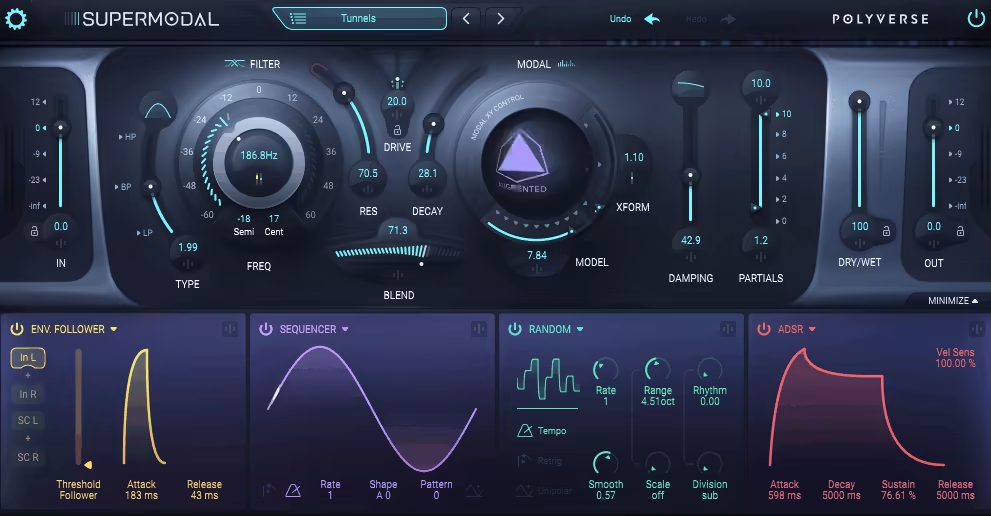
There are filter plugins, and then there is Supermodal from Polyverse. The distinction matters because most filters in any category modify existing frequency content in relatively predictable ways, while Supermodal uses hundreds of precisely tuned bandpass filters to simulate the resonant properties of physical objects, acoustic spaces, and mathematically modeled abstractions.
- 27 Modal Models with Three Variations Each:
Nine modal model types are included, each with three variations for a total of 27 modes. The types span physical objects, acoustic bodies, mathematical abstractions, vocal formants, phasers, and flangers.
Every mode is built from hundreds of surgically tuned bandpass filters that collectively model the resonant behavior of the referenced material. You can morph between all variations using an XY-style trackball display, with smooth transitions that make sound exploration feel intuitive rather than random.
- State-Variable Filter in Parallel:
Running alongside the modal engine is a 24dB per-octave state-variable filter that blends continuously between high-pass, band-pass, and low-pass modes.
It self-resonates at high peak settings, and a Drive control adds saturation before the self-oscillation point. A Blend slider crossfades between the SVF and the modal engine, meaning you can anchor the sound in familiar filter territory and then gradually introduce the modal resonances, or go entirely modal for the full physical modeling treatment.
- Four Modulation Slots with Six Sources:
The modulation system provides four slots each supporting six sources: Meta knob, ADSR, envelope follower, step sequencer, MIDI/CV triggers, and randomizer. Both filters operate in full stereo, with the left and right channels modulatable independently, together, or separately. Sweetwater calls the cross-modulation capability “insane,” and for once that word is appropriate.
- Decay, Damping, and Partials Control:
Shaping the modal resonances involves Decay, which controls how long the resonances ring out; Damping, which attenuates high-frequency content within the resonance tail; and Partials, which shifts the tonal balance between lower and upper resonant frequencies. These three parameters are the precision tools that turn the modal engine from a broad-stroke effect into something surgically useful.
- 200+ Presets:
Over 200 factory presets cover the range of what Supermodal can do across electronic music production, sound design, and cinematic work.
3. Xynth Audio Rezonato
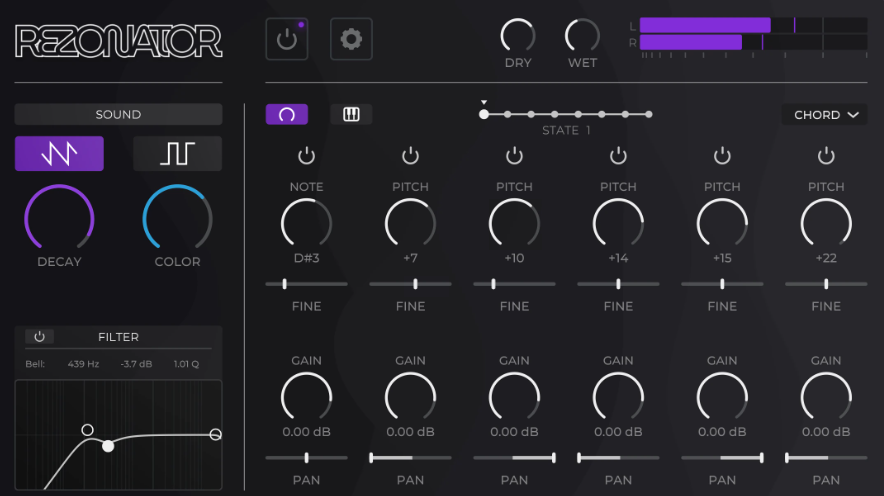
For producers who want a straightforward harmonic resonator at a genuinely accessible price, Rezonato from Xynth Audio is the obvious recommendation. Six tunable resonators, MIDI input, multiple states for chord/harmony programming, and built-in wet-signal effects.
The core engine consists of six individual resonators each independently tunable, with the first resonator setting the root note and the remaining five tuned relative to it. This setup makes chord and harmony construction natural rather than arithmetic. Independent gain and panning controls per resonator allow full spatial placement of each harmonic layer across the stereo field. Saw mode engages positive comb filtering that resonates all harmonics, while Square mode engages negative comb filtering that resonates only odd harmonics.
- Multiple States with Single-Slider Switching:
The States system allows up to eight complete resonator configurations to be stored, switchable instantly with a single slider. This is designed for chord progression, key changes, or complex harmonic sequences that would otherwise require automation of individual resonator pitches. When combined with portamento (glide between note values), real-time transitions become smooth and musical. The SET ALL right-click function sets a parameter to the same value across all eight states simultaneously, which is a practical workflow shortcut when working with complex state sequences.
- MIDI Input and Built-In FX:
Direct MIDI routing into the plugin enables real-time performance of harmonics rather than programming them statically, opening up entirely different compositional approaches. The wet signal also has access to built-in filter, reverb, and stereo-width effects that process only the resonated signal, leaving the dry signal unaffected. This targeted processing keeps the low-end clean while enriching the harmonic content, which the developer notes was a direct response to users consistently wanting to remove “low-end mud” from the resonated output.
4. FabFilter Volcano 3
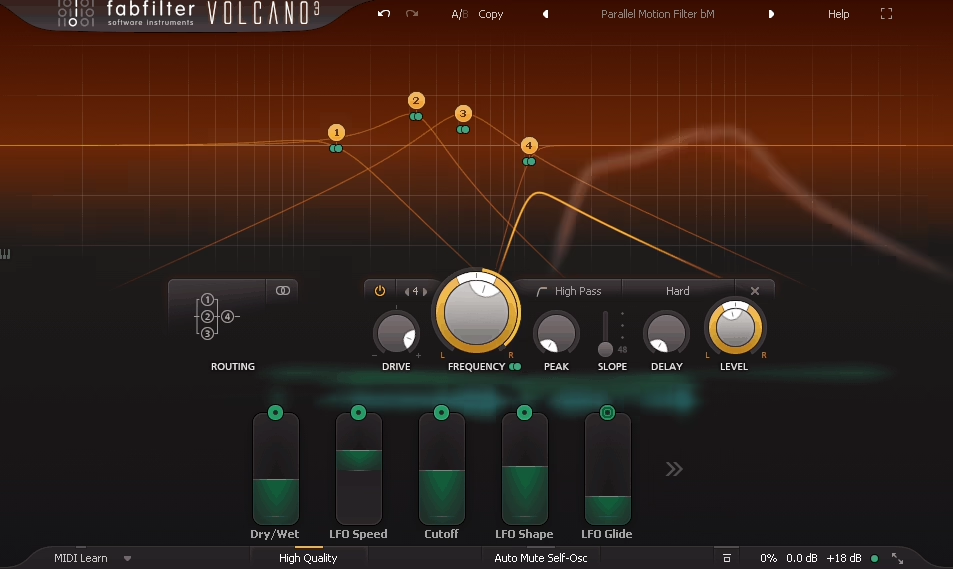
Volcano 3 from FabFilter has been the definitive creative filter plugin in its category since FabFilter first introduced the design in 2005, and the third version represents its most comprehensive evolution yet.
It offers up to four simultaneous filters are available, each configurable in any of eight serial, parallel, or hybrid routing arrangements. This includes per-channel routing in stereo L/R and M/S modes, meaning you can have different filters affecting different parts of the stereo field simultaneously.
Each filter has eleven style options ranging from Gentle and Tube to Metal and Extreme, all with full non-linear saturation characteristics that change based on how hard the Drive is pushed.
- Per-Filter Delay for Comb Effects:
A Delay control per filter adds up to 50ms of offset to that filter’s output, which when combined with parallel routing and the Mix slider produces comb filtering, Haas effects, chorusing, and flanging. Mixonline specifically highlighted this as a feature that transforms Volcano from a conventional filter into a creative effects engine.
- XLFO with Up to 16 Editable Steps:
The XLFO is a host-synced waveform generator with up to 16 editable steps, adjustable glide shapes, per-step quantization to musical note values, and a frequency range that extends to 500Hz, well into audio-rate FM territory. This is not a typical LFO with switchable waveforms. It’s a step-sequencer/LFO hybrid that can sequence arpeggiated filter patterns, random-hold effects, and anything in between. Multiple XLFOs, envelope generators, envelope followers, and MIDI sources can all be deployed simultaneously in Volcano 3’s drag-and-drop modulation system.
- Self-Oscillation with Auto Mute:
All eleven filter styles support resonance boosting up to self-oscillation, and an Auto Mute Self-Osc button at the bottom of the interface mutes the oscillating filter when input audio stops, preventing the filter from ringing on indefinitely when there’s no signal to sustain it.
5. Waves MetaFilter
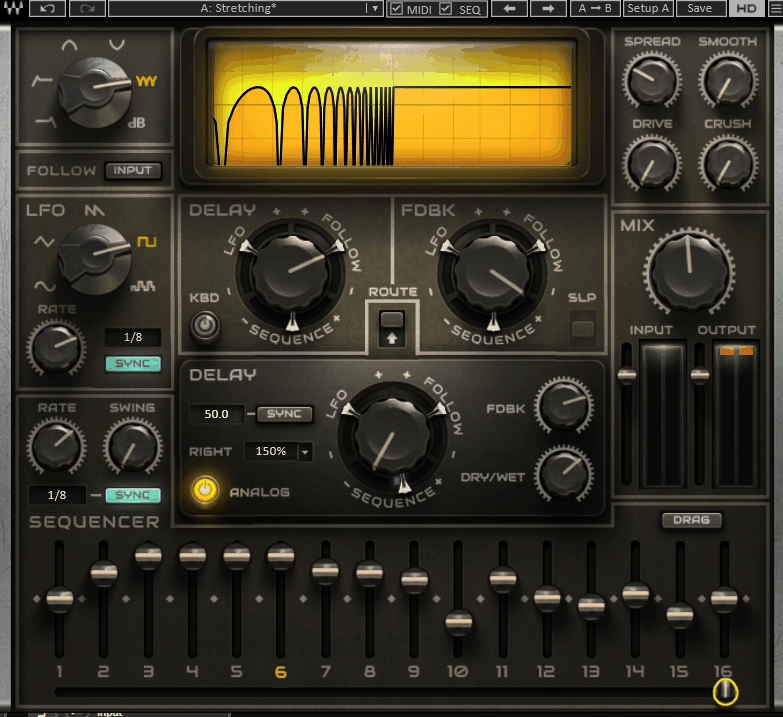
MetaFilter sits in a specific position in this category: it’s the most immediately accessible of all the plugins here, combining six filter modes including a dedicated comb filter mode with a straightforward triple-modulation system and a built-in delay.
It operates in six modes: low-pass, high-pass, band-pass, band-reject, comb, and amp (gate-style level effects). The comb mode specifically uses a very fast delay line to alter the harmonic content of the signal, with the Resonance control adjusting the feedback amount in that mode rather than the filter’s self-oscillation level.
Channel spread offsets the cutoff between left and right channels by up to 50% in either direction, which in comb mode produces stereo widening through phase offset rather than standard L/R level differences.
- Three Simultaneous Modulation Sources:
Three independent modulators can each control the filter cutoff, resonance, and delay time independently with positive or inverted polarity: a 16-step sequencer, an LFO with multiple waveforms, and an envelope follower with sidechaining. The sequencer and LFO both sync to host tempo in ten rhythmic values, keeping everything locked to the groove.
- Built-In Delay with Analog Character:
A fully modulatable analog delay runs inside the plugin with a right-channel offset option at 150% or 200% of the main delay time, creating stereo widening, rhythmic echo, and comb-filtering effects that stack on top of the filter’s own processing. The delay can be routed pre or post filter in the signal chain.
- Drive and Bit-Crusher:
A Drive control adds saturation ranging from subtle analog warmth to aggressive grit, and a separate Bit-Crusher applies digital degradation from gentle crunching to complete contamination of the signal. Both can be placed pre or post filter in the chain.
- Smooth Parameter:
A Smooth control reduces the abruptness of changes caused by any of the modulators, which is useful for taming the step sequencer or producing slower transitions between states in live performance. This is a practical addition rather than a creative one, but for live use and for avoiding click artifacts in automations it’s consistently useful.
6. Minimal Audio Hybrid Filter
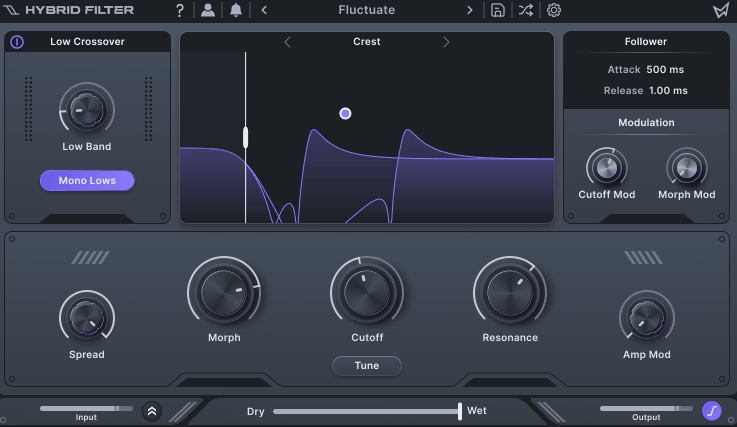
Minimal Audio is a relatively young company but their approach is clear: make tools that genuinely expand what producers can do, not just additional versions of things that already exist. Hybrid Filter sits squarely in that philosophy. With over 50 filter types including morphing, formant, comb, and phaser modes, a real-time filter response display, a safe-bass crossover system, tuned cutoff, amplitude modulation, and soft-clip limiting, it’s genuinely comprehensive without being overwhelming.
- 50+ Filter Types with Custom Morphing:
The standout feature is over 50 filter types across comb, formant, phaser, and morphing modes, plus standard LP/HP/BP filters with carefully designed resonance curves. The morphing mode specifically lets you create custom filter configurations by manipulating a morph parameter that blends between internal filter stages in ways that don’t correspond to any named filter type.
- Safe Bass Crossover:
A built-in multiband crossover keeps the low end of the signal protected from the filter processing while allowing full creative freedom in the mid-range and upper frequencies. For bass music production specifically, this is a genuinely essential feature that no amount of parallel routing can fully replicate in terms of speed and simplicity.
- Tuned Cutoff and Amplitude Modulation:
Setting the filter cutoff to exact note values creates harmonic resonance effects where the filter’s peak aligns with musical pitches, making comb filter textures track the musical content of the signal rather than sitting at arbitrary frequencies. A separate amplitude modulation mode uses cutoff-tracking AM to generate additional harmonic content at the filter frequency, which produces a tuned distortion effect quite unlike anything a standard saturation plugin creates. These two features together are what make Hybrid Filter useful for synthesis-style processing in addition to conventional filtering.
- Envelope Follower and Stereo Spread:
A built-in envelope follower with adjustable attack and release controls the morph and cutoff parameters based on the incoming audio’s amplitude, creating dynamic filter movement that responds to the energy of the input. A Spread knob independently offsets the left and right channel cutoffs for instant stereo widening without any additional routing. The combination of these two features means Hybrid Filter can produce auto-filter effects that move in the stereo field automatically based on the signal’s own dynamics.
7. Tritik Moodal
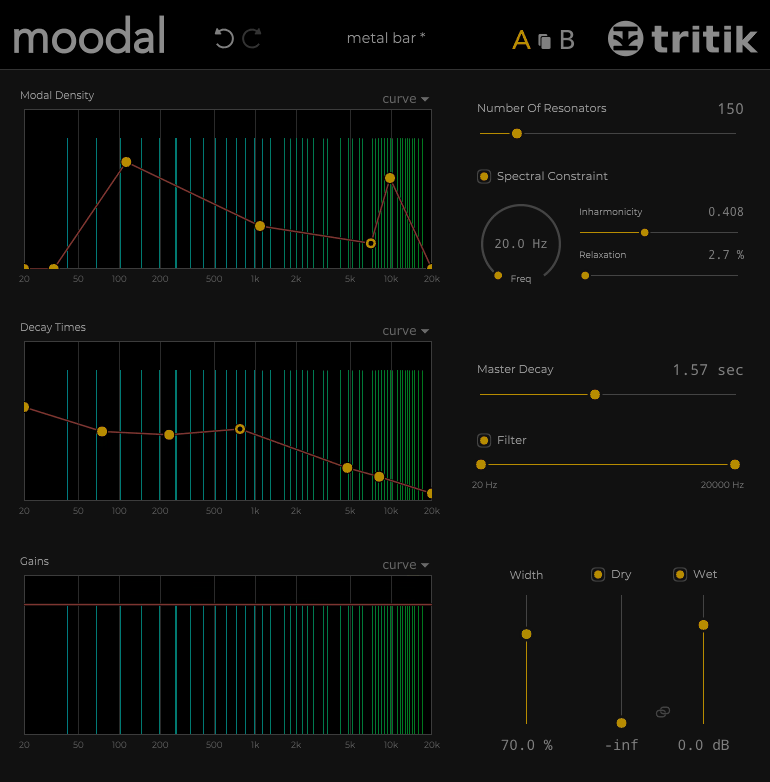
No other plugin on this list sounds quite like Moodal. It’s a spectral resonator that deploys up to 1,000 modal filters simultaneously, shaped by three editable graphic curves that control the density, decay time, and gain of the resonators across the full frequency range.
- Up to 1,000 Modal Resonators:
The engine supports anywhere from 10 to 1,000 simultaneous resonant filters, all visualized in the frequency display. At low counts you get clearly audible individual resonant peaks that create obvious tonal coloration. At high counts the dense filter bank produces a smoother, more reverberant quality that can approach room and hall simulation from a different algorithmic direction than conventional reverb.
- Three Editable Frequency Curves:
Rather than controlling each of the up to 1,000 resonators individually, Moodal uses three graphic curves for Density, Decay, and Gain that shape all resonators simultaneously as a function of frequency. This gives you spectral-level control over how many resonators exist in each frequency range, how long they ring, and how loud they are, all by drawing or adjusting curve shapes in the interface.
- Spectral Constraint with Inharmonicity and Relaxation:
When Spectral Constraint is activated, the resonators align to harmonics of a root frequency set by the F0 knob. Inharmonicity then spreads those harmonics in ways that range from perfectly harmonic at low settings to dramatically dissonant at high settings. The Relaxation slider cross-fades between constrained harmonic partials and unconstrained natural resonator frequencies.
- Up to 10 Seconds of Master Decay:
Master Decay controls the overall resonance tail length across all resonators, with a maximum of ten seconds. At long decay settings the plugin produces reverberant psychoacoustic spaces that feel room-like without using convolution or any conventional reverb algorithm. A binary low/high-pass filter at the output shapes the resonated signal without affecting the dry path.
8. Kilohearts Comb Filter (Free)
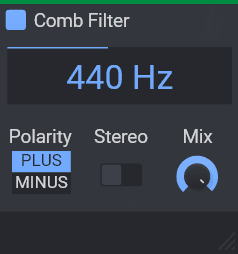
Part of the Kilohearts Essentials free collection, the Comb Filter Snapin is the most minimal plugin on this list: three knobs and two switches. It mixes the input signal with a delayed version of itself, creating peaks and notches at multiples of the base frequency, with adjustable polarity and a stereo mode that flips the polarity on the right channel.
That stereo mode is the genuinely clever feature here.
By processing left and right differently, you get a wide stereo effect that collapses cleanly back to the original signal when summed to mono, which is a property most stereo widening approaches don’t share.
- Positive and Negative Polarity Modes:
Plus polarity places a peak at 0 Hz and creates a positive comb pattern that resonates all harmonics in common with the base frequency. Minus polarity places a trough at 0 Hz and inverts the pattern, creating a negative comb that suppresses those harmonics instead.
The effect is a distinctly different sonic character between the two modes, and switching between them while automating the cutoff frequency produces dynamic spectral movement that’s hard to replicate with conventional EQ or filtering.
9. Sugar Bytes WOW 2
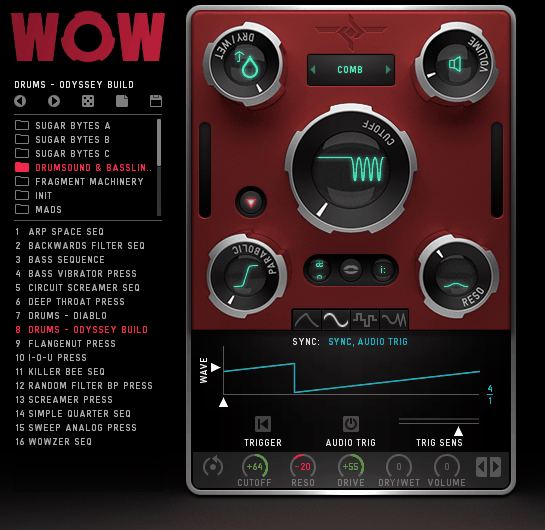
WOW 2 from Sugar Bytes is not a comb filter or resonator plugin in the narrow sense, but it’s on this list because it does both things, along with 19 other filter types, and it does them inside one of the most creative filter plugin designs ever released. Skrillex, Boys Noize, SiriusMo, and Modeselektor use it.
The BPM-synced step sequencer, the borrowed Wobble Generator from the Cyclop synthesizer, and the ability for modulators to modulate each other means WOW2’s behavior can reach a complexity that plugins with more parameters rarely approach.
- 21 Filter Types Including Comb:
WOW2 includes 21 filter types spanning lowpass up to 8-pole, highpass, bandpass, band-reject, SVF, Diode MS ladder, Transistor ladder, and comb, all designed for harmonics without aliasing or degrading the source material.
The steep 8-pole lowpass modes provide the thick, bubbly saturation character that distinguishes the Moog and MS-20 style filters from gentler designs. Sugar Bytes notes all 21 types work in Vowel mode, which means any of them can be made to morph between formant shapes.
- Vowel Mode with Nine Shapes:
The Vowel mode swings the cutoff between two simultaneously selected vowel sounds chosen from a set of nine phonemes. The vowels are precisely defined as IPA phonemes, not approximations.
When combined with comb or bandpass modes at high resonance, this produces genuinely talkbox-like sounds.
- Four Modulation Sources with Cross-Modulation:
Four modulation engines operate in parallel: an envelope follower, a 13-waveform LFO, a 16-step step sequencer, and the Wobble Generator lifted from the Cyclop synthesizer. The extraordinary part is that these modulators can modulate each other, meaning the LFO can control the step sequencer‘s rate, the envelope follower can shift the LFO waveform selection, and so on.
- Seven Distortion Types Pre/Post Filter:
Three analog modeling overdrives and four digital distortion modes can be placed either pre-filter or post-filter in the signal chain. This pre/post placement choice changes the interaction between the distortion and the filter resonance dramatically. Pre-filter distortion adds harmonic content before the filter responds to it, enhancing the filter’s resonant character. Post-filter distortion saturates the filtered output, adding grit to an already-shaped signal.
- Over 250 Presets with One-Click Randomize:
More than 250 factory presets cover the enormous range of what WOW2 can produce, and a single-click randomize function can spawn new starting points from any state.

Hello, I’m Viliam, I started this audio plugin focused blog to keep you updated on the latest trends, news and everything plugin related. I’ll put the most emphasis on the topics covering best VST, AU and AAX plugins. If you find some great plugin suggestions for us to include on our site, feel free to let me know, so I can take a look!