
Choir libraries occupy a strange and wonderful corner of the sample world. Unlike strings or brass, where you can layer and tweak your way to something plausible with enough plugins, a choir that doesn’t sound right is immediately obvious.
The human voice in ensemble is one of the most psychologically loaded sounds there is, and our ears are tuned to flag anything that feels off about it. That’s what makes a genuinely great choir library so valuable and, honestly, so rare.For years the conversation was limited to a handful of behemoth libraries that cost a small fortune and required a serious amount of learning time before they’d give you anything usable. That’s changed considerably.
Between the rise of deeply sampled, polyphonic legato instruments and a new wave of more approachable tools designed for producers who aren’t necessarily scoring for a Hollywood picture, you now have real options at every price point.
Whether you’re sketching an emotional cue for a short film, building an atmospheric layer in an electronic track, or working on a full orchestral mockup and need every SATB section performing independently with convincing legato, there’s something on this list for you.
From the Pluginerds Store
One more thing before you finish reading: we also stock studio hardware and accessories directly through Pluginerds Shop. Microphones, interfaces, controllers, cables, and the small stuff that never comes included with anything.
Visit Pluginerds Shop1. Native Instruments Choir: OMNIA
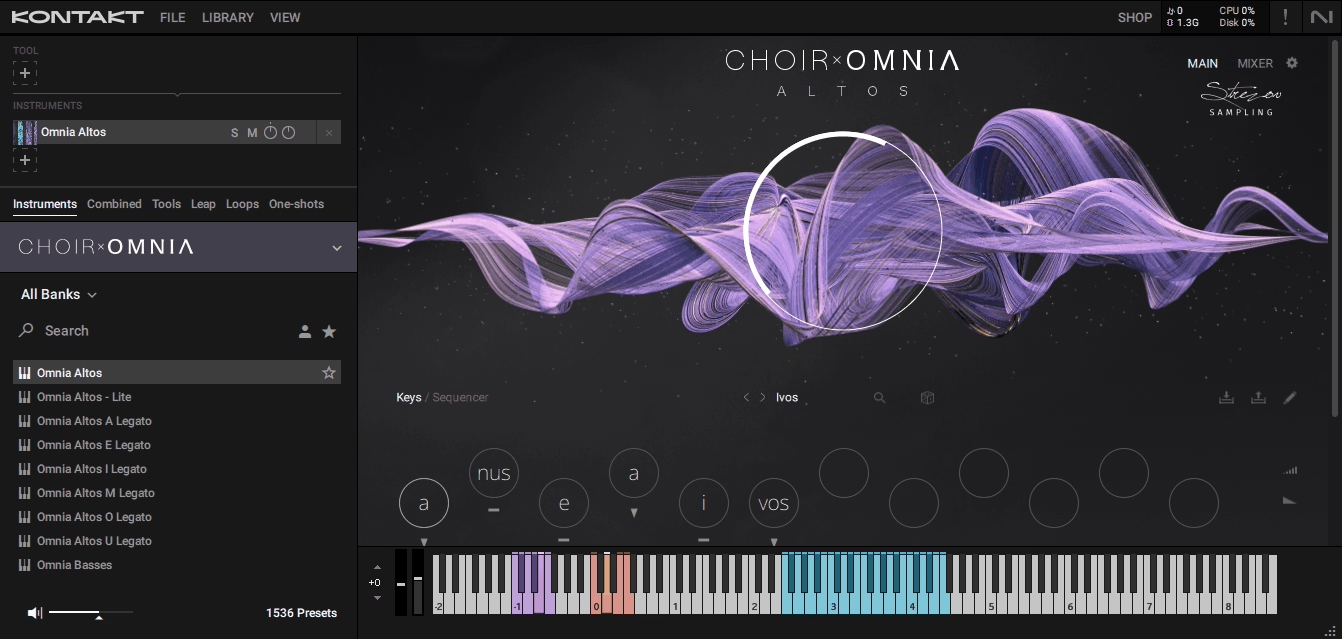
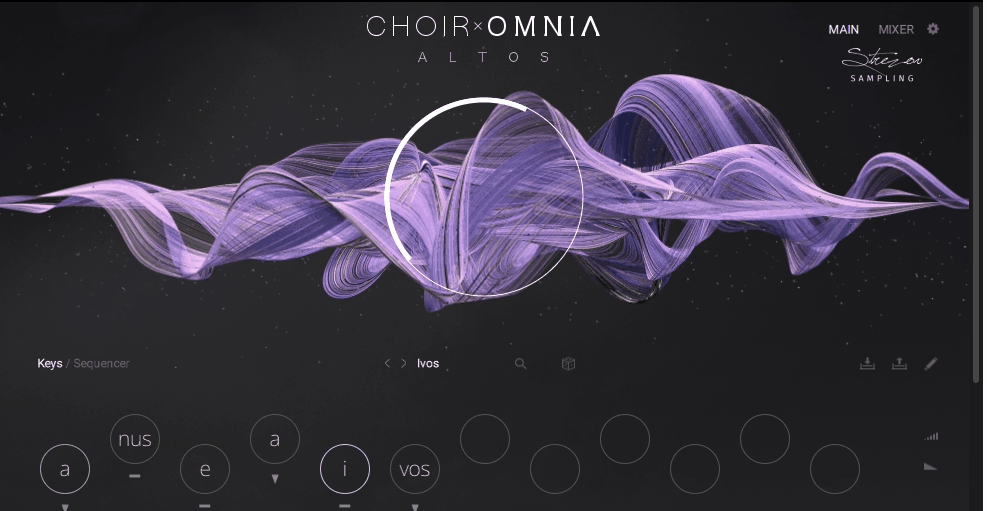
Choir: OMNIA is what happens when you take Strezov Sampling’s deep knowledge of how to record and present a choir with conviction, combine it with NI’s platform resources, and give the result a genuinely novel performance engine.
The library captures 40 singers at Sofia Session Studio over six weeks, using a world-class microphone chain from AEA, Neumann, DPA, and Sanken, and the resulting sound is clear, wide, and distinctly European in character, which suits everything from requiems to contemporary cinematic work. I’d say this is one of the more ambitious choir instruments ever released in terms of what it’s trying to let you actually do at the keyboard in real time.
- Syllabuilder Engine:
The centrepiece of OMNIA is the Syllabuilder, which gives you 16 syllables to work with in two transform modes that merge phonemes to create new vocalizations. In Keys mode, keyswitches let you flip between syllables on the fly for sketching and simple lines.
In Sequence mode, you build a string of syllables with note intervals and other parameters that fire automatically, so you can focus on chords and dynamics without managing every phoneme manually. Randomize buttons generate new syllable sequences for instant variation, and the depth of what you can configure here is genuinely impressive once you spend time with it.
- Polyphonic True Legato:
Like the best Strezov libraries, OMNIA carries Polyphonic True Legato, meaning you can hold chords with one hand and play a melody with the other and have the transitions connect naturally across both.
This is still one of the genuinely hard problems in choir sampling, and hearing it work across all four SATB sections simultaneously is something I found myself returning to just to enjoy.
- Five Mic Positions and 189 Presets:
The five mixable microphone positions give you real control over the acoustic signature of the ensemble, from intimate to room-filling, and the 70GB library is split across four independent instruments covering soprano, alto, tenor, and bass. The 189 factory presets cover a wide stylistic range, but the real value is in building your own combinations knowing each section is this precisely captured.
Get the Free Plugin Starter Kit
The genuinely useful free DAWs and plugins worth installing. No filler. Straight to your inbox.
2. Excite Audio Bloom Vocal Choir
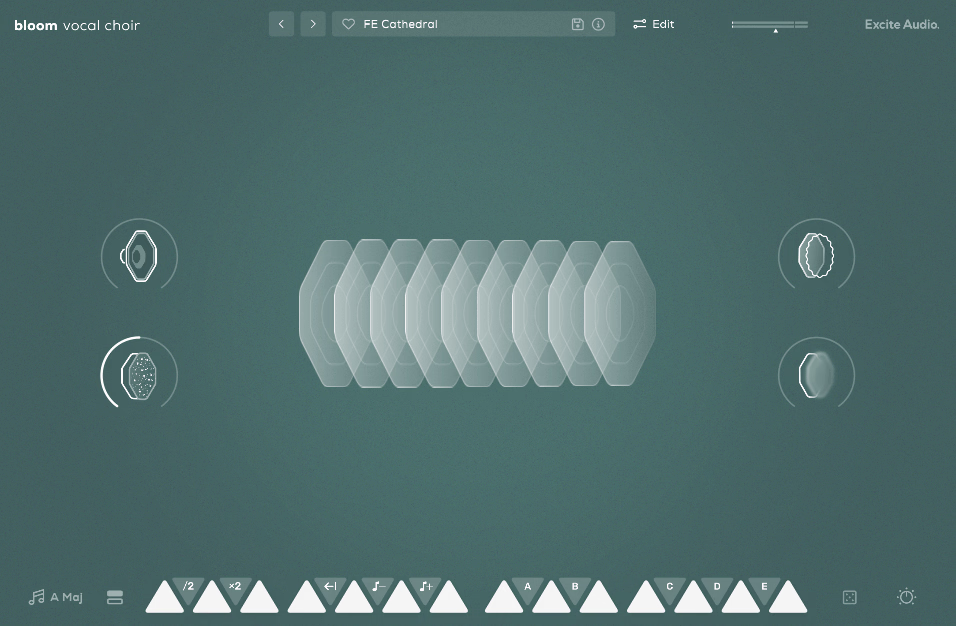
Bloom Vocal Choir launched in April 2025 and immediately stood out for not being the kind of choir library that makes you learn a new instrument before it gives you anything back. Excite Audio have always been good at building tools that feel intuitive the moment you open them, and this one is no exception.
It covers the full vocal spectrum from deep baritones to the highest sopranos, but the way you interact with it is closer to a creative sample instrument than a traditional choir library. For producers working in electronic, ambient, or hybrid cinematic music, I think this hits a specific sweet spot that very few other tools in this list occupy.
- Built-In Sequencer for Harmony Stacking:
The sequencer is Bloom Vocal Choir’s signature feature and the thing that separates it most clearly from traditional choir tools. 14 BPM-synced samples are spread across two octaves, with white keys triggering choir samples and loops while black keys alter properties like playback speed, pitch, and effect modulation. This layout means you can build interweaving vocal harmonies without needing to know how to voice a choir correctly, which I genuinely appreciate as a workflow advantage.
- Eight Banks with 250+ Presets:
The library organizes its content into eight distinct banks covering Basic, Drones, Experimental, Full Ensemble, High, Low, Melodic, and Rhythmic categories, with over 250 presets across them.
The Experimental and Rhythmic categories in particular produce results that no traditional choir library would even attempt, and the Full Ensemble presets do a convincing job of evoking a complete SATB sound when you need something more classical.
- User Sample Import and Sample Edit Page:
One of Bloom Vocal Choir’s newer additions is the ability to drag and drop your own audio files directly into the instrument, set their key and BPM, and have them integrate into the Bloom engine immediately. The Edit page gives you start and end point control, playback direction, pitch, formant, and envelope settings, which effectively makes this a light sample instrument as well as a preset-based choir tool.
- Three Effects and Four Macros:
The built-in effects include Reverb with Hall, Plate, and Spring algorithms, Delay, and a Doubler, and four macro controls (Ascend, Dust, Phaser, and a fourth) handle specialized chains that are tuned to the specific character of the vocal content. I love how quickly these macros transform a preset without needing to touch any deeper settings.
3. Heavyocity Mosaic Voices
Mosaic Voices is not the choir library you reach for when you need a realistic choir passage. I want to be clear about that up front, because it will save you some confusion. What it is, instead, is one of the best hybrid vocal texture instruments available, and that’s a genuinely valuable thing to have.
Heavyocity built it around the three-channel Mosaic Engine, which lets you simultaneously layer organic male and female choir recordings, synthesized vocal pads, and intricate noise and drone layers, mixing all three against each other in real time. The results are often haunting, atmospheric, and sonically unlike anything you’d get from a traditional choir library, which is exactly the point.
- Three-Channel Mosaic Engine:
The engine is where Mosaic Voices lives and breathes. Each of the three channels holds a different category of source material, organic vocals, synth pads, or noise and drone layers, and you blend them with independent level and character controls.
The combinations you can build are genuinely not predictable from any single channel in isolation, and I found this inspires a different kind of compositional thinking than working with a conventional choir.
- 130 Snapshot Presets:
Heavyocity have curated 130 snapshot presets organized into Hybrid, Organic, and Sound Sources categories that present starting points across an enormous range of moods. The rhythmic and arpeggiated presets in particular showcase how far from traditional choir territory this instrument can travel, producing gated, pulsing, evolving textures that would be at home in electronic or dark ambient production as easily as in a cinematic score.
- 8GB+ of Production-Ready Content:
With over 8GB of compressed content, the library is substantial enough to cover a wide range of vocal character across all three channel types. I noticed the sound quality is consistently excellent throughout, which makes Mosaic Voices a reliable instinct for building layered vocal beds quickly without reaching for additional processing to make things sit.
4. EastWest Hollywood Choirs Diamond
The library was produced by Doug Rogers and Nick Phoenix at EastWest Studios on Sunset Boulevard, featuring brand new recordings of separate male and female choirs across 59GB of 24-bit samples, and the dynamic range from a whisper to a full fortissimo is genuinely jaw-dropping when you push it.
Hollywood Choirs Diamond, is by almost any measure, the most complete and technically capable choir library on this list. It’s also the most demanding to use well, which is the tradeoff you accept when you want the most control.
If you’re scoring for film, TV, or games and you need a choir that can actually sing your words in any language, this is the library the industry reaches for.
- WordBuilder 2 with DAW Sync:
The WordBuilder engine is what makes Hollywood Choirs fundamentally different from everything else on this list. You type any word or phrase and the choir sings it, with 26 additional phonemes recorded compared to the predecessor Symphonic Choirs, resulting in significantly improved realism and support for more languages.
WordBuilder 2 adds DAW synchronization so the text position follows your playhead, which solves one of the major workflow frustrations of the original. There is a learning curve to get the phoneme input right, but once you’ve spent the time, the results are unlike anything else.
- Five Mic Mixes:
The Diamond edition includes Main, Close, Stage, Mid, and Surround microphone mixes, giving you full acoustic control over where the choir sits in three-dimensional space. This is essential for surround and spatial audio work, and the quality difference between mic positions is substantial enough that mixing between them genuinely shapes the character of a performance rather than just adjusting level.
- 110 Pre-Built Editable Phrases:
For composers who need to work quickly, 110 ready-made WordBuilder phrases in English, German, and Latin are included and can be dropped directly into a session as starting points. These cover the kinds of choral text that come up repeatedly in cinematic scoring, from liturgical Latin to dramatic English, and they’re all editable, so you can adapt them to your specific needs rather than using them verbatim.
5. Spitfire Originals Epic Choir
For $29, I believe Spitfire’s Originals Epic Choir might be the single best value proposition in this entire category. That’s a strong claim, but when you consider what you’re getting, it holds up.
This is 50 of London’s finest singers recorded at AIR Studios’ Lyndhurst Hall, one of the genuinely legendary recording spaces in the world, split into two sections with sopranos and altos in one and tenors and basses in the other.
The hall acoustics do a lot of heavy lifting, giving the recordings a natural sense of space and grandeur that more clinical-sounding libraries spend a great deal of processing trying to recreate. I found the sound consistently described as natural, classy, and immediately usable, and that matches my own experience with it completely.
- 12 Articulations Across Two Sections:
The library gives you 12 articulations covering longs like Ahh and Mmm, Episodic Combo patches that blend vowels over time, and short staccato syllables that are keyswitchable for rhythmic punctuation. The Episodic Combo articulations are inspired by gothic and medieval chanting and produce a slowly shifting, vowel-blending quality that works brilliantly for anything with a historical or ritual feel. Both sections have identical articulations, so you always have both halves of the ensemble available in the same format.
- Three Mic Signals Including Ethereal:
The Close, Decca Tree, and Ethereal signals give you three fundamentally different acoustic characters to blend. Close is upfront and focused, Tree is spacious and natural using the real Decca array setup in Lyndhurst Hall, and Ethereal applies saturation, reverb, and EQ for a processed, larger-than-life presence that Spitfire describes as similar to a subtle Aural Exciter. I particularly love the Ethereal signal on sustained Ahh passages in atmospheric or ambient contexts.
- Under 3GB, No Third-Party Player:
Epic Choir weighs in at under 3GB and runs in Spitfire’s own self-contained plugin with no Kontakt required, which makes it remarkably easy to install and load. For a library recorded at this level with this size of ensemble, the file size efficiency is genuinely impressive.
6. Heavyocity FOUNDATIONS Emotive Choir (free)
Heavyocity’s FOUNDATIONS line was designed as a way to bring professional-quality cinematic instruments to everyone, and Emotive Choir is the vocal entry in that series.
It is completely free, runs in the free Kontakt Player, and delivers evolving, sustained vowels and textures layered with Heavyocity’s signature sound design character in a highly customizable interface. If you’ve never touched a cinematic choir instrument before and you want to understand what the category is capable of, this is a genuinely ideal first stop, and I’d say it holds its own even if you already have paid tools in your collection.
- Two-Layer Architecture:
Emotive Choir combines pristine organic vocal source material with a sound design layer that adds Heavyocity’s characteristic cinematic texture, giving you the option to work with just the natural choir character or blend in the designed layer for something more atmospheric and hybrid. The two-layer approach is the same fundamental engine used in the paid Mosaic instruments, just distilled to its most accessible form.
- ARP, Gate, Space, and ADSR:
The FOUNDATIONS engine includes an arpeggiator for building complex rhythmic vocal patterns, a Gate for rhythmic gating, Space for reverb depth, and full ADSR control, which together give you a surprisingly deep set of tools for a free instrument. I found the ARP in particular produces interesting results when set to patterns that differ per channel, creating movement and polyrhythmic texture that lifts the sound well above simple sustained pads.
- 10 Custom Presets:
Ten carefully crafted starting presets cover the range of emotional territory the instrument is designed for, from intimate and sparse to swelling and cinematic. These are genuinely useful as actual starting points rather than demo patches, and combined with the customization options, they represent a strong foundation for anyone building their first scoring toolkit.
7. Strezov Sampling Choir Essentials
Strezov Sampling has built one of the most respected reputations in the choir library world specifically because their instruments play so naturally.
Thomas Bergersen from Two Steps from Hell put it well when he said their polyphonic legato is in a league of its own, and Choir Essentials distills the most practical elements of the full Next Generation Choir Series into a single Kontakt Player library at an accessible price.
You get individual SATB sections, full ensembles, and a children’s choir in 11.5GB of content, with the same dynamic range and recording quality found in their premium libraries. For composers who want a single, reliable, go-to choir tool that covers everything from delicate whispers to aggressive fortissimo without requiring you to manage a complex multi-instrument setup, I’d say this is the most practical entry on this list.
- Performance Patches:
Strezov’s Performance Patches are a standout feature that nobody else does quite the same way. Custom edits of the recordings are baked into patches specifically designed to be played quickly and organically, with selectable mappings that let you choose whether the sections are arranged in octaves, divided, or distributed with overlapping ranges. I realized the difference this makes the first time I tried to use a competitor library afterward: the Strezov patches just sit under your fingers in a way that more technically accurate but less playable instruments don’t.
- Polyphonic True Legato:
Like all Strezov choir libraries, Choir Essentials features their Polyphonic True Legato, controlled via the sustain pedal. Hold a chord and play a melody, and the voice leading connects both simultaneously with natural transitions. This feature is what makes Choir Essentials genuinely useful for actual compositional work rather than just texture and pads.
- Three Mic Positions:
Three microphone positions recorded in an ambient concert hall give you control over the acoustic depth and space of the ensemble. The hall itself contributes a natural warmth and roominess that suits cinematic work well, and the three positions cover close, mid, and room perspectives that you can blend to taste. The Sound on Sound review noted the quality of the recording and presentation as “incredibly strong” from the opening, and I’d agree.
- Children’s Choir and Crossgrade Path:
The children’s choir section, covering both Sopranos and Altos, adds a dimension that very few choir essentials-type libraries bother including, and I appreciate that it was prioritized here. Additionally, every copy of Choir Essentials comes with permanent crossgrade discounts to Strezov’s full choir libraries, making it a meaningful entry point into the broader ecosystem rather than a dead end purchase.
Get the Free Plugin Starter Kit
The genuinely useful free DAWs and plugins worth installing. No filler. Straight to your inbox.

Hello, I’m Viliam, I started this audio plugin focused blog to keep you updated on the latest trends, news and everything plugin related. I’ll put the most emphasis on the topics covering best VST, AU and AAX plugins. If you find some great plugin suggestions for us to include on our site, feel free to let me know, so I can take a look!