

Midfield monitors sit further back from your listening position than nearfields, typically three to five feet away, and they’re designed to fill a larger space with more authority than desktop speakers can manage.
If you’ve outgrown your nearfield setup and you’re working in a properly treated room that can actually benefit from bigger, more powerful speakers, midfield monitors give you a more complete picture of your mix.The bass extends deeper and more naturally because larger woofers and cabinets move more air.
The dynamic range is wider because the amplifiers have more headroom. And the stereo image spreads across a physical space that’s closer to how your listeners actually experience music through speakers.
The catch is that midfield monitors demand more from your room. A $3,000 pair of midfields in an untreated bedroom will sound worse than a $300 pair of nearfields on stands, because the bigger speakers excite more room modes and the reflections from untreated walls color everything you hear. If you’re reading this guide, I’m assuming your room has at least basic acoustic treatment and enough physical space to give larger monitors room to breathe.
If you’re still working in an untreated space, invest in treatment first and come back when your room can handle what these speakers deliver. I’ve picked nine midfield monitors that represent the strongest options at this level, from accessible 3-way designs through to flagship professional references.
1. ADAM Audio A77H
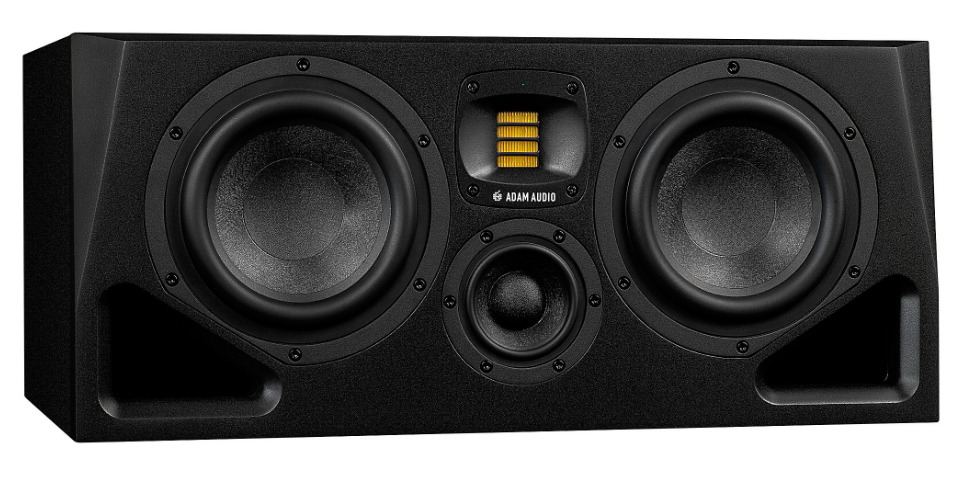
A serious 3-way midfield from one of the most respected studio monitor manufacturers in the world. ADAM Audio A77H features two 7-inch woofers in a horizontal MTM (midwoofer-tweeter-midwoofer) configuration, ADAM’s signature X-ART folded ribbon tweeter, and a dedicated 4-inch midrange driver powered by three Class-D amplifiers totaling 600 watts. The horizontal layout makes it ideal for placement above or below a screen in a control room.
What separates the A77H from nearfield monitors isn’t just volume. It’s the completeness of the frequency picture. The dual 7-inch woofers produce bass extension that single-woofer nearfields physically can’t generate, and the dedicated midrange driver handles the critical vocal and instrument range with a clarity that two-way designs compromise on because their woofer has to handle both bass and mids.
- Horizontal MTM
The midwoofer-tweeter-midwoofer horizontal configuration places the X-ART tweeter between two 7-inch woofers, creating a coherent point source with controlled horizontal dispersion that works perfectly for placement above or below a monitor screen.
The MTM layout produces a vertical radiation pattern that’s tighter than horizontal, which reduces ceiling and floor reflections in control rooms while maintaining a wide horizontal sweet spot. For mix rooms where the monitors sit on a meter bridge or above a console, the horizontal format is the acoustically correct placement option.
- X-ART Tweeter
ADAM’s eXtended Accelerating Ribbon Technology tweeter folds a thin diaphragm into an accordion-like structure that moves air four times faster than a conventional dome tweeter.
The X-ART delivers high-frequency detail with a speed and transient precision that dome tweeters simply can’t match, making reverb tails, hi-hat nuances, and vocal sibilance exceptionally clear. For mastering and critical mixing decisions in the top end of your mix, the X-ART reveals information that lesser tweeters smooth over.
- 3-Way Clarity
The dedicated 4-inch midrange driver handles the vocal and instrument frequency range independently of the bass and treble drivers, which means the midrange isn’t being produced by a woofer that’s simultaneously trying to move enough air for bass frequencies.
The separation between drivers produces a midrange that’s cleaner, more detailed, and more accurate than any two-way monitor can achieve, because each driver focuses exclusively on its own frequency range.
- DSP Suite
Built-in DSP with room correction EQ, crossover optimization, and voicing presets allows you to adapt the A77H to your specific room and listening position. The DSP isn’t a gimmick. In midfield setups where room interactions are more significant than in nearfield, the ability to apply measured corrections to the speaker’s output makes the difference between hearing your mix and hearing your mix plus your room.
2. Neumann KH 420
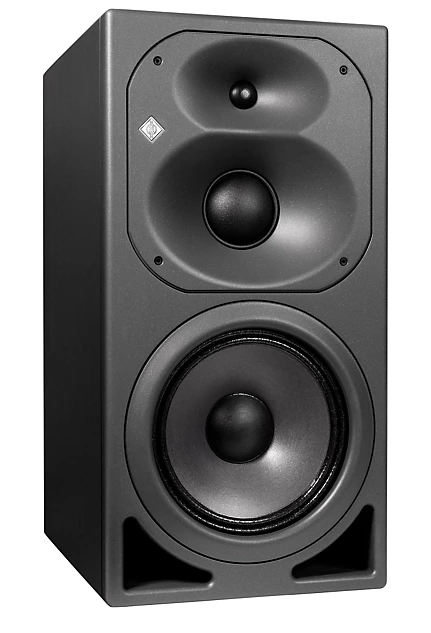
The professional benchmark from the company whose microphones have recorded countless hit records, now applying that same engineering philosophy to monitoring. Neumann KH 420 is a 3-way midfield monitor with a 10-inch woofer, 3-inch midrange dome, and 1-inch titanium tweeter in a design that represents Neumann’s no-compromise approach to studio audio reproduction.
The KH 420 is the monitor I see in mastering studios and high-end control rooms more than almost any other midfield option. The reputation is earned through acoustic performance, build quality, and the kind of long-term consistency that professional facilities require from equipment they rely on for years.
- 10-Inch Authority
The 10-inch woofer provides bass extension and headroom that smaller midfield monitors can’t match, reproducing low frequencies with authority and control down to the deepest content in your mix.
When you’re mastering material that includes sub-bass, the KH 420 shows you exactly what’s happening below 40Hz rather than rolling off or compressing the low end. The 10-inch driver handles high SPLs without audible distortion, which means your monitoring stays accurate even when you need to check your mix at louder levels.
- Dome Midrange
A dedicated 3-inch dome midrange driver provides the critical vocal and instrument range with exceptional clarity and dispersion. The dome shape produces a more uniform radiation pattern than conventional cone midrange drivers, which means the midrange quality is more consistent across the listening area. For a midfield monitor where you’re sitting further from the speakers, the consistent dispersion ensures you hear accurate midrange whether you’re dead center or slightly off-axis.
- Analog Precision
The analog crossover and amplifier design on the KH 420 takes a different approach from DSP-based monitors by keeping the signal path analog throughout.
The analog approach avoids the latency and potential artifacts that digital processing introduces, delivering a signal that’s as close to the original as possible. Some engineers specifically prefer analog crossover monitors because the signal chain is simpler and more transparent.
- Output Headroom
The amplifier section delivers enough power to reach professional monitoring levels with significant headroom to spare. The output capability means you can monitor at any volume from quiet background listening to full control room level without the amplifiers compressing or distorting. For critical listening decisions that sometimes require checking your mix at higher SPLs, the headroom ensures the monitoring stays linear across the entire usable volume range.
- Professional Build
The Neumann construction quality is designed for decades of daily professional use in environments where equipment operates continuously. The cabinet, drivers, crossover components, and amplification are all built to maintain their acoustic performance over years of operation. In professional studios where monitors run eight to twelve hours a day, the build quality directly affects the long-term reliability of your monitoring investment.
- Flexible Mount
The KH 420 includes multiple mounting options including integrated threaded inserts for wall and ceiling mounting, and compatibility with various professional mounting systems.
The mounting flexibility is practical for control rooms where the monitors need to be positioned in specific locations relative to the mix position, whether that’s on a meter bridge, on stands behind a console, or mounted in a soffit.
3. Focal Alpha Twin Evo
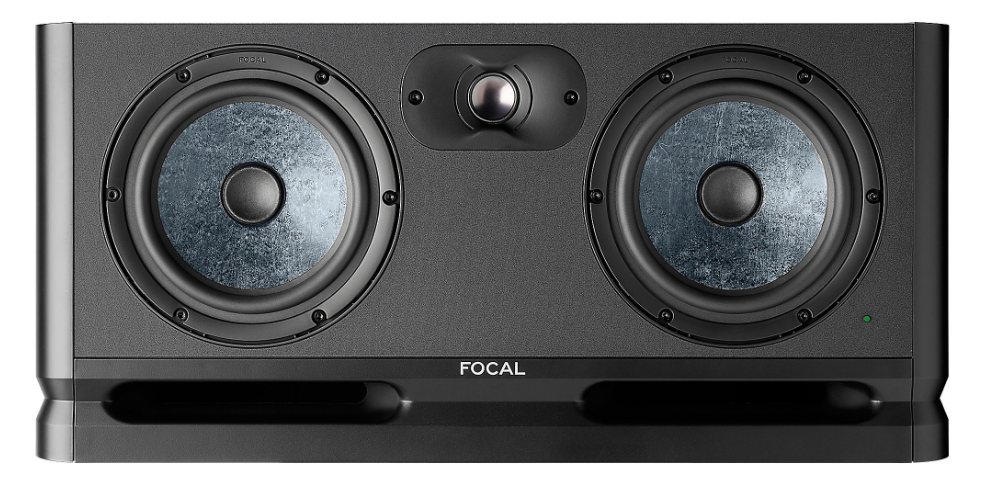
Focal’s most affordable dual-woofer monitor, bringing their characteristic sound to the midfield category at a cost that doesn’t require a studio mortgage. Focal Alpha Twin Evo features two 8-inch Slatefiber woofers and a 1-inch aluminum/magnesium inverted dome tweeter in a 2.5-way design that provides substantial bass extension and Focal’s signature detailed high end.
The Alpha Twin Evo is where I’d start if you’re moving up from nearfields to midfields for the first time. It gives you the dual-woofer bass authority and the wider soundstage that midfield monitoring provides, with Focal’s established tuning quality, at a cost that’s significantly below the flagship options on this list.
- Dual Slatefiber
Two 8-inch Slatefiber woofers in a 2.5-way configuration provide the bass extension and dynamic headroom that single-woofer nearfield monitors can’t match. The Slatefiber material (Focal’s recycled carbon fiber composite) offers a rigid, lightweight cone that responds quickly to transients while handling the power demands of bass reproduction.
The dual-woofer layout means one driver handles both bass and midrange duties while the other reinforces only the low frequencies, combining the midrange clarity of a two-way with the bass authority of a larger system.
- Focal Treble
The aluminum/magnesium inverted dome tweeter delivers the detailed, slightly forward high-frequency character that Focal monitors are known for. The inverted dome shape provides controlled dispersion and smooth off-axis response, which matters in midfield setups where you sit further from the speakers and room reflections contribute more to what you hear.
- Evo Amplifier
The updated Evolution-generation amplification provides improved efficiency, lower noise floor, and more headroom compared to the original Alpha Twin. The amplifier upgrade is particularly relevant for midfield use where you’re driving the speakers harder than you would in a nearfield setup, and the additional headroom ensures the monitoring stays clean during louder passages.
4. Genelec 1032 CPM
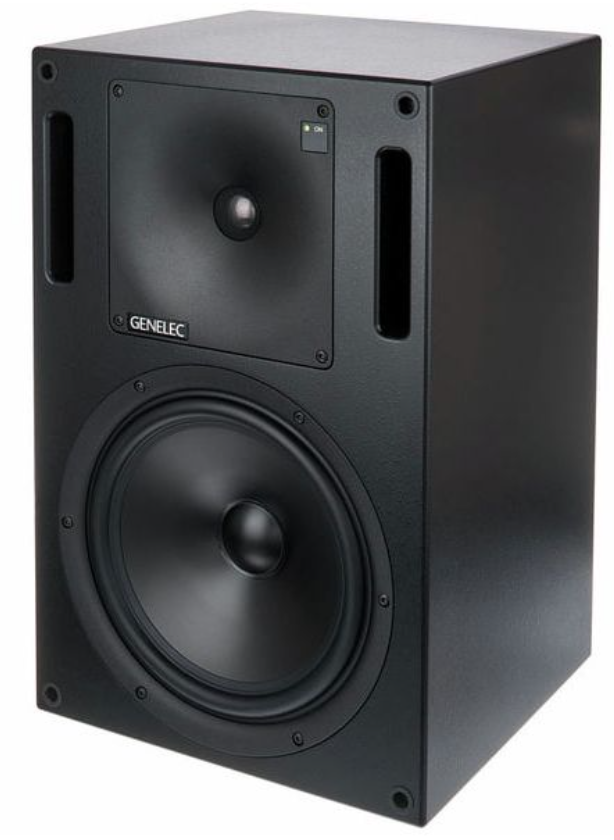
Finnish monitoring heritage in a compact midfield format that has been a control room standard for decades. Genelec 1032 CPM features a 10-inch woofer and 1-inch metal dome tweeter in Genelec’s signature die-cast aluminum Minimum Diffraction Enclosure, with onboard room correction controls and the build quality that Genelec’s professional reputation is built on.
The 1032 has been in professional studios for years, and the CPM version updates the platform with refined amplification and improved room correction. If you walk into a post-production facility, a broadcast studio, or a mastering room and see Genelec monitors on the wall, there’s a good chance they’re 1032s or something closely related.
- MDE Cabinet
The Minimum Diffraction Enclosure with its smooth, rounded aluminum housing eliminates the acoustic diffraction that sharp-edged rectangular cabinets produce. In midfield setups where room interactions play a larger role than in nearfield, the MDE cabinet’s controlled radiation pattern produces a cleaner, more accurate response at the listening position because less energy scatters off the cabinet edges.
- 10-Inch Power
The 10-inch woofer delivers bass extension and SPL capability appropriate for midfield monitoring distances and larger control rooms. The driver size means you hear low-frequency content with the authority and control that mixing and mastering decisions require, including the ability to evaluate sub-bass content, kick drum weight, and bass instrument character with confidence.
- Genelec Reliability
The build quality and engineering are designed for decades of continuous professional operation.
Genelec monitors run in studios for years without performance degradation, and the 1032 CPM’s die-cast aluminum enclosure, precision crossover, and professional-grade amplification maintain acoustic consistency over the life of the monitor. For facilities investing in midfield monitoring, the long-term reliability directly affects the return on investment.
- Room Correction
Onboard room compensation controls allow you to adjust the 1032’s frequency response to address the specific acoustic characteristics of your room. The controls provide targeted adjustment for common room problems including boundary proximity bass buildup and reflection-related frequency response irregularities. The room correction is essential for midfield setups where the room contributes significantly to what you hear.
5. EVE Audio SC3070
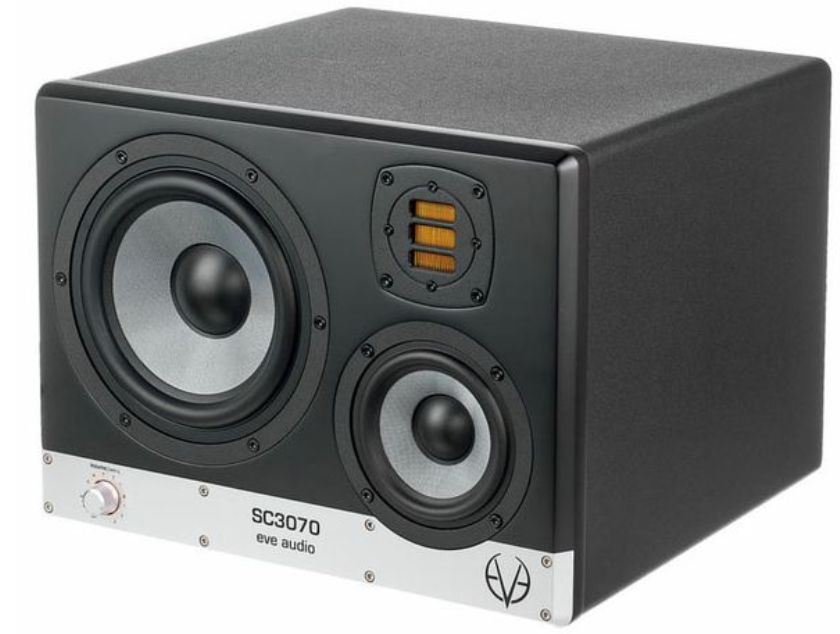
A compact 3-way midfield from the German manufacturer known for their Air Motion Transformer tweeters. EVE Audio SC3070 packs a 7-inch SilverCone woofer, a 4-inch midrange driver, and EVE’s RS3 Air Motion Transformer tweeter into a tri-amplified design that provides full 3-way performance in a cabinet small enough for rooms where larger midfield monitors won’t fit.
I like the SC3070 because it solves a real problem: you want the midrange clarity of a 3-way system and the detailed AMT high end, but your room can’t accommodate a massive cabinet. The SC3070 delivers genuine midfield capability in dimensions that are closer to a large nearfield.
- AMT Tweeter
EVE’s RS3 Air Motion Transformer reproduces high frequencies by squeezing air between the folds of a pleated diaphragm, producing treble with a speed and detail that conventional dome tweeters can’t match. The AMT technology delivers high-frequency transients with a precision that helps you evaluate reverb character, hi-hat definition, and vocal sibilance with confidence. The non-fatiguing character means you hear this detail without the harshness that some ribbon tweeters introduce.
- Compact 3-Way
The 3-way design in a cabinet measuring roughly 13 x 10 x 12 inches provides the dedicated midrange driver advantage of a true three-way system without the physical size that most 3-way midfield monitors demand.
The compact dimensions mean the SC3070 fits in rooms where an ADAM A77H or Neumann KH 420 would be too large, while still delivering the separated driver performance that 2-way monitors compromise on.
- SilverCone Bass
The 7-inch SilverCone woofer with its fiberglass-coated honeycomb diaphragm and low-distortion copper-cap magnet system produces tight, controlled bass without the coloration that cheaper cone materials introduce. The SilverCone technology is proven across EVE Audio’s entire lineup and provides the low-frequency foundation that a midfield monitor needs to give you confidence in your bass mixing decisions.
6. ADAM Audio A8H
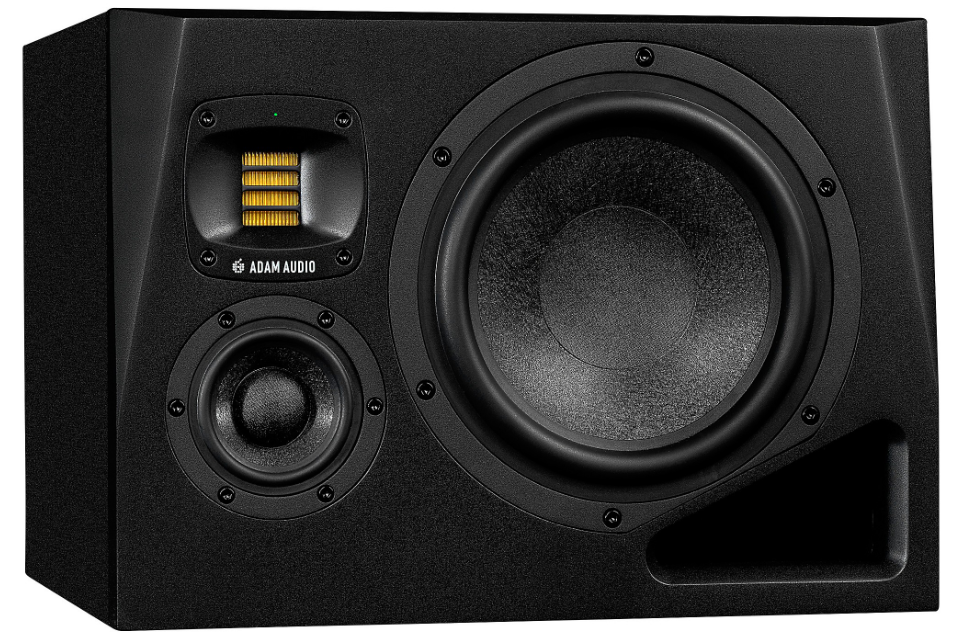
The larger sibling of the A77H with an 8-inch woofer for extended bass response and a similar 3-way horizontal configuration. ADAM Audio A8H features an 8-inch woofer, 4-inch midrange, and the X-ART tweeter in a horizontal format with 500 watts of Class-D amplification and comprehensive DSP for room adaptation.
Where the A77H works best in moderate-sized control rooms, the A8H adds the bass extension and SPL capability for larger spaces. The additional woofer size gives you more confident reproduction of low-frequency content, which matters for mastering work and bass-heavy music production.
- 8-Inch Extension
The 8-inch woofer provides deeper bass extension and more headroom than the A77H’s 7-inch driver, with frequency response reaching confidently into the sub-bass region where kick drums, bass synths, and 808s live. The extra inch of driver size translates to more air movement and lower distortion at equivalent bass levels, which means your low-end decisions are based on cleaner information.
- X-ART Detail
The X-ART folded ribbon tweeter delivers the same speed, transient precision, and extended frequency response that defines ADAM’s monitoring character across their entire range. The X-ART technology is consistent across ADAM’s lineup, meaning engineers who work on ADAM monitors at different facilities hear the same high-frequency character regardless of which specific model they’re using.
- Horizontal Format
The horizontal MTM layout optimizes the A8H for above-screen or below-screen placement in control rooms, providing tight vertical dispersion that reduces floor and ceiling reflections while maintaining a wide horizontal sweet spot at the listening position. The horizontal format is the standard configuration for midfield monitors in professional control rooms, and the A8H is specifically designed for this mounting orientation.
- Room DSP
Comprehensive DSP with parametric EQ and room compensation lets you measure and correct the A8H’s response for your specific room. The DSP includes shelf filters, parametric bands, and desktop/wall proximity compensation that address the acoustic interactions between the speaker and your listening environment. For midfield setups where room influence is more significant than in nearfield, the DSP correction is essential for accurate monitoring.
- Power Reserve
500 watts of Class-D amplification distributed across the three drivers provides substantial headroom for dynamic monitoring at any volume. The power reserve means the amplifiers stay in their linear operating range even during loud transient peaks, which keeps the monitoring clean and accurate at the SPLs that midfield listening positions require.
7. Focal Trio11 Be
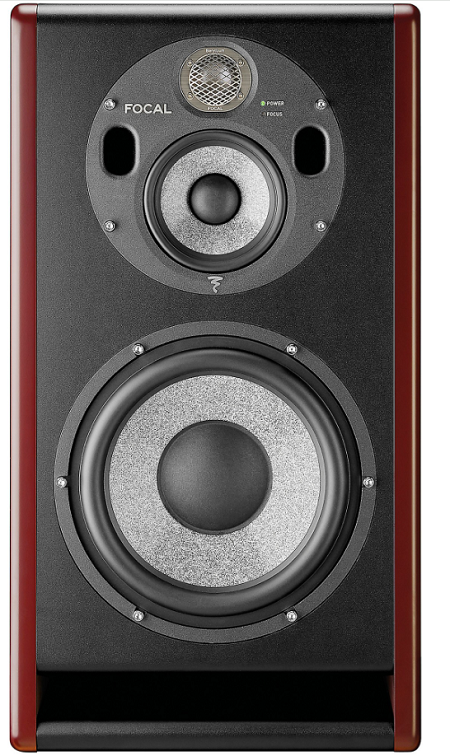
Focal’s flagship professional midfield monitor, featuring beryllium tweeter technology and a unique Focus mode that switches the speaker between full 3-way operation and a simulated single-driver configuration for translation checking. Focal Trio11 Be is a 3-way design with two 10-inch woofers, a 5-inch midrange, and Focal’s 1-inch pure beryllium inverted dome tweeter.
This is the top of Focal’s professional monitoring range, and the beryllium tweeter is the headline. Beryllium is the stiffest and lightest material used in tweeter construction, and the difference in high-frequency speed, extension, and clarity compared to aluminum or silk is audible to anyone who’s worked with it.
- Beryllium Tweeter
The 1-inch pure beryllium inverted dome tweeter delivers high frequencies with a speed, extension, and low-distortion character that no other tweeter material matches. Beryllium’s extraordinary stiffness-to-weight ratio means the dome responds to signal changes faster and with less breakup distortion than any alternative, producing treble detail that makes subtle mix decisions about reverb character, vocal air, and high-frequency effects possible at a level of precision that aluminum or silk dome tweeters don’t provide.
- Focus Mode
A Focus switch changes the Trio11 Be from its full 3-way configuration to a simulated single-driver mode that reduces the frequency response and dynamic range, letting you hear how your mix translates to smaller, less capable playback systems. The Focus mode turns your professional midfield monitor into a crude translation reference without physically switching to a different pair of speakers, which saves time and physical space in the control room.
- Dual 10-Inch
Two 10-inch woofers provide bass extension, SPL capability, and dynamic headroom that smaller midfield monitors can’t approach. The dual-woofer configuration handles the lowest frequencies in your mix with authority and control, giving you reliable information about sub-bass content, kick drum character, and bass instrument balance at any monitoring level.
8. Neumann KH 310 A
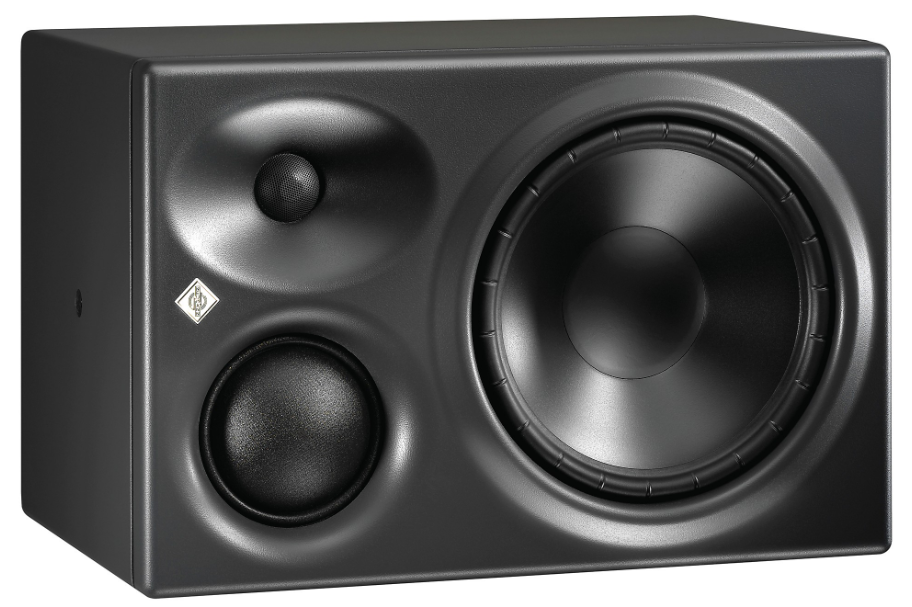
Neumann’s compact 3-way midfield that delivers the company’s reference monitoring quality in a format smaller than the KH 420. Neumann KH 310 A features an 8.25-inch woofer, 3-inch dome midrange, and 1-inch titanium tweeter in a 3-way design with Neumann’s Mathematically Modeled Dispersion (MMD) waveguide and analog signal processing.
The KH 310 fits the gap between nearfield monitors and full-size midfields, making it suitable for medium control rooms where the KH 420 would be oversized. The 3-way design provides the same separated driver advantage in a more manageable package.
- MMD Waveguide
The Mathematically Modeled Dispersion waveguide controls the tweeter’s radiation pattern using computational optimization to produce consistent frequency response across the listening area. The waveguide ensures the high-frequency character remains accurate whether you’re centered or slightly off-axis, which matters in midfield setups where the listening area needs to accommodate more than a single head position.
- Dome Midrange
The 3-inch dome midrange driver handles the critical vocal and instrument frequency range with the precision and dispersion uniformity that Neumann’s professional reputation demands. The dome shape provides more consistent radiation than cone midrange drivers, which means the midrange quality doesn’t degrade as much when you move off-axis.
- Compact Midfield
The 8.25-inch woofer in a moderate cabinet size provides genuine midfield bass extension and SPL capability without the physical bulk of 10-inch designs. For studios that need midfield performance but can’t accommodate the largest monitors, the KH 310 delivers Neumann-quality monitoring in dimensions that fit medium-sized control rooms.
- Analog Path
The analog crossover and signal processing keeps the audio path free of digital conversion, delivering the input signal to the drivers with the shortest, most transparent processing chain possible. The analog approach avoids latency entirely and maintains signal integrity without the quantization effects that digital processing introduces, which some engineers specifically prefer for critical monitoring.
9. Dynaudio LYD-48
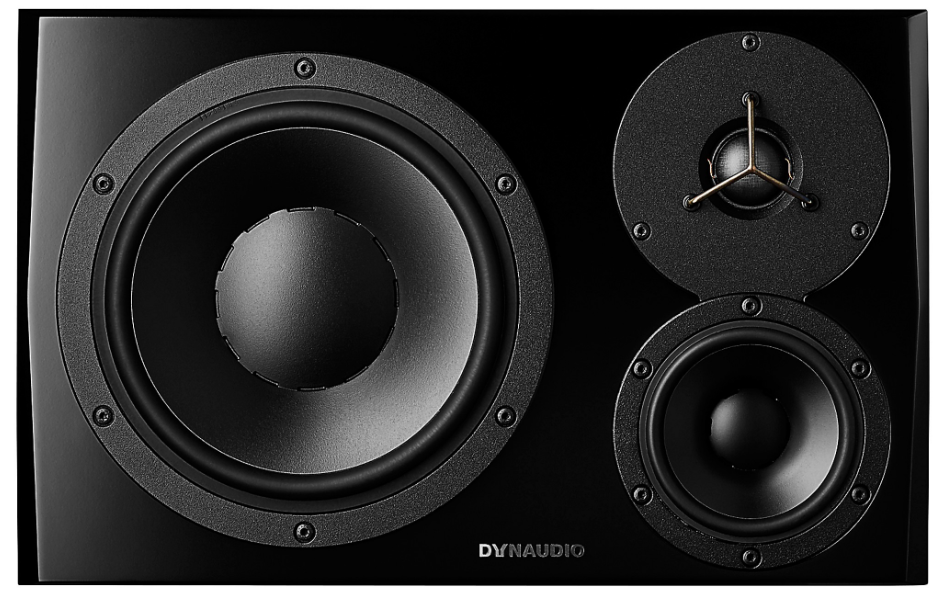
Danish-made monitoring from one of the most respected loudspeaker manufacturers in both the professional and audiophile worlds. Dynaudio LYD-48 is a 3-way midfield monitor with two 8-inch woofers and a 1-inch soft dome tweeter in a design that brings Dynaudio’s acclaimed driver technology and Danish acoustic engineering to the studio monitoring market.
Dynaudio has been building loudspeaker drivers and complete systems for decades, and the LYD-48 benefits from that heritage. The MSP (Magnet System Purpose-designed) drivers are manufactured in-house at Dynaudio’s Danish facility, which means the company controls every aspect of the driver performance.
- Dual 8-Inch
Two 8-inch MSP woofers provide the bass extension and power handling that midfield monitoring demands, with Dynaudio’s in-house driver manufacturing ensuring consistency and quality control that outsourced drivers can’t guarantee. The dual-woofer configuration delivers bass that reaches confidently into the sub-bass region with the tight, controlled character that Danish speaker engineering is known for.
- Danish Drivers
In-house manufactured MSP (Magnet System Purpose-designed) drivers are built at Dynaudio’s own facility rather than sourced from third-party suppliers. The in-house manufacturing means Dynaudio controls the driver materials, tolerances, and quality standards from raw components through to finished drivers. The consistency between individual drivers is tighter than what outsourced manufacturing typically achieves, which matters for stereo imaging accuracy where the left and right monitors need to be as closely matched as possible.
- Soft Dome Detail
The 1-inch soft dome tweeter delivers high frequencies with a smooth, non-fatiguing character that Dynaudio has refined over decades of loudspeaker development. The soft dome approach produces treble that’s detailed and accurate without the aggressive edge that some metallic dome and ribbon tweeters introduce during extended listening. For long mixing and mastering sessions at midfield distances, the smooth treble character reduces ear fatigue while maintaining the resolution you need for critical decisions.
- Voicing Presets
Built-in voicing presets and room correction adapt the LYD-48 to different room sizes, speaker placements, and monitoring preferences. The presets include position-specific compensation for desk, stand, and wall-mounted scenarios, which addresses the most common acoustic interactions that midfield monitors encounter in real-world studio installations.
- Build Heritage
The Dynaudio construction quality reflects the company’s heritage of building loudspeakers that perform consistently for decades in both professional and domestic environments. The cabinet, crossover, and amplification are all engineered for the long-term reliability that professional studios require from equipment running daily. The Danish manufacturing standards ensure that the LYD-48 maintains its acoustic performance throughout years of continuous operation.

Hello, I’m Viliam, I started this audio plugin focused blog to keep you updated on the latest trends, news and everything plugin related. I’ll put the most emphasis on the topics covering best VST, AU and AAX plugins. If you find some great plugin suggestions for us to include on our site, feel free to let me know, so I can take a look!