
Hardware sequencers are the backbone of any setup that isn’t built around a computer screen. If you own synths, drum machines, or modular gear and you want to create patterns, build arrangements, and perform without opening a DAW, a hardware sequencer is what ties it all together.
It’s the “brain” of your rig, the thing that remembers your patterns, controls your instruments over MIDI and CV/Gate, and gives you the physical interface of knobs, pads, and buttons to interact with music in a way that a mouse and piano roll genuinely can’t replicate.
The sequencer market has gotten interesting because the options now span everything from tiny analog step sequencers you can power off batteries to sophisticated multi-track powerhouses that sequence entire studios of gear simultaneously.
Some are designed for eurorack modular users who need tight CV control. Others focus on MIDI sequencing for synths and drum machines. A few try to handle both worlds. I’ve picked nine hardware sequencers that cover this range, from compact modular tools through mid-range workhorse units to flagship production sequencers that can replace a DAW for arrangement duties entirely.
1. Squarp Instruments Hapax
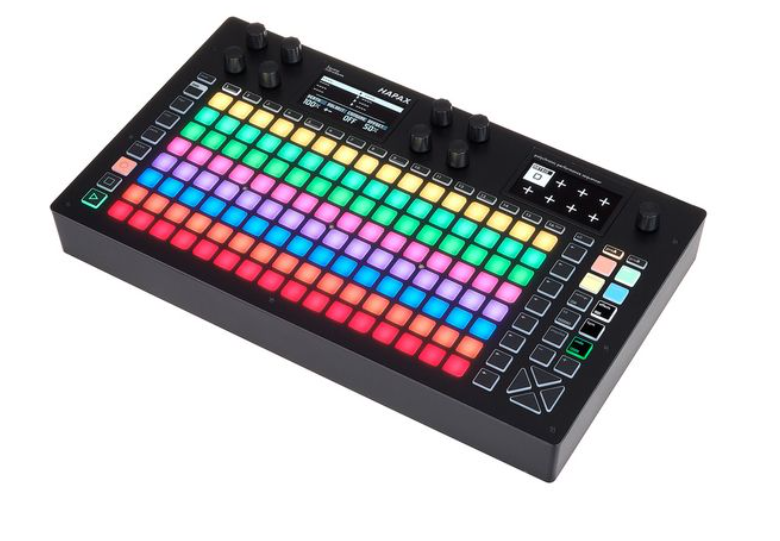
The sequencer I’d choose if I could only have one, because the Hapax handles virtually every sequencing scenario you’ll encounter in a hardware studio. It gives you 16 tracks across a dual-project architecture where you can load and crossfade between two complete projects, a high-resolution color display, eight performance pads, 16 assignable encoders, and connectivity for MIDI, USB, and CV/Gate simultaneously.
What separates the Hapax from the competition is how it handles complexity without making you fight for it. The interface is deep but logical, and once you understand where things live, building elaborate multi-track arrangements with automation, effects, and song structure happens faster than on any other dedicated sequencer I’ve used.
- Dual Projects
The dual-project system lets you load two complete projects simultaneously and transition between them in real time. For live performance, this means you prepare your entire set as a series of project pairs and crossfade between songs without any dead air or awkward silence while the next song loads.
The dual architecture solves one of the oldest problems in hardware live performance: smooth transitions between completely different arrangements without stopping the music. In the studio, it’s equally useful because you can A/B two versions of an arrangement instantly to compare them.
- 16 Tracks
Sixteen independent tracks, each with eight patterns per project, provide enough sequencing capacity for a full studio of instruments. Each track has its own MIDI channel, CV output assignment, length, time signature, and playback direction, meaning you can run a 7/8 pattern on one synth while another plays in 4/4, or have one track running forward while another plays in reverse.
The track count means you sequence every synth, drum machine, and modular voice in your setup from a single device without running out of capacity or needing to bounce tracks.
- Display Depth
The high-resolution color display shows piano roll editing, pattern overviews, automation lanes, and project navigation in a visual format that makes complex arrangements manageable.
The screen quality is genuinely important because you spend a lot of time looking at it during editing sessions, and the Hapax’s display is clear enough to edit individual note data, draw automation curves, and navigate between sections without squinting or guessing. Compared to the tiny OLED screens on most hardware sequencers, the Hapax’s display makes detailed editing practical rather than painful.
- Algorithmic Tools
Built-in algorithmic sequencing tools including euclidean patterns, harmonizers, arpeggiators, scale quantizers, and randomization generate musical content from simple inputs. You feed the algorithm a few notes and a set of rules, and it produces patterns that manual step programming wouldn’t naturally create.
The tools are stackable too, so you can run a euclidean rhythm through a harmonizer and then add probability to individual steps for results that evolve constantly. This makes the Hapax useful for generative and experimental approaches alongside traditional note-by-note composition.
2. Doepfer Dark Time
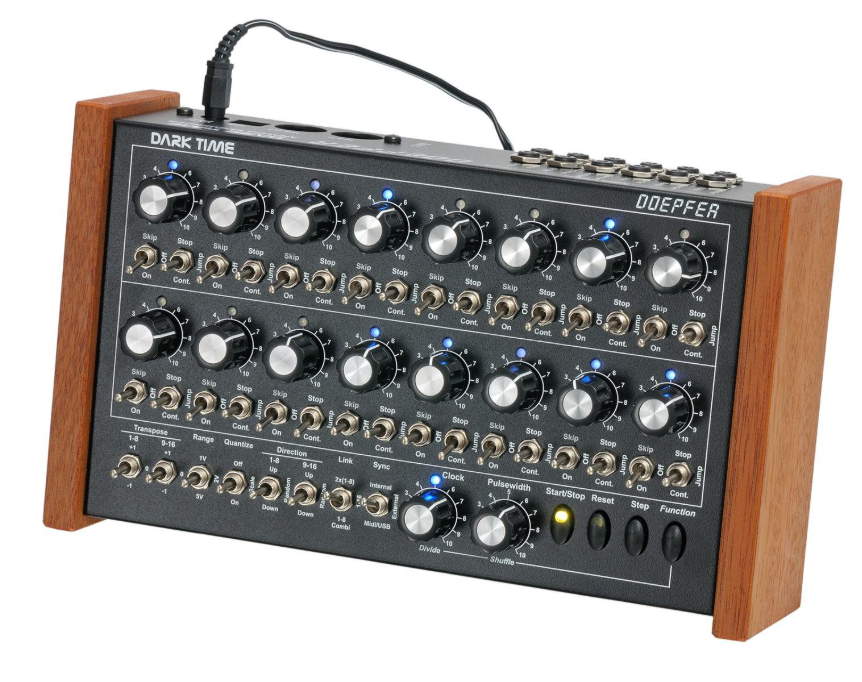
An analog sequencer from the company that essentially created the modern eurorack standard. The Doepfer Dark Time is built around two rows of eight steps with individual knobs for each step, dedicated per-step switches, and an all-analog CV/Gate signal path that sends control voltages to your synths with a precision and immediacy that digital sequencers approximate but don’t quite match.
I appreciate the Dark Time for its honesty. There are no screens, no menus, no hidden functions behind shift buttons. Every parameter is visible and tweakable at all times. What you see is what you get, and what you get is an analog sequencer that feels like an instrument rather than a computer peripheral.
- Analog Path
The all-analog signal path for CV/Gate transmission provides timing precision and voltage stability that digital-to-analog converted signals simply don’t match.
When you’re controlling an analog VCO, the difference between a clean analog pitch CV and a stepped digital approximation is subtle but real, particularly on slides and glides between notes where a digital sequencer produces tiny staircase steps while the Dark Time produces a smooth continuous voltage change.
The analog path gives your sequences a smoothness and tightness that feels inherently right on analog synths, and it’s the reason many modular musicians specifically seek out analog sequencers even when digital ones offer more features.
- Knob Per Step
Dedicated rotary knobs for every step mean you see and adjust your entire sequence at a glance without any menu navigation whatsoever. Turning a knob changes that step’s pitch immediately, and the physical positions of all sixteen knobs give you a visual representation of your melody’s contour just by looking at the panel.
I find this incredibly useful because you develop an intuitive sense of how a melody looks as a physical arrangement, and you can reach over and change a single note without interrupting the running sequence. The one-knob-per-step philosophy keeps the Dark Time’s workflow instant and tactile in a way that encoder-based sequencers with shared controls don’t replicate.
- Dual Rows
Two independent 8-step rows can run separately for polyrhythmic patterns or combine into a single 16-step sequence, giving you flexibility in how you structure your patterns.
Running the rows independently at different speeds or directions creates complex rhythmic relationships from simple step patterns, which is where analog sequencing gets genuinely creative and unpredictable.
You set row A to play forward at one speed and row B to play in reverse at a different division, and the resulting interplay between the two creates a polyrhythmic texture that neither row would produce on its own.
- Audio Rate
The Dark Time can operate at audio-rate speeds, turning it from a note sequencer into a modulation source that generates complex waveforms and control signals at frequencies fast enough to hear as pitched content.
Running the sequencer fast enough produces audible patterns that function more like oscillator waveshaping than traditional step sequencing, which opens experimental sound design territory that most sequencers can’t access. For modular users who like to blur the line between sequencing and synthesis, the audio-rate capability adds a whole dimension of utility.
3. Korg SQ-1
The most affordable dedicated sequencer worth buying, and proof that you don’t need to spend a lot to get genuine creative utility from hardware.
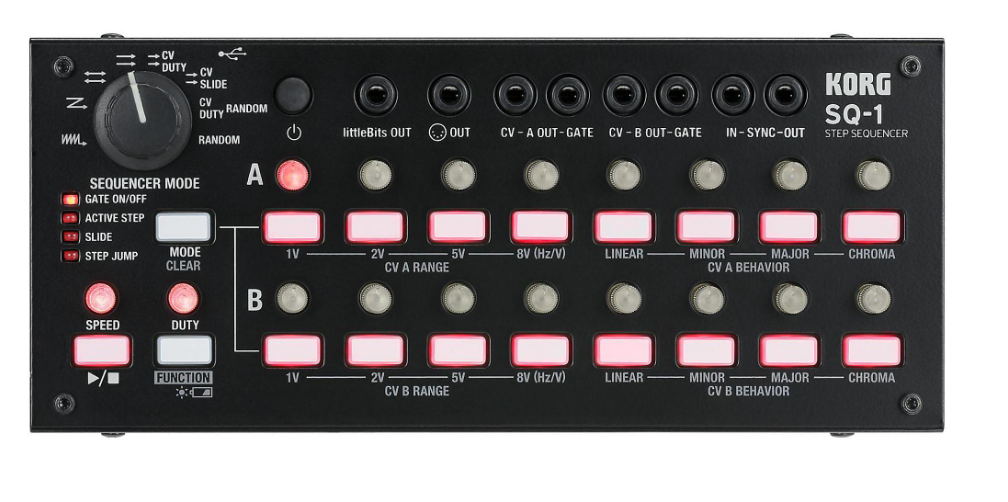
Korg SQ-1 is a compact dual-channel analog step sequencer with two rows of eight steps, CV/Gate outputs, MIDI, and USB connectivity in a metal chassis that runs on batteries and fits in your pocket.
The SQ-1 is intentionally limited, and that’s what makes it good. You don’t get lost in features or spend your creative time configuring settings. You turn knobs, steps play, and your synth responds. It’s the kind of sequencer you reach for when you want to create something quickly without any setup overhead.
- Dual CV
Two independent CV/Gate output channels with both V/Oct and Hz/V scaling drive analog synths from different eras without external converters.
The dual scaling is a detail that sounds minor but matters a lot in practice because it means the SQ-1 controls both modern eurorack modules (which use V/Oct) and vintage Japanese synths like the MS-20 and SH-101 (which use Hz/V) natively. Having two channels also lets you run independent sequences to different instruments simultaneously, which doubles the musical output from a single tiny device.
- Pocket Format
The metal chassis smaller than a paperback book runs on two AA batteries and weighs almost nothing, making the portability claim genuine rather than marketing.
You actually put this in a jacket pocket alongside a Korg Volca or a small semi-modular synth and make music on a park bench, in a hotel room, or anywhere else inspiration finds you. The battery life is decent enough for extended sessions, and the metal build means it survives bouncing around in a bag without damage.
- Play Modes
Multiple playback modes including forward, reverse, alternating, and random create rhythmic variation from simple step patterns without reprogramming anything.
The mode switching is immediate with a physical selector, and combining the two rows in different modes produces unexpected rhythmic relationships from straightforward note sequences. I find the random mode particularly useful for generating melodic ideas that I wouldn’t have composed deliberately, and the alternating mode creates longer phrase shapes from short eight-step patterns.
4. Korg SQ-64
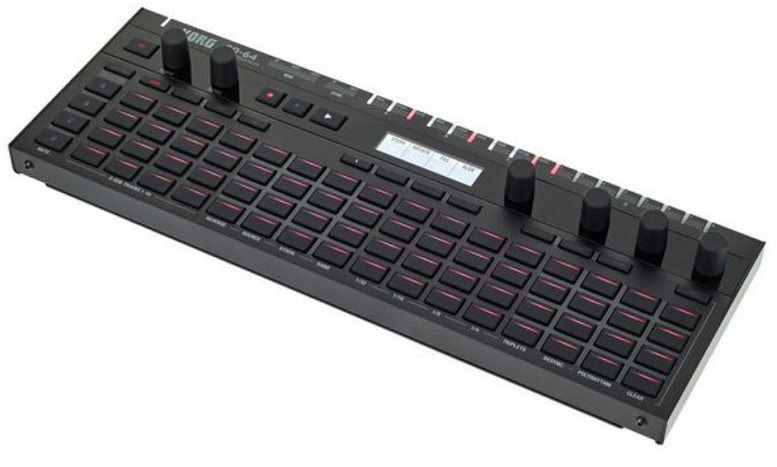
The SQ-1’s bigger sibling with polyphonic capability, more tracks, and a proper step grid. Korg SQ-64 gives you three 64-step melodic tracks with up to eight-note polyphony each, plus a 16-part drum track with individual gate outputs, all packed into a compact format with a step button grid, motion sequencing, and both MIDI and CV/Gate connectivity.
This is the point in the Korg sequencer lineup where you get enough power to sequence a proper multi-instrument setup rather than just driving one or two monosynths. The polyphony and track count make it practical for complete arrangements with chords, bass, melody, and drums all running from one box.
- Poly Tracks
Three melodic tracks with eight-note polyphony each let you sequence full chords, not just monophonic lines, which dramatically expands what you can do from a hardware sequencer. For producers working with polysynths or multi-voice modular patches, the polyphonic capability means your sequencer keeps up with what your instruments can actually do instead of forcing everything into single notes.
You can program a pad chord on track one, a bass line on track two, and a melody on track three, each with their own length and timing, giving you a complete harmonic arrangement.
- Drum Lane
A dedicated 16-part drum track with individual subtrack control gives you a complete drum sequencer alongside the melodic tracks. The drum lane handles sixteen different percussion sounds, each with its own step pattern and gate output assignment, which covers a full drum kit, a bank of eurorack drum modules, or a drum machine with individual trigger inputs.
The separation between melodic and drum sequencing means you don’t sacrifice melodic tracks to program beats, which cheaper sequencers often force you to do.
- Motion Sequence
Motion sequencing records knob movements as per-step automation, capturing your real-time parameter changes as part of your permanent pattern data. You twist the filter cutoff knob while the sequence plays, and the SQ-64 records that movement so it repeats every time the pattern loops.
The motion recording turns filter sweeps, pitch slides, and effect changes into repeatable, recallable parts of your sequence rather than one-time improvisations you can never exactly reproduce.
- Gate Outputs
Multiple CV/Gate outputs connect directly to modular and analog synths, with individual gates assignable to specific drum subtrack steps for tight, dedicated triggering.
The gate output count makes the SQ-64 a practical control hub for modular setups where individual voices need their own CV and trigger connections, and the assignment flexibility means you decide exactly which physical output drives which module in your rack.
5. OXI Instruments One MKII
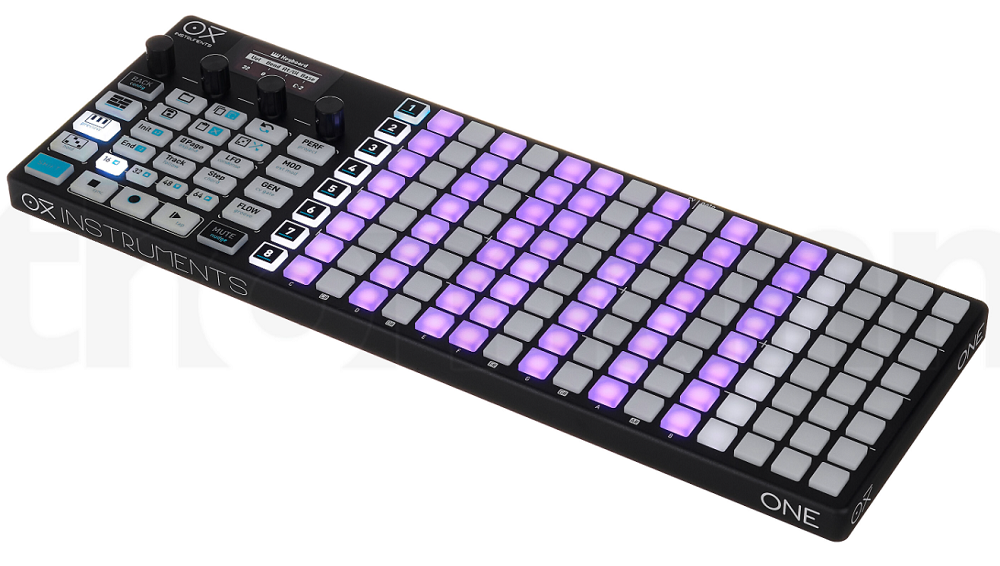
A performance-focused sequencer built for musicians who want to play their sequences like an instrument rather than just program and press start.
OXI One MKII delivers eight independent sequencers, each with six modes (Mono, Poly, Chord, Multitrack, Stochastic, Matrix), a 128-pad RGB touch grid, 8 CV/Gate outputs, MIDI I/O, Bluetooth, and a battery lasting up to eight hours.
The OXI One has developed a dedicated following because of how it handles live performance.
The pad grid and the FLOW performance layer let you manipulate running sequences in real time with a degree of musical expression that pure step sequencers don’t provide. It’s the sequencer I see most often at live electronic shows alongside the Hapax.
- Eight Sequencers
Eight fully independent sequencers with 128 steps each, running simultaneously with independent timing, direction, length, and shuffle parameters.
The eight sequencer count means you’re controlling eight different instruments with complex, evolving patterns from a single device, and each sequencer has its own set of eight modulation lanes, two LFOs, and automation, giving you 64 total modulation lanes and 16 LFOs across the system.
The depth per sequencer is what separates the OXI from simpler multi-track sequencers where tracks share resources.
- FLOW Mode
The FLOW performance layer adds real-time expression on top of running sequences, letting you alter patterns, introduce variations, mute steps, transpose phrases, and perform live changes using the pad grid and encoders.
FLOW turns the OXI from a set-and-forget pattern programmer into a live instrument where your sequences respond to your physical input during performance. You’re not just watching patterns play back. You’re actively shaping them as they run, which fundamentally changes the relationship between performer and sequence.
- Stochastic Mode
A generative stochastic sequencing mode uses probability and randomness as creative tools, producing evolving patterns that are musically coherent but never exactly repeat from one cycle to the next. You set the pitch range, the probability weights, and the rhythmic framework, and the stochastic engine fills in the details differently each time.
The mode is where the OXI gets genuinely experimental, generating melodic and rhythmic ideas that your deliberate programming wouldn’t produce, and it’s surprisingly musical because the probability system respects the boundaries you define.
6. Ketron SD-90
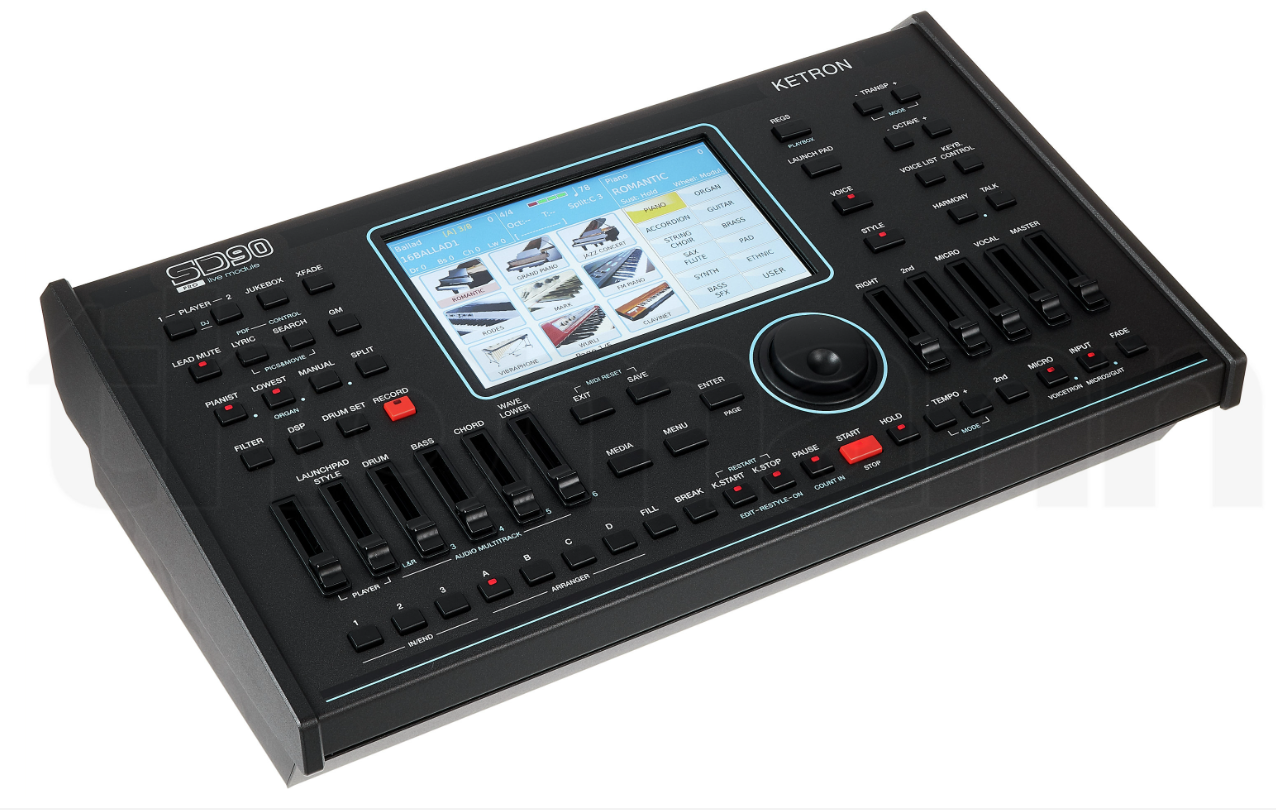
A different beast entirely from the other sequencers here. Ketron SD-90 is a professional arranger module with a 7-inch touchscreen, 672 sounds, 400 accompaniment styles, audio drums, live guitars, a multitrack player, and built-in MIDI sequencing with recording and playback. It’s designed for live entertainers, solo performers, and session musicians who need a complete backing band in a rack-mountable box.
I’m including the SD-90 because for a specific type of musician, it does something no step sequencer or pattern-based device can do: it provides intelligent, chord-following accompaniment that responds to what you play in real time. If you’re a solo keyboardist, guitarist, or vocalist who performs covers or original material live, this is your sequencing solution.
- Intelligent Arranger
The style-based arranger follows your chords in real time, generating bass, drums, piano, guitar, and orchestral parts that adapt to your harmonic input instantly. You play a C major chord with your left hand, and the SD-90 produces a full band arrangement in C major.
Switch to A minor, and every instrument in the arrangement shifts to match without any latency or awkward transitions.
The intelligent chord following means your backing arrangement is always harmonically correct without pre-programming every note of every part, which is something no traditional step sequencer can do because they play back fixed patterns regardless of what you’re playing over them.
- Audio Drums
Up to 250 stereo audio drum loops and over 400 Latin percussion grooves use real recorded performances rather than sequenced MIDI triggers hitting sample banks.
The difference between audio drum loops and triggered samples is the same difference between listening to a real drummer and listening to a drum machine.
The audio drums carry the subtle timing fluctuations, ghost notes, and dynamic variations of human playing, which makes the SD-90’s accompaniment sound convincingly like a live band rather than a sequenced backing track.
- Live Guitars
150+ audio live guitar patterns covering folk acoustic strumming, electric rock rhythm, jazz semi-acoustic comping, nylon classical, and gypsy picking provide convincing rhythm guitar backing that MIDI guitar samples struggle to replicate.
Guitar strumming involves complex string-by-string timing, pick noise, fret buzz, and harmonic content that sampling individual notes doesn’t capture. The Ketron approach of using complete performed guitar audio loops solves this problem by giving you recordings of actual guitarists playing actual patterns.
- Sound Library
672 GM sounds including stereo multilayer grand pianos with natural decay, vintage electric pianos, tonewheel organs with sampled rotary speaker slow/fast switching, orchestral instruments, and synthesis patches give you a massive voice palette for both accompaniment and lead playing.
The sound quality is where Ketron has always excelled. The piano sounds alone would justify attention because they use uncompromised multilayer sampling with long natural tails, which makes them responsive to your dynamics in a way that many arranger modules don’t achieve.
- Modeling System
The Modeling system lets you customize accompaniment styles by selecting and controlling individual instrument templates within each style arrangement. You swap out the bass pattern for a different groove, change the drum feel from brushes to sticks, add or remove guitar parts, adjust the piano voicing, and even import your own custom
MIDI sequences into the arrangement engine. The customization means the 400 factory styles are starting points rather than fixed arrangements, and with enough tweaking you can create accompaniments that sound unique to your performance rather than recognizably preset.
7. Torso Electronics T-1
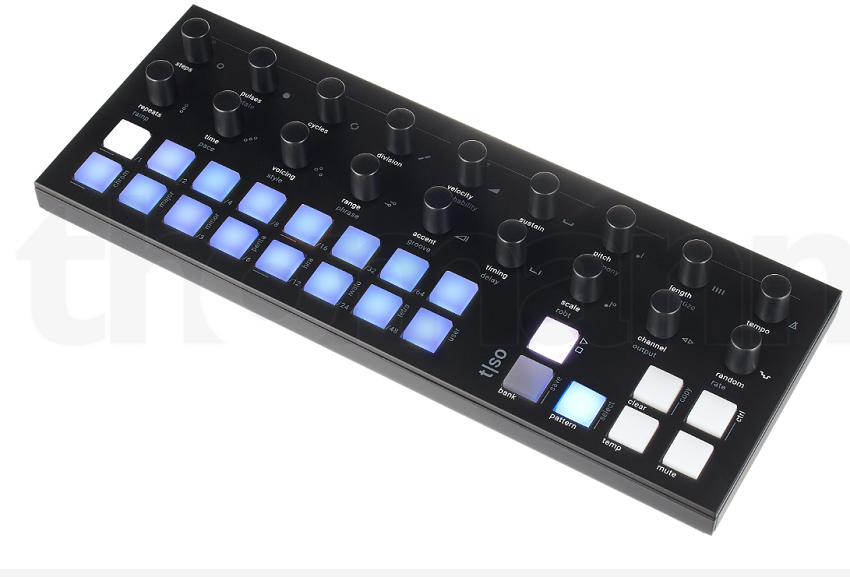
Torso T-1 uses 16 encoders and an algorithm-based sequencing engine to generate evolving melodic and rhythmic patterns from a set of musical parameters you define. You don’t program individual steps.
You set ranges, probabilities, divisions, and musical rules, and the T-1 creates sequences within those boundaries that evolve and shift over time.
The T-1 appeals to producers who want their sequencer to surprise them. Rather than hearing back exactly what you programmed note by note, you hear variations and evolutions that the algorithm generates based on your parameter settings, which means the machine contributes creatively to the music in a way that static step sequencers don’t.
- Algorithmic Core
The generative algorithm creates sequences from parameters like pitch range, note density, rhythm division, accent probability, and melodic direction rather than from individually placed notes on a grid.
You define the musical space by setting boundaries and tendencies, and the T-1 fills it with content that’s musically coherent but never identical from one cycle to the next. The approach produces melodies, rhythms, and modulation patterns that deliberate manual programming wouldn’t naturally create, which is exactly the point.
You get surprised by your own sequences, and those surprises often become the best parts of your tracks.
- 16 Encoders
Sixteen dedicated rotary encoders provide hands-on control over every aspect of the generative algorithm simultaneously, with each encoder controlling a specific musical parameter that you can adjust in real time while the sequence runs.
Because they’re all physical and visible, you reach for the density knob with one hand and the pitch range knob with the other, shaping multiple aspects of your sequence at once without navigating screens or switching encoder pages. The physical immediacy means you interact with the algorithm like you’d interact with a musical instrument, by feel and by ear.
- Compact Build
The compact aluminum chassis keeps the T-1’s footprint minimal while maintaining a substantial, professional feel that belies its small size. The machining and knob quality are noticeably good, and the unit feels like a precision instrument rather than a toy. For studios with limited space or producers who travel with their gear, the small size means the T-1 fits alongside your synths without competing for desk real estate, and the aluminum construction survives being tossed in a bag for mobile sessions.
8. Make Noise 0-Ctrl
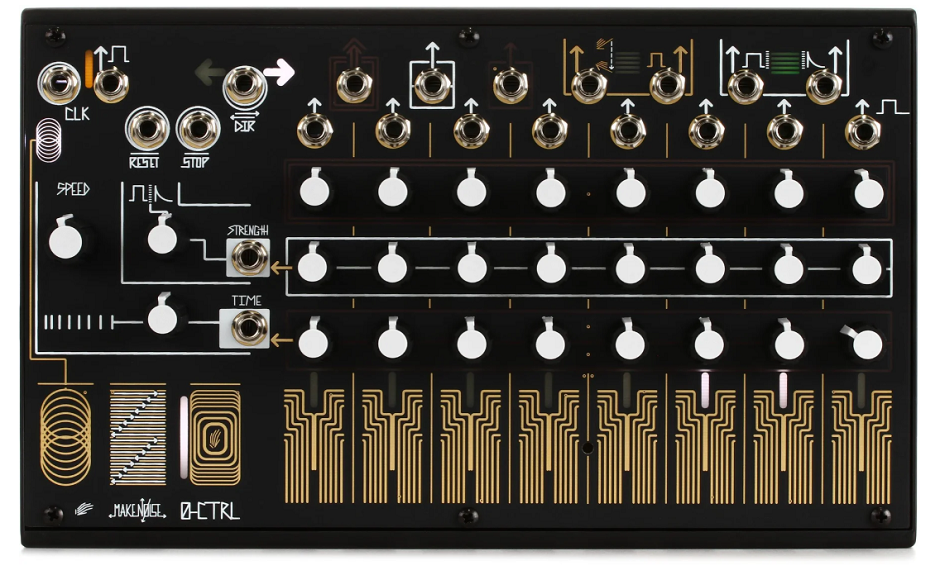
Not a traditional sequencer at all, and that’s exactly the point. Make Noise 0-Ctrl is a desktop controller and touch sequencer with three rows of touch plates for Strength, Time, and Pitch across eight steps, designed to generate CV and Gate signals for modular synths through a physical, tactile interface that you play with your hands like a percussion instrument.
The 0-Ctrl is for musicians who want to touch their sequences literally. You press the plates harder and the note is louder. You tap them faster and the tempo accelerates. You barely brush them and you get a whisper. The relationship between your physical gesture and the musical output is direct, immediate, and deeply satisfying in a way that no screen-based sequencer replicates.
- Touch Plates
Three rows of eight capacitive touch plates for Strength (velocity/amplitude), Time (duration/tempo), and Pitch (note value) respond to your finger pressure, position, and speed of contact. The touch interaction means you’re physically shaping every parameter of each step by how and where you touch the plates, creating sequences through gesture rather than data entry.
A gentle brush produces a soft, quick note. A firm, sustained press produces a loud, held note. The physical vocabulary of touch translates directly into musical vocabulary, and after a few sessions you develop an intuitive understanding of how your gestures translate to sound.
- CV Native
The 0-Ctrl generates analog CV, Gate, and trigger signals directly from the touch plates without any digital processing or conversion in the signal path. The analog-native output connects straight to your modular synth’s pitch, gate, and modulation inputs with the tight timing and smooth voltage transitions that a purely analog connection provides.
There’s no latency, no jitter, and no staircase stepping on the CV output, because the signal is analog from the moment your finger touches the plate to the moment it reaches your oscillator.
- Dynamic Steps
Each step’s behavior changes based on how you physically interact with it, meaning the same sequence produces different results depending on your touch. The dynamic response means the 0-Ctrl is genuinely performed rather than programmed. You sit down, you play the touch plates, and the sequence comes out differently every time based on your physical state, your mood, and your musical intention. It’s the closest a hardware sequencer gets to the experience of playing an acoustic instrument, where your body is directly connected to the sound.
- No Power
The 0-Ctrl is powered entirely by your touch and the connection to your modular system’s gate signal, requiring no batteries, USB power, or wall adapter. You patch it into your modular system and it works immediately, drawing the tiny amount of energy it needs from the electrical interaction between your body and the touch plates.
The zero-power design means there are no power cables cluttering your desk, no batteries to replace, and the 0-Ctrl is always ready to use the moment you connect a patch cable to it.
9. Intellijel Designs Metropolix Solo
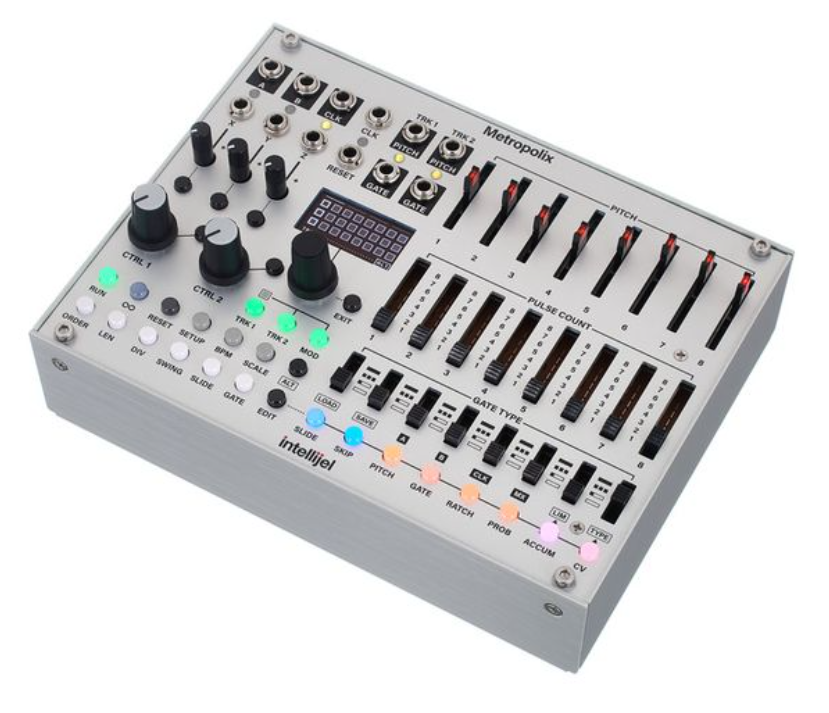
Closing with one of the most musically intelligent eurorack sequencers adapted for desktop use. Intellijel Metropolix Solo is the standalone version of the beloved Metropolix module, giving you a two-track pitch and gate sequencer with eight physical sliders, an OLED display, accumulator engine, slide logic, and extensive modulation routing in a desktop format with its own power supply and CV/Gate outputs that don’t require a eurorack case.
The Metropolix earned its reputation in eurorack for producing melodic sequences that sound composed rather than programmed. The accumulator and slide features generate note relationships and legato phrases that most step sequencers can’t produce without extensive manual editing, and the standalone Solo version brings all of that to producers who don’t own or want a modular system.
- Accumulator
The accumulator engine adds or subtracts pitch values across steps based on configurable rules, creating melodic contours that evolve gradually over multiple passes through the sequence rather than repeating identically every time.
The accumulator produces melodies that develop and shift over time, rising gradually over several cycles before resetting or falling back, generating the kind of slow, deliberate melodic evolution that makes hardware sequenced music feel alive rather than looped. You hear a melody change subtly each time it comes around, and after sixteen repetitions it’s arrived somewhere completely different from where it started, which creates long-form musical narratives from short patterns.
- Slide Logic
Configurable slide behavior between steps creates legato note transitions with controllable speed and character, producing the gliding pitch connections between notes that are essential to certain melodic styles from acid techno to ambient generative music.
The slides produce smooth, continuous pitch changes that step-triggered sequences normally can’t achieve, and the per-step control means you decide exactly where slides occur and how fast they transition. Short slides create quick portamento between notes.
Long slides create dramatic pitch sweeps that span several steps. The slide logic is what gives Metropolix sequences their characteristic flowing, musical quality.
- Physical Sliders
Eight physical pitch sliders provide immediate visual and tactile access to your sequence’s melodic contour that no encoder or screen-based interface matches. You see the melody shape as a physical arrangement of slider positions on the panel, and changing a note is as fast as pushing a slider with your finger.
The slider interface is faster and more intuitive than encoder-based pitch entry for melodic composition because you’re not clicking through values one at a time. You grab a slider and move it to where you want the pitch, and you can see the relative pitch of every step simultaneously by looking at the slider positions.
- Mod Routing
Extensive internal modulation routing with multiple modulation sources and destinations lets you create self-evolving sequences where parameters modulate each other without any external patching.
The internal modulation means your sequences develop complexity from simple starting material, with LFOs, envelopes, random sources, and track interactions driving pitch, gate length, accumulator depth, slide speed, and other parameters automatically.
The modulation depth is what separates the Metropolix from simpler step sequencers, because a modulated sequence never exactly repeats even though the step data is the same.
- Desktop Format
The standalone desktop format with integrated power supply and rear-panel CV/Gate outputs brings the full Metropolix experience outside of eurorack without any compromise on features. You don’t need a eurorack case, bus board, power supply, or any modular infrastructure.
You place the Metropolix Solo on your desk, connect its CV/Gate outputs to your synths with standard patch cables, and start sequencing immediately. For producers who love the Metropolix’s musical intelligence but don’t want to invest in a full modular system, the Solo format removes every barrier to entry.

Hello, I’m Viliam, I started this audio plugin focused blog to keep you updated on the latest trends, news and everything plugin related. I’ll put the most emphasis on the topics covering best VST, AU and AAX plugins. If you find some great plugin suggestions for us to include on our site, feel free to let me know, so I can take a look!