
Strings are the backbone of orchestral music and one of the most frequently needed virtual instrument categories in modern production. Whether you’re scoring a film, adding lush pads to a pop arrangement, or building a full orchestral template, the quality of your string library directly determines how convincing and emotional the result sounds.
A great string library makes the difference between a demo that sounds obviously synthetic and a mockup that clients and listeners accept as a real performance.
The challenge with choosing a string library is that every option involves trade offs. Some prioritize deep articulation coverage and realism at the cost of complexity and disk space. Others focus on playability and speed, getting you a usable string sound quickly without demanding hours of MIDI editing.
A few take the recorded string content and process it into hybrid cinematic textures that go beyond what real strings can do acoustically. I’ve selected nine libraries that cover this full range, from traditional orchestral sampling to physically modeled and hybrid approaches, so you can find the option that matches how you actually work.
1. ujam Symphonic Elements STRIIINGS
If you need convincing string parts in your production without spending weeks learning a complex orchestral template, ujam’s STRIIINGS gets you there faster than any traditional string library. The plugin uses ujam’s phrase and pattern based engine that generates performed string content from your chord input.
The trade off is clear: you sacrifice the note by note control of deep sampling for speed and convenience that traditional libraries can’t match.
- Phrase Engine
The performance engine generates complete string arrangements from simple chord input, handling the voicing, rhythm, articulation, and dynamics of the string section automatically.
You play chords on your keyboard and the engine produces idiomatic string performances that include proper voice leading, bow changes, and dynamic contour without you programming any of these details manually. The phrase engine covers a range of performance styles from gentle sustained pads to rhythmic spiccato patterns, and switching between them is immediate.
- Style System
Genre specific styles configure the entire instrument for different musical contexts, from cinematic scoring to pop arrangement to classical. Each style adjusts the pattern library, performance behavior, tone character, and articulation selection to produce results appropriate to the specific production context.
You can audition different styles on the same chord progression to find the string character that fits your track without rebuilding your approach each time.
- Instant Results
The plugin is designed to produce usable string parts within seconds of loading, which is its primary advantage over deep orchestral libraries that require template building, articulation mapping, and extensive MIDI programming.
The instant usability makes it practical for songwriters, producers, and composers who need string accompaniment as part of a broader production rather than as the primary focus of detailed orchestral writing.
- Finisher Effects
Built in effects processing shapes the string tone within the plugin, providing reverb, EQ, and spatial options that are tuned for orchestral strings specifically.
The integrated effects mean you can get a polished, mix ready string sound without routing through external processing, which further accelerates the workflow.
Here’s the updated section for VSL Synchron Strings Pro:
2. VSL Synchron Strings Pro
The flagship string library from Vienna Symphonic Library, recorded at the purpose built Synchron Stage Vienna with an expanded player count and deeper sampling than the standard Synchron Strings edition. VSL Synchron Strings Pro captures larger string sections with more articulations, more dynamic layers, and more round robins than any other library in VSL’s catalog.
The “Pro” designation isn’t just marketing. The additional sampling depth is audible in the smoother dynamic transitions, more detailed legato behavior, and broader tonal range that the expanded velocity layers and round robins provide compared to the standard edition.
- Synchron Stage
The purpose built scoring stage provides a warm, detailed acoustic environment captured through multiple microphone positions in every sample. The room sound gives you immediately cinematic string tone without external reverb processing because the acoustic signature of a world class performance space is already present in the recordings. The stage was designed specifically for orchestral recording, which means the acoustics serve the instruments naturally rather than imposing a colored or overpowering room character that fights with your mix.
- Pro Sampling Depth
The Pro edition provides expanded dynamic layers, additional round robins, and more articulation variations compared to the standard Synchron Strings, producing smoother transitions between velocity levels and less repetition in fast or sustained passages. The extra sampling depth is where you hear the difference most clearly, because the additional velocity layers fill in the gaps between dynamics that the standard edition crosses with crossfading alone. For exposed string writing where every nuance is audible, the Pro depth justifies itself immediately.
- Microphone Trees
Multiple microphone positions from close to distant provide independent control over the spatial depth and tonal perspective of the strings in your mix. You can blend close mics for definition and presence with room mics for depth and natural ambience, creating exactly the spatial placement you need. The mic positions were all recorded simultaneously, which means they interact naturally when blended because they captured the same performance from different perspectives.
- Legato Transitions
Recorded legato intervals capture the smooth pitch connections between notes that define expressive string playing, including the bow continuity and pitch bending that real players produce. The legato samples handle both slow, lyrical connections and faster, more agile movement, adapting the transition character to the pace of your playing. VSL’s legato programming is among the most natural sounding available, and it’s what prevents your string lines from sounding like a staircase of disconnected notes.
- Synchron Player
The instruments run in VSL’s Synchron Player software, which provides a modern interface with preset management, built in mixer, and effects that improve on the workflow of VSL’s legacy player. The Synchron Player handles articulation switching, expression mapping, and performance logic in an interface that’s faster to navigate and more visually informative than the older Vienna Instruments software.
- Dimension Control
The dimension system allows you to adjust player positioning and section size within the virtual stage, giving you control over the spatial width and depth of the string sections beyond what the microphone mix provides. The dimension control lets you fine tune how the strings sit in the orchestral depth field, which is useful for matching the spatial perspective with other instruments in your template.
3. AIR Studio Strings
A library that provides quality orchestral strings at a price point and complexity level that makes it accessible to producers who don’t want to invest in premium tier orchestral sampling. AIR Studio Strings delivers warm, usable string tones with enough articulation coverage for most production needs.
The practical value is in the balance between quality and accessibility, giving you genuinely good sounding strings without the steep learning curve and cost of flagship libraries.
- Accessible Quality
The library delivers warm, musical string tones that hold up well in productions without requiring extensive MIDI editing or processing to sound convincing.
The recordings are balanced and production ready, sitting in a mix naturally without the resonance problems or harsh frequency buildups that lower quality libraries sometimes exhibit. For producers working across pop, film, and media production, the sound quality handles the majority of string needs competently.
- Core Articulations
The articulation set covers the essential string techniques including sustains, legato, staccato, pizzicato, tremolo, and spiccato that handle the vast majority of string writing requirements. The focused articulation set means less complexity to manage while still covering the techniques you’ll use most frequently in your productions.
- Straightforward Interface
A clean, uncluttered interface presents the controls you need without burying essential functions in sub menus or requiring manual consultation to find basic features. The interface simplicity means you can load the instrument and start writing string parts quickly, which is valuable for producers who use strings as one element of a broader production rather than as the primary focus.
4. Native Instruments Symphony Ensemble Strings
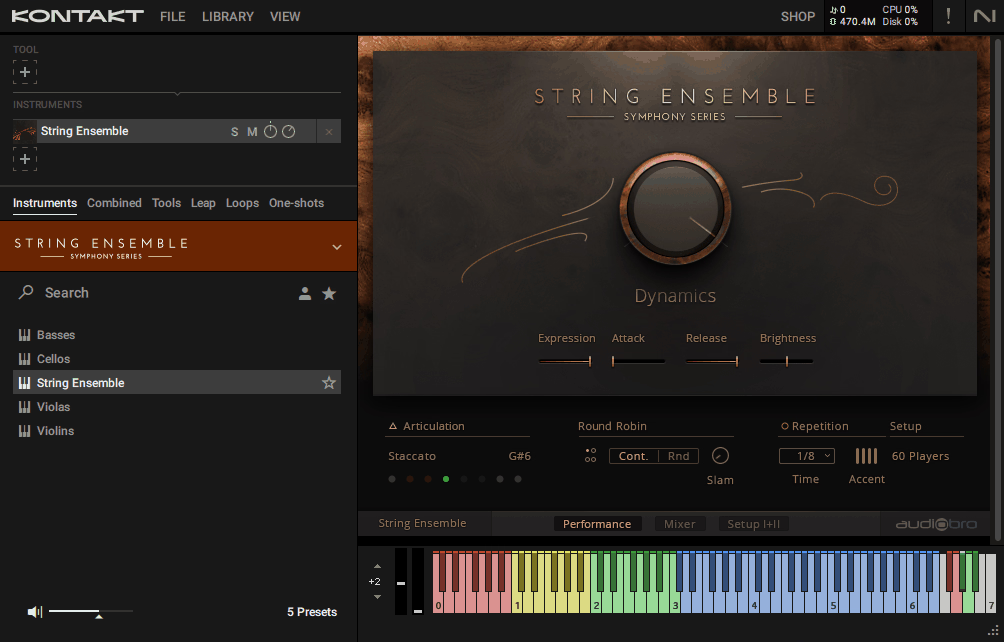
Part of NI’s Symphony Series, this library provides orchestral string sections designed for film, television, and game scoring with the NKS integration that NI users expect. Symphony Ensemble Strings focuses on ensemble recordings rather than individual solo instruments, capturing the natural blend of a string section playing together.
The ensemble recording approach gives you the cohesive section sound that comes from real players performing together in a room, which is difficult to replicate by layering solo instrument libraries.
- Ensemble Blend
The ensemble recordings capture the natural blend of multiple players performing together, including the subtle pitch, timing, and tonal variation that creates the rich, cohesive sound of a real string section. The ensemble approach gives you a section sound immediately without needing to layer multiple solo instruments and hope they blend convincingly, which is how many producers end up working with less integrated libraries.
- Cinematic Focus
The sounds and articulations are selected for scoring applications, emphasizing the dynamic range, expression, and tonal qualities that film and game composers need most frequently. The cinematic orientation means the library prioritizes the techniques and tonal characters that appear in professional scoring rather than attempting comprehensive coverage of every classical technique.
- NKS Integration
Full NKS compatibility provides tagged browsing, hardware parameter mapping, and light guide display on NI keyboards. The integration lets you browse the string library from your keyboard’s display, audition patches in context, and control expression parameters from hardware knobs that are pre mapped to the most useful controls. For producers already invested in the NI ecosystem, the integration streamlines the workflow significantly.
- Dynamic Layering
The dynamic sampling covers a broad range from gentle pianissimo to powerful fortissimo with smooth crossfading between layers. The dynamic response feels continuous rather than stepped, which is essential for expressive string writing where gradual crescendos and diminuendos carry much of the emotional content.
5. Arturia Augmented STRINGS
Rather than aiming for orchestral realism, Arturia takes recorded string content and combines it with synthesis, effects, and processing to create a hybrid instrument that produces sounds no purely acoustic string section could make. Augmented STRINGS sits at the intersection of orchestral sampling and electronic sound design.
The hybrid approach makes this useful for producers working in genres where you want the tonal warmth of real strings combined with electronic textures and evolving synthetic content.
- Hybrid Engine
The instrument combines real string recordings with synthesized layers that you blend, morph, and modulate together. You get the organic character of acoustic strings fused with the evolving textures and tonal range of synthesis, producing sounds that feel rooted in reality but extend beyond what an acoustic string section can produce.
The hybrid approach creates content that’s immediately useful for modern film scoring, electronic production, and pop arrangements where you want string character without a purely traditional orchestral sound.
- Layer Morphing
Independent control over the acoustic and synthetic layers with crossfade morphing lets you move the sound from mostly organic to mostly synthesized at any point. Automating the morph creates evolving passages that transition between acoustic string warmth and electronic texture, which produces movement and development that static string pads lack entirely.
- Modulation System
A comprehensive modulation framework with LFOs, envelopes, and sequencers animates both layers simultaneously, creating breathing, evolving textures that develop over time. The modulation prevents the static quality that makes sustained string pads sound lifeless, introducing subtle variation and movement that keeps the content interesting across extended passages.
6. EastWest Hollywood Strings 2
Co produced by Thomas Bergersen of Two Steps from Hell fame and engineered by Sean Murphy (known for his work on the Star Wars franchise), this library was designed to capture the specific sound of Hollywood film scoring. Hollywood Strings 2 was recorded at EastWest Studio One in Los Angeles, the same room where Frank Sinatra and the Rolling Stones recorded.
The library is one of the most comprehensive orchestral string collections available, with an articulation count that covers virtually every technique a string section can perform.
- Articulation Count
The library provides an enormous number of articulations covering every standard and extended technique including legato with bow changes, portamento, detache, sustains, pizzicato, col legno, Bartok pizz, marcato, ricochet, spiccato, staccato, staccatissimo, tremolo, trills, and playable runs. Each articulation is recorded with multiple velocity layers and round robins, and the short articulations in particular have enough variation to prevent the machine gun effect in fast passages. The sheer breadth means you’ll find virtually any traditional string technique you need without leaving this library.
- Finger Positions
The sampling includes different finger positions on the strings, which affects the tonal quality of each note in the same way that a real player’s choice of string and position changes the sound.
The finger position control gives you tonal variation that most string libraries don’t offer, because they typically record each note in one position only. You can match the tonal character to the musical context by choosing brighter or warmer fingerings.
- Performance Scripts
Powerful scripting implements techniques and performance behaviors that go beyond sample playback, including forcing portamento into sustain patches and adjusting bow stroke characteristics through the performance settings panel.
The scripts let you modify the performance character of loaded patches without switching to different articulation sets, which keeps the workflow fluid when you want to experiment with different playing styles on the same passage.
- Divisi Support
The library includes divisi folders where string instruments are divided between stand partners, producing the separation and clarity that occurs when the section splits into smaller groups. The divisi recordings sound different from the full section because they capture fewer players with more definition per voice, which is essential for passages where the strings divide into multiple independent melodic lines.
- Microphone Positions
Multiple mic positions let you blend close, mid, and ambient perspectives to control the spatial depth and tonal character. The mic selection lets you place the strings anywhere from right in front of you with the close mics to deep in the room with the ambient positions, giving you complete control over how the strings sit in your orchestral depth field.
7. Spitfire Hans Zimmer Strings
Developed in collaboration with Hans Zimmer and recorded at AIR Studios in London with a 344 piece string ensemble (recorded in groups), this library captures the massive, cinematic string sound that defines Zimmer’s scoring style. Spitfire’s Hans Zimmer Strings provides the huge, wall of sound string tone that’s become synonymous with contemporary blockbuster scoring.
The library doesn’t attempt to be a general purpose orchestral string tool. It’s specifically designed to produce big, emotional, cinematic string moments.
- Massive Sound
The recording approach captures an exceptionally large string ensemble that produces the rich, powerful, and emotionally overwhelming string sound associated with Zimmer’s film scores.
The size of the ensemble creates a density and weight that smaller section recordings can’t achieve regardless of processing, because the natural interaction of hundreds of bowed strings in a room produces a sonic complexity that layering smaller sections doesn’t replicate. When you need strings that fill the screen with emotion, this is the library that delivers that specific cinematic weight.
- Zimmer Curation
Hans Zimmer’s direct involvement in the creation of the library means the sound, articulation selection, and preset design reflect the specific aesthetic decisions of one of the most successful film composers working today.
The curation isn’t marketing. Zimmer’s team made practical decisions about which articulations, dynamic ranges, and tonal characters would be most useful based on decades of scoring experience at the highest level of the film industry.
- AIR Studios
The recording at AIR Studios in London captures the specific acoustic signature of one of the world’s most celebrated scoring stages.
The room sound provides a natural warmth, depth, and spaciousness that gives the strings an immediately cinematic quality without external reverb processing. AIR Studios’ acoustic character has been heard on countless film scores, and having that specific room sound embedded in the recordings gives you access to the same environment that major film productions use.
Here’s the updated section for SWAM String Sections:
8. Audio Modeling SWAM String Sections
Where the solo SWAM instruments model individual violins, violas, cellos, and basses, SWAM String Sections applies Audio Modeling’s physical modeling technology to full ensemble string sections. The engine generates the sound of multiple players performing together in real time, simulating not just individual instruments but the interaction between players in a section.
The section modeling captures the subtle pitch, timing, and tonal variation between players that gives a real string section its rich, blended character, all generated mathematically rather than recalled from recorded samples.
- Section Modeling
The engine generates full string sections through physical modeling rather than layering multiple solo instances, simulating the acoustic interaction between players sitting together in an ensemble. The section approach models how multiple bows, strings, and bodies interact acoustically, producing the natural chorus effect and tonal richness that emerges when real players perform together. The result sounds like a cohesive section rather than copies of the same solo instrument stacked on top of each other, which is a problem that layering solo physical models or solo samples creates.
- Continuous Response
Because the sound is generated in real time, every parameter responds continuously without stepping through dynamic layers or switching between articulation samples. Crescendos and diminuendos are perfectly smooth with no crossfade artifacts between velocity groups. Vibrato depth and speed change instantly, and the tonal character morphs fluidly as you adjust bowing parameters. There are no boundaries between dynamic layers, no round robin cycling, and no sample switching discontinuities that interrupt sustained passages.
- Bow Control
You can control bowing parameters including pressure, speed, position on the string, and distance from the bridge in real time through MIDI controllers. The bowing control provides the expressive nuance that defines string playing, and the physical model responds to these parameters the way real instruments do, where changes in bow pressure produce not just volume differences but tonal changes in overtone content, attack character, and string noise. The real time control means you shape the sound as you perform rather than selecting from pre-recorded variations.
- Player Variation
The engine introduces natural variation between the modeled players within each section, including subtle differences in intonation, timing, vibrato rate, and bowing attack. The variation is what prevents physically modeled sections from sounding like a single instrument duplicated, because each virtual player responds slightly differently to the same MIDI input. You can adjust the amount of variation to control how tight or loose the section sounds, from precisely coordinated to more relaxed and human.
9. Orchestral Tools Berlin Symphonic Strings
Closing the list with a library that carries the reputation and recording quality of the Berlin series while focusing on large section string writing rather than the chamber and solo detail of the original Berlin Strings. OT Berlin Symphonic Strings captures 68 instruments across five string sections recorded at the Teldex Scoring Stage in Berlin.
The large section focus gives you the full, rich sound of a complete film scoring string section with the Orchestral Tools quality that professional composers have come to rely on.
- Large Sections
The library captures 68 musicians across the five string sections (18 first violins, 16 second violins, 14 violas, 12 celli, and 8 basses), producing the massive, rich string sound that large scale film scoring demands.
The section sizes are larger than what many libraries record, which gives you a density and power that smaller ensemble recordings can’t achieve through processing alone. The large ensemble creates the lush, cinematic blend that defines the blockbuster scoring sound.
- Adaptive Legato
Orchestral Tools’ Adaptive Legato technology automatically selects the appropriate legato style based on your playing speed and dynamics. Slow, lyrical passages receive melodic legato with natural vibrato and smooth transitions. Fast passages trigger rapid legato optimized for agile runs. Ostinato passages use pattern legato with round robin variation to prevent repetition.
The adaptive behavior means you don’t need to manually switch legato modes as the music changes character, because the engine reads your performance and responds intelligently.
- Teldex Recording
The Teldex Scoring Stage provides a warm, detailed acoustic environment where the Berlin Philharmonic and numerous film scores have been recorded. The room sound is captured through multiple microphone positions including spot mics, tree mics, and ambience mics, giving you flexible control over the spatial depth and tonal perspective.
The Teldex signature provides an immediately cinematic quality that dry recordings require extensive reverb processing to approximate.
- In Situ Seating
The musicians were recorded in their traditional orchestral seating arrangement with violins on the left, violas in the center, and celli and basses on the right.
The in situ recording captures the natural stereo spread and spatial relationships between sections as they occur in a real orchestral performance, which means the panning and depth positioning are built into the recordings rather than artificially created after the fact.
- Mic Flexibility
Multiple microphone positions including two spot mics, tree mics, and ambience captures provide extensive control over the spatial character and tonal balance.
The close spot mics give you clarity and definition for detailed passages, while the tree and ambience positions provide the room character and natural blend that make the strings sound like they’re performing in a real space. Blending different positions lets you place the strings anywhere in the orchestral depth field from intimate and present to distant and enveloping.

Hello, I’m Viliam, I started this audio plugin focused blog to keep you updated on the latest trends, news and everything plugin related. I’ll put the most emphasis on the topics covering best VST, AU and AAX plugins. If you find some great plugin suggestions for us to include on our site, feel free to let me know, so I can take a look!