
Sound design plugins have become some of the most valuable tools in modern music production. They let you shape, twist, and completely transform sounds in ways that were impossible just a few years ago. Whether you’re building textures for electronic music, creating vocal effects, or designing something totally new, the right plugin can turn a simple idea into something unique.
The best plugins for sound designers combine creative effects, synthesis tools, and processing chains that push your audio beyond traditional mixing and into full sonic experimentation.
I’ve spent time with dozens of these tools, and the ones that made this list all share something important: they help you find sounds you didn’t know you were looking for. Some focus on granular manipulation, others on modulation and morphing, and a few bring completely fresh approaches like AI-powered transformations or modal filtering.
This collection covers synthesizers that let you build from scratch, effect processors that reshape existing audio, and hybrid tools that blur the line between the two. You’ll find options for distortion that works differently than anything you’ve used, vocoders that feel modern, frequency shifters, ring modulators, and even a drum synth built around metal percussion.
I’ve also included a free option so you can start exploring without spending anything. Each tool here opens up a different creative path, and together they give you a solid foundation for any sound design challenge you run into.
1. Polyverse Supermodal (Modal Filter & Resonator)
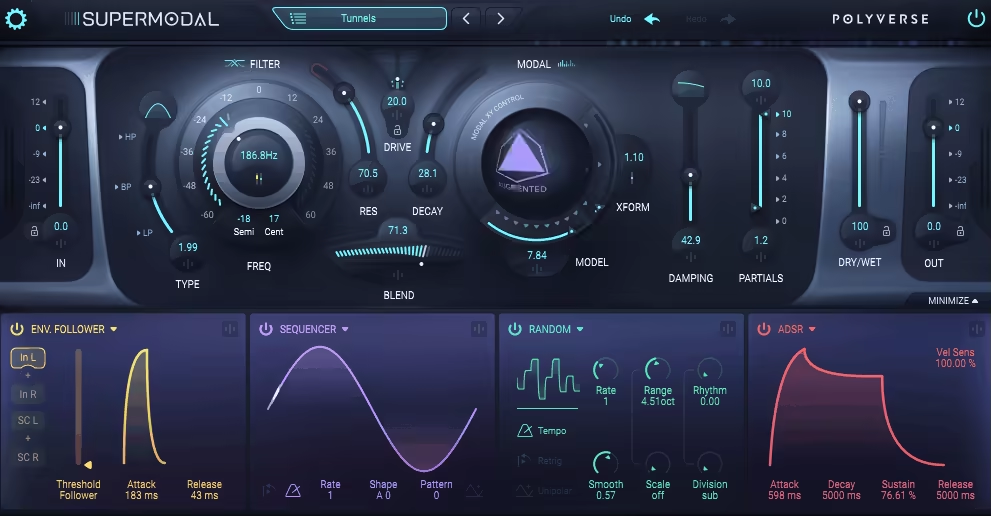
If you’ve ever wanted a filter that doesn’t just cut frequencies but actually reshapes your sounds into something musical, Supermodal is what you’re looking for.
What makes this plugin different is its modal filter engine. Instead of just filtering audio the normal way, it uses hundreds of precise bandpass filters to model how real objects resonate when they vibrate. You can make drums sound like bells, turn white noise into vocal formants, or transform a basic synth pad into something that feels physical and alive.
I use Supermodal when I need sounds to break out of their usual character. The dual-filter setup gives you a classic state-variable filter on one side and the modal resonator on the other, and you can blend between them however you want. That blend control is honestly one of my favorite parts because it lets you add just a hint of body or go completely wild with the effect.
Features:
- 27 Modal Resonator Modes
- State-Variable Filter with Drive
- Deep Modulation System
2. Serum 2 (Design Anything You Want)

I feel a bit awkward always including Serum 2 in every list, but honestly, not having Serum 2 in best sound desing plugins? That would be a huge mistake. Serum 2 isn’t just for creating sounds – you can design entire tracks from scratch, including drums. And yes, nobody will have a clue that those drums came from Serum 2. That’s just how powerful and versatile it is.
Serum 2 takes everything producers loved about the original and blasts it into another dimension. I’m talking about real sonic freedom here. You get five different oscillator types now, including wavetable, multisample, sample, granular, and spectral engines all under one roof.
What grabs me most is how natural it feels to jump between these engines. One minute I’m sculpting a classic wavetable lead, the next I’m loading SFZ multisamples for realistic piano textures or using the granular engine with up to 256 grains per voice to build evolving cinematic pads. It’s rare to find this much variety in a single plugin without the workflow getting messy.
The modulation system is where Serum 2 really shines for me. You now get 10 LFOs instead of 4, plus advanced options like Chaos LFOs based on Lorenz attractors and a Path LFO where you literally draw motion on an XY pad.
When you combine that with 8 macro controls and a flexible modulation matrix, you can automate nearly every parameter in ways that feel musical instead of random.
Features:
- Multi-Engine Oscillators
- Dual Warp Modes & Enhanced Wavetable Engine
- Internal Mixer & Dual FX Buses
- Built-In Sequencer & Arpeggiator
3. Minimal Audio Current 2 (Design Your Dreams)

Well, when I included Serum 2 in the list, it would be shame to not include Current 2. Especially when it comes with unique effects with completely different approach to majority of the plugins out there. When I need sounds that don’t exist anywhere else, Current 2 is sound design plugin I turn to first.
What makes this synth different is how it puts five separate synthesis engines side by side and lets you blend them however you want. You get two spectral wavetable oscillators, a granular sampler, an additive sub oscillator, and a time-stretching sampler all working together. That mix gives you room to build everything from soft pads to wild experimental textures.
The Play View interface keeps things simple when you’re designing sounds. You can tweak four macro controls using the dual XY pad, which makes it easy to morph your sound live or while you’re tracking. I love that you can solo or mute any engine instantly without digging through menus.
Current 2 also connects to Minimal Audio’s Stream platform right inside the plugin. You can browse and download presets, wavetables, and samples without ever leaving your DAW. The factory library comes loaded with over 400 presets, 170 wavetables, and 800 samples, so you have plenty to work with right away.
Features:
- Multi-Engine Sound Design
The granular sampler gives you access to 250+ grain types, perfect when you want glitchy movement or organic textures. You can modulate engines against each other using FM and AM routing, which opens up complex tones fast.
- Integrated Stream Content Library
- Wave Shifter Effect & Advanced Modulation
4. Minimal Audio Evoke (Beyond Vocals)

What caught my attention about Evoke is how it treats vocals like raw material instead of just something to tune or polish.
This plugin uses vocal resynthesis to break down your voice into its core parts, pitch, timbre, formants, then rebuilds it from scratch. That means you’re not just tweaking what’s already there. You’re reshaping the entire character of the sound. I’ve used it on lead vocals that needed a futuristic edge, and it delivered textures I couldn’t get from any standard vocoder or pitch plugin.
Evoke also includes 15 character modes that shift the personality of your vocal instantly. You can go from natural choral sounds to glitchy, robotic, or liquid textures without rewiring anything. The interface stays clean, so you’re not digging through menus when inspiration hits.
What I love:
- Multi-Voice Harmonization & Scale Detection
- Flexible Effects Rack
- Deep Modulation & MIDI Control
5. Devious Machines Infiltrator 2 (Lots of Sound Design Presets)

When I need unpredictable energy and rhythm injected into flat sounds, Infiltrator 2 is my go-to multi-effect plugin.
What I appreciate most is how quickly you can transform boring audio into something wild and moving. I’m talking about pulsating gates, spectral manipulation, sequenced distortions, and rhythmic filters that sync perfectly with your track’s tempo. The plugin comes packed with over 1,500 presets designed by professionals, so you’re never starting from scratch.
I use Infiltrator 2 when I want to break away from typical processing chains. It stacks up to 54 different effects including filters, delays, reverbs, and even time-manipulation tools like reverse and granular stretching. Everything runs through a 32-step sequencer that lets you turn effects on and off per step, creating constantly evolving patterns that feel alive.
You get:
- Massive Preset Library
You get 1,500+ presets right out of the box, which is rare for a creative effects tool
- Sequencer and Real-Time Modulation Control
- 54 effect modules spanning filters, distortions, spectral FFT effects, modulation, delay, reverb, and more
6. Beatsurfing Random METAL (Unique Drum Synth)

Random METAL is a great contender for sound design plugins list as it throws out the usual drum synth rulebook and gives you 25+ distinct percussive engines that generate sounds from scratch instead of cycling through samples.
What I appreciate is how fast you can land on something usable. The RANDOM button reshapes your sound instantly, and you control how extreme the changes get with a deviance slider. One click might give you a subtle shift in tone. Another might turn a metallic clang into something closer to a shaker or bell.
It’s built around exploration, not precision. You’re not loading kicks and snares here. You’re creating metallic hits, abstract textures, and percussive chaos that feels alive. Beatsurfing developed this with producers Phazz and Herrmutt Lobby, and you can tell they wanted something that rewards experimentation over perfection.
Things worth mentioning:
- 25+ Percussive Engines & Randomization Random
- Expressive XY Pad for Real-Time Morphing
- Dual Playback Modes: Pads & Chromatic
7. Neutone Morpho (AI Realtime Morphing)

Neutone Morpho uses machine learning to reshape audio in real time, turning any input into something completely different while keeping the original sound’s shape and feel intact. Vocals, drums, field recordings, synths, whatever you have becomes raw material for transformation. The plugin resynthesizes your input into entirely new timbral styles without losing the expressive details like dynamics or subtle inflections.
And here’s where it gets wild: you can train your own custom models. No coding, no expensive GPU setup. Just drag and drop your sounds into Neutone’s Cocoon service and create a morph target based on your own samples. Your voice, your instrument, your choice.
- AI-Powered Tone Morphing with Pre-Trained Models
- Custom Model Training via Cocoon
- Macro and Micro Control Modes
- Built-In Effects and Low Latency Processing
8. Baby Audio Atoms (Unique Synth)

What drew me to Atoms right away is how it breaks from the usual synth formula. Baby Audio built Atoms around physical modeling using a mass-spring network, which means the sound comes from simulating actual vibrating objects instead of traditional oscillators.
When you play a note, a virtual bow excites these connected springs and masses, creating textures that feel genuinely alive. The tones shift and breathe in ways that standard synths just don’t capture naturally. I find myself reaching for Atoms whenever I need something organic but still futuristic.
The interface stays simple even though the tech underneath is complex. You get six main controls that shape how the physical system behaves.
Chaos adds unpredictable movement, Order damps the vibrations, and Force controls how hard the bow strikes. It’s intuitive once you start twisting knobs and hearing how the sound responds.
- Mass-Spring Physical Modeling Engine
- Six Core Parameters with Motion Control
- Four Physical Profiles and Randomization Tools
9. Beatsurfing CHEat Code

CHEat Code caught my attention because it doesn’t follow the usual multi-effects playbook. Beatsurfing built this plugin with Grammy-winning producer Che Pope, and it shows in how unpredictable and inspiring it feels to use.
What makes this tool different is how freely you can experiment with signal flow. You get 16 specialized effect modules that you can stack, reroute, and morph between serial and parallel processing. That routing flexibility alone opens up sound design territory that most FX chains can’t reach.
I use CHEat Code when I want to push sounds into unusual spaces quickly. The modules range from traditional effects like chorus and reverb to wild tools like Bubble Grain, Shuffler, and Reverser. Each one feels hand-crafted for a specific kind of transformation.
Features:
- 16 Effect Modules With Radical Range
- Flexible Serial and Parallel Routing
- Performance Widget and Macro Control
10. Tracktion Novum by Dawesome

Most samplers just play back your files, but Novum breaks them apart into six independent layers and lets you reshape each one individually.
It’s built around granular synthesis, but with a twist. Instead of just chopping audio into tiny grains, Novum uses a spectral import system that separates different sonic elements from your source material. You can manipulate tone, texture, and dynamics in ways that feel more like sculpting than traditional sound design.
What really hooked me is the “sound clay” idea. You import one sample and Novum gives you six pieces of moldable audio. You can drag timbres and envelopes between layers, lock certain characteristics while browsing presets, and blend completely different sonic qualities together.
Here is what you get:
- Six-Layer Spectral Decomposition
- Advanced Granular Engine with Homogenize
- Timbre Flower & Cross-Synthesis
11. Output Portal (Granular Tool)

Portal by Output completely changed how I think about granular processing. Even though it’s older plugin, Portal is definitely sound design plugin that keeps things surprisingly musical while still giving you wild creative control.
You can break your audio into tiny grains and rebuild them into something fresh. Feed it vocals, drums, synths, or anything else and watch it transform into pads, textures, or glitchy effects. The plugin generates up to 16 grains at once, which you can shape, pitch, reverse, and stretch in ways that feel more like playing an instrument than tweaking an effect.
I really appreciate the scale-locked pitch modulation. This keeps your granular experiments from sounding totally random or off-key. You can push things into weird territory while maintaining some harmonic sense, which makes Portal way more useful in actual tracks.
The X/Y pad and two macro knobs make live performance feel natural. I can morph sounds in real time without menu diving, and the results always surprise me in good ways.
Features:
- Granular Engine with Musical Results
- Over 250 presets cover everything from vocal processing to sound design, giving you solid starting points.
- Built-In Effects Section
Portal includes seven effect types: bit reducer, chorus, distortion, filter, phaser, reverb with freeze, and stereo delay. Each effect has its own wet/dry mix and level controls, so you can layer processing without leaving the plugin.
- Dual Modulation System
- Performance Controls & Visual Feedback
12. GForce Software Halogen FM (FM Synth)

FM synthesis has always intimidated me. The algorithms, the operators, the endless routing options that require a degree in sound engineering just to get a bell sound. Halogen FM flips that completely.
What hooked me right away is the Spark Core, a generative engine that creates full FM patches instantly with one button press. You’re not waiting through trial and error or copying settings from a tutorial.
You hit Spark, and suddenly you have a working patch that actually sounds musical. From there, you can tweak six macro knobs to shape timbre, envelopes, modulation, effects, and the mix between operators.
Despite having only two operators, Halogen FM sounds surprisingly rich. GForce designed these operators based on a rare Japanese FM synth, so the tonal character feels different from typical FM plugins. You can dive into full operator editing when you want control, but the macro system keeps things playful and instinctive.
Main features:
- Spark Core for Instant Patch Generation
- Six Macro Knobs for Fast Sound Shaping
- Expressive Performance Features
- Over 320 Presets with Searchable Browser
The preset library covers pads, bells, plucks, textures, and experimental sounds.
13. Minimal Audio Rift 2 (New approach to Distortion)

What pulled me toward Rift 2 is how it treats distortion like a full creative environment instead of just a drive knob. Most distortion plugins give you one or two flavors and call it a day. Rift 2 gives you 30 distortion types, multi-band processing, and a whole modulation system that turns simple saturation into something alive and animated.
I’ve used it on synth leads, drums, vocals, and even entire busses. The multi-polar engine splits your audio into positive and negative waveform halves and processes them separately, which creates harmonic movement you can’t get from standard distortion. It sounds technical, but in practice it just means richer, more textured results.
What really sets Rift 2 apart is how deep you can go without losing control. The interface switches between Play View and Advanced View, so you can stay simple when you’re exploring presets or dive into six-stage distortion chains when you want to build something wild.
Features:
- Multi-Polar Distortion with 30 Algorithms
- Tunable Feedback Module
- Multi-Band Crossover & Morphing Filters
- Deep Modulation System with Curve Sequencers
14. Moog Moogerfooger MF-102S RingMod (Ring Modulator)

When I need sounds that sit somewhere between vintage analog warmth and full-on sonic chaos, I turn to the MF-102S from Moog. This plugin brings Moog’s legendary ring modulator pedal into your DAW, and honestly, it does a lot more than just make robotic voices.
What stands out most is how playable it feels. The ring modulator, carrier oscillator, and dual-waveform LFO work together in ways that let you shape everything from gentle tremolo wobbles to metallic, bell-like tones that cut through any mix. You’re not locked into one type of sound, which is exactly why I keep coming back to it.
The stereo functionality is a huge upgrade from the original hardware. You can pan the carrier oscillator out of phase or even reverse it, giving you spatial movement that makes boring loops feel alive. I’ve used this on pads and vocal chops where I wanted the modulation to travel across the stereo field instead of sitting flat in the center.
Features:
- Ring Modulator with Wide Carrier Range
- Dual-Waveform LFO for Movement
- CV Modulation and Plugin Interconnectivity
15. Arturia Efx REFRACT

What caught my attention with Efx REFRACT is how it transforms single sounds into something massive and alive without loading multiple plugins or routing tricks.
Arturia built this plugin around a super unison engine that splits your signal into up to eight stereo voices, then spreads them apart with detuning, modulation, and per-voice effects. The result is instant width and depth that feels organic rather than processed. I use it when I need a thin synth line to fill more space or when I want vocals to sound layered without recording multiple takes.
What I appreciate most is how the five Mode FX options let you shape each voice differently before they recombine. You can choose bandpass filters, comb filters, bitcrusher, distortion, or a harmonizer with 12 chord presets. This means you’re not just widening the sound, you’re actually changing its texture and character at the same time.
Features:
- Super Unison Engine with Up to 8 Voices
- Five Mode FX Per Voice
- Built-In LFO Modulation
16. Baby Audio Humanoid (Modern Vocoder)
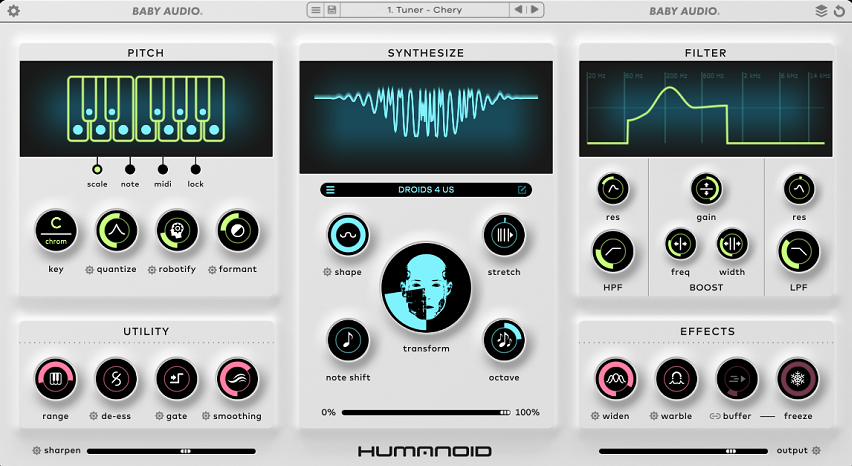
Humanoid caught my attention because it doesn’t feel like your typical pitch correction plugin. It’s more like a vocal synthesizer that treats your voice as raw material for something completely new.
What I appreciate most is how deep you can go with transformation. You’re not just snapping vocals to a grid. You can morph a sung line into wavetable-based textures, build robotic harmonies, or create vocal drones that barely sound human anymore. The FFT-based re-tuning engine keeps things smooth even when you’re pushing extreme settings.
I also love that it gives you three pitch modes to work with. Scale mode locks your vocal to a chosen key. Note mode freezes it to one or two pitches for drone effects. MIDI mode is where things get wild because you can literally play your voice like an instrument and stack 5-note polyphonic harmonies from a single vocal take.
Main features I found:
- Wavetable Resynthesis Core
- MIDI Control & Harmony
- Low-Latency Performance Mode
17. Tonsturm FRQ Shift (Frequency Shifter)

This one does something different than most pitch plugins. It shifts every frequency in your audio by the same amount instead of maintaining harmonic relationships.
That means you can take a normal sound and push it into strange, metallic, or totally alien territory. I use it when I want textures that feel futuristic or just need something that doesn’t sound like anything else in the mix.
FRQ Shift gives you two independent frequency shifter engines that you can blend together. Each engine can be modulated, fed back into itself, and routed through extra effects like delays or resonators. It sounds technical, but once you start turning knobs, the creative possibilities become obvious fast.
Features:
- Dual Shifter Engines With Crossfade
- Feedback Matrix With Insertable Effects
FRQ Shift includes four effects you can drop into the feedback path: delay, resonator, filter, and a second shifter. This feedback routing creates rich, evolving textures that go way beyond a basic shift. You can dial in subtle modulation or push it into full chaos. It’s perfect for sci-fi sound design, glitchy percussion, or drones that morph over time.
- Built-In Modulation System
- High-Precision Control & Stereo Enhancement
18. Lunacy Audio HAZE (Free Plugin)

Finding a truly useful free sound design plugin feels rare, but Haze from Lunacy Audio changed how I think about modulation effects. It blends chorus, phasing, algorithmic reverb, and spectral dispersion into one clean interface that actually sounds expensive.
What makes Haze different is how it treats modulation and space as one connected thing instead of separate effects. You’re not just adding chorus or reverb. You’re building moving textures that feel alive.
I keep reaching for Haze when I want to push a basic sound into something atmospheric. Pads become shimmering clouds. Vocals get that dreamy, washed-out character. Even simple guitar chords turn into wide, evolving layers that sit perfectly in cinematic or ambient tracks.
Features:
- Diffusion Network with Decay, Density & Spread
- Motion & Spectral Dispersion Engine
- Hybrid Chorus, Phase & Reverb in One
19. Minimal Audio Wave Shifter

Wave Shifter caught my attention because it takes frequency manipulation way beyond what most modulation plugins do. It combines frequency shifting, ring modulation, and amplitude modulation with deep FM synthesis and soft-sync controls. The result? You can turn a simple synth line into something metallic, glitchy, or completely unrecognizable.
What really sets it apart is how much control you get. The morphing LFO lets you create intricate rhythms and evolving harmonic movements that change over time. Plus, the feedback system adds resonant textures that can shimmer or scream depending on how you dial it in.
Wave Shifter works as a VST, Audio Units, VST 3, and AAX plugin on both Mac and Windows. It’s also part of Minimal Audio’s $15-a-month All Access subscription if you want their full software lineup.
Things to know:
- Three Processing Modes for Different Textures
- Deep FM and Soft Sync Engine
- Feedback Loop with Filtering

Hello, I’m Viliam, I started this audio plugin focused blog to keep you updated on the latest trends, news and everything plugin related. I’ll put the most emphasis on the topics covering best VST, AU and AAX plugins. If you find some great plugin suggestions for us to include on our site, feel free to let me know, so I can take a look!