
Mastering is the final stage of production, and it’s where your track either comes together or falls apart. A good master chain plugin gives you everything you need in one place: EQ, compression, limiting, stereo enhancement, and tonal shaping, all tuned to work as a cohesive unit rather than a pile of separate processors fighting each other.
The plugins on this list take very different approaches to that same goal. Some hand you full manual control and trust you to know what you’re doing. Others lean on AI analysis, celebrity engineer presets, or psychoacoustic algorithms to do the heavy lifting. And a few land right in the middle, giving you a streamlined set of controls that are hard to get wrong but flexible enough to get exactly right.
The seven plugins we’re covering are Safari Audio Noam’s Mastering Console, LANDR Mastering Plugin Pro, Waves TG Mastering Chain, Brainworx bx_masterdesk Pro, IK Multimedia Lurssen Mastering Console, United Plugins MasterMind, and IK Multimedia ONE.
Let’s get started:
1. Safari Audio Noam’s Mastering Console

Most master chain plugins are built by software companies. Mastering Console was built by a pedal maker who got tired of people asking about the custom tube console sitting behind him in every YouTube video.
Noam Levinberg, founder of Safari Pedals, had a one-of-a-kind analog tube mastering desk built exclusively for Safari HQ, and after receiving countless comments about it, decided to rebuild the entire thing in software.
What landed is a plugin that captures the sonic DNA of that physical console and packages it into a single-screen mastering chain. Early user feedback on Gearspace has been overwhelmingly positive, with producers praising the warmth and straightforward layout.
- Tube Saturation and Filtering
At the heart of the signal chain sits the tube saturation stage, which lets you blend continuously between clean and hot settings. Rather than slapping a generic saturation algorithm on top of your master, this control was modelled to replicate the exact behaviour of the tubes in Noam’s physical console.
High and low cut filters with selectable slopes at 12, 18, and 24 dB per octave handle the cleanup duties. You can engage them at 20 Hz and 20 kHz respectively, giving you precise control over how aggressively you trim the extremes.
What makes this section stand out is that the saturation can be applied to specific frequency ranges, targeting the low end (80, 100, 300, and 450 Hz) and the high frequency range (1, 3, 5, and 16 kHz) independently.
- Tonal Shaping and Stereo Image
A Baxandall EQ provides smooth, musical high and low tone shaping that’s almost impossible to make sound bad. Bax-style curves are gentle by nature, which makes them perfect for mastering where subtlety matters more than surgical precision.
The MS Matrix is where things get really interesting. It lets you sculpt the mid and side image independently, meaning you can widen your stereo field or tighten the center without affecting the other.
Paired with the built-in de-esser for transparent high frequency control before the final gain stage, and a clipper with auto gain options for pushing perceived loudness, the signal chain covers every step from tonal refinement to final delivery.
Available as VST3, AU, and AAX on macOS and Windows.
Get the Free Plugin Starter Kit
The genuinely useful free DAWs and plugins worth installing. No filler. Straight to your inbox.
2. LANDR Mastering Plugin Pro
AI mastering has always been polarising. When LANDR launched its online service back in 2014, the reaction was split between fascination and fear. Would it replace mastering engineers? The answer, a decade later, is more nuanced than that. It won’t replace an experienced engineer with a well-tuned room, but it closes a real gap for producers who write, mix, and release their own music.
Mastering Plugin Pro takes everything LANDR learned from millions of online masters and puts it directly in your DAW. No bouncing, no uploading, no waiting. Real-time AI analysis runs locally on your machine, and once the processing is applied, you get far more hands-on control than the online service ever offered.
Sound On Sound called it “hugely impressive,” and for producers under tight deadlines who need release-ready masters fast, it genuinely delivers.
- AI Analysis and Mastering Styles
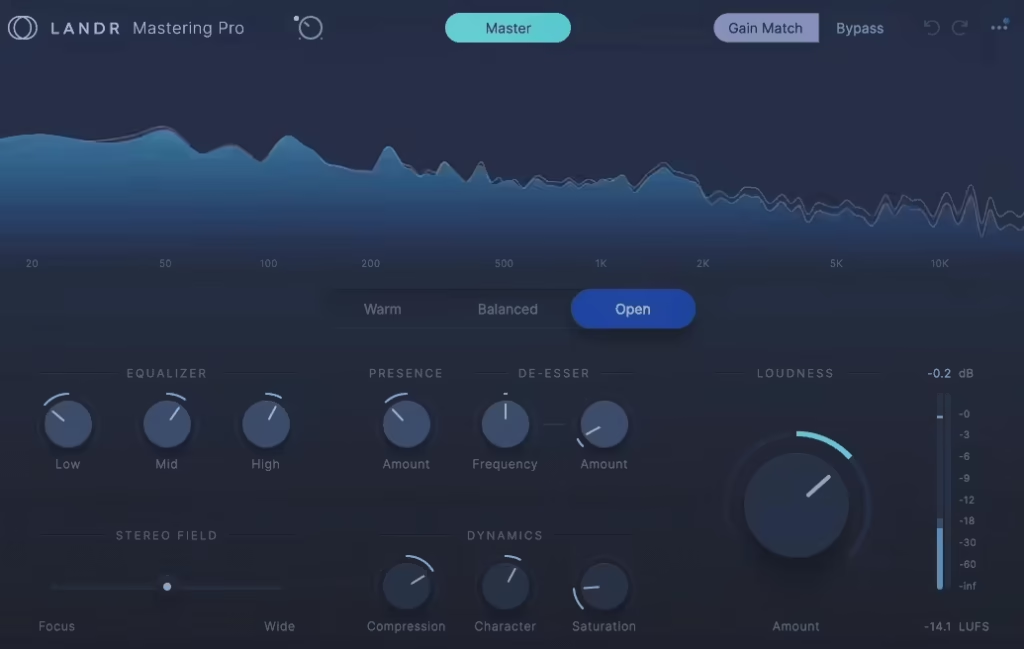
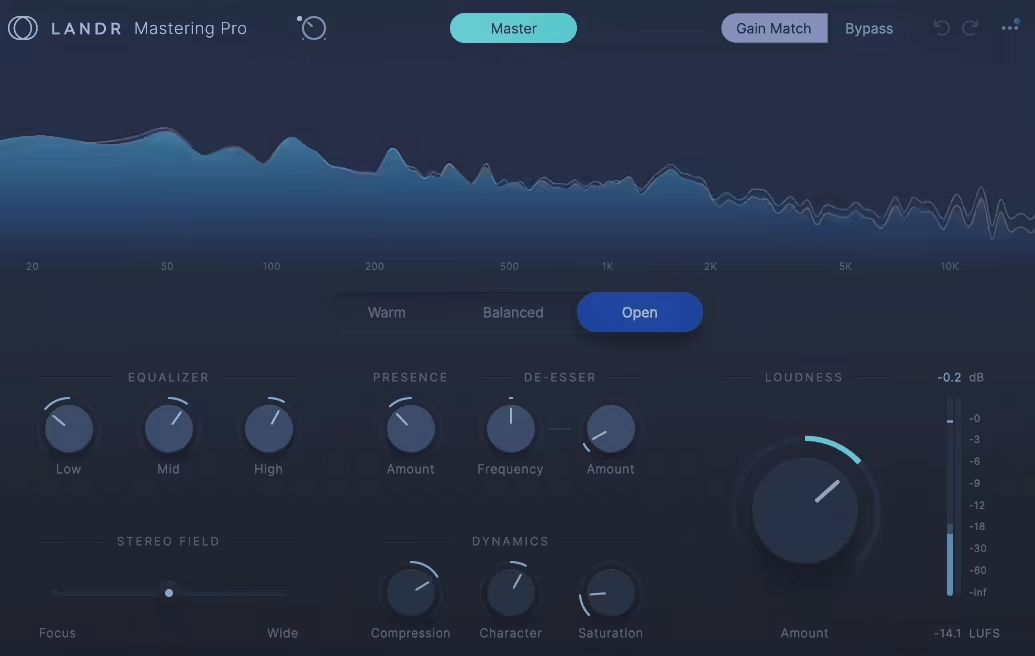
Drop the plugin on your master bus, hit play, and within about 30 seconds it generates three mastering profiles: Warm, Balanced, and Open. Each one represents a different tonal and dynamic approach based on LANDR’s analysis of your track’s genre, dynamics, and frequency response.
What separates this from a simple preset system is that the AI adapts to your specific material. A lo-fi chill beat and a high-energy dance track will receive fundamentally different processing chains. The spectral display shows a side-by-side comparison of your original mix and the mastered version, highlighting exactly what changed in the frequency balance.
Loop a section while comparing styles to really hear the differences without getting distracted by arrangement changes.
- Manual Controls and Metering
Once the AI sets its baseline, you get a solid toolkit for fine-tuning. A three-band EQ with low shelf, high shelf, and a broad mid bell around 400 Hz handles tonal adjustments. The Presence control targets vocal clarity in the 2.5 to 5 kHz range, and a dedicated de-esser smooths any harshness that results from boosting presence.
Stereo Field adjusts the M/S balance from focused to wide. The Dynamics section offers one-knob control over compression, character, and saturation. A large Loudness knob with LUFS and true peak metering rounds out the output stage.
One honest limitation worth noting: there’s no way to set a specific true peak target ceiling, and the CPU overhead is notably higher than a traditional mastering chain. But for the speed and quality of results, most producers will find that tradeoff worthwhile.
Runs as AAX, VST3, and AU on macOS and Windows.
3. Waves Abbey Road TG Mastering Chain
Some pieces of studio gear become legendary not because of marketing, but because of what they helped create. The EMI TG12410 Transfer Console has been a fixture in Abbey Road Studios’ mastering suites since the early 1970s. Pink Floyd’s The Dark Side of the Moon, Radiohead’s OK Computer, Nirvana’s In Utero, Ed Sheeran’s “+”. All of them passed through this desk.
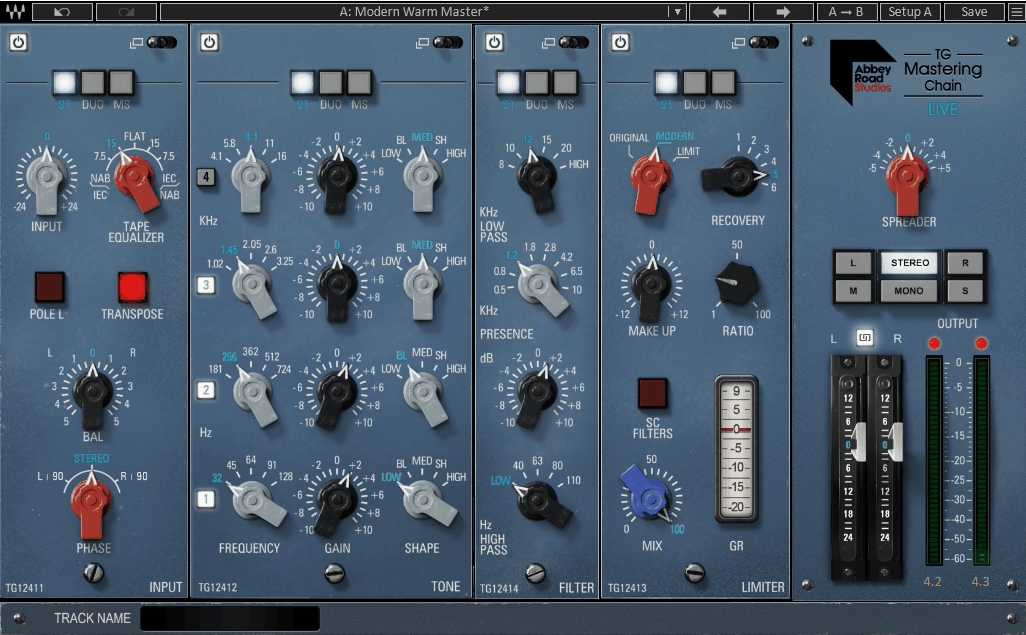
Waves modelled every detail of the hardware in close collaboration with Abbey Road, then added modern features that the original never had. The result is five modular processors that can be rearranged, individually bypassed, and switched between stereo, dual mono, and mid/side operation. TG Mastering Chain is a plugin with genuine character and history behind it, not just another clean digital chain.
- Modular Signal Chain
Five modules make up the processing chain, mirroring the original console’s layout: TG12411 Input, TG12412 Tone (4-band EQ), TG12413 Compressor/Limiter, TG12414 Filter, and TG12416 Output with built-in stereo spread.
Here’s the key: you can drag and reorder the Tone, Limiter, and Filter modules freely. EQ before compression sounds completely different than compression before EQ, and having the flexibility to experiment with signal flow order inside a single plugin is invaluable for mastering.
Each module can also be independently switched between stereo, dual mono, and mid/side processing, meaning you could compress only the mid channel while EQing just the sides.
The 4-band Tone module offers 5 carefully curated frequencies per band with low shelf, high shelf, and bell options. The Filter module supplements this with high pass, low pass, and presence filters across 17 selectable frequencies. Combined, they give you deep tonal control without the overwhelm of a fully parametric EQ.
- Compression and Output
Two distinct compression flavours live inside the Limiter module. Original models the Zener diode compressor from the actual hardware, delivering an aggressive, slightly dirty character faithful to the 1970s sound. Modern is a VCA-style compressor co-designed by Waves and Abbey Road specifically for this plugin, tuned for cleaner, louder masters with higher perceived loudness.
Linear-phase sidechain filters with a steep 48 dB/octave slope let you shape what the compressor reacts to without colouring the output. This preserves the natural sound of the TG while giving you surgical control over dynamics.
The stereo spread enhancer on the output module is modelled on the original EMI TG12416 unit, and multiple producers have called it out as one of the best stereo wideners in any plugin. A separate TG Meter Bridge plugin ships alongside the main chain, providing VU, PPM, phase correlation, and peak metering accessible from any track in your session.
Ships with 170 presets from engineers like Jacquire King, Dave Pensado, Piper Payne, and Greg Wells. Runs as VST, AU, and AAX on macOS and Windows.
4. Brainworx bx_masterdesk Pro

Brainworx owner Dirk Ulrich has spent over 20 years in the mastering industry, and that experience shows in every design choice here. The philosophy behind bx_masterdesk Pro is that mastering doesn’t need to be intimidating.
Three controls handle the core work: Volume, Foundation, and Tone. Turn those knobs, toggle through the presets, and you can have a professional-sounding master in under a minute.
But where previous versions of bx_masterdesk stopped there, the Pro version opens up for more experienced users who want deeper control.
Variable ratio compression, a clipper, glue processing, a full 3-band parametric EQ, resonance filters, and a de-esser have all been added without making the plugin feel cluttered. MusicRadar summed it up as “a heck of a solid tool” that makes great-sounding masters a cinch.
- Dynamics and Saturation
The compressor features 10 selectable TMT (Tolerance Modeling Technology) channels, each one sounding slightly different based on modelled analog component tolerances. Audition them to find which one sits best with your track. Four ratio presets range from 3.2:1 to 7.9:1, though the soft knee means you’ll only hit those higher ratios when driving hard.
Glue introduces gentle VCA-style dynamic smoothing that adds body and cohesion to a mix before it hits the final mastering chain. The Clipper functions more like a peak limiter, catching anything that exceeds 0dBFS. Together with the XL processor that enhances third and fifth-order harmonics for warmth and weight, these tools handle everything from subtle polish to aggressive loudness.
The limiter has been upgraded with controls from Brainworx’s dedicated bx_limiter True Peak, including a modern/classic switch and variable release. Metering transplanted from that same plugin shows peak, RMS, gain reduction, dynamic range, and loudness for both input and output.
- Stereo and Tonal Control
Mono Maker centres everything below a selectable frequency (20 to 300 Hz), which is essential for keeping your low end tight and translation-friendly. The Stereo Enhance knob boosts or attenuates musical material in the side channel, and the Pro version adds four new stereo enhancement EQ curves applied to the side signal for even more width control. A Mid Signal Panorama option rounds out the M/S toolkit.
Resonance Filters are now fully sweepable across the entire 20 Hz to 20 kHz spectrum with two bandwidth options, designed to notch out harsh problem frequencies. The 3-band parametric EQ and high/low pass filters handle broader tonal shaping. 26 excellent presets targeted at specific genres provide starting points that are genuinely useful rather than throwaway.
Runs as AAX, AU, VST2, and VST3 on macOS and Windows.
5. IK Multimedia Lurssen Mastering Console
This plugin takes a fundamentally different approach than anything else on this list. Rather than giving you a rack of processors to tweak, the Lurssen Mastering Console gives you access to the complete mastering signal chain used by Grammy-winning engineers Gavin Lurssen and Reuben Cohen at their facility in Los Angeles. The entire chain, including tube equalizers, solid state EQs, limiters, de-essers, and compressors, has been emulated down to the actual gear hookup schematics.
Gavin and Reuben have mastered records for some of the biggest names in music, and their “whole is greater than the sum of its parts” philosophy is baked into every aspect of this plugin. Select a genre template, and the entire processing chain reconfigures itself to match the settings they’d use in their actual studio. It’s like hiring a mastering engineer through software.
- Style Templates and Processing Chain
40 unique mastering templates called Styles form the core of the plugin. Each Style loads a completely different signal chain configuration tailored to a specific genre: hip-hop, hard rock, heavy metal, country, Americana, classical, jazz, EDM, pop rock, and more.
These aren’t just EQ presets. They reconfigure which processors are active, how they interact, and what settings they use.
The Chain view lets you peek under the hood and see exactly which components make up each Style template. You can adjust things like gain reduction on individual pieces of emulated gear and save your changes as custom presets. This is where the plugin reveals its depth: beneath the simplified exterior sits a complete chain of modelled analog hardware.
- Controls and Workflow
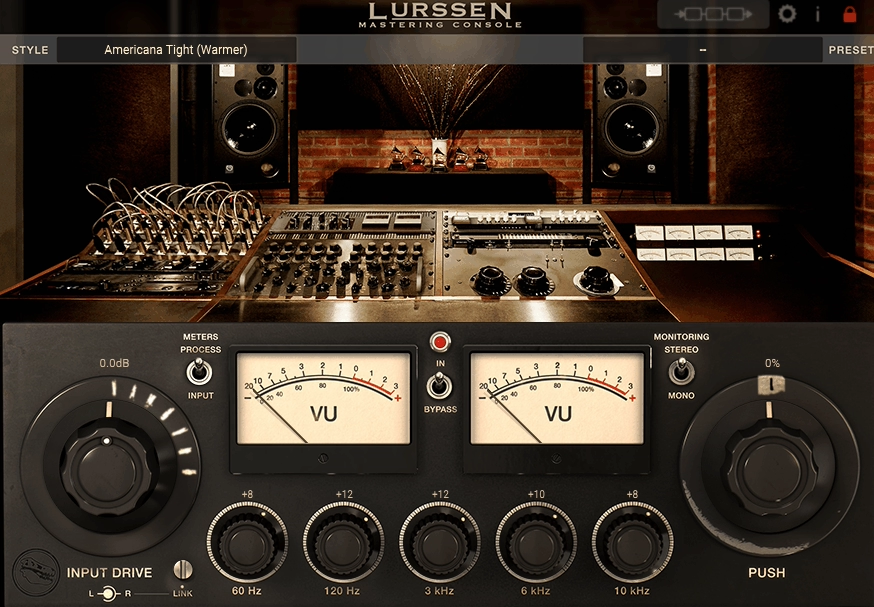
Three primary controls keep things simple in the Studio view: Input Drive (linkable or independent left/right), a 5-band EQ, and the PUSH knob. That last one is the secret weapon. It uniformly nudges all EQ bands simultaneously, letting you “ride” the flow of a song and highlight specific moments with subtle tonal emphasis.
VU meters with a stereo/mono switch provide accurate average volume monitoring and quick phase coherence checking. Automation support on both the Input Drive and PUSH knobs means you can record real-time adjustments for dynamic mastering that responds to arrangement changes.
The Waveform view displays your audio visually with loop playback and automation editing. Processing runs at 88.2/96 kHz internally for maximum sonic detail. A Digital Delivery Mastering feature ensures your exports comply with Apple’s specifications for sample rate, bit depth, and peak levels.
Available as standalone and as AU, VST2, VST3, and AAX on macOS and Windows. Also runs on iPhone and iPad.
6. United Plugins MasterMind

Speed is the entire point of MasterMind. Developed by SounDevice Digital under the United Plugins umbrella, this plugin was designed as the shortest possible route from a finished mix to a polished master. Where other plugins on this list give you extensive processing chains to learn and configure, MasterMind bets on intelligent automation and a handful of well-chosen controls to get you there faster.
The concept works best for producers who need release-ready masters without spending an hour tweaking parameters, or for anyone who wants a quick, professional-sounding master to send to clients while the final version gets handled separately. It’s not trying to replace a dedicated mastering engineer.
It’s trying to close the gap between a raw mix and something you’d feel confident releasing.
- Optimizer and Match EQ
The Optimizer is MasterMind’s signature feature and the reason most people buy it. SounDevice Digital spent considerable time researching mastered material across genres to develop a psychoacoustic algorithm that makes your signal sound richer, bigger, and more cohesive.
One knob controls how much of that processing gets applied. Users on Gearspace have reported that setting the Optimizer around 25% produces noticeably better results without over-processing.
Match EQ is the second major feature. Load a reference track, let MasterMind analyse both your material and the reference for about 5 seconds each, and the plugin generates a custom EQ curve to bring your track’s frequency balance closer to the target.
SounDevice Digital recommends keeping the Match knob around 20 to 30% to avoid over-correction, and for good reason: subtle application unifies your sound without stripping away its identity.
- EQ, Limiting, and Stereo
A 2-band shelving EQ modelled after a classic American tube equalizer provides +/- 16 dB of low and high frequency adjustment. An input level and output trim control how hard you push the EQ stage, which introduces more tube-style saturation the harder you drive it.
The limiter section handles loudness maximisation with gain, threshold, and output ceiling controls. A dedicated saturation stage within the limiter adds glue and warmth to the final output. Stereo width adjustment is a single knob that widens or narrows the stereo field.
A real-time analyser displays three signal stages simultaneously: input, post-EQ (before limiter), and final output. Internal processing uses 64-bit audio with up to 16x oversampling for artifact-free saturation. An intelligent sleep mode disengages processing when no audio is detected, saving CPU resources.
Runs as VST, VST3, AU, and AAX on macOS and Windows. No iLok or dongle required.
7. IK Multimedia ONE
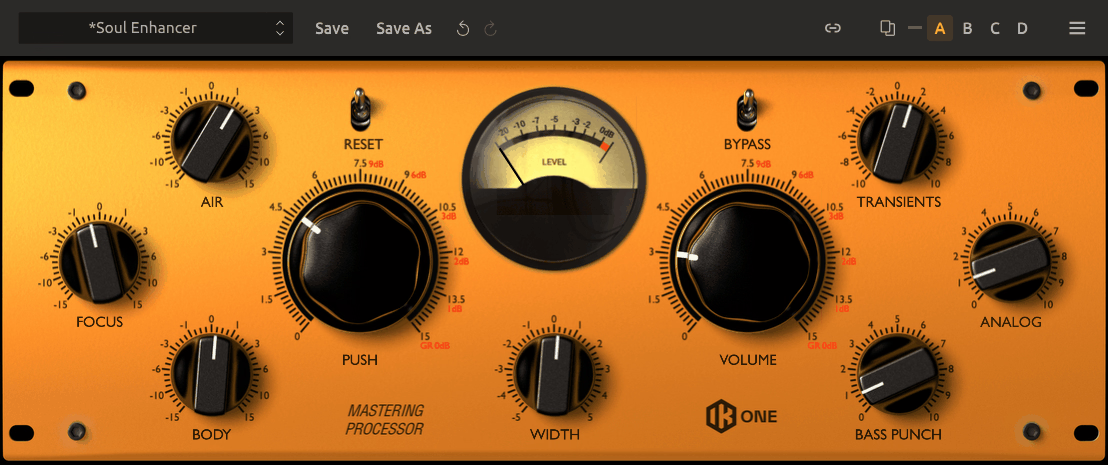
Nine knobs. That’s all you get with IK Multimedia ONE, and that’s exactly the point.
Part of the T-RackS ecosystem, ONE was designed as a true all-in-one mastering processor where every control is named for what it actually does to your sound rather than what type of processing it performs under the hood. No compressor ratios to think about. No filter slopes to calculate. Just descriptive labels and musical results.
Underneath those 9 knobs sits a full processing chain: EQ, compressor, harmonic exciter, low-end enhancer, and limiter, all calibrated to work together.
Tom Lord-Alge has demonstrated the plugin in mixing sessions, and users consistently praise how quickly it delivers polished results on both individual tracks and full masters. For producers who find traditional mastering chains overwhelming, ONE strips the process down to its essence.
- Tonal Sculpting
Three EQ controls handle the frequency spectrum with intuitive labelling. AIR gently boosts or cuts high frequencies for shimmer and sparkle. FOCUS adjusts mid-range intelligibility, bringing vocals and lead instruments forward or pushing them back. BODY fine-tunes the low frequency balance without disrupting the overall tonal picture.
These controls are deliberately broad and musical rather than surgical. Each one affects a wide frequency range with carefully shaped curves, making it nearly impossible to create harsh or unnatural results. For producers who struggle with traditional parametric EQs on the master bus, this approach removes the guesswork entirely.
- Dynamics, Enhancement, and Loudness
BASS PUNCH simultaneously controls low-end boost and tightness, functioning as a combined bass compressor and expander that adds weight without muddiness.
The ANALOG knob introduces harmonic enhancement that gives tracks dimension and colour, modelled using IK’s proprietary DSM and SCC analog modelling technologies.
TRANSIENTS shapes the attack and sustain characteristics of your master, enhancing punch or smoothing aggression depending on which direction you turn it. PUSH handles compression with a musical, program-dependent response that adds density without squashing dynamics. VOLUME drives the final limiter stage for loudness maximisation.
A stereo width control handles spatial enhancement. Processing supports sample rates up to 192 kHz with high-quality oversampling. The module works within the T-RackS standalone application or as a plugin in any compatible DAW. Available as AU, VST2, VST3, and AAX on macOS and Windows.
Get the Free Plugin Starter Kit
The genuinely useful free DAWs and plugins worth installing. No filler. Straight to your inbox.

Hello, I’m Viliam, I started this audio plugin focused blog to keep you updated on the latest trends, news and everything plugin related. I’ll put the most emphasis on the topics covering best VST, AU and AAX plugins. If you find some great plugin suggestions for us to include on our site, feel free to let me know, so I can take a look!